INTRODUCTION
Major Article
Address to: Marlene Andrade Marins. Av. Milão Q 10 LT 01, Condomínio Turquesa Torre 4 Residencial Eldorado, 74367-635 Goiânia, GO, Brasil.
Phone: 55 62 9966-9965
e-mail: [email protected] Received in 13/03/2012
Accepted in 30/10/2012
Prevalence of resistance phenotypes in
Staphylococcus aureus
and coagulase-negaive isolates of venous ulcers of
primary healthcare paients
Marlene Andrade Marins
[1],
Silvana de Lima Vieira dos Santos
[1],
Lara Stefânia Neto de Oliveira Leão
[2],
Nayara Porilho Araújo
[3]and Maria Márcia Bachion
[1][1]. Programa de Pós-Graduação em Ciências da Saúde, Universidade Federal de Goiás, Goiânia, GO. [2]. Laboratório Bacteriologia Médica, Insituto de Patologia Tropical e Saúde Pública, Universidade Federal de Goiás, Goiânia, GO. [3]. Secretaria Municipal de Saúde de Goiânia, Prefeitura Municipal de Goiânia, Goiânia, GO.
ABSTRACT
Introducion: In venous ulcers, the presence of Staphylococcus aureus and coagulase-negaive staphylococcus resistance phenotypes can aggravate and limit the choices for treatment. Methods: Staphylococcus isolated from 69 paients (98 ulcers) between October of 2009 and October of 2010 were tested. The macrolide, lincosamide, streptogramin B (MLSB) group resistance phenotype detecion was performed using the D-test. Isolates resistant to cefoxiin and/or oxacillin (disk-difusion) were subjected to the conirmatory test to detect minimum inhibitory concentraion (MIC), using oxacillin strips (E-test®).
Results: The prevalence of S. aureus was 83%, and 15% of coagulase-negaive staphylococcus (CoNS). In addiion were detected 28% of methicillin-resistant Staphylococcus aureus (MRSA) and 47% of methicillin-resistant coagulase-negaive staphylococcus (MRCoNS). Among the S. aureus, 69.6% were resistant to erythromycin, 69.6% to clindamycin, 69.6% to gentamicin, and 100% to ciproloxacin. Considering the MRSA, 74% were highly resistant to oxacillin, MIC ≥ 256µg/mL, and the MLSBc consituive resistance predominated in 65.2%. Among the 20 isolates sensiive to clindamycin, 12 presented an inducible MLSB phenotype. Of the MRCoNS, 71.4%were resistant to erythromycin, ciproloxacin and gentamicin. Considering the isolates posiive for β-lactamases, the MIC breakpoint was between 0.5 and 2µg/mL. Conclusions: The results point to a high occurrence of muli-drug resistant bacteria in venous ulcers in primary healthcare paients, thus evidencing the need for prevenive measures to avoid outbreaks caused by muli-drug resistant pathogens, and the importance of healthcare professionals being able to idenifying colonized versus infected venous ulcers as an essenial criteria to implemening systemic anibacterial therapy.
Keywords: Methicillin-resistant Staphylococcus aureus. Drug resistance bacterial. Varicose ulcer. Primary health care.
Venous ulcers are the most common type of wound afecing the lower limbs. The ulcers have muli-factor causes, are recurrent, and do not setle easily1. The chronic exposure of these ulcers to the
environment, associated with the intrinsic factors of the paient, predisposes the onset of infectious processes that worsen the prognosis for cure2. Within this context, the healthcare professionals
treaing these wounds must have the necessary clinical judgment to evaluate the possibility of infecion.
Among the many potenial infecious agents present in these wounds, from an epidemiological perspecive, Staphylococcus aureus
and Staphylococcuscoagulase-negaive are of signiicant clinical interest as these pathogens are commonly found in skin and sot issue infecions3. The resistance phenotypes in these microorganisms, when
present in venous ulcers, is an important health condiion due to the pathogenicity involved and also the many virulence factors afecing the therapeuic process4.
The possibility of muli-drug resistant agents (MDROs) is also a problem. Studies in diferent countries or regions, point to a growing prevalence of these pathogens5-8.
Within this context, paricular emphasis is given to methicillin-resistant Staphylococcus aureus (MRSA) and methicillin-resistant coagulase-negaive Staphylococcus (MRCoNS), as well as those suscepible to methicillin: methicillin-sensiive Staphylococcus aureus (MSSA) and methicillin-sensiive coagulase-negaive Staphylococcus (MSCoNS). These microorganisms can present other resistance phenotypes of clinical interest, such as consituive or inducible resistance to the macrolide, lincosamide, streptogramin B (MLSB) group9-11.
In vascular ulcers, these microorganisms integrate the lesion environment with a signiicant bioburden12,13. Therefore, coninuous
monitoring of the infectious agents and their susceptibility to animicrobials is recommended as an important infecion control strategy14, besides contribuing to an efecive therapy approach in
primary healthcare.
The objecives of the present study were: to verify the prevalence and minimum inhibitory concentraion of the isolated (MRSA, MSSA, MRCoNS and MSCoNS) of venous ulcers of primary healthcare paients; evaluate the suscepibility proile of these isolates to animicrobials; and detect consituive and inducible MLSB resistance phenotypes.
METHODS
Seing and ethical consideraions
This secional, clinical and observaional study was performed using a quanitaive approach and is part of a broader project named:
RESULTS
of outpatient care in the municipal health network of Goiânia: improving the perspecives), integrated to Rede Goiana de Pesquisa em Avaliação e Tratamento de Feridas (Goiânia Network for Research in Wound Evaluaion and Treatment), approved by the Research Ethics Commitee of Universidade Federal de Goiás (protocol 041/2009). In this city, primary healthcare comprises a low- and medium-complexity service network, distributed into seven health districts or administraive regions, which include outpaient clinics and health centers, which provide treatment to individuals with leg ulcers.
The data were obtained between October of 2009 and October of 2010. The following inclusion criteria were established: age equal to or more than 18 years; have at least one venous ulcer for at least six weeks; present at least three clinical signs of infecion on the lesion, according to the suggesions of the European Wound Management Associaion2. The exclusion criteria were: having used animicrobials
within 30 days before the specimens were collected.
A total of 69 paients were included in the study, all of which signed the Free and Informed Consent Form. The paricipants had between one and ive lesions, on one or both legs, totaling 98 venous ulcers.
The data were obtained by administering a standardized instrument that includes the list of clinical signs and symptoms for infecion proposed by the European Wound Management Associaion2,
in addiion to a clinical exam and collecion of a specimen from the ulcer for microbiological analysis.
Collecion of the clinical specimens
Ater fully cleaning the ulcers using sodium chloride at 0.9%, the clinical specimens of the lesions were collected using a sterile swab (COPAN®), following the technique proposed by Levine et al15,
referenced by Angel et al16.
The microbiological analyses were performed following the recommended techniques17-18. The quality of the procedures was
controlled using standard strains of the American Type Culture Collecion (Staphylococcus aureus ATCC® 25923).
Bacterial strains and screening to detect MRSA and MRCONS isolates
The samples were inoculated in a selecive culture medium for
Staphylococcus sp., Mannitol salt agar (Himedia®). To increase the probability of isolaing MRSA and/or MRCoNS, the samples were also culivated on trypic soy agar (TSA) Himedia® and trypic soy broth (TSB) Himedia® supplemented with 4% NaCl and 6mcg/mL oxacillin19-20.
The culture media were incubated at 35°C for 24 to 48 hours. The ideniied microorganisms were tested for 12 animicrobials using the disk-difusion technique21.The results were interpreted
simultaneously to the analysis, according to the criteria established by the Clinical and Laboratory Standards Insitute20 and the Briish
Society for Animicrobial Chemotherapy22.
Determining the resistance phenotypes
Specimens that presented resistance to oxacillin or cefoxiin were subjected to the conirmatory test to detect the minimal inhibitory concentraion, E-test®.
The detecion of the inducible MLSB phenotype was performed using disk approximaion, D-test20. In this test, the 2µg-clindamycin
disk was placed 15mm apart from the 15µg-erythromycin disk. The
Characterisics of the populaion
Of the 69 evaluated paients, 40 (58%) were male, and 29 (42%) were female. Of these, 35 (50.7%) were ≤ 60 years old, and 34 (49.3%) > 60 years old. Regarding their social class, 32 (46.4%) were in social class D according to Brazilian socio-economic classiicaion criterion, from the Brazilian Associaion of Research Companies (Associação Brasileira de Empresas de Pesquisa - ABEP). Fity-two (75.4%) paients has only one lesion, while 17 (24.6%) had muliple lesions.
Prevalence and suscepibility of the isolated specimens
Considering the total 98 invesigated lesions, 80 (81.7%) tested posiive for Staphylococcus sp. Among these, 83 S. aureus isolates were obtained, 23 (28%) of which were MRSA and 60 (72%) MSSA. Regarding the CoNS, 15 isolates were ideniied, 7 (47%) of which were resistant (MRCoNS) and 8 (53%) were sensiive (MSCoNS) to methicillin.
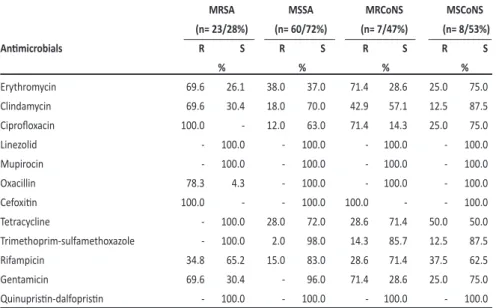
Regarding the MRSA, the analysis of the suscepibility proile revealed resistance to erythromycin (69.6%), clindamycin (69.6%), gentamicin (69.6%), and ciprofloxacin (100%) compared to the MSSA. The later presented the following values: erythromycin (38%), clindamycin (18%), tetracycline (28%), and rifampicin (15%). MRCoNS showed resistance to erythromycin, ciproloxacin and gentamicin, with 71.4% (Table 1).
The drugs with better activity for both isolates, MRSA and MSSA, were mupirocin, linezolid, sulfamethoxazole-trimethoprim, tetracycline and quinupristin/dalfopristin, with sensitivity above 98%. The antimicrobials with the best activity for MRCoNS and MSCoNS were linezolid, mupirocin, quinuprisin/dalfoprisin and sulfamethoxazole-trimethoprim, with sensiivity above 87.5%.
MRCoNS and MSCoNS isolates with intermediate sensiivity were not ideniied. On the other hand, among the MRSA, it was found that 4.3% were sensiive to erythromycin and 17.4% to oxacillin. Among the MSSA, 25% were sensiive to erythromycin and ciproloxacin, 2% to rifampicin and 4% to gentamicin.
Characterizaion of the resistance phenotypes
All the MRSA and MRCoNS were resistant to cefoxiin (marker), while 95.6% showed reduced sensiivity to oxacillin. The E-test results evidenced that 17/23 (74%) MRSA has a high level of resistance to oxacillin (≥ 256µg/mL). The minimum inhibitory concentraion (MIC) for the remaining specimens was between 32 and 96µg/mL. It was found that 3/7 (43%) of MRCoNS had a MIC of 1.5µg/mL (Table 2).
Regarding the MLSB phenotype, the MRSA were highlighted because of their constitutive resistance, in which 15 (65.2%) isolates presented natural resistance to clindamycin. Between the two clindamycin-sensitive MRSA, only one tested positive in the D-test, and, therefore, also for the inducible phenotype. latened inhibiion halo around the clindamycin (halo D) classiied the result as posiive for the inducible phenotype, and, therefore, resistance to clindamycin.
DISCUSSION
TABLE 2 - Distribuion of the minimum inhibitory concentraion (µg/mL) of methicillin-resistant Staphylococcus aureus and methicillin-resistant coagulase-negaive staphylococcus isolated from the venous ulcers of pateints treated in dressing rooms of municipal health centers in Goiânia, October of 2009 to October of 2010.
MRSA Number Percentage
MIC µg/mL
256 17 74.0
32 3 13.1
96 1 4.3
64 1 4.3
48 1 4.3
total 23 28.0
MRCoNS
1.5 3 43.0
2 2 28.5
0.5 1 14.2
0.75 1 14.2
total 7 47.0
MRSA: methicillin-resistant Staphylococcus aureus; MRCoNS: methicillin-resistant coagulase-negaive staphylococcus;MIC: minimum inhibitory concentraion.
TABLE 3 - Distribuion of the macrolide, lincosamide, streptogramin B phenotype detected for methicillin-sensiive Staphylococcus aureus and methicillin-resistant Staphylococcus aureus and methicillin-sensiive coagulase-negaive Staphylococcus and methicillin-resistant coagulase-negaive Staphylococcus isolated from venous ulcers of paients treated in dressing rooms of municipal health centers in Goiânia, October of 2009 to October of 2010.
MSSA MRSA MRCoNS MSCoNS
MLSB resistance phenotype n % n % n % n %
Erythromycin-resistant and clindamycin-sensiive, D-test (+) MLSBi inducible resistance 12 20.0 1 4.4 1 14.2 - -Erythromycin- and clindamycin-resistant- MLSBc consituive resistance 1 1.7 15 65.2 2 28.6 1 12.5 Erythromycin-resistant and clindamycin-sensiive, D-test (-) MSB 8 13.3 1 4.4 2 28.6 1 12.5
Erythromycin-sensiive and clindamycin-sensiive 39 65.0 6 26.0 2 28.6 6 75.0
MLSB; macrolide-lincosamide-streptogramin B; MSSA: methicillin-sensiive Staphylococcus aureus; MRSA: methicillin-resistant Staphylococcus aureus; MRCoNS: methicillin-resistant coagulase-negaive
staphylococcus;MSCoNS: methicillin-sensiive coagulase-negaive Staphylococcus; MSB: macrolide-streptogramin B.
TABLE 1 - Suscepibility of methicillin-resistant Staphylococcus aureus and methicillin-sensiive Staphylococcus aureus and methicillin-resistant coagulase-negaive staphylococcus and methicillin-sensiive coagulase-negaive Staphylococcus (f=98), isolated from venous ulcers of paients treated in dressing rooms of municipal health centers in Goiânia, to the tested animicrobials, October of 2009 to October of 2010.
MRSA MSSA MRCoNS MSCoNS
(n= 23/28%) (n= 60/72%) (n= 7/47%) (n= 8/53%)
Animicrobials R S R S R S R S
% % % %
Erythromycin 69.6 26.1 38.0 37.0 71.4 28.6 25.0 75.0
Clindamycin 69.6 30.4 18.0 70.0 42.9 57.1 12.5 87.5
Ciproloxacin 100.0 - 12.0 63.0 71.4 14.3 25.0 75.0
Linezolid - 100.0 - 100.0 - 100.0 - 100.0
Mupirocin - 100.0 - 100.0 - 100.0 - 100.0
Oxacillin 78.3 4.3 - 100.0 - 100.0 - 100.0
Cefoxiin 100.0 - - 100.0 100.0 - - 100.0
Tetracycline - 100.0 28.0 72.0 28.6 71.4 50.0 50.0
Trimethoprim-sulfamethoxazole - 100.0 2.0 98.0 14.3 85.7 12.5 87.5
Rifampicin 34.8 65.2 15.0 83.0 28.6 71.4 37.5 62.5
Gentamicin 69.6 30.4 - 96.0 71.4 28.6 25.0 75.0
Quinuprisin-dalfoprisin - 100.0 - 100.0 - 100.0 - 100.0 MRSA: methicillin-resistant Staphylococcus aureus; MSSA: methicillin-sensiive Staphylococcus aureus; MRCoNS:methicillin-resistant coagulase-negaive staphylococcus;MSCoNS: methicillin-sensiive coagulase-negaive Staphylococcus; R: resistant; S: sensiive.
Among the MRCoNS, only one isolate was posiive for the MLSBi phenotype and another for the MLSBc phenotype (Table 3).
The highlight regarding the MSSA was their inducible resistance. Considering the 20 clindamycin-sensitive isolates, 12 (20%) presented inducible MLSB phenotype.
Consituive resistance was found in only one MSSA and one MSCoNS isolate. No inducible resistance was observed among the MSCoNS, and 75% of these bacteria were sensiive to both erythromycin and clindamycin.
This is the first study that analyzes the resistance phenotypes of microorganisms isolated from venous ulcers of individuals treated at primary healthcare services in Goiânia, State of Goiás, Brazil.
The present study results show high prevalence of S. aureus (83%) in venous ulcers.
In a study performed in Goiânia, State of Goiás, Brazil, involving paients with leg ulcers (including venous, diabetic and traumatic ulcers) treated in dressing rooms, S. aureus
was the most frequent bacteria (65%)23. A high
bioburden of this pathogen has been reported for chronic lesions, and this is consensual in literature. Staphylococcus aureus is part of the normal skin microbiota, and, therefore, they are frequently found in wounds12,23. However, the
associaion of the paient’s intrinsic factors and the increase in the microbial load predispose infecion1.
In a reference outpaient clinic in Manaus and in reference dressing rooms in Goiânia, Brazil, the MRSA prevalence is of, respecively, 15.5% and 20.5%23-24. Some factors that may contribute to increasing bacterial
resistance are the common use of animicrobial therapy among paients with chronic wounds and the possibility of environment contaminaion7.
Bacteria producing this muli-drug resistance phenotype can spread rapidly in the environment. A coninuous monitoring and prevenive measures should be implemented14,25.
Monitoring with specimens from hospitals is more common. A study in the United States26 found that the MIC of 439 hospital MRSA
ranged between 4 and 256μg/mL, and only 18 isolates presented MIC ≤ 64μg/mL.
MRSA is known to be a pathogen of healthcare-associated infecions (HCAIs) and has been associated with the resistance to methicillin and other drugs. The muli-drug resistance of the hospital MRSA isolates has also been veriied in other studies, however in strains obtained from hospitals25-27.
All the MRSA isolated in this study were resistant to cefoxiin on the anibiogram (marker) and conirmed by the E- test®. Most isolates (74%) showed a high resistance level to methicillin, with an MIC ≥ 256μg/mL. The MIC of the remaining isolated ranged between 32 and 96μg/mL.
Methicillin is a penicillin resistant to the acion of penicillinases and the resistance mechanism of S. aureus to this drug can be veriied by the producion of low-ainity penicillin binding proteins (PBP) or by the hyperproducion of β-lactamases. Classic MRSA strains are associated with the producion of PBP2a or mecA gene mediated PBP2’20,28.
There is a scarcity of studies on Staphylococcus sp. isolated from venous ulcers of paients treated in outpaient clinics in Brazil as well as in other countries. On the other hand, the prevalence of the ideniied pathogens ranges signiicantly in the health centers of diferent countries and in the same region26-31. Diferent services
have diferent condiions, and, for this reason, comparisons are not perinent. In addiion to this diiculty, a variety of methods used are used in the studies12-13. However, it should be observed that most studies
regarding these microorganisms are performed in a hospital seing26-27.
Few studies invesigate the presence of CoNS in the venous ulcers of primary healthcare paients. The approach to this group of microorganisms is another original contribuion made by the present study. A survey in the databases found many studies with CoNS from blood samples and many oxacillin-resistance strains could present the mecA gene31.
Despite the ideniicaion of low frequency of coagulase-negaive Staphylococcus among these microorganisms, it was observed there was an increased in MRCoNS isolates. MDROs microorganisms were ideniied in the study. The co-existence of β-lactams-resistant strains as well as the MLSB group is evidence of this result. This fact is of great concern, and requires rigor from healthcare professionals in the implementaion of contact precauion measures, with the purpose to avoid the disseminaion of pathogens with muliple resistance phenotypes.
MSSA and MSCoNS were both 100% sensiive to this marker. Cefoxiin is recommended as a phenotypic marker because it predicts
mecA gene mediated methicillin resistance20,32.
Multi-drug resistant microorganisms have been identified in people with skin and sot issue infecions, in the hospital and other health care service environments14. MRSA is referred to as an endemic
nosocomial pathogen, with an observed increasing prevalence rate5,27.
A study conducted in outpaient clinics in the United States indicated an increase in MRSA isolates obtained from the community for this type of infecion3.
The isolates recovered from hospitals sets, present an increase in MRCoNS33. The present study found high prevalence rates for MRCoNS
(47%) in people with venous ulcers treated in the community. This inding, in addiion to being pioneer, suggests that the phenomenon of resistance to β-lactams is not restricted to the hospital seing.
Regarding the suscepibility proile of the MRSA isolated in this study, the results conirmed the resistance to the group of β-lactams, in addiion to the crossed resistance to clindamycin, erythromycin, ciproloxacin, rifampicin and gentamicin. These results agree with those reported in other countries, however, in studies performed with paients treated at the hospital28,34.
It was observed that oxacillin-resistant S. aureus has an associated resistance to ciproloxacin (53.1%), sulfamethoxazole-trimethoprim (53.5%) and rifampicin (24.8%)25. Clindamycin,
sulfamethoxazole-trimethoprim, tetracycline and linezolida are choices of oral therapy in cases of mild to moderate infecions, due to community MRSA35.
The isolates showed a resistance above 69.6% to the described drugs. In this sense, considering the local populaion, these agents are not recommended. However, all MRSA isolates (100%) were sensiive to mupirocin, linezolid, sulfamethoxazole-trimethoprim, tetracycline and quinuprisin/dalfoprisin. These are important alternaives for the treatment of infections by MRSA. Though, considering the infection site (skin and sot issues), it is necessary to evaluate the bioavailability (pharmacokineic and pharmacodynamics) of the drugs (sulfamethoxazole-trimethoprim and tetracycline), in the treatment for leg ulcers36-37.
The oral therapies commonly used to treat community MRSA are tetracycline, rifampicin, clindamycin, linezolida and sulfamethoxazole-trimethoprim. It is recommended that a combined therapy be used when rifampicin is chosen, in order to avoid mutant strains28,35. In this
study, 34.8% of the MRSA and 28.6% of the MRCoNS isolates were resistant to rifampicin. Among the MSSA isolates, the resistance was 15%, whereas MSCoNS showed a higher resistance rate (37.5%).
This fact is concerning, considering that there is a limited choice of drugs that are administered orally. Similar results were found in strains obtained in hospitals located in the same city, with 40.7% resistance to rifampicin25. It is presumed that the prevalence of rifampicin-resistant
strains has increased in the outpaient health service seings. Further studies are needed to efecively support the use of antimicrobials at some time during the treatment. However, if necessary, the indicaion must consider the signs and symptoms of infecions, and not only the colonizaion. This recommendaion can avoid the disseminaion of muli-drug resistant bacteria14,38.
The MSSA were sensiive to most of the evaluated animicrobials, except for erythromycin. All isolates (100%) were sensitive to mupirocin, linezolid, and quinuprisin/dalfoprisin. High sensiivity (98%) to sulfamethoxazole-trimethoprim was also observed.
and to eradicate MRSA in the nostrils36. The topic use of mupirocin
for the decontaminaion of venous ulcers has not been described35,39
nor is it recommended according to a systemaic review about the topical indicaion of this animicrobial38. On the venous ulcer treatment
guidelines, the use of topical anibacterial agents can be necessary to reduce the microbial load, but this document does not indicate the class type of the agent39.
A study conducted in Brazil found 38% of MRCoNS isolates, and muli-drug resistance was detected in 86%; however, the MLSBi phenotype was not invesigated33.
Erythromycin (macrolides) and clindamycin (lincosamides) are animicrobials belonging to the MLSB group, and are widely recommended to treat staphylococcal infecions of the skin and sot issues, in addiion to being an alternaive for paients allergic to penicillin19. Some of the drugs on this group are of oral use36, which
facilitates their indicaion in primary healthcare services. The excepion is quinuprisin (streptogramin), which in associaion with dalfoprisin should be administered intravenously36.
In the present study, 100% of the S. aureus and CoNS were sensiive to these two streptogramins. However, their administraion can cause arthralgia, nausea, vomiing, diarrhea, and exanthema; and they are no longer available in Brazil36.
The resistance to macrolides and derivaives in Brazil, along with the group of lincosamides and streptogramins B comprise the MLSB phenotype19. These animicrobials are chemically diferent but with
a similar acion mechanism, afecing the ribosomal binding and inhibiing protein synthesis. For the laboratory point of view, this resistance phenotype can be ideniied on the anibiogram through disk difusion.
The MLSBc consituive resistance is coded by the erm gene and appears on the anibiogram as the resistance to erythromycin and clindamycin. The MLSBi inducible resistance, on the other hand, appears on the anibiogram as the resistance to erythromycin and sensitivity to clindamycin. To detect the MLSBi phenotype, it is necessary to perform a complementary test by disk-approximaion (D-test), in which the clindamycin halo is latened by inducion. In this case, this drug is not recommended19.
MRSA isolates in this study presented higher prevalence of MLSBc resistance (65.2%) compared to MLSBi. Two isolates, iniially sensiive to clindamycin, tested posiive on the D-test, thus, presening inducible resistance. Among the MRCoNS, the three MLSB phenotypes were ideniied, including one isolate with a posiive D-test.These data have great clinical relevance, because when the MLSBi phenotype is not detected the clindamycin treatment can fail19.
The MSSA isolates were predominantly resistant to MLSBi (20%), which reinforces the need to invesigate the induced resistance to clindamycin in S. aureus.
Muli-drug resistant bacteria in venous ulcers limit the opions for treatment, and can thus predispose to complicaions in the clinical outcomes. Skin and sot issue infecions, alone, are risk factors for the transmission of MDROs S. aureus and coagulase-negaive Staphylococcus in the populaion6. These infecions account for most
infecions by MRSA in the community28, which are usually treated in
outpaient clinic seings.
The long treatment period, due to factors that afect on the healing process of the ulcers, could predispose a more frequent use of animicrobial agents, and, thus, contribute to an increase in resistance rates. There is a strong associaion between the occurrence of a chronic wound and the duraion of the empirical animicrobial therapy7. Infecion treatment failures within the community have been
associated with complicaion of the infecion, as well as the increase in the consumpion of animicrobials in primary healthcare40.
The present study finding have clinical and epidemiological relevance, because they evidence the need for contact precauion measures; greater control in cleaning and disinfecing equipment between paients; appropriate hand washing, as well as the use of the recommended individual protecion equipment, besides providing a physical appropriate for the procedures, i.e., adequate dressing rooms. The correct treatment for venous ulcers includes the microbiological tesing to idenify pathogens38-40. A careful indicaion of animicrobials
should be associated to other therapies that, together, could improve the healing process23.
The existence of MDROs pathogens and failures during the treatment are important factors for the paient14. The healthcare
professional can help prevent infecion through specialist healthcare procedures, such as thorough cleaning of the ulcer, applying appropriate coverage, evaluaing the ulcer for dressing changes, forwarding to other professionals, and assessing the animicrobial treatment outcome by evaluaing the clinical signs and symptoms.
The identification of multi-drug resistant bacteria, such as
S. aureus and coagulase-negaive Staphylococcus resistant to methicillin and to the MLSB group in outpaients with venous ulcers reveals a panorama about the suscepibility proile of the pathogens that afect this populaion with chronic wounds. The epidemiological data can contribute with the surveillance systems, in the sense of reviewing the measures that could avoid outbreaks and severe infecions on individuals with venous ulcers, besides providing safe healthcare.
The authors declare that there is no conlict of interest.
CONFLICT OF INTEREST
FINANCIAL SUPPORT
The present study was funded by Fundação de Apoio à Pesquisa do Estado de Goiás (FAPEG).
ABSTRACT IN PORTUgUESE
Prevalência de fenóipos de resistência em
Staphylococcus aureus e
coagulase negaivos isolados de
úlceras venosas de pessoas atendidas na atenção primária
Introdução: Em úlceras venosas, a presença de Staphylococcus aureus e coagulase negaivo com fenóipos de resistênciapode consituir fator agravante e limita as opções terapêuticas. Métodos: Foram avaliados estailococos isolados de 69 pacientes, representando 98 úlceras no período de outubro de 2009 a outubro de 2010. A detecção fenoípica da resistência ao grupo macrolide, lincosamide, streptogramin B (MLSB) foi realizada pelo D-test. Isolados resistentes a cefoxiina e/ou oxacilina (disco-difusão) foram submetidos ao teste confirmatório para detecção da minimum inhibitory concentraion (MIC), empregando itas de oxacilina (E-test®).
Staphylococcus aureus (MRSA) e 47% de methicillin-resistant coagulase-negaive staphylococcus (MRCoNS). Entre o S. aureus, 69,6% apresentaram resistência a eritromicina, 69,6% a clindamicina, 69,6% a gentamicina e 100% a ciproloxacina. Setenta e quatro por cento dos MRSA apresentaram elevado nível de resistência a oxacilina, MIC ≥ 256µg/mL, e em 65,2% predominou a resistência consituiva MLSBc. Dos 20 isolados sensíveis a clindamicina, 12 apresentaram fenóipo MLSB induzível. Um total de 71,4% dos MRCoNS apresentaram resistência a eritromicina, ciproloxacina e gentamicina. Dos isolados posiivos para a enzima β-lactamases, as MIC iveram breakpoint
entre 0,5 a 2µg/mL. Conclusões: Os resultados sinalizam elevada ocorrência de bactérias mulirresistentes em úlceras venosas de pacientes recebendo atenção primária, evidenciando a necessidade de medidas prevenivas que evitem surtos causados por patógenos resistentes a múliplas drogas e a importância dos proissionais em discernir infecção de colonização em úlcera venosa, critério fundamental na indicação anibioicoterapia sistêmica.
Palavras-chaves: Staphylococcus aureus resistente à meicilina. Resistência bacteriana a fármacos. Úlcera varicosa. Atenção primária à saúde.
REFERENCES
1. Percival S, Cuing K. Microbiology of wound. 1nd ediion, CRC Press, Taylor & Francis
Group. 2010; p. 409.
2. European Wound Management Association (EWMA). Position document: Idenifying criteria for wound infecion. London Medical Educaion Partnership, Ltd, 2005. p. 1-19.
3. Hersh A, Chambers HF, Maselli JH, Gonzales R. Naional trends in ambulatory visits and anibioic prescribing for skin and sot-issue infecions. Arch Intern Med 2008; 168:1585-1591.
4. Gordon RJ, Lowy FD. Pathogenesis of Methicillin-Resistant Staphylococcus aureus Infecion. Clin Infect Dis 2008; 46 (suppl 5):350-359.
5. Zurita J, Medjía C, Guzmán-Blancos M. Epidemiology and surveillance of methicillin resistant Staphylococcus aureus in Lain America. Braz J Infect Dis 2010; 14 (suppl 2):79-86.
6. Alvarez C, Labarca J, Salles M. Prevenion strategies for methicillin-resistant Staphylococcus aureus (MRSA) in Latin America. Braz J Infect Dis 2010; 14 (suppl 2):107-118.
7. Howell-Jones, RS, Price PE, Howard AJ, Thomas DW. Anibioic prescribing for chronic skin wounds in primary care. Wound Rep Reg 2006; 14:387-393. 8. Kirketerp-Moller K, Jensen PO, Fazli M, Madsen GK, Pedersen J, Moser C,
et al. Distribuion, organizaion, and ecology of bacteria in chronic wounds. J Clin Microbiol 2008; 46:2717-2722.
9. Delialioglu N, Aslan G, Ozturk C, Baki V, Sen S, Emekdas G. Inducible clindamycin resistance in Staphylococci isolated from clinical samples. J Infect Dis 2005; 58:104-106.
10. Fokas S, Fokas S, TsironiM, Kalkami M, Dionysopouloy M. Prevalence of inducible clindamycin resistance in macrolide-resistant Staphylococcus spp. Clin Microbiol Infect Dis 2005; 11:337-340.
11. Amorim DMR, Person OC, Amaral PJ, Tanaka II. Resistência induzível à clindamicina entre isolados clínicos de Staphylococcus aureus. O Mundo da Saúde 2009; 33:401-405. 12. Gardner SE, Frantz RA, Saltzman CL, Dodgson KJ Staphylococcus aureus is associated
with high microbial load in chronic wounds. Wounds 2004; 16:251-257. 13. Miller CN, Carville K, Newall N, Kapp S, Lewin G, Karimil, Santamaria N. Assessing
bacterial burden in wounds: comparing clinical observaion and wound swabs. Internat Wound J 2010; 8:45-55.
14. Elaine P, Ferreira E, Marques A, Matos B. Infecções associadas aos cuidados de saúde e segurança do doente. Rev Port Saude Publica 2010; 10:27-39. 15. Levine NS, Lindberg RB, Mason AD, Pruit Jr BA. The quanitaive swab culture
and smear: a quick, simple method for determining the number of viable aerobic bacteria on open wound. J Trauma 1976; 16:89-94.
16. Angel DE, LIoyd P, Carville K, Santamaria N. The clinical efficacy of two semi-quantitative wound-swabbing techniques in identifying the causative organism(s) in infected cutaneous wounds. Internat Wound J 2011; 8:176-185. 17. Oplustil CP, Zoccoli CM, Tobouti NR, Sinto SI. Procedimentos básicos em
microbiologia clínica. Editora Sarvier: São Paulo; 2010.
18. Koneman, EW, Woods GL, Procop GW, Schreckenberger PC, Allen SD, Janda WM. Diagnóstico microbiológico - texto e atlas colorido. 7nd edition, Medsi:
Rio de Janeiro; 2008.
19. Rossi F, Andreazzi DB. Resistência bacteriana - interpretando o anibiograma. Editora Atheneu: São Paulo; 2005. p. 118.
20. Clinical and Laboratory Standards Insitute(CLSI). Methods for Diluion Animicrobial Susceptibility Tests for Bacteria that grow Aerobically, Approved Standard. 18th ediion. M7-A8, M100-S21, Wayne, PA: USA, 2009.
21. Naional Commitee for Clinical Laboratory Standards (NCCLS). Performance Standards for Antimicrobial Disk Susceptibility Tests, Approved Standard. 8nd ediion. M2-A8, Wayne, PA: USA, 2003.
22. Briish Society for Animicrobial Chemotherapy (BSAC). Methods for Animicrobial Suscepibility Tesing 2009; 8:91.
23. Marins MA, Tipple AFV, Reis C, Saniago SB, Bachion MM. Úlcera crônica de perna de pacientes em tratamento ambulatorial: análise microbiológica e de susceibilidade animicrobiana. Cienc Cuid Saude 2010; 9:464-470.
24. Ferreira AW, Vasconcelos WS, Ferreira CM, Silva MFP, Gomes JS, Alecrim MGC. Prevalência de Staphylococcus aureus meicilina resistente (MRSA) em pacientes atendidos em ambulatório de dermatologia geral em Manaus-Amazonas. Rev Patol Trop 2009; 38:83-92.
25. Kobayashi CCBA, Sadoyama G, Vieira JDG. Determinação da resistência antimicrobiana associada em isolados clínicos de Staphylococcus aureus e Pseudomonas aeruginosa em um hospital público de Goiânia, Estado de Goiás. Rev Soc Bras Med Trop 2009; 42:404-410.
26. Kim HB, Jang HC, Nam H, Lee YS, Kim BS, Park WB, et al. In vitro aciviies of 28 animicrobial agents against Staphylococcus aureus isolates from Teriary-care hospitals in Korea: a naionwide survey. Animicrob Agents Chemother 2004; 48:1124-1127.
27. Rossi F, Garcia P, Ronzon B, Curcio D, Dowzick MJ. Rates of animicrobial resistance in Lain America (2004-2007) and in vitro Acivity of the Glycylcycline Tigecycline and of Other Anibioics. Braz J Infect Dis 2008; 12:405-415.
28. Luna CM, Rodríguez-Noriega E, Bavestrello L, Gotuzzo E. Treatment of methicillin-resistant Staphylococcus aureus in Latin America. Braz J Infec Dis 2010; 14:119-127.
29. Quege GE, Bachion MM, Lino-Junior RSL, Lima ABM, Ferreira OS, Santos QR, et al.Comparação da aividade de ácidos graxos essenciais e biomembranana microbiota de feridas crônicas infectadas. Rev Eletr Enf 2008; 10:890-905. 30. Grafunder EM, Venezia RA. Risk factors associated with nosocomial
methicillin-resistant Staphylococcus aureus (MRSA) infection including previous use of animicrobials. J Animicrob Chemother 2002; 49:999-1005.
31. Rigatti F, Tizotti MK, Horner R, Domingues VO, Martini R, Letícia EM, et al. Bacteremias por Staphylococcus coagulase negaivos oxacilina resistentes em um hospital escola na cidade de Santa Maria, Estado do Rio Grande do Sul. Rev Soc Bras Med Trop 2010; 43:686-690.
32. Sousa-Júnior FC, Néri GS, Silva AK, Araújo BPRC, Guerra MJPD, Fernandes MJBC, et al. Evaluaion of diferent methods for detecing methicillin resistance in Staphylococcus aureus isolates in a university hospital located in the northeast of Brazil. BMJ 2010; 41:316-320.
33. Keim LS, Torres-Filho SR, Patricia VS, Lenise AT. Prevalence, aeiology and anibioic resistance proiles of coagulase negaive Staphylococci isolated in a teaching hospital. Braz J Microbiol 2011; 42:248-255.
34. Barabouis I G, Tsagalou EP, Papakonstaninou I, Marangos MN, Gogos C, Skoutelis AT, et al. Length of exposure to the hospital environment is more important than anibioic exposure in healthcare associated infecions by methicillin-resistant Staphylococcus aureus: a comparaive study. Braz J Infect Dis 2011; 15:426-435. 35. Liu C, Bayer A, Cosgrove, SE, Daum RS, Fridkin SK, Gorwitz RJ, et al. Clinical Pracice
Guidelines by the infecious diseases society of America for the treatment of methicillin-resistant Staphylococcus aureus infecions in adults and children. CID 2011; 52:18-55.
36. Tavares W. Antibióticos e quimioterápicos para o clínico. Editora Atheneu: São Paulo; 2009. p. 599.
37. Lima ALLM, Oliveira PRD. Recomendações para o manejo das infecções em úlceras neuropáicas das extremidades inferiores. Bevilacqua Editora: São Paulo; 2011. p. 14.
38. O'Meara S, Al-Kurdi D, Ologun Y, Ovington LG. Anibioics and anisepics for venous leg ulcers. Cochrane Database Syst Rev 2010; 1:1-35.