INTRODUCTION
Major Article
Address to: DraCláudia Moura de Melo. LDIP/ITP/UNIT. Av. Murilo Dantas 300, 49032-490 Aracaju, SE, Brasil.
Phone: 55 79 3218-2230
e-mail: [email protected]
Received in 11/03/2012
Accepted in 24/05/2012
Triatomines in dwellings and outbuildings in an endemic area
of Chagas disease in northeastern Brazil
Antonio Fernando Rodrigues Lima
[1], Veronica de Lourdes Sierpe Jeraldo
[1], Maxwell Souza Silveira
[2],
Rubens Riscala Madi
[2], Thiago Bicudo Krempel Santana
[2]and Cláudia Moura de Melo
[1][1]. Laboratório de Doenças Infecciosas e Parasitárias, Insituto de Tecnologia e Pesquisa, Universidade Tiradentes, Aracaju, SE. [2]. Laboratório de Biologia Tropical, Insituto de Tecnologia e Pesquisa, Universidade Tiradentes, Aracaju, SE.
ABSTRACT
Introducion: The present study ideniied the triatomines collected in intra and peri-domesic environments, observed the occurrence of Trypanosoma cruzi
infecion in triatomines and correlated this informaion with housing condiions and the fauna associated with the rural areas of the City of Itabaianinha, located in the State of Sergipe, Brazil. Methods: Quarterly visits were conducted between March 2009 and March 2010, and the homes to be visited for the acive search of insects were determined by random selecion. In each housing unit, the insects were collected by a manual search with a metal clip and lashlight to inspect openings and caviies, with a collecion ime of one hour/home/individual. The Pirisa® dislodge chemical was used to force the insects to leave their ecotopes. Analysis of the intesinal contents of triatomines was performed in the laboratory to establish the presence of Trypanosomaidae. Results: Of the 103 dwellings surveyed, 17.5% were infested with Panstrongylus megistus. The village of Mutuca exhibited the highest infestaion rate (38.1%). All the villages with relevant infestaion rates were situated in the northern area of the city. The highest percentage of vector infecion was found in the village of Água Boa (56.5%). The rural dwellings were found to be primarily brick or wooden house with or without roughcast or plastered walls, and the outbuilding most frequently associated with triatomines was the chicken run. Conclusions: These results emphasise the need for broader vector control and surveillance and for educaional campaigns in the context of the Chagas Disease Control Program.
Keywords: Chagas disease. Panstrongylusmegistus. Endemic area. Sergipe. Brazil.
In Brazil, the vector transmission of human Chagas disease is present in all states of the northeastern region1, and its occurrence depends primarily on the distribution of domestic vectors2. Vector transmission has always been considered to be the most important mode of transmission in Brazil, corresponding to 80% of cases of parasiic diseases, and is associated with the ability of these triatomines to invade and adapt to homes and outbuildings, especially those of low socioeconomic condiions3,4. Carlos Chagas correlated this trypanosomiasis transmission with the presence of triatomines in intra-domesic areas5.
Hunger is one of the main factors involved in the spread of these insects to other ecotopes. Consequently, in addiion to bird nests, tree hollows, crevices between rocks, fallen trunks, exposed roots, loose tree bark and palm tree and bromeliad leaves, triatomines can also be found in peri- and intra-domesic environments, especially in poorly constructed housing units. Triatomines undergo a domiciliaion process when they are forced out of their wild environments due to habitat destrucion around dwellings, ater which they ind shelter in rural construcions6-8.
In addiion, the presence of domesic animals and peri-domesic construcions used for animal maintenance and breeding greatly inluences the presence and transmission of parasites because they provide a permanent food source and promote contact between vectors and humans7,9-12.
The northeastern region of Brazil is sill predominantly rural and has the highest indices of low-quality human dwellings that are adequate to shelter triatomines. In 1996, the Programa de Controle
da Doença de Chagas (PCDCh - Chagas Disease Control Program)
of the Fundação Nacional de Saúde/Ministério da Saúde (FNS/MS - Brazilian Health Ministry National Health Foundation) collected 290576 triatomines in Brazil, the majority (69.2%) collected in the northeastern region of the country13.
In recent years, northeastern Brazil has been afected by several actions impacting the environment, including native vegetation deforestation, mangrove destruction, desertification and the concentraion of coastal estates that, together with certain economic aciviies such as catle raising, citrus fruit culivaion, subsistence agriculture and livestock raising, destroy the environment in areas close to where low-income populaions live14.
The State of Sergipe has been on constant alert since the irst reports of Chagas disease in the northeastern region in 1913, followed by serological surveys conducted in schoolchildren aged between 7 and 14 years in the 1970s and 1990s as well as the Health Ministry’s publicaion of the Consenso Brasileiro em Doença de Chagas15, which aimed to guide control aciviies and classiied the state as a high-risk area. Anthropic destrucion of the environment, such as that associated with citrus fruit plantaions and red ceramic exploraion, have occurred in Sergipe, especially in the City of Itabaianinha. The lack of areas dedicated to the producion of vegetable species used to make fuel in Sergipe has become a serious problem for red ceramic producers due to the destrucion of the naive vegetaion, especially
the caainga (Brazilian xeric shrubland and thorn forest), causing a
relevant impact on the environment.
RESULTS
TABLE 1 - Household infestaion index of triatomines of housing units in the villages of rural Itabaianinha, State of Sergipe, Brazil between March 2009 and March 2010.
Housing units Household infestaion
Villages surveyed infested index (%)
Mutuca 13 5 38.5
Fundão 12 3 25.0
Antas 16 4 25.0
Piabas 11 2 18.2
Mata Verde 13 2 15.4
Água Boa 17 2 11.8
Carretéis 9 0 0.0
Garangau 9 0 0.0
Mauricio 3 0 0.0
Panstrongylus lutzi, Triatoma ibiamaculata, Triatoma melanocephala
and Triatoma pseudomaculata16.
The aim of the present study was to idenify the triatomines collected in the intra- and peri-domestic environments and to observe the occurrence of Trypanosoma cruzi infecion in these insects’ digesive tract, correlaing this informaion with the housing condiions and fauna associated with the rural area of Itabaianinha, State of Sergipe, Brazil.
METHODS
The City of Itabaianinha covers an area of 480.4km2 and is situated in the south-central area of Sergipe (11°16'26'S and 37°47'24''W), 120km from the capital City of Aracaju. The local population is esimated to be 37,431 inhabitants17. The city has a typical dry and sub-humid megathermal climate, with an annual mean temperature of 24.2oC, annual mean rainfall of 976.9 mm and a rainy season that occurs between March and August.
The city’s rural area is divided into 72 villages and includes 55.7% of the populaion. Its economy is based on citrus fruit plantaions, ceramic producion and small and large animal husbandry. The area’s natural vegetaion is composed of grasslands, shrublands, capoeira (secondary vegetaion composed of grasslands and scatered shrubs), caainga and traces of vegetaion18.
The present study was conducted with quarterly visits between March 2009 and March 2010, and the housing units sampled were randomly selected from the rural housing units (intra- and peri-domesic environments) situated in the villages that were registered with the City of Itabaiaininha’s Chagas Disease Control Program.
First, villages with the highest prevalence of Chagas' disease recorded in the control program were selected. Then, a random selecion was held to determine which homes would be visited for the acive search of insects, thus establishing an average seek ime number of 24 housing units per ield trip, for a total of 103 housing units analysed.
In each housing unit, insects were collected using the selecive method, i.e., manual search with metallic tweezers and a lashlight to inspect openings and dark places, with a collecion ime of one hour/housing unit/individual. Pirisa®chemical dislodger was used to force insects to leave their resing places. In the housing units where triatomines were found, a transect extending 50m in all cardinal direcions (north, south, east and west) was established, forming a circle around the house. In the area of the transect, a search based on the selecive method in natural environments was conducted (burrows, openings in the ground, bird nests, waste materials and tree trunks, among others).
The triatomines collected were ideniied using the key of Lent and Wygdzinsky19. Insects were dissected, and their last abdominal segments were compressed to obtain faecal material, which was observed under light microscopy (at 400 x magniicaion) to detect Trypanosomatidae15,20. Housing units where the searches and triatomine collecions were performed were geo-referenced using a GPS (Global Posiioning System) receiver (Etrex-Garmin®).
The housing units visited were classiied according to the type
and loor, ceiling and clay ile or ibre cement roof; Type 2, brick or wooden house with or without roughcast or plastered walls, sub-loor and loor, without a ceiling or clay ile or ibre cement roof; Type 3, wooden, straw or thatch house without a roof or ceiling, or with a roof of zinc, straw or other material21. In addiion, outbuildings, such as deposits, waste deposits, chicken runs, pigsies and corrals, and the animals associated with outbuildings were observed.
The following entomological indicators were used to analyse the data, as recommended by the Brazilian Health Ministry15:
Pearson’s correlation coefficient was obtained to associate
the number of triatomines infected with Trypanosomaidaewith
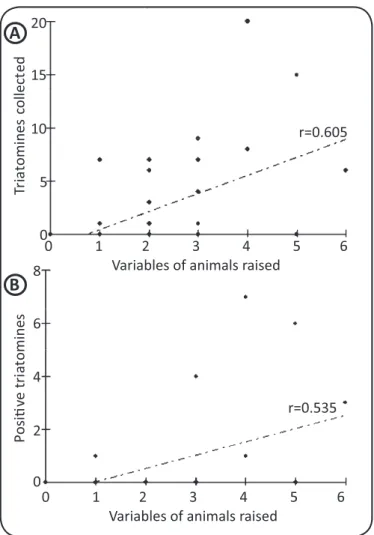
the variety of animal raised. All analyses were performed with a signiicance level of 5%.
Dispersion index (DI) = number of locaions with triatomines x 100 number of locaions surveyed
Household infestaion index (HII)= number of posiive housing units x 100 number of housing units surveyed
Natural infecion index (NII)= number of triatomines infected x 100
number of triatomines collected
Household triatomine density (HTD) = number of triatomine specimens collected x 100 number of housing units surveyed
TABLE 2 - Natural infecion index of triatomines for Trypanosoma cruzi in the villages of rural Itabaianinha, State of Sergipe, Brazil between March 2009 and March 2010.
Number of specimens Natural infecion
Village collected surveyed posiive index (%)
Água Boa 23 23 13 56.5
Mata Verde 35 35 19 54.3
Piabas 8 7 1 14.3
Mutuca 15 13 3 23.1
Fundão 20 18 4 22.2
Antas 40 35 1 2.9
Carretéis 0 0 0 0.0
Garangau 0 0 0 0.0
Maurício 0 0 0 0.0
Total 141 131 41 31.3
TABLE 3 -Distribuion of intra and peri-domesic triatomines collected, according to developmental stage and posiivity, in the villages of Itabaianinha, State of Sergipe, Brazil between March 2009 and March 2010.
Triatomines collected infected
Developmental stage n % n %
1st instar 6 4.3 0 0.0
2nd instar 7 4.9 1 2.4
3rd instar 13 9.2 5 12.2
4th instar 20 14.2 1 2.4
5th instar 21 14.9 5 12.2
Adults 74 52.5 29 70.7
Total 141 100.0 41 100.0
TABLE 4 -Household infestaion index of peri-domesic outbuildings and natural infestaion index of triatomines collected in the outbuildings in the villages of Itabaianinha, State of Sergipe, Brazil between March 2009 and March 2010.
Household infestaion index Natural infestaion index
outbuildings outbuildings HII number of triatomines IIN
Type of outbuilding surveyed infested (%) surveyed posiive (%)
Chicken run 42 7 16.7 42 12 28.6
Corral/barn/stable 29 5 17.2 29 8 27.6
Waste deposit 29 4 13.8 29 4 13.8
Pigsies 13 1 7.7 20 1 5.0
Others 2 0 0.0 0 0 0.0
Total 115 17 14.8 120 25 20.8
HII: household infestaion index; IIN: natural infestaion index of triatomines. The local profile of the rural housing units revealed a very heterogeneous and precarious patern, with the majority of houses as type 2 (56.3%), followed by 27.2% as type 3 and 16.5% as type 1. The mean distance of properies to Itabaianinha’s urban centre was approximately 11.55km (±2.26; maximum=13.81km and minimum=6.54km), and the mean distance between properties was approximately 4.08km (±2.15; maximum=9.63km and minimum=0.66km).
In the peri-domesic areas studied in the City of Itabaianinha, there were corrals, waste deposits and chicken runs, many of which had improvised structures.
Of the 131 triatomine specimens analysed, 41 were posiive for Trypanosomaidae, which corresponds to a natural infecion index (NII) of 31.3% (Table 2). All six villages where triatomines were found exhibited natural infecion indices; the lowest vector infecion percentage was found in Antas (2.9%), while the highest infecion percentage was in Água Boa, where 56.5% of insects studied had Trypanosomaidae in their intesinal contents.
All triatomine specimens collected belonged to the Panstrongylus
megistus species.
With regards to the developmental stage of insects collected, 56.4% were in the adult stage, whereas 43.6% were in nymph stages. Associating the developmental stage with the natural infection indices, adult triatomines exhibited the highest rates of infecion (63%), followed by third-stage nymphs (30.8%) and ith-stage nymphs (23.8%) (Table 3). In addiion, there were traces of triatomines, such as exuviae, exocoria, faeces and eggs. With regards to sex, the number of females collected was higher than that of males at a raio of 1.25:1 (F:M) except in September, when the number of males collected was higher.
The colonizaion index of triatomine P. megistus collected in the region appears to be low due to not having nymphs were found inside the home. However, we emphasize the presence of these developmental stages in household near or adjacent to human dwellings, some of which were found posiive (Table 3).
The triatomine infestaion index in the peri-domesic outbuildings was 31.6% in chicken runs, followed by corrals (26%) and waste deposits (21%) (Table 4).
During collecions, many housing units included breeding domesic animals and other types of animals that can be a food source for triatomines or act as reservoir hosts. Among these animals, chickens (33.1%), dogs (21.3%), pigs (12.4%) and cats (10.7%) stand out.
20
Tr
ia
tomines
col
le
ct
ed
Po
si
�
ve
tri
at
omines
r=0.605
r=0.535 15
10
5
8
6
4
2
0 0
0 1 2 3 4 5 6 Variables of animals raised
0 1 2 3 4 5 6 Variables of animals raised
FIGURE 1 -Pearson correlaion coeicient graphs between the varieies of animals present on the properies and the number of triatomines collected (A) and the number of posiive triatomines (B).
DISCUSSION
All villages that had a household infestaion index were located in northern rural Itabaianinha in an area bordering the Ciies of Riachão do Dantas and Tobias Barreto, both of which are in southern central Sergipe. This region includes citrus plantaions that cover an area of 71.31km2, which corresponds to 16.2% of the total city area18. The changes in the natural landscapes made by agricultural systems intensify the triatomine domiciliaion trend, especially where herbicide and pesicide use is frequent22.
Houses were situated in the middle of pastures and orange plantaions and around small secondary forest fragments. The majority of human dwellings surveyed had a highly heterogeneous structure. Someimes, these housing units were made of bricks; at other imes, they were made of wood, with or without plastered or roughcast walls. The construcion of the housing units contributed further to the maintenance of the parasiic infecion’s domesic cycle and relects the low socioeconomic condiions of the area studied. The area in quesion has a human development index (HDI) of 0.590, which is lower than the mean value of 0.682 found in the State of Sergipe17.
In addiion to poor housing quality, rural Itabaianinha residents
insects with shelter9,11. A study conducted by Villela et al.23 invesigated what could be done to prevent triatomines from entering houses in rural Bambuí, Minas Gerais (Brazil), a city that has tradiionally controlled Chagas disease for more than 50 years. Both adults and children associated ani-triatomine acions with the idea of cleanliness and hygiene, especially by avoiding disorganisaion and accumulated objects at home. This reveals a diferent degree of knowledge of Chagas disease in an area that has been systemaically inluenced by the Chagas Disease Control Program.
High adult triatomine densiies in areas with well-deined dry seasons, such as the State of Sergipe, facilitate insect dispersion to ariicial habitats, such as chicken runs and colonisaion, especially between October and December for Panstrongylusmegistus24.
Pigsies, chicken runs and barns were considered to be the main outbuildings colonised by triatomines in the City of Douradoquara, State of Minas Gerais, according to Diotaiui et al.25. Service26 argued that the maintenance of corrals around houses provides an adequate habitat for Chagas disease vector populaions. Dias27 and Dias et al.28 reported that such types of peri-domesic outbuildings are used for storage and protecion of equipment and tools and create adequate shelter for many insects, which is especially true of triatomines because of their nocturnal habits.
Since the early works of Carlos Chagas, the epidemiological importance of dogs and cats has been emphasised. This is due primarily to the transmission of Trypanosoma cruzi by Triatoma infestans, which also lives in human dwellings29. Thus, dogs and cats play an important role in the maintenance of the disease, in addiion to other domesic and wild mammals that frequent the areas surrounding homes3,4,12. In the case of cats, although infecion rates are low, their associaion with the domesic cycle is closely associated with their wandering habits30. Pig and bird breeding was also signiicant in rural areas and was maintained almost exclusively in the peri-domesic environment. According to Barreto29, natural infecion of pigs had already been detected in 1940, but their role as domesic reservoir hosts needs to be further studied.
Domesic birds represent an important food source, maintaining triatomine colonies10,30. Rossell-Reyes31 suggested that chickens are easily detected due to their high body temperature and high surface/volume raio. In a rural area of the City of Saniago del Estero, Argentina, Wisnivesky-Colli et al.30 established that the feeding behaviour of T. infestans populaions varied depending on the ime of the year. These insects fed predominantly on birds exclusively in the warmer months, a fact that could be atributed to egg incubaion occurring in the intra-domesic environment.
The results conirm the occurrence of Panstrongylus megistus
in rural Itabaianinha, an area where hills predominate and that is located 225 meters above sea level. Infestaion (17.5%) and natural infecion indices (31.3%), in addiion to the presence of such vectors in both peri- and intra-domesic areas, reveal their ability to explore the human environment and their potenial to transmit Trypanosoma
cruzi in the region studied.
In the previous survey conducted by the Chagas Disease
Control Programwas detected in the region, the presence of
Panstrongylus megistus, P. lutzi, Triatoma tibiamaculata,
T. melanocephala and T. pseudomaculata16. Recent data from
A
REFERENCES
The authors declare that there is no conlict of interest.
CONFLICT OF INTEREST
FINANCIAL SUPPORT
ABSTRACT IN PORTUgUESE
households examined and 0.8% of outbuildings were posiive for triatomine bugs, not to menion if the triatomine bugs
were found infected with Trypanosomaidae32. Interesingly,
the secretary of health of Sergipe have reported 98 cases in Itabaianinha from 2001 to 200933.
Based on the results obtained here, the importance of domesic and livestock animals on the maintenance of vector transmission of Chagas disease can be demonstrated in rural areas primarily comprised of poorly constructed houses, as these animals are associated with the peri-domesic environment.
Fundação de Apoio à Pesquisa e à Inovação Tecnológica de Sergipe
(FAPITEC-SE)
Triatomíneos no intra e peridomicílio de área endêmica
de doença de Chagas no Nordeste do Brasil
Introdução: O presente trabalho teve como objeivo ideniicar os triatomíneos coletados no intra e peridomicílio, assim como veriicar a ocorrência de infecção por Trypanosoma cruzi e correlacionar essas informações às condições habitacionais e à fauna associada na zona rural de Itabaianinha, Sergipe, Brasil. Métodos: Visitas trimestrais foram realizadas entre março de 2009 e março de 2010, e as casas visitadas para a busca aiva de insetos foram determinadas por sorteio. Em cada unidade habitacional, os insetos foram capturados por coleta manual com pinça e lanterna para examinar aberturas e cavidades, com um tempo de coleta de uma hora/casa/indivíduo. O desalojador químico Pirisa® foi uilizado para forçar os insetos a abandonar seus ecótopos. A análise do conteúdo intesinal dos triatomíneos foi realizado no laboratório para estabelecer a presença de tripanosomaídeos. Resultados: Em 103 unidades domiciliares examinadas, 17,5% estavam infestadas por triatomíneos da espécie Panstrongylus megistus. O Povoado Mutuca apresentou a mais elevada taxa de infestação das unidades domiciliares (38,1%). Todos os povoados que apresentaram índices de infestação relevantes estavam localizados na região norte do município. A maior percentagem de infecção desse vetor foi observada no Povoado Água Boa (56,5%). As habitações rurais observadas eram em sua maioria de ijolo ou madeira com as paredes rusicamente rebocadas ou sem reboco, e o anexo frequentemente associado ao triatomíneo foi o galinheiro. Conclusões: Os resultados obidos ressaltam a necessidade de vigilância e controle vetorial mais abrangentes, bem como de campanhas educaivas no contexto do PCDCh.Palavras-chaves: Doença de Chagas. Panstrongylusmegistus.
Área endemica. Sergipe. Brasil.
1. Ministério da Saúde. Guia de Vigilância Epidemiológica. Caderno 10: Doença de Chagas. 7ª. Edição. Brasília: Ministério da Saúde; 2010.
2. Vilella MM, Souza JB, Mello VP, Azeredo BVM, Dias JCP. Vigilância entomológica da doença de Chagas na região centro-oeste de Minas Gerais, Brasil, entre os anos de 2000 e 2003. Cad Saude Publica 2005; 21:878-886.
3. Pires HHR, Borges EC, Andrade RE, Lorosa ES, Diotaiui L. Peridomiciliary infestaion with Triatomasordida Stal, 1859 in the county of Serra do Ramalho, Bahia, Brazil. Mem Inst Oswaldo Cruz 1999; 94:147-149.
4. Souza RCM, Soares AC, Alves LC, Lorosa ES, Pereira MH, Diotaiui L. Feeding behaviour of Triatomaviiceps (Reduviidae: Triatominae) in the state of Minas Gerais, Brazil Mem Inst Oswaldo Cruz 2011; 106:16-22.
5. Couinho M, Dias JCP. A descoberta da doença de Chagas. Cad Cien Tecnol 1999; 16:11-51.
6. Silva IG, Fernandes FF, Silva HHG. Infestação de vetores da tripanossomíase americana no ambiente domiciliar no Estado de Goiás. Rev Patol Trop 1995; 24:41-47.
7. Moreno AR, Carcavallo RU. Enfoque ecológico na epidemiologia da doença de Chagas. In: Carcavallo RU, Girón IG, Jurberg J, Lent H, editors. Atlas dos Vetores da Doença de Chagas nas Américas. Vol. III. Rio de Janeiro: Fundação Oswaldo Cruz; 1999. p. 981-1016.
8. Santos CB, Ferreira AL, Leite GR, Ferreira GEM, Rodrigues AAF, Falqueto A. Peridomiciliary colonies of Triatomaviiceps (Stal, 1859) (Hemiptera, Reduviidae, Triatominae) infected with Trypanosomacruzi in rural areas of the state of Espírito Santo, Brazil. Mem Inst Oswaldo Cruz 2005; 100:471-473.
9. World Health Organizaion (WHO). Control of Chagas` Disease. Tecnical Report Series n 811. Genebra: WHO; 1991.
10. Gajate PP, Botazzi MV, Pietrokovsky SM, Wisnivesky-Colli C. Relação entre Triatoma infestans, aves domésicas e o homem num povoado de Saniago del Estero, Argenina. Cad Saude Publica 1994; 10:53-57.
11. Andrade ALSS, Zicker F, Oliveira RM, Silva IG, Silva SA, Andrade SS, et al. Evaluaion of risk factors for house infestaion by Triatomainfestans in Brazil. Am J Trop Med Hyg 1995; 53:443-447.
12. Vilella MM, Rodrigues VLCC, Casanova C, Dias JCP. Análise da fonte alimentar de Panstrongylusmegistus (Hemiptera, Reduviidae, Triatominae) e sua atual importância como vetor doTrypanosomacruzi, no Estado de Minas Gerais. Rev Soc Bras Med Trop 2010; 43:125-128.
13. Dias JCP. O controle da doença de Chagas no Brasil. In: Silveira AC, editor. El control de la enfermedad de Chagas en los países del cono sur de América. Uberaba: Faculdade de Medicina do Triângulo Mineiro; 2002. p. 145-250.
14. Silva RA, Sampaio SMP, Koyanagui PH, Poloni M, Carvalho ME, Rodrigues VLCC. Infestação por triatomíneos em assentamento e reassentamento rurais na Região do Pontal do Paranapanema, Estado de São Paulo. Rev Soc Bras Med Trop 2007; 40:527-532.
15. Ministério da Saúde. Consenso brasileiro em doença de Chagas. Rev Soc Bras Med Trop 2005; 38:1-30.
16. Secretaria Municipal de Saúde. Relatório dos Trabalhos do Programa de Controle de doença de Chagas no município de Itabaianinha 2005-2009. Itabaianinha: Secretaria Municipal de Saúde; 2009.
17. Insituto Brasileiro de Geograia e Estaísica (IBGE). Contagem da população 2007. Rio de Janeiro: IBGE; 2007.
18. Secretaria de Estado do Planejamento. Superintendência de Estudos e Pesquisas (SUPES). Anuário Estaísico de Sergipe. Vol. 25; Aracaju: SUPES; 2005. 19. Lent H, Wygodzinsky P. Revision of the Triatominae (Hemiptera, Reduviidae)
and their signiicance as vectors of Chagas disease. Bull Am Mus Nat Hist 1979; 163:125-520.
20. Guilherme ALF, Pavanelli GC, Silva SV, Costa AL, Araújo SM. Secondary triatomine species in dwellings and other nearby structures in municipalities under epidemiological surveillance in the state of Paraná, Brazil. Rev Panam Salud Publica 2001; 9:385-392.
21. Macedo HS, Marçal Junior O. Distribuição de vetores da doença de Chagas em nível domiciliar: Um estado na Zona Rural de Uberlândia-MG. Cam Geogr 2004; 3:50-66.
22. Abrahan LC, Gorla DE, Catalá SS. Dispersal of Triatomainfestans and other Triatominae species in the arid Chaco of Argenina - Flying, walking or passive carriage? The importance of walking females. Mem Inst Oswaldo Cruz 2011; 106:232-239.
relações com focos naturais da infecção, em área urbana da cidade de São Paulo, Brasil. Rev Saude Publ 1970; 4:19-30.
25. Diotaiui L, Carneiro M, Loiola CCP, Silveira Neto HV, Couinho RM, Dias JCP. Alternaivas de controle do Triatomasordida no Triângulo Mineiro; I. Borrifaçäo parcial: intradomicílio no Município de Douradoquara, MG, Brasil. Rev Soc Bras Med Trop 1988; 21:199-203.
26. Service MW. Agricultural development and arthropod-borne diseases: a review. Rev Saude Publ 1991; 25:165-178.
27. Dias JCP. Perspecivas para o controle da doença de Chagas em áreas endêmicas com inseicidas de ação residual. Experiência de Bambuí, Minas Gerais. [Thesis]. [Belo Horizonte]: Faculdade de Medicina da Universidade Federal de Minas Gerais; 1974. 28. Dias JCP, Loyola CCP, Brener S. Doença de Chagas em Minas Gerais: Situação atual
e perspecivas. Rev Bras Malariol Doenças Trop 1985; 37:7-28.
29. Barreto MP. Estudo sobre os reservatórios e vetores silvestres do Trypanosoma cruzi: primeiro encontro de Triatomainfestans (Hemiptera, Reduviidae) em ecótopos silvestres. Rev Inst Med Trop São Paulo 1963; 5:289-293.
30. Wisnivesky-Colli C, Ruiz AM, Ledesma O, Gürtler RE, Lauricella MA, Salomon DD, et al. Ecologia domésica de la tripanosomiasis americana: peril alimentario del Triatomainfestans em una area rural de la provincia de Saniago del Estero, Argenina. Rev Soc Bras Med Trop 1987; 20:31-39.
31. Rossell-Reyes O. A comparison of the feeding performances of Rhodnius prolixus
Stal and Rhodniusrobustus Larrousse (Hemiptera: Triatominae). [Thesis]. London: University of London; 1984.
32. Secretaria Municipal de Saúde. Relatório dos Trabalhos do Programa de Controle de doença de Chagas no município de Itabaianinha 2010-2011. Itabaianinha: Secretaria Municipal de Saúde; 2011.