INTRODUCTION
Article/Artigo
1. Gerência de Virologia, Fundação de Medicina Tropical Doutor Heitor Vieira Dourado, Manaus, AM. 2. Programa de Pós-Graduação em Doenças Tropicais e Infecciosas, Universidade do Estado do Amazonas, Manaus, AM. 3. Faculdade de Medicina, Universidadede São Paulo, São Paulo, SP.
Addressto: Dr. Wornei Silva Miranda Braga. Gerência de Virologia/FMT-HVD. Av. Pedro Teixeira 25,
Dom Pedro, 69040-00 Manaus, AM, Brasil. Phone: 55 92 2127-3447; Fax: 55 92 3238-3762
e-mail: [email protected]; [email protected]
Received in 18/03/2011
Accepted in 03/08/2011
ABSTACT
Introduction: Reductions in the prevalence of hepatitis B virus (HBV) infection and carriage, decreases in liver cancer incidence, and changes in paterns of liver dysfunctions are described ater hepatitis B vaccination. Methods: We conducted a population-based seroprevalence study aimed at estimating the HBV prevalence and risk of infection in the rural area of Lábrea following nineteen years of HBV vaccination. Results: Half of the subjects showed total anti-HBc of 52.1% (95% CI 49.6-54.7). he HBsAg prevalence was 6.2% (95% CI 5.1-7.6). Multivariate analysis showed an inverse association between HBV infection and vaccination (OR 0.62; 95% CI 0.44-0.87). HBsAg remained independently associated with past hepatitis (OR 2.44; 95% CI 1.52-3.89) and inversely to vaccination (OR 0.43; 95% CI 0.27-0.69). he prevalence of HBeAg among HBsAg-positive individuals was 20.4% (95% CI 12.8-30.1), with the positive subjects having a median age of 11 years (1-46) p=0.0003. Conclusions:
We demonstrate that HBV infection is still an important public health issue and that HBV vaccination could have had beter impact on HBV epidemiology. If we extrapolate these indings to other rural areas in the Brazilian Amazon, we can predict that the sources of chronic infected patients remain a challenge. Future studies are needed regarding clinical aspects, molecular epidemiology, surveillance of acute cases, and risk groups.
Keywords: HBV. Hepatitis B. Prevalence. Vaccination. Epidemiology.
RESUMO
Introdução: Reduções nas taxas de prevalência de infecção pelo vírus da hepatite B (VHB) e de portadores, incidência de câncer de fígado e mudança nos padrões de doenças hepáticas são descritos, depois da introdução da vacinação contra hepatite B. Métodos: Foi conduzido um estudo de soro prevalência de base populacional, com o objetivo de estimar a prevalência do VHB e fatores de risco de infecção na área rural de Lábrea, depois de 19 anos de introdução da vacinação contra hepatite B. Resultados: Metade dos indivíduos investigados mostrou reatividade ao anti-HBc total, 52,1% (IC 95% 49,6-54,7). A prevalência do HBsAg foi 6,2% (IC 95% 5,1-7,6). Análises multivariadas mostrou associação inversa da infecção pelo VHB e vacinação (OR 0,62; IC 95% 0<44-0,87). A presença do HBsAg permaneceu independentemente associada com o passado de hepatite (OR 2,44; IC 95% 1,52-3,89) e inversamente associado a história de vacinação (OR 0,43; IC 95% 0,27-0,69). A prevalência do HBeAg, entre os HBsAg positivos foi 20,4% (IC95% 12,8-30,1), tendo em média os indivíduos positivos 11 anos de idade (1-46) p=0,0003. Conclusões: Foi demonstrado que o VHB é ainda um importante problema de saúde publica, e que a vacinação contra o VHB poderia ter tido um impacto maior na epidemiologia do VHB na região. Se esses achados forem extrapolados para outras regiões rurais da Amazônia brasileira, podemos predizer que a fonte de pacientes crônicos é ainda um desaio a ser vencido. Estudos futuros devem focar os aspectos clínicos, a epidemiologia molecular, vigilância de casos agudos e grupos de risco.
Palavras-chaves: HBV. Hepatite B. Prevalência. Vacinação. Epidemiologia.
Prevalence of hepatitis B virus infection and carriage ater nineteen
years of vaccination program in the Western Brazilian Amazon
Prevalência da infecção e de portadores do vírus da hepatite B, após 19 anos do programa de
vacinação na Amazônia ocidental Brasileira
Wornei Silva Miranda Braga
1,2, Márcia da Costa Castilho
1,2, Fabiane Giovanella Borges
1, Ana Cristina de Souza Martinho
1,
Ivo Seixas Rodrigues
1, Eliete Pereira de Azevedo
1, Márcia Scazufca
3and Paulo Rossi Menezes
3Hepatitis B virus (HBV) infection has a global public health impact, with some 300 million chronic carriers worldwide1. Clinical importance is associated
with both fatal acute infection and chronic diseases (chronic hepatitis, liver cirrhosis, and liver cancer).
High prevalence rates have been described in Southeast Asia2, Africa3, the Paciic Islands4, the
Amazon region5-6, and Alaska7. In these areas, the
virus is primarily transmitted perinatally from infected mothers, horizontally in early childhood8-10,
or by blood exposure as a result of cultural practice11.
In the Brazilian Amazon, prevalence rates of 70% for past infection and 15% for surface antigen (HBsAg) carriage have been described12. Outbreaks
of acute fatal hepatitis used to be very common in small rural villages, with a very high case fatality rate associated with hepatitis delta virus (HDV) infection of HBsAg carriers12-13.
Reductions in the prevalence of HBsAg infection and carriage, decreases in liver cancer incidence, and even changes in paterns of liver dysfunctions have been described after the implementation of hepatitis B vaccination programs in highly endemic countries14-17.
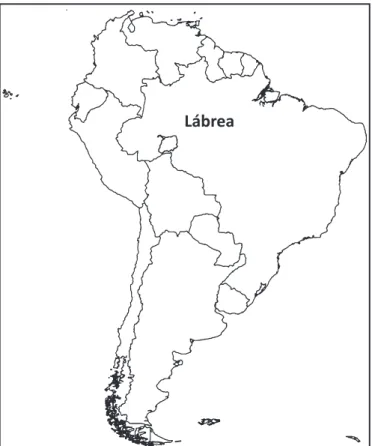
We conducted a population-based cross-sectional survey aimed at estimating the HBV serological marker prevalence and risk of infection in the rural zone of Lábrea county, Western Brazilian Amazon, following nineteen years of implementation of a hepatitis B vaccination program in the region.
METHODS
RESULTS
Lábrea
FIGURE 1 - Map of the study area.
he region was irst reached during the colonization period by those collecting forest products. In the nineteenth century, during the
rubber boom, a huge number of nordestinos, those born in Northeast Brazil, resetled in the area to work at the natural rubber plantations. Currently, the villages are small, formed by those who remained ater rubber extraction declined. he economy is still based on the exploitation of natural resources, such as seasonal agriculture at the half-year looded banks of the Purus River, timber production, growing Brazil nuts, and raising livestock, with the products traded locally. he socioeconomic conditions are very poor, and the annual per capita income is around US$1,000.
he target population consisted of all individuals living in the villages that compose the Lábrea County, along the Purus River. Villages were irst randomly selected from a list from the Malaria Control Program, assuring that we had covered all the provincial geographical areas along the banks of the Purus River. hen, the research team randomly selected households in each village. he villages were visited from March 2005 to April 2006, during three major twenty-day expeditions and a few one-day trips to the villages near the town of Lábrea.
Ater signing the formal consent to participate, each individual illed out a questionnaire. A 10mL blood sample was taken from each of those present during the investigation; some family members were included later during our stay at the location because they were absent at the time of the visit.
he sample size was estimated using the oicial rural population census18, resulting in an estimated HBsAg prevalence of 6.4%19,
a design factor of 2, ±2% precision, and 95% conidence level, which yielded a minimum sample of 1,009 individuals.
he serum samples were stored at -200C locally before being
flown to Manaus, where they were analyzed by enzyme-linked
immunosorbent assay (ELISA). All sera were tested for quantitative anti-HBs and total anti-HBc; those reactive to total anti-HBc and negative for anti-HBs were tested for HBsAg, and those found reactive were tested for HBeAg and anti-HBe using a commercial kit (DiaSorin S.p.A., Saluggia, Italy). he test procedures followed the manufacturer’s recommendations and were performed automatically at the laboratory facilities of the virology unit of Fundação de Medicina Tropical do Amazonas.
Epi Info version 3.3.220was used in data handling and sample size
calculation; the explanatory variables included gender, age group, vaccination against hepatitis B, and personal antecedent of clinical hepatitis or jaundice. he study population was stratiied by two-year groups for the irst four years of life, then by 5-year increments up to the age of 19, and those 20 years or older, which comprised the population at risk of HBV infection before the implementation of hepatitis B vaccination.
he prevalence rates and corresponding 95% conidence intervals (95% CI) of HBV infection and carriage were estimated taking into account the study design. Logistic regression was used to calculate the crude ORs and 95% CIs. A inal multiple logistic regression model including all study variables was used to control for confounding using Stata/IC 10.021.
Ethical considerations
This study was reviewed and approved by the Research Ethics Commitee of the Dr. Heitor Vieira Dourado Tropical Medicine Foundation (FMT-HVD), Manaus, Amazonas, Brazil (no1775/2006 CEP/FMT).
This study included 1,510 individuals from 298 families selected in 54 visited villages. The infection and carriage rates varied signiicantly between villages, from as low as 0% in Realeza
(07º35’52.8”S/66º13’29.2”O) to as high as 37.2% in Madeirinho
(07º34’19.1”S/65º26’31.4”O).
Nevertheless, with regard to HBsAg prevalence, the great majority of the villages with positive subjects showed rates varying from high to moderate endemic paterns, as shown by the prevalence rates of 10.7% in Limeira (07º43’13.4”S/66º42’33.7”W) and 6.5% in Praia do Buraco (07º17’48.6”S/64º58’28.3”W).
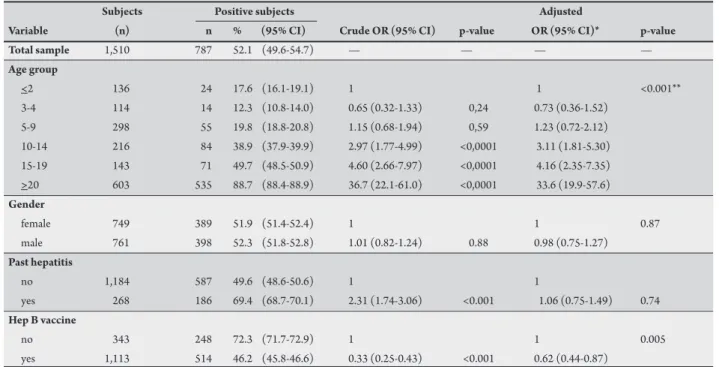
Half of the sample (52.1%) showed serological markers of past HBV infection (95% CI 49.6-54.7). HBV infection was strongly associated with increasing age (Chi-square for linear trend=551.28, p<0.001) and positively associated with past history of clinical hepatitis (OR 2.31(95% CI 1.74-3.06) p<0.001); it was also inversely related to HBV vaccination (OR 0.33 (95% CI 0.25-0.43) p<0.001) (Table 1).
he current infection (HBsAg+) prevalence was 6.2% (95% CI 5.1-7.6) and also increased significantly with age (Chi-square for linear trend=48.21, p<0.001). HBsAg had been present since very early ages, with 2% of those aged up to four years testing positive. However, the rates reached moderate paterns among adolescents (5.6%, 95% CI 4.31-6.89) and were as high as 10% (95% CI 9.34-10.9) within the cohort of those aged 20 years or more (Table 2).
DISCUSSION Ater iting a multiple logistic regression model including all the
study variables, the association of HBV infection with past history of clinical hepatitis disappeared (OR 1.06 (95% CI 0.75-1.49) p=0.74). Nevertheless, we still detected an inverse association with HBV vaccination (OR 0.62 (95% CI 0.44-0.87) p=0.005) (Table 1).
Hepatitis B virus carriage remained independently associated with past history of hepatitis (OR 2.44 (95% CI 1.52-3.89) p<0.001) and inversely related to HBV vaccination (OR 0.43 (95% CI 0.27-0.69) p<0.001) (Table 2).
he prevalence of HBeAg among HBsAg-positive individuals was 20.4% (19∕93) (95% CI 12.8-30.1), with the positive subjects having a median age of 11 years (1-46) (p=0.0003) (Kruskal-Wallis test).
To the best of our knowledge, this is the irst population-based seroprevalence study of HBV infection in the rural areas of the Western Brazilian Amazon, within the deined geographical limits,
TABLE 1 - Hepatitis B infection (anti-HBc reactive) prevalence and associated variables, Rural Lábrea municipality, Western Amazon, Brazil, 2007.
Subjects Positive subjects Adjusted
Variable (n) n % (95% CI) Crude OR (95% CI) p-value OR (95% CI)* p-value
Total sample 1,510 787 52.1 (49.6-54.7) — — — —
Age group
<2 136 24 17.6 (16.1-19.1) 1 1 <0.001**
3-4 114 14 12.3 (10.8-14.0) 0.65 (0.32-1.33) 0,24 0.73 (0.36-1.52) 5-9 298 55 19.8 (18.8-20.8) 1.15 (0.68-1.94) 0,59 1.23 (0.72-2.12) 10-14 216 84 38.9 (37.9-39.9) 2.97 (1.77-4.99) <0,0001 3.11 (1.81-5.30) 15-19 143 71 49.7 (48.5-50.9) 4.60 (2.66-7.97) <0,0001 4.16 (2.35-7.35)
>20 603 535 88.7 (88.4-88.9) 36.7 (22.1-61.0) <0,0001 33.6 (19.9-57.6)
Gender
female 749 389 51.9 (51.4-52.4) 1 1 0.87
male 761 398 52.3 (51.8-52.8) 1.01 (0.82-1.24) 0.88 0.98 (0.75-1.27)
Past hepatitis
no 1,184 587 49.6 (48.6-50.6) 1 1
yes 268 186 69.4 (68.7-70.1) 2.31 (1.74-3.06) <0.001 1.06 (0.75-1.49) 0.74
Hep B vaccine
no 343 248 72.3 (71.7-72.9) 1 1 0.005
yes 1,113 514 46.2 (45.8-46.6) 0.33 (0.25-0.43) <0.001 0.62 (0.44-0.87)
Anti-HBC: antibody against hepatitis B core antigen; n: number; %: percentage; 95% CI: 95% conidence interval; Hep B vaccine: hepatitis B vaccine. *Adjusted for the variables in Table 1; p-value: statistical signiicance;**Chi-square for linear trend; OR: odds ratio.
TABLE 2 - Hepatitis B surface antigen (HBsAg reactive) prevalence and associated variables, Rural Lábrea municipality, Western Amazon, Brazil, 2007. Subjects Positive subjects Adjusted
Variable (n) n % 95% CI Crude OR (95% CI) p-value OR (95% CI)* p-value
Total sample 1,510 94 6.2 (5.2-7.6) — — — —
Age group
<2 136 3 2.2 (0.54-3.86) 1 1
3-4 114 1 0.9 (-0.92-2.72) 0.39 (0.40-3.82) 0,42 0.47 (0.48-4.62) <0.001** 5-9 298 12 4.0 (2.89-5.11) 1.86 (0.51-6.70) 0,34 1.83 (0.50-6.66)
10-14 216 12 5.6 (4.31-6.89) 2.60 (0.72-9.41) 0,14 2.35 (0.64-8.61) 15-19 143 5 3.5 (2.49-4.51) 1.60 (0.37-6.84) 0,52 1.21 (0.28-5.25)
>20 603 61 10.1 (9.34-10.9) 4.98 (1.54-16.14) 0,007 2.88 (0.87-9.55)
Gender
female 749 49 6.5 (5.8-7.2) 1 1
male 761 45 5.9 (5.2-6.6) 0.89 (0.59-1.36) 0,61 0.81 (0.52-1.25) 0.35
Past hepatitis
no 1,184 37 4.8 (4.3 - 5.4) 1 1
yes 268 37 13.8 (12.7-14.9) 3.17 (2.04-4.90) <0.001 2.44 (1.52-3.89) <0.001
Hep B vaccine
no 343 41 12.0 (11.0-13.0) 1 1
yes 1,113 49 4.4 (3.8 - 4.9) 0.33 (0.21-0.56) <0.001 0.43 (0.27-0.69) <0.001
conducted ater the introduction of an immunization program, which allowed us to measure the impact of HBV vaccination in this single region.
We examined the HBV prevalence, taking into account the presence of two speciic serological markers. Because the presence of total antibodies against the core antigen (total anti-HBc) is a marker of past infection, it can measure the importance of the circulation of the virus but lacks the strength for inferences concerning clinical aspects and transmission. Nevertheless, the presence of HBsAg can identify the transmission scenario and potentially chronically ill individuals.
While studies worldwide have found important drops in the rates of past HBV infection, as shown by a study in the Colombian Amazon, where less than 10% of the population aged 5-9 years and around 25% of those 10 to 14 years showed positive, representing a reduction of 72 and 62%, respectively, ater the introduction of the vaccine22. In contrast, our study described much higher igures among
the same age groups: 19.8% and 38.9%, respectively. In addition, we reported rates close to 50% in a group of individuals who should have been immunized ater these nineteen years; that is, those aged 15 to 19 years, who belonged to the target population in the irst ive years of the introduction of the vaccine in the community.
Considering the rates of past infection reported before the introduction of the vaccine, which showed important variations (for example, from 15 to 32% for those up to ive years old)23-24, the rate of
less than 15% among those 3-4 years old reported in the present study suggests some impact of the vaccination program on new infections, especially among younger people. Still, we must be cautious with any conclusions because the majority of previous studies done in this region before the introduction of the HBV vaccine were analyses of non-probabilistic samples.
Our study was able to demonstrate that there has been an important circulation of the virus since very young ages among individuals who should have already been fully immunized. However, we may also stress the fact that the distribution of past infection was heterogeneous among the studied villages and that, in some villages, the whole studied population showed no contact with HBV.
Given that this heterogeneous patern within villages has been described since the late 1960s5-6, HBV vaccination might have had
litle impact in changing the HBV epidemiology, which seems to have maintained its historical patern. We believe that genetic factors25 and
the vaccination program strategies’ failure to focus on risk groups may possibly explain some of these diferences since the environmental and social economic conditions are very similar.
Unlike many other publications from former highly endemic countries describing a dramatic drop in the prevalence of HBV carriage after the introduction of the HBV vaccine in their national immunization programs17,26-28, we report an overall
prevalence of HBV carriage identified only in highly endemic areas, possibly with no counterpart in the literature thus far in the post-vaccination era.
Chronic carriers were found in all age groups. Indeed, we were able to distinguish three diferent cohorts with indications of important transmission intensity among those who theoretically should be protected. Infection among those aged up to two years supports the possibility of vertical transmission, while the prevalence among children aged between three and ten years indicates potential
horizontal transmission among young groups; within adolescents and young adults up to 19 years, it is possible that infection is due to sexual transmission. Since the virus circulates in all ages, the transmission is dependent on the type of risk factor present in each age cohort.
he prevalence and age distribution of HBeAg support the idea of important transmission among early ages because the presence of this serological marker indicates new infections, high viral load, and potential infectivity29.
Taking into account that the prevalence of HBsAg carriage reported in this region before the introduction of the vaccine13,24
varied from 7% and 12%, there has been very litle change in the epidemiological patern of HBV distribution in this speciic region from a hyperendemic situation to a highly to moderately endemic pattern. This is in contrast to the situation in Italy, where the prevalence of HBsAg dropped from 13% to less than 1% ater twenty years of universal vaccination26, and in Taiwan, which expected
an overall prevalence rate of HBsAg carriage of less than 0.01% in the year 201027. In the Colombian Amazon, the prevalence of
HBsAg carriage among those 5-9 years old dropped from 9% to 2%, indicating a reduction of more than 70% ater eight years of HBV vaccination22.
We do not need to go too far to ind beter results of the HVB vaccination program in an Amazonian community. A study done in the year 2000 in the urban area of Lábrea not only demonstrated a low prevalence of HBV carriage among those born in the urban area and no carriers before adolescence but also suggested that the real problem with HBV infection would be in rural sites19.
Risk factors such as increasing age and past history of clinical hepatitis were strong predictors of HBV carriage even ater those nineteen years, suggesting once again that the HBV vaccination program may have had little impact in changing the HBV epidemiology and on the aetiology of acute and chronic hepatitis in this region. Nevertheless, the hepatitis B vaccine has been shown to be an important protection against HBV, with those vaccinated having almost half the risk of infection and carriage of those not vaccinated, reinforcing the notion that the high figures we are describing may be related to a failure to deliver the vaccine to the population at risk.
In conclusion, our study demonstrates that HBV continues to be an important public health issue in the Amazon region and that the implementation of the HBV vaccination program in the rural area of Lábrea should have had a much stronger impact on HBV infection and carriage, as observed elsewhere. Vaccination strategies should focus on speciic risk groups, such as infants born to a HBsAg-positive mother and adolescents. It seems that those who escape the vaccine intervention are responsible for keeping the prevalence rates of HBV infection and carriage among the highest still reported.
ACKNOWLEDGMENTS
he authors declare that there is no conlict of interest. CONFLICT OF INTEREST
FINANCIAL SUPPORT
REFERENCES
We would like to express our gratitude to the municipality of Lábrea, especially to Mayor Gean Barros and the people in the villages we visited, for the very warm welcome and willingness to participate.
his work was inancially supported by the Fundação de Amparo à Pesquisa do Estado do Amazonas (FAPEAM).
1. World Health Organization. Hepatitis B. Fact sheet no. 204. Geneva, Switzerland: World Health Organization; 2000; [cited 2011 May 5 ]. Available from: htp:// www.who.int/mediacentre/factsheets/fs204/en/index.html.
2. Hipgrave DB, Nguyen TU, Hoang TL, Do TD, Tran NT, Jolley D, et al. Hepatitis B infection in rural Vietnam and implications for a national program of infant immunization. Am J Trop Hyg 2003; 69:288-294.
3. Kiire CF. he epidemiology and prophylaxis of Hepatitis B in sub-Saharan Africa: a view from tropical and sub-tropical areas. Gut 1996; 38:S5-12.
4. Vogt TM, Goldstein ST, Kuartei S. Endemic hepatitis B virus infection and chronic liver disease mortality in the republic of Palau, 1990-2002. Trans R Soc Trop Med Hyg 2006;100:1130-1134.
5. Bensabath G, Hadler SC, Pereira Soares MC, Fields H, Dias LB, Popper H, et al.Hepatitis Delta virus infection and Lábrea hepatitis. Prevalence and role in fulminant hepatitis in the Amazon basin. JAMA 1987; 258:479-483
6. Fonseca JFC, Simoneti SRR, Schatzmayr HG, Castejón MJ, Cesário ALO, Simoneti JP. Prevalence of infection with hepatitis delta virus (HDV) among carriers of hepatitis B surface antigen in Amazon State, Brazil. Trans R Soc Trop Med Hyg1988; 82:469-471.
7. Mac Mahon BJ, Schoemberg S, Blkow L, Wainwright RB, Fitzerald MA, Parkinson AJ, et al. Seroprevalence of hepatitis B viral markers in 52,000 Alaska natives. Am J Epidemiol 1993; 138:544-549.
8. Vardas E, Mathai M, Blaau D, McAnerney J, Coppin A, Sim J. Preimmunisation epidemiology of hepatitis B virus infection in South African children. J Med Virol 1999; 58:111-115.
9. Chang MH. Natural history of hepatitis B virus infection in children. J Gastroenterol Hepatol 2000; 15:E16-19.
10. Brasil LM, Fonseca JC, Souza RB, Braga WS, Toledo LM. Prevalência de marcadores para o vírus da hepatite B em contatos domiciliares no Estado do Amazonas. Rev Soc Bras Med Trop 2003; 36:565-570.
11. Brabin L, Brabin BJ. Cultural factors and transmission of hepatitis B virus. Am J Epidemiol 1985; 122:725-730.
12. Bensabath G, Boshel J. Presença do antígeno “Austrália” (Ag) em populações do interior do Estado do Amazonas-Brasil. Rev Inst Med Trop Sao Paulo 1973; 15:284-288.
13. Hadler SC, Monzon M, Ponzeto A, Anzola E, Rivero D, Mondoli A, et al. Delta virus infection and severe hepatitis. An epidemic in the Yucpa Indians of Venezuela. Ann Intern Med 1984; 100:339-344.
14. Chang MH, Chen CJ, Lai MS, Hsu HM, Wu TC, Kong MS, et al. Universal hepatitis B vaccination in Taiwan and the incidence of hepatocellular carcinoma in children. Taiwan Childhood Hepatoma Study Group. N Engl J Med1997; 336:1855-1859. 15. Harpaz R, McMahon BJ, Margolis HS, Shapiro CN, Havron D, Carpenter G, et al. Elimination of new chronic hepatitis B virus infections: Results of the Alaska immunization program. J Infect Dis 2000; 181:413-418.
16. Ni YH, Chang MH, Huang LM, Chen HL, Hsu HY, Chiu TY, et al. Hepatitis B virus infection in children and adolescents in a hyperendemic area: 15 years ater mass hepatitis B vaccination Ann Intern Med 2001; 135:796-800.
17. Zaneti AR, Van Damme P, Shouval D. he global impact of vaccination against hepatitis B: A historical overview. Vaccine 2008; 26:6266-6273.
18. Instituto Brasileiro de Geograia e Estatística.Database of information by census tract; 2000; [cited 2011 May 5]. Available from: http://www.ibge.gov.br/ cidadesat/default.php/.
19. Braga WSM, Brasil LM, Souza AB, Melo MS, Rosas MDG, Castilho MC, et al. Prevalência da infecção pelos vírus da hepatite B (VHB) e da hepatite D (VHD) em Lábrea, Rio Purus, Estado do Amazonas. Epidemiol Serv Saude 2004; 13:35-46.
20. Centers for Diesease Control and Prevention. Epi InfoTM statistical
sotware[computer programm].Version 3.3.2. Atlanta GA: Centers for Diesease Control and Prevention; 2005.
21. Statacorp. Stata Statistical sotware. [computer programm]. Release IC 10.0. College Station, TX: Statacorp; 2006.
22. Hoz F, Perez L, Neira M, Hall AJ. Eight years of hepatitis B vaccination in Colombia with a recombinant vaccine: factors inluencing hepatitis B infection and efectiveness. Int J Infect Dis 2008;12:183-189.
23. Alecrim WD, Marreiros LS, Alecrim MGC, Miranda-Santos IKF. Inquérito sobre presença de HBsAg em habitantes de Lábrea-Amazonas. Rev Soc Bras Med Trop 1986; 19:58-59.
24. Bensabath G, Hadler SC, Soares MCP, Fields H, Dias LB, Popper H, et al. Epidemiologic and serologic studies of acute viral hepatitis in Brazil´s Amazon Basin. Bull Pan Am Health Organ 1987; 21:16-27.
25. Sullivan JS, Hanna JN. A genetic marker associated with non-response to recombinant hepatitis B vaccine by indigenous Australian children. J Paediatr Child Health 1999; 35:412-413.
26. Villa G, Romano L, Sepe A, Lorio R, Paribello N, Zappa A, et al.Impact of hepatitis B vaccination in a highly endemic area of south Italy and long-term duration of anti-HBs antibody in two cohorts of vaccinated individuals. Vaccine 2007;25:3133-3136.
27. Chen CC, Yen CH, Wu WY, Hu SW, Chen SC, Bell WR, et al.Epidemiology of hepatitis B virus infection among young adults in Taiwan, China ater public vaccination program. Chin Med J 2007;120:1155-1158.
28. Tsebe KV, Burnett RJ, Hlungwani NP, Sibara MM, Venter PA, Mphahlele MJ. he irst ive years of universal hepatitis B vaccination in South Africa: evidence for elimination of HBsAg carriage in under 5-year-olds. Vaccine 2001; 19:3919-3926.