Quality of maternal-child health care
at a university hospital, according to
the nurses' perspective
QUALIDADE ASSISTENCIAL NA DIVISÃO DE ENFERMAGEM MATERNO-INFANTIL DE UM HOSPITAL UNIVERSITÁRIO NA ÓTICA DE ENFERMEIROS
CALIDAD ASISTENCIAL EN LA DIVISIÓN DE ENFERMERÍA MATERNO INFANTIL DE UN HOSPITAL UNIVERSITARIO, SEGÚN LA ÓPTICA DE LOS ENFERMEROS
1 Nurse, graduated by School of Nursing, University of São Paulo. Nurse at Hospital. São Paulo, SP, Brazil. [email protected] 2 Nurse.
O
RIGINAL
A
R
TICLE
RESUMO
O objetivo deste estudo foi analisar a qua-lidade assistencial na Divisão de Enferma-gem Materno-Infantil do Hospital Univer-sitário da USP, fundamentado no modelo Donabediano. Os dados foram obtidos em agosto de 2006, empregando-se um ques-tionário, respondido por 55 sujeitos. A aná-lise dos dados ocorreu segundo índices percentuais e testes específicos. O Alpha de Cronbach do instrumento foi 0,71, demons-trando confiabilidade. Na dimensão de es-trutura, 98,2% dos enfermeiros considera-ram adequado o local do carro de emergên-cia e 63,6% apontaram dificuldades em par-ticipar das atividades educacionais. Em pro-cesso, 96,4% concordaram que o SAE é um instrumento de melhoria da qualidade, e 72,7% apontaram dificuldades na comuni-cação com os profissionais de saúde. Para resultado, 72,7% indicaram que a prescri-ção de enfermagem atende às necessida-des dos usuários. A dimensão de estrutura obteve o pior escore, média de 38,5. Acre-dita-se que este estudo subsidie ações de melhoria da qualidade nas três dimensões, sobretudo, na de estrutura.
DESCRITORES
Enfermagem materno-infantil. Cuidados de enfermagem. Qualidade da assistência à saúde. Avaliação em saúde.
Natalia Eiro Yuri1, Daisy Maria Rizatto Tronchin2
ABSTRACT
The objective of the present study was to analyze the quality of health care at the Maternal-Child Division of a Hospital of University of São Paulo, based on the Donabedian model. Data collection was performed in August of the year 2006, us-ing a questionnaire that was answered by 55 subjects. Data analysis was performed by means of percentage rates and specific tests. A Cronbach’s Alpha of 0.71 was found for the instrument, thus showing reliabil-ity. As for structure, 98.2% of nurses con-sidered the emergency car location appro-priate, and 63.6% reported difficulties in participating in educational activities. As for process, 96.4% consider that the SAE is an instrument that improves quality, and 72.7% stated having communication diffi-culties with health care professionals. As for the results, 72.7% reported that the nurs-ing prescription meets the users’ needs. Structure was the aspect with the worst score, a mean of 38.5. This study supports actions to improve quality in the three do-mains, particularly structure.
KEY WORDS
Maternal-child nursing. Nursing care.
Quality of health care. Health evaluation. Nursing.
RESUMEN
El objetivo de este estudio fue examinar la calidad asistencial en la División de Enferme-ría Materno Infantil del Hospital Universitario de la USP de acuerdo con el modelo de Donabedian. Los datos fueron obtenidos en agosto de 2006, empleándose un cuestiona-rio que fue respondido por 55 sujetos. El aná-lisis de los datos se efectuó a través de índices porcentuales y tests específicos. El Alpha de Cronbach del instrumento fue de 0,71, lo que demuestra la fiabilidad del estudio. En la di-mensión de estructura 98,2% de los enferme-ros consideró adecuada la localización de la ambulancia de Emergencias, y 63,6% mencio-naron tener dificultades para participar de las actividades educativas. En proceso, el 96,4% estuvo de acuerdo en que el SAE es una he-rramienta para el mejoramiento de la calidad y el 72,7% se refirió a las dificultades en la co-municación con los profesionales de la salud. Para el resultado, 72,7% indicó que las indica-ciones de enfermería responden a las necesi-dades de los usuarios. La dimensión de la es-tructura obtuvo la peor puntuación, con un promedio de 38,5. Se cree que el estudio con-tribuya a trazar líneas de acción para el mejo-ramiento de calidad en las tres dimensiones estudiadas, particularmente en la estructura.
DESCRIPTORES
INTRODUCTION
Nursing Services, which are part of complex institutions, face the great challenge of guaranteeing health care qual-ity, to effectively meet the needs of both internal and ex-ternal clients.
Today it is observed that the awareness regarding the need to provide quality health care is no longer an iso-lated attitude; it has become a technical and social impera-tive, due to multiple reasons, particularly the increase in health care demands; on one hand, the growing costs of maintaining the service; and on the other hand, the lim-ited resources and the fact that users have become more and more demanding and aware about their rights, in ad-dition to the claims from health care professionals, who yearn for proper and ethical work conditions, and public administrators, who are responsible for guaranteeing fund-ing for the health system(1-2).
In terms of evaluating quality in health, one of the frame-works widely used by researchers and government organi-zations is the Donabedian Model, which comprises the analysis of a three-component approach:
structure-process-outcome. In this model, the
item structure corresponds to the relatively
stable characteristics of institutions: physical area, human, material and financial re-sources, as well as the organizational model. The process item refers to a set of activities developed in the general production, in the health sector, through the relationships es-tablished between professionals and service users – from the search for the service to
di-agnosis and treatment. Finally, the outcome
item concerns the characteristics of the
prod-ucts or services, whose quality translates into the effects
on the health of the clients and population(3).
It is observed, however, that regardless of the quality programs and evaluation models, it is fundamental that the nursing team never loses sight of their commitment with service quality, respecting that commitment, as it has a di-rect impact on the outcomes.
Therefore, it becomes mandatory to obtain data regard-ing the perception of the nurses involved in the service, considering that the program or actions that aim at improv-ing quality require changes in the service, which, in turn, depend considerably on the compromise and commitment of the professionals to make them effective, and, later, evaluate them.
Perception is understood as the process by which people organize and interpret their own sensory impressions, with the purpose of assigning a meaning to the environment they are in. This is important because their behavior
re-flects the perceived reality(4). The author of the
aforemen-tioned statement considers that several factors occur to
shape or distort perception. The main features of the
ob-server are the attitudes or motivations, and the
expecta-tions. The object is represented by the setting, movements
or sounds. Finally, in the context of the situation, the main
factor is the working or social environment itself.
The perceptions also integrate specific contexts, and include a side set of codes, world views and representa-tions that guide practices, values, beliefs and attitudes of
individuals and of the group(5).
This study is, therefore, grounded on the premise that knowing the nurses’ perception about the real conditions of the service being delivered may contribute to estab-lishing the situational diagnosis, identifying limits and possibilities to monitor and guarantee the quality of health care.
OBJECTIVE
To analyze the nurses’ perception about the quality of the nursing care that is delivered at the Maternal Child
Di-vision (DEMI, abbreviation in Portuguese for Divisão
Materno Infantil) at the University Hospital -University of São Paulo (HU-USP), in terms of the structure, process and outcome compo-nents of the Donabedian model.
METHOD
This exploratory-descriptive study was performed at the DEMI of the HU-USP, a pub-lic teaching institution located in the Munici-pality of São Paulo.
The DEMI comprises the following Sections: Obstetric Center (OC), with 8 pre-delivery beds, and 4 delivery rooms; Rooming-in Care (RC), with 53 beds; Nursery (NUR), with 24 beds; Pediatric/Neonatal Intensive Care Unit (P/ NICU), with 16 beds; and Pediatrics (PED), with 36 beds.
During this study, the Division was composed by 61 nurses. Nevertheless, the target-population consisted of 56
nurses, who met the eligibility criteria: inclusion (work at
the institution for at least six months) and exclusion (nurses
who were in a management position, on vacation or on a sick leave during the data collection period). Fifty-five nurses (98.2%) responded the instrument, and were thus the subjects of the present study.
Data collection was performed in August 2006, after the study was approved by the Commission for Teaching and Research and the Research Ethics Committee at the referred Hospital.
The instrument consisted of a two-part questionnaire. The first part included the socio-demographic data of the subjects; the second comprised 36 statements (22
affirma-...knowing the nurses’ perception about the real conditions of the service being delivered
may contribute to [...] guarantee the quality
tive and 14 negative), 12 of which addressed the structure dimension, 12 the process and 12 the outcome, which were randomly distributed. To answer the affirmative items, a Likert scale was used with the purpose of measuring atti-tudes, opinions, perceptions or feelings, with two fields of
variation, one for agreement and one for disagreement (6).
The scale had the following five degrees: Totally disagree (TD), Partially disagree (PD), Neither agree nor disagree (N), Partially agree (PA) and Totally agree (TA).
The statements were created based on literature re-view, emphasizing on service quality, health service evalu-ation, on the Donabedian model, and on national govern-ment organizations – the National Health Surveillance
Agency (ANVISA, abbreviation in Portuguese for Agência
Nacional de Vigilância Sanitária) and the Accreditation Manual of the National Organization on Accreditation (ONA,
abbreviation in Portuguese for Organização Nacional de
Acreditação).
The statements addressing the structure concerned the physical and material resources, nursing staff, furniture and infrastructure; process statements address the group of activities performed by nurses, including interpersonal re-lationships, professional training and healthcare model used. Finally, the items addressing the outcome concerned the desirable characteristics of the service, highlighting the effects of service and the professional satisfaction towards the care that was delivered, as well as the changes regard-ing knowledge and people’s behavior.
In compliance with literature recommendations, in terms of trustworthiness, the questionnaire was submit-ted to validation considering the criteria for internal con-sistency and content. For content analysis, the instrument was evaluated by seven judges, who were experts in issues regarding health service quality and evaluation or in meth-odology. All of the seven judges (100%) requested some of the statements to be rewritten.
The questionnaire was then submitted to a pretest, and was distributed to the study subjects. A 20-day period was established for subjects to return the questionnaires.
To test the reliability of the instrument, Cronbach’s Al-pha was used, which represents the correlation among the items on the scale and all other possibilities, containing a same number of items, constructed from the universe of potential questions that measure the factor of the basic
concept(6-7). An Alpha of 0.71 was found for the
question-naire, and the value 0.60 was used as reference(7).
The data were stored on an Excel® electronic spread-sheet and analyzed based on descriptive statistics and con-sidering a favorability score for each dimension. Friedman’s non-parametric test was used to compare the structure-process-outcome scores. Hence, the maximum value to be found for each dimension was 60 and the minimum was 12. The level of significance used for the tests was 5%.
RESULTS
Of all participants, 54 (98.2%) were women. The aver-age aver-age was 37.4 years (sd+7.4). The averaver-age time since graduation was 13.9 years (sd+7.0), and of work at the HU-USP was 11.1 years (sd+6.4) and in the job position for 10.4 years (sd+5.7). Of the 55 nurses, 9% had a leading position and 91% were assistive staff.
As for their education, 61.8% had a specialization degree. Most nurses specialized in Obstetrical Nursing (52.9%), Pedi-atric Nursing, 17.6%; Neonatal, 14.7%; and Management, 11.7%. Of all nurses, 18.2% also had a master’s degree.
The results with relative frequencies expressing the re-sponses of the participants are presented in tables 1, 2 and 3. The statements were ordered in the tables from the higher to lower percentages obtained in the agreement and disagreement scores. Table 4 indicates the favorability score of the three evaluated dimensions.
Scale degrees Statements
The emergency vehicle is located in a place of easy accessibility. There are insufficient supplies to provide service to users.
The equipment in the emergency vehicle does not function properly. The routines manual is updated.
The vacuum system functions properly whenever it is necessary to perform aspiration of the users' airway. The Education Support Service promotes education activities related with my practice at least as often as every six months.
The medication room permits to perform this activity safely, avoiding preparation errors.
There is difficult accessibility to stretchers, wheelchairs or other transportation equipment at the hospital department.
I find it difficult to participate in educational activities for my professional development. The hospital department has appropriate furniture to meet the users' needs.
The nursing staff is sufficient to provide good service. There is insufficient clothing to provide good service.
TD % PD % N % PA % TA %
1.8 0 0 10.9 87.3 69.1 20 3.6 7.3 0
80 7.3 5.5 5.5 1.8 0 7.3 5.5 49.1 38.2 12.7 3.6 0 14.5 69.1 10.9 10.9 7.3 40 30.9 1.8 18.2 36.4 29.1 32.7 32.7 20 1.8
7.3 23.6 5.5 54.5 9.1 3.6 30.9 9.1 40 16.4 10.9 29.1 5.5 36.4 18.2 27.3 18.2 3.6 45.5 5.5
14.5 12.7
In terms of the structure dimension (Table 1), it was found that, regarding the location of the emergency ve-hicle, 98.2% (sum of partially and totally agree responses) believe it was located in a place of easy accessibility. How-ever, before the statement that there were insufficient sup-plies, 89.1% disagreed, 69.1% totally and 20% partially.
Another aspect of this dimension, analyzed positively by nurses, refers to the equipment in the emergency ve-hicle. Of all interviewees, 87.3% (adding 80% of total and 7.3% partial) disagreed with the statement that they did not work. As for vacuum system functioning, 83.6% (14.5% partially and 69.1% totally) consider it adequate.
Most professionals (70.9% – 40% partial and 30.9% to-tal) agreed that the Educational Support Service promotes educational activities, at least as often as every six months. Nevertheless, 63.6% (partial and total together) reported they found some difficulty to participate in educational activities. Another record of an unfavorable perception
by the professionals who participated in the study was the need to update the routine manual. Only 49.1% agreed, and only partially, with the statement that the manual was up to date. The nurses, in 50.5% of cases (45.5% total and 5% partial), concluded that there is in-sufficient clothing, an important element for them to pro-vide good care.
There was no consensus among the subjects in terms of the number of professionals available. Most, 54.6% (con-sidering total and partial), agreed that the quantity was suf-ficient. On the other hand, 40% (total and partial) reported the contrary.
Table 2 lists the findings regarding the process dimen-sion. The study shows that 96.4% of professionals believe that the Nursing Service System (SAE, abbreviation in
Por-tuguese for Sistema de Assistência de Enfermagem) is an
instrument that is likely to improve nursing service (76.4% of total agreement and 20% partial).
Table 2 - Nurses’ perception regardingservice quality in the process dimension of the Donabedian model, HU-USP - São Paulo - 2006
The Nursing Service System (SAE) is an instrument that helps improve the quality of nursing services.
In the case of an iatrogenic occurrence relative to the nursing service, the necessary actions are implemented to avoid it from occurring again.
I have invested in my technological-scientific knowledge to develop my work. I make complete registers of all service activities.
The monthly rate of hospital infection is used by nursing as an indicator of the service quality. I make complete registers of the managerial activities that I perform.
The iatrogenic occurrences related to nursing service are registered on the users' records. I suggest the implementation of nursing action with the purpose of improving the quality of the service delivered.
Most nurses with whom I work do not invest in their own professional development.
The communication problems between the nursing team and other health professionals reduce the quality of the nursing service.
I participate in nursing team meetings to discuss on the service being delivered.
The quality of the service being delivered is reduced by the communication problems among members of the nursing team.
0 1.8 1.8 20 76.4 1.8 3.6 0 38.2 56.4 0 5.5 7.3 30.9 56.4 65.5 20 3.6 9.1 1.8
3.6 7.3 9.1 34.5 45.5 1.8 9.1 9.1 52.7 27.3 7.3 3.6 10.9 29.1 49.1 1.8 7.3 12.7 30.9 47.3 36.4 40 0 23.6 0 10.9 12.7 3.6 23.6 49.1
3.6 10.9 3.6 32.7 49.1 21.8 30.9 5.5 36.4 5.5
Scale degree Statement
TD % PD % N % PA % TA %
In 94.6% of cases, partial and total responses together, the nurses reported that, in the case of an iatrogenic oc-currence in nursing service, they develop actions so that the event does not occur again. Another 78.2% of nurses report that they register the occurrences on the users’ records. This item had the highest percentage of total agree-ments: 49.1%.
Also in this dimension, it was observed that 87.3% (30.9% in the degree of partial agreement and 56.4% for total agreement) of nurses have invested in their personal technical-scientific knowledge. Of all participants, 76.4% (36.4% total and 40% partial) considered that their pairs make the same investments and disagree from the nega-tive statement.
For 85.5% of professionals, the health care activity records are fully registered, as they disagree from the negative statement (65.5% totally and 20% partially). As for the managerial activities, there was 80% of agreement, though a high number of professionals agreed only par-tially: 52.7%.
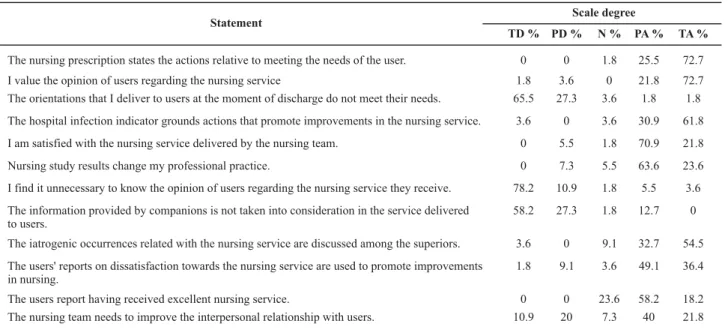
As for the outcomes dimension, in Table 3, 98.2% (72.7% totally and 25.5% partially) of the study subjects stated that the nursing prescription indicates actions related to the us-ers’ needs, and that 94.5% (72.7% total agreement and 21.8% partial agreement) valued the opinions of users /
companions in the service process. The nurses that consid-ered it necessary to know the opinion of users regarding the nursing service, 89.1% (78.2 totally and 10.9 partially) disagree with the negative statement.
Table 3 - Nurses’ perception regarding service quality in the outcomes dimension of the Donabedian model, HU-USP - São Paulo - 2006
The nursing prescription states the actions relative to meeting the needs of the user. 0 0 1.8 25.5 72.7
I value the opinion of users regarding the nursing service 1.8 3.6 0 21.8 72.7
The orientations that I deliver to users at the moment of discharge do not meet their needs. 65.5 27.3 3.6 1.8 1.8
The hospital infection indicator grounds actions that promote improvements in the nursing service. 3.6 0 3.6 30.9 61.8
I am satisfied with the nursing service delivered by the nursing team. 0 5.5 1.8 70.9 21.8
Nursing study results change my professional practice. 0 7.3 5.5 63.6 23.6
I find it unnecessary to know the opinion of users regarding the nursing service they receive. 78.2 10.9 1.8 5.5 3.6
The information provided by companions is not taken into consideration in the service delivered to users.
58.2 27.3 1.8 12.7 0
The iatrogenic occurrences related with the nursing service are discussed among the superiors. 3.6 0 9.1 32.7 54.5
The users' reports on dissatisfaction towards the nursing service are used to promote improvements in nursing.
1.8 9.1 3.6 49.1 36.4
The users report having received excellent nursing service. 0 0 23.6 58.2 18.2
The nursing team needs to improve the interpersonal relationship with users. 10.9 20 7.3 40 21.8
Scale degree Statement
TD % PD % N % PA % TA %
Most subjects (92.8%, total and partial disagreements together) disagreed with the fact that the orientation given at the moment of discharge from hospital did not meet the needs and expectations of the users/companions.
In certain statements, despite the high percentage of agreement that was found, the partiality degree prevailed. Therefore, 70.9% of nurses reported being satisfied with the service provided by the team. Nevertheless, 63.6% con-sider that the study results could help change nursing prac-tice. Another 58% report the fact that users rated the ser-vice as excellent, and 40% refer there is a need for the team to improve the relationship they establish with users.
Furthermore, in the outcomes dimension, 87.2% stated that iatrogenic occurrences related to the nursing service are discussed among their superiors (54.5% totally).
Table 4 shows the comparability of the favorability score of the three dimensions. The average favorability score of nurses, regarding the process dimension was 44.27 (sd±4.70), superior to those of structure and outcomes. The comparison between the three dimensions and that of structure presented less favorability, with a statistically sig-nificant difference, p<0.001.
Table 4 - Structure, process and outcomes dimensions according to the favorability scores attributed by nurses, HU-USP - São Paulo - 2006
Dimension N Mean sd Median Minimum Maximum p*
Process 55 44.27 4.70 45.00 29.00 52.00
Structure(a)
55 38.56 4.68 39.00 29.00 49.00 <0.001
Outcomes(a)(b)
55 42.33 3.22 42.00 33.00 50.00
(*) descriptive level of probability of the Friedman non-parametric test; (a) significant difference: (p< 0.05) of the process score; (b) significant difference: (p< 0.05)
of the structure score
DISCUSSION
In terms of the do questionnaire of the present study, it was found that the internal consistency in the three
dimen-sions was satisfactory, as the Alpha value was above 0.60(7).
There was a considerable proportion of female nurses, which is expected, since nursing is a profession that is
In Brazil, studies about health care workers revealed that women occupy 73% o the work slots and that public institu-tions generate 47.8% of the nurse posiinstitu-tions. As for their age, the average was 37 years, and the professionals stay in the same institution for an average of six years. In the Southeast region, female participation is 88.5%, with an average age of
36 years, and an average 5 years time at the institution(8).
The nurses from the HU-USP, therefore, surpassed the average age and time of permanence at the institution com-pared to the results of the abovementioned study.
In this study, it was verified there is a considerable pro-portion of master and doctorate graduates, especially in obstetrical nursing, which is a specialty required for job positions at RC and OC. Some nurses have completed ser-vice management courses, pediatrics and neonatology, which meets the needs of the clientele of the institution. There is also a reasonable number of professionals with a master degree, with is positive considering that the quality of the service depends on highly qualified professionals,
who commit to their work(9).
As for the evaluation of the structure dimension, it was found that the best agreement rates comprised the items: location, adequate functioning of the emergency vehicle and material supplies.
The location and functioning of the emergency vehicle have a close relationship with service quality, as the equip-ment is used in situations in which lives are at risk. There-fore, they are determining factors in how the image of the health facility is developed and projected. Hospitals that are applying for an evaluation by the National Organization on Accreditation to achieve a level 1 (accreditation), must pri-oritize institution structure and safety, level 2 (full accredita-tion), describe and register the process, and at level 3 (ac-creditation with excellence), focus on the processes linked
to the strategy and continuing improvement of quality(10).
Material supplies are meant to meet the material and equipment needs of those who develop and provide prod-ucts; i.e., health care professionals. In this sense, the selec-tion of products is determined by the health care profes-sionals, who should work with criticism and responsibility, observing the care in the operation, which is always the central objective of quality actions(11).
In the study, the update degree of the routine manual was the item that obtained the highest rate of partial a-greement among the nurses. Therefore, it should be the focus of a project for improvement. The same should apply to the adequacy of professional clothing.
It should be considered that, in everyday practice, rou-tine manuals are administrative instruments that have the purpose of facilitating the work dynamics and nursing prac-tice. Hence they are tools for the compilation, aggregation, and consolidation of norms and rules, administrative or op-erational techniques, permitting to unify terms. They also
act as organizational catalysts, permitting workers to use the same concepts in any area of the organization. Therefore, it is essential for the manuals to be always be updated and to reflect, objectively, the guidelines and norms,
accompany-ing the growth and development of the institution(12).
The number of clothes is influenced by a series of vari-ables, whose management often does not concern Nurs-ing, especially in cases of outsourced service – which is the case of the referred institution.
There was no consensus among the respondents regard-ing the fact that the hospital had adequate nursregard-ing staff to provide quality service. The distribution of human resources in organizations has been a target of attention and reason for conflicts between nurses and health service adminis-trators, as it interferes directly on the quality and opera-tional cost. Hence, it becomes imperative that nurses with the appropriate ethical, technical and political preparation clarify the real situation of the service, use specific meth-odology to measure personnel with the power of argumen-tation and persuasion, when the proposition is to apply for adequate staff, capable of guaranteeing efficient and safe service(13).
As for professional training, the study subjects reported that they have invested in their technical-scientific knowl-edge. Nevertheless, they experience difficulties to partici-pate in educational activities. The survival of organizations depends, unquestionably, on the investment on training and developing their professionals, with the purpose of improving their theoretical-practical knowledge, favor self-development and encourage their participating in educa-tional processes, to meet the needs and expectations of users, who are becoming more and more demanding, seek-ing quality services(14).
Furthermore, it is recommended that the educational process reaches nurses of the Continuing Education Ser-vice and those working in the field of practice, because the observation of reality together with practice helps create updated program content, compatible with the needs of
the service and management(15).
It was observed that the nurses of the DEMI were con-cerned about providing qualified service, as they registered, on the patient records, the iatrogenic occurrences related to the service and, in this respect, they develop nursing action to avoid any recurrence. This attitude reveals an ethi-cal commitment with the quality of care, free of risks and failures, and this fact is possible based on monitoring and
the use of actions so the event will not be repeated(16).
nurs-ing prescription, this is one of the phases of the SAE, in which the nurse decides about the conducts that will be implemented, monitoring and documenting the actions for
a further evaluation of the outcomes(17).
Another interesting finding of the study was high per-centage of nurses who value the opinion of users/compan-ions during the service. The polysemic character of quality demands recognizing the symbolic processes and discur-sive practices of the people involved, particularly users, imposing the valorization of their perceptions, understand-ing them not as decontextualized subjectivities, but as signs of experiences materialized in the relationships established
through health practices(18).
It was observed that items that addressed the registers of nursing service activities are performed more compre-hensively, when compared to managerial activities. That
reality was confirmed by authors(19), who analyzed the
records of users of a university hospital and found high rates of incomplete or fragmented nursing notes, which made it impossible to identify minimal conduct aspects.
Considering that, by means of nursing records it is pos-sible to, indirectly, measure service quality as they are tech-nical and legal documents in the juridical and ethical scopes, it is imperative to build awareness, sensitization and make efforts for the nursing team to make appropriate registers of service as well as managerial activities.
It was observed that certain aspects regarding the com-munication among professionals need to be improved, as there was agreement that this type of problem has reduced the quality of the service. This problematic may be related with the culture of the organization, the works methods or to personnel preparation.
Communication is understood as a process to perform-ing strategies, improvperform-ing and integratperform-ing elements in the structures of the organization. Many inter and intrapersonal barriers explain the inefficacy of the communication; the main ones are selective perception, information overload,
emotion, language, and cultural aspects(20).
Most nurses totally agreed that the iatrogenic occur-rence in nursing service is discussed among superiors. In the Donabedian model, this situation is understood as a complex problem that depends on the infrastructure and process, in which the activities associated with the service are developed. In this aspect, a contextual analysis of the problem is essential to, in addition to identifying the cul-prits, for their punishment, it is necessary to diagnose the existing weaknesses and adopt proactive measures to pre-vent risks(16).
By measuring the level of satisfaction that the nurses attributed to the quality of the service delivered by the nursing team it was found that most agreed partially, de-noting certain dissatisfaction. It is acknowledged that the concept of satisfaction is multidimensional, as it
encom-passes numerous factors such as: the way of living, experi-ences learned, expectations and values, for the individual and for the society(4).
In the comparative analysis of the structure-process-out-come aspects, the dimension with the best evaluation was the process, corresponding to the activities developed in the relationships established by health professionals among themselves and with users, including ethical aspects and all
actions involving the therapy and the diagnosis of users(3).
CONCLUSION
Considering the importance of knowing and analyzing the nurses’ perception in terms of the quality of the service delivered at the DEMI, this study permitted to establish and identify the vulnerable points that should be reconstructed in the three evaluated dimensions and detect those that strengthen the quality attribute at the referred Division.
The structure dimension obtained the worst evalua-tions, involving the services of logistics support and orga-nizational infrastructure. Also regarding this dimension, the responses evidenced that there is a tendency towards a-greement or partial disaa-greement in terms of the items: difficulty to participate in professional training courses, manual updating, and quantity of clothing. There was no consensus regarding the number of nursing professionals, which points at the need for further studies.
The process dimension received the best evaluation from nurses, especially regarding the items related to the implementation of the SAE, services registers and perform-ing actions so that iatrogenic occurrences are not repeated.
The communication between the nursing team and other health care professionals appears as a factor capable of compromising service quality. Although communication is seen as a complex element in the organizations and in human relationships, it is indispensible that nursing pro-fessionals acknowledge the problem and be willing to face it, searching for effective strategies, with a view to mini-mizing the negative consequences – losing service quality.
In the outcomes dimension, although the iatrogenic oc-currences are registered on the users’ records, the nurses stated that, in most cases, those events are discussed ex-clusively among their superiors. This fact deserves atten-tion from managers, who should find administraatten-tion mod-els that are more flexible and that decentralize decisions and promote the effective participation of workers to take on responsibilities, promoting effective team work.
In conclusion, quality administration demands several strategies and tools. Most of all, however, it is necessary to count on the participation and commitment of those
in-volved. After all, workers are the ones directly involved in the flux and dynamic of work, representing the potential of the group.
REFERENCES
1. Klück M, Prompt CA. O Programa Brasileiro de Acreditação Hos-pitalar na gestão da qualidade assistencial. In: Hospitais: admi-nistração da qualidade e acreditação de organizações comple-xas. Porto Alegre: Da Casa; 2004. p. 69-98.
2. Adami NP, Yoshitome AY. Métodos de avaliação da assistência de enfermagem. Rev Bras Enferm. 2003;56(1):52-6.
3. Donabedian A. The role of outcomes in quality assessment and assurance. QRB Qual Rev Bull. 1992;18(11):356-60.
4. Robbins S P. Comportamento organizacional. 9ª ed. São Paulo: Pearson Prentice Hall; 2002. p.77-129.
5. Vaitsman J, Farias LO, Mattos AM, Campos Filho ACC. Metodo-logia do Índice de Percepções Organizacionais. Cad Saúde Públi-ca. 2003;19(6):1631-43.
6. Polit DF, Beck CT, Hungler BP. Fundamentos de pesquisa em en-fermagem: métodos, avaliação e utilização. 5ª ed. Porto Alegre: Artemed; 2004.
7. Hair JFJ, Anderson RE, TathamRL, Black WC. Análisis multivariante. Madrid: Prentice Hall; 1999.
8. Girardi SN, Carvalho CL. Mercado de trabalho e regulação das profissões de saúde. In: Negri B, Faria R, Viana ALD, organizado-res. Recursos humanos em saúde política, desenvolvimento e mercado de trabalho. Campinas: UNICAMP; 2002. p. 221-51.
9. Tronchin DMRT, Melleiro MM, Takahashi RT. A qualidade e a ava-liação dos serviços de saúde e de enfermagem. In: Kurcgant P, coordenadora. Gerenciamento em enfermagem. Rio de Janeiro: Guanabara Koogan; 2005. p. 75-88.
10. Vargas MA, Albuquerque GL, Erdman AL, Ramos RFS. Onde (e como) encontrarmos a qualidade no serviço de enfermagem hospitalar? Rev Bras Enferm. 2007;60(3):339-43.
11. Infante M, Santos MAB. A organização do abastecimento do hos-pital público a partir da cadeia produtiva: uma abordagem logística para a área de saúde. Ciência Saúde Coletiva 2007;12(4):945-54.
12. Borges EL, Oliveira PJ, Sáar SRC. Uso de manuais em instru-mentos de administração na prática de enfermagem. Rev Min Enferm. 2004;8(11):208-14.
13. Gaidzinski RR, Fugulin FMT, Castilho V. Dimensionamento de pessoal de enfermagem em instituições de saúde. In: Kurcgant P, coordenadora. Gerenciamento em enfermagem. São Paulo: Guanabara Koogan 2005. p.125-37.
14. Paschoal AS, Mantovani MF, Meier MJ.Percepção da educação permanente, continuada e em serviço para enfermeiros de um hospital de ensino.Rev Esc Enferm USP. 2007; 41(3):478-84.
15. Siqueira ILCP, Kurcgant P. Estratégia de capacitação de enfer-meiros recém-admitidos em unidades de internação geral. Rev Esc Enferm USP. 2005;39(3):251-7.
16. Padilha KG. Ocorrências iatrogênicas na UTI e o enfoque de qualidade. Rev Lat Am Enferm. 2001;9(5):91- 6.
17. Melleiro MM, Fugulin FMT, Rogenski NMB, Gonçalves VLM, Tronchin DMR. A evolução do sistema de assistência de enfer-magem no Hospital Universitário da Universidade de São Pau-lo: uma história de 20 anos. In: Sistema de Assistência de En-fermagem: evolução e tendências. São Paulo: Ícone; 2001. p. 109-83.
18. Bosi MSM, Uchimura KY. Avaliação da qualidade ou avaliação qualitativa do cuidado em saúde. Rev Saúde Pública. 2007; 41(1):150-3.
19. Labadia LL, Adami NP. Avaliação das anotações de enferma-gem em prontuários de um hospital universitário. Acta Paul Enferm. 2004;17(1):55-61.
20. Robbins SP, Decenzo DA. Fundamentos de administração: con-ceitos essenciais e aplicações. São Paulo: Prentice Hall; 2004. Comunicação e habilidades interpessoais. p. 252-79.