ABSTRACT
BACKGROUND AND OBJECTIVES: Head, face and neck pain afects a large portion of the world population, however there are few studies reporting this condition in general Brazilian population. his study aimed at investigating the prevalence of head, face and neck pain and its impact on the quality of life of adults of Piracicaba city, São Paulo.
METHODS: he sample was made up of 400 volunteers of both genders, aged between 20 and 50 years, who were randomly approached in six crossing points of the city. Socio-demographic, pain prevalence, location, frequency, duration and severity, and self-perception of quality of life data were collected by means of anonymous self-applied questionnaires: Orofacial Pain Ques-tionnaire and WHOQOL-BREF.
RESULTS:Pain prevalence was 54.75%, of predominantly se-vere intensity (21.30%), daily recurrence (41.10%) and present for more than six months (91.32%). Most afected region was the head (36%) being the intraoral region the less frequently re-ported (6%). here has been no signiicant association between pain and factors such as age, economic level and education (p>0.05); however there has been signiicant prevalence among females. No pain was frequently associated to better quality of life (p<0.05). Volunteers reporting pain were more unhappy with quality of sleep (p<0.05), however there has been no sig-niicant association with the frequency of negative feelings.
Prevalence of pain at the head, face and neck and its association with
quality of life in general population of Piracicaba city, Sao Paulo: an
epidemiological study*
Prevalência de dor no segmento cefálico e sua associação com qualidade de vida na
população geral do município de Piracicaba, São Paulo: um estudo epidemiológico
Marília Araújo Ruivo1, Marcelo Corrêa Alves2, Maria da Graça Rodrigues Bérzin3, Fausto Bérzin1
*Received from School of Dentistry of Piracicaba, State University of Campinas, Piracicaba, SP, Brazil.
1. State University of Campinas, School of Dentistry of Piracicaba, Piracicaba, SP, Brazil.
2. University of São Paulo, Piracicaba, SP, Brazil. 3. Clinical Center of Piracicaba, Piracicaba, SP, Brazil.
Submitted in September 29, 2014.
Accepted for publication in February 19, 2015. Conlict of interests: none – Sponsoring sources: CAPES.
Correspondence to: Marília Araújo Ruivo Av. Limeira, 901
13414-903Piracicaba, SP, Brasil. E-mail: [email protected]
© Sociedade Brasileira para o Estudo da Dor
CONCLUSION: he study has identiied high prevalence of head, face and neck pain, signiicant morbidity of people af-fected by this condition and its negative impact on quality of life. Keywords: Chronic pain, Epidemiology, Prevalence, Quality of life.
RESUMO
JUSTIFICATIVA E OBJETIVOS: As dores que acometem o segmento cefálico afetam grande parte da população mundial, porém são poucos os trabalhos que retratam essa condição na população geral do Brasil. O objetivo deste estudo foi investigar a prevalência de dor no segmento cefálico e seu impacto sobre a qualidade de vida de adultos do município de Piracicaba, São Paulo.
MÉTODOS: A amostra foi composta por 400 voluntários de ambos os gêneros, com idade entre 20 e 50 anos que foram alea-toriamente abordados em seis pontos de passagem do município. A coleta de dados sócio-demográicos, prevalência, localização, frequência, duração, gravidade da dor e autopercepção da quali-dade de vida foi realizada por meio de questionários anônimos autoaplicados, o Questionário de Dor Orofacial e o WHOQOL-BREF.
RESULTADOS: A prevalência de dor foi de 54,75%, de inten-sidade predominantemente intensa (21,30%), recorrência diária (41,10%) e presente há mais de seis meses (91,32%). A região mais acometida foi a cabeça (36%) sendo a região intraoral me-nos frequentemente apontada (6%). Não se observou associação signiicativa entre a presença de dor e fatores como idade, nível econômico e escolaridade (p>0,05), porém houve signiicativa prevalência de dor entre as mulheres. A ausência de dor foi fre-quentemente associada à melhor qualidade de vida (p<0,05). Voluntários que relataram dor apresentaram maior insatisfação com a qualidade do sono (p<0,05), porém não foi observada as-sociação signiicativa com a frequência de sentimentos negativos. CONCLUSÃO: O estudo identiicou alta prevalência de dor no segmento cefálico, signiicante morbidade das pessoas acometi-das por essa condição e seu impacto negativo sobre a qualidade de vida.
Descritores: Dor crônica, Epidemiologia, Prevalência, Quali-dade de vida.
INTRODUCTION
Epidemiology may be deined as the “study of distribution and determinants of health-related states or events in specific populations and the application of this study to control health problems”1. Epi-demiological studies in the area of pain are important because they provide information about its prevalence in diferent popu-lation segments and about factors associated to its etiology and persistence, being very useful for health professionals and for the development of pain-ighting programs2.
Currently being considered a severe public health problem, pain, the prevalence of which is growing, is the primary reason for the search for health assistance by the general population3.
Among most frequent pain complaints there are those in head, face and neck4, the so-called orofacial pains (OFP), which may afect head, face and neck soft and hard tissues5. Population studies have shown that the prevalence of oral complex and cra-niofacial pain is high, afecting approximately one fourth of the population at least once in life6.
OFP may be classiied in diferent ways. One of them diferenti-ates acute from chronic pain. Acute pain is commonly associated to toothache and periodontal pain. Persistent or chronic pain is more frequent in temporomandibular disorders and idiopathic facial pain7.
Epidemiological surveys in the United States, Canada and Unit-ed Kingdom have observUnit-ed that the frequency of OFP in general adult population may vary from 14 to 40%8-11. Epidemiological studies with the Brazilian population refer a variation of 32.2 to 73.1% in OFP frequency, especially chronic OFP, depending on evaluated conditions and methodologies used12-15.
When pain persists and become chronic it may negatively im-pact quality of life (QL). Pain becomes the primary focus of pa-tients’ attention, may produce physiological disorders, change emotional balance and cause social and professional losses such as sleep disorders, physical and emotional fatigue, loss of social contact, diiculty to eat, daily life activities limitation and ab-senteeism at work16. In the dental area, individuals afected by OFP sufer major changes in their daily activities, among them, dissatisfaction with oral condition, drug ingestion and dietary changes, which may afect QL more than other systemic condi-tions such as diabetes, hypertension or ulcer17.
he high prevalence of head, face and neck pain and its negative repercussions on QL of individuals have been the focus of pub-lic health investigations, due to the morbidity that may be caused by such conditions. However, notwithstanding the relevance of such symptoms, Brazilian epidemiological studies involving the general population are still scarce and most of them use conve-nience samples such as populations linked to treatment clinics or assistance units, which makes diicult the establishment of social and health policies prioritizing and making feasible adequate pre-vention and treatment, minimizing health costs and especially the distress of those sufering pain, especially chronic pain.
So, this study aimed at estimating the prevalence and character-istics of head, face and neck pain in the general adult popula-tion of the city, and at correlating them to health and QL self-perception.
METHODS
his is a cross-sectional and observational study with the adult population of the city of Piracicaba, São Paulo. Participated in the study 400 volunteers of both genders (200 males and 200 females), aged between 20 and 50 years (mean of 34.70 years and standard deviation of 8.75 years), coming from 68 districts of the city and who were randomly addressed in six crossing points of the city with major population movement. Sample size was calculated as from the oicial city popula-tion, or 385,287 inhabitants (Source: Brazilian Institute of Geography and Statistics, 2013)18, with conidence level of 95% and conidence interval of 5%, calculated by the Sample Size Calculator19.
Data on OFP prevalence and characteristics and QL self-perception were collected by means of two structured, stan-dardized and pre-tested anonymous and self-applied ques-tionnaires: Orofacial Pain Questionnaire and Quality of Life Evaluation questionnaire WHOQOL-BREF.
his study is integral part of the research project “Epidemio-logical study of orofacial pain and correlation with health and QL in the general population of the Brazilian South-Eastern region”, and was carried out in compliance with ethical prin-ciples of the declaration of Helsinki and Resolution 196/96 of the National Health Council.
Orofacial pain questionnaire
Developed by the authors, with no intention of being a diag-nostic tool, the questionnaire is made up of questions aiming at sample demographic characterization (gender, age, education level, economic condition, district of residence), six questions to evaluate the presence of OFP and, when present, pain char-acteristics (pain site, frequency, duration, intensity and location according to head and neck topographic anatomic regions), one question related to recent head, neck or jaw traumas, drug consumption, treatments and the presence of systemic disease. An Economic Classiication Index (ECI) was developed based on the sum of points attributed according to answers to some questions. hose who did not receive government beneits re-ceived 10 points, those with their own home 20 points, if the home was already paid 20 additional points and if it was inanced only 10 points. If their home had a swimming-pool, 40 points and if the person had access at home to broadband Internet, 10 points. According to calculations, a volunteer may receive a score varying from zero (with government bene-it, without access to broadband Internet, without own home and without swimming-pool in the house they lived) up to 100 (no government beneit, with own home paid and with swimming-pool, and with access to broadband Internet). All volunteers were classiied according to described criteria and afterward the classiication was made in quartiles.
Quality of life evaluation questionnaire (WHOQOL-BREF)
do-mains: physical, psychological, social relations and environ-ment. A score varying from zero to 100 was used for analysis of results, being considered three QL levels: good – 75 to 100 points; indiferent – 50 to 75 points and poor – 25 to 50 points20.
Data collection
Questionnaires were applied in six diferent crossing points selected for allowing the approaching of people of diferent socio-economic levels, age and gender and from all regions of the city: Central Terminal of Urban Buses System Integra-tion, School of Dentistry of Piracicaba, squares, traditional commercial areas, Shopping Malls and Intermunicipal Bus Station. Volunteers approached at the School of Dentistry of Piracicaba did not include patients being treated in the institution’s graduation or post-graduation clinic, but rather employees of the institution and escorts of dentistry clinic patients.
Individuals were randomly approached and invited to partici-pate in the research. In case of acceptance, study objectives and methods were clearly presented in writing. After reading and signing the Free and Informed Consent Term (FICT), Orofacial Pain Questionnaire was applied, followed by the Quality of Life Evaluation Questionnaire. If there was no pain, volunteers were oriented to answer questions for socio-demographic evaluation and were then asked to answer the WHOQOL-BREF questionnaire.
Data collection was standardized and carried out only in the morning, approaching individuals before going to work, such as in the Central Integration Terminal and squares. Employ-ees of the School of Dentistry of Piracicaba, Shops and Inter-municipal Bus Station were approached before beginning of the work day to prevent tiredness built-up during the work day and which could inluence answers.
Statistical analysis
Data were analyzed by the statistical program SAS21. Uni-variate contingency tables and correlated Chi-square tests
for proportions equality test were built. Two-dimension contingency tables were built to study the existence of as-sociation among variables. Cochram, Mantel and Haenszel test was applied to correlate answers scores in different lev-els of variables adopted as factors. Additionally, Odds ratio was calculated. To test the existence of association among variables used to build two-dimension tables, Mantel and Haenszel Chi-square test was used for ordinal factors and Wald test was used for nominal factors. Significance level for all tests was 5% (α=0.05).
his study was approved by the Research Ethics Committee under protocol 094/2010 – UNIFAL-MG.
RESULTS
From a total of 400 participants, 200 (50%) were females and 200 (50%) were males, with mean age of 34.7 years. As to education level, only two volunteers (0.50%) have stated having no education. Approximately half the volunteers had completed high school (49.75%), while 106 (26.63%) had stated having incomplete high school and 92 (23.12%) had inished college. Mean ECI was 41.23 with prevalence of quartile 3 made up of 190 volunteers (47.50%), followed by quartile 2 with 97 people (24.25%), quartile 1 with 83 vol-unteers (20.75%) and quartile 4 corresponding to 7.50% of the sample, or 30 volunteers (Table 1).
Observed head, face and neck pain of 54.75% had no statisti-cally signiicant diference (p=0.0574), with predominantly severe intensity (21.30%), daily frequency (41.10%) and last-ing for more than six months (91.32%), belast-ing head the re-gion most commonly indicated (36%), followed by shoulders (22.25%), face (20.00%), neck (19.25%), teeth (9.50%) and intraoral region (6%) (Table 2).
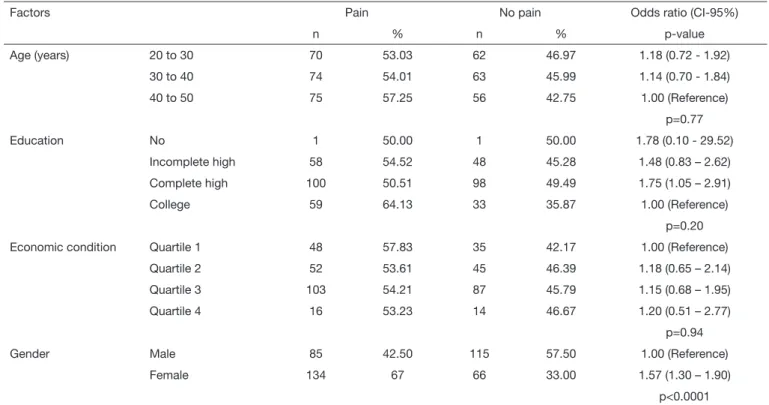
Aiming at checking pain prevalence indices variation accord-ing to gender, age, education level and economic condition variables, Cochram, Mantel and Haenszel test was applied to the irst variable and Wald Chi-square test was applied to remaining variables (Table 3). here has been no
statisti-Table 1. Frequency and percentage of socio-demographic data and Chi-square test p-value for equality of proportions
Factors Categories Frequency (n) Percentage (%) p-value
Gender Male 200 50.00 1.0000
Female 200 50.00
Age (years) 20 – 30 132 33.00 0.9200
30 – 40 137 34.25
40 – 50 131 32.75
Education No education 2 0.50 0.0001
Incomplete high 106 26.63
Complete high 198 49.75
College 92 23.12
Economic condition Quartile 1 83 20.75 0.0001
Quartile 2 97 24.25
Quartile 3 190 47.50
Table 2. Frequency and percentage of orofacial pain classiications reported by volunteers and p-value of Chi-square test for equality of pro-portions
Pain characteristics Category Frequency (n) Percentage (%) p-value
Presence Yes 219 54.75 0.0574
No 181 45.25
Frequency Daily 90 41.10 a 0.0001
Weekly 51 23.29 b
Seldom 34 15.53 bc
Monthly 30 13.70 c
Fortnightly 14 6.39 d
Chronicity Chronic 200 91.32 a 0.0001
Acure 6 2.74 b
Sub-acute 13 5.94 b
Intensity Absent 181 45.36 a 0.0001
Severe 85 21.30 b
Moderate 64 16.04 b
Unbearable 41 10.28 c
Mild 28 7.02 c
Location Head 144 36.00 a 0.0001
Shoulders 90 22.25 b
Face 89 20.00 b
Neck 77 19.25 b
Teeth 38 9.50 c
Inside mouth 24 6.00 c
Percentages with equal letters are not different among them in a same characteristic by Chi-square test (α=0.05).
Table 3. Distribution of orofacial pain self-perception according to gender, age, education level and economic condition
Factors Pain No pain Odds ratio (CI-95%)
n % n % p-value
Age (years) 20 to 30 70 53.03 62 46.97 1.18 (0.72 - 1.92)
30 to 40 74 54.01 63 45.99 1.14 (0.70 - 1.84)
40 to 50 75 57.25 56 42.75 1.00 (Reference)
p=0.77
Education No 1 50.00 1 50.00 1.78 (0.10 - 29.52)
Incomplete high 58 54.52 48 45.28 1.48 (0.83 – 2.62)
Complete high 100 50.51 98 49.49 1.75 (1.05 – 2.91)
College 59 64.13 33 35.87 1.00 (Reference)
p=0.20
Economic condition Quartile 1 48 57.83 35 42.17 1.00 (Reference)
Quartile 2 52 53.61 45 46.39 1.18 (0.65 – 2.14)
Quartile 3 103 54.21 87 45.79 1.15 (0.68 – 1.95)
Quartile 4 16 53.23 14 46.67 1.20 (0.51 – 2.77)
p=0.94
Gender Male 85 42.50 115 57.50 1.00 (Reference)
Female 134 67 66 33.00 1.57 (1.30 – 1.90)
p<0.0001
cally signiicant diference between pain prevalence and age (p=0.77), education level (p=0.30) and economic condition (p=0.94); however, the study has observed higher frequency of pain reports by females (p<0.0001). Odds ratio analysis suggests a risk 1.57 times higher of females having head, face and neck pain as compared to males, however there has been no evidence that individuals of a certain age group, education level or speciic economic condition would be at higher risk to develop OFP.
Mantel and Haenszel Chi-square test provides sound evidenc-es (p<0.01) of a linear association between pain and QL and sleep quality self-perception, so that it is less probable to be happy with sleep or to report a good QL when there is pain (Tables 4 and 5). Pain intensity was also linearly associated to QL self-perception (p=0.0002) (Table 4). However, there has been no signiicant association between frequency of negative feelings, such as depression, anxiety, bad mood, despair and OFP reports (p=0.11) (Table 6).
DISCUSSION
Our study describes a general scenario about biopsycho-social characteristics of the general adult population of the city of Piracicaba with regard to head, face and neck pain.
Although not having a statistically significant frequency, one may state that OFP is a highly prevalent condition in the studied sample (54.75%). This result has clinical biological importance because more than half the adult population of the city has pain, with predominantly severe (21.30%) and moderate (16.04%) intensity, often daily (41.10%) and lasting for more than six months (91.32%), in addition to being higher than values presented by other studies with different populations11,22,23.
Females have reported more pain (67%), which is in line with the literature11,14,24,25, however without emphasis on age group, education level or economic condition.
Sev-Table 4. Quality of life self-perception according to WHOQOL-BREF in groups with and without orofacial pain and quality of life level with regard to pain intensity
Groups Good Indifferent Poor p-value
n % n % n %
With pain 48 21.92 147 67.12 24 10.96 0.0001
Without pain 78 43.09 97 53.59 06 3.31
Mild pain 8 28.57 18 64.29 2 7.14 0.0002
Moderate pain 17 26.56 43 67.19 4 6.25
Severe pain 14 16.47 63 74.12 8 9.41
Unbearable pain 9 21.95 22 53.66 10 24.39
p-value calculated as from Mantel and Haenszel Chi-square test.
Table 5. Prevalence of sleep quality indicators in volunteers with and without orofacial pain according to WHOQOL-BREF
With pain Without pain p-value
Sleep quality indicators (16)
Very unhappy 25 (92.95%) 2 (7.41%) <0.0001
Unhappy 34 (72.34%) 13 (27.66%)
Neither happy nor unhappy 55 (58.51%) 39 (41.49%)
Happy 81 (49.39%) 83 (50.61%)
Very happy 24 (35.29%) 44 (64.71%)
Table 6. Prevalence of negative feelings in volunteers with and without orofacial pain, according to WHOQOL-BREF
With pain Without pain p-value
Frequency of negative feelings (26)
Never 25 (11.42%) 38 (21.11%) 0.11
Sometimes 124 (56.62%) 97 (53.89%)
Often 38 (17.35%) 29 (16.11%)
Very often 17 (7.76%) 9 (5.00%)
Always 15 (6.85%) 7 (3.89%)
eral studies have observed variability on pain prevalence in different age groups, however it is worth stressing that samples were made up of young and elderly people9,11,14,23, while our sample was made up only of adults. However, other authors have also not identified this association6,26. With regard to social aspects, it is possible to observe in the literature discrepant results of OFP prevalence related to education and economic levels. In this aspect, it is worth highlighting difficulties to define and measure different socioeconomic levels in general, which suggests that such factors have secondary importance for the development of this painful condition27.
With regard to head, face and neck pain severity, observed prevalence of severe and moderate pain is similar to what was found by other authors6,28. The fact that more than one fifth of the sample has referred severe pain suggests that a considerable portion of adults living in the city have important morbidity associated to OFP. Other aspect rein-forcing such condition is related to pain frequency. Almost half the individuals reporting OFP suffer this condition every day. Results are in line with an OFP study, carried out in Spain29 with patients of a health center in Cordoba, whose most recurrent answers were: “quite often and “very often”. Such comparison highlights the clinical im-portance of results observed among residents of the city of Piracicaba, who referred pain frequency similar to patients under pain treatment of the above-mentioned study. Most prevalent pain was headache (36.00%), followed by shoulders (22.5%), face (20.00%), neck (19.25%), teeth (9.50%) and intraoral region (6.00%). Few are the stud-ies investigating head, face and neck pain frequency pres-ent in OFP15,32. Some of them point to higher prevalence of toothache as compared to joint or facial pain, or burn-ing mouth6,13,14,26. However, our study has observed high-er prevalence of chronic headache, result also obshigh-erved by other authors15,30. It is possible that the low prevalence of toothache may be associated to preventive measures for the development of tooth decay (major responsible for pulp toothache) carried out in the city, with broad fluoridation of water that reaches homes, in addition to easy access to public dental assistance services specialized in toothache.
The same is not true for the access of the population to specialized head, face and joint pain. The city has 241 health assistance units, however the general academic qual-ification of dentists and physicians has indicators of theo-retical-technical deficiencies in the area of pain31, making difficult the effective diagnostic and therapeutic practice in the assistance of OFP individuals.
Our results also confirm the association of OFP, espe-cially chronic, and the negative impact on QL functional, social and psychological aspects6,12-15,22,23,29,33. Pain has a major impact on QL of people, due to suffering and daily life limitations, which generates severe effects for indi-viduals themselves and also for society, such as high costs of specialized treatment and hours lost in the productive
process11, as well as sleep quality impairment34. Pain in-tensity was also associated to higher frequency of negative reports on QL level. Individuals referring no pain or mild pain had higher WHOQOL means as compared to those reporting severe or unbearable pain. According to other authors29,35, pain intensity is a major QL determinant among all other OFP characteristics, such as number of symptoms, frequency and duration, deserving attention from the professional when treating patients with such painful condition.
We have not identified statistically significant meaning in the association between frequency of negative feelings, such as bad mood, despair, anxiety and depression, and the presence or not of pain, as also observed by a different study26, which highlights the subjectivity of the meaning individuals give to pain with regard to other QL aspects evaluated by the WHOQOL-BREF questionnaire and to the fact that, although there is sound evidence that chronic pain may be related to physical disability, emotional disor-ders and social difficulties, these are not universal phenom-ena and although some people become physically disabled, others adapt well to chronic pain by means of effective pain coping strategies36. In addition, it is not possible to establish, by means of a cross-sectional study, whether the same feelings are result of OFP. However, results point to the importance of recognizing the presence of such feelings in people referring pain and who might need specialized treatment.
Some limitations should be taken into consideration when interpreting the results of this study, which were based on self-reports about pain symptoms, without clinical evalu-ation of volunteers. However, we believe in the fidelity of volunteers’ reports, which does not necessarily affects results. WHOQOL-BREF questionnaire, used to evaluate QL, is an already established research tool in the clini-cal practice for supplying important indicators obtained as from the analysis of different domains. So, results indi-cate association between OFP and poor QL perception, al-though one cannot establish a direct causality relationship between both factors.
CONCLUSION
The study has observed high prevalence of head, face and neck pain in general adult population of the city of Pi-racicaba, predominantly severe to moderate pain, daily fre-quency and lasting for more than six months. Results point to the need for health policies developed based on expla-nation, education, prevention and control of pain, which significantly affects QL of the population.
ACKNOWLEDGMENTS
REFERENCES
1. Last R. A Dictionary of Epideimiology, 4th ed. Oxford: International Epidemiological Association; 2001.
2. Hecke O, Torrance N, Smith BH. Chronic pain epidemiology and its clinical relevan-ce. Br J Anaesth. 2013;111(1):13-8.
3. Schappert SM, Burt CW. Ambulatory care visits to physician oices, hospital ou-tpatient departments, and emergency departments: United States, 2001-2. National Center for Health Statistics. Vital Health Stat. 2006;13(159):1-66.
4. Sessle BJ. Acute and chronic craniofacial pain: brainstem mechanisms of nocicepyive transmission and neuroplasticity, and their clinical correlates. Crit Rev Oral Biol Med. 2000;11(1): 57-91.
5. De Rossi SS. Orofacial pain: a primer. Dent Clin N Am. 2013;(57):383-92. 6. McMillan AS, Wong MC, Zheng J, Lam CL. Prevalence of orofacial pain and
treat-ment seeking in Hong Kong Chinese. J Orofac Pain. 2006;20(3):218-25.
7. LeResche L. Epidemiology of orofacial pain. In: Lund JP, Lavigne GJ, Dubner R, Sessle BJ, editors. Orofacial pain: from basic science to clinical magement. Chicago: Quintessence Publishing Company; 2001.
8. Locker D, Grushka M. Prevalence of oral and facial pain and discomfort: preliminary results of a mail survey. Community Dent Oral Epidemiol. 1987;15(3):169-72. 9. Lipton JA, Ship JA, Larach-Robinson D. Estimated prevalence and distribution of
reported orofacial pain in the United States. J Am Dent Assoc. 1993;124(10):115-21. 10. Riley JL 3rd, Gilbert GH. Orofacial pain symptoms: an interaction between age and
sex. Pain. 2001;90(3):245-56.
11. Macfarlane TV, Blinkhorn AS, Davies RM, Kincey J, Worthington HV. Oro-facial pain in the community: prevalence and associated impact. Community Dent Oral Epidemiol. 2002;30(1):56-60.
12. Michel-Crosato E, Biavenic MG, Nardi A, Crosato E. Relação entre dor orofacial e qualidade de vida: um estudo em trabalhadores. UFES Rev Odontol. 2006;8(2):45-52. 13. Lacerda JT, Ribeiro JD, Ribeiro DM, Traeber J. Prevalência de dor orofacial e seu
impacto no desempenho diário em trabalhadores das indústrias têxteis do município de Laguna, SC. Ciênc Saúde Coletiva. 2011;16(10):4275-82.
14. Silva SR, Leite MC, Ferraz MA, Silva MF, Sousa YT. Dor orofacial e qualidade de vida em adultos. Odontol Bras Central. 2012;21(56):401-5.
15. De Siqueira SR, Vilela TT, Florindo AA. Prevalence of headache and orofacial pain in adults and elders in a Brazilian community: an epidemiological study. Gerodontology. 2013;1-9. [Epub ahead of print]
16. Teixeira MJ. Dor e depressão. Rev Neurociência. 2006;14(2):44-53.
17. Biazevic MG, Araújo ME, Michel-Crosato E. Indicadores de qualidade de vida rela-cionados com a saúde bucal: revisão sistemática. Rev Odontol . 2002;14(1):13-25. 18. IBGE. Instituro Brasileiro de Geograia e Estatística.[acesso em 2 de janeiro de 2014].
Dis-ponível em: http://www.cidades.ibge.gov.br/xtras/peril.php?lang=&codmun=353870 19. Creative Research System. Sample Size Calculator (2012). Creative Research System,
Lone Oak:CA:EUA. [acessado em 10 de stembro de 2013]. Disponível em http://
www.surveysystem.com/sscalc.htm.
20. WHOQOL, World Health Organization. Measuring Quality of Life. he World he-alth Organization quality of life instruments. Geneva: World Hehe-alth Organization, 1997.
21. SAS Institute Inc. he SAS System, release 9.3. SAS Institute Inc., Cary:NC; 2012. 22. Nuttal NM, Steele JG, Pine CM, White D, Pitts NB. he impact of oral health on
people in the UK in 1998. Br Dent J. 2001;190(3):121-6.
23. Kohlmann T. Epidemiology of orofacial pain. Schmerz. 2002;16(5):339-45. 24. Riley JL 3rd, Gilbert GH, Heft MW. Orofacial pain symptom prevalence: selective sex
diferences in the elderly? Pain; 1998;76(1-2):97-104.
25. Macfarlane TV, Blinkhorn AS, Davies RM, Kincey J, Worthington HV. Association between female hormonal factors and oro-facial pain: study in the community. Pain. 2002;97(1-2):5-10.
26. Leung WS, McMillan AS, Wong MC. Chronic orofacial pain in southern Chinese people: experience, associated disability, and help-seeking response. J Orofac Pain 2008;22(4):323-30.
27. Tickle M, Craven R, Worthington HV. A comparison of the subjective oral health status of older adults from deprived and aluent communities. Community Dent Oral Epidemiol. 1997;25(3):217-22.
28. Wong MC, McMillan AS, Zheng J, Lam CL. he consequences of orofacial pain symnptoms: a population-based study in Hong Kong. Community Dent Oral Epide-miol. 2008;36(5):417-24.
29. Blanco-Aguilera A, Blanco-Hungría A, Biedma-Velázquez L, Serrano-Del-Rosa R, González-López L, Blanco-Aguilera E, et al. Application of an oral health-related qua-lity of life questionnaire in primary care patients with orofacial pain and temporoman-dibular disorders. Med Oral Patol Oral Cir Bucal. 2013;19(2):e127-35.
30. Beghi E, Monticelli ML, Amoruso L, Zarrelli MM. Prevalence, characteristics, and patterns of health care use for chronic headache in two areas of Italy. Results of a questionnaire interview in general practice. Cephalgia. 2003;23(3):175-82. 31. Bérzin MG, Siqueira JT. Study on the training of Brazilian dentists and physicians
who treat patients with chronic pain. Braz J Oral Scien. 2009;8(1):44-9.
32. Agerberg G, Bergenholtz A. Craniomandibular disorders in adult populations of West Bothnia, Sweden. Acta Odontol Scand. 1989;47(3):129-40.
33. Kuroiwa DN, Marinelli JG, Rampani MS, de Oliveira W, Nicodemo D. Desordens temporomandibulares e dor orofacial: estudo da qualidade de vida medida pelo Medi-cal Study 36 – Item Short Form Health Survey. Rev Dor. 2011;12(2):93-8. 34. Riley JL 3rd, Benson MB, Gremillion HA, Myers CD, Robinson ME, Smith CL,
et al. Sleep disturbance in orofacial pain patients: pain-related or emotional distress? Cranio. 2001;19(2):106-13.
35. Zheng J, Wong MC, Lam CL. Key factors associated with oral healyh-related qual-ity of life (OHRQOL) in Hong Kong Chinese adults with orofacial pain. J Dent. 2011;39(8):564-71.