348
ARTICLE
Medical conditions and body pain in patients
presenting orofacial pain
Condições médicas e dores corporais em pacientes com dor orofacial
Ana Lúcia Franco1, Gabriel Henrique Farto Runho2, José Tadeu Tesseroli de Siqueira3, Cinara Maria Camparis4
Some studies have reported an association between oro-facial pain, medical conditions, and body pain. Furthermore, the prevalence of comorbidities in orofacial pain patients, other than some speciic psychological disturbances and generalized musculoskeletal disorders, has been described in several studies1-4.
When patients present to the dental oice with orofacial pain complaints, it is essential to understand the cause of the main complaint and to perform a thorough examination that will lead to the correct diagnosis and appropriate treatment. Understanding the possible medical conditions associated
with orofacial pain is essential for a proper diagnosis5. Equally,
the presence of medical conditions may inluence and limit the
treatment options, as so treatment outcomes6.
hus, considering the importance of medical conditions and body pain, the present study was conducted to verify the fre-quency of self-reported medical conditions in orofacial pain pa-tients (Group A), as well as the one of reported body pain areas, comparing them with patients that sought routine dental treat-ment (Group B). he study hypothesis is that patients in Group A tend to report a higher number of medical conditions and more body pain than Group B does.
1 DDS; MSc, Postgraduate Student at the Department of Dental Materials and Prosthodontics in Araraquara Dental School of Universidade Estadual Paulista
(UNESP), Araraquara SP, Brazil;
2 DDS; Dentist, Department of Dental Materials and Prosthodontics, Araraquara Dental School of UNESP, Araraquara SP, Brazil;
3 DDS; PhD,Professor of Orofacial Pain Clinic, Dentistry Division, Hospital das Clínicas, Medical School, Universidade de São Paulo (USP), São Paulo SP, Brazil; 4 DDS; MSc, PhD, Professor at the Department of Dental Materials and Prosthodontics. Araraquara Dental School of UNESP, Araraquara SP, Brazil.
Correspondence: Ana Lúcia Franco; Rua Humaita 1.680; 14801-903 Araraquara SP - Brasil; E-mail: [email protected]
Conflict of interest: There is no conflict of interest to declare.
Received 05 October 2011; Received in final form 01 January 2012; Accepted 10 January 2012
ABSTRACT
Objective: To verify the frequency of self-reported medical conditions and pain areas in orofacial pain patients, comparing them with patients
from the routine dental care. Methods: Data were collected from archives of the Orofacial Pain Clinic (Group A, n=319) and of the routine dental care clinics (Group B, n=84) at Faculdade de Odontologia de Araraquara, São Paulo, in Brazil. All individuals answered a standardized clinical questionnaire and completed a body map indicating their pain areas. Results: The Mann-Whitney’s test demonstrated that Group A presented a higher mean number of medical reports than Group B (p=0.004). In both groups, Pearson’s correlation test showed that the high-est frequencies of medical conditions were positively correlated to highhigh-est frequencies of painful areas (0.478, p=0.001 and 0.246, p=0.000, respectively). Conclusions: Group A tended to report more medical conditions and there was a positive correlation between the number of medical conditions and the one of pain areas for both groups.
Key words: temporomandibular joint disorders, orofacial pain, dental care.
RESUMO
Objetivo: Verificar a frequência de problemas médicos autorrelatados e a frequência de áreas de dor no corpo em pacientes com dor
oro-facial, comparando-os a pacientes submetidos a tratamento odontológico de rotina. Métodos: Os dados foram coletados dos arquivos da Clínica de Dor Orofacial (Grupo A, n=319) e de clínicas de tratamento odontológico rotineiro (Grupo B, n=84) da Faculdade de Odontologia de Araraquara, São Paulo, Brasil. Os indivíduos responderam a questionários e preencheram um mapa corporal indicando os locais de dor.
Resultados: O teste de Mann-Whitney demonstrou que o Grupo A apresentou uma média de relatos de problemas médicos superior ao Grupo
B (p=0,004). Para ambos os grupos, o teste de correlação de Pearson demonstrou correlação positiva entre os problemas médicos e a fre-quência de áreas dolorosas (respectivamente, 0,478, p=0,001 e 0,246, p=0,000). Conclusões: O Grupo A relatou maior número de problemas médicos e houve correlação positiva entre a frequência desses problemas e a de áreas de dor para ambos os grupos.
349
Franco AL et al. Orofacial pain METHODS
Data description
Data were collected from the Orofacial Pain Clinic archive re-cords (Group A: 272 women and 47 men, mean age 35.2 years-old) of Araraquara Dental School of Universidade Estadual Paulista (UNESP), from patients examined in a period of two years (from 2004 until 2006). In addition, archive records from individuals that sought routine dental care treatment at the same school (Group B: 63 women and 21 men, mean age of 37.1 years-old) were cluded as a comparing group. Data were excluded if missing in-formation did not allow comparisons. his study was approved by the Ethics Committee of Research of Araraquara Dental School (number of the protocol approval CAAE 0019.0.199.000-05).
Questionnaires
Standardized questions were applied in both groups by trained graduate students. he questions comprised an inter-view and a systematic evaluation of cervical, cranial, facial, den-tal, and other oral structures, according to the following special-ized diagnostic instruments available:
A clinical protocol was applied based on the American
Academy of Orofacial Pain (AAOP) classiication7 and on the
International Classiication for Headache Disorders (ICHD-I)8,
to detail: the main complaint; the general pain characteristics of the main complaint (location, intensity, quality, duration, time of pain worsening); the presence of headache and body pain com-plaints; and the patient’s medical history, comprising medical conditions grouped in categories according to the physiologic system involved (cardiovascular, hematologic, neurological, gas-trointestinal, pulmonary, dermal, musculoskeletal, endocrine, and genitourinary). Attributed diagnoses were also based on the
AAOP classiication7 and on the ICHD-I8.
Pain drawings: After the interview, patients were request-ed to mark all pain sites on a sketch of the human body. Nine
potential pain sites (head, face, neck, shoulders, arms, chest, ab-domen, back, and legs) could be distinguished9,10.
Statistical analysis
Descriptive statistics were used to characterize the sample, considering the number of medical conditions and painful areas
mentioned by individuals. he χ2 test was used for comparison.
he signiicance level adopted was 5%. Mann-Whitney’s test was used to compare the age, the number of medical conditions and the sites of pain. Pearson’s correlation was used to correlate the number of painful areas and medical conditions. he data were analyzed using the SPSS program, version 11.0 for Windows.
RESULTS
he demographic data are described in Table 1. In Group A, the most common attributed diagnosis was temporoman-dibular disorder (TMD) (n=292, 91.5%), followed by dental pain (n=16, 5.0%). Other diagnoses counted less than 3% of the total sample, and included primary headaches (n=6, 1.2%), neuropathic pain (n=2, 0.6%), and atypical facial pain (n=3, 0.9%).
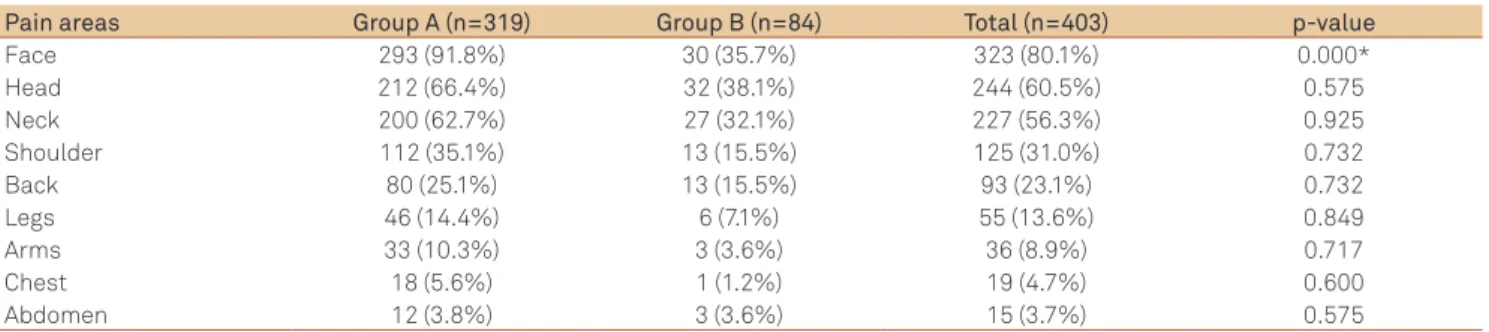
As shown in Table 2, even though Group A was part of a clin-ical sample of orofacial pain patients, 9.2% did not mark pain in the facial region. On the other hand, although Group B patients sought routine dental treatment, 35.7% of them pointed face as a pain area on the body map. For other body pain areas, there were no statistically signiicant diferences between Groups A and B, except for the face, as expected.
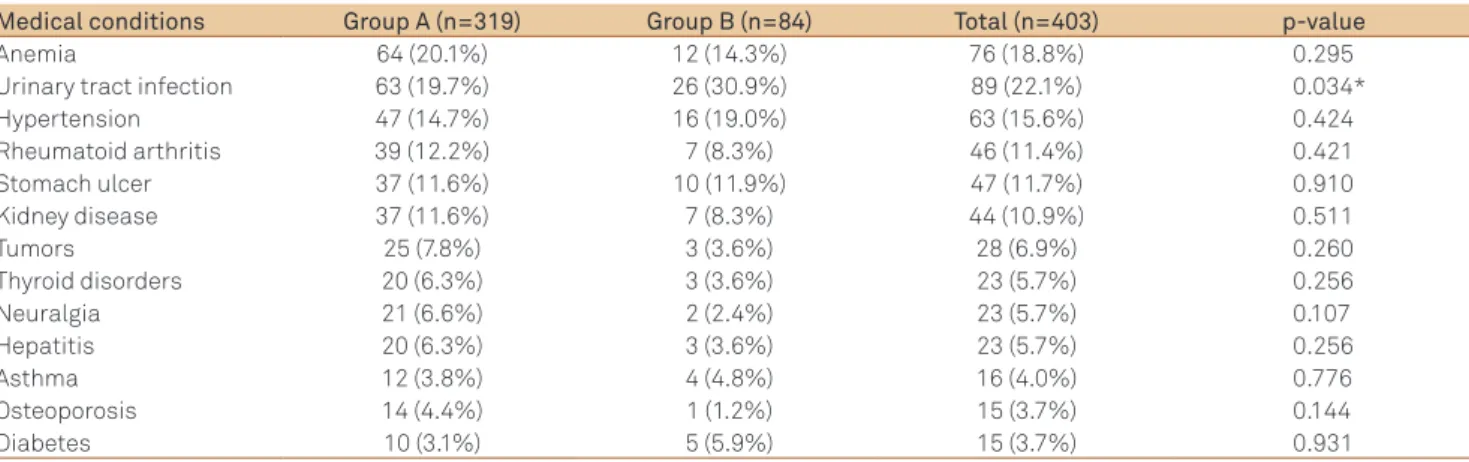
he most frequently reported medical conditions for Groups A and B are described in Table 3. here were no statistically sig-niicant diferences between the two groups, except for urinary tract infection, which was more frequent in Group B. Overall, the ive most commonly reported conditions for both groups were
Number of cases
Group A (%) Group B (%)
Total
Female** Male Female Male
272 (85.3) 47 (14.7) 63 (75.0) 21 (25.0) 403 (100.0)
Mean age (min-max)* 35.2 (18–74) 37.1 (18–66) 35.6 (18–74)
Total (%) 319 (100.0) 84 (100.0) 403 (100.0)
Table 1. Sample demographic data (n=403).
*No statistical significance shown by Mann-Whitney’s test: p=0.167; **Significance of χ2 test: p=0.025.
Pain areas Group A (n=319) Group B (n=84) Total (n=403) p-value
Face 293 (91.8%) 30 (35.7%) 323 (80.1%) 0.000*
Head 212 (66.4%) 32 (38.1%) 244 (60.5%) 0.575
Neck 200 (62.7%) 27 (32.1%) 227 (56.3%) 0.925
Shoulder 112 (35.1%) 13 (15.5%) 125 (31.0%) 0.732
Back 80 (25.1%) 13 (15.5%) 93 (23.1%) 0.732
Legs 46 (14.4%) 6 (7.1%) 55 (13.6%) 0.849
Arms 33 (10.3%) 3 (3.6%) 36 (8.9%) 0.717
Chest 18 (5.6%) 1 (1.2%) 19 (4.7%) 0.600
Abdomen 12 (3.8%) 3 (3.6%) 15 (3.7%) 0.575
Table 2. Frequency of pain areas according to body pain maps (n=403).
350 Arq Neuropsiquiatr 2012;70(5):348-351
anemia, urinary tract infection, hypertension, rheumatoid ar-thritis, and gastric ulcer.
Table 4 shows that although there were no statistically signif-icant diferences between the two groups for isolated frequency of each medical condition, when considering the mean frequen-cy of medical conditions reported by Groups A (n=319) and B (n=84), Mann-Whitney’s test showed statistically signiicant dif-ference (p=0.004). Group A presented higher mean frequency of reports than Group B. For both groups, Pearson’s correlation test showed that the highest frequencies of medical conditions were positively correlated to the highest frequencies of painful areas (0.478, p=0.001 and 0.246, p=0.000, respectively).
DISCUSSION
Assessing the medical history of each patient in a health care service should be a routine practice. It is very important to have an overview of past and present medical conditions for proper diagnosis and treatment, since several studies have reported an association between orofacial pain, general medical diseases or disorders,and general pain conditions4,10-15.
Although in Group A TMD was the most common diagnosis for orofacial pain complaints, according to body pain maps, part of this group did not mark the facial region. Probably, it referred to individuals who sought the clinic presenting pain complaints, but not speciically located on the face (e.g., headaches only). Our data corroborate that TMD relects the most common
type of chronic orofacial pain referred to dentists6,7.According
to literature, many patients with TMD and orofacial pain report pain outside the masticatory system12,14-16.However, in the
pres-ent study, the mean number of reported pain areas prespres-ented no statistically signiicant diferences between the two groups.
Facial, head, and neck pain complaints were commonly report-ed in both groups. Statistically signiicant diference was only detected for facial pain report, probably because, in Group A, patients were seen at an orofacial pain clinic.
According to literature, medical conditions that have pre-sented associations with orofacial pain include: headache17-20,
ibromyalgia21-22, gastrointestinal disorders2,15, psychological
dis-tress14 and psychiatric diseases2, cardiovascular diseases23,24,and
rheumatoid arthritis25. However, in general, the present study
only conirmed urinary tract infection as a statistical signiicant diference between groups.
When considering gender, in both groups, women presented greater demand for treatment than men (respectively 6:1 and 3:1). In agreement with the literature, women were mostly referred to the Orofacial Pain Clinic (Group A) in comparison to routine dental care treatment (Group B), probably because TMD is more
common in women than in men26,27. Women are at higher risk
for developing diseases such as osteoporosis and rheumatoid ar-thritis, all of which may have implications on their oral health28.
Also, women are at greater risk for developing chronic pain
condi-tions29. However, in our results, gender diferences in number did
not inluence the frequency of medical conditions on each group. Although Group A presented two times more women thanB, the irst reported numerous medical conditions as did the latter.
he last ind is related to the mean frequency of medical conditions reported by groups. According to literature, adverse response to illness is common in chronic pain patients, and oro-facial pain syndromes may commonly be a manifestation of a
process of somatization4,13.he medical conditions observed
may also be due to a central sensitization process, since, for both groups, the highest frequencies of medical conditions were positively correlated to the ones of painful body areas. When central sensitization is established, many conditions can afect
Medical conditions Group A (n=319) Group B (n=84) Total (n=403) p-value
Anemia 64 (20.1%) 12 (14.3%) 76 (18.8%) 0.295
Urinary tract infection 63 (19.7%) 26 (30.9%) 89 (22.1%) 0.034*
Hypertension 47 (14.7%) 16 (19.0%) 63 (15.6%) 0.424
Rheumatoid arthritis 39 (12.2%) 7 (8.3%) 46 (11.4%) 0.421
Stomach ulcer 37 (11.6%) 10 (11.9%) 47 (11.7%) 0.910
Kidney disease 37 (11.6%) 7 (8.3%) 44 (10.9%) 0.511
Tumors 25 (7.8%) 3 (3.6%) 28 (6.9%) 0.260
Thyroid disorders 20 (6.3%) 3 (3.6%) 23 (5.7%) 0.256
Neuralgia 21 (6.6%) 2 (2.4%) 23 (5.7%) 0.107
Hepatitis 20 (6.3%) 3 (3.6%) 23 (5.7%) 0.256
Asthma 12 (3.8%) 4 (4.8%) 16 (4.0%) 0.776
Osteoporosis 14 (4.4%) 1 (1.2%) 15 (3.7%) 0.144
Diabetes 10 (3.1%) 5 (5.9%) 15 (3.7%) 0.931
Table 3. Frequency of medical conditions according to Groups A (n=319) and B (n=84).
*Significance of χ2 test.
SD: standard deviation; *Significance of Mann-Whitney’s test.
Number of cases Group A (n=319) Group B (n=84) Total (n=403) p-value
Medical conditions 2.10 (1.42%) 1.54 (1.66%) 1.99 (1.63%) 0.004*
Pain areas 3.26 (1.67%) 3.05 (1.89%) 3.23 (1.70%) 0.337
351
Franco AL et al. Orofacial pain 1. Dahlström L. Diagnoses among referrals to a Swedish clinic specialized
in temporomandibular disorders. Acta Odontol Scand 1998;56:143-147. 2. De Leeuw JR, Steenks MH, Ros WJ, Lobbezoo-Scholte AM, Bosman
F, Winnubst JA. Multidimensional evaluation of craniomandibular dysfunction, I: symptoms and correlates. J Oral Rehabil 1994;21:501-514. 3. Esposito CJ, Panucci PJ, Farman AG. Associations in 425 patients having
temporomandibular disorders. J Ky Med Assoc 2000;98:213-215. 4. Mcgregor NR, Butt HL, Zerbes M, Klineberg IJ, Dunstan RH, Roberts TK.
Assessment of pain, symptoms, SCL-90-R inventory responses, and the association with infectious events in patients with chronic orofacial pain. J Orofac Pain 1996;10:339-350.
5. Auvenshine RC. Temporomandibular disorders: associated features. Dent Clin N Am 2007;51:105-127.
6. Okeson JP. Bell’s orofacial pains: the clinical management of orofacial pain. 6th ed. Quintessence: Chicago; 2005.
7. Okeson JP. Orofacial pain: guidelines for assesment, diagnosis and management. Quintessence: Chicago; 1996.
8. Headache Classification Committee of the International Headache Society. Classification and diagnostic criteria for headache disorders, cranial neuralgias and facial pain. Cephalalgia 1988;8:1-96.
9. Türp JC, Kowalski CJ, Stohler CS. Temporomandibular disorders – pain outside the head and face is rarely acknowledged in chief complaint. J Prosthet Dent 1997;78:592-595.
10. Türp JC, Kowalski CJ, O’Leary N, Stohler CS. Pain maps from facial pain patients indicate a broad pain geography. J Dent Res 1998;77:1465-1472. 11. Yap AU, Tan KB, Chua EK, Tan HH. Depression and somatization in patients
with temporomandibular disorders. J Prosthet Dent 2002;88:479-484. 12. Macfarlane TV, Gray RJM, Kincey J, Worthington HV. Factors associated
with the temporomandibular disorder, pain dysfunction syndrome (PDS): Manchester case-control study. Oral Diseases 2001;7:321-330. 13. Macfarlane TV, Blinkhorn AS, Davies RM, Ryan P, Worthington HV,
Macfarlane GJ. Orofacial pain: just another chronic pain? Results from a population-based survey. Pain 2002;99:453-458.
14. Macfarlane TV, Blinkhorn AS, Davies RM, Kincey J, Worthington HV. Predictors of outcome for orofacial pain in the general population : a four-year follow-up study. J Dent Res 2002;83:712-717.
15. Macfarlane TV, Worthington HV. Association between orofacial pain and other symptoms: a population-based study. Oral Biosci Med 2004;1:45-54. 16. John MT, Miglioretti DL, LeResche L, Von Korff M, Critchlow CW.
Widespread pain as a risk factor for dysfunctional temporomandibular disorder pain. Pain 2003;102:257-263.
17. Kemper JT, Okeson JP. Craniomandibular disorders and headaches. J Prosthet Dent 1983;49:702-705.
18. Ciancaglini R, Radaelli G. The relationship between headache and symptoms of temporomandibular disorder in the general population. J Dent 2001;29:93-98.
19. Franco AL, Gonçalves DAG, Castanharo SM, Speciali JG, Bigal ME, Camparis CM. Migraine is the most prevalent primary headache in individuals with temporomandibular disorders. J Orofac Pain 2010;24:287-292.
20. Gonçalves DAG, Bigal ME, Jales LCF, Camparis CM, Speciali JG. Headache and symptoms of temporomandibular disorder: an epidemiological study. Headache 2010;50:231-241.
21. Hedenberg-Magnusson B, Ernberg M, Kopp S. Presence of orofacial pain and temporomandibular disorder in fibromyalgia: a study by questionnaire. Swed Dent J 1999;23:185-192.
22. Yunus MB. Central sensitivity syndromes: a new paradigm and group nosology for fibromyalgia and overlapping conditions, and the related issue of disease versus illness. Semin Arthritis Rheum 2008;37:339-352.
23. Beaton RD, Egan KJ, Nakagawa-Kogan H, Morrison KN. Selfreported symptoms of stress with temporomandibular disorders: comparisons to healthy men and women. J Prosthet Dent 1991;65:289-293.
24. Maixner W, Fillingim R, Kincaid S, Sigurdsson A, Harris MB. Relationship between pain sensitivity and resting arterial blood pressure in patients with painful temporomandibular disorders. Psychosom Med 1997;59:503-511.
25. Aaron LA, Burke MM, Buchwald D. Overlapping conditions among patients with chronic fatigue syndrome, fibromyalgia, and temporomandibular disorder. Arch Intern Med 2000;160:221-227.
26. Dworkin SF, Huggins KH, LeResche L, et al. Epidemiology of signs and symptoms in temporomandibular disorders: clinical signs in cases and controls. J Am Dent Assoc 1990;120:273-381.
27. Drangsholt M, LeResche L. Temporomandibular disorder pain. In: Crombie IK, Croft PR, Linton SJ, LeResche L, Von Korff M (Eds). Epidemiology of pain. Seattle: IASP Press; 1999. p. 203-233.
28. Zakrzewska JM. Women as dental patients: are there any gender differences? Int Dent J 1996;46:548-557.
29. Sa KN, Baptista AF, Matos MA, Lessa I. Chronic pain and gender in Salvador population, Brazil. Pain 2008;139:498-506.
30. Tracey I, Mantyh PW. The cerebral signature for pain perception and its modulation. Neuron 2007;55:377-391.
References
diferent body systems and cause concomitant health
diseas-es22. Furthermore, patients with chronic orofacial pain
report-ed wider distribution of pain areas, which can afect patients’
shoulders, back, and extremities4. Probably, that is why Group A
presented a higher mean frequency of reports than Group B. It seems that in the presence of chronic pain, the integrative noci-ceptive framework is disrupted, contributing to the generation
and maintenance of pain experiences30.
Some of the methodological considerations about the pres-ent study deserve attpres-ention. First, the results of this study cannot be extended to the general population, because we restricted the study sample to patients that sought public health treatment at a dental school. Secondly, the questions used were based on the AAOP7 and ICHD-I8, since these criteria were available when
examinations were performed. Moreover, because the medi-cal history questionnaire was based on self-reports, it may have
generated inaccuracies; however, potential inaccuracies may be similarly expected in both groups.