*Correspondence Rua Abadia dos Dourados, 297 - casa 7
São Paulo – SP 05586-000
Telefone: (11) 9742-3232
ABSTRACT
Objective. To estimate the prevalence of physical inactivity among adolescents (aged 14 to 18 years) in the municipality of Maringá, state of Paraná, Brazil and to explore its association with demographic, socioeconomic and behavioral variables and nutritional status indicators.
MethOds. Cross-sectional study with a representative sample of 991 high school students (54.5% of
girls) from both public and private high schools selected through multi-stage random sampling. Habitual physical activity was assessed using the International Physical Activity Questionnaire (IPAQ) adapted
for adolescents, with the previous week taken as reference period. Physical inactivity was deined as
<300 min/week of moderate and vigorous physical activity. Independent variables studied were: sex,
age, type of school, socioeconomic level, smoking, sedentary behavior (≥4 h/day), nutritional status,
and abdominal obesity.
Results. The prevalence of physical inactivity among adolescents was 56.9% (girls= 57.9%, boys=
55.7%, p=0.46). Risk factors associated with physical inactivity were lower socioeconomic level, attendance to public schools and obesity.
cOnclusiOn. A high prevalence of physical inactivity was found in the population investigated. The development of strategies to increase physical activity among adolescents are urgently needed. It can be achieved through content-based activities that promote a healthy lifestyle.
Keywords: Motor Activity. Epidemiology. Questionnaires. Adolescent Behavior.
P
Revalence
Of
Physical
inactivity
and
assOciated
factORs
aMOng
adOlescents
augustO césaR feRReiRade MORaes1*, caRlOs alexandRe MOlena feRnandes2, Rui gOnçalves MaRques elias3, alika teRuMi aRasaki nakashiMa4, feliPe fOssati ReicheRt5, MáRiO cíceRO falcãO6
Study conducted at Faculdade Ingá – Uningá, in collaboration with Universidade de São Paulo
1. Aluno do programa de pós-graduação em Ciências da Faculdade de Medicina da Universidade de São Paulo – USP, São Paulo, SP
2. Mestre em Ciências da Saúde e Doutorando em Ciências Farmacêuticas - Professor da Faculdade Estadual de Educação Ciências e Letras de Paranavaí - FAFIPA, PR 3. Mestre em Ciências da Saúde - Professor da Faculdade Ingá – Uningá e da Universidade Estadual de Maringá. Maringá, PR
4. Mestre em Ciências da Saúde - Professora da Pontifícia Universidade Católica, Maringá, PR.
5. Doutor em Epidemiologia - Professor Adjunto do Departamento de Educação Física, Centro de Educação Física e Esporte, Universidade Estadual de Londrina, Londrina, PR
6. Doutor em Ciências - Professor colaborador de Pediatria da Faculdade de Medicina da Universidade de São Paulo – USP, São Paulo, SP
i
ntROductiOnPhysical activity in adolescence has several health bene-fits, such as weight control and maintenance1 and reduction of cardiovascular risks.2 Moreover, cohort studies have evidenced that physical inactivity during childhood and/or adolescence tends to continue into adulthood, becoming difficult to change.3 Therefore, programs to stimulate physical activities in this age range should be a priority for public health policies and a focus for teachers.
Despite the acknowledgement that physical activity is important for health, there are still few population-based or school-based studies about the topic among adolescents in Brazil. Previous research has shown very high prevalence rates of physically inactive adolescents and a strong association
with demographic, socioeconomic and biological factors.4,5 However, a recent review study emphasized important metho-dological differences in the literature, with distinct instruments and cutoff points, which frequently prevent comparisons among studies.6
The objectives of this study were to estimate the prevalence of physically inactive adolescent high school students in the South of Brazil and to explore the association of physical inactivity with demographic, socioeconomic, indicators of nutritional status, and behavioral variables.
M
ethOdsof Paraná, in the South of Brazil. Maringá has a high Human Development Index (HDI= 0.84, while HDI for Brazil is 0.79).7
After having received a formal request and information on the importance, the objectives and the methodology of this study, the school board of each school selected gave permission for this study to be conducted. This study was approved by the Research Ethics Committee of Centro Universitário de Maringá, in accordance with Brazilian laws.
s
aMPlingSample selection was done in two stages. A 95% confidence level and a 5% margin of error were assumed and the estimated prevalence was of 50%, with a design effect of 2. Based on this, it was estimated that data from 734 adolescents would have to be collected. Due to other objectives of the research project and to possible occa-sional losses and refusals, an extra 20% of adolescents were added to the sample. In the first stage, the number of schools with students within the age range under study was identified (n = 38 schools), and then schools were selected according to the probability propor tional to the number of students within the eligible age range and to the type of school (public or private). Eight public schools and four private schools were selected. In the second stage, simple random sampling was used to select groups in each school, so that the propor tion of students in each year (1st to 3rd year of high school) would be maintained. Sample size enabled a prevalence estimate of 50% of physical inactivity in each age group, with a 4% margin of error. Fur thermore, prevalence ratios of 1.3 were statistically significant at the 5% level, with a power of 80% for 50% prevalences.
All students from the selected groups who were present at the day of data collection were considered eligible to participate in the study after their parents or guardians gave a written consent and the students themselves gave their verbal consent.
v
aRiablesThe International Physical Activity Questionnaire (IPAQ) short, 8th version was used to collect information on habitual physical activity, with the previous week taken as reference.8,9 Physical inactivity was established with a cutoff level of 300 minutes of moderate/vigorous physical activity per week, in accordance with current guidelines of physical activity for adolescents.10
Independent variables investigated were: sex; age; type of school; socioeconomic level [classified according to criteria of the Brazil Criterion of Economic Classifica-tion (Critério de Classificação Econômica Brasil, Asso-ciação Brasileira de Empresas de Pesquisa)11 into levels A (highest), B, C, D, or E (lowest) taking into consideration, among other aspects, consumer goods available at home];
type of school (public or private); nutritional status [based on the body mass index (BMI), adolescents were nutri-tionally classified according to cutoff points for sex and age12]; abdominal obesity (based on evaluation of waist circumference and according to cutoff points for sex and age13); smoking (those who reported smoking at least one cigarette in a habitual week were considered to be smokers); and sedentary behavior (time spent in front of the televi-sion, computer/games). Excessive time spent in front of
television, computer/games was established to be ≥ 4h/day.
Data were collected by a team of four interviewers previously trained in two pilot studies, with one week of interval, at schools that were not included in the final sample. Kappa coefficient was used to verify agreement between both questionnaire applications. The agreement observed was high (k=0.91).
Statistical treatment of information was per formed with Stata® version 8.0. At first, the propor tion of physically inactive adolescents was analyzed according to each independent variable. Crude and adjusted prevalence ratios (PR) with 95% confidence inter val (95%CI) were calculated with Poisson regression, which is recommended for high prevalence outcomes.14 Adjusted analysis was per formed according to a four-level, hierarchical model determined a priori: 1) sex, age, socioeconomic level; 2) nutritional status and abdominal obesity; 3) smoking; and 4) sedentar y behavior. In this model, the effect of each variable on the outcome is adjusted for other variables in the same level or above in the hierarchical model.15 For a variable to be retained in the model, significance level was set at p<0.20. Statistical significance was establi-shed at 5%.
R
esultsThe number of adolescents selected at public and private schools was 774 and 492 students, respectively. In this sample, there were 275 losses/refusals: 92 students were absent from school in the days data were collected (76.1%, n=70, students from public schools) and 183 students did not bring the consent form or refused to answer the ques-tionnaire or undergo assessments (82%, n=150, students from private schools). Therefore, the final sample included 991 adolescent high school students (67.7%, n=671, students from public schools).
The sample was comprised of 67.7% of adolescents from public institutions, 55.5% of girls, 6.1% of students belon-ging to D and E socioeconomic levels (the lowest), 77.2% of students classified as normal weight (nonobese), and 32.7% of students with abdominal obesity. The mean age, body mass and height were: 16.3±0.9 years, 61.3±12.6 kilos and 168.9±13 centimeters, respectively.
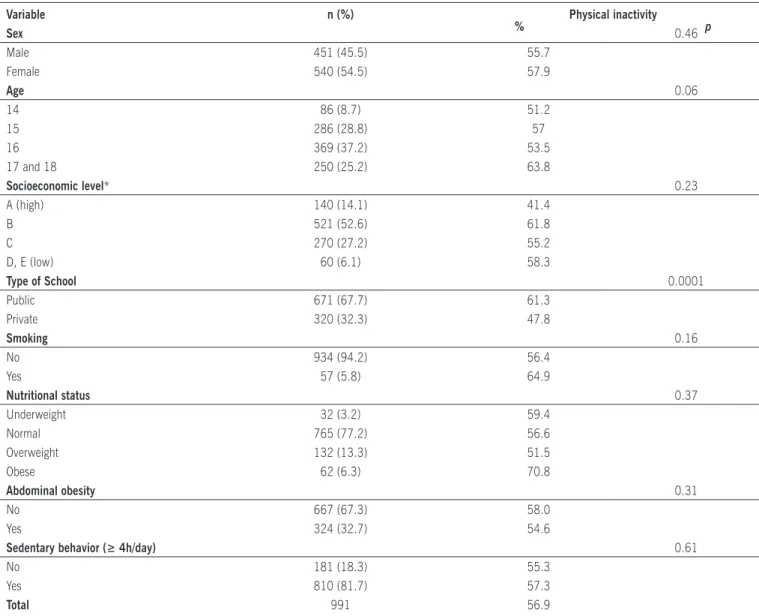
Table 1. Prevalence (%) of physical inactivity according to the independent variables studied among adolescent high school students from Maringá, state of Paraná, Brazil
Variable n (%)
% Physical inactivity p
Sex 0.46
Male 451 (45.5) 55.7
Female 540 (54.5) 57.9
Age 0.06
14 86 (8.7) 51.2
15 286 (28.8) 57
16 369 (37.2) 53.5
17 and 18 250 (25.2) 63.8
Socioeconomic level* 0.23
A (high) 140 (14.1) 41.4
B 521 (52.6) 61.8
C 270 (27.2) 55.2
D, E (low) 60 (6.1) 58.3
Type of School 0.0001
Public 671 (67.7) 61.3
Private 320 (32.3) 47.8
Smoking 0.16
No 934 (94.2) 56.4
Yes 57 (5.8) 64.9
Nutritional status 0.37
Underweight 32 (3.2) 59.4
Normal 765 (77.2) 56.6
Overweight 132 (13.3) 51.5
Obese 62 (6.3) 70.8
Abdominal obesity 0.31
No 667 (67.3) 58.0
Yes 324 (32.7) 54.6
Sedentary behavior (≥ 4h/day) 0.61
No 181 (18.3) 55.3
Yes 810 (81.7) 57.3
Total 991 56.9
*Brazilian economic classiication criteria according to the Brazil Criterion of Economic Classiication (Critério de Classiicação Econômica Brasil, Associação Brasileira de Empresas de Pesquisa)11. Wald test for heterogeneity.
Wald test for linear trend.
prevalence of physical inactivity among the assessed adolescents; more than half of the sample does not perform
any physical activity for ≥ 300 min/week. Regarding
independent variables, adolescent students from private schools showed a lower prevalence of physical inactivity in comparison to their peers from public schools (p=0.0001). The other independent variables were not statistically signi-ficant. However, the prevalence of sedentary behavior (more than 4 hours/day) was also high, similar to the prevalence of physical inactivity.
Among risk factors for physical inactivity (<300 min/ week), there was no linear trend associated with age. The probability of obese adolescents being physically inactive
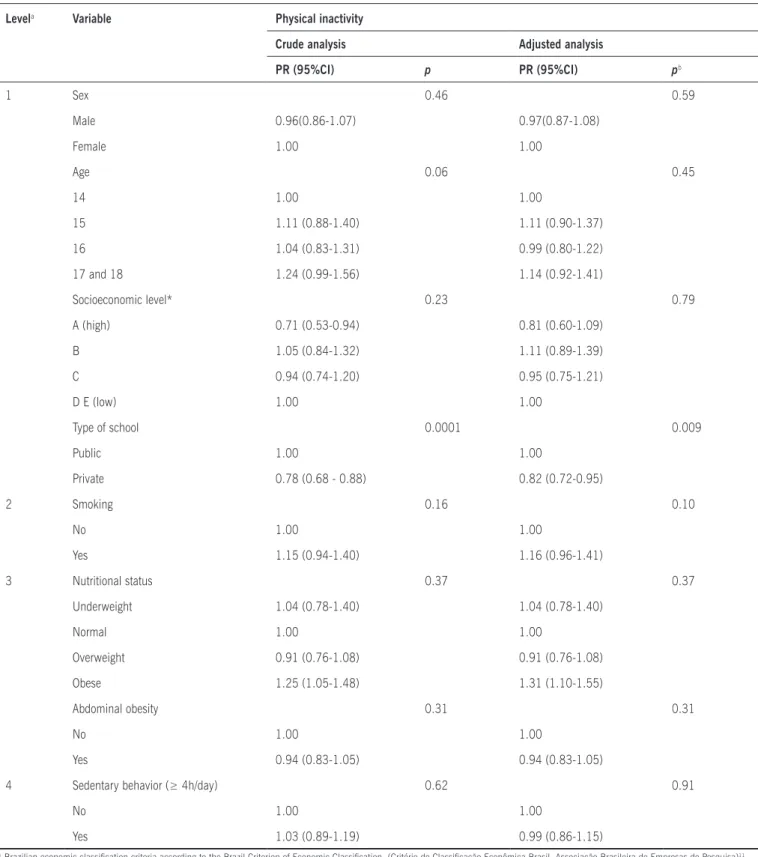
was higher if compared to normal adolescents (PR=1.31 95%CI=1.10-1.55). It was also observed that students from private schools had a lower probability of being physi-cally inactive (PR=0.82 95%CI=0.72-0.95, p=0.009). In the crude analysis, the high economic level (A) was associated with the outcome; however, after being adjusted in the hierarchical model, it lost its statistical significance (Table 2).
d
iscussiOnOur results showed that more than half (56.9%) of the assessed adolescents were not used to performing any
Table 2. Crude and adjusted prevalence ratios (PR), with 95% conidence interval (95%CI), according to independent variables for
adolescent high school students from Maringá, state of Paraná, Brazil.
Levela Variable Physical inactivity
Crude analysis Adjusted analysis
PR (95%CI) p PR (95%CI) pb
1 Sex 0.46 0.59
Male 0.96(0.86-1.07) 0.97(0.87-1.08)
Female 1.00 1.00
Age 0.06 0.45
14 1.00 1.00
15 1.11 (0.88-1.40) 1.11 (0.90-1.37)
16 1.04 (0.83-1.31) 0.99 (0.80-1.22)
17 and 18 1.24 (0.99-1.56) 1.14 (0.92-1.41)
Socioeconomic level* 0.23 0.79
A (high) 0.71 (0.53-0.94) 0.81 (0.60-1.09)
B 1.05 (0.84-1.32) 1.11 (0.89-1.39)
C 0.94 (0.74-1.20) 0.95 (0.75-1.21)
D E (low) 1.00 1.00
Type of school 0.0001 0.009
Public 1.00 1.00
Private 0.78 (0.68 - 0.88) 0.82 (0.72-0.95)
2 Smoking 0.16 0.10
No 1.00 1.00
Yes 1.15 (0.94-1.40) 1.16 (0.96-1.41)
3 Nutritional status 0.37 0.37
Underweight 1.04 (0.78-1.40) 1.04 (0.78-1.40)
Normal 1.00 1.00
Overweight 0.91 (0.76-1.08) 0.91 (0.76-1.08)
Obese 1.25 (1.05-1.48) 1.31 (1.10-1.55)
Abdominal obesity 0.31 0.31
No 1.00 1.00
Yes 0.94 (0.83-1.05) 0.94 (0.83-1.05)
4 Sedentary behavior (≥ 4h/day) 0.62 0.91
No 1.00 1.00
Yes 1.03 (0.89-1.19) 0.99 (0.86-1.15)
* Brazilian economic classiication criteria according to the Brazil Criterion of Economic Classiication (Critério de Classiicação Econômica Brasil, Associação Brasileira de Empresas de Pesquisa)11. aThe effect of each variable is controlled for other variables belonging to the same or higher hierarchical levels.
bVariables with p>0.2 were not retained in the model.
the prevalence of physical inactivity among adolescents should be cautious, since the studies available in the literature use different instruments and cutoff points, as was observed in a recent review article.6 Nevertheless, a comparison between studies conducted among American and Brazilian adolescents using the same cutoff points of the present study showed that results are similar: 55.9%16 and 58.2%,4 respectively. This is an alarming outcome, because physical activity patterns in adolescence tend to continue into adulthood17.
According to studies conducted in Brazil18 and around the world,19 boys are more active than girls; however, diffe-rently from those studies, differences between sexes were not observed in our study, which was the reason why our analyses were not stratified. These results may partially be explained by the fact that boys have more social and family support to engage in physical activities20.
In the present study, physical inactivity was positively associated with socioeconomic level; adolescents within the highest level had the lowest risk behavior. However, rese-arch results available in the literature are not consensual, so that a direct association between exposure and outcome cannot be made. Some international studies indicate a positive association,21,22 whereas Brazilian studies indicate a negative association.18,23 According to the literature, these differences may be explained by the demographic context of the population studied24.
Adolescent students from private schools had a low preva-lence of physical inactivity. Despite the apparent consensus on the fact that physical education classes promote a healthy lifestyle,25 research results do not support this statement.26,27 These research studies indicate the need to develop school contents on healthy lifestyle aiming at reducing physical inactivity and other risk behaviors, such as smoking and inadequate eating habits28.
The nutritional status, classified according to BMI, was associated with physical inactivity; however, statistic signifi-cance was reached only for obese adolescents. These results corroborate previous studies which identified that physical activity among obese adolescents is lower than among normal adolescents,29,30 further contributing to increase obesity, as observed in Brazil and in other countries31,32.
c
OnclusiOnIn sum, the prevalence of physically inactive adoles-cents in our study was high, according to criteria currently adopted. Our results show that adolescent students from public schools and of lower socioeconomic levels are less active; thus, programs designed to promote physical activity, especially in the school environment of these adolescents, are urgently needed. Guidelines issued by governmental institutions, such as the Brazilian Ministry of Health (Ministério da Saúde) and US Centers for Disease
Control and Prevention (CDC), may help train personnel to develop school-based programs.
a
cknOwledgeMentsThe authors thank the coordinators of the Research Group on Exercise and Obesity (Grupo de Pesquisa em Exercício e Obesidade – GREPO) of Universidade Estadual de Maringá for borrowed materials during the development of this study
No conlict of interest declared concerning the publication of
this article.
R
efeRences1. Shepard RJ. Physical activity, fitness and health: the current consensus. Quest. 1995;47:288-303.
2. Blair SN, Brodney S. Effects of physical inactivity and obesity on morbidity and mortality: current evidence and research issues. Med Sci Sports Exerc. 1999;31(Suppl.):S646-62.
3. Aarnio M, Winter T, Peltonen J, Kujala UM, Kaprio J. Stability of leisure-time physical activity during adolescence - a longitudinal study among 16-, 17- and 18-year-old Finnish youth. Scand J Med Sci Sports. 2002;12:179-85.
4. Hallal PC, Bertoldi AD, Goncalves H, Victora CG. [Prevalence of sedentary lifestyle and associated factors in adolescents 10 to 12 years of age]. Cad Saúde Pública. 2006;22:1277-87.
5. Oehlschlaeger MH, Pinheiro RT, Horta BL, Gelatti C, Santana P. Sedenta-rismo: prevalência e fatores associados em adolescentes de área urbana. Rev Saúde Pública. 2004;38:157-63.
6. Tassitano RM, Bezerra J, Tenório MCM, Colares V, Barros MGV, Hallal PC. Atividade física em adolescentes brasileiros: uma revisão sistemática. Rev. Bras Cineantropom Desempenho Hum. 2007;9:55-60.
7. Programa das Nações Unidas para o Desenvolvimento (PNUD). Atlas de Desenvolvimento Humano no Brasil [citado 11 ago 2007]. Disponível em : http://www.pnud.org.br/atlas.
8. Arvidsson D, Slinde F, Hulthèn L. Physical activity questionnaire for adolescents validated against doubly labelled water. Eur J Clinl Nutr. 2005;59:376-83.
9. Guedes DP, Lopes CC, Guedes JERP. Reprodutibilidade e validade do questionário internacional de atividade física em adolescentes. Rev Bras Med Esporte. 2005;11:151-8
10. Strong WB, Malina RM, Blimkie CJR. Evidence based physical activity for school-age youth. J Pediatr. 2005;146:732-7.
11. Associação Brasileira de Empresa e Pesquisa - ABEP. Critério de classi ficação econômica Brasil. 2003. [citado 11 maio 2007]. Disponível em URL: www.abep.org.
12. Conde WL, Monteiro CA. Body mass index cutoff points for evaluation of nutritional status in Brazilian children and adolescents. J Pediatr. 2006;82:266-72.
13. Taylor RW, Jones IE, Williams SM, Goulding A. Evaluation of waist circum-ference, waist-to-hip ratio, and the conicity index as screening tools for high trunk fat mass, as measured by dual-energy X-ray absorptiometry, in children aged 3-19 y. Am J Clin Nutr. 2000;72:490-5.
14. Barros AJD, Hirakata V. Alternatives for regression in cross-seccional studies: an empirical comparision of models that directly estimate the prevalence ratio. BMC Med Res Methodol. 2003;3:21.
15. Victora CG, Huttly SR, Fuchs SC, Olinto MT. The role of conceptual frameworks in epidemiological analysis: a hierarchical approach. Int J Epidemiol. 1997;26:224-7.
16. Riddoch CJ, Bo Andersen L, Wedderkopp N, Harro M, Klasson-Heggebo L, Sardinha LB, et al. Physical activity levels and patterns of 9 and 15-yr-old European children. Med Sci Sports Exerc. 2004;36:86-92. 17. Azevedo MR, Araujo CL, Da Silva MC, Hallal PC. Tracking of physical
activity from adolescence to adulthood: a population-based study. Rev Saúde Pública 2007;41:69-75.
18- Bastos JP, Araújo CLP, Hallal PC. Prevalence of insufficient physical activity and associated factors in Brazilian adolescents. J Phys Activity Health. 2008;5:777-94.
Artigo recebido: 29/10/08 Aceito para publicação: 17/03/09
21. Lasheras L, Aznar S, Merino B, Lopez EG. Factors associated with physical activity among Spanish youth through the National Health Survey. Prev Med. 2001;329:455-64.
22. Woodfield L, Duncan M, Al-Nakeeb Y, Nevill A, Jenkins C. Sex, ethnic and socio-economic differences in children’s physical activity. Pediatr Exerc Sci. 2002;14:277-85.
23. Fernandes RA, Freitas Júnior IF, Cardoso JR, Ronque ENV, Loch MR, Oliveira AR. Association between regular participation in sports and leisure time behaviors in Brazilian adolescents: a cross-sectional study. BMC Public Health. 2008;8:329.
24. Seabra AF, Mendonça DM, Thomis MA, Anjos LA, Maia JA. Determinantes biológicos e sócio-culturais associados à prática de atividade física de adolescentes. Cad Saúde Publica. 2008;24:721-36.
25. Vilhjalmsson R, Thorlindsson T. Factors related to physical activity: a study of adolescents. Soc Sci Med. 1998;47:665-75.
26. McKenzie TL, Marshall SJ, Sallis JF, Conway TL. Student activity levels, lesson context, and teacher behavior during middle school physical education. Res Q Exerc Sport. 2000;71:249-59.
27. Guedes DP, Guedes JERP. Esforços físicos nos programas de educação física escolar. Rev Paul Educ Fís. 2001;15:33-44.
28. Nahas MV, Barros MVG, Assis MAA, Hallal PC, Florindo AA, Konrad L. Methods and participant characteristics of a randomized intervention to promote physical activity and healthy eating among brazilian high school students: The Saudena Boa Project. J Phys Activity Health.; 2009 (in press).
29. Koezuka N, Koo M, Allison KR, Adlaf EM, Dwyer JJM, Faulkner G, et al. The relationship between sedentary activities and physical inactivity among adolescents: results from the Canadian Community Health Survey. J Adol Health. 2006;39:515-22.
30. Fernandes RA, Casonatto J, Christofaro DGD, Ronque ERV, Oliveira AR, Freitas Júnior IF. Riscos para o excesso de peso entre adolescentes de dife-rentes classes socioeconômicas. Rev Assoc Med Bras. 2008;54:334-8. 31. Ministério da Saúde. Ministério do Planejamento Orçamento e Gestão.
Instituto Brasileiro de Geografia e Estatística. Pesquisa de orçamentos familiares 2002-2003. Antropometria e análise do estado nutricional de crianças e adolescentes no Brasil, 2006. [citado 29 mar 2008]. Disponível em: http://www.saude.gov.br.