SYSTEMATIC AND FORMAL INSTRUMENTS
FOR LANGUAGE ASSESSMENT OF PRESCHOOLERS
IN BRAZIL: A LITERATURE REVIEW
Instrumentos sistemáticos e formais de avaliação da linguagem
de pré-escolares no Brasil: uma revisão de literatura
Tâmara Andrade Lindau(¹), Fernando Del Mando Lucchesi(1),
Natalia Freitas Rossi(1), Célia Maria Giacheti(1)
(1) Universidade Estadual Paulista – UNESP, Marília, São
Paulo, Brasil.
Institute: Philosophy and Science College of Sao Paulo State University– UNESP, Marilia, SP, Brazil.
Source of assistance: Foundation for Research Support of the Sao Paulo State -FAPESP (Process nº 2012/19808-5)/ National Ins-titute of Science and Technology about Behavior, Cognition and Teaching (CNPq: #573972/2008-7, FAPESP#2008/57705-8).
Conlict of interest: non-existent
individual performance at any given time. However,
one must consider the various inluences that the subject suffered throughout life and also the inlu -ences arising from the task itself and the peculiarities belonging to the environment in which the evalu-ation is conducted1.
Psychology is the science that supports the use of measuring instruments matter that has been widely debated. The instruments - tests - are considered systematic / formal procedures towards investigating situations of decision making. The formal and systematic evaluation emerged in the late nineteenth century, along with psychometrics, which formed the basis of assessment technology4.
Changes of spoken language can inluence the
social and academic skills of children learning, and
early identiication of this modiication also enables
early intervention, thus contributing to minimize the aggravation and persistence of these changes5-8.
In this direction, different methods are used in the evaluation of spoken language, and its effectiveness will depend on the use of appropriate procedures to
INTRODUCTION
In Speech Language Therapy context, the evalu -ation is one of the most frequent actions in the work routine, whose success is assured by the production
of information that helps to raise, conirm or deny a
diagnosis hypothesis. It is the purpose of the review
to list the set of dificulties and skills in different
areas, check and specify the problems and also to obtain data for decision making1-3.
The evaluation is a complex process in which speciic and appropriate procedures characterize
ABSTRACT
Systematic and formal instruments of language in children aged between two and ive years are of
predominant importance both for the investigation of possible alterations and to propose language intervention. However, currently there are few instruments available in Brazilian Portuguese for research and clinical use. The aim of this study therefore was to present a review on systematic and
formal assessment instruments spoken language in preschool, used in scientiic research in Brazil,
built nationally or in the adaptation and validation process. Seven different instruments have been
described in 22 scientiic papers, which is a low number compared to other countries, and especially in comparison to non-scientiic publications, not necessarily validate the eficiency of the instrument.
It is suggested increased investment both in the construction of instruments as in the adaptation and validation of instruments already used in other languages.
were held in national databases; and the third in the international databases.
The descriptors were selected after consulting the Health Sciences Descriptors (DeCS-VHL) and crossed as follows:
Search 1: (“Child Language”) Or “Language Disorders”) Or “Speech Pathology”) Or “Language”) Or “Language Development”) Or “Language Development Disorders”) Or “Verbal Behavior”) or “Language Arts”) or “Verbal Learning”) or “Vocabulary”) or “Narration” [Subject Descriptor]
AND “Language Tests” [Subject descriptor] AND
(“Child, Preschool”) or “Child Rearing”)
Search 2: “Cross-cultural comparison” [Words] and “language” [Words]
Search 3: (“Language Tests”[Mesh]) AND
(“Child Language”[Mesh]) OR “Language Disorders”[Mesh]) OR “Speech-Language Pathology”[Mesh]) OR “Language”[Mesh]) OR (“Language Development”[Mesh] OR “Language Development Disorders”[Mesh])) OR “Verbal Behavior”[Mesh]) OR “Language Arts”[Mesh]) OR “Verbal Learning”[Mesh])”[Mesh]) OR “Vocabulary”[Mesh]) OR “Narration”[Mesh])
The exclusion criteria for this literature study
were: (1) repeated articles as they are published in more than one language; (2) repeated articles located in in more than one database; (3) review articles; (4) articles that presented different casuistry with different chronological age of preschool age
group (two to ive years old); (5) studies conducted
in other languages (i.e. Spanish) and (6) instru-ments designed to assess only one component of spoken language (i.e. “Teste Brasileiro Infantil de Repetição de Pseudopalavras” (BCPR)22; “Teste
de Vocabulário Auditivo Expressivo” (TVExp)23;
Avaliação Fonológica da Criança (AFC)24;
Consciência fonológica: instrumento de avaliação sequencial (CONFIAS)25 e Peril das Habilidades
Fonológicas (PHF)26.
LITERATURE REVIEW
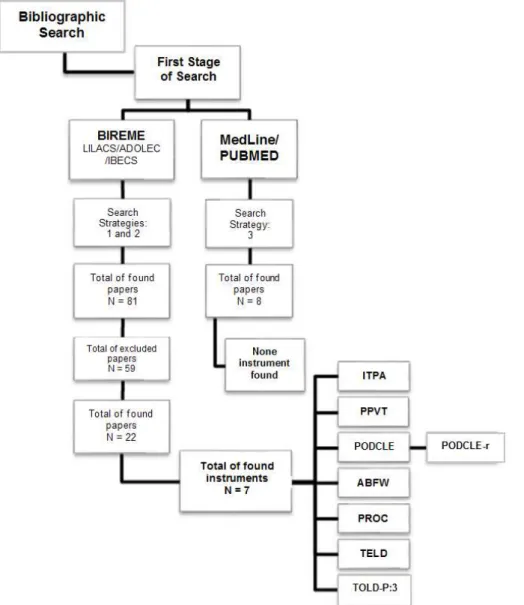
The results of the search are willing to follow, according to the databases that were selected (Figure 1).
conditions of age group and language ability of the subject reported that supplemented and appreciated by a professional, allow diagnostic decision making and intervention9-12.
Knowledge and practices diffused in other areas may contribute to the assessment, diagnosis, treatment and monitoring of human communication and its disorders13. One of the ways of
dissemi-nation of such knowledge under evaluation refers to the use of standardized / formal tests that provide
a comprehensive or speciic assessment of the studied proile14-16.
Brazil is still in need regarding the availability of systematic and formal instruments for assessment
and diagnosis in the ield of Speech, Language and
Hearing Sciences in general, and especially for preschool children17-20.
The characterization of the target population of this study, the “preschool” term was adopted for didactic purposes. According to Guidelines and Bases of National Education, preschool population
is characterized by children of four and ive years
old21, however for the speech language assessment
taking into account the importance of identifying early changes5-8 that concept has been expanded to
covering children aged two to ive years old.
In front of the foregoing, this current study aimed to present a literature review on systematic and formal assessment instruments of spoken language
in children between two and ive years old, used in scientiic and/or clinical practice investigations,
in Brazil, built in nationwide or in adaptation and validation process.
METHODS
Scientiic articles that used protocols, evidence or systematic/formal tests were raised, indexed
in national and international data. It was used the descriptors in health sciences (DeCs), related to the purpose of this study, i.e., systematic and formal evaluation instruments of preschoolers’ spoken
language, used in scientiic and/or clinical practice
researches, in Brazil.
Searches were conducted on the basis of national and international data: Virtual Health Library (VHL) - Bireme (Lilacs, Ibecs and Adolec) and PUBMED / MEDLINE.
For this, the adopted procedures were divided
International language assessment instruments adapted or in the process of adaptation to Brazilian Portuguese
With an initial focus in the international instru-ments for the evaluation of spoken language that have been adapted or are in the process of adaptation to the linguistic culture of Brazilian Portuguese, is quoted initially the “Illinois Test of Psycholinguistic Abilities” (ITPA), adapted to Brazil in 1975/197727,28. This test is intended to investigate
psycholinguistic skills, based on communication processes29 in children between two and 10 years
At the end of the survey, 22 articles were selected that contemplated a total of seven systematic and formal procedures for language evaluation of subjects in preschool. Among these seven instruments, four are international and three are instruments developed in Brazil and do not have international version.
Following it will be presented the international instruments that evaluate the spoken language of preschool children, which have been adapted or are in the process of adaptation to the linguistic culture of Brazilian Portuguese, and at the end, the presen-tation of the instruments built nationwide.
Legend: BIREME = Virtual Health Library; N = number of papers found; ITPA = “Illinois Test of Psycholinguistic Abilities”; PPVT = “
Pea-body Picture Vocabulary Test”; PODCLE = “Protocolo para Observação do Desenvolvimento Cognitivo e de Linguagem Expressiva”;
PODCLE-r= “Protocolo para Observação do Desenvolvimento Cognitivo e de Linguagem Expressiva - revisado”; ABFW= “Teste de
Linguagem Infantil – ABFW”; PROC= “Protocolo de Observação Comportamental”; TELD= “Test of Early Language Development:
Third Edition”; TOLD-P:3 = “Test of Language Development Primary: 3”.
Instruments built nationwide: Protocols
In Brazil, there are two published protocols
which consider the expressive and receptive
language level: the “Protocolo de Observação Comportamental” - PROC34 and “Protocolo para
Observação do Desenvolvimento Cognitivo e de Linguagem Expressiva” - PODCLE35, and its revised
version (PODCLE-r) 36.
PROC is focused on the evaluation of the communicative and cognitive development in children aged one to four years old, through behav-ioral observation for early detection of changes in receptive oral language development. Importantly a 2012 recent study provided the reference values for a quantitative analysis of that procedure34,37.
PODCLE and PODOCLE-r are focused on the analysis of the diversity of achievements and linguistic productions presented by children from birth to seven years old. They provide a set of information that guides the evaluator look for
speciic aspects included by the protocol, but does
not include a reference value for the analysis of quantitative point of view - in which the authentic and generalized data that drive the analysis for
conirmation of a pre-established hypothesis are
disposed35,36,38.
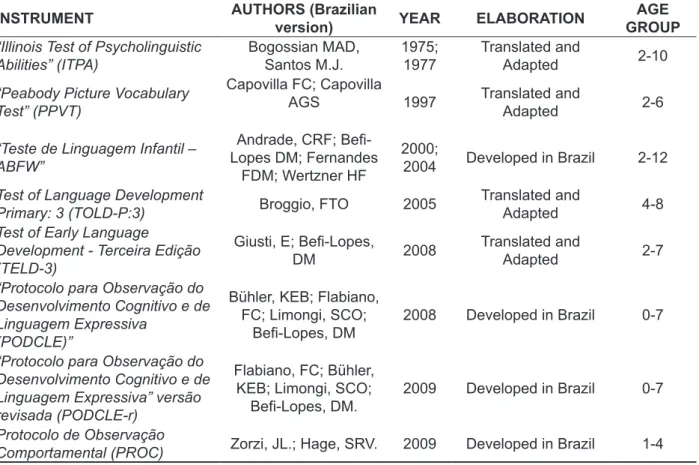
Table 1 summarizes the instruments described previously, especially the information of authorship, year of publication, production and age range of the instrument.
It is observed that the instruments found only two (TELD and TOLD-P: 3) evaluate receptive and
expressive aspects in the same instrument. Only the expressive ability is addressed by three instruments
(ABFW, PODCLE and PODCLE-r), and receptive abilities in three other instruments (PROC, PPVT and ITPA).
The obtained results in this study are compatible with the literature regarding the lack of validated instruments for evaluation of spoken language in preschool children17-20.
In brief survey on the American Speech-Language-Hearing Association (ASHA) website, it
was found as a result an approximate number of
20 instruments available for use in the evaluation
of receptive or expressive language of preschool
children in the English language39. A discrepant result
when compared to that found in the current study, which records four instruments used in research in Brazil (ITPA, PPVT, TELD and TOLD:P-3) , in which three of them are restricted to researchers who have adapted and therefore are not available for clinical use in Brazil. Therefore, there are only three instruments available for clinical use, because they are built nationwide (ABFW, PROC, PODCLE/ PODCLE-r). Other instruments found during the and 11 months old. But because of being outdated,
has been rarely used in Brazil.
The “Peabody Picture Vocabulary Test”
(PPVT), which evaluates the lexical development in the receptive ield, was translated, validated and regulated for subjects from two to six years old30.
The model of multiple-choice PPVT facilitates the application in subjects with restrictions on the use of writing, speech or for cases with mental disability.
With further reference to procedures that have been adapted to Brazil, there are two more to be presented in sequence. The “Test of Language Development Primary: 3” (TOLD-P: 3) has been broadly used for diagnosis of developmental changes in English speaking children , was adapted and regulated for Brazilian Portuguese by Broggio31.
This test covers the subjects of preschool and school age, i.e. the evaluation age is between four and eight years old. As a result of the research, the authors stated that the data may serve as a parameter for future research on the language acquisition and development in subjects with typical development31.
The latter refers to “Test of Early Language Development: Third Edition” (TELD-3) , which applies to children aged between two and seven years and 11 months old, which are within the range of preschool and early education for the evaluation
of receptive and expressive language context. It was translated and adapted by Giusti and Bei-Lopes32.
It is noteworthy that, from the study results after analyzing the performance of Brazilian children with typical language development, the instrument is capable of use without major cultural or linguistic adaptations, demonstrating that it is valid - besides the diagnostic process - monitoring the clinical evolution in cases of communication disorders32.
Systematic instrument built nationwide
Among the national instruments, i.e., developed in Brazil, it is shown the “Teste de Linguagem Infantil - ABFW”12,33, which was developed based on the
linguistic culture of Brazilian Portuguese to evaluate the spoken language of children in the preschool age group and school, aged between two and 12 years
old in the areas of phonology, vocabulary, luency
and pragmatics. This instrument has been widely
used in clinical and scientiic contexts in Brazil,
given the provision of reference values12,33 which
allow tracing comparative parameters of a subject in relation to the age group of reference. However, the test does not provide standardized score for the
evaluated components, thus making it dificult to
assessing the language of preschool children both in construction as in the translation, adaptation and validation of instruments used in other countries.
ACKNOWLEDGEMENTS
To Denise Giacheti Gillio, Librarian of Hospital of Rehabilitation of Craniofacial Anomalies (HRAC / USP) for her assistance and cooperation in the data collection.
search itted in the exclusion criteria for allowing reviews of speciic language skills (i.e. receptive/ expressive vocabulary or phonology).
CONCLUSION
Based on these data, it is conirmed the lack of
instruments for evaluating spoken language in the age group investigated and it is suggested, therefore, a greater investment in the study of instruments for
Table 1 - Information about the assessment instruments of spoken language, presented in chronological order
INSTRUMENT AUTHORS (Brazilian
version) YEAR ELABORATION
AGE GROUP “Illinois Test of Psycholinguistic
Abilities” (ITPA)
Bogossian MAD, Santos M.J.
1975; 1977
Translated and
Adapted 2-10
“Peabody Picture Vocabulary Test” (PPVT)
Capovilla FC; Capovilla
AGS 1997 Translated and
Adapted 2-6
“Teste de Linguagem Infantil – ABFW”
Andrade, CRF;
Bei-Lopes DM; Fernandes FDM; Wertzner HF
2000;
2004 Developed in Brazil 2-12
Test of Language Development
Primary: 3 (TOLD-P:3) Broggio, FTO 2005
Translated and
Adapted 4-8
Test of Early Language
Development - Terceira Edição (TELD-3)
Giusti, E; Bei-Lopes,
DM 2008
Translated and
Adapted 2-7
“Protocolo para Observação do Desenvolvimento Cognitivo e de Linguagem Expressiva
(PODCLE)”
Bühler, KEB; Flabiano, FC; Limongi, SCO;
Bei-Lopes, DM 2008 Developed in Brazil 0-7
“Protocolo para Observação do Desenvolvimento Cognitivo e de Linguagem Expressiva” versão revisada (PODCLE-r)
Flabiano, FC; Bühler, KEB; Limongi, SCO;
Bei-Lopes, DM. 2009 Developed in Brazil 0-7
Protocolo de Observação
REFERENCES
1. Salvia J, Ysseldyke JE. Avaliação: em educação especial e corretiva. 4 ed. São Paulo: Manole, 1991. 2. Giacheti CM, Rossi NF. Diagnóstico fonoaudiológico dos distúrbios da comunicação. Pró-Fono R Atual Cient;. 2008;20(Supl):4-6.
3. Pasquali L. Taxonomia dos instrumentos
psicológicos. In: Pasquali L. Instrumentação psicológica: fundamentos e práticas. Rio de Janeiro: Artmed, 2010. p. 48-55.
4. Pasquali L. Histórico dos procedimentos psicológicos. In: Pasquali L. Instrumentação psicológica: fundamentos e práticas. Rio de Janeiro: Artmed, 2010. p. 11-47.
5. American Speech-Language-Hearing Association – ASHA. Language.1982. Disponível em: <www. asha.org/policy>.
6. Bishop DVM, Edmundson A. Language impaired 4-year-olds: Transient from persistent impairment. J. Speech Hear. Disord.1987;52:156-73.
7. Bishop DVM, Adams C. A prospective study
of the relationship between speciic language
impairment, phonological disorders and reading retardation. J. Child Psychol. Psychiatry Allied Discipl. 1990;31:1027-50.
8. Peixoto V. Perturbações da Comunicação: A
Importância da detecção precoce. 1a ed. Portugal
(Porto): Edições Univ. Fernando Pessoa; 2007.
9. Anastasi A, Urbina S. Testagem psicológica. 7a ed. Porto Alegre: Artmed; 2000.
10. Bei-Lopes DM. Prova de veriicação do
vocabulário: aspectos da efetividade como instrumento diagnóstico. [Tese de Livre-Docência]. São Paulo (SP): Universidade de São Paulo; 2002.
11. Shipley KG, MCafee JG. Foundations of assessment. In: Shipley KG, MCafee JG. Assessment in speech-language pathology: a resource manual. 4th ed. New York: Delmar Cengage Learning; c2009. p. 3-21.
12. Andrade CRF, Bei-Lopes DM, Fernandes FDM,
Wertzner HF. ABFW: teste de linguagem infantil:
nas áreas de fonologia, vocabulário, luência e
pragmática. 2a ed. rev. ampl. e atual. Barueri: Pró-Fono; 2004.
13. Goulart BNG, Chiari BM. Testes de rastreamento
x testes de diagnóstico: atualidades no contexto da
atuação fonoaudiológica. Pró Fono R Atual Cient. 2007;19(2):223-32.
14. Duarte CS, Bordin IAS. Instrumentos de avaliação. Rev. Bras. Psiquiatr. 2000;22(2):55-8. 15. Jorge MR. Adaptação transcultural de instrumentos de pesquisa em saúde mental. Rev Psiquiatr Clin. 1998;25(5):233-9.
16. Menezes PR, Nascimento AF. Validade e
coniabilidade das escalas de avaliação em
psiquiatria. In: Gorenstein C, Andrade LHSG, Zuardi AW. Escalas de avaliação clínica em psiquiatria e psicofarmacologia. São Paulo: Lemos Editorial, 2000. p. 23-8.
17. Guillemin F, Bombardier C, Beaton D. Cross-cultural adaptation of healthy-related quality of life measures: literature review and proposed guidelines. J Clinical Epidemiol. 1993;46(12):1417-32.
18. Freitas S, Lopes CS, Coutinho W, Appolinario JC. Tradução e adaptação para o português da Escala de Compulsão Alimentar Periódica. Rev. Bras. Psiquiatr. 2001;23(4):215-20.
19. Giusti E, Bei-Lopes DM. Tradução e adaptação
transcultural de instrumentos estrangeiros para o Português Brasileiro (PB). Pró-Fono R Atual Cient. 2008;20(3):207-10.
RESUMO
Instrumentos sistemáticos e formais deavaliação da linguagem em crianças com idade entre dois e
cinco anos são de suma importância, tanto para a investigação de possíveis alterações quanto para
propor intervenção fonoaudiológica. No entanto, atualmente, são poucos os instrumentos disponíveis
no Português brasileiro para investigações e uso clínico. O objetivo do presente estudo, portanto, foi apresentar uma revisão bibliográica sobre instrumentos sistemáticos e formais de avaliação da linguagem falada em pré-escolares, utilizados em investigações cientíicas no Brasil, construídos em
âmbito nacional ou em processo de adaptação e validação. Foram descritos sete diferentes
instru-mentos em 22 artigos cientíicos, número este baixo em comparação a outros países e, sobretudo, em comparação a publicações não cientíicas, que não necessariamente validam a eiciência do ins -trumento. Sugere-se maior investimento, tanto na construção de instrumentos quanto na adaptação e validação de instrumentos já utilizados em outras línguas.
30. Capovilla F, Nunes LROP, Nogueira D, Nunes D, Araújo I, Bernat AB, et al. Desenvolvimento do vocabulário receptivo auditivo da pré-escola à
oitava série: normatização luminense baseada
em aplicação coletiva da tradução brasileira do Peabody Picture Vocabulary Test. Cienc. Cog. 1997;1(1):381-440.
31. Broggio FTO. Desempenho de crianças típicas de 4 a 8 anos de idade no Test of Language Development Primary 3 adaptado para o Português Brasileiro [dissertação]. São Paulo (SP):
Faculdade de Filosoia Letras e Ciências Humanas,
Universidade de São Paulo; 2005.
32. Giusti E. Performance de Crianças Falantes do Português Brasileiro no Teste Early Language Development (TELD 3). [Tese] São Paulo (SP):
Faculdade de Filosoia Letras e Ciências Humanas
(FFLCH) USP; 2007.
33. Andrade CRF, Bei-Lopes DM, Fernandes FDM,
Wertzner HF. ABFW: Teste de Linguagem Infantil nas áreas de Fonologia, Vocabulário, Fluência e Pragmática, Carapicuíba: Pró-Fono, 2000.
34. Zorzi JL, Hage SRV. PROC- Protocolo de observação comportamental: avaliação de linguagem e aspectos cognitivos infantis. São José dos Campos: Pulso, 2004.
35. Bühler KEB, Flabiano FC, Limongi SCO,
Bei-Lopes DM. Protocolo para Observação do
Desenvolvimento Cognitivo e de Linguagem
Expressiva (PODCLE). Rev Soc Bras Fonoaudiol.
2008;13(1):60-8.
36. Flabiano FC, Buhler KEB, Limongi SCO,
Bei-Lopes DM. Protocolo para Observação do
Desenvolvimento Cognitivo e de Linguagem
Expressiva – versão revisada (PODCLE-r):
proposta de complementação. Rev Soc. Bras. Fonoaudiol. 2009;14(1):26-35.
37. Hage SRV, Zorzi JL, Pereira TC. Protocolo de Observação Comportamental-PROC: valores de referência para uma análise quantitativa. Rev CEFAC. 2012;14(4):677-90.
38. Del Ré A. A pesquisa em aquisição da linguagem: teoria e prática. In: Del Ré A, Préneron C, François F, Banks-Leite L, Venturi MA, Vasseur M. et al. Aquisição da linguagem: uma abordagem
psicolinguística. 1a ed. São Paulo: Contexto; 2006.
p. 13-44.
39. Directory Of Speech-Language Pathology Assessment Instruments. 2013. Disponível em:
<http://www.asha.org/assessments.aspx?type=
Spoken%20Language%20Assessment:%20 Children&lang=English>
20. Gurgel LG, Plentz RDM, Rodrigues MC, Joly MCRA, Reppold CT. Instrumentos de avaliação da compreensão de linguagem oral em crianças e adolescentes: uma revisão sistemática da literatura. Rev. Neuropsicol. Latinoam. 2010;2(1):1-10.
21. Brasil. Lei. 12.796 de 4 de abril de 2013. Estabelece as diretrizes e bases da educação nacional, para dispor sobre a formação dos
proissionais da educação e dar outras providências.
Atos do poder Legislativo; 2013; Seção 1;1-2
22. Santos FH, Bueno OFA. Validation of the Brazilian Children’s Test of Pseudoword Repetition in Portuguese speakers aged 4 to 10 years. Braz J Med Biol Res. 2003;36(11):1533-47.
23. Capovilla FC, Negrão VD, Damázio, M. Teste
de vocabulário por iguras USP – Tvfusp. 1 ed. São
Paulo: MEMNON, 2011.
24. Yavas M, Hernandorena CM, Lamprecht RR. Avaliação Fonológica da Criança. Porto Alegre: Artmed, 1991.
25. Moojen S, Lamprecht R, Santos RM, Freitas GD, Brodacz R, Siqueira M et al. CONFIAS – Consciência fonológica: instrumento de avaliação sequencial. 2a ed. São Paulo: Casa do Psicólogo, 2003.
26. Alvarez AMMA, Carvalho IAM, Caetano AL.
Peril de habilidades fonológicas: manual. 1a ed.
São Paulo: Via Lettera; 1998.
27. Bogossian MADS. Estudo preliminar sobre a bateria I.T.P.A. Illinois Test of Psycholinguistic Abilities. [Dissertação] Rio de Janeiro (RJ): Pontifícia Universidade Católica; 1975.
28. Bogossian MAD, Santos MJ. Manual do
examinador: teste de habilidades psicolinguísticas.
Rio de Janeiro: EMPSI; 1977.
29. Giacheti CM. Displasia Fronto-Nasal: achados da linguagem oral em indivíduos com e sem anomalias estruturais do corpo caloso. [Tese] São Paulo (SP): Escola Paulista de Medicina, Universidade Federal de São Paulo; 1996.
Received on: January 20, 2014 Accepted on: April 23, 2014 Mailing address:
Célia Maria Giacheti Av. Higyno Muzzi Filho, 737 Marília – SP
CEP: 17525-000