CASE REPORT
599
Bras J Rheumatol 2010;50(5):596-602
Received on 01/25/2010. Approved on 08/26/2010. We declare no conflict of interest.
Service of Rheumatology, Hospital de Clínicas, Department of Internal Medicine of Universidade Federal do Paraná – UFPR, Brazil. 1. Specialization in Rheumatology at Hospital de Clínicas – UFPR (ongoing)
2. Internal Medicine Resident Physician at Hospital de Clínicas – UFPR 3. Professor of the Discipline of Rheumatology at Hospital de Clínicas – UFPR 4. Resident Physician in Rheumatology at Hospital de Clínicas – UFPR
Correspondence to: Robson Luiz Dominoni. Av João Gualberto nº 850 apto 107, Curitiba, PR, Brazil. CEP: 80030-000. E-mail: [email protected].
Systemic lupus erythematosus complicated by
intestinal vasculitis and pneumatosis intestinalis
Débora Karine Marinello1, Daniane Rafael2, Eduardo dos Santos Paiva3, Robson Luiz Dominoni4
ABSTRACT
Gastrointestinal manifestations in systemic lupus erythematosus (SLE) are not uncommon. Non speciic symptoms
are often observed, such as abdominal pain, nausea, vomiting and diarrhea. On the other hand, pneumatosis cystoides
intestinalis, which is characterized by multiple gas-illed cysts located throughout the intestinal wall, is a rare condition
in SLE. We describe a case of a 20-year-old man who was admitted with fever, weight loss, headache and arthralgia and had a diagnosis of systemic lupus erythematosus. During his hospital stay, he developed abdominal symptoms that suggested intestinal vasculitis. The computed tomography of the abdomen showed the double halo sign, or target sign and pneumatosis cystoides intestinalis. The patient presented complete recovery after conservative treatment, with intestinal rest and total parenteral nutrition.
Keywords: systemic lupus erythematosus, vasculitis, pneumatosis cystoides intestinalis, gastrointestinal tract.
INTRODUCTION
Pneumatosis intestinalis (PI) is an unusual condition,
characte-rized by multiple cysts illed with gas in the intestinal mucosa, submucosa or subserosa. The irst description dates from 1730, but Meyer was the irst to use the term.1 There are several
associated conditions and among the conjunctive tissue dise-ases, the most common is systemic sclerosis.1 It rarely occurs
in systemic lupus erythematosus (SLE), with only 14 cases described to date in the literature. We describe herein a rare case of PI in a 20-year-old man with a recent diagnosis of SLE.
CASE REPORT
A previously healthy twenty-year-old male patient, presented fever for 10 days, accompanied by weight loss, severe headache and history of two painful oral ulcers.
At admission, he presented regular general status, dehydra-tion and looked pale. He was conscious, oriented and febrile.
Cervical lymphadenomegaly was observed, without oral ulcers.
Chest examination was normal. The abdomen was lat, laccid
and hydro-aerial noises were present. The patient presented pain in the right hypochondriac region; the liver was palpated 4 cm below the right costal border and the spleen could not be palpated. The patient presented knee and elbow arthritis. The neurological assessment was normal.
Laboratory assessment showed: anemia (Hemoglobin: 11.0 g/dL); lymphopenia (331/mm3); thrombocytopenia
(63.000/mm3); Coombs reagent; reticulocytes: 0.3%; normal
liver function tests; ESR 44 mm/h; creatinine 1.4 mg/dL; urea 64 mg/dL; partial urinalysis with protein +++, 10,000 leukocytes, 40,000 erythrocytes, > 10 hyaline cylinders; negative blood cultures.
Marinello et al.
600 Bras J Rheumatol 2010;50(5):596-602
Ziehl, serological test for herpes and direct mycological examination were negative.
The serological tests for hepatitis B and C, HIV and toxoplasmosis were negative; for CMV and EBV, IgG was positive and IgM was negative, respectively. The Antinuclear Antibody (ANA) test was positive, with a titer higher than 1:640, homogenous nuclear pattern; C3 and C4 were decreased
(52 and 8 mg/dL, respectively); ENA proile was non-reagent
and Anti-DNA was > 1:640.
The echocardiogram showed an ejection fraction of 74% (> 58%), small pericardial effusion, with no vegeta-tion. Systemic lupus erythematosus (SLE) was diagnosed (arthritis, serositis, hematological alterations, nephritis, anti-DNA and ANA). The patient started to present mental confusion, generalized tonic-clonic seizures, abdominal pain and nausea. A skull computed tomography (CT) with contrast showed diffuse hypodensities in the brain hemis-pheres, which could not rule out vasculitis. Pulse therapy with 1g/day of methylprednisolone IV was started due to the severe Central Nervous System involvement, followed by 1g of cyclophosphamide IV on the fourth day, which was immediately followed by complete neurological re-covery and worsening of the abdominal picture, with gas and stool retention. The abdomen was slightly distended and hypertympanic; hydro-aerial noise was absent and the patient presented diffuse pain on palpation, with rebound tenderness (Blumberg sign).
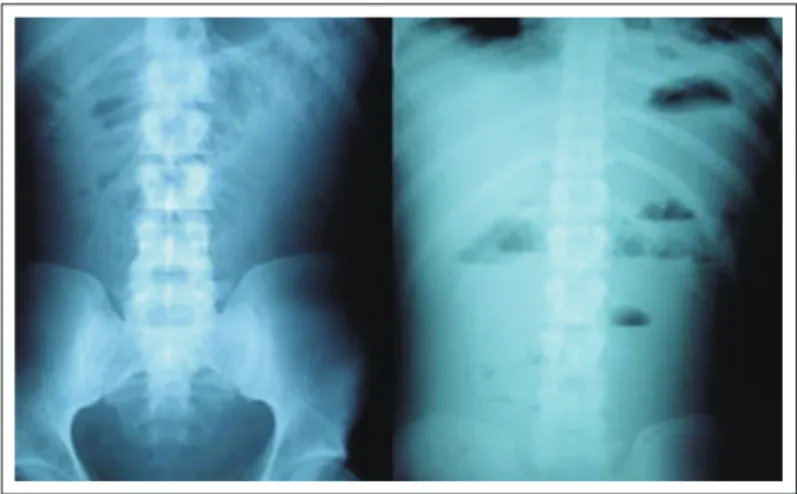
The acute abdomen X-ray showed hydro-aerial levels and small bowel dilatation, with “stack-of-coins” appearance (Figure 1).
The ultrasonography (US) showed enlarged kidneys and loss of cortico-medullary differentiation; moderate amount of
free luid in the peritoneal cavity, edema and thickening of the
small bowel loop, with increased echogenicity of the mesen-teric fat around it. The abdominal CT showed, in addition to
the US indings, liquid distension and thickening of the small
bowel loop wall, associated to PI (Figure 2).
The probable diagnosis of vasculitis of the small vessels of
the intestinal wall was attained through the CT, which justiied
the diffuse enteric involvement, loop edema and PI.
The surgical approach was chosen together with the con-servative treatment – antibiotic therapy by IV route, bowel rest and total parenteral nutrition (TPN) – while waiting for
the response to the pulse therapy. As there was free luid in the
cavity, a paracentesis was performed and bacterial peritonitis was ruled out.
There was improvement in abdominal pain. After 8 days, the patient started to have bowel movements. Four days later,
Figure 1 – X-ray of Acute Abdomen.
Bowel with “stack-of-coins” appearance and hydroaerial levels.
Figure 2 - Abdominal CT.
Systemic lupus erythematosus complicated by intestinal vasculitis and pneumatosis intestinalis
601
Bras J Rheumatol 2010;50(5):596-602
an oral diet was re-introduced and was well tolerated. A new
abdominal CT performed 10 days later demonstrated signii -cant improvement in the intestinal loop distension and wall edema, with disappearance of the PI.
The patient was discharged with oral prednisone (1 mg/ kg/d), in addition to planned monthly pulses of cyclophos-phamide IV. During the follow-up, he did not present new exacerbations of the intestinal picture.
DISCUSSION
The incidence of vasculitis of the gastrointestinal tract varies between 0.2% and 53% in lupus, with a close correlation with disease activity. There have been 14 cases of PI associated with SLE described in the literature. Underlying vasculitis was demonstrated in 50% of them.2,3,4,5,6
The vasculitis usually affects small vessels of the in-testinal wall. The histological assessment demonstrates atrophy and degeneration of the media, fibrinoid necrosis, thrombosis and lymphocytic infiltrate in lamina propria; the immunohistochemical analysis shows deposit of immune complexes, complement and fibrinogen.4,7 PI is
suppo-sedly caused by an increase in the intraluminal pressure, mucosal injury and gas production by bacteria in the mucosa.1,6,8The clinical picture is variable. It can manifest
as unspecific abdominal discomfort, diarrhea, abdominal distension, to acute abdomen with massive bleeding. The use of high-dose immunosuppressive drugs and corticoids can mask peritonitis. The absence of hydro-aerial noise and abdominal defense are late signs. Gastrointestinal tract vasculitis is almost always accompanied by activity in other organs, such as skin, kidneys and CNS.2,3,4,5 PI is
usually asymptomatic; however, the cysts can rupture and cause pneumoperitoneum.1,9,10There seems to be an
asso-ciation between new leukopenia and thrombocytopenia or worsening of the pre-existing leukopenia with intestinal vasculitis.4,7
The X-ray is usually normal at irst, but can demonstrate
signs of paralytic ileus, loop edema and pneumoperitoneum. X-rays with contrast medium can demonstrate sign of
“thumb-printing’ (edema or hemorrhage of submucosa, highly speciic
for intestinal ischemia) and escape of contrast medium in in-testinal perforation.4,5,7 The echography can demonstrate wall
thickening and the presence of free luid.4,11
The “gold standard” assessment is the computed
tomo-graphy (CT). The most frequent indings are loop edema,
wall thickening and loop enhancement by the contrast (target sign or double halo sign, highly suggestive of vasculitis). It
is also sensitive to detect collections of intramural gas, such as PI.4,8,9,10,11,12,13
Arteriography is not useful, as the disease usually affect small vessels. Endoscopy and colonoscopy are useful to locate ulcers and perform biopsies.4
The differential diagnosis is a challenge due to the multiple causes of abdominal pain in the patient with SLE.14
When there is no evidence of intestinal perforation, is-chemia is potentially reversible and a conservative treatment is indicated. That includes high-dose corticoids (prednisone 1-2 mg/kg/day) or pulse therapy with methylprednisolone 1 g/day, for 3 days. Intestinal rest must be associated (TPN). Prokinetic agents can improve the peristaltism and reduce intraluminal pressure. Intravenous antibiotic therapy is used as adjuvant in the presence of IP; it aims at reducing bacterial overgrowth and gas production by anaerobic bacteria.3,4,5,15
Cyclophosphamide pulse therapy, 0.75-1 g/m, is indicated in refractory cases.2,4,13
There have been reports on the use of inhaled oxygen or hyperbaric chamber in an attempt to remove the gas from the cysts and of octreotide to improve motility and reduce bacterial overgrowth.10
Prognosis is poorer when there is surgical indication, which can be improved when the procedure is perfor-med early.4,5,7 Early clinical suspicion and treatment are
essential for a good evolution. Factors associated with recurrence are thickening of the intestinal wall > 9 cm at the tomography and lower cumulative dose of immuno-suppressive agents.15
Although gastrointestinal tract vasculitis and IP are rare manifestations of SLE, the present case report describes a possible association between the two conditions.
REFERÊNCIAS
REFERENCES
1. Yamaguchi Y, Ohno S, Yamazaki S, Ideguchi H, Shirai A, Takeno M et al. A case of systemic lupus erithematosus complicated with pneumatosis cystoides intestinalis. Mod Rheumatol 2005; 15:440-4. 2. Machado WM, Freire BFA, Rocha OM, Azambuja CAP, Oliveira
MEC. Proposta de questionário para caracterização da prevalência de sintomas digestivos nas doenças difusas do tecido conjuntivo. Arq. Gastroenterol 2004; 1:64-70.
3. Grimbacher B, Huber M, Kempis J, Kalden P, Uhl M, Khöler G et al. Successful treatment of gastrointestinal vasculitis due to systemic erythematosus lupus with intravenous pulse cyclophosphamide: a clinical case report and review of the literature. B J Rheum 1998; 37:1023-8.
Marinello et al.
602 Bras J Rheumatol 2010;50(5):596-602
5. Hallequa DS, Wallace DJ. Gastrointestinal manifestations of systemic lupus erythematosus. Curr Opin Rheumatol 2000; 12:379-85.
6. Mizogushi F, Nanki T, Miyasaka N. Pneumatosis cystoides intestinalis following lupus enteritis and peritonitis. Inter Med 2008; 47:1267-71.
7. Lee CK, Ahn MS, Lee EY, Shin JH, Cho YS, Ha HK et al. Acute abdominal pain in systemic lupus erythematosus: focus on lupus enteritis (gastrointestinal vasculitis). Ann Rheum Dis 2002; 61:547-50.
8. Freiman D, Chon H, Bilaniuk L. Pneumatosis intestinalis in systemic lupus erythematosus. Radiology 1975; 116:563-4.
9. Hiraishi T, Tokuda M, Mitsunaka H, Dobashi H, Takahara J. Assymptomatic pneumatosis cystoides intestinalis in a patient with systemic lupus erythematosus. Ryumachi 1999; 39:580-5. 10. Atsumi T, Sagawa A, Watanabe I, Amasaki Y, Katsumata K,
Nakabayashi T et al. Pneumoperitoneum without perforation of the gastrointestinal tract in a patient with systemic lupus erythematosus. Ryumachi 1991; 31:398-404.
11. Caiado AHM, Menezes MR, Ishikawa WY, Gattas G, Sampaio ML, Yamashiro E et al. Qual o seu diagnóstico? Radiol Bras 2003; 36:V-VII.
12. Byun JY, Ha HK, Yu SY, Min KJ, Park SH, Kim HY et al. CT Features of systemic lupus erythematosus in patients with acute abdominal pain: emphasis on ischemic bowel disease. Radiology 1999; 211:203-9.
13. Laing TJ. Gastrointestinal vasculitis and pneumatosis intestinalis due to systemic lupus erythematosus: successful treatment with pulse intravenous cyclophosphamide. Am J Med 1988; 85:555-8.
14. Osler W. On the visceral complications of erythema exudativum multiforme. Am J Med Sci 1895; 110:629-46.