ORIGINAL ARTICLE
Associations of cerebrovascular metabolism genotypes
with neuropsychiatric symptoms and age at onset of
Alzheimer’s disease dementia
Fabricio F. de Oliveira,
1Elizabeth S. Chen,
2Marilia C. Smith,
2Paulo H. Bertolucci
11Departamento de Neurologia e Neurocirurgia, Escola Paulista de Medicina (EPM), Universidade Federal de Sa˜o Paulo (UNIFESP), Sa˜o Paulo, SP, Brazil.2Departamento de Morfologia e Gene´tica, EPM, UNIFESP, Sa˜o Paulo, SP, Brazil.
Objective:To study associations of cerebrovascular metabolism genotypes and haplotypes with age at Alzheimer’s disease dementia (AD) onset and with neuropsychiatric symptoms according to each dementia stage.
Methods: Consecutive outpatients with late-onset AD were assessed for age at dementia onset and Neuropsychiatric Inventory scores according to Clinical Dementia Rating scores, apolipoprotein E gene (APOE) haplotypes, angiotensin-converting enzyme gene (ACE) variants rs1800764 and rs4291, low-density lipoprotein cholesterol receptor gene (LDLR) variants rs11669576 and rs5930, cholesteryl ester transfer protein gene (CETP) variants I422V andTaqIB, and liver X receptor beta gene (NR1H2) polymorphism rs2695121.
Results: Considering 201 patients, only APOE-e4 carriers had earlier dementia onset in multiple correlations, as well as less apathy, more delusions, and more aberrant motor behavior. Both ACE polymorphisms were associated with less intense frontally mediated behaviors. Regarding LDLR variants, carriers of the A allele of rs11669576 had less anxiety and more aberrant motor behavior, whereas carriers of the A allele of rs5930 had less delusions, less anxiety, more apathy, and more irritability.CETPvariants that included G alleles of I422V andTaqIB were mostly associated with less intense frontally mediated behaviors, while severely impaired carriers of the T allele of rs2695121 had more anxiety and more aberrant motor behavior.
Conclusion:Though onlyAPOE haplotypes affected AD onset, cerebrovascular metabolism geno-types were associated with differences in several neuropsychiatric manifestations of AD.
Keywords: Alzheimer disease; dementia; cerebrovascular disorders; genetics; neuropsychiatry
Introduction
Cerebrovascular risk factors play an important role in the pathogenesis of Alzheimer’s disease dementia (AD). When present in midlife, pooled cerebrovascular risk factors synergistically increase AD risk and lower the age at AD onset.1As a result, these patients usually present with a combination of AD and vascular neuropathological pro-files.2Conversely, we have previously shown that higher cerebrovascular risk in late life leads to cognitive and functional stabilization or even improvement for patients with AD, possibly related to enhanced cerebral perfu-sion,3though some studies have shown that cerebrovas-cular risk factors may lead to faster cognitive decline.2
The astrocyte-secreted apolipoprotein E is a cholesterol-binding lipoprotein that transports cholesterol through cell membranes4 and is involved in cholinergic dysfunction,5
atherogenesis, and amyloidogenesis,6 besides being a
high-affinity ligand for the low-density lipoprotein receptor (LDLR) within the central nervous system.7 The apolipo-protein E gene (APOE) is a moderately penetrant gene that is neither a prerequisite nor a sufficient agent for development of AD, despite the fact that APOE-e4 is the most important genetic risk factor for incidence8and earlier
onset of late-onset AD,1 while also affecting behavioral performance2and decreasing prospective physical activity in such patients.3APOE-e4 carriers are also more prone to decreased risk of dementia associated with physical activity,9while neuropsychiatric assessment findings may
correlate with specific biomarkers.10
Several other genetic variants involved in cerebrovas-cular metabolism have been associated with AD. The two functional variants of the angiotensin-converting enzyme gene (ACE) with the most significant effects for higher activity and boosted serum levels of the angiotensin-converting enzyme (ACE) are the promoter polymorphisms rs1800764 and rs4291, affecting risk and age at onset of the amnestic phenotype of AD,11as well as cognitive
decline and incidence of early-onset hypertension.12 The LDLR mediates increased astrocytic expression of APOE
induced by amyloid-b,4 whereas storage and release of cholesterol depend on the expression of the low-density lipoprotein receptor gene (LDLR), which resides within a
Correspondence: Fabricio Ferreira de Oliveira, Departamento de Neurologia e Neurocirurgia, Escola Paulista de Medicina, Universi-dade Federal de Sa˜o Paulo, Rua Botucatu 740, CEP 04023-900, Sa˜o Paulo, SP, Brazil.
E-mail: [email protected]
Submitted Apr 26 2016, accepted Jul 05 2016, Epub Jan 12 2017.
region linked to AD in 19p13.3; rs116695767and rs593013
are two of the most important genetic variants of the epidermal growth factor precursor homology domain of
LDLRto be associated with disrupted cholesterol metabo-lism and variability in the risk of AD. Cholesterol governs synaptogenesis and myelin biosynthesis,14while the cho-lesteryl ester transfer protein (CETP) is associated with reverse cholesterol transport (from tissues to the liver)5;
protective cholesteryl ester transfer protein gene (CETP) variants lead to lower serum CETP levels and healthier lipid profiles,15though not all studies have shown gene-tically mediated lifetime cognitive effects.16 Nevertheless, the A allele of rs708272 (TaqIB) is associated with lower serum CETP activity and lower coronary heart disease risk,17while the G allele of rs5882 (I422V) has been asso-ciated with lower serum CETP levels and greater white matter integrity in young adults,14as well as with preserved
cognitive function in longevity18and less medial temporal lobe atrophy inAPOE-e4 carriers with AD.19Moreover, the
nuclear liver X receptorb(LXR-b) isoform is also expres-sed in the brain,4 acting as a regulator of cholesterol homeostasis, controlling amyloidogenesis, and modulating inhibition of angiotensin II, while several variants of the LXR-b gene (NR1H2) close to APOEin chromosome 19 have also been linked with variable risk of AD.20
We aimed to examine associations of genetic variants ofAPOE,ACE,LDLR,CETP, and intron 2 ofNR1H2with age at onset of late-onset AD and with neuropsychiatric symptoms, stratified by stage of dementia.
Methods
Participants
In this cross-sectional study, consecutive outpatients with late-onset AD according to U.S. National Institute on Aging-Alzheimer’s Association criteria21were recruited from the Setor de Neurologia do Comportamento, Hospital Sa˜o Paulo, Universidade Federal de Sa˜o Paulo (UNIFESP), Sa˜o Paulo, SP, Brazil, from October 2010 to February 2013. All outpatients with this diagnosis who were followed during the study period were recruited. Late-onset AD was defined as AD with onset of dementia syndrome after age 60 years.1All patients underwent magnetic resonance
imaging (MRI) to evaluate either medial parietal or medial, basal, or lateral temporal atrophy or, in cases of claus-trophobia or pacemaker use, a computed tomography (CT) scan to exclude vascular lesions. Patients with history of stroke were not included in the study.
A detailed self-report and/or proxy report was con-ducted for assessment of age at AD onset, years of school-ing, gender, and history of antipsychotic and antidepressant therapy. Information on age at dementia onset was obtained through a review of medical records and confirmed after an interview with the caregiver (preferably a family member), who was required to visit the patient frequently. The time of onset of subjective memory complaints or mild cognitive impairment was not taken into account; rather, only the time of dementia onset (when functional decline actually began) was considered. Use of antipsy-chotics or antidepressants was quantified in patients who
had been receiving them for at least 3 months before the evaluation, to ensure that proper clinical response result-ing from stability of drug levels in the central nervous system had been achieved, as well as because follow-up assessments at the study facility are usually conducted in 3-month intervals.
Neuropsychiatric assessment
A thorough neuropsychiatric evaluation was conducted, with particular attention to caregiver-reported Clinical Demen-tia Rating (CDR)22and the 10-item version of the Neuro-psychiatric Inventory, which does not take into account night-time behavior disturbances or appetite and eating abnormalities.23Effects of body mass index on age at AD onset1 and cognitive and functional change3 have been
previously assessed in our population, and associations of sleep duration and sleep satisfaction with neuropsychiatric symptoms and APOE haplotypes have been described elsewhere.24Ratings for the final score of each item in the Neuropsychiatric Inventory took into account the frequency and severity of each patient’s behaviors, while the total score was the sum of the subscale scores. All functional and behavioral assessments were conducted on weekday mornings, by the same examiner (FFO).
Genotyping procedures
Blood samples were collected from all patients into tubes containing 0.1% ethylenediaminetetraacetic acid (EDTA). Genomic DNA was extracted from these samples using a standard salting-out procedure for determination ofAPOE
haplotypes (polymorphisms rs7412 and rs429358), ACE
genotypes and haplotypes (polymorphisms rs1800764 and rs4291),LDLRgenotypes and haplotypes (polymorphisms rs11669576 and rs5930),CETPgenotypes and haplotypes (polymorphisms rs5882 and rs708272), and genotypes of rs2695121 (intron 2 of theNR1H2gene). All single nucle-otide polymorphisms (SNPs) were assessed by real-time polymerase chain reactions using TaqMan®
SNP Geno-typing Assays on the Applied Biosystems®7500 Fast Real-Time PCR System (Applied Biosystems®
, Carlsbad, USA). Standard manufacturer protocols were followed. Geno-typing procedures were carried out only after clinical data had been collected from all patients, thus ensuring observer blinding to genetic data.
Outcome measures
Primarily, we sought to determine associations of genetic variants ofAPOE,ACE,LDLR,CETP, and intron 2 of the LXR-b gene NR1H2 with age at AD onset and neuro-psychiatric symptoms, stratified by dementia stage. Sec-ondarily, we also investigated combined associations of gender and schooling with age at AD onset, as well as associations of gender, schooling, age at dementia onset, antipsychotic therapy, and antidepressant therapy with each neuropsychiatric symptom according to CDR scores.22 Finally, frequencies and scores for all behavioral symp-toms were compared according to stage of dementia.
Rev Bras Psiquiatr. 2017;39(2)
Statistical analysis
Associations of APOE haplotypes, ACE genotypes and haplotypes of rs1800764 and rs4291, LDLR genotypes and haplotypes of rs11669576 and rs5930,CETP geno-types and haplogeno-types of rs5882 and rs708272, and genotypes of rs2695121 with age at AD onset were investigated independently by way of the Mann-Whitney
Utest and further assessed in combination in a multiple linear regression model that included male gender and schooling as covariates. Multiple linear regression models including a copy of each minor allele, each copy ofAPOE-e4, male gender, years of schooling, age at dementia onset, antipsychotic therapy, and antidepressant therapy were employed at each dementia stage to investigate associa-tions of these factors with each behavioral symptom and with Neuropsychiatric Inventory total scores. Each haplo-type that was represented in at least three patients was associated with each behavioral symptom and with Neuropsychiatric Inventory total scores at each dementia stage by the Mann-WhitneyUtest. The threshold of signifi-cance was set at po0.05.
Ethical considerations
This study is part of a larger research project (1067/10) approved by the Ethics Committee of Hospital Sa˜o Paulo, UNIFESP, in August 2010 (CAAE 0540.0.174.000-10). All invited patients and their legal representatives agreed to participate in the study and provided written informed consent before the evaluation.
Results
At the end of the recruitment period, 217 patients had been included. Of these, 16 (7.4%) were excluded due to missing genetic information, resulting in a final sample of 201 patients.
Table 1 shows demographic and clinical results for the final sample. More than two-thirds of patients were female, 47 patients (23.4%) received antipsychotic treatment, and 85 (42.3%) were on at least one antidepressant.
Table 2 reports genotypes and haplotypes for the final sample. Overall, 108 patients (53.7%) were APOE-e4 carriers, while 93 (46.3%) were APOE-e4 non-carriers. All assessed genetic variants were in Hardy-Weinberg equilibrium.
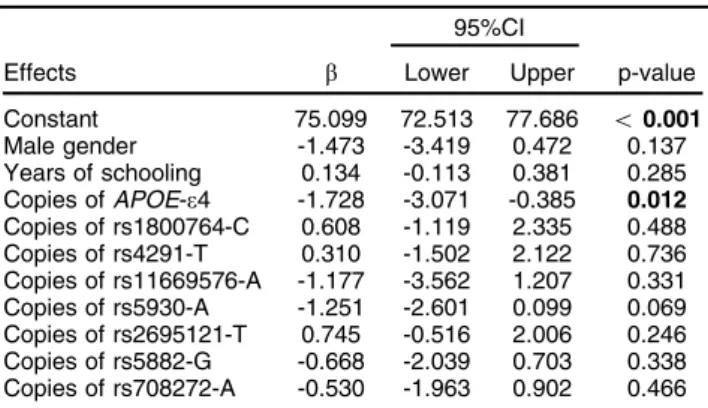
Regarding independent haplotypes that could affect age at dementia onset, we found that APOE-e4/e4 car-riers had earlier dementia onset by 4.31 years (p = 0.001), rs5882-AA/rs708272-AG carriers had later dementia onset by 1.77 year (p = 0.048), rs5882-AG/rs708272-AA carriers had earlier dementia onset by 4.55 years (p = 0.014), and rs11669576-GG/rs5930-GG carriers had later dementia onset by 2.14 years (p = 0.021). The only isolated genotype that affected age at AD onset was rs5882-AA: carriers had later dementia onset by 1.76 year (p = 0.018), but this analysis did not survive multiple correlations. According to Table 3, the only variable to affect age at AD onset in a multiple linear regression model was the APOEhaplotype: each copy ofAPOE-e4 led to earlier dementia onset by 1.728 year (p = 0.012).
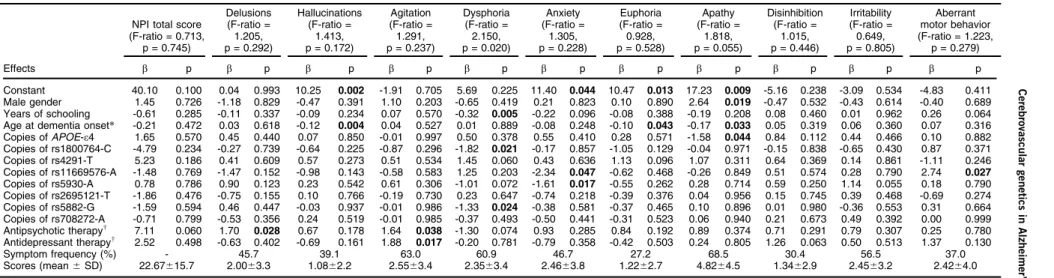
Tables 4, 5, and 6 show the results of multiple linear regression analyses regarding factors that may affect
Table 1 Demographic and clinical profile (n=201)
Assessed factors n (%) Mean6SD Range
Gender
Female 141 (70.1) -
-Male 60 (29.9) -
-Age at dementia onset (years) - 73.5366.3 60.0-88.0
Schooling (years) - 4.2263.7 0-15
Neuropsychiatric Inventory score (0-120 points) - 22.11616.3 0-87
Antipsychotic therapy (mg/day)
Olanzapine 1 (0.5) 10.0060.0 10-10
Quetiapine 36 (17.9) 70.83674.5 25-400
Risperidone 10 (5.0) 1.9060.9 1.0-4.0
Antidepressant therapy (mg/day)*
Amitriptyline 1 (0.5) 25.0060.0 25-25
Bupropion 8 (4.0) 150.0060.0 150-150
Citalopram 18 (9.0) 23.3367.7 20-40
Clomipramine 1 (0.5) 25.0060.0 25-25
Escitalopram 3 (1.5) 10.0060.0 10-10
Fluoxetine 11 (5.5) 27.27610.1 20-40
Mirtazapine 2 (1.0) 30.0060.0 30-30
Nortriptyline 1 (0.5) 10.0060.0 10-10
Paroxetine 8 (4.0) 27.50614.9 20-60
Sertraline 25 (12.4) 60.00620.4 50-100
Trazodone 9 (4.5) 61.11622.0 50-100
Venlafaxine 3 (1.5) 175.006114.6 75-300
*Overall, 85 patients (42.3%) used antidepressants during the evaluation, five of whom were on two antidepressants at the same time: one took bupropion 150 mg/day+trazodone 50 mg/day, one took citalopram 20 mg/day+mirtazapine 30 mg/day, and three took sertraline 50 mg/day+trazodone 50 mg/day.
each behavioral symptom and Neuropsychiatric Inventory total score for patients who were mildly impaired (CDR = 1.0), moderately impaired (CDR = 2.0), and severely impaired (CDR = 3.0), respectively. Overall, Neuropsy-chiatric Inventory total scores increased according to dementia severity. For mildly impaired patients (n=78), anxiety was the most frequent and highest-scored symp-tom, while euphoria was the least frequent and hallucina-tions were the lowest-scored symptom. For moderately impaired patients (n=92), apathy was the most frequent and the highest-scored symptom, while euphoria was the least frequent and hallucinations were the lowest-scored symptom. For severely impaired patients (n=31), apathy was the most frequent and highest-scored symptom, while euphoria was the least frequent and lowest-scored symptom.
Considering associations of independent haplotypes with behavioral scores in mildly impaired patients, rs1800764-CC/rs4291-AT carriers (n=10) had more hallucinations (1.4062.6 versus 0.1560.4, p=0.031), rs1800764-CT/rs4291-AA carriers (n=11) had more dis-inhibition (1.0061.3 versus 0.3961.3, p=0.021) and more irri-tability (3.0064.1 versus 1.1263.0, p=0.022), rs1800764-TT/ rs4291-AA carriers (n=19) had more agitation (3.3263.1 versus 1.6963.1, p=0.017), rs11669576-AG/rs5930-AG carriers (n=5) had more apathy (7.2063.6 versus 3.1963.7, p=0.026), rs11669576-AG/rs5930-GG carriers (n=8) had less apathy (1.0062.1 versus 3.7363.8, p=0.033), rs5882-AA/rs708272-AG carriers (n=14) had lower Neuropsychiatric Inventory total scores (9.866
6.7 versus 18.66611.3, p=0.007) and less irritability (0.576
0.8 versus 2.8063.1, p=0.008), rs5882-AA/rs708272-GG carriers (n=13) had higher Neuropsychiatric Inventory total scores (24.3869.4 versus 15.62611.0, p=0.007) and more apathy (5.3163.4 versus 3.0863.8, p=0.041) and more dysphoria (3.3863.8 versus 1.3462.2, p=0.036), rs5882-AG/ rs708272-GG carriers (n=12) had less anxiety (1.4262.7 versus 4.3964.5, p=0.025), and rs5882-GG/rs708272-AG carriers (n=5) had more delusions (3.4065.1 versus 0.5861.7, p=0.027).
Table 2 Genetic analysis findings (n=201)
Genotypes and haplotypes n (%) p-value*
APOEhaplotypes
e4/e4 23 (11.4)
-e4/e3 78 (38.8)
-e4/e2 7 (3.5)
-e3/e3 83 (41.3)
-e3/e2 10 (5.0)
-e2/e2 0 (0.0)
-rs1800764 genotypes
CC 53 (26.4) 0.291
CT 93 (46.3)
TT 55 (27.3)
rs4291 genotypes
AA 93 (46.3) 0.245
AT 82 (40.8)
TT 26 (12.9)
ACEhaplotypes
rs1800764 CC/rs4291 AA 7 (3.5)
-rs1800764 CC/rs4291 AT 20 (10.0) -rs1800764 CC/rs4291 TT 26 (12.9) -rs1800764 CT/rs4291 AA 31 (15.4) -rs1800764 CT/rs4291 AT 62 (30.9)
-rs1800764 CT/rs4291 TT 0 (0.0)
-rs1800764 TT/rs4291 AA 55 (27.3)
-rs1800764 TT/rs4291 AT 0 (0.0)
-rs1800764 TT/rs4291 TT 0 (0.0)
-rs11669576 genotypes (LDLR8)
AA 2 (1.0) 0.425
AG 27 (13.4)
GG 172 (85.6)
rs5930 genotypes (LDLR10)
AA 23 (11.4) 0.593
AG 95 (47.3)
GG 83 (41.3)
LDLRhaplotypes
rs11669576 AA/rs5930 AA 0 (0.0)
-rs11669576 AA/rs5930 AG 0 (0.0)
-rs11669576 AA/rs5930 GG 2 (1.0)
-rs11669576 AG/rs5930 AA 0 (0.0)
-rs11669576 AG/rs5930 AG 10 (5.0) -rs11669576 AG/rs5930 GG 17 (8.5) -rs11669576 GG/rs5930 AA 23 (11.4) -rs11669576 GG/rs5930 AG 85 (42.3) -rs11669576 GG/rs5930 GG 64 (31.8)
-rs2695121 genotypes (NR1H2gene)
CC 76 (37.8) 0.691
CT 93 (46.3)
TT 32 (15.9)
rs5882 genotypes (CETPgene)
AA 75 (37.3) 0.412
AG 100 (49.8)
GG 26 (12.9)
rs708272 genotypes (CETPgene)
AA 21 (10.5) 0.058
AG 106 (52.7)
GG 74 (36.8)
CETPhaplotypes
rs5882 AA/rs708272 AA 3 (1.5)
-rs5882 AA/rs708272 AG 38 (18.9)
-rs5882 AA/rs708272 GG 34 (16.9)
-rs5882 AG/rs708272 AA 11 (5.5)
-rs5882 AG/rs708272 AG 56 (27.8)
-rs5882 AG/rs708272 GG 33 (16.4)
-rs5882 GG/rs708272 AA 7 (3.5)
-rs5882 GG/rs708272 AG 12 (6.0)
-rs5882 GG/rs708272 GG 7 (3.5)
-ACE= angiotensin-converting enzyme gene;APOE=
apolipoprotein E gene;CETP= cholesteryl ester transfer protein gene;LDLR= low-density lipoprotein cholesterol receptor gene; NR1H2= liver X receptor beta gene.
*Hardy-Weinberg equilibrium (chi-square test).
Table 3 Multiple linear regression for age at AD onset (n=201)
95%CI
Effects b Lower Upper p-value
Constant 75.099 72.513 77.686 o0.001 Male gender -1.473 -3.419 0.472 0.137 Years of schooling 0.134 -0.113 0.381 0.285 Copies ofAPOE-e4 -1.728 -3.071 -0.385 0.012 Copies of rs1800764-C 0.608 -1.119 2.335 0.488 Copies of rs4291-T 0.310 -1.502 2.122 0.736 Copies of rs11669576-A -1.177 -3.562 1.207 0.331 Copies of rs5930-A -1.251 -2.601 0.099 0.069 Copies of rs2695121-T 0.745 -0.516 2.006 0.246 Copies of rs5882-G -0.668 -2.039 0.703 0.338 Copies of rs708272-A -0.530 -1.963 0.902 0.466
F-ratio = 2.044; multiple R = 0.312; adjusted squared multiple R = 0.050; p = 0.031.
95%CI = 95% confidence interval; AD = Alzheimer’s disease dementia;APOE= apolipoprotein E gene.
Results in bold are significant.
Rev Bras Psiquiatr. 2017;39(2)
Table 4 Multiple linear regression analysis of each neuropsychiatric symptom in mildly impaired patients (CDR = 1.0) (n=78)
NPI total score (F-ratio =
1.655, p = 0.093)
Delusions (F-ratio = 1.717, p = 0.079)
Hallucinations (F-ratio =
1.741, p = 0.073)
Agitation (F-ratio = 1.245, p = 0.270)
Dysphoria (F-ratio = 1.351, p = 0.209)
Anxiety (F-ratio =
1.006, p = 0.456)
Euphoria (F-ratio = 0.860, p = 0.597)
Apathy (F-ratio =
0.789, p = 0.669)
Disinhibition (F-ratio =
1.422, p = 0.174)
Irritability (F-ratio = 1.317, p = 0.227)
Aberrant motor behavior (F-ratio = 0.831,
p = 0.627)
Effects b p b p b p b p b p b p b p b p b p b p b p
Constant 9.04 0.601 -0.47 0.884 -0.07 0.963 0.39 0.939 0.62 0.881 7.50 0.295 1.86 0.538 1.32 0.833 0.94 0.645 0.34 0.941 -3.39 0.520
Male gender 1.88 0.502 0.56 0.293 -0.11 0.684 -0.30 0.713 -0.94 0.163 -0.13 0.908 -0.31 0.521 0.55 0.586 -0.24 0.463 1.93 0.013 0.88 0.304
Years of schooling -0.26 0.389 -0.08 0.140 0.04 0.145 -0.10 0.277 -0.05 0.530 0.09 0.483 0.01 0.983 -0.10 0.382 -0.01 0.845 -0.08 0.314 0.02 0.817
Age at dementia onset* 0.06 0.792 0.01 0.814 -0.01 0.935 0.05 0.475 0.01 0.793 -0.07 0.458 -0.02 0.646 0.03 0.743 -0.01 0.861 0.01 0.798 0.04 0.568
Copies ofAPOE-e4 -1.37 0.490 0.03 0.930 0.02 0.907 0.42 0.467 0.02 0.973 -0.89 0.279 -0.40 0.248 -0.06 0.932 0.21 0.365 -0.45 0.403 -0.28 0.646
Copies of rs1800764-C 0.72 0.768 0.41 0.369 0.51 0.028 -1.15 0.109 -0.09 0.870 -0.01 0.997 0.33 0.428 -1.09 0.220 0.38 0.191 -0.01 0.981 1.43 0.056
Copies of rs4291-T -0.72 0.779 0.10 0.831 -0.17 0.472 -0.37 0.617 0.61 0.317 0.05 0.959 -0.65 0.147 0.99 0.286 -0.23 0.440 0.02 0.979 -1.07 0.171
Copies of rs11669576-A 1.69 0.599 0.52 0.390 0.07 0.815 0.03 0.970 0.14 0.859 -1.18 0.373 0.14 0.808 1.72 0.143 0.08 0.837 0.06 0.945 0.11 0.906
Copies of rs5930-A 0.64 0.752 -0.77 0.046 -0.37 0.051 0.30 0.615 -0.40 0.404 0.04 0.958 0.68 0.059 1.12 0.132 -0.30 0.212 -0.20 0.714 0.56 0.367
Copies of rs2695121-T -0.74 0.683 -0.15 0.658 -0.31 0.070 -0.41 0.443 0.12 0.785 0.55 0.462 -0.23 0.468 -0.33 0.612 -0.17 0.418 -0.17 0.726 0.37 0.503
Copies of rs5882-G 1.15 0.551 0.81 0.028 0.16 0.383 -0.01 0.979 -0.20 0.672 -0.59 0.458 -0.03 0.927 0.51 0.472 -0.36 0.117 0.31 0.560 0.57 0.336
Copies of rs708272-A -0.30 0.890 0.39 0.339 0.23 0.247 -0.25 0.690 -0.16 0.757 1.15 0.200 -0.13 0.732 -1.30 0.100 0.11 0.668 0.49 0.400 -0.83 0.208
Antipsychotic therapyw
13.35 0.009 -0.47 0.613 -0.45 0.330 2.74 0.062 1.75 0.142 2.92 0.156 0.12 0.887 0.97 0.588 1.69 0.005 2.39 0.078 1.67 0.269
Antidepressant therapyw 7.38
0.008 -0.40 0.434 0.33 0.194 0.55 0.489 1.38 0.035 1.93 0.087 0.70 0.139 1.25 0.207 0.11 0.739 0.98 0.182 0.55 0.504
Symptom frequency (%) - 23.1 17.9 50.0 52.6 67.9 16.7 60.3 20.5 65.4 26.9
Scores (mean6SD) 17.08611.1 0.7662.1 0.3161.0 2.0963.2 1.6862.6 3.9464.4 0.6061.8 3.4563.8 0.4761.3 2.4062.9 1.3863.2
APOE= apolipoprotein E gene; CDR = Clinical Dementia Rating; NPI = 10-item Neuropsychiatric Inventory; SD = standard deviation. *Age in years.w
Pharmacological therapy = yes or no. Results in bold are significant.
Table 5 Multiple linear regression analysis of each neuropsychiatric symptom in moderately impaired patients (CDR = 2.0) (n=92)
NPI total score (F-ratio = 0.713,
p = 0.745)
Delusions (F-ratio = 1.205, p = 0.292)
Hallucinations (F-ratio =
1.413, p = 0.172)
Agitation (F-ratio = 1.291, p = 0.237)
Dysphoria (F-ratio =
2.150, p = 0.020)
Anxiety (F-ratio =
1.305, p = 0.228)
Euphoria (F-ratio = 0.928, p = 0.528)
Apathy (F-ratio =
1.818, p = 0.055)
Disinhibition (F-ratio =
1.015, p = 0.446)
Irritability (F-ratio = 0.649, p = 0.805)
Aberrant motor behavior (F-ratio = 1.223,
p = 0.279)
Effects b p b p b p b p b p b p b p b p b p b p b p
Constant 40.10 0.100 0.04 0.993 10.25 0.002 -1.91 0.705 5.69 0.225 11.40 0.044 10.47 0.013 17.23 0.009 -5.16 0.238 -3.09 0.534 -4.83 0.411
Male gender 1.45 0.726 -1.18 0.829 -0.47 0.391 1.10 0.203 -0.65 0.419 0.21 0.823 0.10 0.890 2.64 0.019 -0.47 0.532 -0.43 0.614 -0.40 0.689
Years of schooling -0.61 0.285 -0.11 0.337 -0.09 0.234 0.07 0.570 -0.32 0.005 -0.22 0.096 -0.08 0.388 -0.19 0.208 0.08 0.460 0.01 0.962 0.26 0.064
Age at dementia onset* -0.21 0.472 0.03 0.618 -0.12 0.004 0.04 0.527 0.01 0.889 -0.08 0.248 -0.10 0.043 -0.17 0.033 0.05 0.319 0.06 0.360 0.07 0.316
Copies ofAPOE-e4 1.65 0.570 0.45 0.440 0.07 0.850 -0.01 0.997 0.50 0.378 0.55 0.410 0.28 0.571 -1.58 0.044 0.84 0.112 0.44 0.466 0.10 0.882
Copies of rs1800764-C -4.79 0.234 -0.27 0.739 -0.64 0.225 -0.87 0.296 -1.82 0.021 -0.17 0.857 -1.05 0.129 -0.04 0.971 -0.15 0.838 -0.65 0.430 0.87 0.371
Copies of rs4291-T 5.23 0.186 0.41 0.609 0.57 0.273 0.51 0.534 1.45 0.060 0.43 0.636 1.13 0.096 1.07 0.311 0.64 0.369 0.14 0.861 -1.11 0.246
Copies of rs11669576-A -1.48 0.769 -1.47 0.152 -0.98 0.143 -0.58 0.583 1.25 0.203 -2.34 0.047 -0.62 0.468 -0.26 0.849 0.51 0.574 0.28 0.790 2.74 0.027
Copies of rs5930-A 0.78 0.786 0.90 0.123 0.23 0.542 0.61 0.306 -1.01 0.072 -1.61 0.017 -0.55 0.262 0.28 0.714 0.59 0.250 1.14 0.055 0.18 0.790
Copies of rs2695121-T -1.86 0.476 -0.75 0.155 0.10 0.766 -0.19 0.730 0.23 0.647 -0.74 0.218 -0.39 0.376 0.04 0.956 0.15 0.745 0.39 0.468 -0.69 0.274
Copies of rs5882-G -1.59 0.594 0.46 0.447 -0.03 0.937 -0.01 0.986 -1.33 0.024 -0.38 0.581 -0.37 0.465 0.10 0.896 0.01 0.980 -0.36 0.553 0.31 0.664
Copies of rs708272-A -0.71 0.799 -0.53 0.356 0.24 0.519 -0.01 0.985 -0.37 0.493 -0.50 0.441 -0.31 0.523 0.06 0.940 0.21 0.673 0.49 0.392 0.00 0.999
Antipsychotic therapyw 7.11 0.060 1.70 0.028 0.67 0.178 1.64 0.038 -1.30 0.074 0.93 0.285 0.84 0.192 0.89 0.374 0.71 0.291 0.79 0.307 0.25 0.780
Antidepressant therapyw
2.52 0.498 -0.63 0.402 -0.69 0.161 1.88 0.017 -0.20 0.781 -0.79 0.358 -0.42 0.503 0.24 0.805 1.26 0.063 0.50 0.513 1.37 0.130
Symptom frequency (%) - 45.7 39.1 63.0 60.9 46.7 27.2 68.5 30.4 56.5 37.0
Scores (mean6SD) 22.67615.7 2.0063.3 1.0862.2 2.5563.4 2.3563.4 2.4663.8 1.2262.7 4.8264.5 1.3462.9 2.4563.2 2.4264.0
APOE= apolipoprotein E gene; CDR = Clinical Dementia Rating; NPI = 10-item Neuropsychiatric Inventory; SD = standard deviation. *Age in years.wPharmacological therapy = yes or no.
Results in bold are significant.
Rev
B
ras
Psiquiatr
.
2017;39(2)
C
erebrovascular
genetics
in
Alzheimer’
s
d
Considering associations of independent haplotypes with behavioral scores in moderately impaired patients, rs1800764-CC/rs4291-AT carriers (n=8) had less agitation (0.3760.7 versus 2.7663.5, p=0.018), rs11669576-AG/ rs5930-GG carriers (n=7) had less apathy (2.0064.5 versus 5.0564.5, p=0.049), rs11669576-GG/rs5930-AA carriers (n=8) had less anxiety (0.1260.4 versus 2.686
3.9, p=0.033), rs11669576-GG/rs5930-AG carriers (n=42) had less irritability (3.2663.7 versus 1.7662.6, p=0.034), rs11669576-GG/rs5930-GG carriers (n=30) had less irritability (1.3762.4 versus 2.9763.4, p=0.006), rs5882-AG/ rs708272-AA carriers (n=8) had more agitation (4.7562.9 versus 2.3563.4, p=0.008) and more hallucinations (3.0063.8 versus 0.8961.9, p=0.018) and more disinhibition (4.0065.3 versus 1.0862.5, p=0.029), and rs5882-AG/ rs708272-AG carriers (n=23) had less agitation (1.3962.9 versus 2.9463.5, p=0.012).
Considering associations of independent haplotypes with behavioral scores in severely impaired patients, rs1800764-CT/rs4291-AA carriers (n=3) had more aber-rant motor behavior (9.3362.3 versus 3.1464.6, p=0.033), rs1800764-CT/rs4291-AT carriers (n=11) had less disin-hibition (1.2762.9 versus 3.3564.0, p=0.038), rs1800764-TT/ rs4291-AA carriers (n=12) had more disinhibition (4.2564.5 versus 1.5862.8, p=0.029), rs5882-AA/rs708272-AG car-riers (n=5) had more anxiety (8.0065.7 versus 2.3563.6, p=0.023), rs5882-AG/rs708272-AG carriers (n=11) had more irritability (6.0964.1 versus 2.3063.6, p=0.028), and rs5882-AG/rs708272-GG carriers (n=8) had less delu-sions (0.2560.5 versus 3.0063.9, p=0.017).
Discussion
With the exceptions of anxiety and irritability, a trend was found for all other behavioral symptoms to be intensified according to functional decline; likewise, most significant correlations were found in later dementia stages. Anxiety is usually inversely correlated with apathy,25whereas overall neuropsychiatric symptoms tend to correlate better with functional independence than with cognitive decline.25,26
Antipsychotic therapy was associated with higher Neu-ropsychiatric Inventory total scores for mildly impaired patients, particularly regarding disinhibition, and with more delusions and more agitation for moderately impaired patients, probably representing the need for psychotropic treatment when more behavioral symptoms are present, while agitation does not usually improve with atypical antipsychotics in the long term.26Likewise, antidepressant therapy was associated with higher Neuropsychiatric Inventory total scores for mildly impaired and severely impaired patients (particularly regarding dysphoria), and with more agitation for moderately impaired patients, also representing the expected need for such therapy accord-ing to symptoms of depression.
Male gender was associated with more irritability in mildly impaired patients, more apathy in moderately impaired patients, and higher Neuropsychiatric Inven-tory total scores, particularly regarding delusions, in severely impaired patients. Gender differences have been reported in other studies, particularly regarding greater anxiety and dysphoria in women.6
Table 6 Multiple linear regression analysis of each neuropsychiatric symptom in severely impaired patients (CDR = 3.0) (n=31) NPI total s core (F-ratio = 2 .801, p = 0.024) Delusions (F-ratio = 2.837, p = 0.023) Hallucinations (F-ratio = 1 .184, p = 0.366) Agitation (F-ratio = 1.205, p = 0.353) Dysphoria (F-ratio = 1.747, p = 0.140) Anxiety (F-ratio = 1.830, p = 0.121) Euphoria (F-ratio = 0.753, p = 0.694) Apathy (F-ratio = 1.592, p = 0.182) Disinhibition (F-ratio = 1.550, p = 0.196) Irritability (F-ratio = 1.225, p = 0.342) Aberrant motor behavior (F-ratio = 2 .339, p = 0.051) Effects b p b p b p b p b p b p b p b p b p b p b p Constant -106.0 0.056 -4.02 0.628 -21.57 0.092 -9.04 0.456 -6.52 0.550 -21.73 0.080 -9.91 0.372 -19.71 0.109 -27.17 0.018 -12.11 0.333 25.82 0.040 Male gender 20.44 0.043 5.52 0.002 2.38 0.292 -0.46 0.832 0.17 0.930 3.56 0.109 0.84 0.673 2.05 0.345 1.92 0.318 2.41 0.287 2.06 0.340 Years of s chooling -5.40 0.003 -0.03 0.901 -0.51 0.171 -0.76 0.044 -0.46 0.167 -0.70 0.057 -0.66 0.054 -0.28 0.431 -0.53 0.103 -0.83 0.034 -0.64 0.078 Age at dementia onset * 1.45 0.041 -0.03 0.784 0.28 0.086 0.14 0.366 0.19 0.189 0.26 0.099 0.11 0.443 -0.36 0.027 0.39 0.009 0.13 0.409 -0.37 0.022 Copies of APOE -e 4 11.00 0.116 2.98 0.011 0.45 0.777 1.23 0.431 -0.26 0.854 2.49 0.115 -0.03 0.984 -1.99 0.200 0.89 0.511 1.94 0.230 3.31 0.040 Copies of rs1800764-C -7.00 0.279 0.88 0.386 -1.19 0.428 -2.04 0.173 0.08 0.949 -0.09 0.948 -0.51 0.702 -1.34 0.354 -2.18 0.100 -1.58 0.297 0.96 0.502 Copies of rs4291-T -6.43 0.471 -2.52 0.084 -0.03 0.988 1.09 0.592 -3.83 0.049 -1.82 0.368 1.26 0.498 0.84 0.675 0.31 0.861 2.22 0.294 -3.95 0.060 Copies of rs11669576-A 7.53 0.638 -2.62 0.305 0.51 0.891 -1.31 0.720 4.08 0.227 1.82 0.615 0.74 0.825 5.73 0.125 0.86 0.789 -0.45 0.904 -1.82 0.615 Copies of rs5930-A 17.15 0.003 1.55 0.064 1.34 0.265 1.79 0.133 1.84 0.092 2.01 0.090 0.37 0.724 3.13 0.012 1.60 0.126 2.68 0.034 0.83 0.465 Copies of rs2695121-T 9.50 0.244 0.31 0.806 -0.09 0.963 1.05 0.567 -1.63 0.331 3.86 0.044 2.83 0.103 -1.52 0.402 -1.10 0.492 1.21 0.521 4.58 0.019 Copies of rs5882-G 2.61 0.680 0.38 0.706 2.52 0.102 2.07 0.165 -1.56 0.242 -3.08 0.043 0.84 0.528 1.09 0.449 1.51 0.241 1.41 0.349 -2.55 0.086 Copies of rs708272-A 16.69 0.036 4.18 0.002 1.41 0.420 0.07 0.967 0.18 0.906 4.66 0.012 1.41 0.369 -3.21 0.068 0.28 0.850 1.17 0.504 6.54 0.001 Antipsychotic therapy w 4.37 0.588 1.58 0.223 1.26 0.504 -0.48 0.794 0.16 0.924 0.81 0.656 1.16 0.494 -0.95 0.602 -0.52 0.748 0.81 0.670 0.54 0.764 Antidepressant therapy w 23.78 0.025 1.64 0.296 2.13 0.359 2.14 0.348 0.74 0.716 3.66 0.112 2.85 0.177 3.99 0.085 2.91 0.151 4.25 0.079 -0.54 0.806 Symptom frequency (%) -58.1 64.5 74.2 71.0 45.2 38.7 87.1 4 8.4 67.7 45.2 Scores (mean 6 SD) 33.10 6 22.4 2.29 6 3.6 2.94 6 4.1 3.16 6 4.0 3.55 6 4.0 3.26 6 4.4 1.87 6 3.3 6.03 6 4.2 2.61 6 3.7 3.65 6 4.1 3 .74 6 4.8 AP OE = apoli poprotei n E gene ; C DR = Clinical Demen tia R ating; NPI = 10-item N europsyc hiatri c Inve ntory; SD = standar d deviati on. * Age in years. wPharm acologi cal therapy = yes or no. R esults in bold are signi ficant.
Rev Bras Psiquiatr. 2017;39(2)
Schooling did not correlate with dementia onset in this sample. Nevertheless, more years of education were associated with less dysphoria in moderately impaired patients and with lower Neuropsychiatric Inventory total scores in severely impaired patients, particularly regard-ing agitation and irritability. Though an earlier study showed that educational attainment and AD duration did not affect behavior,25patients were not stratified by
dementia stage, and some associations may have been missed. Education enhances cognitive reserve and may affect the way the brain copes with the burden of AD neuropathology, thus modulating behavior.
Later dementia onset was associated with fewer hal-lucinations, less euphoria, and less apathy for moderately impaired patients. Considering that hallucinations are strong predictors of faster functional decline,26they may also be more frequent when dementia starts earlier. A high prevalence of hallucinations and extrapyramidal signs might predict the presence of Lewy bodies in patients with AD.27 In severely impaired patients, later dementia onset was associated with higher Neuropsy-chiatric Inventory total scores, particularly regarding dis-inhibition, but also with less apathy and less aberrant motor behavior, a complex link that could be partly due to
APOE-e4 non-carriers having later AD onset.
On analysis of multiple correlations, only APOE hap-lotypes affected the age at dementia onset in this sample, confirming the essential role of genetically mediated neurodegeneration on AD onset.1 Furthermore, mod-erately impaired APOE-e4 carriers had less apathy, whereas severely impaired APOE-e4 carriers had more delusions and more aberrant motor behavior. Whereas some cross-sectional studies have not found associations ofAPOEhaplotypes with specific neuropsychiatric symp-toms25or sleep satisfaction,24other studies have shown dose-dependent associations of copies ofAPOE-e4 with delusions,28 aberrant motor behavior,6 anxiety,29 and agitation.30Mechanisms involve atrophy of the prefrontal cortex,29 temporal lobe hypoperfusion,28 cholinergic imbalance,6 and tau-mediated disruption of frontal
ser-otonergic and dopaminergic networks.30 APOE haplo-types have also been associated with variable frequency of hallucinations.6,28The incidence of delusions and hal-lucinations tends to be dissociated, considering that in AD delusions are usually more common than hallucinations, while in Lewy body dementia syndromes, hallucinations are more common than delusions.31 Though
APOE-e4 carrier status seems to predispose to late-onset depres-sion,3particularly in women,32we did not find correlations
with dysphoria in our sample. Nevertheless, one study showed that women have earlier AD onset when they are
APOE-e4 carriers with a history of depression,33 confirm-ing that gender differences might affect dementia onset.
ConsideringACEgenotypes, carriers of the C allele of rs1800764 had more hallucinations when mildly impaired and less dysphoria when moderately impaired, whereas carriers of the T allele of rs4291 had less dysphoria when severely impaired. Regarding represented haplotypes in independent analyses, presence of the C allele of rs1800764 was associated with less agitation, while presence of the A allele of rs4291 was associated with
more agitation, more disinhibition, more irritability, and worse aberrant motor behavior. To the best of our knowledge, these are all previously unreported associations, while only the T allele of rs4291 was reported as a susceptibility factor for unipolar major depression and hypothalamic-hypophy-seal-adrenocortical axis hyperactivity in an earlier study of subjects without dementia.34 Given that angiotensin-con-verting enzyme degrades amyloid-b35and is overexpressed in a compensatory manner in the hippocampus, frontal cortex, and caudate nucleus of both hemispheres of patients with AD,12 suppression of frontally mediated behaviors could occur by boosted enzyme levels and activity. Func-tional studies are needed to confirm these associations.
ConsideringLDLRgenotypes, carriers of the A allele of rs11669576 had less anxiety and more aberrant motor behavior when moderately impaired, whereas carriers of the A allele of rs5930 had less delusions when mildly impaired, less anxiety when moderately impaired, and higher Neuropsychiatric Inventory total scores when severely impaired, particularly regarding apathy and irritability. Regarding represented haplotypes in independent ana-lyses, presence of the G allele of rs5930 was asso-ciated with less apathy in mildly and moderately impaired patients. Still, carriers of rs11669576-GG/rs5930-GG had later dementia onset. The A allele of rs11669576 has been associated with variable risk of AD, either increasing risk when in combination with copies ofAPOE-e47or decreas-ing risk - only in women - when in combination with other
LDLR polymorphisms,36 while the A allele of rs5930 was associated with lower risk of AD when combined with otherLDLRpolymorphisms in an earlier study.13Although
neuropsychiatric symptoms have not previously been studied in association with variants of LDLR, genotypes associated with less AD neuropathology36 could lead to later dementia onset and milder behavioral burden in earlier stages.
cognitive decline and higher risk of AD,38or with increased
risk of AD only forAPOE-e4 non-carriers.39The G allele of rs708272 and the G allele of rs5882 seemed to play protective roles in our sample, possibly by improving myelin biosynthesis in the brain.
Severely impaired carriers of the T allele of rs2695121 had more anxiety and more aberrant motor behavior. Among all polymorphisms of the LXR-b gene (NR1H2), the T allele of rs2695121 is the most significant for risk of AD,20though it had not been previously associated with
behavioral symptoms. Polymorphisms in cellular choles-terol efflux-related genes may affect the neuropsychiatric profile of patients with AD, as increased cholesterol levels induce amyloidogenesis.
An important limitation of this study is that it was con-ducted in a single center with no randomization. We tried to mitigate this drawback by ensuring that examiners were blinded to genetic data during the evaluations. In addition, the genotype and haplotype frequencies found were similar to those reported in most previous studies, confirming that our outpatient sample was probably representative of our population as a whole. The cross-sectional design of this study precludes deeper assumptions regarding causal relations. Even though APOE haplotypes were the only genetic factors to consistently affect age at AD onset, variants involved in cerebrovascular metabolism were associated with several behavioral symptoms, leading to the conclusion that cerebrovascular risk plays an important genetically mediated role in neuropsychiatric manifesta-tions of AD.
Acknowledgements
This work was sponsored by Coordenac¸a˜o de Aperfeic¸
o-amento de Pessoal de Nı´vel Superior (CAPES) (grant 1067/10) and Fundac¸a˜o de Amparo a` Pesquisa do Estado
de Sa˜o Paulo (FAPESP) (grant 2015/10109-5). FFO has received research support from CAPES and FAPESP. MCS has received grants from CAPES, Conselho Nacional de Desenvolvimento Cientı´fico e Tecnolo´gico (CNPq), and FAPESP. PHB has received grants from FAPESP.
Disclosure
FFO serves as a healthcare council member for Gerson Lehrman Group. PHB has served as a consultant for Lund-beck, Novartis, and Support. The other authors report no conflicts of interest.
References
1 de Oliveira FF, Bertolucci PH, Chen ES, Smith MC. Risk factors for age at onset of dementia due to Alzheimer’s disease in a sample of patients with low mean schooling from Sa˜o Paulo, Brazil. Int J Geriatr Psychiatry. 2014;29:1033-9.
2 Ferreira LK, Tamashiro-Duran JH, Squarzoni P, Duran FL, Alves TC, Buchpiguel CA, et al. The link between cardiovascular risk, Alzhei-mer’s disease, and mild cognitive impairment: support from recent functional neuroimaging studies. Rev Bras Psiquiatr. 2014;36:344-57. 3 de Oliveira FF, Pivi GA, Chen ES, Smith MC, Bertolucci PH. Risk factors for cognitive and functional change in one year in patients with Alzheimer’s disease dementia from Sa˜o Paulo, Brazil. J Neurol Sci. 2015;359:127-32.
4 Carter CJ. Convergence of genes implicated in Alzheimer’s disease on the cerebral cholesterol shuttle: APP, cholesterol, lipoproteins, and atherosclerosis. Neurochem Int. 2007;50:12-38.
5 Martins IJ, Berger T, Sharman MJ, Verdile G, Fuller SJ, Martins RN. Cholesterol metabolism and transport in the pathogenesis of Alzhei-mer’s disease. J Neurochem. 2009;111:1275-308.
6 Del Prete M, Spaccavento S, Craca A, Fiore P, Angelelli P. Neuropsychiatric symptoms and the APOE genotype in Alzheimer’s disease. Neurol Sci. 2009;30:367-73.
7 Retz W, Thome J, Durany N, Harsa´nyi A, Retz-Junginger P, Kornhuber J, et al. Potential genetic markers of sporadic Alzheimer’s dementia. Psychiatr Genet. 2001;11:115-22.
8 Bilbul M, Schipper HM. Risk Profiles of Alzheimer disease. Can J Neurol Sci. 2011;38:580-92.
9 Rovio S, Ka˚reholt I, Helkala EL, Viitanen M, Winblad B, Tuomilehto J, et al. Leisure-time physical activity at midlife and the risk of dementia and Alzheimer’s disease. Lancet Neurol. 2005;4:705-11.
10 Braun M, Tupper D, Kaufmann P, McCrea M, Postal K, Westerveld M, et al. Neuropsychological assessment: a valuable tool in the diagnosis and management of neurological, neurodevelopmental, medical, and psychiatric disorders. Cogn Behav Neurol. 2011;24: 107-14.
11 Vardy ER, Brown K, Stopford CL, Thompson JC, Richardson AM, Neary D, et al. Cognitive phenotypes in Alzheimer’s disease and genetic variants in ACE and IDE. Neurobiol Aging. 2012;33:1486.e1-2. 12 de Oliveira FF, Bertolucci PH, Chen ES, Smith MC. Brain-penetrating angiotensin-converting enzyme inhibitors and cognitive change in patients with dementia due to Alzheimer’s disease. J Alzheimers Dis. 2014;42:S321-4.
13 Gopalraj RK, Zhu H, Kelly JF, Mendiondo M, Pulliam JF, Bennett DA, et al. Genetic association of low density lipoprotein receptor and Alzheimer’s disease. Neurobiol Aging. 2005;26:1-7.
14 Warstadt NM, Dennis EL, Jahanshad N, Kohannim O, Nir TM, McMahon KL, et al. Serum cholesterol and variant in cholesterol-related gene CETP predict white matter microstructure. Neurobiol Aging. 2014;35:2504-13.
15 Sanders AE, Wang C, Katz M, Derby CA, Barzilai N, Ozelius L, et al. Association of a functional polymorphism in the cholesteryl ester transfer protein (CETP) gene with memory decline and incidence of dementia. JAMA. 2010;303:150-8.
16 Johnson W, Harris SE, Collins P, Starr JM, Whalley LJ, Deary IJ. No association of CETP genotype with cognitive function or age-related cognitive change. Neurosci Lett. 2007;420:189-92.
17 Thompson A, Di Angelantonio E, Sarwar N, Erqou S, Saleheen D, Dullaart RP, et al. Association of cholesteryl ester transfer protein genotypes with CETP mass and activity, lipid levels, and coronary risk. JAMA. 2008;299:2777-88.
18 Barzilai N, Atzmon G, Derby CA, Bauman JM, Lipton RB. A genotype of exceptional longevity is associated with preservation of cognitive function. Neurology. 2006;67:2170-5.
19 Murphy EA, Roddey JC, McEvoy LK, Holland D, Hagler DJ Jr, Dale AM, et al. CETP polymorphisms associate with brain structure, atrophy rate, and Alzheimer’s disease risk in an APOE-dependent manner. Brain Imaging Behav. 2012;6:16-26.
20 Infante J, Rodrı´guez-Rodrı´guez E, Mateo I, Llorca J, Va´zquez-Iguera JL, Berciano J, et al. Gene-gene interaction between heme oxyge-nase-1 and liver X receptor-band Alzheimer’s disease risk. Neurobiol Aging. 2010;31:710-4.
21 McKhann GM, Knopman DS, Chertkow H, Hyman BT, Jack CR Jr, Kawas CH, et al. The diagnosis of dementia due to Alzheimer’s disease: recommendations from the National Institute on Aging-Alzheimer’s Association workgroups on diagnostic guidelines for Alzheimer’s disease. Alzheimers Dement. 2011;7:263-9. 22 Chaves ML, Camozzato AL, Godinho C, Kochhann R, Schuh A,
de Almeida VL, et al. Validity of the clinical dementia rating scale for the detection and staging of dementia in Brazilian patients. Alzheimer Dis Assoc Disord. 2007;21:210-7.
23 Camozzatto AL, Kochhann R, Simeoni C, Konrath CA, Pedro Franz A, Carvalho A, et al. Reliability of the Brazilian Portuguese version of the Neuropsychiatric Inventory (NPI) for patients with Alzheimer’s disease and their caregivers. Int Psychogeriatr. 2008;20:383-93. 24 de Oliveira FF, Bertolucci PH, Chen ES, Smith Mde A. Assessment of
sleep satisfaction in patients with dementia due to Alzheimer’s dis-ease. J Clin Neurosci. 2014;21:2112-7.
Rev Bras Psiquiatr. 2017;39(2)
25 de Oliveira FF, Wajman JR, Bertolucci PH, Chen ES, Smith MC. Correlations among cognitive and behavioural assessments in patients with dementia due to Alzheimer’s disease. Clin Neurol Neurosurg. 2015;135:27-33.
26 de Oliveira FF, Bertolucci PH, Chen ES, Smith Mde A. Pharmaco-logical modulation of cognitive and behavioral symptoms in patients with dementia due to Alzheimer’s disease. J Neurol Sci. 2014;336:103-8. 27 Iqbal K, Flory M, Soininen H. Clinical symptoms and symptom
sig-natures of Alzheimer’s disease subgroups. J Alzheimers Dis. 2013; 37:475-81.
28 Scarmeas N, Brandt J, Albert M, Devanand DP, Marder K, Bell K, et al. Association between the APOE genotype and psychopathologic symptoms in Alzheimer’s disease. Neurology. 2002;58:1182-8. 29 Yoo HB, Lee HW, Shin S, Park SW, Choi JS, Jung HY, et al.
Butyrylcholinesterase K and apolipoprotein e4 affect cortical thick-ness and neuropsychiatric symptoms in Alzheimer’s disease. Curr Alzheimer Res. 2014;11:137-44.
30 Craig D, Hart DJ, McKool K, McIlroy SP, Passmore AP. Apolipo-protein E e4 allele influences aggressive behaviour in Alzheimer’s disease. J Neurol Neurosurg Psychiatry. 2004;75:1327-30. 31 Oliveira FF, Machado FC, Sampaio G, Marin SM, Chen ES, Smith
MC, et al. Contrasts between patients with Lewy body dementia syndromes and APOE-e3/e3 patients with late-onset Alzheimer dis-ease dementia. Neurologist. 2015;20:35-41.
32 Delano-Wood L, Houston WS, Emond JA, Marchant NL, Salmon DP, Jeste DV, et al. APOE genotype predicts depression in women with
Alzheimer’s disease: a retrospective study. Int J Geriatr Psychiatry. 2008;23:632-6.
33 de Oliveira FF, Bertolucci PH, Chen ES, Smith MC. Assessment of risk factors for earlier onset of sporadic Alzheimer’s disease dementia. Neurol India; 2014;62:625-30.
34 Baghai TC, Binder EB, Schule C, Salyakina D, Eser D, Lucae S, et al. Polymorphisms in the angiotensin-converting enzyme gene are associated with unipolar depression, ACE activity and hypercortiso-lism. Mol Psychiatry. 2006;11:1003-15.
35 Ning M, Yang Y, Zhang Z, Chen Z, Zhao T, Zhang D, et al.
Amyloid-b-related genes SORL1 and ACE are genetically associated with risk for late-onset Alzheimer disease in the Chinese population. Alzhei-mer Dis Assoc Disord. 2010;24:390-6.
36 La¨msa¨ R, Helisalmi S, Herukka SK, Tapiola T, Pirttila¨ T, Vepsa¨la¨inen S, et al. Genetic study evaluating LDLR polymorphisms and Alzhei-mer’s disease. Neurobiol Aging. 2008;29:848-55.
37 Li Q, Huang P, He QC, Lin QZ, Wu J, Yin RX. Association between the CETP polymorphisms and the risk of Alzheimer’s disease, carotid atherosclerosis, longevity, and the efficacy of statin therapy. Neuro-biol Aging. 2014;35:1513.e13-23.
38 Yu L, Shulman JM, Chibnik L, Leurgans S, Schneider JA, De Jager PL, et al. The CETP I405V polymorphism is associated with an increased risk of Alzheimer’s disease. Aging Cell. 2012;11:228-33.