RELATIONS BETWEEN ORTHOGRAPHIC AND
PHONETIC-PHONOLOGICAL ASPECTS OF PLOSIVE PHONEMES
Relações entre aspectos ortográficos
e fonético-fonológicos de fonemas oclusivos
Isabela de Oliveira Pezarini (1), Suellen Vaz (1), Larissa Paschoal (1), Lourenço Chacon (2)
(1) Universidade Estadual “Julio de Mesquita Filho” – FFC/
UNESP, Marília, São Paulo, Brasil.
(2) Universidade Estadual de São Paulo campi de Marília e
São José do Rio Preto, Marília, São Paulo, Brasil.
Conselho Nacional de Desenvolvimento Cientíico e Tecnoló -gico – CNPq
Fundação de Amparo à Pesquisa do Estado de São Paulo - FAPESP
Conlict of interest: non-existent
errors accomplished, but also, mainly, the way as the writing acquisition is expanded 1-3; (ii) to
investigations about the orthographic development in reading, written and phonological awareness tasks 4-10; and (iii) to the effectiveness of speech
therapy programs aiming the improvement of the students performance 11,12. In other work they
are also approached issues related to the infant authorship in the writing and to the criteria which characterize the errors as pathological 13,14.
Although it is veriied a lot of concern in the literature with the orthographic issues, few studies point out the relation among these subjects and phonetic-phonological aspects of language. However, recently, links among orthography and phonology have been investigated by the Group of Research “Studies about the writing language
INTRODUCTION
In the late studies about the acquisition of the writing, primarily, it is pointed out the performance of the students in tasks of orthography codiication and decoding. The prominence to this performance can be observed in guided studies: (i) to the orthog-raphy errors which describe not only the types of
ABSTRACT
Purposes: to describe the children’s orthographic performance – regarding to the record of plosive
consonants from the Brazilian Portuguese; check if the accent inluences the occurrence of mistakes inside the words; and classify the pattern of the mistakes distribution. Methods: 210 text productions
referred to 14 thematic proposals were analyzed, they were collected during the year 2001, when the individuals attended the First grade of Primary School. To describe the children’s performance, for the irst objective, the data were divided in Hits and Mistakes; for the second objective, the mistakes were classiied according to their occurrence in accented and non-accented syllables, and, inally, for the third objective, the mistakes were subclassiied in omissions, orthographic and phonological mistakes. The phonological mistakes were even subdivided, according to their occurrence inside and outside the occlusive class. Results: for the irst objective, 5.746 possibilities of occurrence of plosive
consonants in a position of simple syllable onset were found, with a high amount of hits; for the second objective, it was observed a higher occurrence of mistakes in non-accented syllables; and inally, for the third objective, it was possible to observe the predominance of phonological mistakes, followed by omissions and by orthographic mistakes, both inside the non-accented syllables and the accented ones. Still according to the third objective, in the phonological mistakes, a higher occurrence of mistakes inside the class was observed and, again, no accent inluence. Conclusion: the importance of the phonetic-phonological aspects analysis in the acquisition of child orthography is highlighted, as well as the relevance of the distribution of hits and mistakes in the orthographic performance.
However it was expected for the analysis a total of 210 textual productions (15 subjects x 14 proposals). Nevertheless due to 26 absences of children and to the discard of nine texts whose writing was charac-terized by random sequences of graphemes, the inal total of analyzed productions was 175 texts.
Regarding the way of analyzing the data, with the intention to describe the orthographic performance in the occlusive consonants in position of simple syllabic attack - irst goal -, the data were divided into (1) hits – when the occlusive phonemes were regis-tered according to the conventional orthography of the Brazilian Portuguese (BP); and (2) errors – when these same phonemes were not registered according to the conventional orthography of the BP.
After that, to verify whether the errors could be inluenced by the accent or not, of the syllable – second goal -, they were classiied as they occurred in (1) stressed syllables – registered occlusive phonemes (or not) in the stressed positions of words and in stressed monosyllables; and in (2) unstressed syllables – registered occlusive phonemes (or not) in pre-stressed, pos tonics positions and in unstressed monosyllables.
Finally, to verify the standard of the errors distri -bution – third goal -, they were sub classiied in: (a) omissions – when the occlusive phoneme was not registered orthographically, as for example, in the word PENTE written as PENE; (b) non phonological orthographic replacements – when the phoneme was registered by a grapheme which did not change its phonological value, as for example the word CORTA written as QORTA; and (c) phonological orthographic replacements – when the phoneme was registered by a grapheme which changed its phonological value, as for example the word GALO written as CALO.
The phonological orthographic replacements were subdivided yet as they occurred: inside the class (IC) and outside the class (OC). Therefore, when the replacement of the phoneme happened inside the class of the occlusive ones – as for example in the word COLA written as GOLA –, this replacement was classiied as IC. On the other side when the replacement involved phonemes of classes different from the occlusive ones – as for example the word GUERRA written as GERRA – it was classiied as OC.
Statistical analysis
A statistical treatment of the data was carried out with the use of the software Statistica (version 7.0) and descriptive and inferential analyses were accomplished.
acquisition” (GEALE/CNPq), from the Federal University of Pelotas (UFPel) 15-17. . Besides GEALE,
other work which investigate these same relations have been produced by the Group of Research “Studies about the language” (GPEL/CNPq) 18-26, hosted at FFC/UNESP. It is pointed out in the work developed by both groups, the investigation of a very diversiied set of orthographic and phonetic-phonological issues. Similarly to the investiga-tions accomplished by both groups, the present research also strove in analyzing the inluence of the phonetic-phonological aspects in the infant orthography acquisition. Nevertheless, pointing out on it, the phonology/orthography interface, it was proposed a more speciic investigation of the ortho-graphic performance of occlusive consonants of the Brazilian Portuguese (BP) in the position of simple syllabic attack - in other words, in the initial position of the syllable, not followed by another consonant, but by vowel - , investigation not covered yet, more particularly, in the literature.
The goals which guided the development of the research were (1) to describe the orthographic performance of children – regarding the registration of occlusive consonant of the BP; (2) to verify if the accent inluences the occurrence of errors inside the words; and (3) to classify the standard of the errors distribution.
METHODS
The present work had its development approved by the Ethics Committee in Research of Faculdade de Filosoia e Ciências da UNESP/ Marília under the number 0132/2010.
The data used were extracted from a bank which supports investigations of the Group of Research “Studies about the Language” (GPEL/CNPq). This bank is composed by textual productions collected by researchers from the GPEL, who followed the writing development of children from two municipal schools from São José do Rio Preto (SP) in the period 2001 and 2004. To select the children who would compose these databases, it was adopted as exclusion criterion complaints of learning or language development trouble.
RESULTS
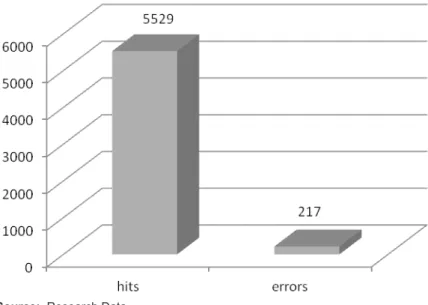
The results will be arranged according to the goals of the present research. As proposed in the irst goal, they were found 5.746 possibilities of occlusive consonants registration in the simple syllabic attack position. These possibilities resulted in writings with hits and errors, whose values will be exposed in Figure 1 and in the Table 1:
For the analysis of the data referring to the three goals proposed it was used the parametric test T-test to dependent variables, been considered statisti-cally relevant when α≤0,05. Also for the analysis of the third goal it was used the non parametric test
Friedman ANOVA and Kendall Coeff. of
concor-dance to dependent variables been considered
statistically relevant when α≤0,05.
Source: Research Data
Figure 1 – Hits and errors in occlusive consonants.
Table 1 - Hits and errors in occlusive consonants.
Accuracy Average Standard Deviation T-test
Hits 365,07 193,55 t=7,015
p=0,00 df=13
Errors 15,5 10,09
Source:Research data. Parametric test T-test to dependent variables (α≤0,05). t: value of the distribution T of
Student. df: degree of freedom
It is possible to observe, in the results presented, greater amount of hits, quantity which was shown statistically meaningful.
Finally, as exposed in the third goal, the errors were distributed according to their typology. The results will be available in Table 3:
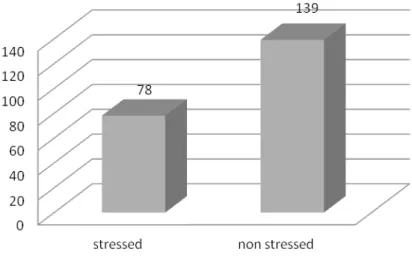
Through the results, it is observed that the accent inluences meaningfully the emergence of errors in non stressed syllables.
Source: Research Data
Figure 2 – Errors in stressed and non stressed syllables
Table 2 - Errors in stressed and non stressed syllables
Accuracy Average Standard Deviation T-test
Stressed 5,57 6,65 t=-2,33
p=0,037 df=13
Non stressed 9,93 5,58
Source: Research data. Parametric test T-test to dependent variables (α≤0,05). t: value of the distribution T of Student. df: degree of
freedom
Table3 - Distributions of errors
Total
Occurrences Average
Standard
Deviation Sum of rank
Friedman ANOVA and kendall coeff. of
concordance Non
phonological 25 1,78 1,53 20,5
(N= 14 df= 2) = 8,76
Phonological 122 8,71 7,39 36 p=0,01
Omissions 70 5 4,71 27,5
Source: Research data. non parametric test Friedman ANOVA and Kendall Coeff. of concordance (α≤0,05).
It is possible to observe the predominance of phonological errors, followed by omissions and non phonological errors.
Still according to the third goal, the phonological errors were sub classiied in IC and OC. The results of these sub classiication will be exposed in Table 5.
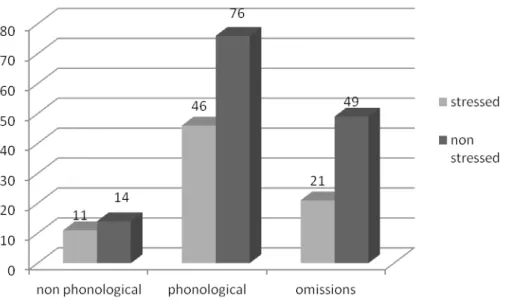
The results show greater occurrence of phono -logical errors among graphemes which refer to phonemes of the occlusive phonological class. It is possible to observe again predominance of
phonological errors, followed by the omissions and inally by the non phonological errors, both inside the stressed and non stressed syllables. It was also observed relevant statistic difference among stressed and non stressed syllables, only in the omissions.
Source: Research Data
Figure 3 – Typology of errors
Table 4 - Typology of errors
Syllables Average Standard Deviation T-test
Non phonological Stressed Non stressed
0,78 1
1,42 1,24
t=-0,37 p=0,72 df=13
Phonological Stressed Non stressed
3,28 5,43
4,51 3,99
t=-1,89 p=0,08 df=13
Omissions Stressed
Non stressed
1,5 3,5
1,83 3,59
t=-2,33 p=0,03 df=13
Source:Research data. Parametric test T-test to dependent variables (α≤0,05). t: value of the distribution T of
Student. df: degree of freedom
Table 5 - Distributions of phonological errors
Accuracy Total Occurrences Average Standard
Deviation T- test
Inside the class 79 5,64 4,70 t=2,73
Outside the class 43 3,07 3,38 p=0,01
df=13
Source:Research data. Parametric test T-test to dependent variables (α≤0,05). t: value of the distribution T of
they do not register it correctly. The greater number of omissions in the non stressed syllables, on its turn, is justiied for being less aurally noticeable as exposed previously.
Finally, but still considering the results found for the third goal, the greater occurrence of phonological orthographic errors which mobilized phonemes of the occlusive class suggests that the children studied in the present research understood well the phonetic-phonological aspects which distin-guish the occlusive phonemes from the phonemes which compose other phonological classes. It also suggests that these children already recognize which graphemes correspond to the phonemes of the occlusive phonological class.
On account of not being found studies developed with subject and methodology similar to the ones of the present study, it was not possible to establish comparisons among results. It is suggested then the accomplishment of more studies based in theoretical-methodological aspects similar to this one to future comparison of results.
CONCLUSION
The results of the present research point to the importance to take into account the inluence of the phonetic-phonological aspects to a better compre-hension of the orthographic performance of the occlusive phonemes in the infant orthography, to the extent that:
because of these aspects the children are more likely to hit than to misspell the occlusive phonemes;
the presence/absence of the accent interferes in the distribution among hits and errors;
this distribution is also affected by the trans -parency or by the opacity in the relation phoneme/ grapheme in the occlusive class.
ACKNOWLEDGEMENT
To the Conselho Nacional de Desenvolvimento Cientíico e Tecnológico (CNPq – Process 305206/2013-3) and to the Fundação de Amparo à Pesquisa do Estado de São Paulo (FAPESP – Process 2013/13814-6), by the inancing granted for the accomplishement of the research whose results were reported in the present article.
DISCUSSION
Regarding the result found in the irst goal – greater quantity of hits – it is possible to point out that the children of the present research, in spite of being in the beginning of their literacy showed meaningful stability regarding the registration of the occlusive consonants. This stability is not empha -sized in the literature which, mostly, points out the errors as indicators of the children orthographic performance 1-3 and disregards the importance of
hits on their characterization.
About the result found to the second goal – greater occurrence of errors in non stressed syllables – it can be justiied by the inluence of the phonetic aspects in the registration of the conso-nants. On account of the stressed syllable presents greater duration, greater intensity and more elevated frequency, this set of acoustic characteristics tends to result into more noticeable aurally syllables. On other hand, on account of the non stressed syllable presents shorter duration, shorter intensity and more lowered frequency, it tends to become less noticeable aurally; therefore the children tend to present greater dificulty in the registration of the occlusive consonants when they are found in non stressed syllables.
Regarding the results found to the third goal – greater quantity of phonological orthographic errors – it can be justiied by the predominance of the orthographic transparency of the occlusive phonemes. As a matter of fact, out of the six phonemes of this class, four (/p/, /b/, /t/ e /d/) present transparent spelling, in other words, present only one possibility of orthographic representation; thereby, a replacement which involves one of these phonemes will necessarily cause change of phono -logical value of the word. It can also be justiied, by the predominance of the transparency, the low occurrence of non phonological orthographic errors, once that, only two of the phonemes from this class (/k/ e /g/) do not present transparent relation among phoneme-grapheme.
7. Ferreira F, Correa J. Consciência metalinguística e a representação da nasalização na escrita do Português Brasileiro. Rev CEFAC. 2010;12(1):40-50. 8. Furnes B, Samuelsson S. Predicting reading and spelling dificulties in transparent and opaque orthographies: A Comparison between Scandinavian and US/Australian Children. Dislexia. 2010;16:119-42.
9. Pontes VL, Diniz NLF, Martins-Reis VO. Parâmetros e estratégias de leitura e escrita utilizados por crianças de escolas pública e privada. Rev CEFAC. 2013;15(4):827-36.
10. Galletly SA, Knight BA. Because trucks aren’t bicycles:orthographic complexity as an important variable in Reading research. Aust. Educ. Res. 2013;40:173-94.
11. Brito CLR, Uzêda CPQ, Vieira JG, Cavalheiro LG. Habilidades de letramento após intervenção fonoaudiológica em crianças do 1o ano do ensino fundamental. Rev. Soc. Bras. Fonoaudiol. 2010;15(1):88-95.
12. Cárnio MS, Pereira MB, Alves DC, Andrade RV. Letramento escolar de estudantes de 1a e 2a séries do ensino fundamental de escola pública. Rev. Soc. Bras. Fonoaudiol. 2011;16(1):1-8.
13. Machado MLCA, Berberian AP, Santana AP. Linguagem escrita e subjetividade: implicações do trabalho grupal. Rev CEFAC. 2009;11(4):713-9. 14. Massi G, Signor R, Berberian AP, Munhoz CMA, Guarinello AC, Krüger S et al. A análise de
REFERENCES
1. Capellini SA, Amaral AC, Oliveira AB, Sampaio MN, Fusco N, Cervera-Mérida JF et al. Desempenho ortográico de escolares do 2o ao 5o ano do ensino público. J. Soc. Bras. Fonoaudiol. 2011;23(3):227-36.
2. Rosa CC, Gomes E, Pedroso FS. Aquisição do sistema ortográico: desempenho na expressão escrita e classiicação. Rev CEFAC. 2012;14(1):39-45.
3. Capellini SA, Romero ACL, Oliveira AB, Sampaio MN, Fusco N, Cervera-Mérica JF et al. Desempenho ortográico de escolares do 2o ao 5o ano do ensino particular. Rev CEFAC. 2012;14(2):254-67.
4. Paolucci JF, Ávila CRB. Competência ortográica e metafonológica: inluências e correlações na leitura e escrita de escolares da 4o série. Rev. Soc. Bras. Fonoaudiol. 2009;14(1):48-55.
5. Nunes C, Frota S, Mousinho R. Consciência fonológica e o processo de aprendizagem de leitura e escrita: implicações teóricas para o embasamento da prática fonoaudiológica. Rev CEFAC. 2009;11(2):207-12.
6. Furnes B, Samuelsson S. Preschool cognitive and language skills predicting Kindergarten and Grade 1 reading and spelling: a cross-linguistic Comparison. J. Res. Read. 2009;32(3):275-92.
RESUMO
Objetivos: descrever o desempenho ortográico de crianças - quanto ao registro de consoantes
oclu-sivas do Português Brasileiro; veriicar se a acento inluencia a ocorrência de erros no interior das palavras; e classiicar o padrão da distribuição dos erros. Métodos: foram analisadas 210 produções
textuais referentes a 14 propostas temáticas, coletadas durante o ano de 2001, quando os sujeitos cursavam a 1ª série do Ensino Fundamental. Para descrever o desempenho das crianças, para o primeiro objetivo, os dados foram divididos em Acertos e Erros; para segundo objetivo, os erros foram classiicados em sílabas acentuadas e não-acentuadas, e, por im, para o terceiro objetivo, os erros foram subclassiicados em omissões, erros ortográicos e erros fonológicos. Os erros fonológicos foram subdivididos, ainda, conforme ocorressem dentro e fora da classe. Resultados: para o primeiro objetivo, encontraram-se 5.746 possibilidades de ocorrência de consoantes oclusivas na posição de ataque silábico simples, com maior quantidade de acertos; para o segundo objetivo, observou-se maior ocorrência de erros em sílabas não-acentuadas; e por im, para o terceiro objetivo, foi possível observar predomínio de erros fonológicos, seguidos pelas omissões e pelos erros ortográicos, tanto no interior das sílabas não-acentuadas quanto das acentuadas. Ainda conforme o terceiro objetivo, nos erros fonológicos, observou-se sua maior ocorrência dentro da classe; e novamente, não-inlu-ência do acento. Conclusão: conclui-se, então, a importância da análise dos aspectos
fonéticos--fonológicos na aquisição da ortograia infantil, bem como a relevância da distribuição dos acertos tanto como dos erros.
20. Komesu FC, Tenani LE. A relação fala-escrita em dados produzidos em contexto digital. Scripta. 2010;13:203-17.
21. Chacon L, Berti LC, Burgemeister A. Ortograia da nasalidade em ataque e coda silábica na escrita infantil: características fonéticas e fonológicas. Verba Volant. 2011;2:1-21.
22. Amaral AS, Freitas MCC, Chacon L, Rodrigues LL. Omissão de grafemas e características da sílaba na escrita infantil. Rev CEFAC. 2011;13:846-55. 23. Tenani LE, Reis MC. “E veveram felizes para sempre”: análise de graias não-convencionais de vogais pretônicas. Verba Volant. 2011;2:22-43. 24. Campos PBB, Tenani LE, Berti LC. Os registros não-convencionais da coda nasal em dados de EJA. Est. Linguíst. 2011;40:524-38.
25. Schier AC, Berti LC, Chacon L. Desempenho perceptual-auditivo eortográico de consoantes fricativas na aquisição da escrita. Codas. 2013;25(1):45-51.
26. Chacon L, Vaz S. Relações entre aquisição da percepção auditiva e aprendizagem da ortograia: consoantes soantes em questão. Ling. Disc. 2013;13(3):695-719.
elementos de referenciação em textos produzidos por sujeitos em processo de apropriação da escrita. Rev. Distúrb. Comum. 2009;21(2):169-78.
15. Adamoli MA, Miranda ARM. Do conhecimento fonológico ao conhecimento ortográico: as diferentes graias dos ditongos orais mediais ai e ei em textos de escrita inicial. Cad. Pesq. Ling. 2009;4:232-55.
16. Miranda ARM, Matzenauer CLB. Aquisição da fala e da escrita: relações com a fonologia. Cad. Educ. 2010;35:359-405.
17. Teixeira SM, Grassi LH, Oliveira ND, Miranda ARM. Uma relexão acerca do erro ortográico: a importância do conhecimento sobre a língua para a prática pedagógica de professores das séries iniciais. Verba Volant. 2011;2:78-94.
18. Cardoso MH, Rodrigues LL, Freitas MCC, Chacon L. A complexidade da coda silábica na escrita de pré-escolares. Rev. Distúrb. Comum. 2010;22:213-21.
19. Berti LC, Chacon L, Santos AP. A escrita de /aN/ por pré-escolares: pistas acústico-auditivas. Cad. Educ. 2010;19:195-291.
Received on: August 09, 2014 Accepted on: November 21, 2014
Mailing address:
Isabela de Oliveira Pezarini
Rua Manoel Santos Chieira, nº 380, bairro Jardim Araxá
Marília –SP – Brasil CEP: 17525-010