Chronic kidney disease and the aging population
Authors
Marcello Tonelli1
Miguel Riella2
1 University of Alberta.
Alberta, Canada. 2 Catholic University of
Parana, Curitiba, Brazil.
Submitted on: 12/12/2013. Approved on: 01/10/2014.
Correspondence to:
Marcelo Tonelli. Department of Medicine, University of Alberta. 11–107 Clinical Sciences Building, Edmonton, AB T6G 2G3, Canada.
E-mail: mtonelli-admin@med. ualberta.ca
Youth, which is forgiven everything, forgives itself nothing: age, which forgives itself everything, is forgiven nothing.
George Bernard Shaw
The proportion of older people in the general population is steadily increasing worldwide, with the most rapid growth in low- and middle-income countries.1 This demographic change is to be celebrated, because it is the consequence of socioe-conomic development and better life ex-pectancy. However, population aging also has important implications for society - in diverse areas including health systems, labor markets, public policy, social pro-grams, and family dynamics.2 A success-ful response to the aging population will require capitalizing on the opportunities that this transition offers, as well as effec-tively addressing its challenges.
Chronic kidney disease (CKD) is an important public health problem that is characterized by poor health outcomes and very high health care costs. CKD is a major risk multiplier in patients with diabetes, hypertension, heart disease and stroke - all of which are key causes of de-ath and disability in older people.3 Since the prevalence of CKD is higher in older
people, the health impact of population aging will depend in part on how the kid-ney community responds.
March 13, 2014 will mark the celebra-tion of the 9th World Kidney Day (WKD), an annual event jointly sponsored by the International Society of Nephrology and the International Federation of Kidney Foundations. Since its inception in 2006, WKD has become the most suc-cessful effort to raise awareness among policymakers and the general public about the importance of kidney disease. The topic for WKD 2014 is “CKD in ol-der people”. This article reviews the key links between kidney function, age, heal-th and illness - and discusses heal-the implica-tions of the aging population for the care of people with CKD.
E
PIDEMIOLOGY OF AGINGThe key drivers of population aging are socioeconomic development and incre-asing prosperity - which result in lower perinatal, infant and childhood mortality; lower risk of death in early adulthood due to accidents and unsafe living conditions; and improving survival of middle-aged and older people due to chronic disease. The resulting increases in life expectancy
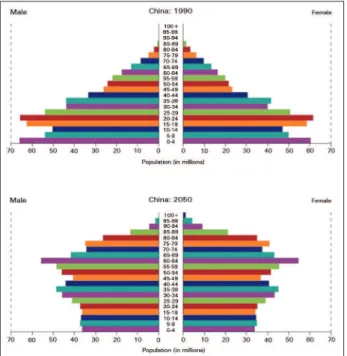
(together with the lower birth rates that typically accompany socioeconomic development) mean that older people account for a larger proportion of the general population.1 The extent of the resulting chan-ges in population characteristics can be startling, es-pecially for developing countries (Figure 1).
Figure 1. Changing age distribution in general population of China, 1990-2050. U.S Census Bureau, International Data Base.
In contrast to the situation even two generations ago, people can expect to live for many years after the usual retirement age. For example, U.K men and women aged 65 years in 2030 can expect to live until age 88 and 91 years, respectively.4 Predicted life pectancy for today’s children is controversial, but ex-perts estimate that 50% of U.K children born in 2007 will live to at least 103 years.4 Although it is clear that people are living longer, it is uncertain how much of the increased life expectancy will translate into ye-ars of good health. These demographic changes have dramatic potential implications for conditions such as CKD, for which the prevalence increases with age.
CKD
IS COMMON IN OLDER PEOPLE AND ITSPREVALENCEINCREASES INPARALLEL WITH AGE
It has been known for decades that estimated glome-rular filtration rate (eGFR) declines in parallel with age.5 The prevalence of CKD among females in the Chinese general population increases from 7.4% among those aged 18-39 years to 18.0% and 24.2%
among those aged 60-69 and 70 years respectively.6 Relative increases in the prevalence of CKD with age are equally striking for populations in the U.S, Canada and Europe,7-9 although there are between-country differences in the absolute prevalence.
At older ages, an increased proportion of preva-lent CKD cases has low eGFR alone (as compared to albuminuria alone, or both low eGFR and albuminu-ria).10 Although this might suggest that many older people with CKD can expect lower rates of kidney function loss, available data are inconclusive - and current knowledge does not allow clinicians to relia-bly distinguish between those whose CKD will and will not progress.
As for other age groups, the incidence of dialy-sis-dependent kidney failure has steadily increased among older people over the last few decades: in the U.S, a 57% age-adjusted increase in the number of incident octogenarians and nonagenarians was noted between 1996 and 2003 alone.11 Despite this increase, patients aged > 80 years are still less likely to initiate dialysis than those aged 75-79 years - although a large recent study suggested that the risk of developing very low eGFR (< 15 ml/min/1.73 m2) is similar for older and younger adults.12 It is uncertain whether this dis-crepancy is due to between-age differences in the true rate of progressive kidney function loss, the risk of death due to competing causes, patient views about dialysis, or physician practices.12,13 Regardless of the explanation, the aging population will likely lead to continued increases in the number of older people with severe CKD.
CKD
IS HARMFUL BUT TREATABLE IF PATIENTS AT RISK ARE IDENTIFIEDLike younger people, older people with advanced CKD are at increased risk of death, kidney failure, myocardial infarction and stroke compared to otherwise similar people with normal or mildly reduced eGFR.14,15 Although death is by far the most common of these adverse outcomes, this does not mean that older patients with clinically relevant CKD cannot benefit from timely specialist referral.
lower risk of cardiovascular events, and (for those who are interested in renal replacement) a more in-formed choice of renal replacement modality, inclu-ding timely creation of vascular access.16 The aging population will likely lead to continued increases in the number of older people who might require such referral, which should be considered in assessments of future nephrology workforce capacity.
D
IALYSISCANBENEFITOLDERPEOPLEWITHKIDNEYFAILURE
In developed countries, the default management stra-tegy for older people with kidney failure appears to have shifted from conservative management to ini-tiation of dialysis.17 On average, life expectancy af-ter initiation of dialysis is relatively short for older patients: median survival among incident U.S dialysis patients aged 80-84 years is 16 months - and is only 12 months among those aged 85-89 years.11 At the same time, these median statistics reflect a bimodal distribution of survival time in older dialysis patients: although a large proportion die within 6 months of commencing dialysis, a substantial minority may live for years. This heterogeneity in mortality appears to be driven by differences in baseline comorbidity. For example, analyses of a small U.K cohort of people wi-th advanced kidney failure suggested wi-that initiation of dialysis was not associated with increased survival for those aged > 75 and with two or more comorbidi-ties.18,19 Similarly, the presence of two to three comor-bid conditions in U.S. dialysis patients aged > 65 years was associated with substantially increased mortality compared to those in better health.11 When functional status is lower at baseline, initiation of dialysis often signals the onset of further declines: among 3702 nur-sing home residents initiating dialysis, 58% had died and 87% had experienced additional loss of function at 1 year.20 Although available data have limitations, quality of life appears reasonable among selected older dialysis patients - and can remain stable despite moderate or high levels of comorbidity.21,22
These data suggest that dialysis is an appropriate treatment option for well-informed older patients with kidney failure - especially for those with good baseline quality of life. On the other hand, the very poor outcomes experienced in those with more comorbidity or lower functional status at baseline clearly demonstrate that dialysis does not improve
clinical outcomes for all older people with kidney failure - and that good clinical judgment and careful communication will be increasingly required as the general population continues to age.
K
IDNEY TRANSPLANTATION CAN ALSO BENEFITOLDER PEOPLE WITHKIDNEY FAILURE
It is generally accepted that older age alone does not preclude kidney transplantation in otherwise suitable candidates. However, older patients with kidney failure are more likely to have absolute and relative contraindications to transplantation, and are less likely to be placed on the kidney transplantation waiting list. Unsurprisingly, patient and graft 5-year survival probabilities are lower among U.S kidney transplant recipients aged ≥ 65 years as compared to those aged 35-49 years (patient: 67.2% vs. 89.6%; graft: 60.9% vs. 75.4%, respectively).23 In addition, older people who are potential kidney transplant reci-pients face several potential disadvantages compared to their younger counterparts (Chart 1).
CHART 1 UNMETNEEDSFORKIDNEYTRANSPLANTATION
INOLDER CKD PATIENTS • Organ shortage
• Paucity of live donors
• Organ allocation policies that appropriately weight likelihood of benefit from transplantation as well as chronological age
• Ensuring appropriate referral of potentially suitable older recipients for transplantation assessment • Ethical concerns about offering a kidney to an
older patient versus a younger one • Optimal immunosuppressive regimen Adapted from reference 29.
of older people has been most pronounced. However, because transplant surgery itself temporarily increa-ses the risk of death, the mortality benefits associa-ted with kidney transplantation (regardless of donor type) are restricted to those with reasonable baseline life expectancy and without dramatically increased perioperative risk.27
comorbidities, functional status, quality of life and preferences of each individual patient. Clinicians can be reassured that dialysis and kidney transplan-tation can increase life expectancy - and will allow reasonable quality of life in selected older people with kidney failure. Perhaps more importantly, clinicians, patients and their families can be comforted by the knowledge that timely specialist evaluation can help to improve outcomes and reduce symptoms in older people with advanced kidney disease - whether they have selected conservative management or dialysis as their treatment plan.
A
CKNOWLEDGEMENTSDr. Tonelli was supported by a Government of Canada research chair in the optimal care of people with chronic kidney disease.
R
EFERENCES1. World Health Organization. Good health adds life to years: Global brief for World Health Day 2012. Geneva; 2012. 2. Wiener JM, Tilly J. Population ageing in the United States of
America: implications for public programmes. Int J Epidemiol 2002;31:776-81. DOI: http://dx.doi.org/10.1093/ije/31.4.776 3. Couser WG, Remuzzi G, Mendis S, Tonelli M. The
contribu-tion of chronic kidney disease to the global burden of major noncommunicable diseases. Kidney Int 2011;80:1258-70. PMID: 21993585 DOI: http://dx.doi.org/10.1038/ki.2011.368 4. Select committee on public service and demographic change.
Ready for Aging? Report. London: House of Lords; 2013. 5. Davies DF, Shock NW. Age changes in glomerular filtration
rate, effective renal plasma flow, and tubular excretory capaci-ty in adult males. J Clin Invest 1950;29:496-507. DOI: http:// dx.doi.org/10.1172/JCI102286
6. Zhang L, Wang F, Wang L, Wang W, Liu B, Liu J, et al. Preva-lence of chronic kidney disease in China: a cross-sectional sur-vey. Lancet 2012;379:815-22. DOI: http://dx.doi.org/10.1016/ S0140-6736(12)60033-6
7. Coresh J, Selvin E, Stevens LA, Manzi J, Kusek JW, Eggers P, et al. Prevalence of chronic kidney disease in the United Sta-tes. JAMA 2007;298:2038-47. PMID: 17986697 DOI: http:// dx.doi.org/10.1001/jama.298.17.2038
8. Zhang QL, Rothenbacher D. Prevalence of chronic kidney di-sease in population-based studies: systematic review. BMC Pu-blic Health 2008;8:117. PMID: 18405348 DOI: http://dx.doi. org/10.1186/1471-2458-8-117
9. Arora P, Vasa P, Brenner D, Iglar K, McFarlane P, Morri-son H, et al. Prevalence estimates of chronic kidney disea-se in Canada: results of a nationally repredisea-sentative survey. CMAJ 2013;185:E417-23. DOI: http://dx.doi.org/10.1503/ cmaj.120833
10. James MT, Hemmelgarn BR, Tonelli M. Early recogni-tion and prevenrecogni-tion of chronic kidney disease. Lancet 2010;375:1296-309. PMID: 20382326 DOI: http://dx.doi. org/10.1016/S0140-6736(09)62004-3
11. Kurella M, Covinsky KE, Collins AJ, Chertow GM. Octogenarians and nonagenarians starting dialysis in the United States. Ann Intern Med 2007;146:177-83. PMID: 17283348 DOI: http://dx.doi.org/10.7326/0003-4819-146-3-200702060-00006
CHART 2 MEETINGTHEGROWINGDEMANDFORKIDNEY
TRANSPLANTATIONINOLDER CKD PATIENTS • Preferential transplantation of organs from older
donors to older recipients
• Enlarge the donor pool by accepting expanded criteria donors: ≥ 60 years old or ≥ 50 with any of the following 2 conditions: history of hypertension, serum creatinine ≥ 1.5 mg/dl or death due to cerebrovascular accident.
• Transplanting two marginal kidneys instead of one Adapted from reference 29.
R
ESEARCH NEEDSAlthough much is known about chronic kidney disease in older populations, a great deal remains to be learned. Many trials of therapies for CKD have excluded older patients28,29 - and most do not provide guidance on how to manage comorbidities that often accompany CKD but may lead to competing thera-peutic priorities. More information is needed on how to accurately identify people who will progress to kidney failure - and among these, the subset that can expect reasonable life expectancy and quality of life if they opt for dialysis treatment. Future studies should test new ways to communicate information about the risks and benefits of dialysis (as compared to conser-vative management), to facilitate informed patient decisions. Above all, we need more studies that de-monstrate how to optimize quality of life and mana-ge symptoms in elderly people with CKD - including those who have chosen conservative management.
T
HE WAY FORWARD12. Hemmelgarn BR, James MT, Manns BJ, O'Hare AM, Muntner P, Ravani P, et al. Rates of treated and untreated kidney failure in older vs younger adults. JAMA 2012;307:2507-15. PMID: 22797451 DOI: http://dx.doi.org/10.1001/jama.2012.6455 13. Keith DS, Nichols GA, Gullion CM, Brown JB, Smith DH.
Longitudinal follow-up and outcomes among a population with chronic kidney disease in a large managed care organiza-tion. Arch Intern Med 2004;164:659-63. DOI: http://dx.doi. org/10.1001/archinte.164.6.659
14. Hemmelgarn BR, Manns BJ, Lloyd A, James MT, Klarenbach S, Quinn RR, et al. Relation between kidney function, protei-nuria, and adverse outcomes. JAMA 2010;303:423-9. PMID: 20124537 DOI: http://dx.doi.org/10.1001/jama.2010.39 15. O'Hare AM, Bertenthal D, Covinsky KE, Landefeld CS, Sen S,
Mehta K, et al. Mortality risk stratification in chronic kidney di-sease: one size for all ages? J Am Soc Nephrol 2006;17:846-53. 16. Stevens PE, Levin A.; Kidney Disease: Improving Global Out-comes Chronic Kidney Disease Guideline Development Work Group Members. Evaluation and management of chronic kid-ney disease: synopsis of the kidkid-ney disease: improving global outcomes 2012 clinical practice guideline. Ann Intern Med 2013;158:825-30. DOI: http://dx.doi.org/10.7326/0003-4819-158-11-201306040-00007
17. Thorsteinsdottir B, Montori VM, Prokop LJ, Murad MH. Ageism vs. the technical imperative, applying the GRADE framework to the evidence on hemodialysis in very elderly pa-tients. Clin Interv Aging 2013;8:797-807. DOI: http://dx.doi. org/10.2147/CIA.S43817
18. Chandna SM, Da Silva-Gane M, Marshall C, Warwicker P, Greenwood RN, Farrington K. Survival of elderly patients with stage 5 CKD: comparison of conservative management and renal replacement therapy. Nephrol Dial Transplant 2011;26:1608-14. DOI: http://dx.doi.org/10.1093/ndt/gfq630 19. Murtagh FE, Marsh JE, Donohoe P, Ekbal NJ, Sheerin NS,
Harris FE. Dialysis or not? A comparative survival study of patients over 75 years with chronic kidney disease stage 5. Nephrol Dial Transplant 2007;22:1955-62. PMID: 17412702 DOI: http://dx.doi.org/10.1093/ndt/gfm153
20. Kurella Tamura M, Covinsky KE, Chertow GM, Yaffe K, Landefeld CS, McCulloch CE. Functional status of elderly adults before and after initiation of dialysis. N Engl J Med 2009;361:1539-47. PMID: 19828531 DOI: http://dx.doi. org/10.1056/NEJMoa0904655
21. Lamping DL, Constantinovici N, Roderick P, Normand C, Hen-derson L, Harris S, et al. Clinical outcomes, quality of life, and costs in the North Thames Dialysis Study of elderly people on dialysis: a prospective cohort study. Lancet 2000;356:1543-50. PMID: 11075766 DOI: http://dx.doi.org/10.1016/S0140-6736(00)03123-8
22. Unruh ML, Newman AB, Larive B, Dew MA, Miskulin DC, Greene T, et al.; Hemodialysis Study Group. The influence of age on changes in health-related quality of life over three years in a cohort undergoing hemodialysis. J Am Geriatr Soc 2008;56:1608-17. DOI: http://dx.doi.org/10.1111/j.1532-5415.2008.01849.x
23. Knoll GA. Kidney transplantation in the older adult. Am J Kidney Dis 2013;61:790-7. DOI: http://dx.doi.org/10.1053/j. ajkd.2012.08.049
24. Merion RM, Ashby VB, Wolfe RA, Distant DA, Hulbert-Shearon TE, Metzger RA, et al. Deceased-donor cha-racteristics and the survival benefit of kidney transplantation. JAMA 2005;294:2726-33. PMID: 16333008 DOI: http:// dx.doi.org/10.1001/jama.294.21.2726
25. Cohen B, Smits JM, Haase B, Persijn G, Vanrenterghem Y, Frei U. Expanding the donor pool to increase renal transplantation. Nephrol Dial Transplant 2005;20:34-41. DOI: http://dx.doi. org/10.1093/ndt/gfh506
26. Gill J, Bunnapradist S, Danovitch GM, Gjertson D, Gill JS, Cecka M. Outcomes of kidney transplantation from older living donors to older recipients. Am J Kidney Dis 2008;52:541-52. PMID: 18653267 DOI: http://dx.doi. org/10.1053/j.ajkd.2008.05.017
27. Gill JS, Tonelli M, Johnson N, Kiberd B, Landsberg D, Pereira BJ. The impact of waiting time and comorbid conditions on the survival benefit of kidney transplantation. Kidney Int 2005;68:2345-51. PMID: 16221239 DOI: http://dx.doi. org/10.1111/j.1523-1755.2005.00696.x
28. O'Hare AM, Kaufman JS, Covinsky KE, Landefeld CS, McFarland LV, Larson EB. Current guidelines for using angio-tensin-converting enzyme inhibitors and angiotensin II-recep-tor antagonists in chronic kidney disease: is the evidence base relevant to older adults? Ann Intern Med 2009;150:717-24. PMID: 19451579