0021-7557/08/84-05/467 Jornal de Pediatria
Copyright © 2008 by Sociedade Brasileira de Pediatria
B
RIEFC
OMMUNICATIONPrevalence of mouth breathing among children
Rubens Rafael Abreu,1 Regina Lunardi Rocha,2 Joel Alves Lamounier,3 Ângela Francisca Marques Guerra1
Abstract
Objective:To determine the prevalence of mouth breathing among children aged 3 to 9 years living in the urban districts of the town of Abaeté, MG, Brazil.
Methods:This study assesses a representative, randomized sample of the town’s population (23,596 inhabitants). Children were selected by lots according to a random number table until 370 had been enrolled; this number had been determined by statistical calculation. A protocol for anamnesis and clinical assessment of the patients was specially developed for this project, since no preexisting instruments could be found in the literature that had been validated and were appropriate for the purpose. Data were analyzed using SPSS version 10.5.
Results:The prevalence of mouth breathing was found to be 55%, or 204 children.
Conclusion:Further studies are needed to validate a questionnaire for the clinical diagnosis of mouth breathers at the primary care level.
J Pediatr (Rio J). 2008;84(5):467-470:Prevalence, mouth breathing, child.
Introduction
Respiration is one of the body’s vital functions and under physiological conditions, breathing takes place through the nose. The mouth breathing syndrome (MBS) is when a child stops breathing exclusively through the nose and begins mixed breathing i.e. the nose is supplemented by the mouth. According to the literature, exclusively oral breathing pat-terns are rare or non-existent.1mouth breathing syndrome
is characterized by disorders of speech organs and joints due to the predominately oral breathing pattern, generally com-bined with facial deformities, abnormal positioning of teeth and body posture, and with the potential to progress to car-diorespiratory and endocrine disease, sleep and mood disor-ders and poor performance at school. Furthermore, MBS is related to genetic factors, unhealthy oral habits and nasal obstructions of varying severity and duration.2
Mouth breathers can be classified as one of three types:
organicmouth breathers have some type of mechanical
obstruction making nose breathing more difficult;purely func-tionalmouth breathers continue breathing through the mouth even after all mechanical, pathological or functional obstacles have been removed; andspecial needsmouth breeders have some type of neurological dysfunction that is responsible for their mouth breathing (MB).3
Mouth Breathing can cause abnormal posture and can affect stomatognathic system structures which can result in abnormal growth involving, teeth, face, respiration, suction, mastication, deglutition and speech. The main orofacial effects are: forward displacement of the head, a long and nar-row face, open, or pursed, and dry lips, short upper lip with reduced function, voluminous and everted lower lip and a hypotonic tongue in a lower position than normal. There is maxillary atresia with a high arched palate, open bite and crossbite, orofacial musculature is hypotonic, the nose is flat-tened and the nostrils are small, the upper teeth protrude and
1. Mestre, Universidade Federal de Minas Gerais (UFMG), Belo Horizonte, MG, Brazil. Centro de Pós-Graduação, Faculdade de Medicina, UFMG, Belo Horizonte, MG, Brazil.
2. Professora adjunta, Departamento de Pediatria, Faculdade de Medicina, UFMG, Belo Horizonte, MG, Brazil. 3. Professor titular, Departamento de Pediatria, Faculdade de Medicina, UFMG, Belo Horizonte, MG, Brazil.
Financial and logistical support: Municipal Health Department of Abaeté, MG, Brazil. No conflicts of interest declared concerning the publication of this article.
Suggested citation:Abreu RR, Rocha RL, Lamounier JA, Guerra AF. Prevalence of mouth breathing among children. J Pediatr (Rio J). 2008;84(5):467-470. Manuscript received Jan 09 2008, accepted for publication Apr 23 2008.
doi:10.2223/JPED.1806
the angle of the mandible undergoes rotational displacement in the clockwise direction.4-6
Breastfeeding plays an important protective role, since it promotes correct development of the facial musculature and other stomatognathic system structures. Non-nutritional sucking, such as prolonged thumb-sucking, has been linked to dental malocclusion problems.7Pacifiers and artificial
nipples, which are often used to quiet babies, can interfere with breastfeeding and negatively affect oral motor function, and as such play a significant role in MBS.8
Mouth breathing can be related to a variety of causes, including enlarged adenoids, tonsils and nasal concha, obstructive nasal septum displacement, allergic rhinitis, nasal or facial deformities and, more rarely, by foreign bodies.9
The objective of this study was to determine the preva-lence of mouth breathing among children aged from 3 to 9 years and resident in the urban districts of the town of Aba-eté, MG, Brazil.
Methods
This was a population-based study approved by the Pedi-atrics Department and the Research Ethics Committee at the Medical Faculty of the Universidade Federal de Minas Gerais. The town of Abaeté had a population of 23,596 inhabitants, with 20,073 (85.1%) of these living in the its urban neighbor-hoods. There were 2,927 children in the age range from 3 to 9 years of age, with 2,490 of these living in the urban areas, accounting for 10.6% of the entire population.10
The sample comprised 370 children selected at random from households in the town’s urban areas. The calculation was based on the following parameters: a population of 2,490 children, an expected prevalence of 30.0%, a design effect of 1, a 95% confidence level and a 10% larger sample than cal-culated in order to compensate for possible losses.
The urban area consists of 487 blocks in 10 neighbor-hoods. Seventy-one of these blocks were uninhabited or fall into “special categories,” such as schools, hospitals, military bases and others. The remaining 416 blocks contained 7,461 households, with an average of 18 residences per block. The mean number of inhabitants per block was 48, and the mean number of inhabitants per household was 2.7.11With the
objective of increasing the representativeness of the sample, only one child was enrolled from each residence.
The interviewers visited 1,538 households clustered in 106 blocks. Inhabited blocks were assigned numbers from 1 to 416 and a random number table was used to choose the first 90 blocks. Extra blocks were then chosen by lots using the same system until enough had been chosen to ensure the sample of 370 children would be achieved. These blocks were then regrouped into their 10 neighborhoods, which were num-bered from 1 to 10 and the sequence of fieldwork visits was determined by lots.12
Children were excluded from the study if they had heart disease, pneumonia or other severe comorbidities that could affect the results of the study. Children were not included if their parents did not sign a free and informed consent form or if they were younger than 3 or older than 9.
Two nursing students from the Universidade Presidente Antônio Carlos (UNIPAC), in Bom Despacho, MG, were trained by the researcher to carry out the interviews and apply the socioeconomic questionnaire. The interviewers visited a pre-viously defined number of homes on each weekday. At each household the parents or guardians were invited to take part and, if they agreed, they signed a free and informed consent form. In 16 cases permission was not granted. The question-naire was developed by the authors to obtain socioeconomic, demographic and environmental data on the study population.
Children were referred for clinical assessment by the researcher, carried out at the Casa da Criança e da Gestante e Centro de Apoio à Mulher, which is a specialist center for wom-en’s and childrwom-en’s health run by the Municipal Health Depart-ment (Secretaria Municipal de Saúde) of Abaeté. This pediatric clinic is part of the Brazilian National Health Service (Sistema Único de Saúde – SUS), which means that everybody, irre-spective of social class, had the same chance of taking part in the study, as long as parental authorization was granted.
The patients and/or their guardians were given the right to take part or not as they wished with no type of penalty or restriction whatsoever resulting from a decision to drop out.
The clinical examination was carried out by the researcher, who is a pediatric physician. Clinical diagnosis of MB was made according to a patient history and clinical examination proto-col specially designed for this research and making it possible to reproduce this study.
During anamnesis, the child’s parent was asked about the following clinical manifestations; the child snores, sleeps with the mouth open, drools on the pillow, has a blocked nose every day (major signs); has an itching nose, an intermittently blocked nose, difficulty breathing at night or agitated sleep, somnolence or irritability during the day, difficulty swallow-ing or is slow to swallow food, more than three episodes of throat or ear infection or sinusitis (confirmed by a doctor) dur-ing the previous 12 months, difficulty learndur-ing at school or repeated years (minor signs). The patient history was consid-ered compatible with MB if two major signs were present or if one major sign was combined with two or more minor signs.
During the clinical assessment, the presence of the follow-ing features were noted: craniofacial abnormalities (adenoid facies), high arched palate, open bite (without thumb and/or pacifier sucking), hypertrophy of nasal concha, obstructive displacement of the nasal septum, enlarged tonsils and labial cleft (major signs); thoracic abnormalities, postural abnor-malities, disorders of the tympanic membranes, speech dis-orders, nasal voice (minor signs). The clinical examination
468
Jornal de Pediatria - Vol. 84, No. 5, 2008 Prevalence of mouth breathing in children - Abreu RR et al.findings were considered compatible with MB if two major signs were present or if one major sign was combined with two or more minor signs.
Statistical analysis was performed using SPSS version 10.5 to apply Pearson’s chi-square test, with results consid-ered significant at p < 0.05.
Results
The 370 children in the sample included 193 boys and 177 girls, with a mean age of 5.9 years (±1.9). Of these, 204 were diagnosed as mouth breathers, which was 55% of the whole sample. The evaluation resulted in 189 children with both his-tory and clinical examination compatible with MB, while nine had clinical assessment compatible with MB alone and six had history suggestive of MB, but normal clinical examination.
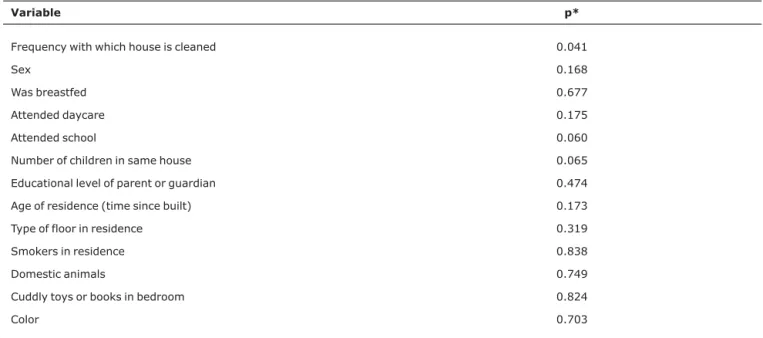
Table 1 lists the results of analysis of the socioeconomic and environmental data.
Discussion
Few articles were found on the prevalence of MB in a review of the literature indexed in MEDLINE, LILACS, JPED and Google Scholar and published from the year 2000 onwards. The studies that do exist were carried out with small samples of convenience, at specialist clinics or departments. This study carried out in Abaeté therefore provides new information and data from a study of a representative sample of the population.13
One possible limitation of this study is the lack of a vali-dated instrument in the specialist literature for the clinical diagnosis of MB.
In Venezuela a prevalence of 63% was observed in a sample of 389 children aged between 5 and 14 and enrolled at a single school.14In Delhi, in India, a study assessing oral
habits among 5,554 children aged 5 to 13 years and attend-ing school found a 6.60% prevalence of MB.15In Brazil, a study
carried out in Pernambuco1with children aged 8 to 10 years
enrolled on the Santo Amaro Project, observed an MB preva-lence of 53.3%. The prevapreva-lence of MB described in the litera-ture covers such a wide range that comparisons are problematic.
When diagnosing MB, both anamnesis and clinical exami-nation must be focused on the principal clinical manifesta-tions, since parents tend to believe that their children’s mouth breathing is normal or unimportant.
It can be concluded that the prevalence of MB was elevated in this study, but there was no statistical association with sex, socioeconomic condition or age group. Further studies are needed to validate a questionnaire for clinical diagnosis of MB at the primary care level.
Referências
1. De Menezes VA, Leal RB, Pessoa RS, Pontes RM.Prevalência e fatores associados à respiração oral em escolares participantes do projeto Santo Amaro - Recife, Brasil.Rev Bras Otorinolaringol. 2006;72:394-9.
2. Godinho R, Britto AT, Carvalho DG, Mocellin M. The role of adenotonsillar hipertrophy in mouth breathing syndrome. In: Sih T, editor. IV IAPO Manual of Pediatric Otorhinolaryngology. São Paulo: Interamerican Association of Pediatric Otorhinolaringology; 2006. p. 83-8.
Table 1- Environmental and socioeconomic factors
Variable p*
Frequency with which house is cleaned 0.041
Sex 0.168
Was breastfed 0.677
Attended daycare 0.175
Attended school 0.060
Number of children in same house 0.065
Educational level of parent or guardian 0.474
Age of residence (time since built) 0.173
Type of floor in residence 0.319
Smokers in residence 0.838
Domestic animals 0.749
Cuddly toys or books in bedroom 0.824
Color 0.703
* Significant at p < 0.05.
3. Becker HM, Guimarães RE, Pinto JA, Vasconcelos MC. Respirador bucal. In: Leão E, Corrêa EJ, Mota JA, Viana, MB, editores. Pediatria ambulatorial. Belo Horizonte: Coopmed; 2005. p. 487-93.
4. Di Francesco RC, Passerotii G, Paulucci B, Miniti A.Respiração oral na criança: repercussões diferentes de acordo com o diagnóstico.Rev Bras Otorinolaringol. 2004;70:665-70. 5. Faria PT, Ruellas AC, Matsumoto MA, Anselmo WT.Dentofacial
morphology of mouth breathing children.Braz Dent J. 2002;13: 129-32.
6. Morel JE, Cordón MM, Reys BL, Infante EA. La respiración bucal y su efecto sobre la morfologia dentonaxilofacial. Correo Cientifico Médico de Holguin. http://www.cocmed.sld.cu/no91/ n91ori6.htm. Access: 25/08/2007.
7. Trawitzki LV, Anselmo-Lima WT, Melchior MO, Grechi TH, Valera FC.Aleitamento e hábitos orais deletérios em respiradores orais e nasais.Rev Bras Otorinolaringol. 2005;71:747-75.
8. Lamounier JA.O efeito de bicos e chupetas no aleitamento materno.J Pediatr (Rio J). 2003;79:284-6.
9. Maniglia JV, Molina FD, Maniglia LP, Maniglia CP.
Rinosseptoplastia em crianças.Rev Bras Otorinolaringol. 2002; 68:320-3.
10. Instituto Brasileiro de Geografia e Estatística. (Secretaria Municipal de Saúde de Abaeté).http://www.ibge.gov.br. Access: 09/2006.
11. Fundação Nacional de Saúde. (Secretaria Municipal de Saúde de Abaeté).http://www.funasa.gov.br. Access: 09/2006.
12. Barros CF, Victora GC. Epidemiologioa da saúde infantil: um manual para diagnósticos comunitários. São Paulo: Hucitec, Unicef; 1998.
13. Abreu RR. Prevalência e fatores associados em crianças de três a nove anos respiradoras orais em Abaeté - MG, Brasil [dissertação]. Belo Horizonte: Universidade Federal de Minas Gerais; 2007.
14. Parra Y.El paciente respirador bucal una propuesta para el estado Nueva Esparta 1996 – 2001.Acta Odontol Venez. 2001;42: 97-106.
15. Kharbanda OP, Sidhu SS, Sundaram K, Shukla DK.Oral habits in school going children of Delhi: a prevalence study. J Indian Soc Pedod Prev Dent. 2003; 21:120-4.
Correspondence: Rubens Rafael de Abreu
Rua Aristeu Alves de Alencar, 135 - Bairro Amazonas CEP 35620 000 - Abaeté, MG - Brazil
Tel.: +55 (37) 3541.4097 Fax: +55 (37) 3541.1144
E-mail: [email protected]