Copyright © 2007 by Sociedade Brasileira de Pediatria
R
EVIEWA
RTICLECurrent perspectives for treating children with
diabetic ketoacidosis
Jefferson P. Piva,1 Mauro Czepielewski,2 Pedro Celiny R. Garcia,3 Denise Machado4
Abstract
Objective:To review current concepts of physiopathology, diagnosis and treatment of diabetic ketoacidosis (DKA)
in childhood, as well as preventive measures to avoid cerebral edema.
Sources:The authors selected articles from MEDLINE with the keywords diabetes, ketoacidosis, hyperglycemia
and cerebral edema, and priority was given to studies including children and that contained complete texts published in English, Portuguese or Spanish. Chapters of books published in Brazil describing the treatment of DKA in pediatric intensive care unit were also reviewed. Based on the reviewed literature and on the author’s experience, the most efficient and recommended measures for DKA management are presented.
Summary of the findings:Normal saline solution (NaCl 0.9%) has been increasingly used for fast replacement
and hydration, as a substitute to diluted (hypotonic) solutions, as well as contraindication of sodium bicarbonate to repair metabolic acidosis in DKA. Regular insulin should be used as continuous infusion (0.1 IU/kg/h) without the need of a loading dose. For fast corrections of glucose oscillations, a practical scheme using two bags of electrolytic solutions is presented. Cerebral edema, its physiopathological mechanism and current treatment are reviewed.
Conclusions:Use of continuous infusion of regular insulin associated with adequate water and electrolyte
replace-ment using isotonic solutions, besides being an effective treatreplace-ment for DKA, preserves plasma osmolarity and prevents cerebral edema.
J Pediatr (Rio J). 2007;83(5 Suppl):S119-127:Diabetes, acidosis, dehydration, insulin, cerebral edema.
Introduction
Diabetic ketoacidosis (DKA) is a frequent cause of admis-sion in emergency rooms or pediatric intensive care unit (PICU), and even nowadays it has high morbidity and mortal-ity rates. After insulin was discovered and introduced in the treatment of DKA, it has been possible to reduce its mortality from 100% (early 20thcentury) for the current 2-5%.1-12
Despite all available therapeutic options, DKA is still the main cause of death in children and adolescents with type 1 diabe-tes mellitus (DM1). Most fatal cases are related to the devel-opment of cerebral edema, which is present in 0.5-2% of
patients with DKA, with mortality rate between 40-90% and able to produce sequelae in 10-25% of survivals.1,2,3,13,14
Other causes of morbidity and mortality are hypokalemia, hyperkalemia, hypoglycemia, infections and changes in the central nervous system (CNS).1,2,9,11
According to DKA definition, there must be metabolic aci-dosis (pH < 7.3 and/or HCO3< 15 mEq/L) secondary to
keto-sis (ketonemia and ketonuria), hyperglycemia (over 200 mg/dL) and several dehydration degrees in patients with dia-betes mellitus (DM).1,2,9,10Hyperglycemia in this situation is
usually high, but not necessarily so. Small or partially treated
1. Professor, Departamento de Pediatria, Faculdade de Medicina, Pontifícia Universidade Católica do Rio Grande do Sul (PUCRS), Porto Alegre, RS, Brazil. Departamento de Pediatria, Universidade Federal do Rio Grande do Sul (UFRGS), Porto Alegre, RS, Brazil. Chefe associado, UTI Pediátrica, Hospital São Lucas da PUCRS, Porto Alegre, RS, Brazil.
2. Professor, Departamento de Medicina Interna, UFRGS, Porto Alegre, RS, Brazil. Serviço de Endocrinologia, Hospital de Clínicas de Porto Alegre (HCPA), Porto Alegre, RS, Brazil. Diretor, Faculdade de Medicina, UFRGS, Porto Alegre, RS, Brazil.
3. Professor, Departamento de Pediatria, Faculdade de Medicina, PUCRS, Porto Alegre, RS, Brazil. Chefe, UTI Pediátrica, Hospital São Lucas da PUCRS, Porto Alegre, RS, Brazil.
4. Residente, 3º ano, Pediatria, área de concentração em UTI pediátrica, Serviço de Pediatria, Hospital São Lucas PUCRS, Porto Alegre, RS, Brazil.
Suggested citation:Piva JP, Czepielewski M, Garcia PC, Machado D. Current perspectives for treating children with diabetic ketoacidosis. J Pediatr (Rio J). 2007;83(5 Suppl):S119-127.
doi 10.2223/JPED.1707
children, as well as pregnant adolescents, may present DKA with almost normal blood glucose levels (euglycemic ketoaci-dosis).1,2,9In DKA, there is relative or absolute insulin
defi-ciency, associated with increased counter-regulatory hormones, changing carbohydrate, protein and lipid metabolism.1-12
In small children, it is often hard to characterize the clas-sical and characteristic signs of DM, such as polyuria, polydip-sia and weight loss. Many of those symptoms can be attributed to other more prevalent diseases, delaying diagnosis. Even in developed countries, between 15-70% of new cases of DM in childhood are diagnosed based on a DKA crisis.1-12
Preva-lence of DKA is inversely associated with effectiveness of the health system and with prevalence of diabetes in the commu-nity.1,3Adolescents and young adults with type 2 DM can also
present DKA at diagnosis, therefore it is not considered a char-acteristic disorder of DM1.1-12
Although a significant part of patients have DKA as an ini-tial manifestation of DM, exclusion and/or identification of one or more triggering factors is needed. It is crucial to perform a thorough and detailed anamnesis and clinical examination, associated with a minimal amount of laboratory investiga-tion, with the aim of identifying possible triggering factors. The fact that morbidity and mortality of DKA are associated with type of intervention and treatment used over the first hours has been well documented.1,3,11,13-15
In patients with previously diagnosed DM, DKA is usually associated with inadequate use of insulin. Adolescents have problems adhering treatment and diet, as well as psychologi-cal factors associated with eating disorders that could trigger up to 20% of cases of recurrent DKA.1-3,9,10In patients
sub-mitted to insulin pump therapy, its inappropriate interrup-tion, even if transient, leads to DKA due to low serum levels of insulin common to this type of therapy.2
Among the most common precipitating factors of DKA are infections (30-40% of cases).1-3,13,14Insulin resistance is
associated with increased levels of stress hormones (adrena-lin, glucagon, hydrocortisone and growth hormone) and some cytokines (for example, interleukin-1) that are also increased in infections.2,10High doses of glucocorticoids, atypical
antip-sychotics, diazoxide and some immunosuppressive drugs have been reported as KDA precipitants in patients without previous diagnosis.2Other causes of KDA are pancreatitis and
trauma.9,15As a general rule, possible triggering factors
should be assessed in all patients with KDA and only after they are discarded the irregular treatment should be considered as causal factor. In 2-10% of cases, it is not possible to iden-tify the precipitating factor.9,15
Physiopathology
Clinical manifestations and laboratory changes in DKA (Figure 1) occur as a consequence of interactions of absolute or relative insulin deficiency and increased counter-regulatory
hormones (glucagon, catecholamines, cortisol and growth hormone). Therefore, counter-regulatory hormones are usu-ally increased in situations of infection and stress, which often precipitate DKA in diabetic patients, whereas hyperglycemia, dehydration, hyperosmolarity, electrolytic and acid-basic dis-orders perpetuate release of counter-regulatory hormones.1-13
Ketoacidosis
Insulin is an anabolic hormone, promoting synthesis and/or storage of carbohydrates, fats, proteins and nucleic acids. Insulin action allows energy generation through use of glucose by muscles, adipose tissue and liver cells. When insu-lin is absent, there is lipolysis with increased fatty acid mobi-lization for hepatic gluconeogenesis and release of ketone bodies. Excessive production of ketones exceeds the buffer capacity of organic alkalis, resulting in metabolic acidosis. Consequently, according to acidosis intensity, DKA can be quantified into mild (pH 7.3-7.2), moderate (7.2-7.1) and severe (< 7.1).1,2,9,15A characteristic of metabolic acidosis
in DKA is increased anion gap (normally between 10 and 12), which is obtained by the following formula: anion gap = Na -(HCO3+ Cl).
In DKA, ketosis is primarily caused by increase in β-hydroxybutyrate and acetoacetate. Beta-hydroxybutyrate is the ketone found in higher circulating levels during DKA, with aβ-hydroxybutyrate:acetoacetate ratio of 3:1 during early disease stages. Ketonemia tests are generally per-formed qualitatively or semi-quantitatively in relation to acetoacetate. Considering that, during ketoacidosis correc-tion,β-hydroxybutyrate is transformed into acetoacetate, ketonemia test can be positive for some time, even with proper treatment. Therefore, persistence of positive ketone-mia does not necessarily mean that DKA treatment is being ineffective.9Anion gap could thus be used as an indirect
indi-cator of ketone body levels, since reduction in anion gap value represents reduced ketone body levels, which represent treat-ment efficiency.1,2,9,10,12
Hyperglycemia
In case of insulin deficiency (or absence) associated with the action of counter-regulatory hormones, cells cannot cap-ture and metabolize glucose, causing muscle and hepatic gly-cogenolysis and subsequent hyperglycemia.9Blood glucose
levels higher than 180 mg/dL exceed the maximum capacity of glucose reabsorption in the proximal tubule, causing gly-cosuria and osmotic diuresis. Osmotic diuresis leads to poly-uria with loss of free water and electrolytes, promoting polydipsia. In If adequate water ingestion is maintained, dehy-dration will be mild and blood glucose will stabilize between 300- 400 mg/dL. In some cases, blood glucose can reach lev-els of up to 800 mg/dL, especially when there is severe dehy-dration with reduction in glomerular filtration rate.9,15,16
Although hyperglycemia is the rule in DKA, there may be cases of DKA with normal blood glucose levels. This phenomenon occurs in patients partially treated with insulin and without receiving fluids with carbohydrates and/or in situations with long periods of vomiting and no ingestion of carbohy-drates.1,2,9,12,16
Dehydration
Osmotic diuresis associated with vomiting and insuffi-cient ingestion causes dehydration of several degrees in DKA, while shock is a rare event in this situation.1As dehydration
progresses, there is reduction in the intravascular volume and consequent progressive loss of glomerular filtration rate. Reduction in glomerular filtration rate causes reduction in diuresis and glucose loss, resulting in worsening of hypergly-cemia. Blood glucose levels close to 600 mg/dL indicate that glomerular filtration rate is reduced in approximately 25%, whereas glucose of 800 mg/dL suggests a 50% reduction in glomerular filtration rate, as a consequence of severe dehy-dration.1,2,9,10
Hyperosmolarity
Plasma osmolarity can be estimated using the calculation [(Na + K) x2] + (blood glucose/18). It is easy to note that, with blood glucose at 180 mg/dL, contribution of glucose in plasma osmolarity will be minimal (around 10). However, in case of blood glucose increases to, for instance, 720 mg/dL, osmolarity impact caused by hyperglycemia will be 40. Under these circumstances, there is movement of free water from the intracellular to the extracellular space (intracellular dehy-dration). Maintenance of this hyperosmolar state stimulates cells’ (especially neurons) production of substances with cellular osmotic activity (idiogenic osmoles) to preserve intra-cellular water. In case of sudden fall in blood osmolarity (quick fall of blood glucose or reduction in plasma sodium), this will cause the shift of water into the intracellular space, favoring occurrence of cerebral edema.14-16 It has been
demon-strated that hypernatremia can be a protective factor of cere-bral edema in patients with DKA.16
Electrolytic disorders
Polyuria caused by osmotic diuresis may induce dehydra-tion with several degrees of associated electrolytic changes: hyper- or hyponatremia, hypokalemia, hypophosphatemia and hypocalcemia.
Sodium
In DKA, there may be dilutional hyponatremia associated with increased osmolarity caused by hyperglycemia. A reduc-tion in the blood sodium level of 1.6 mEq/L is estimated for each 100 mg/dL of glucose above the limit of 100 mg/dL. Other factors, such as increase in serum lipids with low sodium content, action of antidiuretic hormone, urinary sodium loss related to osmotic diuresis and elimination of ketone bodies, may enhance hyponatremia.1,2,9,11Hypernatremia, despite
being less frequent, has been observed in the presence of DKA. Increase in serum sodium, since it maintains plasma osmolarity, seems to be a protective factor in the develop-ment of cerebral edema in DKA, because there is reduction in blood glucose levels.16Therefore, in the light of current
knowl-edge, hyponatremia should be avoided and treated in chil-dren with DKA. Moderate hypernatremia (between 150-160 mEq/L) could be accepted and considered protective in chil-dren with DKA who have more marked hyperglycemia (higher than 600 mg/dL).16
Potassium
Glycogenolysis and proteolysis caused by insulin defi-ciency promote output of cell potassium into the extracellular fluid. Many factors influence reduction in serum potassium in DKA: urinary excretion along with ketoacids, increased aldos-terone caused by dehydration, vomiting and potassium input in the cell along with glucose when insulin infusion is started. However, at DKA diagnosis, serum potassium may be normal or increased, because acidosis causes potassium shift from the intracellular environment into the extracellular space.1,2,9
Nevertheless, even if this occurs, it should be stressed that total body potassium is reduced. Therefore, normal or reduced potassium dosage at the beginning of DKA indicates need of early replacement, since the treatment tends to reduce serum levels of this ion.1,2,9,11
Calcium
As a result of acidosis correction during DKA treatment and improvement in glomerular filtration rate, there is a tendency to hypocalcemia. Use of phosphate in the treatment of patients with DKA is also associated with hypocalcemia.1,2,9
Phosphorus
can lead to reduction in oxygen supply to tissues due to dis-placement in hemoglobin dissociation curve; however, this effect does not usually have clinical repercussion in DKA.1,2,9
Clinical and laboratory diagnosis of diabetic ketoacidosis
Polyuria, polydipsia, enuresis, weight loss and polyph-agia characterize DM. When it progresses to DKA, there are nauseas, vomiting, progressive anorexia, abdominal pain, fatigue and signs of dehydration: dry skin and mucosa, reduced skin turgor, tachycardia and reduced perfusion according to degree of dehydration. It is estimated that defi-cit in extracellular fluid in DKA is between 5-10% of body weight. However, as previously stated, hypotension (hypov-olemic shock) is a rare and late finding in children with DKA, often associated with sepsis or cerebral edema.1,2,9,16In case
of changes in sensorium (sleepiness, clouding of conscious-ness), hypothesis of cerebral edema should be immediately considered, since it has high mortality rates.
There is also tachypnea (hyperventilation to compensate metabolic acidosis), ketotic breath (sweetish odor due to keto-sis) and fever (which can be associated with infectious, bac-terial or viral process).1-11
DKA should be suspected in every patient who has depres-sion of sensorium with or without clinical signs of acidosis; capillary blood glucose screening and/or tests for ketonuria should always be performed in initial assessment.1-11
Laboratory criteria to define DKA are pH (venous or arte-rial) lower than 7.30 and/or bicarbonate lower than 15 mEq/L, blood glucose higher than 200 mg/dL and presence of ketone-mia and ketonuria.1,2,9It should be stressed that arterial gas
analysis is painful, has a higher risk, and the data we intend to evaluate (pH, bicarbonate and base deficit) are equivalent in both arterial and venous blood. Besides blood glucose, ketonemia and venous gas analysis, serum values of lactate, sodium, potassium, ionic calcium, chlorine, phosphorus, urea, creatinine, hematocrit and hemoglobin should be initially monitored, as well as glycosuria and ketonuria. If there is sus-picion of infection, specific exams should be required accord-ing to clinical status.1,2,9,11Leukocytosis with left shift is a
frequent finding in patients with DKA, and there is no strong association with presence of infection.1,2,9Serum amylase is
often high in DKA, which is not usually an indicator of pancre-atitis. This hypothesis should be investigated in the presence of suggestive clinical signs and markedly high amylase lev-els.1,2,9
In many patients with DKA, there are case reports of patients submitted to urgent exploratory laparotomy, which lately proved to be unnecessary. This conduct may add sig-nificant morbidity and mortality in DKA management. There-fore, it should be stressed that presence of abdominal pain associated with vomiting and often with signs of peritoneal
irritation (positive Blumberg’s sign) may occur in DKA, mim-icking acute abdomen due to infection, acute appendicitis, pancreatitis, cholecystitis or other causes. Under these situ-ations, before indicating surgical treatment using explor-atory laparotomy, the patient should be better investigated and DKA should be corrected, waiting a few hours for resolu-tion of abdominal pain. Such conduct should not evidently be established in the presence of severe infectious status, sep-sis or clear evidence of associated abdominal disease.
Treatment
DKA is a life-threatening situation in which the treatment should be performed by an experienced medical team in inten-sive care unit (ICU) or hospital ward and trained to receive this type of patients. This situation does not allow improvisa-tions or attitudes based on empirical evidence. Therefore, it is recommended that every service has its own protocol adjusted to local operational resources and difficulties. Another important principle in the treatment of patients with DKA is individualization of therapy, with careful monitoring of fluids, electrolytes and control of serum glucose as a prior-ity.1,2,9,16The criteria used for the treatment of DKA are listed
below:1-17
Correction of dehydration and electrolytic disorders
Volumetric replacement in DKA follows the same prin-ciples of other situations of dehydration or shock: an initial stage of rapid expansion (1-4 hours) followed by a slower stage of rehydration and replacement of losses (20-22 hours).1,2,9,16Some retrospective and multi-centered
stud-ies concluded that in DKA there is a strong association between cerebral edema and administration of large amounts of fluids.13,14However, it should be stressed that those
stud-ies do not allow concluding that cerebral edema exclusively occurred due to excess of infused fluids or because it is a most severe group of patients, which requires more amount of vol-ume replacement. As long as such doubt is not clarified, we have followed the current recommendations for volume replacement in patients with dehydration and/or shock: vol-ume expansion in the early stage followed by a moderate maintenance during the late stage.9
Expansion stage (1-4 hours)
peripheral accesses should be punctured, so that the volume calculated is replaced within predicted time.
DKA usually requires two to three volume expansions of 20 mL/kg with NSS until dehydration signs are reverted. This fast replacement with SS reestablishes blood volume and improves renal perfusion, which increases glomerular filtra-tion, resulting in glucose-induced osmotic diuresis, with reduction in blood glucose and plasma osmolarity.1,9,17In the
treatment of DKA, expansions with NSS, since it is isotonic in relation to plasma (NSS: Na = 154 mEq/L), promote higher increase in blood volume than the diluted solutions, causing a slower reduction in the osmolarity.1,9,17Therefore, even in
situations of DKA in which initial serum sodium is higher than 150 mEq/L, hypotonic solutions are not used.
Rehydration stage (20-22 hours)
As soon as the signs of blood volume depletion (tachycar-dia, hypoperfusion, hypotension, etc.) are reverted, fast expansions with NSS are suspended and maintenance stage is started.1,2,9,16,17This stage should include maintenance
volume (1,800-2,000 mL/m2/day) along with volume for
replacement of further losses, in cases of persistent vomiting and diarrhea. In patients with marked hyperglycemia, even receiving adequate treatment, it should be assumed that they will continue to have increased urinary losses. In such case, it is recommended an increase of up to 30-50% in maintenance water supply, which corresponds to an infusion of up to 2,500-3,000 mL/m2/day.1,2,9,14,16To avoid hyperhydration,
peri-odic assessments should be performed with the aim of reducing water supply to maintenance values.
Some authors suggest initial use of NaCl 0.45% (Na = 75 mEq/L) in cases in which serum sodium exceeds 150 mEq/L, or when calculated plasma osmolarity is higher than 340 mOsm/L.12,15Due to the reasons described above, even in
those cases, we prefer to maintain infusion of isotonic NSS until blood glucose is around 300 mg/dL, when 5 g of glucose should be added for each 100 mL.1,9,16,17
It is estimated that there is a potassium deficit of 4-6 mEq/kg in DKA, which is more evident after acidosis correc-tion and due to insulin accorrec-tion (which promotes input of glu-cose and potassium into the cell).1,2,9,18In the presence of
diuresis, potassium should be added (40 mEq/L) in the rehy-dration solution and adjustments should be performed according to laboratory data. In severe cases of hypopotas-semia (levels lower than 2.5 mEq/L), replacement can be per-formed using 0.4-0.6 mEq/kg/h for 6 hours. Until recently, there has been a recommendation to administer part of potas-sium as phosphate, but randomized studies did not show ben-efits in phosphate replacement, since clinical effects of hypophosphatemia are rare. Phosphate replacement should only be started in patients with respiratory depression and in those with serum level < 1.0 mg/dL. In those cases, 1/3 of potassium is administered as potassium phosphate.1,2,9
Correction of metabolic acidosis in patients with DKA occurs with volumetric replacement, especially due to insulin action, which reverts formation of ketoacids. Metabolic acido-sis, as stated above, is a marker of severity. Differently from what was previously believed, it has been demonstrated that acid pH alone is not a determining factor that increases risk of death or organic failure.9,19-22On the other hand,
adminis-tration of sodium bicarbonate in DKA has been associated with cerebral edema and death.1,2,13-15Use of sodium
bicarbon-ate may cause many side effects, such as hypokalemia, wors-ening of hyperosmolarity, increased intracellular acidosis due to CO2 production, paradoxical acidosis in the CNS, left shift in hemoglobin dissociation curve with reduction in oxygen supply to tissues, slower reduction of ketonemia and possible association with development of cerebral edema.1-14
Recent consensus reports by the American Diabetes Asso-ciation for children with DKA consider use of bicarbonate when pH is lower than 6.9 and persists after the first hour of hydra-tion. In these cases, 1-2 mEq/kg of sodium bicarbonate should be administered in 1-2 hours.1,2In our services, we have
avoided infusion of sodium bicarbonate in DKA, even in the presence of pH lower than 7.0.
Oral diet should be started with the patient awake, with-out vomiting and with improved acidosis. Parenteral hydra-tion soluhydra-tion should be maintained as along as continuous insulin is necessary.1-12
Insulin therapy
Administration of insulin promotes glucose input into the intracellular space, reverts catabolic status and suppresses lipolysis and ketogenesis, correcting blood glucose and acidosis.1,2,10,18,22-24
Despite the fact that some authors recommend an infu-sion of a loading dose of regular insulin (0.1 IU/kg) in patients with DKA, we have chosen to directly start continuous infu-sion of 0.1 IU/kg/h of regular insulin diluted in NSS.1,2,9,11,23
As previously mentioned, adequate replacement of blood vol-ume induces improvement in renal perfusion, resulting in reduced blood glucose. If, associated with this fact, we admin-ister a loading dose of regular insulin, we can induce a marked reduction in blood glucose and osmolarity (main factor asso-ciated with cerebral edema).1,9,23
In our services, we use a dilution of regular insulin at 0.1 IU/mL (250 mL of SS adding 25 IU of regular insulin), which is infused at a speed of 1 mL/kg/h (0.1 IU/kg/h) using an infu-sion pump. Due to insulin adherence to plastic, we use the first 50 mL of the solution to wash the catheter.9
In general, glucose infusion is started in the treatment of DKA when blood glucose reaches 250-300 mg/dL. To do so, glucose is added to the NSS to obtain a 5% concentration (50 g/L, or 100 mL of glucose at 50% for each liter of NSS). An infusion of 2,000 mL/m2/day of a solution wit 5% glucose
Such variation occurs because body weight and surface do not have an absolutely linear correlation. Therefore, besides the calculation of amount of supplied fluid (mL/m2/day), glucose
infusion rate (mg/kg/min) should be calculated based on glu-cose concentration in the solution, patient’s weight and infu-sion rate.
DKA treatment initially aims at correcting acidosis and maintaining blood glucose between 150-250 mg/dL during infusion with continuous insulin. Use of continuous insulin infusion may provide reduction in blood glucose between 50-100 mg/dL at every hour.1,9,23In cases in which reduction
in glucose levels is lower than 50 mg/dL/h, insulin infusion should be increased to 0.15-0.2 IU/kg/h. If reduction in blood glucose is faster than 100 mg/dL/h during continuous insulin infusion, administration of intravenous glucose should be increased and may reach up to 5 mg/kg/min.1,9,23
Acidosis and ketonemia are the main markers of insulin and glucose insufficiency in the cell metabolism during DKA. Blood glucose correction is faster than acidosis correction. Therefore, in patients who have major reduction in blood glu-cose, but who maintain positive acidosis and/or ketonemia, continuous insulin infusion should not be reduced. In these cases, it is necessary to increase glucose infusion, some-times using 10% glucose.1,2,9,23
Continuous insulin infusion should only be reduced when there is need of glucose infusion higher than 5 mg/kg/min to maintain blood glucose between 150-200 mg/dL. Such phe-nomenon may occur in: (a) patients with recently diagnosed DM who still have some endogenous insulin production and higher insulin sensitivity; and (b) patients with residual long-acting insulin levels (for example, users of insulin glargine or detemir). In this situation, we reduce insulin infusion rate to 0.05 U/kg/h and maintain glucose infusion (between 3.5-5 mg/kg/min).1,2,9,22-24
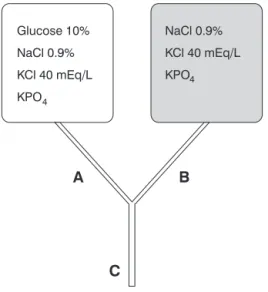
Therefore, by adding glucose to hydration solution (NSS) and in the presence of continuous insulin infusion, it is com-mon to perform frequent adjustments in glucose infusion rate, due to higher or lower blood glucose reduction. Changing solu-tions is often needed, which demands time and cost. Some authors propose using a system with two bags (Figure 2), which have identical electrolytic content (NaCl = 150 mE/L and KCl = 40 mEq/L), being different in relation to the glu-cose concentration (0 and 10%), placed in the shape of an “Y” in a single venous access in the patient.25Variations in supply
of infused glucose would only occur when adjusting dripping of each bag, maintaining previously estimated water and elec-trolyte supply. This system allows quick adjustments accord-ing to blood glucose, and it is possible to infuse solutions with concentrations between 0-10% of glucose, so that therapy can be individualized to the needs of any patient.25
Continuous insulin infusion can be suspended when blood pH is higher than 7.30, serum bicarbonate is≥18, anion gap
is between 8 and 12, and the patient is under conditions of being fed through the digestive system (Figure 3).1,2,9,11
One hour before suspending continuous insulin infusion, a subcutaneous regular insulin bolus of 0.1 IU/kg should be administered. Subsequent doses of insulin should be defined according to previous insulin regime for each patient. In patients whose DM diagnosis was established based on cur-rent DKA status, an initial daily insulin regime between 0.6-0.7 IU/kg/day is recommended, divided into long- and short-acting insulin, which is administered in two or three applications before meals.1,2,9From the practical
perspec-tive, suggestion is to perform transition of intravenous insu-lin to NPH insuinsu-lin at times close to the patient’s meals, preferentially in the morning. In cases in which the patient fulfils the criteria for suspension of continuous insulin at dif-ferent times, such as at night, for example, intravenous infu-sion can be maintained for a few extra hours, with adjustments in glucose infusion rate as needed.
A new option in this transition of regular intravenous insu-lin into subcutaneous insuinsu-lin is the use of insuinsu-lin glargine (Lan-tus). Insulin glargine is a slow-release and long-acting insulin, mimicking the effect obtained when using insulin infusion pump therapy. In a study including children with DKA, pro-gression of a group treated with traditional regular intrave-nous (IV) insulin was compared with another group that was given 0.3 IU/kg of insulin glargine over the first 6 hours of treatment associated with regular IV insulin infusion. Addi-tion of that low and stable dose of insulin glargine allowed sus-pension of continuous IV insulin infusion earlier, reduction in total amount of insulin administered, faster correction of aci-dosis and earlier ICU discharge.26
Complications
Electrolytic disorders (hypopotassemia, hypo- or hyper-natremia, hypophosphatemia, etc.) and hypoglycemia (men-tioned above) are among the main complications in the treatment of DKA. Hyperchloremic acidosis is also a frequent complication, resulting from excess of chlorine replacement, present both in sodium chloride and in potassium chloride, used in initial management of patients. In general, it is mani-fested after some days of DKA and does not require specific treatment, spontaneously progressing in the presence of nor-mal renal function.
Cardiac arrhythmias
These are caused by electrolytic disorders (hypo- or hyperpotassemia, hypocalcemia, hypomagnesemia), and rarely occur in DKA.7,9
Aspiration of gastric content
As major changes in the sensorium occur and many patients have recurrent vomiting, there may be pulmonary aspiration of gastric content. This complication should be pre-vented by careful supervision of patients at an adequate hos-pital setting.
Pulmonary edema
It is not a common complication. There is an increase in oxygen demand, and there may or may not be radiological
changes compatible with pulmonary edema. Many factors can be involved: low oncotic pressure, increased pulmonary cap-illary permeability and neurogenic pulmonary edema. Treat-ment includes oxygen therapy, use of diuretics and ventilatory support when indicated.9,27-29
Cerebral edema
It is practically restricted to the pediatric age group, with prevalence of 1-2% in children with DKA, being more preva-lent in children 5 years and younger and in the first DKA diag-nosis. It is a much feared complication of DKA, since it has mortality rate between 40-90%, whereas part of survivors will have sequelae. There is evidence that many patients with DKA have some degree of subclinical cerebral edema even before starting treatment.3,13,14,16,30-33
Clinical manifestations of cerebral edema are usually sud-den, and there may be fast progression to brain herniation, even when clinical status is recognized and aggressively treated.31Cerebral edema usually occurs within 4-12 hours
headache and vomiting.1-3,13,14,17,31,32In up to 40% of
chil-dren with clinical status of cerebral edema, initial brain tomog-raphy may be normal.1
Physiopathology of cerebral edema in DKA has not been completely clarified, and is more frequently associated with fast decline in plasma osmolarity, excess of fluids (higher than 4,000 mL/m2/day), administration of bicarbonate, low pCO
2,
high plasma urea, brain hypoperfusion and direct action of ketones in release of brain inflammatory interleukin. Fast reductions in concentration of serum sodium and plasma osmolarity during treatment, associated with presence of idio-genic osmoles in CNS cells, are the main mechanism in cere-bral edema genesis.1-3,13,14,16,17,29-32It is believed that
vasogenic cerebral edema is prevalent, which is more respon-sive to treatment.1,32
Treatment of cerebral edema can be performed using infu-sions of mannitol 0.25-0.5 g/kg/day at every 2-4 hours, or using 3% hypertonic saline solution (5-10 mL/kg/every 30 min), maintaining plasma sodium between 150-160 mEq/L. In cases with early diagnosis, before occurrence of changes in pupil and heart rate, mannitol often promotes significant improvement, and intubation and ventilatory support are not required. When ventilatory support is used, pCO2should be
controlled between 30-35 mmHg, besides maintaining head of the bed elevated at 30 º and normovolemia. In cases of herniation, mortality rate is high, even starting treatment. Therefore, frequent and judicious monitoring of the patient’s consciousness status over the first hours of treatment is cru-cial and, in the presence of any acute deterioration, mannitol should be immediately administered.1,3,9,16,17,32
Prevention
Despite improvement in diagnostic and therapeutic resources, there has been no reduction in mortality due to DKA over the past 2 decades.1-3,13,14,17Therefore, the main
objec-tive of managing patients with insulin-dependent DM should de prevention of DKA episodes through a high suspicion index with rigorous monitoring of symptoms.1,2,9,12
Prevention of recurrent DKA episodes, especially in ado-lescents, demands an efficient participation and surveillance by the family and health team. Recurrent DKA episodes should be considered as failure in long-term treatment. Efficient DKA prevention comprehends:1,2,9,12,18(a) recognition of early
signs of diabetes decompensation; (b) identification of events that may precipitate increase in insulin supply; (c) early intervention; and (d) aggressive intervention at the family core of patients with recurrent DKA episodes.
DKA prevention when diagnosing new cases of DM involves physicians’ knowledge of the disease’s initial mani-festations, as well as a high suspicion index. Early diagnosis of diabetes and beginning of treatment avoid progression to DKA.1It is also important to stress that whenever a diagnosis
of DM is established, we should also characterize whether DM
is insulin-dependent or not. In children and adolescents, at first, all cases are insulin-dependent. In this situation, all patients with DM should be treated from the start using insu-lin therapy. Use of oral hypoglycemic agents is not indicated, since they are dependent upon existence of pancreatic insu-lin secretion to be effective. Unfortunately, there are still cases of patients with recently diagnosed DM that progress to DKA when oral hypoglycemic agents are used. In these cases, DKA could be prevented by correct diagnostic and therapeutic guid-ance of insulin-dependent DM.
References
1. Wolfsdorf J, Glaser N, Sperling M; American Diabetes Association.
Diabetic ketoacidosis in infants, children and adolescents: a consensus statement from the American Diabetes Association. Diabetes Care. 2006;29:1150-9.
2. Dunger DB, Sperling MA, Acerini CL, Bohn DJ, Daneman D, Danne TP, et al.European Society for Paediatric Endocrinology/Lawson Wilkins Pediatric Endocrine Society consensus statement on diabetic ketoacidosis in children and adolescents. Pediatrics. 2004;113:e133-40.
3. Lawrence SE, Cummings EA, Gaboury I, Daneman D.
Population-based study of incidence and risk factors for cerebral edema in pediatric diabetic ketoacidosis.J Pediatr. 2005; 146:688-92.
4. White NH.Diabetic ketoacidosis in children.Endocrinol Metab Clin North Am. 2000;29:657-82.
5. Rosenbloom AL, Hanas R.Diabetic ketoacidosis (DKA): treatment guidelines.Clin Pediatr (Phila). 1996;35:261-6.
6. Edge JA.Management of diabetic ketoacidosis in childhood.Br J Hosp Med. 1996;55:508-12.
7. Klekamp J, Churchwell KB.Diabetic ketoacidosis in children: initial clinical assessment and treatment.Pediatr Ann. 1996; 25:387-93.
8. Kaufman FR, Halvorson M.The treatment and prevention of diabetic ketoacidosis in children and adolescents with type I diabetes mellitus.Pediatr Ann. 1999;28:576-82.
9. Giugno K, Müller H, Bagatini A. Cetoacidose diabética. In: Piva J, Garcia PC, editores. Medicina intensiva em pediatria. Rio de Janeiro: Revinter; 2005. p. 349-61.
10. Magee MF, Bhatt BA.Management of decompensated diabetes. Diabetic ketoacidosis and hyperglycemic hyperosmolar syndrome. Crit Care Clin. 2001;17:75-106.
11. Kaufman FR. Prevention and treatment of diabetes and its complications. Med Clin North Am. 1998;82:182-96.
12. Silink M.Practical management of diabetic ketoacidosis in childhood and adolescence. Acta Paediatr Suppl. 1998;425: 63-6.
13. Glaser N, Barnett P, McCaslin I, Nelson D, Trainor J, Louie J, et al.Risk factors for cerebral edema in children with diabetic ketoacidosis. The Pediatric Emergency Medicine Collaborative Research Committee of the American Academy of Pediatrics.N Engl J Med. 2001;344:264-9.
15. Delaney MF, Zisman A, Kettyle WM.Diabetic ketoacidosis and hyperglycemic hyperosmolar nonketotic syndrome. Endocrinol Metab Clin North Am. 2000;29:683-705, V.
16. Hoorn EJ, Carlotti AP, Costa LA, MacMahon B, Bohn G, Zietse R, et al.Preventing a drop in effective plasma osmolality to minimize the likelihood of cerebral edema during treatment of children with diabetes ketoacidosis.J Pediatr. 2007;150:467-73.
17. Fiordalisi I, Novotny WE, Holbert D, Finberg L, Harris GD; Critical Care Management Group.An 18-yr prospective study of pediatric diabetic ketoacidosis: an approach to minimizing the risk of brain herniation during treatment. Pediatr Diabetes. 2007;8:142-9.
18. American Diabetes Association.Hyperglycemic crises in patients with diabetes mellitus. Diabetes Care. 2001;24:154-61.
19. Viallon A, Zeni F, Lafond P, Venet C, Tardy B, Page Y, et al.Does bicarbonate therapy improve the management of severe diabetic acidosis?Crit Care Med. 1999;27:2690-3.
20. Bureau MA, Bégin R, Berthiaume Y, Shapcott D, Khoury K, Gagnon N.Cerebral hypoxia from bicarbonate infusion in diabetic acidosis. J Pediatr. 1980;96:968-73.
21. Green SM, Rothrock SG, Ho JD, Gallant RD, Borger R, Thomas TL, et al.Failure of adjunctive bicarbonate to improve outcome in severe pediatric diabetic ketoacidosis.Ann Emerg Med. 1998;31:41-8.
22. Wintergerst KA, Deiss D, Buckingham B, Cantwell M, Kache S, Agarwal S, et al.Glucose control in pediatric intensive care unit patients using an insulin-glucose algorithm.Diabetes Technol Ther. 2007;9:211-22.
23. Bradley P, Tobias JD.Serum glucose changes during insulin therapy in pediatric patients with diabetic ketoacidosis.Am J Ther. 2007;14:265-8.
24. Rosenbloom AL.Hyperglycemic crises and their complications in children.J Pediatr Endocrinol Metab. 2007;20:5-18.
25. Poirier MP, Greer D, Satin-Smith M.A prospective study of the “two-bag system” in diabetic ketoacidosis management.Clin Pediatr (Phila). 2004;43:809-13.
26. Shankar V, Haque A, Churchwell K, Russel W.Insulin glargine supplementation during early management phase of diabetic ketoacidosis in children.Intensive Care Med. 2007;33:1173-8. 27. Sprung CL, Rackow EC, Fein IA. Pulmonary edema; a complication of diabetic ketoacidosis.Chest. 1980;77:687-8. 28. Brun-Buisson CJ, Bonnet F, Bergeret S, Lemaire F, Rapin M.
Recurrent high-permeability pulmonary edema associated with diabetic ketoacidosis.Crit Care Med. 1985;13:55-6.
29. Powner D, Snyder JV, Grenvik A.Altered pulmonary capillary permeability complicating recovery from diabetic ketoacidosis.
Chest. 1975;68:253-6.
30. Hale PM, Rezvani I, Braunstein AW, Lipman TH, Martinez N, Garibaldi L.Factors predicting cerebral edema in young children with diabetic ketoacidosis and new onset type I diabetes.Acta Paediatr. 1997;86:626-31.
31. Mahoney CP, Vlcek BW, DelAguila M.Risk factors for developing brain herniation during diabetic ketoacidosis. Pediatr Neurol. 1999:21:721-7.
32. Takaya J, Ohashi R, Harada Y, Yamato F, Higashino H, Kobayashi Y, et al.Cerebral edema in a child with diabetic ketoaciosis before initial treatment.Pediatr Int. 2007;49:395-6. 33. Roberts JS, Vavilala MS, Schenkman KA, Shaw D, Martin LD, Lam AM. Cerebral hyperemia and impaired cerebral autoregulation associated with diabetic ketoacidosis in critically ill children.Crit Care Med. 2006;34:2217-23.
Correspondence: Jefferson P. Piva
Vicente da Fontoura, 3008/301
CEP 90640-002 – Porto Alegre, RS – Brazil Tel.: +55 (51) 3315.2400