The Impact of Dysphagia Therapy on Quality of
Life in Patients with Parkinson
’
s Disease as
Measured by the Swallowing Quality of Life
Questionnaire (SWALQOL)
Annelise Ayres
1Geraldo Pereira Jotz
2Carlos Roberto de Mello Rieder
3Artur Francisco Schumacher Schuh
4Maira Rozenfeld Olchik
51Post-Graduation Program of Health Sciences, Universidade Federal
de Ciências da Saúde de Porto Alegre, RS, Brazil
2Department of Morphological Sciences, Universidade Federal do Rio
Grande do Sul, Porto Alegre, RS, Brazil
3Movement Disorders Unit, Hospital de Clínicas de Porto Alegre,
Porto Alegre, RS, Brazil
4Department of Medical Sciences, Universidade Federal do Rio Grande
do Sul, Porto Alegre, RS, Brazil
5Department of Surgery and Orthopaedics, Universidade Federal do
Rio Grande do Sul, Porto Alegre, RS, Brazil
Int Arch Otorhinolaryngol 2016;20:202–206.
Address for correspondence Maira Rozenfeld Olchik, Universidade Federal do Rio Grande do Sul, Rua Ramiro Barcelos, 2492, Porto Alegre, RS, 90035-002, Brazil (e-mail: [email protected]).
Keywords
►
Parkinson disease
►
quality of life
►
deglutition disorders
►
dysphagia
►
rehabilitation
Abstract
Introduction
Dysphagia is a common symptom in Parkinson
’
s disease (PD) and it has
been associated with poor quality of life (QoL), anxiety, depression.
Objective
The aim of this study was to evaluate the quality of life in individuals with PD
before and after SLP therapy.
Methods
The program consisted of four individual therapy sessions. Each session
comprised guidelines regarding food and postural maneuvers (chin down). The Quality
of Life in Swallowing Disorders (SWAL-QOL) questionnaire was applied before and after
therapy.
Results
The sample comprised of 10 individuals (8 men), with a mean (SD) age of 62.2
(11.3) years, mean educational attainment of 7.5 (4.3) years, and mean disease duration
of 10.7 (4.7) years. Thirty percent of patients were Hoehn and Yahr (H&Y) stage 2, 50%
were H&Y stage 3, and 20% were H&Y stage 4. Mean scores for all SWAL-QOL domains
increased after the intervention period, with signi
fi
cant pre- to post-therapy differences
in total score (
p
¼
0.033) and domain 4 (symptom frequency) (
p
¼
0.025). There was
also a bias signi
fi
cance for domain 5 (food selection) (
p
¼
0.095).
Conclusion
Patients exhibited improvement in swallowing-related quality of life after
a SLP therapy program. The earlier in the course of PD, greater the improvement
observed after therapy.
received
November 16, 2015
accepted
February 16, 2016
published online
April 19, 2016
DOI http://dx.doi.org/ 10.1055/s-0036-1582450.
ISSN 1809-9777.
Copyright © 2016 by Thieme Publicações Ltda, Rio de Janeiro, Brazil
Introduction
Dysphagia is a common symptom in Parkinson’s disease (PD) and may occur at any stage in the disease course. It is estimated that up to 80% of patients with early-stage PD experience oropharyngeal dysphagia. At advanced stages, the incidence may be as high as 95%.1–4 The main signs and symptoms of dysphagia in PD are: delayed oral transit; difficulties in bolus formation; residual food in the oral cavity; poor bolus ejection; multiple swallows; posterior loss of bolus; decreased swallowing reflex; alterations in vocal fold closure; reduced pharyngeal and esophageal motility; pha-ryngeal stasis; esophageal sphincter dysfunction; gastro-esophageal reflux; laryngeal penetration; pulmonary aspiration; oropharyngeal bradykinesia; reduced anterior hyoid bone movement; and decreased epiglottis rotation angle during swallowing.5–7 Furthermore, studies show that pneumonia is the main cause of death in patients with PD, demonstrating the importance of speech-language pa-thologist (SLP)-based intervention for dysphagia to delay the onset of this symptom.8,9
Within this context, a growing number of studies have search to assess the efficacy and efficiency of therapeutic interventions made by SLP for this signs and symptom of dysphagia in PD, as described above.5,10–12These studies have demonstrated the benefits of several treatment strategies in decreasing signs and symptoms of dysphagia and improving swallow safety in patients with PD, including food consisten-cy modification, thermal–tactile stimulation, and expiratory muscle strength training (EMST).5,10–12
According to literature,6,13,14 patients with PD scored lower in the SWAL-QOL survey, suggesting poor quality of life. Furthermore, patients with more advanced disease scored lower on the questionnaire. Thus, dysphagia has been associated with poor quality of life (QoL), anxiety, depression.
In the revised literature, we observed an absence of national studies that ascertain the impact on QoL of SLP-based intervention. Within this context, the present study assess QoL in patients with PD before and after a speech-language pathologist-led dysphagia therapy program.
Methods
This is a case-control study with subjects with Parkinson’s disease. We selected participants from the Movement Dis-orders Center at a reference hospital. The study received approval from the Research Ethics Committee, registered under number 140263. All subjects signed an informed consent.
The inclusion criteria were a confirmed diagnosis of PD and accept to take part of a therapy program involving one session a week, during four consecutive weeks. The exclusion criteria were patients with language and/or hearing impair-ments that would prevent comprehension of the intervention program and patients with dementia.
Before and after therapy, patients underwent assessments which included the application of the SWAL-QOL tool. This
questionnaire comprises 44 items that assess 11 domains (Burden; Eating desire; Feeding duration; Symptom frequen-cy; Food selection; Communication; Fear; Mental health; Social Function; Sleep; and Fatigue), which are scored on a scale of 0 to 100. It is designed to ascertain the symptoms experienced by patients and the influence of these symptoms on QoL. The SWAL-QOL is an important tool for monitoring the efficacy of rehabilitation from the patient’s point of view by assessing swallowing-related QoL. We used the Brazilian Portuguese validated version of the questionnaire.15
The questionnaire was administered in an examining room and had an average duration of 20 minutes. The investigator read the items and answer choices to each patient, to minimize the effect of low education level and the decrease in visual acuity, thus, ensuring a proper under-standing of the questionnaire and minimizing misleading answers due to the lack of understanding of the question-naire. To avoid possible bias, we followed this procedure with all individuals. Data collection took place from March to August 2014.
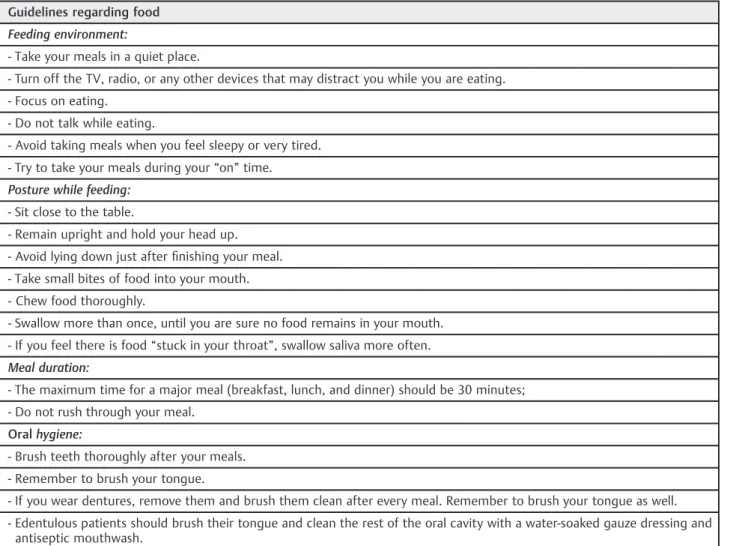
Patients took part in a SLP intervention program, which consisted of four individual therapy sessions with 30 minute each, during which patients received guidelines regarding food (►Table 1) and a postural maneuver (chin down). The chin-down posture maneuver follows the recommendations in the literature due to be easy to learn for the patient, as well as its aim of reducing the early escape and possible food intake in the airway.16–18
For statistical analysis, we conducted the Shapiro-Wilks test to verify normality of the variables. The Wilcoxon test was used to compare mean scores for each SWAL-QOL domain before and after therapy (variables without asymme-try distribution). The paired-samples Studentt-test was used for comparison of total SWAL-QOL scores before and after therapy (variables with normal distribution). Spearman cor-relation coefficients were used to correlate pre- and post-therapy differences in each SWAL-QOL domain with the variables age, Hoehn and Yahr (H&Y) stage, and educational level (variables without normal distribution). We used the Mann-Whitney Test to correlate pre- and post-therapy differ-ences in each SWAL-QOL domain with the variable gender. Analysis of covariance was used for analysis of total SWAL-QOL scores in relation to the variables gender, age, and H&Y stage. We assumed a 5% error rate for all tests. We performed all analyses in SPSS 20.0.
Results
The study sample comprised 11 patients with PD. However, one patient was excluded for failure to take part in all sessions. The final sample comprised 10 participants. Of these, 80% were male. The mean (SD) age was 62.2 (11.3) years, the mean educational level was 7.5 (4.3) years, and the mean disease duration was 10.7 (4.7) years. Regarding disease stage, three patients (30%) were H&Y stage 2,five patients (50%) were H&Y 3, and two patients (20%) were H&Y 4.
Table 1 Guidelines regarding food
Guidelines regarding food
Feeding environment:
- Take your meals in a quiet place.
- Turn off the TV, radio, or any other devices that may distract you while you are eating.
- Focus on eating.
- Do not talk while eating.
- Avoid taking meals when you feel sleepy or very tired.
- Try to take your meals during your“on”time.
Posture while feeding:
- Sit close to the table.
- Remain upright and hold your head up.
- Avoid lying down just afterfinishing your meal.
- Take small bites of food into your mouth.
- Chew food thoroughly.
- Swallow more than once, until you are sure no food remains in your mouth.
- If you feel there is food“stuck in your throat”, swallow saliva more often.
Meal duration:
- The maximum time for a major meal (breakfast, lunch, and dinner) should be 30 minutes;
- Do not rush through your meal.
Oralhygiene:
- Brush teeth thoroughly after your meals.
- Remember to brush your tongue.
- If you wear dentures, remove them and brush them clean after every meal. Remember to brush your tongue as well.
- Edentulous patients should brush their tongue and clean the rest of the oral cavity with a water-soaked gauze dressing and antiseptic mouthwash.
Table 2 SWAL-QOL scores before and after Dysphagia therapy
SWAL-QOL Domain PRE POST p Uw
Mean SD Mean SD
1. Burden 77.5 14.44 82.5 30.73 0.258 1.131
2. Eating desire 79.15 19.35 82.49 24.67 0.527 0.632
3. Feeding duration 52.5 39.87 58.75 36.82 0.833 0.211
4. Symptom frequency 69.61 10.82 79.42 14.97 0.025 2.244
5. Food selection 65 26.87 86.25 28.53 0.095 1.667
6. Communication 42.5 23.71 55 31.84 0.103 1.630
7. Fear 66.87 25.69 76.87 29.47 0.260 1.127
8. Mental health 80.5 22.04 84 26.64 0.752 0.315
9. Social Function 71 28.06 83 26.58 0.116 1.572
10. Sleep 31.25 38.75 46.25 39.10 0.176 1.355
11. Fatigue 70.8 27.28 83.31 17.58 0.123 1.544
SWAL-QOL domains increased after the SLP intervention period. However, the difference was only significant for the Symptom Frequency domain (p¼0.025 and r¼-2.24). In addition, a significant difference in total scores was observed after therapy (p¼0.033).
The mean scores for each SWAL-QOL domain before and after therapy were then tested for correlation with the variables gender, H&Y stage, age and educational level, as shown in►Table 3. A significant correlation of domain Sleep was observed with gender (p¼0.047) and H&Y stage (p¼0.024 and r¼-0.74). Furthermore, the Food Selection domain correlated significantly with H&Y stage (p¼0.051 and r¼0.66). In this way, the earlier stage of PD, the better the improvement experienced in QoL after therapy.
In the assessment of swallowing, with regards to the signs and symptoms of dysphagia, there was a significant reduction after SLP therapy for both consistencies, solid (p<0.001) and liquid (p¼0.022).
Discussion
Although the literature1,2 reports the high incidence of dysphagia in patients with PD,1,2the influence of dysphagia as a leading cause of death in PD,8,9the silent aspiration which reduces complaints,19 and its negative impact in QoL,13,20 there are still great difficulties in conducting studies with rehabilitation. This is due to the absence of patient com-plaints,17and the difficulties of movement in patients with PD, caused by postural instability, a characteristic symptom of PD. These factors mean that few patients agree to participate in this type of study, decreasing adherence to the therapeutic process. In addition, SLP therapy is a continuous process, which can be impaired due to clinical fluctuations of the patient, such as worsening of motor symptoms.
Thus, few studies have investigated the influence of ther-apy on swallowing-related QoL. In the literature review for this article, we found only three studies,6,10,14all of which
reported QoL and clinical improvement after SLP interven-tion, regardless of the therapeutic technique used and the number of sessions.
Data analysis showed that average scores for all SWAL-QOL domains improved after the intervention period. However, this difference was only significant for the Symptom Frequen-cy domain, providing evidence of a positive modification in QoL regarding the frequency of symptoms. These findings corroborate with the literature.6,14 In addition, there is a positive change in the complaints, due to reduction in the frequency of symptoms presented by the patients. Corrobo-rating with Argolo et al,6which found significant improve-ment in Fear and Frequency of Symptoms domains.
In this study, we verified that the relation between QOL and swallowing was moderate in thefirst assessment before the therapy program, showing that dysphagia had a negative effect on patient QoL. According to the study by Plowman-Prine et al2036 patients with and without dysphagia, with a mean age 65.6 years (10.8) and disease duration 11.5 years (0.5), and similar to ourfindings, patients with PD evaluated by SWAL-QOL exhibited moderate swallow-related QoL. In addition, dysphagia had a negative impact on patient QoL; total scores in the dysphagia group were lower than in the non-dysphagia group.
Regarding swallowing-related complaints, the study found positive impacts on QoL regardless of age, educational level, or H&Y score; Disease stage was the only variable to interfere with QoL. This corroborates with the existing literature,6 which reports a reduction in swallow-related complaints after SLP intervention. However, in both studies, the sample can be a limiting factor, due to the significantly small sample size of 10 patients in this study and 15 patients in the literature. The limited sample size in the present study was due to the difficulty of conducting a study therapy in PD individuals.
Thus, it is important to note the importance of dysphagia therapy for this population, to reduce the complaints regard-ing swallowregard-ing and provide an improvement in QoL of these Table 3 Correlations of SWAL-QOL Domains with Gender, H&Y stage, age, and educational level
SWAL-QOL Domain Gendera H&Y Age Education
p r p r p r
1. Burden 0.506 0.203 0.469 1.0 0.000 0.772 0.106
2. Eating desire 0.224 0.792 0.103 0.627 0.176 0.174 0.467
3. Feeding duration 0.895 0.396 0.323 0.407 0.295 0.892 0.050
4. Symptom frequency 0.433 0.646 0.178 0.365 0.321 0.464 0.262
5. Food selection 0.694 0.051 0.665 0.542 0.220 0.331 0.344
6. Communication 0.143 0.807 0.096 0.892 0.049 0.523 0.230
7. Fear 0.147 0.560 0.226 0.134 0.508 0.086 0.569
8. Mental health 0.589 0.709 0.146 0.519 0.232 0.089 0.565
9. Social Function 0.893 0.444 0.293 0.379 0.313 0.890 0.050
10. Sleep 0.047 0.024 0.743 0.320 0.351 0.993 0.003
11. Fatigue 0.147 0.773 0.113 0.324 0.177 0.358 0.326
patients. We verified that the therapeutic strategies used in both studies are distinct, and yet the results resemble each other. Thisfinding suggests that SLP therapy regarding the increased attention given to the feeding problem by the patient may be the deciding factor for the success of the therapeutic process. This is due the fact that silent aspiration is a frequent clinical sign of dysphagia in patients with PD. It is known that the absence of the cough reflex limits the possibility of dysphagia identification, which can cause a decrease in the complaint and awareness of the problem by patients.21,22
Thisfinding demonstrates the importance of dysphagia therapy in this population, as a way of reducing swallowing-related complaints and improving QoL.
Our sample was predominantly composed by males, with mean age of 62.2 (11.3) years, as in the previous studies of Plowman-Prine et al20and Argolo et al,6in which the mean age was65.6 and59.2 years, respectively. According to the literature men have a higher estimated risk of developing PD than women.23
Although the intervention applied in the present study consisted of only four weekly sessions of therapy, versusfive weekly sessions in the Argolo et al6 study and 13 to 15 sessions in the Heijen et al14 study, we observed similar outcomes in terms of QoL improvement. Therefore, the number of therapy sessions does not seem to be a factor of direct influence on the improvement of QOL in this popula-tion. Furthermore, in studies from Troche et al,10Argolo et al6 and Heijen et al,14 it was not used the same therapeutic strategy, and yet, it was found in all studies a improvement of QOL in the patients. Tis way, it also verifies the diversity of SLP treatment strategies for improvement of QOL related to swallowing, in individuals with PD.
Conclusion
Our results suggest that swallowing-related QoL improved after a SLP intervention. The early stage of PD, the greater the improvement experienced after therapy. This demonstrates that the earlier start SLP intervention better will be the effects on quality of life. We observed positive modifications in dysphagia-related complaints regardless of gender, age, edu-cational level, and H&Y stage. Thus, disease stage was the only variable found to interfere with QoL.
References
1 Wintzen AR, Badrising UA, Roos RAC, Vielvoye J, Liauw L, Pauwels EKJ. Dysphagia in ambulant patients with Parkinson’s disease: common, not dangerous. Can J Neurol Sci 1994;21(1):53–56 2 Nagaya M, Kachi T, Yamada T, Igata A. Videofluorographic study of
swallowing in Parkinson’s disease. Dysphagia 1998;13(2):95–100 3 Potulska A, Friedman A, Królicki L, Spychala A. Swallowing disorders in Parkinson’s disease. Parkinsonism Relat Disord 2003;9(6):349–353 4 Kalf JG, de Swart BJ, Bloem BR, Munneke M. Prevalence of oropharyngeal dysphagia in Parkinson’s disease: a meta-analysis. Parkinsonism Relat Disord 2012;18(4):311–315
5 Smith SK, Roddam H, Sheldrick H. Rehabilitation or compensation: time for a fresh perspective on speech and language therapy for dysphagia and Parkinson’s disease? Int J Lang Commun Disord 2012;47(4):351–364
6 Argolo N, Sampaio M, Pinho P, Melo A, Nóbrega AC. Swallowing disorders in Parkinson’s disease: impact of lingual pumping. Int J Lang Commun Disord 2015;50(5):659–664
7 Kim YH, Oh BM, Jung IY, Lee JC, Lee GJ, Han TR. Spatiotemporal characteristics of swallowing in Parkinson’s disease. Laryngoscope 2015;125(2):389–395
8 Pinter B, Diem-Zangerl A, Wenning GK, et al. Mortality in Parkin-son’s disease: a 38-year follow-up study. Mov Disord 2015;30(2): 266–269
9 Macleod AD, Taylor KS, Counsell CE. Mortality in Parkinson’s disease: a systematic review and meta-analysis. Mov Disord 2014;29(13):1615–1622
10 Troche MS, Sapienza CM, Rosenbek JC. Effects of bolus consistency on timing and safety of swallow in patients with Parkinson’s disease. Dysphagia 2008;23(1):26–32
11 Pitts T, Bolser D, Rosenbek J, Troche M, Okun MS, Sapienza C. Impact of expiratory muscle strength training on voluntary cough and swallow function in Parkinson disease. Chest 2009;135(5): 1301–1308
12 Regan J, Walshe M, Tobin WO. Immediate effects of thermal-tactile stimulation on timing of swallow in idiopathic Parkinson’s disease. Dysphagia 2010;25(3):207–215
13 Leow LP, Huckabee ML, Anderson T, Beckert L. The impact of dysphagia on quality of life in ageing and Parkinson’s disease as measured by the swallowing quality of life (SWAL-QOL) question-naire. Dysphagia 2010;25(3):216–220
14 Heijnen BJ, Speyer R, Baijens LWJ, Bogaardt HCA. Neuromuscular electrical stimulation versus traditional therapy in patients with Parkinson’s disease and oropharyngeal dysphagia: effects on quality of life. Dysphagia 2012;27(3):336–345
15 Portas JG. Validação para a língua portuguesa-brasileira dos questionários: qualidade de vida em disfagia (Swal-qol) e satisfa-ção do paciente e qualidade do cuidado no tratamento da disfagia (Swal-care). [dissertation]. São Paulo: Fundação Antônio Pru-dente, em São Paulo, Programa de Pós-graduação em Oncologia;2009
16 Logemann JA. The dysphagia diagnostic procedure as a treatment efficacy trial. Clin Commun Disord 1993;3(4):1–10
17 Logemann JA, Gensler G, Robbins J, et al. A randomized study of three interventions for aspiration of thin liquids in patients with dementia or Parkinson’s disease. J Speech Lang Hear Res 2008; 51(1):173–183
18 Luchesi KF, Kitamura S, Mourão LF. Dysphagia progression and swallowing management in Parkinson’s disease: an observational study. Braz J Otorhinolaryngol 2015;81(1):24–30
19 Monteiro L, Souza-Machado A, Pinho P, Sampaio M, Nóbrega AC, Melo A. Swallowing impairment and pulmonary dysfunction in Parkinson’s disease: the silent threats. J Neurol Sci 2014;339(1–2): 149–152
20 Plowman-Prine EK, Sapienza CM, Okun MS, et al. The relationship between quality of life and swallowing in Parkinson’s disease. Mov Disord 2009;24(9):1352–1358
21 Gasparim AZ, Jurkiewicz AL, Marques JM, Santos RS, Marcelino PCO, Junior FH. Deglutição e Tosse nos Diferentes Graus da Doença de Parkinson. Arq Int Otorrinolaringol 2011;15(2): 181–188
22 Angelis EC. Doença de Parkinson. In: Jotz GP, Angelis EC, Barros APB, ed. Tratado da Deglutição e Disfagia - No adulto e na criança. Rio de Janeiro: Revinter; 2009:274–278