Working Paper Series
Directed Giving: Evidence from an Inter-Household
Transfer Experiment
Cátia Batista
Nova School of Business and Economics and IZA
Dan Silverman
Arizona State University and NBER
Dean Yang
University of Michigan, NBER and BREAD
ISSN 2183-0843
NOVAFRICA | Nova School of Business and Economics|Faculdade de Economia | Universidade Nova de Lisboa Campus de Campolide | 1099-032 Lisboa – Portugal | T: (+351)213 801 673 | F: (+351) 213 801 105 | www.novafrica.org
Any opinions expressed here are those of the author(s) and not those of NOVAFRICA.
Research published in this series may include views on policy, but the center itself
takes no institutional policy positions.
NOVAFRICA is a knowledge center created by the Nova School of Business and
Economics of the Nova University of Lisbon. Its mission is to produce distinctive
expertise on business and economic development in Africa. A particular focus is on
Portuguese-speaking Africa, i.e., Angola, Cape Verde, Guinea-Bissau, Mozambique,
and Sao Tome and Principe. The Center aims to produce knowledge and disseminate
it through research projects, publications, policy advice, seminars, conferences and
other events.
NOVAFRICA Working Papers often represent preliminary work and are circulated to
encourage discussion. Citation of such a paper should account for its provisional
0
Directed Giving: Evidence from an Inter-Household Transfer Experiment
*Catia Batista, Nova University of Lisbon and IZA Dan Silverman, Arizona State University and NBER Dean Yang, University of Michigan, NBER, and BREAD
July 2013
Abstract
We investigate the determinants of giving in a lab-in-the-field experiment with large stakes. Study participants in urban Mozambique play dictator games where their counterpart is the closest person to them outside their household. Dictators share more with counterparts when they have the option of giving in kind (in the form of goods), compared to giving that must be in cash. Qualitative post-experiment responses suggest that this effect is driven by a desire to control how recipients use gifted resources. Standard economic determinants such as the rate of return to giving and the size of the endowment also affect giving, but the effects of even large changes in these determinants are significantly smaller than the effect of the in-kind option. Our results support theories of giving where the utility of givers depends on the composition (not just the level) of gift-recipient expenditures, and givers thus seek control over transferred resources.
Keywords: sharing, altruism,giving,dictator game, inter-household transfers, Mozambique
JEL Codes: C92, C93, D01, D03, D64, O17
*
Batista: Faculdade de Economia, Universidade Nova de Lisboa and IZA ([email protected]); Silverman: Department of Economics, Arizona State University and NBER ([email protected]); Yang
1 In both rich and poor countries, transfers of resources across individuals and across
households are common and often large in magnitude. In developing countries, inter-household
transfers play an important role in replacing public transfers when those public sources are not
available (Cox and Jimenez, 1992; Cox et al. 2004; Jensen 2004; Kazianga 2006). Similarly,
informal transfer and credit relationships between households also augment missing insurance
markets in developing countries (Townsend 1994, Udry 1994, Jalan and Ravallion 1999,
Angelucci et al 2010). In developed countries, inter-household transfers are also widespread
(Altonji et al 1992, 1997; Bernheim et al 2004; Arrondel and Masson 2006).
Becker’s (1974) model of altruistic transfers is the seminal theory of intra-household
transfers. This model was subject to an early test by Cox (1987), who found that inter vivos
transfers were more consistent with exchange-related motives than with pure altruism. A recent
literature has used experimental methods to examine motivations behind giving. Studies have
explored the existence and nature of altruistic motives for giving, such as Andreoni and
Vesterlund (2001), Andreoni and Miller (2002), Camerer and Fehr (2004), and DellaVigna et al
(2012). Other work, such as Leider et al (2009) and Ligon and Schechter (2010), has highlighted
that transfers may reflect selfish or “exchange” motives – desires on the part of givers to reward
recipients for past behavior or to influence future behavior – in addition to altruism.1
In this paper, we examine a cross-cutting issue: whether and how givers seek to influence or
control the consumption patterns of gift recipients. Would an ability to wield control over
recipient consumption out of gifted resources affect givers’ expected utility from giving, and
their giving decisions overall?
To our knowledge, this question – whether and how givers value “directed” giving – has not
been addressed in the literature, and it has potentially important theoretical and practical
implications. From a theoretical standpoint, evidence of a desire for control on the part of givers
rules out certain models of the giving decision – for example, it is inconsistent with a simple
model of pure altruism and perfect rationality on the part of givers and recipients.
Evidence on directed giving motives could also have important practical or policy
implications. If such motives exist and play a quantitatively substantial role, real-world transfer
1
2 behavior may be affected by regulatory or technological developments that facilitate givers’
control over recipient consumption. For example, new technologies such as the Internet facilitate
in-kind giving over distances (via online merchants), and telecommunications can improve
long-distance monitoring of transfer recipients. In the legal realm, trusts and other legal instruments
allow givers to place limits on how recipients can use inter-vivos transfers and bequests. In the
charitable giving context, directed giving motives might explain the strategy of soliciting
donations for specific, defined uses, rather than general ones. Directed giving motives could also
explain political support for government programs providing government transfers in kind (e.g.,
the US SNAP or “Food Stamps” program) instead of in cash.
The question we pose is also related to research on the motivations behind in-kind giving.
Giving often takes the form of cash transfers, but a substantial share of giving is in-kind,
meaning it is in the form of non-cash goods and services. Standard models of giving imply that
gift-givers, who may not be fully aware of recipient preferences, cannot do better at raising
recipient utility than by giving cash (as opposed to making in-kind gifts), which can then allow
recipients to make utility-maximizing consumption choices on their own.2 The prevalence of
in-kind giving is therefore a puzzle.
Alternative hypotheses have been proposed to explain this puzzle. Pollak (1988) presents
in-kind gifts, or tied transfers, within the family as direct consequences of paternalistic preferences,
where parents derive utility from their children’s consumption of only a subset of goods from
their children’s overall consumption basket. In-kind gifts are just a way to promote the
consumption of those preferred goods. Waldfogel (1993) hypothesizes that individuals may give
in-kind gifts if they think they know the recipient’s preferences better than recipients do
themselves. His data reject this hypothesis, however: undergraduates report valuing in-kind gifts
received at large discounts relative to market prices. Prendergast and Stole (2001) instead
rationalize in-kind gifts in a signaling model. They hypothesize that in-kind gifts allow givers to
send positive signals to recipients, by putting in the effort to select a gift and to show the
recipient that the giver knows the recipient’s preferences well. Our “directed giving” hypothesis
provides an alternative explanation for in-kind giving.
2
3 A number of theoretical approaches can generate directed giving, or giving in which givers
seek control over the use of transferred resources. In the examples we discuss, givers’ desire for
control arises because giver utility depends on the composition (not just the level) of
gift-recipient expenditures. For example, in a paternalistic model, givers may value the utility
recipients gain from consumption of “virtue” goods, but not recipient utility from consumption
of “vice” goods. This makes it possible for givers to raise their own utility from giving by
making in-kind gifts. An alternative model is one where gift recipients may consume either
“public” goods (goods which generate utility for givers as well as recipients) or “private” goods
(which generate utility only for recipients).3 In this public goods model, givers can raise their
own utility from giving by making in-kind gifts of public goods. In both the paternalistic and
public goods models, giver utility rises with in-kind giving because givers can control recipient
consumption patterns better with in-kind gifts than with cash gifts. Both models make ambiguous
predictions as to whether the possibility of making in-kind gifts leads to more or less gift-giving
overall.
The main contribution of our paper is to provide the first direct experimental evidence
supporting a class of models that generate motives for directed giving. In addition, we reveal a
pattern in the results that is distinctive of the paternalistic model and thus suggests this model
more relevant than either the public goods or the signaling model of giving. We conduct a
lab-in-the-field experiment with large stakes. Respondents were clients of a microfinance institution in
urban Mozambique, and played a series of dictator games in which their counterpart (the
recipient of gifted funds) was, according to the respondents, the closest person to them outside of
their own household. One of the choices made by each respondent is, at the end of the
experiment, chosen at random to be implemented in reality.4
Our focus on transfers between members of a social network distinguishes our research from
the vast majority of dictator game experiments on willingness to give anonymously to unknown
recipients with whom no future interaction is expected. Leider et al (2009) and Ligon and
Schechter (2010) are recent exceptions that also study individuals with social ties. In our view,
3
Examples of public goods in this context include housing and other household durables, which may be enjoyed by givers on occasion, or investments in children in the recipient household who are related to the giver.
4
4 experiments on non-anonymous giving in social networks merit greater attention. Many have
observed that the level of sharing in anonymous lab settings is high relative to similar
interactions of strangers outside the lab (e.g., Della Vigna, 2009). This suggests that the motives
behind giving in classic dictator game experiments may be different from those that inspire the
large amounts of giving that occurs between members of social networks. Our experiment is
designed to understand better the motives for giving among friends and family.
By studying giving within a social network, we lose an advantage of anonymous giving
experiments. Because we expect our subjects to interact after the experiment, the possibility that
they are playing a repeated game makes interpretation of their behavior in the experiment more
difficult. To aid interpretation, we will use our experimental results and a survey of the
participants to investigate the role played by repeated interaction. In particular, we will look for
evidence of favor trading after the experiment and for evidence that givers favored durable goods
that could serve as tangible reminders of their favor to recipients. We will also look for evidence
of standard economic advantages of giving in-kind rather than cash, such as convenience or
price, that would motivate in-kind giving in repeated games among agents with standard
preferences. This is important because, as explained below, the advantages of cash giving in
static models also apply to many dynamic ones.
We find that in-kind giving amounts to a substantial share of giving. When respondents can
freely choose to give in cash or in kind, they give 25.9% of the endowment in cash and 19.2% in
kind; in-kind giving therefore accounts for 42.6% of giving.5
Another key finding is that offering respondents the option of in-kind giving leads to
substantially more total giving. When gifts can only be made in cash, respondents give away
39.6% of their endowments. But when respondents also have the option of making in-kind gifts
(in addition to cash gifts), they give 45.1% of their endowments. This 5.5 percentage point
increase amounts to about three-tenths of a standard deviation of the percentage given in the
experiment.
The in-kind effect is also large relative to the effect of other determinants of giving in our
experiment. A very large increase in the rate of return to giving (moving from 0% to 200%
5
5 return) raises the fraction shared by 2.4 percentage points,6 while a four-fold increase in the size
of the endowment given to respondents (from 300 to 1200 meticais) leads sharing to fall by 2.7
percentage points.7 The in-kind effect is therefore at least twice as large in magnitude as the
effects of these very large changes in other economic determinants of giving.
These results are consistent with both directed giving models (paternalistic and public goods
models), as well as a signaling model of giving (Prendergast and Stole 2001) where givers seek
to demonstrate how well they know the preferences of their recipients. To distinguish among
these models, we implemented additional experimental choices where givers could not make the
exact in-kind consumption choices themselves. In these rounds, givers only specified the money
amounts allocated to in-kind goods, and recipients made the final choice of goods purchased
with these in-kind funds.8 The goods that recipients could choose among in these in-kind
allocations included both public and private goods; in other words, givers could not control
whether recipients chose public vs. private goods. The manner of selection of the in-kind goods
by gift recipients was such that recipients could not use the in-kind resources for expenditures
such as alcohol, tobacco, or entertainment, that would be viewed by givers as unproductive or
inappropriate (vice goods). Making in-kind gifts in this fashion would also presumably have no
signaling value. If in-kind giving is little affected by the ability to ensure the gift takes the form
of public goods, then paternalism, rather than public good consumption or signaling, is the
dominant motive behind in-kind giving.
We find that offering this form of the in-kind option also has a statistically significant
positive effect on giving. This effect is only slightly smaller than the effect of the main in-kind
option (where respondents make final purchase decisions), and the two in-kind effects are
statistically indistinguishable from one another. The fact that the in-kind effect is still positive
and significant when recipients make final purchase decisions suggests that the paternalistic
model of giving is the most empirically relevant in this context.
Additional analysis helps us evaluate other explanations for the results. We provide evidence
– based on an examination of heterogeneity in the treatment effect – against the hypotheses that
6
In experimental rounds with a rate of return to giving of x%, each amount a respondent gave out of their
endowment to the counterpart was “matched” by the experiment with funds amounting to an additional x% and then shared with the counterpart.
7
One US dollar was worth roughly 27 Mozambican meticais during the time period of this experiment.
8
6 the “in-kind effect” reflects the value of free delivery of the in-kind items, the opportunity for
counterparts to consume goods not available in their local areas, or the opportunity to give the
counterpart a tangible reminder of the giver’s generosity.
As a final test of whether the in-kind effect is driven by directed giving as opposed to other
motivations, we examine qualitative respondent self-reports on their own motivations for in-kind
giving. These data reveal that a desire to control how recipients use gifted resources figures
prominently in decisions to give in kind, and these individual-level responses correlate positively
with the extent to which respondents increase their own giving in response to the in-kind option
in the experiment. Other motivations for in-kind giving figure much less prominently in these
qualitative data.
The remainder of the paper is organized as follows. Section 2 presents a model of directed
giving. Section 3 describes the experiment and the baseline data. Section 4 presents the main
empirical results, quantifying the in-kind effect. Section 5 presents additional empirical analyses
intended to reveal the mechanisms behind the in-kind effect. Section 6 concludes.
2. Directed Giving in Theory
We present here two simple models that generate directed giving, or giving in which givers
seek control over the use of transferred resources: a paternalistic model and a public goods
model. In both cases, givers’ desire for control arises because giver utility depends on the
composition, not just the level, of gift-recipient expenditures. Giver utility therefore rises with
in-kind giving because givers can control recipient consumption patterns better with in-in-kind gifts
than with cash. Both models make ambiguous predictions as to whether the possibility of making
in-kind gifts leads to more or less gift-giving overall.
A paternalistic model of giving
In this model, givers value the utility recipients gain from consumption of so-called “virtue”
goods, but not recipient utility from consumption of “vice” goods. This makes it possible for
givers to raise their own utility from giving by making in-kind gifts.
An altruistic “giver” decides how much of a windfall to donate to a recipient, either in cash
or in kind. Suppose, for simplicity, that there are two composite goods x and y with prices px
7 good, and y the vice good.
In the absence of a gift, a recipient with wealth would solve
max
x,y uxvy
s.t. −pxx−pyy ≥ 0
x,y ≥ 0
Under standard assumptions, the recipient's indirect utility is a well-behaved function of
wealth, R; so if the giver donates some amount of cash g to the recipient then the benefit to the recipient is Rg−R. Denote by x∗g,y∗g the optimal choices associated with a cash gift of size g.
Suppose instead that the giver allocates an amount k of the virtue good to the recipient.
Assume that this gift cannot be sold for cash but that its market value is g pxk g . In this case, the recipient solves
(P)
max
x,y uxkvy
s.t. −pxx−pyy ≥ 0
x,y ≥ 0
If the solution to this problem is interior, then the recipient's optimal choices x̃, ỹ satisfy
u′x̃k v′ỹ
px
py, x̃ k x∗g, and ỹ y∗g. In other words, the giver's demand that the
recipient consume at least k of the virtue good is not binding in this case; and the recipient's
ultimate consumption (utility) does not depend on whether the gift with a market value of g
meticais was cash or in-kind.
In the more interesting case, the size of the in-kind gift, k, exceeds the amount of the virtue
good that the recipient would have chosen were the gift to be made in cash, x∗g. A standard argument about the advantages of cash over in-kind assistance then applies. If k x∗g the recipient is worse off than she would be with the gift’s cash equivalent, g. We know this is true
8 but she does not choose it. By revealed preference, the insistence that she consume at least k of
the virtue good is therefore worse for the recipient.
This is not to say that the in-kind gift harms the recipient. So long as she values the virtue
good at the margin, the recipient benefits from the in-kind gift, even if it is “oversized.” We will
denote by K,k the indirect utility of the recipient with wealth and who has been allocated an in-kind gift of size k. Using this notation, the standard argument about the
advantages of cash assistance given above then implies that for a gift composed of a cash amount
i and an in-kind amount k, such that, pxki g,
(1)
Rg ≥ Ki,k
and the inequality is strict if k x∗g.
The argument behind inequality (1) makes in-kind giving a puzzle for simple models of
altruism. We offer here a simple theory of in-kind gifts. The theory is a blend of altruism and
paternalism. In a standard model of altruism, when given a money windfall of size m the giver
solves
max
c,i,k1−VcKi,k
s.t. m−c i−pxk
1r ≥ 0 c,i,k ≥ 0
where Vc is the giver’s utility from consumption of a composite good c denominated in meticais, ∈ 0, 1 gives the altruistic weight on the recipient’s utility, and all other variables are defined as above. Anticipating our experiments, we also introduce a relative price of giving
r. When r is higher, giving is cheaper. Inequality (1) from above implies that giving nothing
in kind, k∗ 0, solves this altruistic giver’s problem. If, in addition, we set aside cases where
the giver is just indifferent between cash and in-kind because the in-kind gift would not bind,
then in-kind giving is never optimal.
Suppose, instead, that the giver, while altruistic, does not entirely respect the preferences of
9 assume that the giver respects only the recipient’s consumption of virtue goods. In this case, the
giver solves
max
c,i,k1−Vc
ui,k
s.t. m−c− ipxk
1r ≥ 0 c,i,k ≥ 0
where ui,k gives the value from virtue good consumption of a recipient who received a gift consisting of cash i and in-kind amount k. That is,
ui,k ≡ ux∗i,k
where x∗i,k solves problem (P) above given wealth i and in-kind gift k. This simple model of altruism tinged by paternalism makes sense of in-kind gifts. More
precisely, this model implies:
Result 1:The giver strictly prefers an in-kind gift k with market value g to a cash gift of
g if and only if k x∗g.
In other words, the giver prefers to give in-kind whenever it generates more consumption of
the virtue good than would occur if he just gave cash. That is true because, in this simple model,
the giver places zero value on the recipient's vice good consumption and values her virtue good
consumption monotonically. Note that, if we set aside knife-edge cases of indifference, this
simple model also predicts that gifts would never combine of cash and in-kind. A richer model of
giver preferences that, instead of entirely ignoring vice utility only gave it a weight less than one,
would predict that some gifts would consist of both cash and in-kind. In these cases, the giver
would equate the marginal altruistic utility from giving in-kind with the marginal altruistic utility
from giving cash.
Result 2:The level of virtue good consumption is weakly higher when the option to give
in-kind is available.
Proof: See Appendix A. Let ĝ denote the optimal gift when only cash can be given, and
i′,k′ the optimal gift when both forms of giving are possible. If ĝ 0, the claim is trivially
10 allocation 0,k′′ where k′′ x∗ĝ generates strictly higher utility from altruism than
i′,k′. Most important, because the vice good is normal, the marginal propensity to consume
the virtue good is less than one and therefore
(2)
pxk′′ ≤ ĝ.
It follows that if the gift ĝ was feasible then so is 0,k′′, and this alternative gift leaves the giver with at least as much own consumption as the strictly cash gift ĝ. By construction,
marginal utility to the giver from altruism is the same at gift 0,k′′ as at ĝ, 0, and we have just argued that marginal utility from own consumption is weakly lower. Thus, either 0,k′′ is optimal, or an even larger in-kind gift is preferred.
Inequality (2) isolates the key effect on the giver of providing the in-kind option. The
possibility of giving in-kind lowers the effective price, in terms of own consumption c, of
producing virtue good consumption and thus altruistic utility. This effective price change
generates income and substitution effects which both point in the same direction. The
substitution effect gives incentive to buy more virtue good and less own consumption, and the
income effect creates incentive to buy more of both.
If we understand that the introduction of the in-kind option effectively reduces the price to
the giver of generating recipient virtue good consumption, it is straightforward to see that the net
effect on the total market value of the gift, or its complement c , is ambiguous. The lower
effective price of getting the recipient to consume the virtue good creates incentive for the giver
to substitute out of own consumption and into giving (the substitution effect). But the lower
effective price makes every level of virtue good production cheaper, in terms of c, to obtain,
and thus creates incentive to purchase more own consumption (income effect). Whether the
market value of the gift increases when the in-kind option becomes available depends, therefore,
on the relative magnitude of these income and substitution effects.
Result 3:The introduction of the in-kind option has an ambiguous effect on the total market
value of the gift.
11 A related but distinct model of directed giving is one where gift recipients may consume
either “public” goods (goods which generate utility for givers as well as recipients) or “private”
goods (which generate utility only for recipients). In this public goods model, givers can raise
their own utility from giving by making in-kind gifts of public goods.
In the interest of brevity, we provide the formal exposition of this model in Appendix A, and
simply note here that the model makes similar predictions to the paternalistic model. In
particular, analogs of Results 1 through 3, discussed above in the context of the paternalistic
model, also hold in the public goods model.
Impure altruism and in-kind giving
These two simple models of giving address the puzzle that in-kind giving presents for
standard models of altruism. In a standard model of altruism, where all goods are private and the
donor's utility simply includes a positive weight on the utility of their recipient, giving in-kind
can never help, and might hurt.
This observation has motivated alternative models of giving that rationalize in-kind gifts.
Waldfogel (1993) offers a model of altruistic donors, and recipients who may not know, with
certainty, what consumption bundle they would prefer. The model thus opens the possibility that
a donor may know his recipient better than she knows herself. At a minimum, it creates the
incentive for a donor to take on a bit of risk by giving in-kind with the hope that the realization
of the utility from the gift beats the safe return from giving cash. Prendergast and Stole (2001)
take a different approach. They motivate non-monetary gifts with a donor’s preference to be
perceived as confident about what the receiver would like. By purchasing a gift, the donor issues
a costly signal that he is so confident in the preferences of the recipient he is willing to give
in-kind rather than cash. That model explains both why people give non-monetary gifts, and why,
when it comes to gifts, the thought alone does not count as much as the thought backed up by an
actual purchase.
The two simple models presented above suggest alternative motivations for giving in kind. In
the paternalistic model, the donor simply gains utility from the recipient's consumption of some
goods (virtue goods), but not others (vice goods). In the public goods model, the mechanism
behind in-kind giving is shared consumption. In many settings, both donor and recipient may
12 consumes the gift as well.
These are different forms of impure altruism than the one developed in Andreoni (1989,
1990). In Andreoni’s models, the donor is motivated to by the warm glow he derives from the
gift. This impure altruism doesn't induce preferences over in-kind vs. cash giving. In our models,
the donor’s altruism is again impure but structured in particular ways. The common feature of
the models we present is that the donor’s utility is influenced by the composition of recipient
expenditures (even when the level of recipient expenditures is held constant). The donor gives in
kind, and thus benefits the recipient, because she either induces consumption of the particular
(“virtue”) goods she differentially values, or procures valuable public goods for herself.
Distinguishing among the models
While the paternalistic and the public goods model share many predictions, a test allows us to
distinguish between them and, as a byproduct, shed light on the relevance of the signaling model.
The test examines whether givers still seek in-kind giving if the in-kind allocations can only be
made to a very broad set of goods that includes a mixture of public and private goods, but that
excludes “vice” goods. To be specific (and anticipating our experimental setup), consider a
situation where in-kind giving involves providing recipients with something akin to a gift card,
that can be used for purchases of a wide range of goods from a catalog, but that rules out use for
vices (e.g., alcohol, tobacco, or sex services).
In such a scenario, paternalistic givers would value in-kind giving just as much as they did
when they directly controlled the purchases, so long as vice goods are not in the catalog. Because
the catalog includes both private and public goods, however, givers motivated by their interest in
consuming public goods will value this form of giving much less than when they directly
controlled the purchases. The value to the giver of an in-kind gift is diminished, in this scenario,
by the recipients’ purchases of private goods.9 In addition, there would also be no value of
in-kind giving under the signaling model, as givers would be unable to signal their knowledge of
recipient preferences.
9
13
Result 4:If givers assign the same value to direct control of an kind option as to an
in-kind option that excludes only vice goods, this would be consistent with a paternalistic model,
but not with either a public goods or signaling model of giving.
This result motivates our first analysis in Section 5 below.
3. Background, Sample, and Description of Intervention
Sample and baseline survey
Participants were individuals with savings accounts at Banco Opportunidade de Moçambique
(BOM), our local project partner. BOM is a microfinance bank in the Opportunity International
network. It has two branches in the Maputo capital city area at which we conducted this study.
Participants were interviewed immediately before the experiment between May and July 2012,
along with their counterparts.10
The interviewer team had a desk at each of the two Maputo branches of BOM and invited
savings account holders visiting the branch when the team was present to participate in the
experiment.11 To be considered eligible, a respondent had to identify a counterpart at their “most
closely connected household” (MCCH) outside of their own home who owned a cell phone and
had a bank account (other than one shared with the respondent). This selection criterion was
designed to allow for phone interviews of the counterpart and bank transfers of the monetary
payoffs from the experiment.12
The baseline survey was administered immediately before the experiment and asked
questions about the participants’ demographic characteristics, labor market status, expenditure
patterns and property ownership, as well as on gift giving (and receiving) behavior.
10
A simultaneous 10-minute phone interview was conducted with the counterpart of each participant. At the beginning of the phone interview, clients were asked to briefly talk to their counterpart, reassuring them that they were collaborating with the research team conducting the interviews and summarizing the purpose of the project. It was not possible to contact 29 counterparts (or 12.1%) of the clients interviewed. A few counterpart interviews (6.9%) were not conducted at the same time as client interviews, but sometime within the week following the initial client interview.
11
Interviewer teams were present in the BOM branches during all working hours of all working days. For project funding reasons, there were two spells of interviewer presence at BOM branches: the first started on May 2nd and ended on May 17th; the second went from June 18th to July 20th.
12
14 Our sample of interest consists of 239 respondents who were administered the baseline
survey and asked to make the dictator-game allocations. We excluded a small number (5) of
individuals who did not provide complete responses to all experimental rounds.
Table 1 presents summary statistics from the baseline survey. Nearly half of the sampled
respondents (47 percent) were females. Respondents had a median age of 34 years and 57
percent of these respondents had not been born in Maputo city. A majority (61 percent) were or
had been married before, and the median household size was 5 people. A large fraction (80
percent) of the respondents in our sample had completed primary school and 27 percent had
finished high school. Most (77 percent) of the respondents in our sample reported being
employed. Median monthly household expenditure was 7,425 meticais (roughly US$275), 74
percent of the respondents reported owning their home, 48 owned agricultural land, 41 owned
farm animals, and 27 percent owned a car.
We note that 21 percent of the counterparts to our respondents do not live in the greater
Maputo city area, i.e. their closest relationship outside the home is in a distant location. In terms
of transfers made, 60 percent of the respondents in the baseline sample report having given cash
to their counterparts over the past year. The average of annual cash transfers is 5,668 meticais.
Many (46 percent) report having made in-kind transfers to their counterparts over the past year.
Annual in-kind transfers are valued at an average of 687 meticais. Overall, 66 percent of the
individuals in our sample state they have given money or goods to their counterpart in the
MCCH, and average annual transfers are valued at 6,355 meticais.
Table 1 also presents data on transfers received by the participants in the experiment from
their counterparts in the MCCH, which are also substantial. More than half (56 percent) of the
baseline survey respondents report having received cash from their counterparts in the MCCH
(with an annual average value of 2,995), whereas 51 percent declare having received in-kind
gifts (with an average value of 1,453 meticais). In total, 66 percent of the respondents in the
baseline survey received either money or gifts from their counterparts in the MCCH, with an
average annual value of 4,448 meticais. The percentage of people sending remittances is
therefore very close to the percentage of people receiving transfers, although the annual amount
of cash received is only about 70% of the annual amount sent.
Table 2 shows the relationship between the respondents in the baseline sample and their
15 tend to be siblings (nearly one third), followed by friends (about 17 percent), cousins and
children (each around 10 percent).
Description of experiment
The experimental intervention was administered to participants face-to-face, immediately
after they answered the baseline survey and their counterparts simultaneously answered their
survey over the phone.
The intervention consisted of proposing a number of choices to participants, so that they
could decide on the allocation of a large real stake that could be as high as 3600 meticais
(roughly US$133). This amount is nearly half the median monthly household expenditure in the
baseline sample.
Participants were offered 29 different choice rounds, which are detailed in the Appendix.
One of these choices would be implemented in reality, following a random draw made by the
individual at the end of the experiment, and respondents knew this in advance. A subset of 15 of
these rounds is the subject of the present paper. Analysis of other rounds will be the subject of
future separate papers.13
The first set of choices, rounds 1-4, asked individuals to decide on how to share an amount of
money between “self” and “other,” to be paid the day after,14 as a function of the return to giving
(i.e. the added value to the amount given) and of the overall amount at stake. In this set of
rounds, the rate of return to giving was either 0% or 200%.15 The overall amount at stake for
“self” was either 300 or 1,200 meticais. These rounds are referred to as “cash rounds” because
respondents could only share resources with counterparts in the form of cash.
The second set of choices proposed to participants was the same as above, with an added
option: individuals could decide whether gifts to the counterpart would be made in the form of a
direct deposit to their counterpart’s account on the next day (cash), or in the form of a delivery of
goods (with the value that they choose to allocate) to their counterpart’s doorstep (in-kind).
Respondents were shown a catalog from which they could choose the goods they wanted to send.
13
The other rounds not analyzed in the current paper are aimed at examining present-bias in sharing decisions. These were four cash rounds where all payments were delayed 60 days, and another ten rounds measuring the time consistency of choices using the convex time budget method. See the Appendix for further details.
14
The value at stake would be deposited in the respondent’s or the counterpart’s bank account the next day.
15
16 They were told that they would be given the option of shopping for these items with the project
team or of having the team directly shop for these items. Either way, the team would deliver the
goods directly to the counterpart’s doorstep. These rounds are referred to as “in-kind rounds.”
Due to time constraints, we did not ask for each in-kind round what the exact goods to be
purchased would be. The exact goods to be delivered in kind were only chosen if an in-kind
round was selected for implementation at the end of the experiment (and that allocation had
nonzero allocation to in-kind).
In a first subset of choices (rounds 5-8), respondents were told that they would select the
in-kind goods if one of those rounds was chosen for implementation. These are the “in in-kind with
respondent purchase” rounds. In a second subset of choices (rounds 9-12), the in-kind goods
selection would be made by the counterpart (“in kind with counterpart purchase”). (See section 5
below for further discussion and analysis of rounds 9-12.)
In two additional rounds, the entire endowment of 1200 meticais was allocated to the
counterpart, and the focus is on the respondent’s preferences for making the allocation in cash
vs. kind. In round 14, respondents were asked to divide the endowment into cash versus an
in-kind gift with respondent purchase. The choice in round 15 was similar, but in this case the
options were cash vs. in-kind with counterpart purchase.
In practice, the experiment was implemented as follows. Each participant was given a
number of tokens (which varied depending on each round, as detailed in the Appendix), and had
two bins placed in front of him/her as in Appendix Figure 1. Depending on the decision round,
he or she would be told that one bin represented a certain value for him or herself, whereas the
other represented value for his or her counterpart in the MCCH.16 Whenever the participant
needed to allocate value between cash or in kind, a smaller bin would be placed inside the
counterpart’s bin to represent the in-kind allocation. The order under which the different rounds
were presented to the experiment participants was randomized as detailed in Appendix B. The
actual round to be implemented was chosen randomly: the participant would pick a round from a
closed box, as shown in Appendix Figure 4.
As noted in the introduction, we expect participants and their counterparts to meet again, and
the anticipation of these repeated interactions should influence participants’ choices. While our
model is static, it can capture in reduced form certain repeated interactions that simply involve
16
17 the donor’s future consumption of the virtue good. However, the model does not capture a form
of repeated interaction that involves the participant and counterpart playing, in effect, a trust
game or trading favors outside of the experiment. In such interactions, the pair takes advantage
of the high rate of return to giving that the experiment provides, and the counterpart returns part
of the gift (or some other favor) to the participant after it is delivered. We note, however, that in
kind gifts are much less divisible and fungible than money. This makes in kind gifts less
attractive for purposes of trust game or favor trading interactions. The relative difficulty of
returning gifts in kind, or recovering favors of equal monetary value, suggests that any such
interactions should dampen the effects of motives for giving in kind.
4. Empirical Results
Most empirical analyses of the paper contain multiple observations per respondent; each
respondent was asked to make choices in multiple versions of the dictator game and our interest
is in comparing sharing decisions across choices that vary in dimensions such as the availability
of the in-kind option, the endowment size, and the rate of return to giving. Some other empirical
analyses will be at the respondent level (one observation per respondent), for example when we
examine the relationship between a respondent’s propensity to share in the experimental
allocations and his or her transfer activity in the baseline survey.
A key outcome in this investigation is the fraction of the endowment that a respondent
chooses to share with his or her counterpart. Table 1 presents some summary statistics on
fraction shared with the counterpart in various rounds, looking separately at the cash rounds
(1-4), the in-kind rounds with respondent purchase (5-8), and the in-kind rounds with counterpart
purchase (9-12). Respondents share substantial fractions of their endowments on average: in the
cash rounds the fraction shared is 0.396, while in the in-kind rounds the figure is 0.451 and 0.436
when the purchase decision is made, respectively, by respondents and counterparts.
Table 3 provides a round-by-round examination of this outcome variable. Panel A presents
the fraction shared in the cash rounds (rounds 1-4), which ranges from 0.380 to 0.429. Panel B
presents the fraction shared in the in-kind rounds with respondent purchase (rounds 5-8), which
ranges from 0.428 to 0.480. Finally, Panel C displays the fraction shared in the in-kind rounds
18 When the in-kind option is available, a substantial amount of the sharing is done in kind, on
average. In the in-kind rounds with respondent purchase (Panel B), 42.6% of sharing is in kind
(0.191 divided by 0.448), while in the in-kind rounds with counterpart purchase (Panel C), the
corresponding figure is 39.0%.
Does sharing in the experiment correspond with real world transfers?
It is important to ask whether decisions in the experiment have any statistical relationship
with non-experimental transfer behavior reported in the baseline survey. If they do, this increases
confidence that our results are relevant for decisions outside of experimental conditions.17 We
regress various types of transfer activity reported in the baseline survey (transfers made to
counterparts and received from counterparts, separately for cash, in-kind, and total) on the
fraction that respondents share in the experiment (the average across in rounds 1-8). The fraction
shared variable has a median of 0.4, a mean of 0.424, and a standard deviation of 0.189.
Results presented in Table 4 reveal a positive relationship between experimental and
“real-world” sharing. The fraction shared in the experiment is positively and statistically significantly
associated with both real-world transfers made by respondents to counterparts, in cash and in
total (columns 1 and 3). The coefficient on real-world transfers in-kind (column 2) is also
positive, but smaller in magnitude and is not statistically significantly different from zero.
Transfers received by respondents from counterparts are also positively associated with
respondent sharing in the experiment, and the coefficients in the regressions for cash and total
transfers are statistically significantly different from zero at the 10% level (columns 4 and 6).
The association between sharing in the experiment and self-reported transfer behavior lends
credence to the idea that patterns revealed in this experiment reflect real-world behavior.
Impact on sharing of in-kind option and other economic determinants: main results
We now turn to estimating the impact on sharing of the in-kind option and other economic
determinants. To address this question, we focus on rounds 1-8 (the four cash rounds plus the
four in-kind rounds with respondent purchase), so there are eight observations per respondent.
17
19 Our main regression equation is as follows:
(1) yir = + Kr + Rr + Er + i+ir,
where yir is the fraction of the endowment shared with the counterpart for respondent i in
experimental round r. Kr is an indicator variable equal to 1 if a round allows sharing with
counterparts in kind, and is 0 otherwise (if Kr = 0, the round only allows sharing in cash). Rr is
an indicator variable equal to 1 if there is a high rate of return to giving (200%) in that round,
and is 0 otherwise (if Rr = 0, rate of return to giving is 0%). Er is an indicator variable equal to 1
if the round involves a large endowment (1200 meticais), and is 0 otherwise (if Er = 0, the
endowment is 300 meticais). i is a respondent fixed effect, and ir is a mean-zero error term.
The regression equation is estimated via ordinary least squares with standard errors clustered
at the respondent level. The variation in Kr, Rr, and Er across rounds is imposed by the
experiment and therefore exogenous. Coefficient estimates on these variables can therefore be
interpreted as causal.
Results are in Table 5. We first exclude respondent fixed effects and in column 1 simply
regress the fraction of the endowment shared with the counterpart on indicator variables for the
in-kind rounds, rounds with the high rate of return to giving (200% instead of 0%), and rounds
with a large endowment (1200 instead of 300 meticais). The coefficient on the in-kind indicator
is positive and statistically significantly different from zero at the 1% level. Because each
respondent makes decisions for each round, the coefficients are mechanically identical when
individual fixed effects are included in the regression (column 2). Individual fixed effects explain
a substantial fraction of variation in giving: the R-squared of the regression rises from 0.02 to
0.51 between columns 1 and 2 of the table.18 The “in-kind effect” – 5.5 percentage points – is
large, amounting to about 14% of mean sharing across the cash rounds and 0.285 standard
deviation of the fraction shared in the cash rounds.
Standard economic determinants also have statistically significant effects on sharing. In
rounds with the high rate of return to giving, respondents share 2.4 percentage points more. The
high endowment has the opposite effect, reducing fraction shared by 2.7 percentage points.
Strikingly, the in-kind effect is larger in magnitude than the impacts of these large changes in
“standard” economic factors, the rate of return to giving and the endowment. P-values of linear
18
20 hypothesis tests reported at the bottom of the table (in both columns 1 and 2) indicate that the
coefficient on the in-kind indicator () is statistically significantly different from that of the high
rate of return (), at the 5% level. The same is true for the test of the difference between the
in-kind coefficient and the coefficient on the high endowment indicator ().
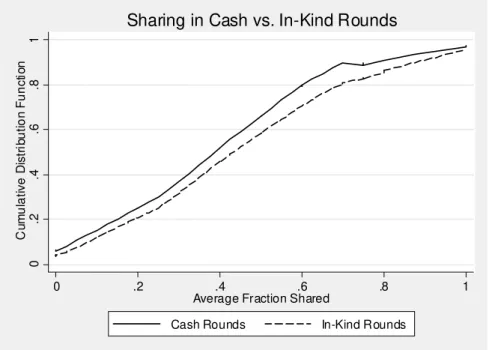
Figure 1 presents the cumulative distribution function of giving when transfers can be in cash
alone (top line) and when either in-kind or cash giving is allowed (bottom line). The CDF for
giving with the in-kind option is clearly shifted to the right, indicating that the in-kind option
increases giving across the full giving distribution.
In column 3, we test whether the in-kind, rate of return, and endowment effects interact with
one another by adding to the right-hand-side of equation (1) all possible interactions among the
three indicator variables:
(2) yir = + Kr + Rr + Er +Kr * Rr+ Kr * Er+ Er * Rr+ i+ir,
The in-kind effect is independent of the rate of return and the endowment size: neither
interaction with the in-kind indicator is statistically significantly different from zero. The
endowment size and the rate of return to giving do interact: the coefficient on that interaction
term is negative and statistically significantly different from zero at the 5% level. P-values of
hypothesis tests reported at the bottom of the table indicate that the rate of return effect is only
statistically significantly different from zero when the endowment is low; and the endowment
effect is only significantly different from zero when the rate of return to giving is high.
5. Discussion and Additional Analyses
In the context of the theoretical model presented above, the results presented so far indicate
that respondents do value giving in kind, since in-kind sharing represents a substantial fraction of
giving in rounds where it is allowed. In addition, we find that the in-kind option leads to
increased sharing, a point on which the theory was ambiguous.
The analyses we present in this section are aimed at distinguishing among possible theories
of these results.
Distinguishing among the paternalistic, public goods, and signaling models
We begin with an evaluation of the paternalistic, public goods, and signaling motivations
21 the choice of goods from the catalog for in-kind allocations are given to the counterpart (instead
of the respondent).
In the rounds examined so far, where the respondents can ultimately choose exactly what the
counterpart is getting (the “in-kind with respondent purchase” rounds), paternalistic, public
goods, and signaling motivations could all help explain demand for in-kind giving. But when the
ultimate choice of goods out of in-kind allocations is given to the counterpart (in the “in-kind
with counterpart purchase” rounds), counterparts could choose freely from among private or
public goods. As a result, if the public goods motive for giving were dominant then the demand
for in-kind giving by respondents should be importantly diminished in these rounds. In addition,
the “in-kind with counterpart purchase” rounds do not allow respondents to signal their
knowledge of counterpart preferences, and so in-kind giving in those rounds could not be
explained by the signaling model.
By contrast, if clients are motivated by paternalistic giving motives, they could still increase
their giving in the “in-kind with counterpart purchase” rounds because that option makes it very
difficult to use the gifted resources for socially undesirable expenses such as gambling, sex
services, and possibly even alcohol. The “in-kind with counterpart purchase” rounds make vice
good purchases less likely because choices in the in-kind rounds are made from the catalog
presented at the outset of the experimental rounds, or by the requirement that the respondent
accompany the project staff to purchase the goods in question. This set-up is likely to exclude
socially undesirable purchases by counterparts, and – more to the point – is likely to discourage
purchases of which counterparts know respondents would not approve.
For analysis of these “in-kind with counterpart purchase” rounds, we add four additional
observations per respondent to the dataset analyzed in Table 5. These are rounds 9-12, where
sharing is also allowed in-kind but if one of these rounds is chosen for implementation at the end
of the experiment, the counterpart (rather than the respondent) makes the final purchase decision
for any amounts allocated to in-kind by the respondent.
We estimate the following regression:
(3) yir = + Kr + Rr + Er +Kr * Cr+ i+ir,
where Cr is an indicator variable equal to 1 for the “in-kind with counterpart purchase” rounds
(rounds 9-12), and 0 otherwise. The in-kind indicator variable Kr is equal to 1 for all in-kind
22 effect of the in-kind option when counterparts make the final purchase decision, relative to the
effect of the in-kind option when respondents make the final purchase decision. A large and
statistically significant negative interaction term coefficient () would be evidence in favor of the
signaling or public goods models, as would an inability to reject the hypothesis that the in-kind
effect is zero when counterparts make the final purchase decision ().
Results are in Table 6. The empirical evidence favors the paternalistic model, rather than the
public goods or signaling models of giving. While the coefficient on the interaction term
coefficient is negative, it is small in magnitude (only about three-tenths the size of the “in-kind
with respondent purchase” coefficient ) and is not statistically significantly different from
zero.19
In the context of our theoretical model, these results indicate that the “in-kind with
counterpart choice” rounds still give sufficient assurance to respondents that counterparts will
use gifted resources in ways of which they approve, leading them to be about as willing to share
with counterparts in those rounds as they are in the “in-kind with respondent choice” rounds.
Because the “in-kind with counterpart choice” rounds offer respondents no ability to direct
counterpart consumption to public goods or to signal their knowledge of counterpart preferences,
we conclude that there is little evidence that either the public goods or signaling models could
explain the “in-kind effect” in this experiment.20
Are respondents and counterparts playing a favor exchange game?
A possible alternative explanation for our results is that individuals are playing a favor
exchange game, as in Abdulkadiroglu and Bagwell (forthcoming) or Hauser and Hopenhayn
(2008). Respondents, aware that they are in a repeated relationship with their counterparts, may
make transfers with the expectation of receiving a subsequent benefit. While existing favor
exchange models do not provide a rationale for making gifts in kind, one might imagine that
19
An F-test on the hypothesis that the in-kind effect is zero when counterparts make the purchase decision () is rejected at the 1% level (the p-value of the test, reported at the bottom of the table, is 0.001).
20
23 kind gifts are used as a system of accounting between parties to a transfer, being more tangible
than cash and thus more likely to ensure later reciprocity.
We provide two pieces of evidence that respondents do not appear to be playing a favor
exchange game with counterparts, and that a (modified) favor exchange model is unlikely to
explain the in-kind effect we find. First, we analyze data from a post-experiment survey
(conducted 30 days after the experiment) and find no evidence of favor exchanges: real-world
net transfers from counterparts to respondents do not respond to our experimental transfers from
respondents to counterparts. Second, we show that the in-kind effect is not larger for individuals
who are more inclined to make in-kind gifts of durable (as opposed to more immediately
consumable) goods; in other words, the in-kind effect does not seem to be motivated by a desire
to provide a longer-lasting, tangible reminder of the gift. We provide details and further
discussion of these analyses in Appendix C.
Are respondents simply valuing free delivery of in-kind goods?
Another hypothesis about the mechanism behind the in-kind effect is that respondents simply
value the free delivery of the in-kind items, which was offered as part of the experiment. This
explanation says that the increase in total sharing in the in-kind rounds simply reflects
respondents “purchasing” the free delivery.
One way of testing this hypothesis would be to test whether the in-kind effect is larger for
respondents whose counterparts live in another city, for whom delivery costs would be more
important than when respondents and counterparts both live nearby. All our respondents live in
Maputo City, while 21 percent of counterparts live outside of the city and its suburbs.
We test the “free delivery” hypothesis by running the following regression:
(5) yir = + Kr + Rr + Er +Kr * Farr+ i+ir,
where Farr is an indicator variable equal to 1 if the counterpart lives outside Maputo City, and 0
otherwise. If the “free delivery” hypothesis were true, it should be the case that >0.
Results are in Table 7. We are missing information on counterpart location for 21
respondents, so we first confirm in column 1 that the original in-kind effect (from estimation of
equation 1) still holds for this slightly smaller sample. Results are almost identical to those in the
24 In column 2, we present results from estimation of equation (5). Contrary to the prediction of
the free delivery hypothesis, the coefficient on is actually negative and not statistically
significantly different from zero at conventional levels. There is no support in these results for
the free delivery hypothesis.21
Evidence from post-experimental qualitative responses
Our last evidence on the relevance of static models of directed giving as explanations for the
in-kind effect comes from qualitative responses on the part of respondents. After all experimental
rounds had been completed, we asked respondents several questions related to their motivations
for giving in-kind. We instructed respondents to think about their responses in rounds 5-8 (in
kind with respondent purchase) in comparison to their responses in the cash rounds (1-4).
Mean responses to these binary responses are presented at the bottom of Table 1. We first
asked respondents what effect the in-kind option had on their willingness to share their
endowments with counterparts. We were interested in the extent to which this qualitative
response accorded with our quantitative findings in the experiment. 70 percent of respondents
reported having shared more when the in-kind option was available.22
We then asked respondents four other questions aimed at revealing mechanisms behind the
in-kind effect. 59 percent of respondents agreed with the statement, “I like the in-kind option
because it gives me more control over what my relative is purchasing” (which we take to be
representative of directed giving hypothesis). Smaller percentages agreed with other statements
representing alternative mechanisms: 33 percent agreed with the statement “I like the in-kind
option because of the free delivery of the in-kind items,” and 46 percent agreed that “I like the
in-kind option because I can get my relative items he/she can’t get in his/her local area.” Finally,
when we asked respondents to directly choose between two options by asking whether they
agreed with the statement “When it comes to the in-kind option, I prefer the control aspect over
the free delivery aspect,” 73 percent expressed agreement.
21
These results also are inconsistent with the related hypothesis that respondents like the in-kind option because it allows them to purchase goods for their counterparts that the counterparts cannot obtain in their local areas. This hypothesis arises because Maputo City is the country’s largest urban area with the largest variety of goods. This “availability of goods” hypothesis would also predict that the in-kind effect would be larger for respondents whose counterparts live outside Maputo City.
22
25 We interpret these qualitative responses as supportive of the hypothesis that directed giving
preferences are an important source of in-kind giving in the experiment. It is useful, however, to
further test this claim by asking whether these qualitative responses are correlated with
respondents’ actual behaviors in the experimental rounds.
To this end, we created a variable intended to capture each individual’s in-kind effect. We
define the “individual in-kind effect” as the mean fraction given to counterpart in in-kind rounds
(5-8) minus the mean fraction given to counterpart in the cash rounds (1-4), separately for each
individual. The mean (std. dev.) of the individual in-kind effect is 0.055 (0.138), and its
distribution is presented in Figure 2. The individual in-kind effect is greater than zero for 60.7%
of observations.
We then regress the binary variables representing the answers to the qualitative questions just
described on the individual in-kind effect variable. Results are in Table 8. A first test of the
consistency of the qualitative self-reports is the result in column 1: the individual in-kind effect
strongly positively predicts whether a respondent reports that the in-kind option made him/her
share more with the counterpart.
If a desire for control underlies the in-kind effect found in this experiment (our directed
giving hypothesis), then we should find that the individual in-kind effect is positively correlated
with the answers to the questions in columns 2 and 5 of the table (liking in-kind due to control,
and preferring control over free delivery). This is exactly what we find: the coefficients on the
individual in-kind effect are positive and significantly different from zero at conventional levels.
If other mechanisms, such as a desire for free delivery and obtaining hard-to-obtain goods for
counterparts, were important, we should also find a positive and significant relationship between
the individual in-kind effect and the dependent variables in columns 3 and 4 of the table. As it
turns out, however, the evidence here is much weaker. While the coefficients on the individual
in-kind effect are positive in both columns, in neither case is the coefficient statistically
significantly different from zero at conventional levels.23
All told, these results indicate that respondents were attracted to the in-kind option because it
gave them more control over what counterparts would consume. By contrast, other reasons why
23
26 respondents may have valued the in-kind option get much weaker (if any) support in these
qualitative responses.
Evidence against the “two box” hypothesis
Another interpretation of the “in-kind effect” is that it reflects a kind of experimenter
demand. In the in-kind rounds, respondents were presented with two boxes in which to place
their chips to be shared with counterparts. In the cash rounds, respondents were presented with
just one box for their shared chips. (In all cases there was only one box for chips kept by the
respondent.) A worry is that respondents may have felt some implicit demand to put at least
some chips in each box they were presented with. The question is whether the “in-kind effect”
we document derives simply from the fact that the in-kind rounds involved the addition of one
more box to receive shared allocations.
If this alternative interpretation were true, the prediction would be that the in-kind effect
should be driven by (or at least be larger for) individuals who have a tendency to split their
sharing with the respondent into both cash and in-kind allocations (in the in-kind rounds). By
contrast, if the in-kind effect is just as large for individuals who do not split their in-kind
allocations, this “two box” hypothesis would have less credence. We test this hypothesis and find
no evidence in support of the “two box” hypothesis. We provide details of the analysis and a
discussion of the results in Appendix D.
6. Conclusion
We conducted a lab-in-the-field experiment among microfinance bank clients in urban
Mozambique. Respondents made allocations in a dictator game where their counterpart was the
closest person to them outside of their household, and so are intended to represent
inter-household transfers from respondents to counterparts. Our aims were to test the extent to which
individuals seek to make gifts in kind (in the form of goods and services, instead of purely cash),
and to measure the impact on total giving when respondents could share resources in kind as well
as in cash. We find that in-kind giving is commonly chosen even when respondents have the
option of giving purely in cash. What’s more, the option to give in kind raises total giving
(compared to giving that can only be in cash). We provide auxiliary results suggesting that these