Abstract
I present new data on the Atlantic Forest endemic
Stigmaphyllon carautae
(Malpighiaceae), including an
amended morphological description describing fruits and seeds for the first time. Additionally, I present the
first analysis of its conservation status.
Key words:
Brazil, Espírito Santo state, Malpighiales, Stigmaphylloid, taxonomy.
Resumo
Apresento novos dados sobre o
Stigmaphyllon carautae
(Malpighiaceae), endêmico da Floresta Atlântica,
incluindo uma descrição morfológica emendada descrevendo seus frutos e sementes pela primeira vez.
Adicionalmente, apresento a primeira análise de seu status de conservação.
Palavras-chave:
Brasil, Espírito Santo, Malpighiales, Stigmaphylloide,
taxonomia.
Amended description and conservation status of
Stigmaphyllon carautae
(Malpighiaceae)
Rafael Felipe de Almeida
1,2 http://rodriguesia.jbrj.gov.brDOI: 10.1590/2175-7860201768425
1 Universidade Estadual de Feira de Santana, Depto. Ciências Biológicas, Prog. Pós-graduação em Botânica, Av. Transnordestina s/n, 44036-900, Feira de Santana, BA, Brazil. 2 Author for correspondence: [email protected]
Introduction
Stigmaphyllon A. Juss. comprises ca. 120 species occurring within the Neotropics, Pacific Islands, Southeast Asia, West Africa, and Western Australia (Almeida & Amorim 2014; Anderson 2011). Most species are woody vines with long-petiolate, elliptical to cordate leaves, clusters of yellow flowers arranged in dichasia, styles with lateral foliar appendages at the apex, and schizocarps splitting into three mericarps, each usually bearing a large dorsal wing (Anderson 1997, 2011). About 75% of its species are confined to the Neotropics, being especially diverse along water streams in the Amazon and Atlantic Forests (Anderson 1997; Almeida & Amorim 2014).
In Brazil, the genus is especially diverse in the Atlantic with 31 from ca. 45 species occurring almost exclusively in this biome (BFG 2015). Field trips in poorly collected areas in the Atlantic Forest of Espírito Santo and Minas Gerais states, have contributed to the understanding of enigmatic species in Malpighiaceae (Almeida 2015; Almeida & Amorim 2015; Almeida & Pellegrini 2016; Almeida et al. 2015; Amorim &
São-Matheus 2008; Sebastiani & Mamede 2010). Recent field collections from Southern Espírito Santo state rediscovered an endangered species of
Stigmaphyllon previously endemic to the state of Rio de Janeiro.
We present an amended description of
Stigmaphyllon carautae C.E. Anderson, including the description for the first time of fruit and seed morphology.
Methods
(holotype: GUA!; isotype: MICH!, R!). Figs. 1-3
Woody vines; stems costate, sparsely sericeous to glabrate at age; branches sericeous to glabrate at age.
Stipules 0.8–1.1 × 0.5–0.7 mm wide, free, triangular, eglandular, glabrous, occasionally deciduous. Leaves
opposite, reduced in inflorescences; petioles 4–7 cm long, sparsely sericeous with scalelike T-shaped hairs, not confluent across the node, 2-glandular at apex, each gland 1.5–2 mm diam., cupulate; leaf blades 9–13 × 6.5–13 cm, pinnately 5–7-lobed (3-lobed to entire when associated to inflorescences), each lobe with a filiform hair at apex (broken off in herbarium specimens), base auriculate, adaxially glabrate, abaxially tomentose to sparsely tomentose (T-shaped hairs with trabecula 0.4–1 mm long, straight or wavy, stalk up to 0.1 mm long), hairs deciduous at age, margin shallowly and irregularly dentate, each tooth ending in a filiform hair (up to 5 mm long) or sometimes a stalked capitate gland (0.2–0.3 mm in diameter, ca. 0.2–0.5 mm long) or sometimes the margin also with sessile glands (ca. 0.4 mm in diameter) (fringed with filiform hairs in leaves associated to inflorescences). Umbels, 15–20-flowered, disposed in dichasia; rachis with scalelike T-shaped hairs; peduncles 7–13 mm long, densely tomentose with scalelike T-shaped hairs; bracts 1.8–2.2 × 1.4–2 mm, triangular, apex acute, abaxially sericeous with scalelike T-shaped hairs, eglandular; bracteoles 2.5–3 × 1.6–2.2 mm, oblong, apex obtuse, abaxially sericeous with scalelike T-shaped, eglandular. Flowers 1.5–1.7 × 2–2.5 cm diam; floral bud 6–8 cm diam., with a reddish macula; pedicels 6.5–11 mm long, tomentose with scalelike T-shaped hairs. Sepals 3.5–4 × 2–3 mm, glands 1.8–2.1 × 1–1.2 mm, green to yellowish.
Petals yellow, glabrous, margin lacerate-fimbriate, fimbriae 0.9–1.1 mm long; lateral petals with limb 15–17 × 15–17 mm, obovate to orbicular, claw 2–3 mm long; posterior petal with limb 14–15.5 × 14–15.5 mm, obovate, with reddish stripes at base, claw 3.8–4 mm long, apex dented. Androecium with 10 stamens; filaments 1.5–3.5 mm long, unequal,
stalk up to 0.1 mm long), hairs deciduous at age; nut 10–12 × 6–7 mm, prominent, smooth or with two lateral ridges, densely sericeous (T-shaped hairs with trabecula 0.4–1 mm long, straight or wavy, stalk up to 0.1 mm long), hairs deciduous at age; areole 6–7 × 4–5 mm, wide-oblong, rugose. Seeds (immature) 3–5 × 1.5–2 mm, oblong, rugose; embryo 3.4–4.7 × 1.7–1.9 mm, outer cotyledon folded over the inner cotyledon.
Specimens examined: BRAZIL. Espírito Santo: Cachoeiro do Itapemirim, distrito de Burarama, Pedra do Cantagalo, 20o41’22”S, 41o22’24”W, 20.V.2016, fl. e fr.,
R.G.Barbosa-Silva et al. 509 (RB).
Distribution, habitat and phenology:
Stigmaphyllon carautae is known only from Seasonally Dry Forests associated to inselbergs
from northern Rio de Janeiro and southern Espírito Santo states (Fig. 2). It grows in clearings and edges of secondary forests. Flowering from May to June and fruiting in May.
Conservation status: Stigmaphyllon carautae
is represented by only two records restricted to highly fragmented areas of Seasonally Dry in the borders of Espírito Santo and Rio de Janeiro states. Its AOO comprises 8.000 km2 within Semi-deciduous Dry Forests highly fragmented, due to several threats imposed by farming, logging and mining activities (Almeida & Mamede 2014). Combined with its extent of occurrence, S. carautae
can be regarded as a critically endangered species (criteria B1a and B1b).
Comments: Stigmaphyllon carautae is one of the seven species (S.auriculatum (Cav.) A.Juss., S. ciliatum (Lam.) A.Juss., S. jatrophifolium A.Juss.,
S. macedoanum C.E.Anderson, S. mikanifolium
Figure 1
–
Stigmaphyllon carautae
– a. leaf shoot; b. adaxial side of a leaf; c. detail of sericeous young leaves bearing
filiform hairs; d. flowering branch; e. floral bud; f. flower in frontal view; g. samaras in lateral view; h. areole of a
samara in frontal view; i. immature seed in lateral view. Photos: R.G.B. Silva.
a b c
d e f
g h i
2016). On leaf shoots of S. carautae, it is possible to observe long filiform hairs involving young leaves (Fig. 1a). Since those hairs seem to fall or break along leaf expansion, we hypothesize that they might protect leaf shoots from herbivory of its delicate membranous leaves. All Stigmaphyllon species
Figure 2
– Distribution map of
Stigmaphyllon carautae
in Southeastern Brazil.
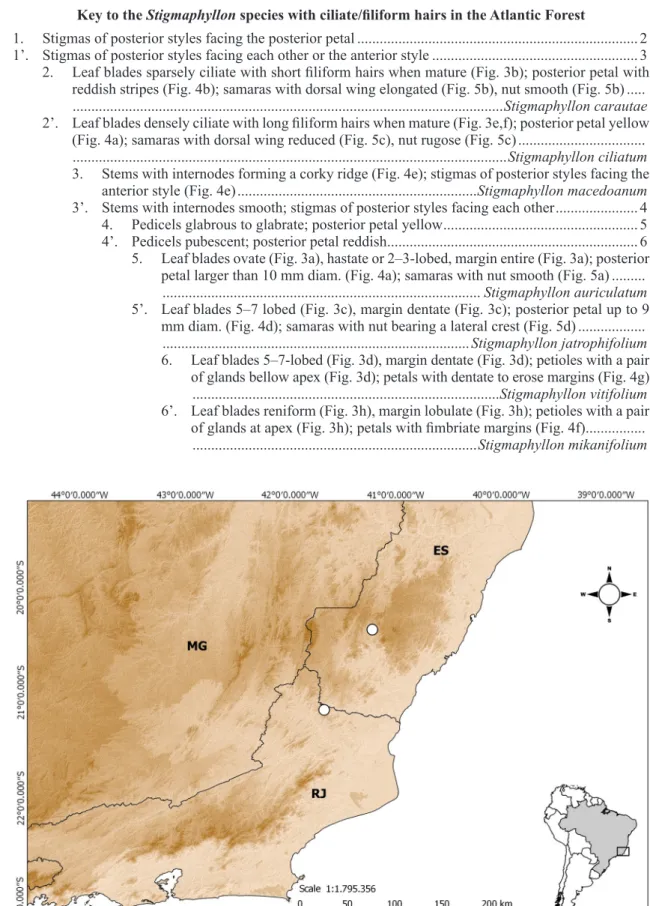
4. Pedicels glabrous to glabrate; posterior petal yellow ... 5 4’. Pedicels pubescent; posterior petal reddish ... 6 5. Leaf blades ovate (Fig. 3a), hastate or 2–3-lobed, margin entire (Fig. 3a); posterior
petal larger than 10 mm diam. (Fig. 4a); samaras with nut smooth (Fig. 5a) ... ...Stigmaphyllon auriculatum
5’. Leaf blades 5–7 lobed (Fig. 3c), margin dentate (Fig. 3c); posterior petal up to 9 mm diam. (Fig. 4d); samaras with nut bearing a lateral crest (Fig. 5d) ... ...Stigmaphyllon jatrophifolium
6. Leaf blades 5–7-lobed (Fig. 3d), margin dentate (Fig. 3d); petioles with a pair of glands bellow apex (Fig. 3d); petals with dentate to erose margins (Fig. 4g) ...Stigmaphyllon vitifolium
6’. Leaf blades reniform (Fig. 3h), margin lobulate (Fig. 3h); petioles with a pair
of glands at apex (Fig. 3h); petals with fimbriate margins (Fig. 4f) ...
Figure 4
– Flowers of
Stigmaphyllon
species from the Atlantic Forest bearing ciliate/filiform hairs – a.
S. auriculatum
;
b.
S. carautae
; c.
S. ciliatum
; d.
S. jatrophifolium
; e.
S. macedoanum
; f.
S. mikanifolium
; g.
S. vitifolium
. Photos: a.
R.F.Almeida; b. R.G.B.Silva; c. M.O.O.Pellegrini; d. W.R.Anderson; e. R.Arruda; f. C.N.Fraga; g. A.C.S.DalCol.
Figure 3
– Leaves of
Stigmaphyllon
species from the Atlantic Forest bearing ciliate/filiform hairs (white arrows) – a.
S. auriculatum
; b.
S. carautae
; c.
S. jatrophifolium
; d.
S. vitifolium
; e. young leaves of
S. ciliatum
; f. mature leaf of
S. ciliatum
; g.
S. macedoanum
; h.
S. mikanifolium
. Photos: a,c,h. R.F.Almeida; b. R.G.B.Silva; d. A.C.S.DalCol; e,f.
M.O.O.Pellegrini; g. R.Arruda.
a
e
b
f
c
g
d
h
a b
e f g
Figure 5
– Fruits of
Stigmaphyllon
species from the Atlantic Forest bearing ciliate/filiform hairs – a.
S. auriculatum
; b.
S. carautae
; c.
S. ciliatum
; d.
S. jatrophifolium
; e.
S. vitifolium
. Photos: a. C.Pessoa; b. R.G.B.Silva; c,e. R.F.Almeida;
d. W.R.Anderson.
Acknowledgements
I would like to thank Marco Octávio de Oliveira Pellegrini and Rafael Gomes Barbosa-Silva for valuable comments on an early version of the manuscript; A.C.S. Dal Col, C.N. Fraga, C. Pessoa, M.O.O. Pellegrini, R. Arruda, R.G. Barbosa-Silva, and W.R. Anderson for field photographs; FAPESB for my Ph.D. fellowship (DEB BOL0584/2013); and Universal Malpighiales (DEB 486079/2013-9), and Reflora Malpighiales (DEB 563548/2010-0) for sponsoring my herbarium studies.
References
Almeida RF & Amorim AM (2014) Stigmaphyllon caatingicola (Malpighiaceae), a new species from Seasonally Dry Tropical Forests in Brazil. Phytotaxa 174: 82-88.
Almeida RF (2015) New records of Stigmaphyllon puberulum Griseb. (Malpighiaceae) from the Atlantic Forest, northeastern Brazil. Check List 11: 1510-1512.
Almeida RF & Amorim AM (2015) Stigmaphyllon mikanifolium (Malpighiaceae), a new species from Espírito Santo state, Brazil. Kew Bulletin 70: 47.
a b
c d
Almeida RF & Pellegrini MOO (2016) Synopsis of Bunchosia Kunth (Malpighiaceae) from the Atlantic Forest. Phytotaxa 257: 158-166.
Almeida RF & Mamede MCH (2016) Sinopse de Malpighiaceae no estado do Espírito Santo, Brasil:
Stigmaphyllon A.Juss. Hoehnea 43: 601-633. Amorim AM & São-Matheus WMB (2009) Redescrição
de Heteropterys bahiensis Nied. (Malpighiaceae). Rodriguésia 60: 367-370.
Anderson CE (1997) Monograph of Stigmaphyllon
(Malpighiaceae). Systematic BotanyMonographs 51: 1-313.
Anderson CE (2011) Revision of Ryssopterys and transfer to Stigmaphyllon (Malpighiaceae). Blumea 56: 73-104.
Anderson WR (1981) Malpighiaceae. In: The botany of the Guayana Highland - Part XI. Memoirs of the New York Botanical Garden 32: 21-305.
Bachman S, Moat J, Hill AW, Torre J & Scott B (2011) Supporting Red List threat assessments with GeoCAT: geospatial conservation assessment tool. e-Infrastructures for data publishing in biodiversity science. ZooKeys150: 117-126.
BFG - The Brazil Flora Group (2015) Growing knowledge: an overview of seed plant diversity in Brazil. Rodriguésia 66: 1085-1113.
IUCN (2012) IUCN Red List categories and criteria: version 3.1. 2nd ed. Gland, Switzerland and
Cambridge, UK: IUCN. Available at <http://www. iucnredlist.org/technical-documents/categories-and-criteria>. Access on 7 May 2016.
QGIS Development Team (2015) QGIS geographic information system. Open Source Geospatial Foundation Project. Available at <http://qgis.osgeo. org>. Access on 7 May 2016.
Radford AE, Dickison WC, Massey JR & Bell CR (1974) Vascular plant systematics. Harper & Row, New York. Pp. 891.
Sebastiani R & Mamede MCH (2010) Estudos t a x o n ô m i c o s e m H e t e ro p t e r y s s u b s e c t .
Stenophyllarion (Malpighiaceae). Hoehnea 37: 337-366.
Spjut RW (1994) A systematic treatment of fruit types. Memoirs of the New York Botanical Garden. Vol. 70. The New York Botanical Garden, New York. Pp. 1-181.
Thiers B [continuously updated] Index Herbariorum: a global directory of public herbaria and associated staff. New York Botanical Garden’s Virtual Herbarium. Available at <http://sweetgum.nybg. org/ih/>. Access on 7 May 2016.
Weberling F (1965) Typology of inflorescences. Botanical Journal of the Linnean Society59: 15-221. Weberling F (1989) Morphology of flowers and
inflorescences. Cambridge University, Cambridge.
Pp. 348.