Localised Effects of a Mega-Disturbance:
Spatiotemporal Responses of Intertidal
Sandy Shore Communities to the 2010
Chilean Earthquake
Roger D. Sepúlveda1,2
*, Nelson Valdivia3,4
1Instituto de Ciencias Ambientales y Evolutivas, Facultad de Ciencias, Universidad Austral de Chile, Valdivia, Chile,2Centro de Investigación: South American Research Group on Coastal Ecosystems (SARCE), Universidad Simón Bolívar, Caracas, Venezuela,3Instituto de Ciencias Marinas y Limnológicas, Facultad de Ciencias, Universidad Austral de Chile, Valdivia, Chile,4Centro de Investigación FONDAP: Dinámica de Ecosistemas Marinos de Altas Latitudes (IDEAL), Universidad Austral de Chile, Valdivia, Chile
Abstract
Determining the effects of unpredictable disturbances on dynamic ecological systems is challenged by the paucity of appropriate temporal and spatial coverage of data. On 27 Feb-ruary 2010, an 8.8 Mw mega-earthquake and tsunami struck central Chile and caused coastal land-level changes, massive damage to coastal infrastructure, and widespread mor-tality of coastal organisms. Wave-exposed sandy beaches showed significant changes of species abundances from before to after the earthquake, but the highly dynamic biotic and abiotic conditions of these habitats make difficult to draw clear-cut conclusions from these patterns. Here, we analysed a beyond-BACI (Before-After Control-Impact) sampling design to test whether the effects of the Maule earthquake on sandy-shore species diversity, dance, and structure were heterogeneous along the shore. Invertebrate species abun-dances were quantified before (i.e. February 2010) and after (i.e. March 2010, September 2010, and March 2011) the earthquake at three sandy shores randomly located within the earthquake rupture area and three sites within a“control”area located>400 km southward
from epicentre. Immediately after the earthquake took place, the three sites located in the rupture area showed anomalous beach-profile uplifts that did not comply with the erosion (i.e.“negative”uplifts) that regularly occurs during late summer in the region. Species rich-ness, abundance, and community structure significantly varied from before to after the strike, but these patterns of change varied among sites within both areas. Only the site with the strongest and persistent beach-profile uplift within the rupture area showed significant concomitant changes in species richness and community structure; after 13 months, this community showed a similar multivariate structure to the before-disturbance state. This site, in particular, was located in the section of the rupture area that received most of the impact of the after-earthquake tsunami. Therefore, our results suggest that the effects of the Maule mega-earthquake on the ecological communities were spatially heterogeneous and highly localised. We suggest that high mobility and other species’adaptations to the dynamic a11111
OPEN ACCESS
Citation:Sepúlveda RD, Valdivia N (2016) Localised Effects of a Mega-Disturbance: Spatiotemporal Responses of Intertidal Sandy Shore Communities to the 2010 Chilean Earthquake. PLoS ONE 11(7): e0157910. doi:10.1371/journal.pone.0157910
Editor:Jiang-Shiou Hwang, National Taiwan Ocean University, TAIWAN
Received:April 17, 2015
Accepted:June 7, 2016
Published:July 6, 2016
Copyright:© 2016 Sepúlveda, Valdivia. This is an open access article distributed under the terms of the Creative Commons Attribution License, which permits unrestricted use, distribution, and reproduction in any medium, provided the original author and source are credited.
Data Availability Statement:All relevant data are within the paper and its Supporting Information files.
environmental conditions of sandy beaches might explain the comparatively high resilience of these assemblages. With this work we hope to motivate further experimental research on the role of individual- and population-level properties in the response of sandy-beach com-munities to interacting sources of disturbances.
Introduction
Understanding the patterns of species diversity, abundance, and community structure after natural and anthropogenic disturbances is central to provide accurate predictive models of community recovery and resilience. However, lack of before-impact and spatially extensive data usually hampers our ability to infer causality of patterns. In addition, the effects of distur-bances on local communities can be difficult to determine in systems characterised by high spa-tiotemporal variability in environmental conditions and population abundances [1]. Patterns in natural abundances depend on the spatial scale of observation [2], so that significant responses to disturbances may be discernible at certain scales, but not necessarily at others [3,4]. Therefore, appropriate temporal and spatial coverage at multiple scales is necessary to assess the magnitude of disturbances affecting natural communities.
In coastal ecosystems, mega-disturbances such as hurricanes and earthquakes can generate massive events of mortality in intertidal and shallow subtidal communities. The Mw 8.8 mega-earthquake and tsunami that struck central Chile on 27 February 2010 generated coastal land-level changes, sand deposition, and mortality of coastal organisms at a number of locations along the shores [5,6]. The epicentre of this earthquake, the fifth largest ever instrumentally recorded in the world, was located ca. 120 km northeast of Concepción (36°49’S, 73°03’W); the maximum length of rupture was bounded between 34°S and 38°30’S, resulting in a rupture area of ca. 500 km long [7,8]. Within this area, co-seismic land-level changes were heteroge-neous along the shore, and the largest uplifts were recorded in Arauco Peninsula (37.1°S to 37.7°S). In Isla Santa María (37°02’S, 73°31’W), for example, coastal uplift caused massive mor-tality of intertidal rocky-shore sessile species [5]. Moreover, the tsunami waves following the earthquake deposited large quantities of sediment on sandy beaches along the shore, changing the slope, width, and sedimentary characteristics of beaches to varying degrees [6]. Accord-ingly, post-stroke changes in intertidal sandy-shore species abundance were heterogeneous along the rupture area, and depended on particular features of sites such as land-level change, height wave, and local coastal infrastructure [6].
Along the rupture zone, most of the coast is characterised by wave-exposed sandy shores [9]. These habitats usually show sharp seasonal changes in physical conditions, because winter storms can remove large amounts of sand from the beach, hold them in suspension, and then deposit them offshore [10,11]. This swell-related erosion result leads to a decrease in beach profile of wave-exposed sandy shores during late summer and throughout winter (see ref. [6] for southern Chile). Sandy beaches therefore have been regarded as dynamic and varying envi-ronments, where organisms must be very mobile and able to burrow before being swept off-shore by the swash [11]. In fact, it is expected that sandy-beach species are extraordinarily adapted to habitat changes and physical instability. Sandy-shore populations, moreover, can be highly dynamic over the year. For example, dominant intertidal invertebrates can show con-trasting patterns of temporal variation, from apparently stochastic to clearly seasonal [12]. Therefore, assessing the potential impact of unpredictable disturbances—such as the Maule earthquake—on sandy-shore communities is challenged by a high spatiotemporal variation in both, physical settings and local population abundances.
Beyond-BACI (Before-After Control-Impact) designs are powerful tools usually used to assess the impact of anthropogenic disturbances on local populations in variable environments [13,14]. These designs can be used, therefore, to accurately determine the degree to which the Maule earthquake and tsunami impacted the local assemblages in the dynamic wave-exposed beaches in southern Chile. Sandy shores cover more than the 70% of the ice-free coasts of the world, are used for several recreational activities, and are probably the best-known marine environment to most humans [11,15]. These coastal habitats are highly vulnerable to climate change-related impacts, especially erosion caused by increased storms and sea-level rise [16,17]. Despite the relevance and vulnerability of these shores, the understanding of commu-nity-wide responses to disturbances in these systems has lagged behind in development com-pared to other marine systems [15,18].
Here, using a beyond-BACI sampling design, we explore the short- to mid-term patterns of intertidal sandy shore assemblages before and after the Maule earthquake. We hypothesise that, since the earthquake caused a heterogeneous land-level change within the rupture area [7,19], the concomitant change in local assemblages should follow a heterogeneous spatial pat-tern. Therefore, we predict that (1) the Maule earthquake generated significant changes on sandy-shore species diversity, abundance, and structure, and that (2) those impacts were stron-ger at those sites showing larstron-ger morphodynamic changes.
Materials and Methods
Ethic statement
In this study, no specific permits were required to access the sampling sites, because these are unrestricted to public access, are not privately owned, and not designated as protected areas. No protected or endangered species were involved in this study.
Study area and sampling design
This study took advantage of an on-going sampling programme of intertidal sandy-shore assemblages arranged along the central Chilean coast (~36°S to 40°S,Fig 1) during early Febru-ary 2010; that is, before the Maule earthquake took place in 27 FebruFebru-ary. Samplings of several times before the disturbance would have been desirable in order to have a more comprehensive picture of the community-level responses. Unfortunately, this was not feasible due to the sto-chastic nature of earthquakes. After the earthquake, species abundances were estimated in March 2010, September 2010, and March 2011.
The multi-scale sampling programme encompassed two areas of ~200 km in alongshore length (Fig 1): a first area around the Maule earthquake epicentre (hereafter referred to as rup-ture area) and a second area located>400 km south of the epicentre (hereafter referred to as
The number of taxonomic identities (i.e. species richness) and the sum of all species abun-dances (i.e. total abundance) were calculated from the species abundance dataset (S1 Tablein the Supporting Material). In addition, we estimated the difference in species richness and total biomass from before to after the stroke took place. This was done by randomly pairing tran-sects from before (February 2010) and immediately after the earthquake (March 2010), and then estimating the mean pairwise difference for each sampling site.
Finally, we used the Emery’method to elaborate a profile of the beach at each site. The beach profiles were repeated every sampling time in order to determine the morphological dynamics of the intertidal sandy shores. Then, the before-after earthquake difference in beach height was estimated for each distance from coastline and for each site.
Data analysis
Permutational Multivariate Analysis of Variance (PERMANOVA, [20]) were used to analyse separately species richness and total abundance based on Euclidean distances matrices from raw data, and community structure based on Bray-Curtis dissimilarities matrix from fourth-root transformed data. PERMANOVA was performed using“Time”(four levels: February 2010, March 2010, September 2010, and March 2011) and“Area”(two levels: rupture and con-trol areas) as fixed factors, and“Site”(six intertidal rocky shores) as random factor nested within“Area”. In order to test our predictions and generate appropriatea prioriindependent contrasts, we identified the site(s) with stronger profile deformations after the earthquake. Llico, within the rupture area, was the only site showing a discernible pattern of deformation over time (seeResults: Spatiotemporal changes in beach morphology, below). Therefore, two independent contrasts were included in the statistical models: a“temporal contrast”comparing before (February 2010) vs. after (the March 2010-September 2010-March 2011 centroid) the earthquake, and a“spatial contrast”comparing Llico (Ll) vs. the mean response of Cocholgüe and Hualpén (C-H) within the rupture area. A significant interactive effect of the temporal contrast by Area would support the prediction (1) that the Maule earthquake generated cant changes on sandy-shore species diversity, abundance, and community structure; a signifi-cant effect of the spatial contrast by Time would support the prediction (2) that the impact of the Maule earthquake was stronger at those sites showing larger geomorphological deforma-tions. Multivariate spatiotemporal patterns in species abundances were depicted by means of Principal Coordinates Analysis (PCoA) based on Bray-Curtis dissimilarities calculated from fourth-root transformed data [21]. All probability values were derived from a pseudo-F distri-bution calculated through 10,000 permutations of the same dataset; when the simulated per-mutations were<1000, the probability value was obtained through Monte-Carlo simulations.
Both, uni- and multivariate analyses were performed using PERMANOVA+ for the PRIMER statistical package.
Results
Spatiotemporal changes in beach morphology
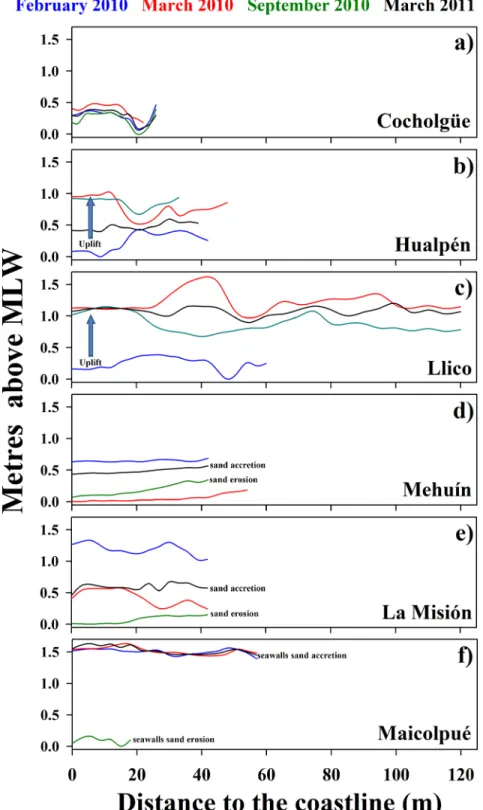
The six study sites showed different spatiotemporal patterns in beach profile. Within the rup-ture area, the three shores showed different degrees of beach-profile uplifts, contrary to the reg-ular downward movement of beach profiles during late summer. The beach-profile uplift at Fig 1. Map of the sampling sites in the central Chilean coast.The Maule earthquake epicentre is indicated by a red star. Cocholgüe, Hualpén, and Llico were located within the earthquake rupture area (red area) and<150 km of lineal distance to epicentre (*36°S). Mehuín, La Misión, and Maicolpué were located within the“control”area (blue area) and>400 km away from the epicentre (*40°S).
Cocholgüe (northern site,Fig 2A) was small and shore morphology remained relatively stable over time. Hualpén and Llico, on the other hand, performed height changes up to 0.95 m from February to March 2010 (Fig 2B and 2C; compare the vertical positions of blue and red lines). In addition, beach width at Llico (Fig 2C) increased from ca. 0.20 m in February 2010 to 1.20 m in March 2010. Within the control area, Mehuín and La Misión decreased in height during the sampling period (Fig 2D and 2E), according to the process of erosion that normally starts on late summer. In Maicolpué, we observed a single reduction in beach height and width dur-ing September (austral sprdur-ing) 2010; the beach returned to its previous morphology by late aus-tral summer in March 2011 (Fig 2F).
Ecological responses of community to the Maule earthquake
Across the entire study region, species richness showed the strongest decrease from before to after the stroke at Llico, the site with the largest coastal uplift within the rupture area (Fig 3A). Mehuín and La Misión, both sites located in the control area, showed negative coastal deforma-tions and also comparatively strong decreases in species richness (Fig 3A). Total abundance followed a similar pattern, with the exception of Cocholgüe (rupture area,Fig 3B). This site showed a nil coastal deformation and a comparatively large, but highly variable, mean decrease in total abundance (Fig 3B).
For sites within rupture area the number of intertidal invertebrate species slightly decreased from February 2010 to September 2010 and increased during March 2011 (Fig 4A–4C). Partic-ularly, Llico showed a sharp decrease in the mean number of species (Fig 4C). Among the con-trol sites (Fig 4D–4F), we observed temporal fluctuations in species numbers of comparable magnitude to those observed in the rupture area. Mehuín and La Misión displayed the stron-gest variations in species richness within the control area, decreasing from February 2010 to March and September 2010—species richness increased in these sites in March 2011 (Fig 4D–
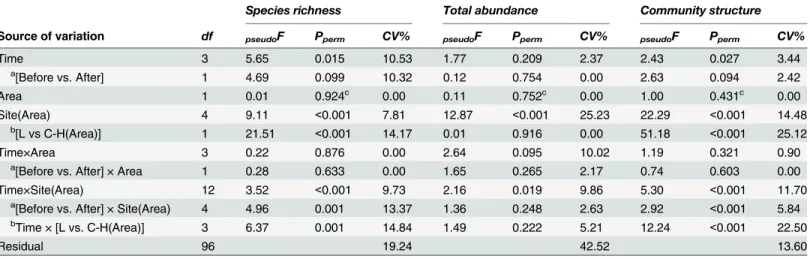
4F). According to these patterns of variation in species richness, the PERMANOVA showed significant effects of Time × Site(Area), the interaction effect between Site and the temporal contrast (i.e. [Before vs. After] × Site(Area) inTable 1), and that of Time and the spatial con-trast within the rupture area (i.e. Time × [L vs. C-H] term inTable 1).
Total abundance strongly varied over times and among sandy shores (Fig 5). Within the rupture area (Fig 5A–5C), the sites showed a decrease of the abundances from February 2010 to September 2010, with a slight recovery during March 2011, which was not so evident for Cocholgüe (Fig 5A). In the control area, only Mehuín and La Misión decreased in abundance between February 2010 to March and September 2010 (Fig 5D and 5E); while Maicolpué remained homogeneous abundances during the study period (Fig 5F). The PERMANOVA indicated that the temporal trends in total abundance varied significantly among sites (i.e. Time × Site(Area) inTable 1). However, the spatial and temporal contrasts remained statisti-cally non-significant for total abundance (Table 1).
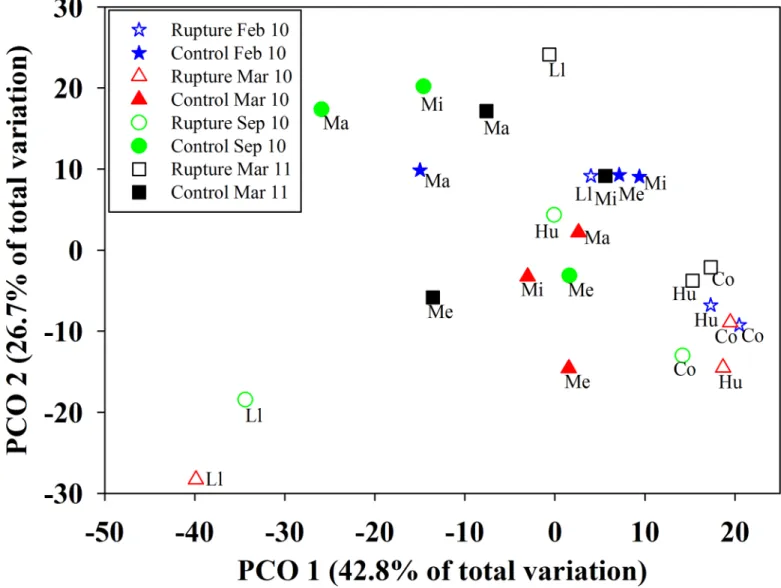
The multivariate ordination showed that Llico performed the larger variation in community structure throughout time, as the centroids from March and September 2010 were well sepa-rated along the first PCO axis (Fig 6). The before-earthquake centroid (i.e. February 2010) of Llico remained in the main cloud of sites in the bivariate space (Fig 6). In addition, the sam-pling conducted 13 months after the earthquake lied within the main cloud, suggesting that the assemblage returned to a certain degree of the pre-disturbance structure. The samples from the control area remained at the centre of the ordination, with those samples from Maicolpué standing out along the second PCO axis (Fig 6).
Fig 2. Profile of beaches in the earthquake rupture and control areas.For each site, each line represents the profile of the sampling beach at each sampling time.“Metres above MLW”(mean low water) denote the height of the beach at a given distance from the coastline. Profiles are given for before (February 2010, blue line) and after (March 2010, red; September 2010, green; and March 2011, black line) the earthquake and tsunami of February 27, 2010.
Fig 3. Coastal uplift and changes in species richness and total abundance from before (February 2010) to immediately after the earthquake (March 2010).Mean change was calculated by randomly pairing replicate transects from before- and after-earthquake samples and then averaging these values for each site. Values are given as mean±1 S.
E.
were spatially heterogeneous (Table 1). In addition, the significant interaction between the temporal contrast (i.e. [Before vs. After] × Site(Area)) supports the idea of a discernible effect of the earthquake on the structure of local assemblages. More specifically and within the rup-ture area, the temporal multivariate patterns of Llico were significantly different from those of the Cocholgüe-Hualpén centroid; that is, there was a significant interaction between Time and Fig 4. Number of invertebrate species in the intertidal sandy shores.Values are given for before (February 2010) and after (March 2010, September 2010, and March 2011) the earthquake and tsunami of February 27, 2010. Error bars denote±1 S.E.
the spatial contrast (i.e. Time × [L vs. C-H(Area)] term inTable 1). The statistical terms that included the spatial contrast accounted for the highest multivariate components of variation (22.50%). For community structure, as well as for species richness and total abundance, the residual term contributed a high proportion of variability, hinting for a high spatial patchiness at the local scale. The overall multivariate similarity between before- and after-earthquake sam-ples slightly increased over time. Between February 2010 and March 2010 samsam-ples, similarity was of 76.92%, between February 2010 and September 2010 was of 79.19%, and between Febru-ary 2010 and March 2011 was of 87.71%. Llico, on the other hand, showed a steeper increase in similarity. Community structure between February and March 2010 showed 27.88% similarity, between February and September 2010 a 31.57% similarity, and between February 2010 and March 2011 reached up to 49.19% similarity.
Four species accounted for most of the total abundance across sites and sampling times (Table 2). The temporal patterns of these taxa were highly variable between sites. At Llico, the mid-intertidal cirolanid isopodExcirolana hirsuticaudaand the high-intertidal talitrid amphi-podOrchestoidea tuberculata(EhandOtinTable 2, respectively) occurred in February 2010, showed a general pattern of near-zero abundances during March and September 2010, and a further increase in March 2011. The low-intertidal mole crabEmerita analoga(EainTable 2) remained with zero abundance in the end of the study in March 2011. Within the rupture area, the polychaeteEuzonus heterocirrus(EuinTable 2) was relatively abundant at Cocholgüe and Hualpén, but nearly absent at Llico; in the control area, this species was also scarce.
Discussion
Our results showed concurrent patterns of change in beach profiles and sandy-beach assem-blages from before to after the Chile 8.8 mega-earthquake. In agreement with recent geomor-phological studies [7,19], we observed that the deformation of beach profiles following the Table 1. PERMANOVA for the spatiotemporal effects of the Maule earthquake on intertidal sandy-shore assemblages.The analyses were con-ducted on a Euclidean distance matrix for species richness and total abundance, and on a Bray-Curtis resemblance matrix of species abundances for com-munity structure. The analysis was performed using Time (four sampling times: February 2010, March 2010, September 2010, and March 2011) and Area (two areas: Rupture and Control) as fixed factors, and Site (three sites located within each area) as random factor nested in Area. CV% = Components of variation.
Species richness Total abundance Community structure
Source of variation df pseudoF Pperm CV% pseudoF Pperm CV% pseudoF Pperm CV%
Time 3 5.65 0.015 10.53 1.77 0.209 2.37 2.43 0.027 3.44
a[Before vs. After] 1 4.69 0.099 10.32 0.12 0.754 0.00 2.63 0.094 2.42
Area 1 0.01 0.924c 0.00 0.11 0.752c 0.00 1.00 0.431c 0.00
Site(Area) 4 9.11 <0.001 7.81 12.87 <0.001 25.23 22.29 <0.001 14.48
b[L vs C-H(Area)] 1 21.51 <0.001 14.17 0.01 0.916 0.00 51.18 <0.001 25.12
Time×Area 3 0.22 0.876 0.00 2.64 0.095 10.02 1.19 0.321 0.90
a[Before vs. After] × Area 1 0.28 0.633 0.00 1.65 0.265 2.17 0.74 0.603 0.00
Time×Site(Area) 12 3.52 <0.001 9.73 2.16 0.019 9.86 5.30 <0.001 11.70
a[Before vs. After] × Site(Area) 4 4.96 0.001 13.37 1.36 0.248 2.63 2.92 <0.001 5.84
bTime × [L vs. C-H(Area)] 3 6.37 0.001 14.84 1.49 0.222 5.21 12.24 <0.001 22.50
Residual 96 19.24 42.52 13.60
a
Temporal independent contrast: before (February 2010) vs. after (March 2010-September 2010-March 2011) the Maule earthquake.
bSpatial independent contrast: Llico (Ll) vs. Cocholgüe-Hualpén (C-H) within the impacted area. c
P-value derived from Monte-Carlo simulations (PMC).
earthquake was heterogeneous along the rupture area. Llico, a site located at the centre of the rupture area [7] and impacted hardest by the after-earthquake tsunami, showed the strongest changes in beach profile and, thus, in species richness and community structure. The multivar-iate analyses also suggested that the effect of the earthquake on community structure
Fig 5. Total species abundance in the intertidal sandy shores.Values are given for before (February 2010) and after (March 2010, September 2010, and March 2011) earthquake and tsunami of February 27, 2010. Error bars denote±1 S.E.*Note difference y-axis scale for Cocholgüe.
significantly decreased 13 months after the mega-earthquake took place. Therefore, these results support our hypothesis of spatially heterogeneous effects of the Maule earthquake and tsunami on the diversity and structure of local sandy beach communities. On the following lines, we propose testable hypotheses to explain these patterns in the light of current ideas about the role of disturbances in structuring sandy-shore communities. With this, we hope to stimulate further experimental research to understand how these dynamic systems respond to present and projected disturbance regimes.
Wave-exposed sandy shores are characterised by wide and persistent changes in shore mor-phology and beach profiles. In particular, sandy shores show significant depressions of beach profile during autumn and winter (e.g. [6,22]). According to our results, only the patterns of those sites located in the control areas conformed to this general pattern of seasonal erosion. The exception in the control area was Maicolpué (Ma), site that showed a delayed downward movement of the beach profile in September 2010. This lack of normal seasonal changes in Fig 6. Principal Coordinates Analysis (PCoA) of the spatiotemporal patterns of community structure of six intertidal sandy shores. Ordination plot includes the rupture and control areas (empty and filled symbols, respectively) before (February 2010) and after (March 2010, September 2010, and March 2011) the earthquake and tsunami of February 27, 2010. Each symbol represent the centroid of five replicate transects deployed in each site and time.
beach profiles has been explained by the effect of manmade coastal defenses that significantly reduce the natural variation of sandy beaches [6]. On the other hand, the sites located in the rupture area showed very unusual patterns of variation in beach profile after the earthquake took place—the three locations performed different degrees of coastal uplift contrary to the regular winter erosion. As in the control area, the small albeit still positive uplift observed in Cocholgüe can be explained as a response to manmade coastal structures that buffer sediment movement [6]. Therefore, there is a very high probability that the unusual coastal uplift observed in the rupture zone was a consequence of the Maule earthquake that took place in February 2010.
In our study, Llico showed the strongest changes in the profile of the beach and also in spe-cies richness and community structure. Unfortunately, we did not count with long-term time series of species abundances at this site. Nevertheless, our spatially extensive design allows us to determine that the impacted site harboured the lowest pre-stroke population numbers in the rupture zone. Low population densities can negatively affect different components of individ-ual fitness, which can scale up to the demography of the entire population [23]. Dominant taxa in these ecosystems, such as mole crabs, cirolanid isopods, and talitrid sandhoppers, perform mating as a reproductive strategy (e.g. [24,25]). Such strategy can be very sensitive to variations in population numbers, because low numbers can reduce the probability of encounter between females and males [26]. Theoretical work suggests that increased extinction risks in species Table 2. Mean abundances (±1 SD) for the four most abundant species in the intertidal sandy shores. Abundances values are given for the rupture and control areas registered before (February 2010) and after (March 2010, September 2010 and March 2011) the Maule earthquake (27 February 2010). The listed species are the anomuran crabEmerita analoga(Ea, low intertidal), the cirolanid isopodExcirolana hirsuticauda(Eh, mid-intertidal), the talitrid amphipodOrchestoidea tuberculata(Ot, high intertidal), and the ophelid polychaeteEuzonus heterocirrus(Eu, low/mid-intertidal).
Site Species February 2010 March 2010 September 2010 March 2011
Cocholgüe Ea 291.2 (91.2) 243.2 (87.7) 72.8 (45.2) 31.0 (12.9)
Eh 7.6 (3.4) 5.6 (4.0) 2.4 (2.1) 11.4 (4.4)
Ot 3.0 (1.9) 5.6 (3.1) 6.4 (3.1) 7.4 (6.4)
Eu 18.0 (12.2) 8.2 (8.6) 0.6 (0.9) 17.6 (13.3)
Hualpén Ea 49.0 (17.9) 62.4 (25.2) 5.8 (2.9) 19.4 (16.8)
Eh 10.2 (5.6) 2.0 (1.2) 13.0 (6.2) 14.0 (9.1)
Ot 3.4 (2.4) 9.6 (2.5) 3.2 (1.9) 15.2 (4.2)
Eu 16.6 (11.3) 3.0 (3.1) 0.0 (0.0) 4.6 (3.0)
Llico Ea 14.6 (12.6) 0.4 (0.5) 1.0 (0.7) 0.0 (0.0)
Eh 14.2 (6.7) 0.0 (0.0) 0.4 (0.5) 33.8 (24.1)
Ot 3.8 (3.1) 0.0 (0.0) 0.0 (0.0) 11.4 (6.7)
Eu 0.0 (0.0) 0.20 (0.5) 0.0 (0.0) 0.0 (0.0)
Mehuín Ea 6.8 (5.3) 7.0 (3.2) 7.6 (8.6) 2.8 (3.1)
Eh 9.4 (3.6) 0.8 (0.8) 3.2 (2.2) 5.2 (5.5)
Ot 11.6 (8.8) 5.2 (4.1) 5.6 (2.9) 2.0 (2.5)
Eu 0.2 (0.4) 0.0 (0.0) 0.0 (0.0) 0.0 (0.0)
La Misión Ea 11.0 (4.3) 1.8 (1.9) 1.0 (1.7) 4.2 (1.6)
Eh 17.0 (11.8) 2.6 (3.2) 14.6 (4.8) 13.6 (5.4)
Ot 32.4 (12.5) 15.6 (11.0) 6.2 (11.8) 35.6 (10.2)
Eu 0.0 (0.0) 0.0 (0.0) 0.0 (0.0) 0.0 (0.0)
Maicolpué Ea 3.4 (2.2) 6.8 (5.9) 0.6 (0.9) 1.4 (1.5)
Eh 24.4 (20.4) 27.2 (17.5) 17.8 (7.1) 27.8 (10.1)
Ot 0.2 (0.4) 1.4 (1.1) 0.0 (0.0) 1.0 (0.7)
Eu 0.0 (0.0) 1.8 (1.6) 0.0 (0.0) 0.0 (0.0)
with small population abundances and densities can lead to community-wide instability (e.g. [27,28]), which might explain the high temporal variability observed at the community level in the impacted site. The variation in population-level attribute, therefore, could be a pivotal ele-ment the community-wide resistance to disturbances—and thus stability—of intertidal sandy shores.
The effects of the mega-disturbance on emergent community properties significantly decreased after 13 months. This potential community-wide recovery was mostly accounted for by the increase in abundance ofE.hirsuticaudaandO.tuberculata, which show adaptations to dynamic environmental conditions and unpredictable impacts. For example, sandhopper’ adaptations can include, among others, rapid escape reactions and horizontal orientation toward optimal zones of the beach [29–32]. In southern Chile,O.tuberculataandE. hirsuti-caudashow different patterns of movement and habitat use in the beach, which likely prevents interspecific competitive interactions [33]. Interesting, some areas within the impacted sites (i.e. areas armoured with manmade structures) showed a rapid colonisation of sandhoppers and isopods right after the earthquake, generating a local spatial mosaic of population abun-dances [33]. Therefore, the ability of sandhoppers and beach isopods to actively move between different zones of the beach could have mediated the rapid increase in population numbers after the disturbance took place. In a more general context, the movement of organisms among habitat patches can have significant effects on the stability of the entire meta-community, as suggested by theoretical models [34] and manipulative field experiments (e.g. [35]). Manipula-tive experiments, in addition to the assessment of dispersal strategies of dominant species (e.g. [36]), should be conducted in order to test the effects of varying levels of species mobility on the resilience and elasticity of sandy beach communities.
Contrarily to the peracarid species, the abundance of the mole crabE.analogashowed virtu-ally no recovery after the earthquake by March 2011. Perhaps, the significant and persistent changes in the profile of the beach, likely triggered by the Maule earthquake, resulted in more prohibitive environmental conditions for the reestablishment ofE.analogaimmigrants in Llico. The tsunami waves deposited large amounts of sand on intertidal sandy shores and also gener-ated significant changes in the granulometry of beaches to coarser grain sizes [22]. Morphody-namic beach properties, including granulometry, have been shown to significantly account for the probability of occurrence of benthic communities in southern Chile and elsewhere [37–39]. In particular, burial rate ofE.analogais slower in beaches with coarser grain sizes [40], which can reduce the chances for survival of new recruits after they are swept away by waves. Neverthe-less, this species can show morphological adaptations that can improve the burrowing perfor-mance of local subpopulations [40]. Testing the effect of morphodynamic beach properties on the capacity of recovery of local population numbers would require the combination of removal and transplant experiments in order to account for the influence of local adaptations.
Supporting Information
S1 Table. Raw data matrix of intertidal sandy-shores species abundances estimated at six sites along the southern Chilean coast before and after the Maule earthquake of 27 Febru-ary 2010.
(XLSX)
Acknowledgments
We thank P. Antileo, E. Barría, M.J. Frugone, and H. Müller for their help in the collection of samples along the central Chilean coast. Ross Coleman, Islay Marsden, Hans-Uwe Dahms, and two anonymous reviewers provided valuable comments on early versions of this manuscript.
Author Contributions
Conceived and designed the experiments: RDS. Performed the experiments: RDS. Analyzed the data: RDS. Contributed reagents/materials/analysis tools: RDS NV. Wrote the paper: RDS NV.
References
1. Underwood AJ (1992) Beyond Baci—the Detection of Environmental Impacts on Populations in the Real, but Variable, World. J Exp Mar Biol Ecol 161: 145–178.
2. Menge BA, Gouhier TC, Hacker SD, Chan F, Nielsen KJ (2014) Are meta-ecosystems organized hier-archically? A model and test in rocky intertidal habitats. Ecol Monogr 85: 213–233.
3. Wiens JA (1989) Spatial scaling in ecology. Funct Ecol 3: 385–397.
4. Terlizzi A, Anderson MJ, Fraschetti S, Benedetti-Cecchi L (2007) Scales of spatial variation in Mediter-ranean subtidal sessile assemblages at different depths. Mar Ecol Prog Ser 332: 25–39.
5. Castilla JC, Manriquez PH, Camano A (2010) Effects of rocky shore coseismic uplift and the 2010 Chil-ean mega-earthquake on intertidal biomarker species. Marine Ecology Progress Series 418: 17–23. 6. Jaramillo E, Dugan JE, Hubbard DM, Melnick D, Manzano M, Duarte C, et al. (2012) Ecological
Implica-tions of Extreme Events: Footprints of the 2010 Earthquake along the Chilean Coast. PLoS ONE 7: e35348. doi:10.1371/journal.pone.0035348PMID:22567101
7. Farias M, Vargas G, Tassara A, Carretier S, Baize S, Melnick D, et al. (2010) Land-Level Changes Pro-duced by the M-w 8.8 2010 Chilean Earthquake. Science 329: 916–916. doi:10.1126/science. 1192094PMID:20671154
8. Madariaga R, Metois M, Vigny C, Campos J (2010) Central Chile Finally Breaks. Science 328: 181– 182. doi:10.1126/science.1189197PMID:20378806
9. Thiel M, Macaya EC, Acuna E, Arntz WE, Bastias H, Brokordt K, et al. (2007) The Humboldt Current System of northern and central Chile. Oceanogr Mar Biol 45: 195–344.
10. Nybakken JW, Bertness MD (2005) Marine Biology: an ecological approach. San Francisco: Benjamin Cummings.
11. McLachlan A, Brown AC (2010) The Ecology of Sandy Shores. Philadelphia: Elsevier Science. 12. Jaramillo E, Stead R, Quijon P, Contreras H, Gonzalez M (1996) Temporal variability of the sand beach
macroinfauna in south-central Chile. Rev Chil Hist Nat 69: 641–653.
13. Underwood AJ (1994) On Beyond BACI—Sampling Designs That Might Reliably Detect Environmental Disturbances. Ecol Appl 4: 3–15.
14. Terlizzi A, Benedetti-Cecchi L, Bevilacqua S, Fraschetti S, Guidetti P, Anderson MJ (2005) Multivariate and univariate asymmetrical analyses in environmental impact assessment: a case study of Mediterra-nean subtidal sessile assemblages. Mar Ecol Prog Ser 289: 27–42.
15. Dugan JE, Defeo O, Jaramillo E, Jones AR, Lastra M, Nel R, et al. (2010) Give Beach Ecosystems Their Day in the Sun. Science 329: 1146.
17. Defeo O, McLachlan A, Schoeman DS, Schlacher TA, Dugan J, Jones A, et al. (2009) Threats to sandy beach ecosystems: A review. Estuar Coast Shelf Sci 81: 1–12.
18. Nel R, Campbell EE, Harris L, Hauser L, Schoeman DS, McLachlan A, et al. (2014) The status of sandy beach science: Past trends, progress, and possible futures. Estuar Coast Shelf Sci 150: 1–10. 19. Vigny C, Socquet A, Peyrat S, Ruegg JC, Metois M, Madariaga R, et al. (2011) The 2010 M-w 8.8
Maule Megathrust Earthquake of Central Chile, Monitored by GPS. Science 332: 1417–1421. doi:10. 1126/science.1204132PMID:21527673
20. Anderson M.J. 2001. A new method for non-parametric multivariate analysis of variance. Austral Ecol 26: 32–46.
21. Gower JC (2005). Principal Coordinates Analysis. Encyclopedia of Biostatistics. John Wiley & Sons, Ltd.http://dx.doi.org/10.1002/0470011815.b2a13070.
22. Veas R, Hernandez-Miranda E, Quinones RA, Diaz-Cabrera E, Rojas JM, Farina JM (2013) The influ-ence of environmental factors on the abundance and recruitment of the sand crabEmerita analoga (Stimpson 1857): Source-sink dynamics? Mar Environ Res 89: 9–20. doi:10.1016/j.marenvres.2013. 04.004PMID:23688579
23. Stephens PA, Sutherland WJ, Freckleton RP (1999) What is the Allee effect? Oikos 87: 185–190. 24. Subramoniam T, Gunamalai V (2003) Breeding biology of the intertidal sand crab,Emerita(Decapoda:
Anomura). Adv Mar Biol 46: 91–182. PMID:14601412
25. Brusca RC, Brusca GJ (2003) Invertebrates. Sunderland: Sinauer Associates.
26. Courchamp F, Berec L, Gascoigne J (2008) Allee Effects in Ecology and Conservation. New York: Oxford University Press.
27. Lande R (1993) Risks of Population Extinction from Demographic and Environmental Stochasticity and Random Catastrophes. Am Nat 142: 911–927.
28. Donohue I, Petchey OL, Montoya JM, Jackson AL, McNally L, Viana M, et al. (2013) On the dimension-ality of ecological stability. Ecol Lett 16: 421–429. doi:10.1111/ele.12086PMID:23419041
29. Scapini F, Fanini L, Gambineri S, Nourisson D, Rossano C (2013) Monitoring changes in sandy beaches in temperate areas through sandhoppers’adaptations. Crustaceana 86: 932–954. 30. Fanini L, Defeo O, Do Santos C, Scapini F (2009) Testing the Habitat Safety Hypothesis with
beha-vioural field experiments: amphipod orientation on sandy beaches with contrasting morphodynamics. Mar Ecol Prog Ser 392: 133–141.
31. Rossano C, Gambineri S, Fanini L, Durier V, Rivault C, Scapini F (2009) Behavioural adaptations in tali-trids from two Atlantic beaches. Estuar Coast Shelf Sci 85: 573–584.
32. Scapini F, Dugan J (2008) Sun and landscape orientation in adult and juvenile sandhoppers Orchestoi-dea tuberculata (Amphipoda, Talitridae) from two beaches in south central Chile. Mar Ecol-Evol Persp 29: 19–27.
33. Jaramillo E, Contreras H, Duarte C, Avellanal MH (2003) Locomotor activity and zonation of upper shore arthropods in a sandy beach of north central Chile. Estuar Coast Shelf Sci 58: 177–197. 34. Loreau M, Mouquet N, Gonzalez A (2003) Biodiversity as spatial insurance in heterogeneous
land-scapes. P Natl Acad Sci USA 100: 12765–12770.
35. Valdivia N, Buschbaum C, Thiel M (2014) Succession in intertidal mussel bed assemblages on different shores: species mobility matters. Mar Ecol Prog Ser 497: 131–142.
36. Munguia P, Mackie C, Levitan DR (2007) The influence of stage-dependent dispersal on the population dynamics of three amphipod species. Oecologia 153: 533–541. PMID:17554564
37. Rodriguez JG, Lopez J, Jaramillo E (2001) Community structure of the intertidal meiofauna along a gra-dient of morphodynamic sandy beach types in southern Chile. Rev Chil Hist Nat 74: 885–897. 38. Defeo O, McLachlan A (2013) Global patterns in sandy beach macrofauna: Species richness,
abun-dance, biomass and body size. Geomorphology 199: 106–114.
39. Veiga P, Rubal M, Cacabelos E, Maldonado C, Sousa-Pinto I (2014) Spatial variability of macrobenthic zonation on exposed sandy beaches. J Sea Res 90: 1–9.