www.atmos-chem-phys.net/17/2217/2017/ doi:10.5194/acp-17-2217-2017
© Author(s) 2017. CC Attribution 3.0 License.
Benzo[
a
]pyrene in urban environments of eastern Moscow:
pollution levels and critical loads
Nikolay S. Kasimov, Natalia E. Kosheleva, Elena M. Nikiforova, and Dmitry V. Vlasov
Department of Landscape Geochemistry and Soil Geography, Faculty of Geography, Lomonosov Moscow State University, Moscow 119991, Russia
Correspondence to:Dmitry V. Vlasov ([email protected]) Received: 20 July 2016 – Discussion started: 11 October 2016
Revised: 20 January 2017 – Accepted: 31 January 2017 – Published: 14 February 2017
Abstract.Polycyclic aromatic hydrocarbons (PAHs),
partic-ularly benzo[a]pyrene (BaP), are toxic compounds emitted from various anthropogenic sources. Understanding the BaP concentrations, dynamics and decomposition in soil is re-quired to assess the critical loads of BaP in urban environ-ments. This study is the first attempt to evaluate all major input and output components of benzo[a]pyrene (BaP) bal-ance and to calculate the permissible load on the urban envi-ronment in different land-use zones in the Eastern district of Moscow. BaP contamination of the snow cover in the Eastern district of Moscow was related to daily BaP fallout from the atmosphere. In 2010, the mean content of the pollutant in the snow dust was 1942 ng g−1, whereas the average intensity of
its fallout was 7.13 ng m−2per day. Across the territory, BaP
winter fallout intensities varied from 0.3 to 1100 ng m−2per
day. The average BaP content in the surface (0–10 cm) soil horizons was 409 ng g−1, which is 83 times higher than the
local background value and 20 times higher than the maxi-mum permissible concentration (MPC) accepted in Russia. The variations in soil and snow BaP concentrations among different land-use zones were examined. A significant contri-bution of BaP from the atmosphere to urban soils was identi-fied. Based on the measurements of BaP atmospheric fallout and BaP reserves in the soils, the critical loads of BaP for the land-use zones in the Eastern district were calculated for dif-ferent values of degradation intensity and difdif-ferent exposure times. It was established that at an annual degradation inten-sity of 1–10 %, ecologically safe BaP levels in the soils of all land-use zones, excluding the agricultural zone, will only be reached after many decades or centuries.
1 Introduction
The early 21st century is characterized by a significant ex-acerbation of environmental problems, especially in large in-dustrial and urban centres. According to demographic pro-jections, by 2050 about 66 % of the 9 billion people on Earth will be living in cities (UN DESA, 2015), which will lead to an increase in the anthropogenic impact on the environment and its further contamination.
Toxic substances, like polycyclic aromatic hydrocarbons (PAHs) and their most dangerous member, benzo[a]pyrene (BaP) with its carcinogenic and mutagenic properties, are of significant importance in environmental studies (Haglund et al., 1987; Gennadiev and Pikovskii, 1996; Garban et al., 2002; Chung et al., 2007; Jacob, 2008; Pergal et al., 2015). This gives a special relevance to research focused on the long-term dynamics of BaP content in the urban environment related to the intensity of BaP emissions from anthropogenic sources and its accumulation in and destruction of soils.
BaP is released from industrial, heating, vehicle and do-mestic waste. It is also a byproduct of organic waste and fuel combustion (Larsen and Baker, 2003; Pergal et al., 2015). BaP is added to the urban environment from polluted air with dust, precipitation and aerosols and accumulates in the surface layers of soils (Wania and MacKay, 1996; Trapido, 1999; Fernández et al., 2000; Nam et al., 2009). In the United Kingdom, over 90 % of all PAH reserves in the environment are limited to the surface layer of soil (Wild and Jones, 1995). PAH concentration in the air is generally significantly higher in winter than in summer because of greater fuel combustion (Ollivon et al., 2002; Gaga et al., 2009; Birgül et al., 2011).
values (Trapido, 1999; Ma et al., 2005). Long-term (1990– 2006) monitoring of BaP concentrations in the Eastern Ad-ministrative District (EAD), one of the most polluted parts of Moscow, demonstrates a steady increase in pollution and related deterioration of soil functioning (Kosheleva and Niki-forova, 2011).
The rate of BaP accumulation in soil depends on the bal-ance between its fallout from the atmosphere and the inten-sity of removal and decomposition. BaP addition to urban soil is almost entirely derived from anthropogenic sources, whereas BaP removal through volatilization, degradation and leaching depends on landscape, geochemical and bioclimatic factors (Morillo, 2008; Kosheleva and Nikiforova, 2011). BaP input is measured by the rates of its deposition with road and industrial dust (Yu et al., 2014). In cities with cold climates, the BaP deposition from the atmosphere can be determined by examining BaP reserves in the snow cover (Haglund et al., 1987; Kasimov, 1995; Sharma and McBean, 2001). However, particulate matter and the water-soluble fraction of snow are rarely analyzed for BaP contents, so the contribution of these fractions to the formation of BaP anomalies in the urban environment has so far been poorly studied.
Among the individual PAHs, BaP is the least soluble in natural fresh waters and has a limited ability to be leached from the soils. Therefore, the losses of BaP from the soils are mostly determined by its destruction, which is enhanced by ultraviolet radiation (Gennadiev and Pikovskii, 1996). The rates of PAH and BaP molecule transformation are also heav-ily dependent on soil properties, such as pH, soil organic matter (SOM) content, particle aggregation, texture, redox conditions and heat and water fluxes and regimes. PAH and BaP biodegradation is affected by the molecular structure of specific compounds (Wild and Jones, 1995; Doelman, 1995; Kleeman et al., 2000; Johnsen and Karlson, 2007; Jiang et al., 2009; Birke et al., 2011; Kosheleva and Nikiforova, 2011; Kasimov et al., 2014).
The determination of BaP input and losses makes it pos-sible to evaluate the resilience of urban soils to organic pol-lutants and to assess the possibility of their self-purification. The concept of critical loads on the urban environment pro-vides a methodological framework for this kind of research. The critical load of a pollutant is defined as the maximal in-put to an ecosystem that does not lead to irreversible changes in its biochemical structure, biodiversity or productivity over a long period of time (Vries et al., 1997; Baskhin et al., 2004). So, the aim of the present study is to analyze the fate of BaP in the urban environment of the EAD of Moscow us-ing the concept of critical loads. The particular tasks are as follows:
– to identify the intensity of atmospheric BaP addition to
the snow cover in the winter period on the basis of dust deposition rates and the BaP contents in the solid frac-tion of snow;
– to determine BaP concentrations and to reveal the
spe-cific features of BaP spatial distribution in the soil cover of the EAD, including the localization and size of an-thropogenic anomalies;
– to assess the ecological risk of BaP pollution on the
ba-sis of sanitary and hygienic standards for BaP concen-tration in soils, as accepted in Russia by legislation;
– and to calculate BaP critical loads on urban soils with
respect to BaP degradation rates and exposure periods.
2 Materials and methods
2.1 Study area
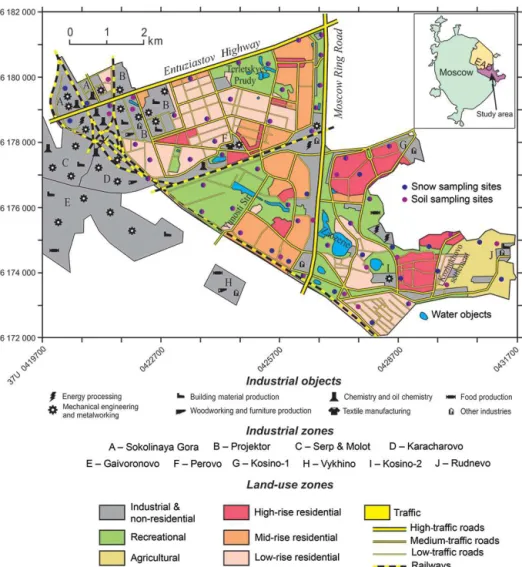
The work was conducted in the territory of Moscow, one of the largest cities in the world with a population of about 12 million. The city of Moscow is divided into 12 administra-tive districts. The study area is located in the eastern part of Moscow, which is considered to be one of the most pol-luted in the city because of its large industrial sector and con-centration of large processing enterprises. The study area be-longs to the southern taiga landscapes of the Meschera low-land, which is a flat outwash plain with mean altitudes of about 150 m (Fig. 1). The land surface is dominated by ur-ban structures. Urbic Technosols dominate in the soil cover; their morphological, physical and chemical properties differ greatly from those of the background Retisols developing un-der coniferous–deciduous forests on loamy deposits (Koshel-eva and Nikiforova, 2011). Anthropogenically modified and artificial soils are also represented by Eutric Retisols, Trans-portic Technosols, Ekranic Technosols (sealed by asphalt) and by several other soil types developed on man-made sed-iments and the cultural layer (Prokof’eva et al., 2014).
Traffic releases more than 90 % of pollutants in the aerosol and gas phase, including PAHs, into the air and thus defines the ecological situation in the district (Kasimov et al., 2014). Car exhaust emissions from large highways cause a signifi-cant adverse effect on urban soils (Fig. 1). A few large indus-trial zones with chemical and petrochemical plants and two thermal power plants are also sources of BaP pollution.
2.2 Sampling
Figure 1.Land-use zoning of the study area with main sources of BaP and locations of the sampling points; the UTM coordinate system.
formed by mixing 10 replicate samples taken with a plas-tic tube 5 cm in diameter; the composite soil samples were compiled from 3–4 individual samples. Due to a prevailing western atmospheric transfer, background (reference) snow samples were collected 50 km west of Moscow, near the city of Zvenigorod. The background area for urban soils was lo-cated in the Meschera lowland, 40–50 km east of Moscow, since the natural soils in that area (Retisols) were formed on the same parent materials (sandy clays and light clay loams) as the urban soils.
2.3 Laboratory technique and analysis
The solid fraction (particulate matter) was separated from snow samples using a membrane filter with a pore diam-eter of 0.45 µm. The BaP contents in the snow solid frac-tion and in the bulk soil samples were measured via low-temperature spectrofluorimetry under the Shpolsky effect us-ing the “Fluorat-02-Panorama” (Lumex Instruments, Mis-sion, BC, Canada), which was supplemented by an “LM-3”
monochromator and a “CRYO-1” cryogenic attachment with a precision of±25 % (Alekseeva and Teplitskaya, 1981). The cold extraction of BaP is carried out withn-hexane, and its concentration is determined by gas chromatography–mass spectrometry (GC–MS) with a precision of 15–20 % (Gen-nadiev and Pikovskii, 1996).
The geochemical data treatment included the calculation of the enrichment factor (EF), which compares the abun-dances of BaP in urban soils to the reference value. For as-sessing the risk of contamination, the ecological risk index (PI) was estimated on the basis of the maximum permissible concentration (MPC), which is a general BaP sanitary level equal to 20 ng g−1(GN.2.1.7.2041-06). The intensity of BaP
atmospheric fallout, ng m−2per day, is calculated as follows:
D=Pn×C, wherePnis the daily dust deposition on the
ur-ban territory (g m−2)andC is the BaP concentration in the
solid fraction of snow (ng g−1). InP
n=m/(n·l·s),mis the
Table 1. BaP contents in the solid fraction of snow and BaP fallout intensities in the winter period for the background territory and the land-use zones in the EAD of Moscow (2010).
Indices B (10) Land-use zones∗(number of samples)
T (13) I (5) residential areas A (3) R (6)
L (5) M (13) H (5)
BaP content in the solid fraction of snow
Average, ng g−1 169 3605 5732 604 1225 224 197 154
Min–max 69.4–489 26.7–22 530 275–22 040 232–1466 13.2–7278 14,5–466 149–238 14.2–379
Cv, % 106 201 163 84,8 178 77.8 22.9 90.2
EF 1.0 21.3 33.9 3.57 7.25 1.32 1.16 0.91
BaP fallout intensity with the solid fraction of snow onto the soil surface
Average, ng m−2per day 2.0 163 189 18.7 43.2 7.2 3.4 2.4
Min–max 1.2–5.4 1.8–1150 8.9–495 0.3–21.4 0.3–283 0.3–21.4 2.4–4.2 0.3–4.8
Cv, % 92.1 193 125 102 190 116 27.0 80.2
LF 1.0 80.7 93.4 9.24 21.4 3.56 1.66 1.18
BaP content in the background and urban soils
Average, ng g−1 4.93 566 1563 84.3 283 34.6 4.7 164
Min–max 0–15 1.4–3278 299–3611 1.3–299 7.0–1273 0–67.0 0–14.0 0–798
Cv, % 92.7 153 83.8 147 131 85.6 171 194
EF 1.0 115 317 17.1 57.4 7.02 0.95 33.3
∗Here and in Tables 2 and 3 and Fig. 2, land-use zones are denoted as follows: B, background; T, traffic; I, industrial; H, M and L, residential areas with high-, mid- and low-rise buildings respectively; A, agricultural; and R, recreational.
the tube in m2. The excess of BaP atmospheric fallout over
the background level is defined as LF=D/Db, whereDand Dbrefer to the BaP fallout intensities on the urban and back-ground areas respectively. The balance calculations were per-formed using averaged data for land-use zones, so the accu-racy of the balance components was 2–3 times higher than those in the single samples. This provided sufficient reliabil-ity of the BaP critical load values.
3 Results and discussion
3.1 BaP concentrations in snow and its deposition from
the atmosphere in background and urban environments
BaP is commonly added to soil cover through atmospheric precipitation, falling either in liquid or solid phases. Since the velocity of snowfall is slower and snowflakes have larger sur-faces compared to raindrops, they become rich in BaP faster (Vasilenko et al., 1985).
In the background area near Zvenigorod, the snow is weakly acidic (pH 5.8). The average BaP content in the dust fraction of snow is 169 ng g−1(Table 1), which denotes low
atmospheric addition of BaP to the background soils. BaP distribution in the snow cover is characterized by high spa-tial variability with a variation coefficient (Cv)of 106 %. BaP fallout intensity is estimated to be approximately 2 ng m−2
per day, which is close to the values of 0.1–2.2 ng m−2per
day measured by passive sampling and reported for the un-polluted area in the Serpukhovsky District of the Moscow region by Chernyansky et al. (2007).
The estimations performed by Gabov et al. (2008) for the undisturbed territories of the East European Plain in the taiga zone showed that the annual average rate of BaP deposition with dust and snowfall to the soil surface is 30–40 ng m−2.
These elevated fallout values were explained by a large at-mospheric concentration of BaP due to high anthropogenic emissions on a regional level.
In this study, snow water inurban areashad a higher pH in relation to the background level. This is especially ap-parent in industrial zones (pH 7.6) and in residential areas with high-rise buildings outside the Moscow Ring Road (pH 6.4). The solid fraction of snow in the EAD was enriched with BaP: its average content was 1942 ng g−1, which was
BaP delivery from the atmosphere is defined not only by its content in solid particles of snow, but also by its fallout intensity. In the EAD, the BaP fallout with the snow dust during the winter period was quite significant, and it aver-aged 75.6 ng m−2per day, ranging from 189 in the industrial
zone to 2.4 in the recreational zone (Table 1).
BaP fallout, measured as the loading factor (LF), in the two most polluted zones was much higher than in the back-ground territories (LF=93–80); however, the difference be-tween the recreational zone and the reference sites was in-significant (LF=1.2). These data on the intensity of BaP fallout with snow dust were consistent with the results re-ported for the city of Bratsk, Siberia. In the industrial zone of Bratsk, where a large aluminum plant and a pulp and pa-per factory are located, the BaP load rose to 1000 ng m−2per
day, while in the residential area of the central district it was 100–200 ng m−2per day (Kasimov, 1995).
The mean anthropogenic BaP addition to soil cover in Moscow’s EAD (75.6 ng m−2per day) is comparable to
fall-out levels in other urban territories of the world with indus-trial and transport emissions of BaP. For example, in Bursa, Turkey, the daily BaP deposition was 100–1000 ng m−2
(Esen et al., 2008; Birgül et al., 2011); in Ankara it was 65 ng m−2 in spring and winter and 10 ng m−2 in summer
and autumn (Gaga et al., 2009). In Jersey City, NJ, USA, the daily BaP addition with precipitation was 25 ng m−2, and dry
deposition accounted for 83 ng m−2(Gigliotti et al., 2005). In
Nahant, MA, USA, BaP fallout increased to 71 ng m−2day−1
(Golomb et al., 1997), while in Kuopio, Finland, the fallout ranged from 40 to 250 ng m−2day−1(Hautala et al., 1995).
3.2 BaP in background and urban soils
The surface horizons of the background soils, which are rep-resented by Retisols, were acidic (pH 5.5) with low BaP con-centrations that were 34 times lower than the mean BaP value in the solid fraction of snow (Table 1). Still, like dust in the snow cover, the natural soils showed typically high variabil-ity of BaP contents (Cv=92.7 %). For example, undisturbed Norwegian soils had the same level (5 ng g−1)of BaP
con-tent, but the world background soils were characterized by higher BaP values of – 22 ng g−1(Nam et al., 2009).
Urban soilswere weakly alkaline, ranging in the reaction from basic (pH 8.1 in the industrial zone) to weakly acidic (pH 6.5 in the recreational zone). Based on our data, the aver-age BaP concentration was 409 ng g−1, which was 43 times
higher than the background level. The BaP content varied greatly across land-use zones (Table 1), reaching a maximum in the industrial zone and along highways, where the surface horizons represent well-defined anthropogenic geochemical barriers (Kosheleva et al., 2015). According to the BaP en-richment of the surface layers, the land-use zones can be ar-ranged in the following order by EF: industrial (241), large highways (115), mid-rise residential (72), recreational (66), low-rise quarters (19), high-rise blocks (11) and agricultural
(0.9). BaP concentrations in the urban soils vary greatly: the variation coefficientsCvexceed 130 % in five out of seven zones.
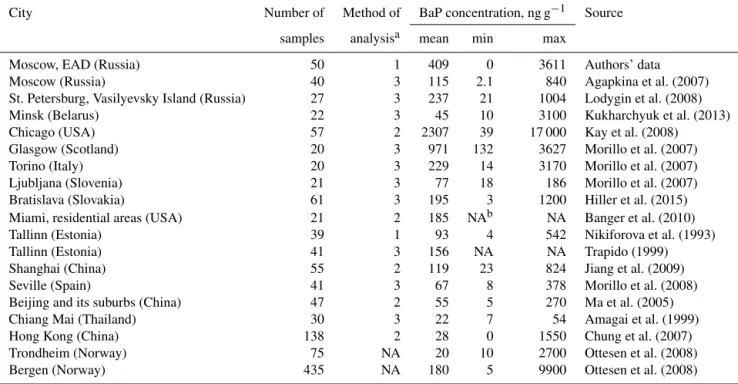
In the majority of land-use zones, the solid fraction of snow had higher (4–7 times) BaP concentrations than the sur-face soil layers. This situation is typical for cases where rel-atively high BaP concentration is observed for the airborne particles (Amagai et al., 1999). In the agricultural zone, the relative enrichment of snow dust with BaP increased up to 42 times with respect to soil material. The difference between the BaP content in the snow and in the soils can be attributed to two factors. First, nearby sources, such as the Kozhukhovo settlement with homes individually heated by furnaces and the Rudnevo industrial zone with a waste incineration plant, probably released a considerable amount of BaP. Second, the cultivated soils in this zone had higher BaP decomposition rates compared to the soils in other zones due to favourable moisture and air regimes (Nikiforova and Alekseeva, 2005). The ratio between the average BaP concentrations in snow and in the surface soil horizons indicated a significant BaP addition from the atmosphere and its progressive accumula-tion in the soils, especially in the industrial and traffic zones. In order to evaluate the ecological risk associated with BaP soil pollution, the average concentrations of BaP in the dis-trict’s land-use zones were compared with the sanitary stan-dards (MPC) accepted in Russia. The highest risk index (PI) was revealed in the industrial zone (PI=78), followed by the traffic zone (28) and residential areas with mid-rise buildings (14). The lowest level of risk was observed in the residen-tial high-rise (1.7) and agricultural (0.2) zones outside the Moscow Ring Road. The average BaP content in the urban soils exceeded the norm by 20 times, indicating that the soils were in an extremely dangerous ecological condition with regards to BaP pollution. Territories where the BaP content was 30 or more times higher than the MPC make up 20 % of the district’s area, whereas 35 % of the area was occupied by soils with BaP concentrations 10–30 times higher than the MPC. The rest of the EAD territory was occupied by clean soils and soils not exceeding the MPC by more than 10 times. The measured BaP contents in the soils of Moscow’s EAD were much higher than the BaP levels recorded in the major-ity of the other cities (Table 2). However, the comparison of our data with the results of BaP surveys in Moscow, as well as in a number of Russian and Belarusian cities, indicates similarity in the BaP levels. As a rule, the average BaP con-centrations in the soil and in the atmospheric fallout make up no more than 10–15 % of the total PAH content (Garban et al., 2002), and maximum concentrations are usually observed in the soils in the industrial and traffic zones.
3.3 Critical loads of BaP
Table 2.BaP content in the topsoils in some cities of the world.
City Number of Method of BaP concentration, ng g−1 Source
samples analysisa mean min max
Moscow, EAD (Russia) 50 1 409 0 3611 Authors’ data
Moscow (Russia) 40 3 115 2.1 840 Agapkina et al. (2007)
St. Petersburg, Vasilyevsky Island (Russia) 27 3 237 21 1004 Lodygin et al. (2008)
Minsk (Belarus) 22 3 45 10 3100 Kukharchyuk et al. (2013)
Chicago (USA) 57 2 2307 39 17 000 Kay et al. (2008)
Glasgow (Scotland) 20 3 971 132 3627 Morillo et al. (2007)
Torino (Italy) 20 3 229 14 3170 Morillo et al. (2007)
Ljubljana (Slovenia) 21 3 77 18 186 Morillo et al. (2007)
Bratislava (Slovakia) 61 3 195 3 1200 Hiller et al. (2015)
Miami, residential areas (USA) 21 2 185 NAb NA Banger et al. (2010)
Tallinn (Estonia) 39 1 93 4 542 Nikiforova et al. (1993)
Tallinn (Estonia) 41 3 156 NA NA Trapido (1999)
Shanghai (China) 55 2 119 23 824 Jiang et al. (2009)
Seville (Spain) 41 3 67 8 378 Morillo et al. (2008)
Beijing and its suburbs (China) 47 2 55 5 270 Ma et al. (2005)
Chiang Mai (Thailand) 30 3 22 7 54 Amagai et al. (1999)
Hong Kong (China) 138 2 28 0 1550 Chung et al. (2007)
Trondheim (Norway) 75 NA 20 10 2700 Ottesen et al. (2008)
Bergen (Norway) 435 NA 180 5 9900 Ottesen et al. (2008)
aMethods of analysis were the following: 1, low-temperature spectrofluorimetry; 2, gas chromatography–mass spectrometry; and 3, liquid chromatography and
spectrofluorimetry.
b Not available (NA).
the uppermost soil layer with a thickness of 10 cm, an area of 1 m2 and the BaP concentrations (C, mg t−1) measured
in 2010. The topsoil reserves of BaP are calculated byB= S·h·ρ·C, whereBis the BaP reserve in the surface layer of soil in mg,Sis the model area (1 m2),his the thickness of the soil horizon (0.1 m) andρis its density in t m−3. The density of urban soils varies from 1.12 to 1.93 g cm−3 (Charzy´nski
et al., 2013). Density is one of the diagnostic characteris-tics of the technogenic horizon of urban soils: it cannot be less that 1.2 g cm−3(Prokof’eva et al., 2014). Therefore, we
took the soil density to be 1.2 g cm−3in recreational and
agri-cultural zones and 1.4 g cm−3in all the other zones that are
subjected to significant anthropogenic impact. The topsoil re-serves (B) in different land-use zones decrease in the follow-ing sequence: industrial (219 mg), traffic (79.2 mg), mid-rise residential (39.6 mg), recreational (19.7 mg), low-rise resi-dential (11.8 mg), high-rise resiresi-dential (4.84 mg) and agricul-tural (0.564 mg).
The MPC of 20 ng g−1was used to define the critical level
of BaP in urban soils, below which significant harmful ef-fects on the soil biota do not occur. Critical BaP reserves in the soil surface horizons (BMPC, mg) correspond to the MPC of BaP in topsoils. They are 2.4 mg in the agricultural and recreational zones and 2.8 mg in the others.
Because the BaP concentrations exceeded the MPC in the majority of the EAD land-use zones, we considered a load critical if after a specific time interval (5, 10 or 25 years,
etc.) and given the rate of the pollutant’s degradation the BaP content would decrease to the permissible level.
The long-term dynamics of BaP reserves in the surface soil horizon (B, mg) can be described as follows:
dB
dt = −β·B+v, (1)
whereβ is the rate of BaP degradation (year−1)andvis the
intensity of its atmospheric fallout (mg) per 1 m2 per year.
This equation assumes that the process of BaP degradation in soil follows a first-order kinetic model and that BaP input is constant. BaP vertical and lateral off-site translocation was ignored because practically all BaP is absorbed by soil par-ticles (Gennadiev and Pikovskii, 1996; Kosheleva and Niki-forova, 2011).
Equation (1) can be solved by dividing the variables with
−1
βln(v−β·B)=t+α0,
whereα0is a random constant. Transforming this equation gives
v−β·B=e−β·α0e−βt=α
1e−βt. (2) When t=0, v−β·B=e−β·α0=α1 and B=B0, Eq. (2)
takes the formv−β·B0=α1. Taking into account the initial
condition, we get the solution of Eq. (1):
B= v β −
v β −B0
With an annual degradation intensity ofβ and a BaP fallout rate equal to the critical loadν=DMPC, the critical reserve of BaP (BMPC)in the surface layer of soil isBMPC=DMPCβ − (DMPCβ −B0)e−βt orBMPC=DMPC
β (1−e
−βt)+B
0e−βt. Then, the BaP critical load is determined by the formula
DMPC=β(BMPC−B0·e−βt)/(1−e−βt). (3) The intensity of the relative BaP degradation is given in frac-tions of 1. For example, a degradation intensity of 1 % means β=0.01 and 5 % meansβ=0.05, etc.;t is the model time of exposure in years. BaP can be preserved in soils for many years and decades or for even longer time periods up to hun-dreds and thousands of years (Shilina et al., 1980; Wild et al., 1991; Gennadiev et al., 2004).
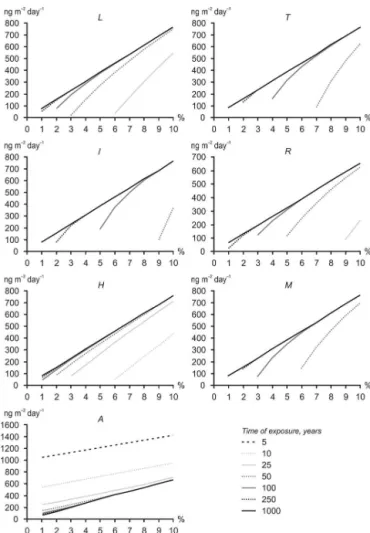
According to the β estimates reported in Wild and Jones (1995), the annual degradation intensity in soils is 10 % for PAHs and 6 % for BaP. In order to take into account the vari-ability of the BaP content in the soils related to different soil conditions, its critical loads were calculated using several values of degradation rates ranging from 1 to 10 % (Fig. 2).
The analysis of Fig. 2 demonstrates that the critical loads (DMPC)vary greatly depending on the BaP degradation rates and the exposure time in all studied zones, except for the agricultural zone. If the BaP decomposition is assumed to be slow (1–3 % yearly), the soil pollution in most of the land-use zones will decrease to the permissible level only under insignificant BaP addition and during long exposure times (over 100 years). If the exposure time is shorter (even in the case of nil atmospheric addition of the pollutant), the BaP re-serves in the soil cannot drop below the critical levels, which are 2.4–2.8 mg m−2, due to its low degradation rate. In the
agricultural zone, the calculated critical loads of BaP are tens to hundreds of times higher than the measured pollutant fall-out rates because of initially low BaP levels in the soil.
As the BaP degradation rate increases, so does the value of the critical loads (DPMC). However, even at a very high degradation intensity (10 % per year), the non-zero critical loads appear in the high-rise residential areas when the expo-sure period is longer than 10 years. They appear in the low-rise residential areas with an exposure period over 25 years and in the traffic, industrial and mid-rise residential zones with an exposure time over 50 years, which can be explained by the high initial levels of BaP in these zones.
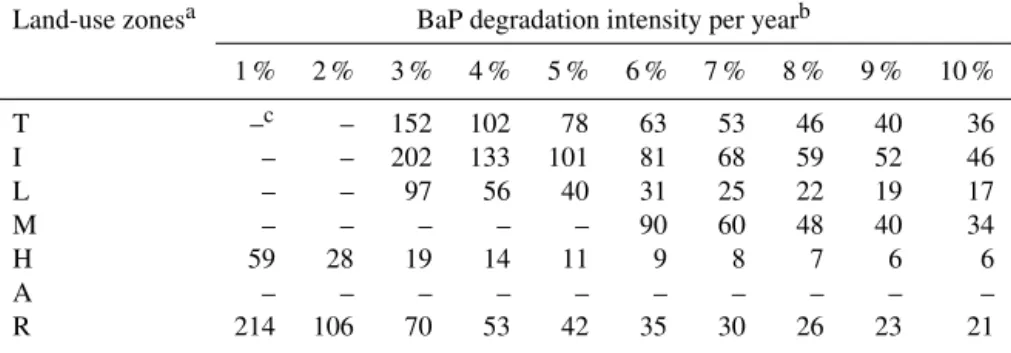
The critical BaP load values calculated using this model demonstrate that at a certain degradation intensity the BaP concentrations in the EAD soils can decrease to the level of MPC, although this will take a relatively long time. Based on the above formulas, the time necessary for BaP content in the soil to reach the MPC can be calculated as follows:
T =ln[(B0−D/β)/(BMPC−D/β)]/β, (4) whereD is the BaP load measured in 2010 in mg m−2 per day. The results of these calculations are shown in Table 3.
Figure 2.The critical loads of BaP (ng m−2day−1)plotted against
the degradation intensities (%) and exposure time (years) for the different land-use zones in the Eastern Administrative District of Moscow. The land-use zone abbreviations are explained in Table 1.
At existing levels of BaP deposition with insignificant degradation intensity (1–2 %), the BaP concentrations will reach the MPC in high-rise residential areas in 28–59 years. The BaP concentrations will lower to the MPC in the recre-ational zone in 106–214 years based on our calculations. It is worth noting that the MPC will never be reached in the other zones because the input of BaP into the soils exceeds its losses through decomposition.
Table 3.The number of years required to lower the BaP content in the soils of the EAD to the MPC (20 ng g−1)at the existing fallout levels.
Land-use zonesa BaP degradation intensity per yearb
1 % 2 % 3 % 4 % 5 % 6 % 7 % 8 % 9 % 10 %
T –c – 152 102 78 63 53 46 40 36
I – – 202 133 101 81 68 59 52 46
L – – 97 56 40 31 25 22 19 17
M – – – – – 90 60 48 40 34
H 59 28 19 14 11 9 8 7 6 6
A – – – – – – – – – –
R 214 106 70 53 42 35 30 26 23 21
a Land-use zone abbreviations are explained in Table 1.
b The BaP degradation intensity is shown as a percentage of its initial concentration in 2010.
c “–” means that at the accepted BaP degradation intensity, the drop in its concentration below the MPC is impossible.
Thus, at the existing emission rates of BaP into the atmo-sphere and its subsequent accumulation in the soil, its content in the soils in all of the land-use areas (except the agricul-tural zone) may come to the permissible level after decades or hundreds of years. In this situation, to achieve and to main-tain environmentally acceptable BaP levels in urban soils, it is necessary to remove the contaminated soil surface layer and replace it with unpolluted soil material as well as to re-duce BaP emissions.
4 Conclusions
The intensity of the BaP fallout from the atmosphere onto urban soils with the solid fraction of snow in the EAD ter-ritory of Moscow ranged from 0.3 to 1150 ng m−2 per day.
The average BaP content in the snow dust was 1942 ng g−1,
which is 11.5 times higher than its level in the reference (background) sites. The BaP contents in the snow cover var-ied dramatically across the land-use zones: from 5732 ng g−1
in the industrial zone and 3605 ng g−1in the traffic zone to
154 ng g−1in the recreational zone.
The average BaP content in the soil surface layers of Moscow’s EAD in 2010 was 409 ng g−1, which is 83 times
higher than the levels measured in the unpolluted background soils. The district’s land-use zones can be arranged by BaP soil enrichment in the following order: industrial, traffic, mid-rise residential, recreational, low-rise residential, high-rise residential and agricultural. The BaP pollution on aver-age exceeded 20 times the norm (MPC). The highest ecolog-ical risk posed by the BaP soil pollution was observed in the industrial zone and in the areas situated along large highways (PIs of 78 and 28 respectively), and the lowest risk was ob-served in the high-rise residential areas (PI=1.7) and in the agricultural zone (PI=0.2).
The calculations of the BaP critical loads on the soils in the EAD showed that, at degradation intensities ranging from 1 to 10 % per year, the BaP concentrations may decrease to the permissible level only after a relatively long period of time up
to many decades or centuries. Because the urban soils have limited self-purification abilities, a combination of remedi-ation measures must be taken to reduce the ecological risk posed by BaP soil pollution.
The first experience of the application of the critical loads approach for BaP demonstrated its feasibility for contami-nation control in the urban environment. It also showed the need for further research on BaP entry and loss rates from urban soils, especially in relation to the conditions and rates of BaP decomposition. A reliable assessment of the pollu-tant’s input and output is the basis for a sound prediction of the long-term dynamics of contamination with highly toxic organic compounds, such as BaP, in the urban environment.
5 Data availability
The data used are available in the Supplement.
The Supplement related to this article is available online at doi:10.5194/acp-17-2217-2017-supplement.
Author contributions. All authors cooperated in designing the ex-periments. E. Nikiforova, N. Kosheleva and D. Vlasov carried out the fieldwork. D. Vlasov and N. Koshleleva calculated the critical loads of BaP. All authors calculated the pollution levels of BaP in urban soils and snow cover, and all authors contributed to preparing the paper.
Competing interests. The authors declare that they have no conflict of interest.
of Landscape Geochemistry and Soil Geography at the Faculty of Geography, Lomonosov Moscow State University: N. I. Khlynina for her analytical work as well as M. Y. Lychagin, I. N. Semenkov, T. S. Koshovsky and G. L. Shinkareva for their participation in the fieldwork. We are grateful to E. N. Aseyeva, who helped us to prepare the paper for publication. This work contributes to the Pan-Eurasian Experiment (PEEX) research agenda.
Edited by: V.-M. Kerminen
Reviewed by: A Khaustov and one anonymous referee
References
Agapkina, G. I., Chikov, P. A., Shelepchikov, A. A., Brodskii, E. S., Feshin, D. B., Bukhan’ko, N. G., and Balashova, S. P.: Poly-cyclic aromatic hydrocarbons in soils of Moscow, Moscow Univ. Soil Sci. Bull., 62, 149–158, doi:10.3103/S0147687407030076, 2007.
Alekseeva, T. A. and Teplitskaya, T. A.: Methods of Spectroflu-orimetric Analysis of Aromatic Hydrocarbons in Natural and Techogenic Environments, Gidrometeoizdat, Leningrad, USSR, 215 pp., 1981 (in Russian).
Amagai, T., Takahashi, Y., and Matsushita, H.: A survey on poly-cyclic aromatic hydrocarbon concentrations in soil in Chiang-Mai, Thailand, Environ. Int., 25, 563–572, doi:10.1016/S0160-4120(99)00026-4, 1999.
Banger, K., Toor, G. S., Chirenje, T., and Ma, L.: Polycyclic Aromatic Hydrocarbons in Urban Soils of Different Land Uses in Miami, Florida, Soil Sediment Contam., 19, 231–243, doi:10.1080/15320380903548516, 2010.
Baskhin, V., Kurbatova, A. S., and Savin, D. S.: A Methodical Ba-sis for the Evaluation of Critical Loads of Pollutants on Urban Ecosystems, NIiPIEG, Moscow, Russia, 64 pp., 2004 (in Rus-sian).
Birgül, A., Tasdemir, Y., and Cindoruk, S. S.: Atmospheric wet and dry deposition of polycyclic aromatic hydrocarbons (PAHs) de-termined using a modified sampler, Atmos. Res., 101, 341–353, doi:10.1016/j.atmosres.2011.03.012, 2011.
Birke, M., Rauch, U., and Stummeyer, J.: Urban Geochemistry of Berlin, Germany, in: Mapping the Chemical Environment of Ur-ban Areas, edited by: Johnson, C. C., Demetriades, A., Locutura, J., and Ottesen, R. T., John Wiley & Sons, Ltd, Chichester, UK, 245–268, 2011.
Charzy´nski, P., Hulisz, P., and Bednarek, R. M. (Eds.): Technogenic soils of Poland, Polish Society of Soil Science, Toru´n, Poland, 357 pp., 2013.
Chernyansky, S. S., Volosatova, Y., and Krasnopeeva, A. A.: For-mation of the anomalies of polyaromatic hydrocarbons in soil cover, Vestnik Moskovskogo Unviersiteta, Ser. Geografiya, 31– 37, 2007 (in Russian).
Chung, M. K., Hu, R., Cheung, K. C., and Wong, M. H.: Pollutants in Hong Kong soils: polycyclic aromatic hydrocarbons, Chemo-sphere, 67, 464–473, doi:10.1016/j.chemosphere.2006.09.062, 2007.
Doelman P.: Microbiology of soil and sediments, in: Biogeodynam-ics of Pollutants in Soils and Sediments, edited by: Salomons, W. and Stigliani, W. M., Springer Berlin Heidelberg, Berlin, Heidel-berg, Germany, 31–53, 1995.
Esen, F., Sıddık Cindoruk, S., and Tasdemir, Y.: Bulk de-position of polycyclic aromatic hydrocarbons (PAHs) in an industrial site of Turkey, Environ. Pollut., 152, 461–467, doi:10.1016/j.envpol.2007.05.031, 2008.
Fernández, P., Vilanova, R. M., Martínez, C., Appleby, P., and Gri-malt, J. O.: The Historical Record of Atmospheric Pyrolytic Pol-lution over Europe Registered in the Sedimentary PAH from Re-mote Mountain Lakes, Environ. Sci. Technol., 34, 1906–1913, doi:10.1021/es9912271, 2000.
Gabov, D. N., Beznosikov, V. A., Kondratenok, B. M., and Yakovl-eva, E. V.: Formation of polycyclic aromatic hydrocarbons in northern and middle taiga soils, Eurasian Soil Sci., 41, 1180– 1188, doi:10.1134/S1064229308110069, 2008.
Gaga, E. O., Tuncel, G., and Tuncel, S. G.: Sources and Wet Depo-sition Fluxes of Polycyclic Aromatic Hydrocarbons (PAHs) in an Urban Site 1000 Meters High in Central Anatolia (Turkey), Env-iron. Forensics, 10, 286–298, doi:10.1080/15275920903347594, 2009.
Garban, B., Blanchoud, H., Motelay-Massei, A., Chevreuil, M., and Ollivon, D.: Atmospheric bulk deposition of PAHs onto France: trends from urban to remote sites, Atmos. Environ., 36, 5395– 5403, doi:10.1016/S1352-2310(02)00414-4, 2002.
Gennadiev, A. N. and Pikovskii, Y. (Eds.): Geochemistry of Poly-cyclic Aromatic Hydrocarbons in Rocks and Soils, Moscow Uni-versity Publishing, Moscow, Russia, 192 pp., 1996 (in Russian). Gennadiev, A. N., Pikovskii, Y., Chernyanskii, S. S., Alekseeva, T. A., and Kovach, R. G.: Forms of polycyclic aromatic hydro-carbons and factors of their accumulations in soils affected by technogenic pollution (Moscow Oblast), Eurasian Soil Sci., 37, 697–709, 2004.
Gigliotti, C. L., Totten, L. A., Offenberg, J. H., Dachs, J., Reinfelder, J. R., Nelson, E. D., Glenn 4th, T. R., and Eisenreich, S. J.: Atmo-spheric Concentrations and Deposition of Polycyclic Aromatic Hydrocarbons to the Mid-Atlantic East Coast Region, Environ. Sci. Technol., 39, 5550–5559, doi:10.1021/es050401k, 2005. GN 2.1.7.20411-06. Rospotrebnadzor’s Federal Center for
Hy-giene and Epidemiology: Maximum Permissible Concentra-tions (MPC) of Chemical Compounds in Soil: Hygienic Norms, Moscow, Russia, 2006 (in Russian).
Golomb, D., Ryan, D., Underhill, J., Wade, T., and Zembar, S.: Atmospheric deposition of toxics onto Massachusetts Bay – II. Polycyclic aromatic hydrocarbons, Atmos. Environ., 31, 1361– 1368, doi:10.1016/S1352-2310(96)00277-4, 1997.
Haglund, P., Alsberg, T., Bergman, A., and Jansson, B.: Analysis of halogenated polycyclic aromatic hydrocarbons in urban air, snow and automobile exhaust, Chemosphere, 16, 2441–2450, doi:10.1016/0045-6535(87)90303-1, 1987.
Hautala, E.-L., Rekilä, R., Tarhanen, J., and Ruuskanen, J.: Depo-sition of motor vehicle emissions and winter maintenance along roadside assessed by snow analyses, Environ. Pollut., 87, 45–49, doi:10.1016/S0269-7491(99)80006-2, 1995.
Hiller, E., Lachká, L., Jurkoviˇc, and Vozár, J.: Polycyclic aromatic hydrocarbons in urban soils from kindergartens and playgrounds in Bratislava, the capital city of Slovakia, Environ. Earth Sci., 73, 7147–7156, doi:10.1007/s12665-014-3894-1, 2015.
Jiang, Y.-F., Wang, X.-T., Wang, F., Jia, Y., Wu, M.-H., Sheng, G.-Y., and Fu, J.-M.: Levels, composition profiles and sources of polycyclic aromatic hydrocarbons in ur-ban soil of Shanghai, China, Chemosphere, 75, 1112–1118, doi:10.1016/j.chemosphere.2009.01.027, 2009.
Johnsen, A. R. and Karlson, U.: Diffuse PAH contamination of surface soils: environmental occurrence, bioavailability, and mi-crobial degradation, Appl. Microbiol. Biotechnol., 76, 533–543, doi:10.1007/s00253-007-1045-2, 2007.
Kasimov, N. S. (Ed.): Ecogeochemistry of Urban Landscapes, Moscow University Publishing, Moscow, Russia, 336 pp., 1995 (in Russian).
Kasimov, N. S., Bityukova, V. R., Malkhazova, S. M., Kosheleva, N. E., Nikiforova, E. M., Shartova, N. V., Vlasov, D. V., Timo-nin, S. A., and Krainov, V. N.: Regions and Cities of Russia: the Integrated Assessment of the Environment, Publisher Filimonov M.V., Moscow, Russia, 560 pp., 2014 (in Russian).
Kay, R. T., Arnold, T. L., Cannon, W. F., and Graham, D.: Concentrations of polycyclic aromatic hydrocarbons and in-organic constituents in ambient surface soils, Chicago, Illi-nois: 2001–2002, Soil Sediment Contam., 17, 221–236, doi:10.1080/15320380802006939, 2008.
Kleeman, M. J., Schauer, J. J., and Cass, G. R.: Size and Composition Distribution of Fine Particulate Matter Emitted from Motor Vehicles, Environ. Sci. Technol., 34, 1132–1142, doi:10.1021/es981276y, 2000.
Kosheleva, N. E. and Nikiforova, E. M.: Multiyear dynam-ics and factors of accumulation of benzo(a)pyrene in ur-ban soils (on the example of the Eastern Administrative Okrug, Moscow), Moscow Univ. Soil Sci. Bull., 66, 65–74, doi:10.3103/S0147687411020062, 2011.
Kosheleva, N. E., Kasimov, N. S., and Vlasov, D. V.: Factors of the accumulation of heavy metals and metalloids at geochem-ical barriers in urban soils, Eurasian Soil Sci., 48, 476–492, doi:10.1134/S1064229315050038, 2015.
Kukharchyk, T. I., Khomich, V. S., Kakareka, S. V., Kurman, P. V., and Kozyrenko, M. I.: Contamination of soils in the urbanized ar-eas of Belarus with polycyclic aromatic hydrocarbons, Eurasian Soil Sci., 46, 145–152, doi:10.1134/S1064229313020099, 2013. Larsen, R. K. and Baker, J. E.: Source apportionment of poly-cyclic aromatic hydrocarbons in the urban atmosphere: a com-parison of three methods, Environ. Sci. Technol., 37, 1873–1881, doi:10.1021/es0206184, 2003.
Lodygin, E. D., Chukov, S. N., Beznosikov, V. A., and Gabov, D. N.: Polycyclic aromatic hydrocarbons in soils of Vasilievsky Island (St. Petersburg), Eurasian Soil Sci., 41, 1321–1326, doi:10.1134/S1064229308120107, 2008.
Ma, L., Chu, S., Cheng, H., Wang, X., Liu, X., and Xu, X.: Poly-cyclic aromatic hydrocarbons contamination in subsoil from out-skirts of Beijing, People’s Republic of China, Geoderma, 129, 200–210, doi:10.1016/j.geoderma.2004.11.026, 2005.
Morillo, E., Romero, A. S., Maqueda, C., Madrid, L., Ajmone-Marsan, F., Grcman, H., Davidson, C. M., Hursthouse, A. S., and Villaverde, J.: Soil pollution by PAHs in urban soils: a compar-ison of three European cities, J. Environ. Monit., 9, 1001–1008, doi:10.1039/B705955H, 2007.
Morillo, E., Romero, A. S., Madrid, L., Villaverde, J., and Maqueda, C.: Characterization and Sources of PAHs and Potentially Toxic Metals in Urban Environments of Sevilla (Southern Spain),
Wa-ter Air Soil Pollut., 187, 41–51, doi:10.1007/s11270-007-9495-9, 2008.
Nam, J. J., Sweetman, A. J., and Jones, K. C.: Polynuclear aro-matic hydrocarbons (PAHs) in global background soils, J. En-viron. Monit., 11, 45–48, doi:10.1039/B813841A, 2009. Nikiforova, E. M. and Alekseeva, T. A.: Polycyclic aromatic
hydro-carbons in soils of suburban agricultural landscapes in Eastern Moscow region, Eurasian Soil Sci., 38, 1213–1225, 2005. Nikiforova, E. M., Kozin, E. S., and Tsird, K.: The Specifics
of Polycyclic Aromatic Hydrocarbon Pollution of Urban Soils Based on the Influence of Heating, Eurasian Soil Sci., 25, 91– 102, 1993.
Nikiforova, E. M., Kosheleva, N. E., Labutina, I. A., and Khay-brakhmanov, T. S.: Geoinformation Landscape-Geochemical Mapping of Urban Areas (with the Example of Eastern Adminis-trative District of Moscow), J. Civ. Eng. Sci., 3, 142–151, 2014. Ollivon, D., Blanchoud, H., Motelay-Massei, A., and Garban,
B.: Atmospheric deposition of PAHs to an urban site, Paris, France, Atmos. Environ., 36, 2891–2900, doi:10.1016/S1352-2310(02)00089-4, 2002.
Ottesen, R. T., Alexander, J., Langedal, M., Haugland, T., and Høy-gaard, E.: Soil pollution in day-care centers and playgrounds in Norway: national action plan for mapping and remediation, En-viron. Geochem. Health, 30, 623–637, doi:10.1007/s10653-008-9181-x, 2008.
Pergal, M. M., Teši´c, Ž, L., and Popovi´c, A. R.: Influence of An-thropogenic and Environmental Conditions on Polycyclic Aro-matic Hydrocarbon Pollution Originating from Coal Ash Dumps, Water Air Soil Pollut., 226, 35, doi:10.1007/s11270-015-2319-4, 2015.
Prokof’eva, T. V., Gerasimova, M. I., Bezuglova, O. S., Bakhma-tova, K. A., Gol’eva, A. A., Gorbov, S. N., Zharikova, E. A., Matinyan, N. N., Nakvasina, E. N., and Sivtseva, N. E.: Inclu-sion of soils and soil-like bodies of urban territories into the Rus-sian soil classification system, EuraRus-sian Soil Sci., 47, 959–967, doi:10.1134/S1064229314100093, 2014.
Revich, B. A., Saet, Y. E., Smirnova, R. S., and Sorokina, E. P.: Me-thodical Recommendations on the Geochemical Evaluation of Pollution of Urban Territories by Chemical Elements, IMGRE, Moscow, Russia, 112 pp., 1982 (in Russian).
Sharma, M. and McBean, E. A.: PAH deposition to snow surface, Environ. Sci. Pollut. Res., 8, 11–18, doi:10.1007/BF02987290, 2001.
Shilina, A. I., Vaneeva, L. V., and Zhuravleva, A. V.: Benzo(a)pyrene Life Span in Soil After Deposition with Soil Dust Particles, in: Transport of Pollutants in Soil and Adjacent Environments, edited by: Bobovnikova, T. I. and Malakhov, S. G., Gidrometeoizdat, Leningrad, USSR, 100–105, 1980 (in Russian).
Trapido, M.: Polycyclic aromatic hydrocarbons in Estonian soil: contamination and profiles, Environ. Pollut., 105, 67–74, doi:10.1016/S0269-7491(98)00207-3, 1999.
UN DESA: World Urbanization Prospects: The 2014 Revision, United Nations, Department of Economic and Social Affairs, Population Division, New York, USA, 493 pp., 2015.
Vries, W. de, Bakker, D. J., Sverdrup, H. U., Paces, T., and Tipping, E.: Effect-based approaches to assess the risks of heavy metal in-puts to soils. Background document for the workshop on critical limits and effect-based approaches for heavy metals and POP’s, Bad Harzburg, Germany, 126 pp., 1997.
Wania, F. and MacKay, D.: Tracking the Distribution of Persis-tent Organic Pollutants, Environ. Sci. Technol., 30, 390A–396, doi:10.1021/es962399q, 1996.
Wild, S. R. and Jones, K. C.: Polynuclear aromatic hydrocarbons in the United Kingdom environment: a preliminary source inven-tory and budget, Environ. Pollut., 88, 91–108, doi:10.1016/0269-7491(95)91052-M, 1995.
Wild, S. R., Obbard, J. P., Munn, C. I., Berrow, M. L., and Jones, K. C.: The long-term persistence of polynuclear aromatic hy-drocarbons (PAHs) in an agricultural soil amended with metal-contaminated sewage sludges, Sci. Total Environ., 101, 235–253, doi:10.1016/0048-9697(91)90037-F, 1991.