regional committee
PAN AMERICAN
SANITARY
ORGANIZATION
VII Meeting
WORLD
HEALTH
ORGANIZATION
V Meeting Washington, D. C.
9-19 October 1953
I
CD7/49 (Eng. )* 9 April 1954
ORIGINAL: SPANISH
PRECIS MINUTES
OF THE
VII MEETING OF THE DIRECTING COUNCIL OF THE PAN AMERICAN SANITARY ORGANIZATION,
V MEETING OF THE REGIONAL COMMITTEE OF THE WORLD HEALTH ORGANIZATION
*Definitive text of the precis minutes, incorporating the provisional texts contained
ir Documents CD7/31, CD7/32, CD7/33, CD7/34, CD7/35, CD7/37, CD7/39,
CD7/49 (Eng.)
Page iii
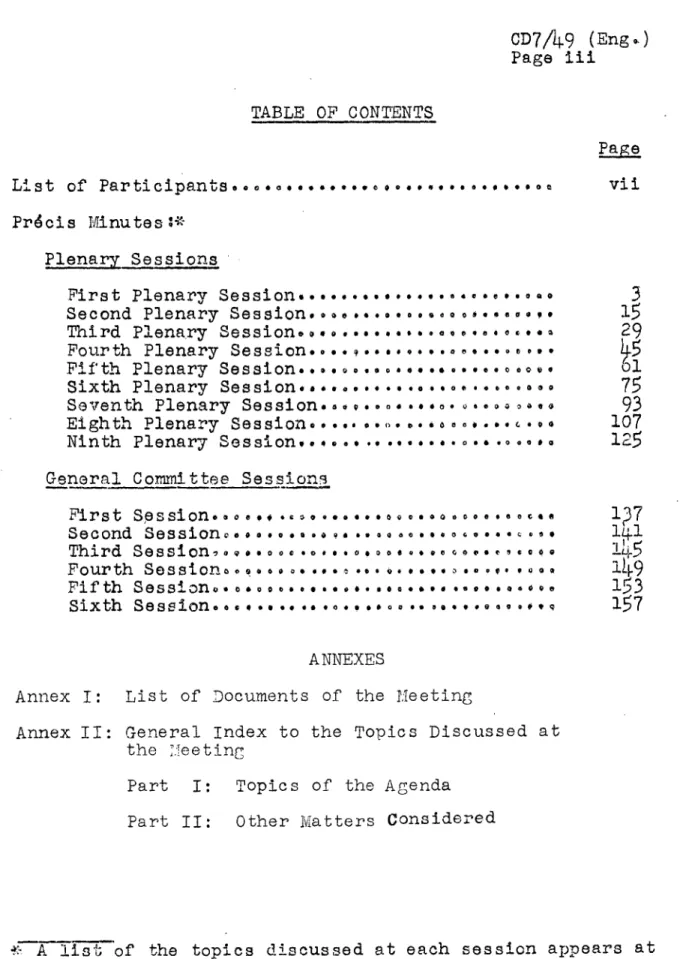
TABLE OF CONTENTS
Page
List of Participantse.o oa.... ... O ... vii
Pr6cis Iinutes:*
Plenary Sessions
First Plenary Session...*..*...*..eoo 3
Second Plenary Session..ooooo... soo....e
15
Third Plenary Session,,. ...oo.e¢.,* 29
Fourth Plenary Sessiono....* ... 4 o *o * ... o
45
Fifth Plenary Session... ... .O..o..o. 1
Sixth Plenary Session§... .. o ...75
Seventh Plenary Session.o... o.eoo...o. o..oooo
93
Eighth Plenary Session...o. oo.... ... 107
Ninth Plenary Session.,.o . ...o..o .... oo 125
General Committee Sessions
First Session.
oe,
, 9s.. 009.. o . 0o
.o
o0.
0 C137
Second Sessiono°. .9.o .oe* *oee9o.oo e.
11
Third Session, . . .o
o.
o . o . . .r5
Fourth Sessiono o o o.. *. ..e.. * * * * * o o 1.9
Fifth Sessi onO.o*e.°9.0..°°.
153
Sixth Session. o ... o.., ... ,..,9 157
ANNEXES
Annex I: List of Documents of the Ieeting
Annex II: General Index to the Topics Discussed at the PJeeting
Part I: Topics of the Agenda
Part II: Other Matters Considered
CD7/49 (Eng. )
Page v
CD7/49 (Eng.) Page vii
LIST OF PARTICIPANTS
ARGENTINA
Representative
Mr. Andres Rodriguez
Undersecretary for Administration Ministry of Public Health
Buenos Aires, Argentina
Medical Adviser
Dro Gerardo Segura
Director, International Health Relations Paseo Col6n 367 - 100 piso
Buenos Aires, Argentina
Economic Adviser
Mr, Oscar Peralta
Comptroller, Department of Public Health Buenos Aires, Argentina
BRAZIL
Representative
Dr. Almir de Castro
Director, National Plague Service National Department of Health Rio de Janeiro, Brazil
CANADA
Observer
Mro L. H. Peebles
Third Secretary, Embassy of Canada 1746 Massachusetts Avenue, N.Wv.
CD7/49 (Eng.)
Page viii
CHILE
Representative
Dr. Hernan Urzua
Director General, National Public Health Service P.O. Box No. 41-D
Santiago, Chile
Adviser
l.Ir. Victor M. Vergara
Counselor, Embassy of Chile
1736 Massachusetts Avenue, N.W. Washington, D.C.
DOMINICAN REPUBLIC
Representative
Dr. Nelson Estruch
Unde±rsecretary of State for Public-Heal th Ciudad Trujillo, Dominican Republic
Alternate and Adviser
Mr. Hip6lito S&nchez Baea
Chief, Legal and Foreign Affai rs Section
Secretariat of State for Public Health Ciudad Trujillo, Dominican Republic
ECUADOR
Representative
Dr. Leonardo E. Bello Sarria
Assistant Director General of Public Health P.O. Box No. 813
CD7/49
(Eng.)Page ix
FRANCE
Representative
Dr. Rene Lavoine, ·
Departmental Director of Health Martinique, F. W, I.
Advisers
Mr. Jean Pierre Benard
Counsellor, Embassy of France 2535 Belmont Road, N.vV.
Washington, D.C.
Mr. Pierre Carraud
Second Secretary, Embassy of France 2535 Belmont Road, N.W.
Washington, D.C.
GUATEMALA
Representative
Mr. Francisco Anguiano
First Secretary,. Embassy of Guatemala 1614 - 18th Street, N.w.
Washington, D.C.
HAITI
Representative
Dr. Lucien Pierre-Noel
Assistant Director General of Public Health Port-au-Prince, Haiti
Alternate
Dr. Antoine Grand-Pierre
Administrator of the Health District of St, Marc
CD7/49 (Eng.)
Page x
MEXICO
Representative
Dr. Jose Zozaya
Chief, Office of International Affairs Ministry of Public Health and Welfare Mexico, D. F., Mexico
NETHERLANDS
Representative
Dr. Nicilaas H. Swellengrebel Professor of Parasitology
Univcrsity of Amsterdam
Director of the Institute for tropical Medicine and Geographical Pathology
Amsterdam, Netherlands
Alternates
Dr. Edwin van der Kuyp
Director, Bureau of Public Health Jessurunstr. 15, Paramaribo
Surinam
Dr. A. Pieron
Chief of Medical Services Curac ao
NICARAGUA
Representative
Dr. Manuel Antonio Sinchez Vigil
Director of the National Institute of Hygiene Technical Assistant, Ministry of Public Health Managua, Nicaragua
PANAMA
Representative
Dr. Alberto Bissot, Jr. Director'of Public Health
CD7/49 (Eng.)
Page xi
PARAGUAY
Representative
Dr. Carlos Ramirez Boettner Professor of Clinical Medicine National University
Asunci6n, Paraguay
UNITED KINGDOM
Representative
Dro A. Ao Peat
Director of Medical Services Trinidad, B.W.I.
Adviser
Dr. Co C. Wedderburn
Assistant Director of Medical Services Jamaica, B. Wo .I: .
UNITED STATES
Representative
Dr. Leonard A, Scheele
Surgeon General, U.'' S. Public Health Service
Department of Health, Education and Welfare, Washington, D.C.
Alternates
Dr. Frederick J. Brady
International Health Representative Division of International Health U. S. Public Health Service
Department of Health, Education and Welfare, Washington,DC.
Mr. Howard B. Calderwood'
Office of United Nations Economic and Social Affairs
Department of State, Washington, D.C.
Dr. Ho van Zile Hyde
Chief, Division of International Health Services U. S. Public Health Service
CD7/49 (Eng.)
Page xii
UNITED STATES
Advisers:
Mr. Wyman Stone
Director, Division-of Health, Welfare and Housing
Institute of Inter-American Affairs
Foreign Operations Administration, Washington, D.C.
Mrs. Mary B. Trenary
Division of International Administration Department of State, Washington, D.C.
Dr. Charles L. Williams, Jr.
Associate Director, Division of Health, Welfare and Housing
Institute of Inter-American Affairs
Foreign Operations Administration, Washington, D.C.
Mr. Simon No Wilson
Office of Regional American Affairs Department of State
Washington, D.C.
URUGUAY
Representative
Dr. Jos6 May
Medical Director, Dermatology Clinic, Maciel Hospital
Director, Department of Venereal-Disease Care and Prevention
Mercedes 933
Montevideo, Uruguay
VENEZUELA
Representative
Dr. Daniel Orellana
Director of Public Health
Ministry of Public Health and Social Welfare Caracas, Venezuela
Adviser
Dr. Pablo Liendo Col.l Technical Officer
CD7/49 (Eng.) Page xiii
WORLD HEALTH ORGANIZATION '(WHO)
Dr, M;GI Candaup Director-General
Dr. H. Ss Gear, Assistant Director-General
PAN AMERICAN SANITARY BUREAU (PASB)
Dr. Fred L. Soper, Director;-Member ex officio of the Council
Dro Miguel E. Bustamante, Secretary General Secretary of the Council
Advisers;
Dro Carlos L. Gonzdlez, Chief, Division of Public
Health
Mr. Harry A. Hinderer, Chief, Division of Administration
Dr My yron Wegman, Chief, Division of Education and
Training
Dr. P. F, de Caires, A'rea Supervi'sor, Zone I Dro Guillermo Samame, Representative, Zone II
Dr. Stanford F. Farnsworth, Representative, Zone III Dr. Oswaldo Jo da Silva, Representative, Zone IV Dr, Kenneth Oo Courtney, Representattive Zone V Dr. Emilio Budnik, 'Representative} Zone VI
Mr. Clarence Moore, Chief, Office of Coordination
Press Officerf -.
Mr, Harold Ballou
Conference Officer .
Mro Guillermo A. Suro
ORGANIZATION OF AMERICAN STATES (OAS)
Mro Paul R. Kelbaugh
Chief, Division of Conferences and Organizations Pan American Union
CD7/49 (Eng.) Page xiv
SPECIALIZED AGENCIES OF THE UNITED NATIONS
Food and Agriculture Organization (FAO) Mrse Andromache Sismanidis
Nutrition Representative
Regional Office for North America
Drb Ws R. Aykrcyd, Nutrition Director
Rome, Italy
INTERGOVERNPENTAL ORGANIZA TI ONS
United Nations International Children's Emergency Fund
(UNICEF)
Dr. Robert L, Dav6e, Regional Director for Latin America Mrs David Ra Hunter
Dr. I. C. Yuan Mr. Fred Tooby
NONGOVERNMENTAL ORGANIZATIONS
International Council of Nurses
Miss Annabelle Petersen
International Dental Federation
Dr. Co Willard Camalier
International Hospital Federaticn
CD7/49 (Eng.)
Page xvInternational Union Against Tuberculosis Mr. Frederick D. Hopkins
International Union Against the Venereal Diseases Mrs. Josephine V. Tuller
League of Red Cross Societies Dr. David N. W. Grant
CD7/49 (Engo)
Page 1
PRECIS MINUTES
CD7/49 (Eng.) Page 3
PRECIS MINUTES OF THE FIRST PLENARY SESSION Washington, D. C.
Friday, 9 October 1953, at 10 a.m.
Provisional Chairman:
Chairman :
Vice-Chairmen:
Secretary:
Dr. Daniel ORELLANA
Dr. Hernan URZUA
Mr. Andres RODRIQUEZ
Dr. Alberto BISSOT, Jr.
Dr. Miguel E. BUSTAMANTE
Venezuela
Chile
Argentina
Panama
Pan American Sanitary Bureau
SUMMARY
Topic 1: Opening by the Provisional Chairman of
the Directing Council
Topic 2: Establishment of Committee on Credentials
Topic 3: Election of Chairman and' two Vice-Chairmen
Speech by Dr. M. G. Candau, Director-General of the World Health Organization
Topic 4: Establishment of the General Committee
Topic 5: Adoption of the Agenda (Document CD7/1,
Rev, 3)
Topic 6: Adoption of the Program of Meetings
(Docu-ment CD7/2)
Topic 7: Annual Report of the Directing Council to the Participating Governments (Document CD7/18)
Topic 8: Annual Report of the Chairman of the Execu-tive Committee
Page
4
4
4
5
11
11
12
12
CD7/.49 (Eng.) Page
TOPIC lo OPENING BY THE PROVISIONAL CHAIT-IIANT OF TIE
DIRCTING "C"(OUTCIL
Dr. Daniel ORETrhLAYNZ (Venezuela), Provisional Chairman
of the Council, in opening the VII Meeting, extended a cor-dial welcome' to the--Representatives, ObserverS, and other
par-ticipapnts, and expressed special pleasure at the presence of
Dr. M. G, Candau., Director-General of the World,Health
Organizs-tion. Speaking for the Representatives, he said that he hoped Dr. Candau Trould address the Council.
The SFCRETARY announced that, in order to facilitate the deliberations,simulteneous interpretation ,rould be provided
in English, French, Spanish, and Portuguese- 'the four official languages of the Organization. He also commented briefly on t1e three volumes of wrorking documents that head been distributed to
all participants prior to the meeting.
TOPIC 20 ESTABLISTEI:.fNT OF COTf{ITTEE ON CT]DiNTIAL,S
The CHAIRHII.Nf announced that, pursuant to Article 22 of the Rules of Procedure, the Directing Council would proceed -·ith the establishment of a Colmmittee on Credentials. He sug-gested that this Committee be composed of the Representatives of Guatemala, the United States, and Uruguay.
Dr. CASTRO (Brazil), r, RODRIGUEZ (Argentina), and Dr. BTSSOT (Fan.a)na sunported the suggestion.
DEC IS TB! TAIEN
The Representatives of Guatemala, the United States, and Uruguay vTere unanimously elected to the Cowmmittee on
Credentials.
TOPIC 3° EUICTION OF CTIF' TT1f,1T,: AND jTWO VIC'-CHAIR1EFN
The CHAIROlMAN called for no-minations for the office ('
Chairmnan of the VIi 'leeting of the Directing Council,
Dr. BISSOT (Panama) nominatecd Dr. Hernan Urz'a,.Repre-sentative of Chile, as Chairman.
rit. RODRIGUFZ (Argentina), Dr. BELT,O SARRIA (Ecuador), and Dr. iAY (Uruguay) supported the proposal.
The CHAIR;'IAYI called for a vote. The Representative of
CD7/4? (Eng.)
Page
DEC IS!O!,!
'T
."ThKlNDr. Hernan U'rzila. R'eresentetive of Chile) was
Lunan-imously elected Chairman of the Directing Council.
Dr. URZU! (Chile), after taking the Chair, thanked the Council for this high honor and declared thal;t he w!,ould endeavor
to peroormL his duties to 'the best of his abilities,
The CHAIRIAN called for the elect-ion of the tvo
Vice-Chairmen of the meeting.
Dr. CASTRO (Brazil.) no:-inated the Representatives of
Argentina and Panama.
Dr. ESTRUICH (Dominican Republic), ir. A'1TG.UTAI0iO (Guatemala), Dr. BELLO SARRIi (.cuador) , Dr.
tr1AY
(Uruguay), and Dr. PLR2IRRE-INOTC' (Haiti) supported the P7roposal of the Representactive of Brazi!.DE
C
ISIOIT TAITl.The Representatives of Argentina and Panas!na were
unan-inously elected Vice-Chairnmen.
SPCHII BY DR. eI. G. CANDA\I. DIRECTOR-G.FERALJ OF TEE ,IS.RLD
IL.. .,T I -RGO IZT ON
Dr. CAIDAU (Director-General, IWHO) stated that he w.as pleased to be once again in lAnerica, before a group of leaders
in the field of public health. He extended a cordial greeting to them all and expressed the hope that, through its decisionsa the Vi-I `leeting of the Directing Council of the Pan hnerrican Sanf try Orgenization, Region]. Committee of the VtqWH, wi11
contribute to the impro-vemlent of public health in the Americas and the rest of the iworld. He spore of the Council's main functi ons End pointed out that this wras the fourth meeting of
a U-iHO Regional Committee that hc had had the honor to attend writhin the short space of a month. He then su:Amarized his
impressions of these meetings. WVhenever delegates get together *to deal w ith co-ilmon public health problems, one is impressed not by their variety but rather by their basic si.milerity. He
declared that the delegates are bound by a si.ngle purpose: to nake it p:ossible for the. world to enjoy the health to -hich its neople and its nations are all entitled. Although health programs and methods of combating disease should be adapted to local
CD7/9
(4Ing
.)
Page '
place if it continues to e::ist in another and thereby threatens tbo spread throughout the-ro.rld, The ¥IHO is contributing to the achievement Ofthis task, atnd it will continue -'to offer
increas-ing assistance, by fostering a greater understanding of public health administration and. methods, The speaker was'deeply im-pr.essedTby the similarity of the problems facinlg us; that is, ignorance', poverty, a lackl of public health facilities, the prevalence of contagious diseases, arid an appalling rate of infant mortality. To deal writh this situation we must adopt a colds analytical approach that rwill prevent us from being
carrieQ away by thi.e immediate needs and thereby losing sight of the long-range probl.ems. He congratulated the Pan Ame~rican Saniteary Bureau on the work it has carried out, *or rather-, on the guidance it has offered in collaborating with and encourag-ing the various Gcvernrments in improvencourag-ing public health services and in undertackirAg campaigns against some of the principal
dis-eases. In this connection, he said that the Pan America-n Sani-tary Organizationt s continent-;wide program for the eradication
of the Agdes aevrati is an e:cellent example worthy of imitation, Dr, Candau consi.dered it very important to inform the .REepresentatives of the Member Countri-es of this Region as to the -inancial status of the WJHO. He explained that the
Or'gani-zation has been faced wJith a very difficult situation during 1953;- a situation" mistunderstood by many Governrnents. In order tobmeet the probleff"raised'by the shortage 6f United Nations
Technical Assistance funds, the WHO had to cut dornn its regular
program and use a half million do'ltars to cover the TA proje6ts. This half-million-dollar cut in the WHO itegular Budget has
re-sulted in the non-implementation of projects that were approved by the Regional Committee for the Americ'as in 1951 and by the World Health Assembly last year. He added that all the
Repre-sentatives present were ar.are that in flay of this year the-Executive Board and the wJorld Health Assembly authorized the
transfer of funds in order to continue the impl.etentation of
the TA programs arnd to avoid losing what had already' been gained,
He did not believe tlhEat the situation existing in 1953 would be any better in 1954, and it was his duty as Director-General
to state very clearly that 1954 is going to be as difficult as
1953, or even more so.
In order to save money so as to be able to continu.e
Drc-jects during 1954, he explaihed,he had been placed in the posi-tion of postponing new projects in 1953 and of curtailing the
expenses of both the present projects of the Regular Budget and those of the TA Program. He reminded the Representatives that he had issued instructions to the Regional-Directors to postpone any new appointments', fellowships, and comrmitments
CD7/49 (ng-.) Page 7
this decision wlas :made .iin order to economize, so as to perrlit the continuatilon of present projects during 1954, arind. added that all the I0HO could expect to have in 1954 for the TA
Ex-pand ed .rograi1nes . .2,50C00O, The situation might poss.ibly
change, he said, but not during the first six months of the year. Under the circumstances, he had had to estimate how
much 1:ould be needed to continue with the present TA projects. He believed that the ':HO would need )4,000000, and he -as faced
w:ith
the task ofgetting
an
additional !1,00 O00, wrhich he was having some difficulty in finding.The Director-General went on to say that.he proposed. to keep the restrictions on Tli programs so cs to ;-nsure greater
savings, He hoped to have made economies of ',4,tO0",OfC by the
end of the year in the 1953 TA Program, and to apply this amount
to continuing projects in, 195)-. However, he would still heve
to face the deficit of i;,l100,OC0O arid'-therefore he intended 'i
pro.-mo:se to the E,;ec.utive Board tthat all new projects 'in theo lT..1OReggular u'.!'cget for 195- be postponed. These economies yield !.60,00C',0
'but he did not at thenmoi-ent knowr how. he wTould find the additional
"500 9 000
The Director-General then stated that he was.,.trying to di scuss this problem iwith UNl.CEF i.n the hope that perhaps par t
of this money could come fro-l them, but even so,. the amount
wTould not be more than about '300,000, and 'the difference would
have to be found elsewhere. He had some ideas on how to obtain sufficient funds for the continuation of the TI. projects, and
·i,Tould submit them to the Executive: Board. He emphasized the fact. that he did not intend to add any new project but wrould continue 'rith the present TA 'projects and those of the Regular
Budget, This, he said, is the fincncial situation for thle year
As for the year 1955, Dr. Candau stated that he hacd Dre-pared pla.ns for relquestirng an incre-se in the Regular B.udget af the ''orld Health Organizatibln, He pointed out to the
Represen-tatives that, as they could. see in the document that ha.d been ?resented to them, there was an increase in so:iie of the projects
for the Region of the Ameri cas End that the samlte h;eld true for ot.her Regions. .Then the increases for all Regions are added
up, it naturally means an increase in the RegulEr Budget of the
IJHOo Ile wished to make it clear that in speak1i.ng of the Reguulir 1udget, ',hich w-ill include the new projects for 195S, he doubted ?.hether the O -rganization vould have any more money for all
ore-gram s ½i I1 -f55 than it had in 1952, 1953 or 1'954. This, he sa'id, w!ould depend on the amouints tlhe Organization .rould receive from
CD7/149 (Engo) Pager 8
TA. In 1953 the Wi,(' had about '{';13,O0000O and for 1954 there may be around :(l.,50C,00'), but he did not !mow how much there
would be for 1955.
lie went on to say' that his reason for stating this was that an increase in the Regular Budget i-ight not necessarily mean an increase in the Organization's activities, because
feilure to get other funds might still irLply a cut in the over-all activities of the Organization. This9of course, was mere-!.y an assumption, Neither he nor any one else could be sure of what light happen, and the only suggestion he had received was that he look into a crystal ball. He explained that one of the lrge items in the increase in. the Regular Dudget for
1955 was the use of Spanish as a full .rorking language. lie reminded the Reoresentatives that the 'MIO had started using
Spanish as a working langucage a few years ago, and added that a proposal was now.T being made to start some documentation in Spanish in 1975'. This wCould amount to ,'160,000, and the rest of the increases related to field projects.
Another thing the Director-General wished to mention ..as that if the -T'HO and the PkSB, as an integrated
organiza-tion, w.7anted to be a large health organization -- the IWJorld Health Organization -- some funds .,would be recuired to carry
out its commitments vwith the TJUNICEF.
A.t the present timne, he said, IJI\TTCEF has certain suMls
available for health Projects which are welcomed by the Organiza-tion- but at the same time the Organization is' placed in the
position of not being able to carry out its conmmitments as regards payment of its personnel on joint projects, and for
this reason he had approached the Executive Board of UNICEF with the request that some funds be allocated in order to help out the WHVO in this situation. The Director-General added that he hoped the situation could be improved in the future, since it had far more importEunce than appeared on the surface. He went on to say that it; lvas necessary to be prepared to carry
out coj-mmitments as an international health organization, and
to use UNICEF funds for joint iprojects in the manner established in 1950 by the Joint Committee on Health Policy, which delineated
the fields of action of both Organi zations.
CD7/49(Eng.) Page 9
He explained that regardless of what increase might be made in the budget for 19559 the Miscellaneous income of about
.f98C0,Oo00 which was available in 19514 carnnot be counted on for 1955. This matter should be clearly understood at the present time. he said. Owing to the fact that the miscel-laneous income of the Organization in 1955' will not be the same as in'"19514, it will be necessary to increase the
as-sessments if the present level of. activities is to be main-tained. He expressed the hope that he had made this point very clear, for if the countries did not want to have their assessments increased, then the activities of the Organiza-tion.rwould have to be decreased.
Dr. Candau iwent on to say that if the countries decided to decrease the budget of the Organization, he would not con-sider it any reflection on himl although he was well aware that it' was his duty to defend the budget of the WHO and the main-tenance of the present level of activities, regardless of whether they "Tere TA or Regular Budget funds. But it was up to the coun-trie's to decide what they wanted from the Organization. If they did'.not wish the saee -sized program, they would have to decide at 'the next Assembly how it should be cut. He stated that he wes.'not defending any so-called Secretariat point of view, but only the present level-of activities of the Organization. He invited the Representatives of the Me:mber Countries to make their wishes known to him and he wrould carry out any decisions they made, without permitting his personal feelings to inter-fere. He felt that he had to make this point of view very clear in order to avoid misunderstandings, .si-nce he would not be able to stay to discuss the matter ate- length .or be. present to answer questions at subsequent sessions.of the Meeti-ng. He added that he was truly sorry he iwould not be present, but felt sure that
Dr. Soper, wrho knows the Organization as well as he, or better, would be able to supply all the information that rmight be
re-quired .
In conclusion, Dr. Candau recalled that 29000 years ago Galen described health as a kind- of'harmony based upon the re-cognition of human differences and the distinctlvenexs s of individ-ualso We must also realize that, although people, races, and
nations differ, as do individuals, our ideal is the same; and this ideal, carried in our hearts and minds, may be swnmarized in two words: health and peace.
CD7/49 (Eng.) Page 10
Mr. ANGUIANO (Guatemala) observed that all matters con-cerning the financial situation of the Organization are of vital interest to all the Representatives and, inasmuch as Dr. Candau had stated he would be unable to be present for a detailed dis-cussion of the points raised in his speech, he suggested that the Representatives jointly request Dro Candau to set a date during the meeting of the Directing Council then he would be able to take part in such a discussion.
Dr. MAY (Uruguay) suggested that the budget be consider-ed immconsider-ediately so that Dr. Candau could take part in the dis-cus sion.
Dr. CANDAU (Director-General, WHO) saw no advantage in discussing the financial situation at this time, since the only information available is that there will be much less money. The answer to the question that had been raised rests with the Governments, whose representatives to the Pledging Conference for Technical Assistance in November will decide what funds will be available for 1954, The WHO needs approximately $5,000,000
for that year. It can count on $2,500,000 and another $2,500,000 will have to be found, The speaker considered it wiser to dis-cuss a program of work first and later adapt it to the size of the budget. In conclusion, he said that the problem was extreme-ly complex.
Mr. ANGUIANO (Guatemala) reminded the Chairman that no response had been given to the motion that Dr. Candau be invited to set a date on which he could discuss in detail the points raised in his speech, and he proposed that the matter be put to a vote.
Dr. SOPER (Director, PASB) said that he would be glad to provide the Council with any information it might wish, ex-cept on the afternoon of 9 October, when together with Dr. Candau he will attend meetings with officials of the United Stateso He added that the chiefs of the various divisions of the PASB would be present at the afternoon session in order to clarify any points concerning the budget.
Dr. CASTRO (Brazil) stated that, in view of the fact that all aspects were taken into consideration in the prepara-tion of the budget, he believed that the Secretary General could clarify any point.
CD7/49 (Eng.) Page 11
document takes into account the technical assistance funds that were expected to be received, or. the basis of information avail-able during the first months of this year. The latest limiting provision of the WHO had been approved in August. The 1955
Budget, therefore, does not reflect the curtailed program to which Dr. Candau had referred.
DECISION TAKEN
In view of the fact that Dr. Candau will not be in Wjashington, it vas decided to postpone the consideration of the budget.
TOPIC A: ESTABLISHMENT OF THE GENERAL COMMITTEE
The CHAIRMAN announced that the Council would proceed with the appointment of two Representatives who, together with the Chairman and the two Vice-Chairmen, would constitute
the General Committee. He proposed that the Representatives of Brazil and the United States be so appointed.
Mr. RODRIGUEZ (Argentina), Dr. BISSOT (Panama), and Dr. BELLO SARRIA (Ecuador) supported the proposal of the Chair.
DECISION TAKEN
The Representatives of Brazil and the United States were unanimously elected members of the General Committee.
TOPIC 5: ADOPTION OF THE AGENDA (Document CD7/1, Rev. 3)
The CHAIRMAN announced that the Agenda(Document CD7/1,
Rev, 3) had been approved by the Executive Committee and he,
-in turn, submitted it to the Council for approval,
Dr. MAY (Uruguay) stated;that he would be unable to attend every session of the Meeting aid asked if the Council would be willing to consider Topics 27 and 29 of the Agenda on Tuesday.
CD7/49 (Engg)
Page 12
DECISION TAKEN
The Agenda (Document CD7/1, Rev, 3) was unanimously approved.
TOPIC 6: ADOPTION OF THE PROGRAM OF MEETINGS (Document. CD7/2)
The CHAIRMAN submitted the Program of Meetings (Docu-ment CD7/2) to the Council for consideration.
Dro SWELLENGREBEL (Netherlands) proposed that considera-tion of Topic 9 (Annual Report of the Director of the Pan
American Sanitary Bureau, Document CD7/3) be postponed, inas-much as this document is extremely important and many
Repre-sentatives will wish to study it thoroughly before discussing it,
Mr. ANGUIANO (Guatemala) requested that the General Committee postpone consideration of Topic 10, concerning the Proposed Program and. Budget of the Pan American Sanitary
Bureau for 1954.
DECISION TAKEN
The Program of Meetings (Document CD7/2), with the pro-posals for postponement made by the Representatives of the Netherlands and Guatemala, were unanimously approved.
TOPIC 7:: ANNUAL REPORT OF THE DIRECTING COUNCIL TO.THE
PARTICIPATING GOVERNMENTS (Document CD7/18-)
The SECRETARY read the document related to this topic.
The CHAIRMAN proposed that,: in view of the fac.t that the procedure previously adopted had proved satisfactory, the proposed resolution appearing in Document CD7/18 be approved.
Mr. RODRIGUEZ (Argentina) and Dr. CASTRO (Brazil) supported the proposal of the Chairman.
*DECISION TAKEN
CD7/49 (Eng.) Page 13
Directing Council, together with the Annual Report of the Director of the Pan American Sanitary Bureau, for the purpose of complying with Article 8-E of the Constitution of the Pan
American Sanitary Organization. /
TOPIC 8: ANNUAL REPORT OF THE CHAIRMAN OF THE EXECUTIVE COMMITTEE
The CHAIRMAN announced that Dr. Juan A. Montalv.n
(Ecuador), Chairman of the 19th Meeting of the Executive Com-mittee, had reported that he had been unable to prepare his
report owing to the fact that he had had to make a trip to
Europe, He therefore requested that the Representatives
agree tohaving the annual report of the Chairman sent at a later date for transmittal to the Governments.
It was so agreed.
The session was adjourned at 11:30 a.mo
CD7/49 (Eng.) Page 15
PRECIS MINUTES OF? TE SECOND PLENARY SESSION Washington, D.C.
Friday, 9 October 1953, at 2:30 p.m.
Chairman: Dr. Hernan URZUA
Vice-Chairman: Dr. Alberto BISSOT, Jro
Chile
Panama
Secretary: Dr. Miguel E. BUSTAMANTE Pan American
Sanitary Bureau
SUM}LARY
Topic 12:
Topic 13:
Topic 19:
.Topic 20
Topic 21:
Topic 21:
Topic 24:
Rei.nbursement of Travelling Expenses of Representatives to Regional Com-,mittee Meetings (Document CD7/16 and
Addendum I)
Plan of Long-Range Public Health Programs (Document CD7/28)
Remuneration of the International Staff Members of the Pan American Sanitary Bureau (Documents CD7/9, CE19/8)
Retainment of Positions in their Own Countries by the International Staff of the Pan American Sanitary Bureau.
(Dbcument CD7/21 and Annex I)
Report on Amendments Made to the Staff Rules of the Pan American Sanitary Bureau (Documents CD7/10, CE19/6)
Repayment of Loans to the
Rocke-feller and Kellogg Foundations (Docu-ments CD7/11, CE19/5)
16
20
22
CD7/49 (Eng.) Page 16
The CHAIRMAN announced that the General Committee had already approved the program of work for next Monday and
Tuesday and had set the afternoons of Tuesday, Wednesday, and Thursday for the consideration of technical topics dealing with public health, He added that the Report of the Committee on Credentials (Document CD7/30) had been distributed.
TOPIC i2: REIMBURSEMIENT OF TRAVELLING EXPENSES OF REPRESENTATIVES TO REGIONAL COMMITTEE
MEETINGS (Document CD7/1 6 and Addendum I)
The CHAIRMAN submitted Topic 12', on the reimbursement of travelling expenses of Representatives to Regional Commit-tee meetings, for consideration.
Dr. SEGURA (Argentina) stressed the necessity of bring-ing into agreement the existbring-ing viewpoints on this matter. He enumerated the obstacles that the Representatives fre-quently have to overcome in order to attend the meetings, and the effects of.the uncertainty of their attendance. He added that, since the attendance or the greatest possible number of Representatives at the meetings is of vital importance and
since it is evident that the Region of the Americas contributes quotas to two organizations and receives less cooperation than other regional agencies, it might well receive the benefit of reimbursement. He stated that if the World Health Organization does not make the reimbursement, the Pan American Sanitary
Bureau could do so and thereby it would only be anticipating an expenditure that later would be covered by the countries. He concluded by stating that the Argentine Delegation would
propose this when the revision of the Constitution is discussed.
Dr. CASTRO (Brazil) said that the measure appeared to him to be inadvisable because, Judging by the opinion ex-pressed by an authorized person, there is little hope that the World Health Organization will pay for it, and if the Pan American Sanitary Bureau did so it would then be obliged to
divert funds alloted fo:r carrying out the programs.
Dr. BRADY (United States) supported Dr. Castrots views
and stated that not only was it obvious that the Bureau
would have to sacrifice part of the funds already earmarked, but there were many other reasons in support of the
CD7/49 (Eng.) Page 17
The CHAIRMAN affirmed that there were two ways of attaining this objective: onu, the simple approval and
transmittal to the Assembly for a definitive decision; and the other, the revision'of the Constitution of the Pan American Sanitary Organization. He added that the maximum
estimated cost of the'hdlding meetings in another country
is $14,402, an amount he considered small if the importance of the problem is kept in mind.
Mr. ANGUIANO (Guatemala) agreed with the Representa-tive of Argentina.
Dre PIERRE-NOEL (Haiti) considered it desirable for the Permanent Committee on Revision of the Constitution to consider this matter, since the payment of reimbursement would also entail a constitutional revision.
Dro BELLO SARRIA (Ecuador) supported the view of the Representative of Brazil.
Mr. RODRIGUEZ (Argentina) supported the view of the Representative of Haiti.
Mr. HINDERER (Chief, Division of Administration, PASB) believed that two subjects were being discussed. The docu-ment under consideration was prepared on instructions of the Sixth World H3alth Assembly, the Regional Committee being
asked for its opinion as to whether the VWorld Health Organiza-tion should reimburse the travel expenses of Members to
Regional Committee meetings, He thought that the subject under discussion, the subject of whether the Pan American Sanitary Organization should make reimbursement to members of the Directing Council, seemed to be a different subject and could be discussed as a separate item.
The CHAIRMAN asked whether the elimination of the Directing Council would not entail the elimination of the Regional Committee.
The SECRETARY stated that if the Directing Council were eliminated the Regional Committee would continue.
CD7/49 (Eng.) Page 18
The SECRETARY explained that the DirectorGeneral of the 'torld Health Organization had sent an inquiry about reimbursemnent of the travelling expenses of Representatives to Regional Committee meetings and that, as was done with the opinions of the Regional Committees of Europe, Africa, the Western Pacific, and Southeast Asia, the opinion of this Committee would be trmansmitted to Geneva to be referred' to-the Assembly.
Dr. BRADY'(United States) stated that at this meeting it was necessary to consider the reply that must be made to the inquiry from the World Health Organization and that postponement of the discussion of this topic until another occasion weas not justified.'
Mrz SANCIhZ BAEZ (Dominican Republic) disagreed with the Delegate of Argentina that the problem of reimbursement should be submitted to the Permanent Commnittee on Revision of the Constitution for consideration. He added that there would always be some agency that would function as a Regional. Committee and that the main problem was whether or not there w..as agreement with respect to reimbursement.
Mro VERGAIUi (Chile) expressed the opinion, after refer-ring to the provisions in the present Constitution, that the expenses of the Representatives should'be met by the Bureau and not by the Governments and repeated his hope that-a decision to this effect would ensure greater attendance at
the meetings.
Dr. SEGURA (Argentina) affirmed that they could ex:pect that the World Health Organization was not going to meet the expenses and that at the time the Constitution is discussed
it would be possible to determine whether the expenses of the Representatives were going to be met by the Bureau or by the' Governments.. He added that nothing would be lost by postponing the discussion.
The CHAIRMtAN asked whether the proposal of the Represent-ative of'Argentina was accepted.
Dr. IAY (Uruguay) stated that postponement did not gmean settlement of the 'problem.
Mr.', PODRIG:UEZ (Argentina) ' Dr. CASTRO- (Brazil)';Mr VERGAMI (Chile), Mr. SANC':[Z BAEZ (Dominican Republic), D'.i;
PI-.PE-NOEL (Haiti), and 'Dr. BISSOT (Panama) set forth
CD7/49 (Eng.) Page 19
The CHAIRMAN, considering the matter to have been sufficiently discussed,. called for a vote on postponement
of the discussion.
DECISION TAKEN
A vote was taken and the SECRETARY announced that there had been four votes in favor of the proposal and four votes against it, with seven abstentions.
Dr. MAY (Uruguy) was of the opinion that the discus-sion should continue.
Mr. RODRIGUEZ (Argentina) thought that the Chairman should cast the deciding vote.
Dr. BRADY (United States) asked that Article 9-C of the Constitution of the Pan American Sanitary Organization be read.
Mr. VERGARA (Chile) stated that, in his opinion, the proposal had been rejected.
Mr. RODRIGUEZ (Argentina) called for a new secret ballots
Mr. PERALTA (Argentina) said he wished to clarify the legal. import of the wording of Article 9-C of the Constitution. He pointed out thatp considering the lack of a legal precedent as regards the application of this text, the spirit of the
text should be followed, which would be in support of the opinion of the Delegation of Chile'. However, there is one factor that changes this position entirely and that is that
the phrase following the la st 'comma was not placed at..the
be-ginning of the text of the article and it was therefore up to the Chairman to decide the matter° Mr. Peralta suggested that the Chairman submit the matter to a secret ballot, as was proposed by Mr. Rodriguez (Argentina).
Mr. VERGARA (Chile) did not object and recognized that
it was a question of grammar, that is, the placing of the
phrase and the comma.
CD749 (Eng.)
Page 20
DECISION TAKEN
Eight countries voted in favor of not postponing the
discussion and four voted against it. Three countries
ab-stainedo
The CHAIRMAN requested the Council to reach an agree-ment on the substance of the question.
Dr. CASTRO (Brazil) stated that it was not possible to give such a reply and proposed that the inquiry of the World Health Organization, which appears in Document CD7/16, be read.
lThe SECRETARY read the section requested and the
CHAIRMAN submitted the question of accepting reimbursement to a vote, appointing Dr. CASTRO (Brazil) and Dr. BELLO SARRIA (Ecuador) as tellers.
DECISION TAKEN
A secret ballot was taken.
Number of ballots cast: 13
Number of void ballots: 0
Number of valid ballots: 13
Abstentions: 2
Number of countries present: .15.
Number of.affirmative votes; 7
Majority necessary: 7
The CHAIRMAN declared the proposal favoring reimburse-ment of the travelling expenses of representatives attending Regional Committee Meetings. approved, adding that this opinion would be sent to Geneva as the view of the Regional Committee. v
TOPIC 13: PLAN OF LONG-.RANGE PUBLIC HEALTH PROGRAMS D-5ocunr.nt CD7/28)
The SECRETARY read Document CD7/28.
The CHAIRMAN stated that this topic had been amply dis-cussed at the 20th Meeting of the Executive Committee, during which the Chief- of the'Division of Public Health of the Bureau
had furnished detailed information on the matter, at the re-quest of the Representatives of Brazil and Chile. The Chair-man pointed out that in the Proposed Program and Budget of the PASB for 1955 allotments necessary to take care of long-range public health programs had been included,
CD7/9 (Eng.) Page 21
Mr. ANGUIANO (Guatemala) requested that since paragraph
4 of Resolution VI approved at the V Meeting of the Directing Council is mentioned in the present resolution, the paragraph be read.
The SECRETARY proceeded to read Resolution VI of the V Meeting of the Directing Council.
Mr. RODRIGUEZ (Argentina): stated that, inasmuch as point 2 of the operative part, in his opinion, implied that
the quota contributions of Member Countries could be in-creased, he would like to suggest that this point be modi-fied to read as follows:
"2. To instruct the Director to prepare these programs, after due analysis, in harmony with future budgets."
Dr. BISSOT (Panama), nMr. SANCHEZ BAEZ (Dominican Re-public) and Dr. MAY (Uruguay) seconded the proposal of the Representative of Argentina.
Dr. CASTRO (Brazil) inquired whether the Directing Council coul'd modify a resolution approved by- the Executive Committee,
The SECRETARY explained that since this was a resolu-tion submitted to the Directing Council, the latter could mod-ify it.
Dr. ORELLANA (Venezuela) stated that the modification suggested by the Representative of Argentina 'merely changed
the order of the words but in no way changed the substance,
and indicated that he would prefer the original wording.
Dr. BELLO SARRIA (Ecuador) and Dr. CASTRO (Brazil) agreed with the point of view of the Representative of
Vene-zuela.
DECISION TAKEN
.'.:./The resolution in Document CD7/28, page 1, was approved with the: modification proposed by the Representative of
Argen-tina. 3/
CD7/49 (Eng.)
Page 22
The session recessed at 4:35 p.m. and was resumed 15
: .minutes later.
TOPIC 19: REMUNE3RATION OF THE INTERNATIONAL STAFF MEMBERS OF THE PAN AMIERICAN SANITARY BUREAU (Documents CD7/9 and CE19T-T
The SECRETARY read Document CD7/9.
Dr. MAY (Uruguay) inquired whether the repatriation grant is paid to staff members who have not'completed two full years of service wi:th theBureau.
Mr. HINDERER (Chief, Division of Administration, PASB) pointed out that .there is a difference between. travel back to
the home country and repatriation as a grant. All personnel are entitled to travel expenses back to their respective home countries, The repatriation grant applies only to personnel serving outside the home country for'two or'more years.. They are entitled to an additional remuneration[ to help- them become reestablished in their own country. A single man, when he returns to his home country after two years of service, is en-titled to four weeks' additional salary;' and for 'ach additional year of service, he is entitled to one additional''week's salary.
Dr. MAY (Uruguay) felt that it should be made clear that the return trip is always paid, even though the staff member works less than two yearsp and requested that this be placed in the record.
DECISION TAKEN
The proposed.resolution in Document CD7/9 was
unani-mously approved.
/
TOPIC 20: RETAI:NMENT OF POSITIONS IN THEIR OWN COUNTRIES BY THE INTERNATIONAL STAFF OF THE PAN AMERICAN SANITARY BUREAU
(Document CD7/21 and Annex I)
The SECRETARY read Document CD7/21 and Annex I, which sets forth the opinions of the Member' Governments on this
topic. :~z , ,~
CD7/ 9 (Eng.) Page 23
Dr. MAY (Uruguay) explained that the opinion.sent by his country at the request of the Director of the Bureau appeared in a letter signed by the Director of the Division of Health of the Ministry of Public Health of Uruguay, and it therefore was not a resolution of the Executive Power of his country. He added that there were cases in which employ-ees whose'positions were included in the budget had been
detailed on special assignments without losing their posts.
Mr. SANCHEZ BAEZ (Dominican Republic).indicated that the opposition of his Government,. expressed in the document Just read, was based on a constitutional provision and that he would like this fact to be placed in the record°
The CHAIRMAN pointed out the difficulties encountered
-:by the Pan American Sanitary Bureau in recruiting qualified
personnel from Latin American countries He stressed the
im-portance of this matters because the personnel hired by the ·Bureau represented a loss to the country of origin of the
staff members He then pointed out that although the countries wished to grant these facilities to their public health per-sonnel, the problem consisted cf deciding the duration of the
- special assignment.. He added that in his own country there
-is a public health career service and an absent staff member remained in a static position°
Dr. SEGURA (Argentina) explained 'that in his country, when leave of absence is granted to a staff members, the
dura-tion and terms thereof are specified.
Dre BELLO SARRIA (Ecuador) stated that in his country leave with salary is granted for a period of three months only, after which the staff member loses his rights.
Dr. ORELLANA (Venezuela) said that in his opinion the problem under discussion was of the utmost importance. He felt that the Directing Council should gimve an opinion on the matter, He agreed that the limitations imposed by national legislation should be respected, but the question should be discussed most thoroughly.
~ z Mr. SANCHEZ BAEZ (Dominican Republic) stated that it was his observation that the opinions of the various Member Governments were in favor of the idea, in some instances a
CD7/4A9 (Eng.) Page 24
Government should, in his opinion, be entitled to receive a
salary frommhis, own Government. .He, indicated that it would
be preferable,t6 have this matter studied in greater detail by a working.,party.
The CHAIRLViN remarked that in Chile an employee who has absented himself from the country'cannot retain his position after three years. He pointed out the difficulties faced by'
the staff member on his return by having to start his career anew. He mentioned the advantage of having an exchange of
technical. personnel and the important experience acquired in international organizations. He proposed the adoption of a resolution along the following lines:
"To recommend to the Member Countries of the Organi-zation thatt they grant every facility to enable their experts
to serve .with the Pan American Sanitary Bureau and retain their poslts, in accordance with existing legislation in the respective countryo"
Mr. RODRIGUEZ (Argentina) seconded the motion of the Chair, believing it to be in accordance with the wishes of
the countries,
Dr. BRADY (United States) agreed with the Representa-tive of Venezuela that the limitations imposed by the legi_-lation of each country should be respected and recommended' that the proposal of the Chairman be referred to the Drafting Commi t tee e
Mro ANGUIANO (Guatemala), Dr. BELLO SARRIA (Ecuador) and Dr. MAY (Uruguay) agreed with the proposal of the Chair.
Mr. SANCHEZ BAEZ (Dominican Republic) stated that he would agree with the proposal of the Chairman if the word
"recommend" were changed to another that was less specific.
The CHAIRMAN proposed that the term be changed to "tsuggestl, which was accepted by the Council.
DECISION TAKEN
The modified proposal of the Chairman was unani-mously approved, with the understanding that it would be
transmitted to the Drafting Committeeo /
-CD7/49 (Eng.),. _ Page 25
TOPIC 21: REPORT ON AkENDMENTS MADE TO THE STAFF RULES OF' HE PANi AMERICAN SANITAIY BUREAU
(Documents CD7/10o,
tE1976)
The SECRETARY read Document CD'7/10.The CHAIRMAN wished to know whether these amendments to the Staff Rules of the Pan American Sanitary Bureau had been examined by the Staff Committee.
Mr. HINDERER (Chief, Division of Administration, PASB). explained that, according to the policy followed in the Bureau, the amendments to the Staff Rules are put into effect by the Director, after having been referred to the Staff Committee of
the Staff Association for comment end criticism, which was done in this case.
The CHAIRMAN approved of this procedure, as he
con-sidered the welfare of the staff to be essential to the proper-functioning of the Bureau.
DECISION TAKEN
The proposed resolution in Document CD7/1O was unani-mously approved. _
The CHAIRMAN then suggested- that, in view of the late-ness of the hour, the Agenda be changed and Topic 24 be con-sidered next.
TOPIC 2k: REPAYMENT OF LOANS TO THE ROCKEFELLER
AND KELLOGG FOUNDATIONS (Documents CD7/11,
CE19/5)
The SECRETARY read Document CD7/11.
Mr. ANGUIANO (Guatemala), in view of the unpromising financial picture given by the Director-General of the WHO at
the first plenary session, moved that payment of the loans not be approved at this time.
Mr. SANCHEZ BAEZ (Dominican Republic) said he agreed with the proposed resolution and moved that it be approved°
CD7/49 (Eng.) Page 26
Dr. BELLO SARRIAZ (Ecuador) and Dr. CASTRO (Brazil) seconded the motion.
Mr. ANGUIANO (Guatemala) felt that it would be advisa-ble to hear. an explanation. from the Chief .of the Division of Administration of the Bureau. In ..view of the statements made by the Director-General of the World Health Organization'at
the previous session and because of the fact that both these Foundations are very powerful economic institutions, he pro-posed..that the surplus be retained instead of being used to repay the loanso
' Mr.. HINDERER .(Chiefp .Division of Administration, PASB) pointed out that, since the $170,000 is now available, the Director felt that it would be more appropriate to pay off
the loans .and be..r.id of the obligation of $50,000 a year dur-ing the next four years. By paydur-ing off the total obligation now, the continuing programs could be increased by $50sOOO a year beginning immediately, and it would not be necessary to include the $50O000 for the buildings in future budgetso
Mr.. ANGUIANO (Guatemala) repeated his original proposal that the debt should not; be paid at the present time. He re-quested Mr. Hinderer to explain whether this did not, in facts constitute an advance payment of the funds owed to the
Founda-tionso He pointed out that in the original agreement the
Director was under obligation to pay $50,000 a year for the
ensuing six years.
Mr& HINDERER (Chie f, Division of Administration, PASB) said it is true that when the'Director made the agreement with
the Kellogg and Rockefeller Foundations, he agreed that the payment would be made within.,six years. The statement by the Representative of Guatemala is corrects the balance could be paid on the. basis of .$50,000 a year for the next four years.
Dr.? PIERRE-NOEL (Haiti) stated that, ias member of the Executive Committee, his delegation had voted in favor of re-paying the loans made by the Rockefeller and Kellogg
Founda-tions. However, because. of the pessimistic statements made by the Director-General of the World Health Organization con-cerning the financial situation of that Organization for 1954, he felt that he should change his position in this question
and proposed that the Council make the regular payment of t50,000 and that the remaining funds be reserved to cope with
CD7/49 (Engo) Page 27
Mro RODRIGUEZ (Argentina) and Dr. BISSOT (Panama) favored liquidating the debt with the surplus available,
Mr. SANCHEZ BAEZ (Dominican Republic) proposed that, since the matter had been discussed sufficiently, this
ques-tion be put to a vote. He added that the Director-General of the V.IHO had made reference to the financial difficulties of the 1R0HO and for this reason be believed it advisable for
the PASB to be free of debt in the future.
DECISION TAKEN
The proposed resolution in Document CD7/11 was
approved the Representatives of Guatemala and Haiti
dis-sentingo o/
The CHAIRMAN announced that the next session would be held on the following Monday at 9:30 a.mos at which the Direc-tor's Report and the Budget would be dealt with4 He therefore called the attention of the Representatives to these documentss
The session was adjourned at
6:oo
p.m.CD7/ 9 (Eng.)
Page 29
PRECIS MINUTES OF THIE THIRD PLENARY SESSION Washington, D. C.
Monday, 12 October 1953, at 9:50 a.mo
Chairman: Dr. Herntin URZUA
Vice-Chairm
Secretary:
len: Mr. Andrds RODRIGUEZ
Dr. Alberto BISSOT, Jr.
Dr. Miguel E. BUSTAMANTE
Argentina
Panama
Pan American Sanitary -Bureau
SUM,1ARY
Page
Communication from the Director General of Public
Health -of Bolivia
Topic 9: Annual Report of the Director of the
Pan American Sanitary Bureau (Docu-ment CD7/3 )
(Proposal Concerning Unification of Action-in Public Health Programs in
the Region of the Americas)
Program of Future Plenary Sessions
Chile.
30
30
___
CD7/49 (.ng.) Page 30
Co0lTUNICATION FROM TIE DIRECTOR .OEITERAL OF PUBLIC HEALTH
OF BOLIVIA
The CHAIRMlAiN announced that a cablegram had been received from the Director General of Public Health of Bolivia, Dr:,
Francisco Torres Bracamonte.
The. SECRETARY read the cablegram, in which Dr. Torres Bracamonte expressed his regret at not being able to attend the meeting, of. the Coulncil and wished''it the greatest success in its
work. .,
TOPIC 9: ANNUAL REPORT OF THE DIRECTOR OF THE PAN
AMERICAN SANITARY BUTRE_.U (Document CD7/3)
Dr. SOPER (Director, PASB) stated that the Annual Report is a document which, as he had pointed out at the VI Meeting of the Council in Havana, should be prepared by the Directors of' Public .{4ealth of the Member States. The PASB and the !WHO have the responsibility of collaborating with and assisting the public health authorities.of- the Member CountrieS:.and dconsequently, whatever work is carried out in each' of: them. depends to a great
extent on the national authorities. For this' reason, it is very difficult for the PASB to prepare an Annual Report that might
not be misinterpreted.' - -;.
Dr. Soper went on to discuss some of the more important points of the Report. 'He spoke first.of the, International SanitaMy Regulations No. 2 of the WHO, which entered into force on
1 October 1952, and as a result of which many aspects of the Pan American Sanitary Code ceased to be in force. There is a
very important part of *the Regulations that refers to yellow
fever. Pursuant to the International Sanitary Regulations, there are now two conditions necessary to declare q zone endemic for this disease: first, the existence of the Aedes ae.vpDti mosquito, and second, the existence of jungle yellow fever virus. Article 70 provides that the fever endemic zones and the
yellow-fever receptive areas shall be delineated by the Organization in consultation with each of the health administrations concerned, and that a local area which is part of a yellow-fever ,endemic zone may be declared to be outside such zone if the Aedes aegvpti
CD7/49 (Eng.)
Page 31
zone or yellow-fever receptive area shall be kept free from the* Aedes aegypti mosauito. This, he stated, is an important point as a Government that declares a zone to be receptive to the
disease has authority to demand certain restrictions in relation to passenger traffic. He hoped that this would increase interest
in the eradication of the Aedes aevypti in the countries, since it is more important to eradicate the mosquito in a region than it is to keep the ports and airports free from mosquit'oso He added that, during 1951 and 1952, difficulties were encountered
in pursuing the campaign for the eradication of the Aedes aegypti owing to the administrative reorganization ard the transfer of functions to the Zone Offices, and also to the question of
pro-jects financed with Technical Assistance funds, but that begin-ning this year, the situation in this regard has been much better than was expected. At present, certain countries are being
urged to lay emphasis on the need to proceed with the eradication of Aedes aeqypti from certain parts of their territory in order to protect neighboring countries. For information, DrSoper added that, the Yellow Fever Committee, which met in September at Kampala, recommended to the Committee on Quarantine that the endemic zone in Central America, which was established first by UIJRA and later by the VHIO, be maintained. This zone includes
Panama but not Costa Rica and Nicaragua, where a short time ago cases of yellow fever occurred, since the Aedes aeovnti mosquito .. not present in these two countries, He recalled that the
p blem of yellow fever was discussed at the First Inter-American Congress of Public Health, held last year in Havana,
a discussion in which the Director of the Pasteur Institute took part. This Institute is responsible for the preparation of vaccine to be applied by skin scarification. He added that an acceptable explanation had been found for the cases of postvac-cinal encephalitis that occurred in Costa Rica in 1951, the
conclusion being that they were due to the reduction of the virus in the vaccine, which was caused by the fact that it was not
given the proper care before it was applied, since tests made later in monkeys showed'no clinical disturbances ,when large amounts were used, but when very small amounts were applied a large number of monkeys died of the disease. Later 80 cases occurred in Nigeria and the virus was isolated in the brains of 4 cases. Consequently, it was decided to recommend -the use of vaccine with 17D virus, initially prepared by the Rock-efeller Foundation. In 1952, an agreement was concluded withthe Govern-ment of Columbia to renew ard improve the installations for the
preparation of vaccine in Bogota. In Brazil a process has been evolved whereby the vaccine arrives in the field for application
in a dilution of 1 percent instead of 1:0. and 1:20 as was pre-viously the case. There have been delays in obtaining the
personnel and equipment necessary to prepare vaccine in accordance with this new technique,-but it is hoped that all the vaccine
CD7/49 (Eng.)
Page 32
Dr. Soper then referred to the program for the eradica-tion of yaws in `-To-iti, started in 1950, in which the Government
of HIaiti9 UNICEF-, 0H, and PASB have cooperated.
After the initial experiments in 1951, a service was established for house-to-house treatment, under the personal responsibility of the Inspectors within a well-defined zone to treat not only the apparent cases but also the contacts. The maximum dose applied was 600,000 units of penicillin. Within a
few months during 1952, 100,000 persons were treated. The Yaws Service in .Laiti has treated 96% of the inhabitants of the
north-ern part of the Republic. Professor Hume of the Johns Hopkins University, has visited Haiti during the last three years and he
has arrived at the conclusion that the dose of 600,000 units of penicillin is sufficient to achieve the total eradication of yaws in that country. However, it is also necessary to eliminate yaws from the large cities in the country, and in this respect the problem of syphilis arises, since while yaws is being elimi-nated from rural areas, syphilis might be spread from the cities to those areas. Consequently, one campaign cannot be separated from the other. Furthermore, all eradication programs should be subject to expansion. For example, if yaws is eradicated in Haiti, it s7 ould also be eradicated in the islands of the Carribbean so as to prevent reinfection in Haiti. Something similar occurred in Brazil with the eradication of the Aides
Iacy-pit . Brazil, whose borders touch upon ten different countries or territories, foresaw the importance of reinfestation and urged the neighboring countries to proceed with the work of eradication. Consequently, it becomes necessary to interest UNICEF and the
countries and territories in solving the yaws problem, a problem that has been almost solved in :aiti.
Dr. SWTELLEiTPGREBEL (Netherlands) pointed out that in the introduction to his report, the Dir-ector complained that it falls short of the ideal he had set himself to attain. This ideal he described as follows on page 3:
1) .A clear statement of the objectives of the Organization. 2) A description of the activities of the Bureau in
attempt-ing to reach these ,objectives.
3) An outline. of tho difficulties, encountered. 4) An evaluation of the progress made.
Commenting further, Dr. Swellengrebel said that one of the reasons why, in his opinion, the Director had failed to prepare an ideal report was that the Bureau cannot report on the dif-ficulties encountered in each individual country. But, lhe added,
i-h.en studying the document he had wondered wF.~y could not the