online | memorias.ioc.fiocruz.br
Sandfly species diversity in association with human activities
in the Kani tribe settlements of the Western Ghats,
Thiruvananthapuram, Kerala, India
Srinivasan Ranganathan/+, Subramanian Swaminathan
Vector Control Research Centre, Indian Council of Medical Research, Pondicherry, Pondicherry, India
Sandfly prevalence in the Kani tribe settlements of Western Ghats in India was investigated. A total of 1,279 sandflies comprising 17 species was obtained. Sandfly abundance showed a negative correlation (r = -0.97, p = 0.003) with increase in altitudinal ranges from 0-1,000 m. When sandfly samples were grouped according to land-scape characteristics of the location, the estimated Shannon-Weiner index (H) and species richness index (S) were high and species evenness index (J) was low in settlements located at 0-300 m altitudinal range. On the contrary, the values of H and J were high, while S was low at 301-600 m altitudinal range. With further increase in altitude, species diversity, S and J were low. Though the relative abundance of sandflies decreased with increase in altitude, the influence of altitudinal variation could not be attributed to determine sandfly diversity, since the number of sampling units were not uniform at all the altitudinal gradients due to nonavailability of suitable resting shelters. Sandfly species showed great aggregation at 0-300 m altitude interval, where not only the number of settlements were maximum (n = 19), but also the environmental conditions favoured sandfly abundance due to the concentration of tribal settlements, human dwellings and his activities.
Key words: sandfly diversity - human activity - tribal settlements - the Western Ghats - Kerala - India
doi: 10.1590/0074-02760140272 Financial support: ICMR
+ Corresponding author: [email protected] Received 30 July 2014
Accepted 25 February 2015
Environmental conditions were conducive for the oc-currence of diseases transmitted by haematophagous ar-thropods. Malaria, leishmaniases and viral encephalitis diseases propagated by blood sucking insects cause sev-eral millions of deaths among human in countries located in the tropical region (Jacobson et al. 2003). Leishmania-sis is an example of the diseases caused by flagellate para-sites of the genus Leishmania and transmitted by female sandflies (Diptera: Psychodidae) (Killick-Kendrick 1990). These insects are adapted to a range of environments and conditions, with some species having wide geographi-cal distribution, consequently occupying various biomes (Lewis 1978, 1987, Dhanda et al. 1983, Killick-Kendrick 1983, Kalra & Bang 1988, Kumar et al. 1992, Srinivasan et al. 2013). The Indian subcontinent, which has diversi-fied physiographic conditions, has many foci of visceral and cutaneous leishmaniasis due to sandfly abundance.
Distribution of sandflies in relation to ecological fac-tors and altitude has been studied by several investiga-tors in India. Ranjan et al. (2005) reported that soil, water table, temperature, annual rainfall, humidity and vegeta-tion favour sandfly distribuvegeta-tion. Bhunia et al. (2010) made an in-depth investigation and stated that in kala-azar en-demic areas of Bihar in India the number of kala-azar
cases decreased with increase in altitude (> 50 and 300 m) and beyond the altitude 300 m no kala-azar case was recorded, which implies that topography play a major role in determining sandfly distribution. Landform and land usage pattern have been reported to influence sandfly abundance in coastal areas of Pondicherry (Srinivasan et al. 2013). Recently, cutaneous leishmaniasis cases have been reported among the Kani tribe community, which is one of the Indian ethnicity or social groups settled in southernmost part of the Western Ghats, district of Thiru-vananthapuram, state of Kerala (Simi et al. 2010, VCRC 2012). Srinivasan et al. (2014) described a new sandflies species from this region of the Western Ghats. As the area is known for cutaneous leishmaniasis transmission, a cross-sectional study was conducted to determine sand-fly species composition and their abundance in relation to human activity in the tribal settlements.
MATERIALS AND METHODS
In-dia. The minimum temperature remained within 20ºC. Summer was followed by southwest monsoon that started pouring in June and continued till September. The north-east monsoon began in October and stopped at the end of December. Peak rain occurred in October. With the arrival of winter, there was a drop in the temperature. The winter lasted from November-January or February. There were great varieties of vegetation all along the Western Ghats: scrub jungles, dry and moist deciduous forests and semi-evergreen, evergreen forests and grassland (Parthasara-thy 1999). Explorations conducted by the Kerala Forest Research Institute, Zoological Survey of India and other institutions brought out the wealth of the fauna and em-phasised the need for further studies (Lewis 2012). The diversity of insect fauna of this region remained practi-cally unknown, till the area came into the attention with the proposal of a hydel project (Gadgil 2012).
The Kani tribes were one of the Indian ethnicity or social groups who were settled in 28 settlements over southernmost part of the Western Ghats (08º37’49.7”N 077º11’29.7”E, 08º36’51.2”N 077º09’54.9”E, with
alti-tude ranging from 0-1,000 m). The tribes were inhabit-ing in hut dwellinhabit-ings made of thatched roof (dry leaves, polythenesheets, tin sheets), walls with either dry plant materials, bamboo slots, sticks or polythene sheets, and a floor with mud or mud floor, each with one-two rooms (76.2%). The remaining tribes occupied in houses made of brick wall plastered with cement and rein-forced concrete cement roof (23.8%). Their traditional occupation includ-ed collection of nontimber forest products such as honey, bee-wax, medicinal plants, gumsetc. All the tribal settle-ments were located in the difficult-to-reach area (VCRC 2012) and were under the control of Kuttichal Primary Health Care area, Nedumangadu, Thiruvananthapuram.
A cross sectional survey of sandflies was made in all the 28 tribal settlements, between November 2011-March 2012, which were conducive for sandfly survival due to optimum temperature and relative humidity (RH). Hand-held mechanical aspirator collections were made indoors (human dwellings and cattle-sheds) and outdoors (tree holes, tree-buttresses, rock holes, rodent burrows) for collecting sandflies found on natural resting shelters. For TABLE I
Study area: details of latitude, longitude, altitude and altitudinal ranges (m) of the Kani tribe settlements
Settlement
number Settlements
North latitude
East longitude
Altitude (m)
Altitudinal range
1 Kombidi 08°35’14.7” 077°07’40.1” 72 0-300
2 Podium 08°34’55.5” 077°07’27.3” 110 0-300
3 Kamalagam 08°34’55.5” 077°07’27.3” 110 0-300
4 Mela Amala 08°34’55.5” 077°07’27.3” 110 0-300
5 Patanipara 08°35’29.7” 077°09’30.6” 119 0-300
6 Chonambara 08°35’39.3” 077°09’09.9” 126 0-300
7 Kaithode 08°35’11.7” 077°07’50.7” 148 0-300
8 Mangode 08°35’11.7” 077°07’50.7” 148 0-300
9 Valpara 08°35’16.3” 077°10’15.2” 173 0-300
10 Ariyavila 08°35’08.5” 077°09’58.5” 174 0-300
11 Molamode 08°36’36.1” 077°10’18.7” 190 0-300
12 Erambiade 08°36’43.9” 077°11’22.5” 194 0-300
13 Monumukkam 08°35’56.8” 077°09’13.6” 197 0-300
14 Ploth 08°35’56.8” 077°09’13.6” 197 0-300
15 Panacavu 08°35’56.8” 077°09’13.6” 197 0-300
16 Keezheamala 08°35’18.5” 077°09’40.9” 204 0-300
17 Ayiramkal 08°33’48.3” 077°11’49.7” 217 0-300
18 Mukothivayal 08°33’48.3” 077°11’49.7” 217 0-300
19 Amode 08°33’10.8” 077°12’07.2” 223 0-300
20 Pothode 08°36’26.1” 077°11’36.3” 369 301-600
21 Cherumangal 08°36’26.1” 077°11’36.3” 369 301-600
22 Viavila 08°36’26.1” 077°11’36.3” 369 301-600
23 Anakkal 08°36’26.1” 077°11’36.3” 369 301-600
24 Pattampara 08°36’26.1” 077°11’36.3” 369 301-600
25 Kunnadi 08°36’26.1” 077°11’36.3” 369 301-600
26 Thannipara 08°34’56.6” 077°12’04.1” 439 301-600
27 Kunnatheri 08°35’50.2” 077°11’50.4” 739 601-800
28 Thottinpura 08°36’16.3” 077°11’58.4” 820 801-1,000
this purpose, in each settlement, 10 samplings units, five number each, indoor and outdoor, were chosen based on random sampling method and sandflies were collected spending 10 min in each sampling unit, between 10:00 am 12:00 am. Light traps (each 5 number indoor and outdoor) were installed and activated between 05:00 pm-10:00 am using 12 watt batteries. Sticky traps (each 5 indoor and outdoor) made of white cardboard sheets (30 x 21 cm) and smeared with castor oil were placed indoors and out-doors at suspected breeding places of sandflies. Due to wild animal threat handheld aspirator collections were made after 10:00 am in the tribal settlements. Sandflies obtained in all collection methods were identified to spe-cies referring the standard keys (Artemiev 1978, Lewis 1978, Kalra & Bang 1988). The geographic coordinates were measured ~middle of each settlement, employing handheld Garmin GPS map 76 (Table I).
The density of sandflies was calculated for each type of collection methods. Sandflies obtained using handheld aspirator were divided by the total number of man-hour (MHR) spent for collection and the density was expressed in number of sandflies per MHR. Similarly, the number of sandflies obtained from light trap and sticky trap col-lections were divided by the total number of traps used and the density was mentioned number of sandflies/light trap and number of sandflies/sticky trap, respectively.
Since the number of settlements was not uniform at each altitude to assess sandfly species diversity in rela-tion to altitude, the elevarela-tion gradients of the Western Ghats of the tribal settlements were grouped into four categories: category I, 0-300 m with scrub vegetation, category II, 301-600 m with deciduous vegetation, cat-egory III, 601-800 m with semi-ever green, and catcat-egory IV, 801-1,000 m with ever green forest. Data on soil type, canopy coverage and slope of the terrain published by Sabu et al. (2008) and Pascal et al. (2004) for the Western Ghats region were taken into consideration for analysis.
Sandfly species diversity in relation to altitude was evaluated. Shannon-Weiner index (H) and evenness
in-dex (J) were computed from the data obtained from dif-ferent types of collections of sandflies in all the 28 tribal
settlements, as follows: H = Σ Pi log
2 Pi, where Pi is the proportion of total samples belonging to i-th species, J = H/ln (S), where S is the species richness, equal to the number of species in the total samples. The statistical analysis was performed in PAST (Hammer et al. 2001).
Even though sandfly diversity depends on S, to know whether sandflies in these tribal settlements were distributed evenly, a regression analysis was also made using H and S.
RESULTS
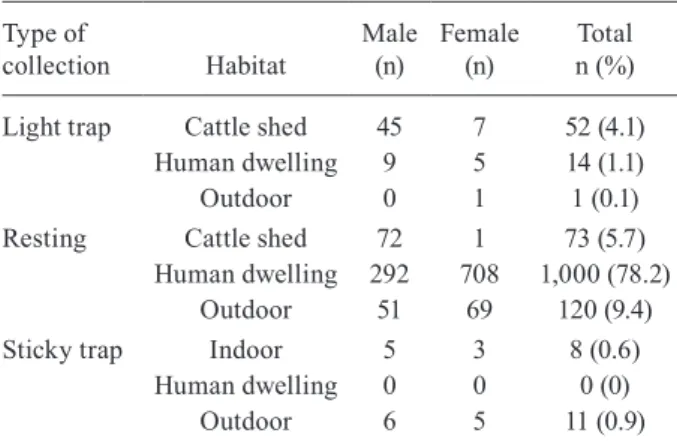
A total of 1,279 sandflies was obtained from all the 28 settlements. Among the three collection methods, hand-held aspirator collection yielded significantly (p < 0.05) more number of sandfly specimens (93.3%) followed by light trap (5.3%) and sticky trap catches (1.4%) (Table II). Seventeen species of sandflies (n = 1,279) were recorded: Phlebotomus (Euphlebotomus) argentipes (25.7%), Phle-botomus (AnaphlePhle-botomus) colabaensis (2.9%), Phlebo- tomus (Anaphlebotomus) stantoni (1.6%), Sergentomyia (Parrotomyia) baghdadis (50.7%), Sergentomyia (Par-rotomyia) babu (5.6%), Sergentomyia (Neophlebotomus) zeylanica (4.9%), Sergentomyia (Neophlebotomus) ar-boris (1.7%), Sergentomyia (Parrotomyia) kauli (1.6%), Sergentomyia (Neophlebotomus) monticola (1.2%), Ser-gentomyia (Parrotomyia) barraudi (0.9%), Sergento-myia (ParrotoSergento-myia) jerighatiansis (0.9%) Sergentomyia (Neophlebotomus) malabarica (0.6%), Sergentomyia (Parrotomyia) rectangulata (0.5%), Sergentomyia (nic nic gr.) bailyi (0.5%), Sergentomyia (Parrotomyia) short-tii (0.3%), Sergentomyia (Neophlebotomus) dhandai (0.2%) and Sergentomyia (Sintonius) hospitii (0.2%). P. (Eup.) argentipes, the proven vector of visceral leishma-niasis (kala-azar) in India, was found prevalent in 21 out of 28 settlements. All the 17 species were recorded in-doors, among them, only 11 from outdoors.
There were variations in the number of settlements at each altitudinal range. The number of settlements found
TABLE II
Total number of sandflies obtained from different
types of collections made in the Kani tribe settlements located at different altitudes
Type of
collection Habitat
Male (n)
Female (n)
Total n (%)
Light trap Cattle shed 45 7 52 (4.1) Human dwelling 9 5 14 (1.1)
Outdoor 0 1 1 (0.1)
Resting Cattle shed 72 1 73 (5.7)
Human dwelling 292 708 1,000 (78.2)
Outdoor 51 69 120 (9.4)
Sticky trap Indoor 5 3 8 (0.6)
Human dwelling 0 0 0 (0)
Outdoor 6 5 11 (0.9)
at altitudinal ranges between 0-300 m, 301-600 m and 601-800 m, were 19, eight and one in number, respective-ly. At altitudinal ranges between 801-1,000 m and > 1,000 m, no settlement was found. A highest frequency of sand-flies (n = 998) was captured in the settlements located at altitude ranging between 0-300 m, representing thrice the total captured specimens compared to those obtained in settlements located at altitudinal ranges between 301-600 m (n = 275), 601-800 m (n = 10) and 801-1,000 m (n = 5) (Fig. 1). No sandfly was obtained at > 1,000 m elevation. Of the 17 species recorded, 14 species were found up to an altitudinal range of 800 m, while S. (Par.) baghdadis and S.(Par.) babu were found up to 1,000 m altitude.
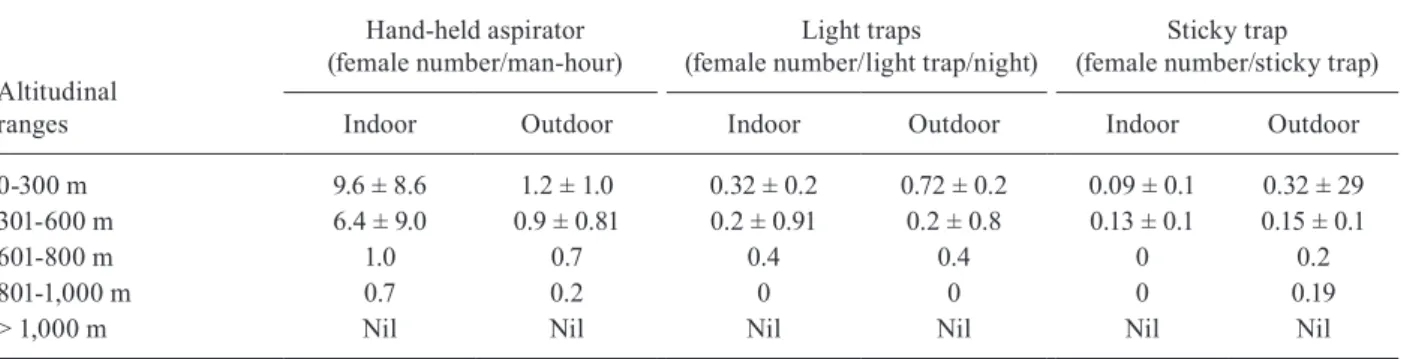
Density of sandflies obtained indoor and outdoor us-ing handheld mechanical aspirator, light trap and sticky traps in settlements located at all altitudinal ranges were given in Table III. Although the number of sandflies collected was divided by the total MHR spent, mean density of sandflies obtained from settlements located at altitudinal ranges between 0-300 m was the highest. The increase in altitudinal ranges showed a decrease in sandfly density. Handheld aspirator collection yielded significantly high (p < 0.05) sandfly density than that of the light trap and sticky trap collections.
The sandfly species diversity as indicated by the val-ue of H, J and S among the settlements located at various altitudinal gradients (Figs 2-4) showed significant differ-ences (r = -0.97, p = 0.003). In settlements located at the altitudinal range between 0-300 m, both species diversity and J were relatively low and S was high. On the other hand, species diversity and J were high and S was low at altitudinal range 301-600 m. With further increase in alti-tude (> 601 m) species diversity, J and S were very low.
Although the relative abundance of sandflies showed a negative correlation (r = -0.97, p = 0.003) with increase in altitudinal ranges, altitudinal variations alone could not be attributed to determine sandfly diversity in the study, since the numbers of sandfly sampling units were not uni-form at all the altitudinal gradients. The number of tribal settlements and number of human dwellings decreased with increase in altitude (r = -0.82, p = 0.001) due to lack of transport and communication, as the mountain region was difficult-to-reach. Human dwellings were found scattered in 19 settlements at the lower altitudinal gradient (0-300 m). S was high in the settlements located at lower altitu-dinal range. The reduction in H and J was due to irregular distribution of sandflies in the altitudinal range between 0-300 m (Fig. 5) where a particular sandfly species, i.e., Se. (Par.)bagdhadis dominated the sandfly community. TABLE III
Density (mean ± standard deviation) of female sandflies obtained from different types of collections in Kani tribe settlements located at different altitudinal ranges
Altitudinal ranges
Hand-held aspirator (female number/man-hour)
Light traps
(female number/light trap/night)
Sticky trap (female number/sticky trap)
Indoor Outdoor Indoor Outdoor Indoor Outdoor
0-300 m 9.6 ± 8.6 1.2 ± 1.0 0.32 ± 0.2 0.72 ± 0.2 0.09 ± 0.1 0.32 ± 29
301-600 m 6.4 ± 9.0 0.9 ± 0.81 0.2 ± 0.91 0.2 ± 0.8 0.13 ± 0.1 0.15 ± 0.1
601-800 m 1.0 0.7 0.4 0.4 0 0.2
801-1,000 m 0.7 0.2 0 0 0 0.19
> 1,000 m Nil Nil Nil Nil Nil Nil
Fig. 2: sandfly species Shannon-Weiner index (H) in relation to in-crease in altitude in southernmost part of the Western Ghats.
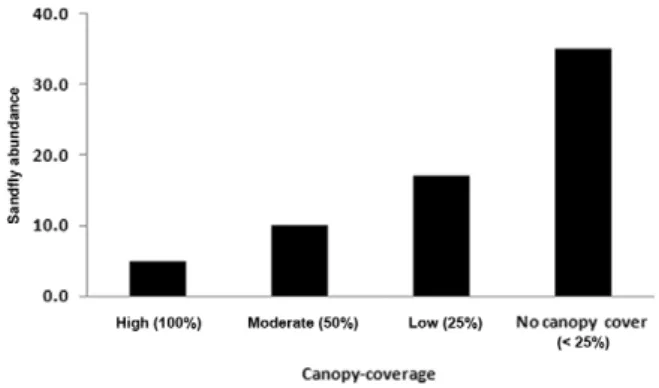
When the influence of soil type was analysed, sandflies were found to be abundant in settlements having humifer-ous soil [geometric mean (GM) = 35.0] followed by sandy soil (GM = 16) and red soil (GM = 5). Sandfly abundance showed a negative association with increase in mountain slope (Y = -9.6651x - 7.8912; R2 = 0.9712). Forest canopy-Fig. 6: sandfly abundance in relation to canopy-coverage in southern-most part of the Western Ghats.
Fig. 4: sandfly species richness index (S) in relation to increase in altitude in southernmost part of the Western Ghats.
Fig. 5: relationship between Shannon-Weiner index (H) and species richness index (S) in ecosystem disturbed by human activity is shown in logarithmic regression equation.
coverage also influenced sandfly abundance to a greater extent (Fig. 6). Increase in canopy-coverage decreased sandfly abundance (Y = 9.7074x - 7.5174; R2 = 0.9096) in the tribal settlements. Sandflies were found to be sig-nificantly abundant (χ² = 9891.5; p = 0.0001) (n = 998) in settlements located at altitude, ranging between 0-300 m, where the number of tribal settlements was also high (n = 19) compared to those located at higher altitudinal ranges (301-1,000 m). Therefore, the increase in the number of tribal settlements has influenced of environment due to human activities resulting in sandfly abundance.
DISCUSSION
The Western Ghats is one of the biodiversity hot spots in the world. This mountain range mediates with the rainfall pattern in India by intercepting the south-western monsoon winds and experiences heavy an-nual rainfall during the southwest monsoon from June-September and northeast monsoon from Octo-ber-December. The wide variation in rainfall patterns coupled with the complex geography, particularly the altitude, produces a great variety of vegetation types (Parthasarathy 1999). Although forest vegetations, hu-miferous soil with leaf litter, ambient temperature, RH and heavy rain fall create ecological richness and pro-vides conditions conducive for sandfly propagation and survival in this region, the number of sandflies caught in domestic and peridomestic habitats decreased with increase in altitudinal ranges. The capture of sandflies within the disturbed forest area located at 0-300 m altitu-dinal range was higher than the captures made at the ar-eas located at 301-600 m and > 600 m altitudinal range.
and ecological richness of the region provides numerous adult resting and larval sites for sandflies. It seems the altitude is one of several important factors that is neces-sary to predict the sandfly fauna in a region, but it is not a sufficient factor (Mohammad et al. 2013). Bhunia et al. (2010) reported that the number of kala-azar cases in endemic areas of Bihar decreased with increase in altitu-dinal range (50-300 m), which was indirectly evident that sandfly abundance diminished with increase in altitude. Further, they also correlated sandfly and sandfly-borne disease distribution with vegetation and found that low density vegetation or nonvegetative areas were found to be a favourable factor for sandfly abundance. Similarly, in the Kani tribe settlements sandfly abundance was high in no canopy-coverage areas.
Expansion of existing tribal settlements has resulted in the conversion of primary forest into secondary forest. Subsequently, Kani tribes altered the environment suit-able for cultivation. This was possible, as the settlements receive rainfall throughout the year. Water clog made the soil and organic materials to retain moisture. Thus, a change in the terrain due to human activity changed ecological niches and conditions, favourable for sandfly proliferation. The agricultural activity due to scattering of food grains attracts rodents, which form ideal blood meal source for sandflies. Hence, sandfly abundance was found to be associated with human activities, as highest prevalence of sandflies was obtained in settle-ments located at the altitudinal ranges between 0-300 m. Cross et al. (1996) and Ghosh et al. (1999) had also observed abundant in areas which were in proximity to vertebrate host and cultivable areas. Further, Azevedo et al. (1996) and Sherlock (1996) had suggested that inva-sion of human into the forest enhances the risk of spread of sandfly-borne diseases, as zoophagic sandflies get adapted to anthropophagic feeding behaviour.
In the present investigation in tribal settlements locat-ed at lower altitudinal range, sandfly S was high and spe-cies diversity and J were low. Perhaps even distribution of ecological niche due to environmental change suiting to cultivation favoured a particular species to be more abundant, influencing species diversity. Hence, sandfly fauna was rich in this altitudinal range (0-300 m). Inva-sion of human in this part of the reserve forest region for domestication and cultivation supported sandfly-genic conditions, favouring sandfly abundance. In view of oc-currence of cutaneous leishmaniasis cases among the Kani tribes (VCRC 2012), prevalence of sandflies with multiple hosts feeding pattern, including human (Sathish 2013), there is a risk of transmission of the cutaneous disease among the Kani tribes in the settlements. At this juncture, the investigation on sandfly diversity carried out in the Western Ghats region gains significance.
ACKNOWLEDGEMENTS
To Dr P Jambulingam, Vector Control Research Centre of Pondicherry, for support to carry out the study in the inac-cessible tribal belt, to Directorate of Health Services, Gov-ernment of Kerala, Directorate of Scheduled Tribe Develop-ment DepartDevelop-ment, GovernDevelop-ment of Kerala, and Principal Chief Conservator of Forests (Wildlife) and Chief Wildlife Warden,
Kerala, for the facilities provided to carry out the study in the reserve forest region of Western Ghats, and to B Edwin, S Chandrasekaran and N Ramesh, Vector Control Research Centre of Pondicherry, for technical assistance in collecting sandflies in the reserve forest region and in the laboratory.
REFERENCES
Artemiev MM 1978. Sandflies (Diptera: Psychodidae: Phlebotomi-nae) of Afghanistan, Marzinovoskyi Institute of Medical Parasi-tology and Tropical Medicine, Moscow, 83 pp.
Azevedo ACR, Vilela ML, Souza NA, Andrade-Coelho CA, Barbosa AF, Firmo ALS, Rangel EF 1996. The sand fly fauna (Diptera: Psy-The sand fly fauna (Diptera: Psy-chodidae: Phlebotominae) of a focus of cutaneous leishmaniasis in Ilhéus, state of Bahia, Brazil. Mem Inst Oswaldo Cruz 91: 75-79.
Belen A, Alten B 2006. Variation in life table characteristics among populations of Phlebotomus(Phlebotomus)papatasi at different altitude. J Vector Ecol 31: 35-44.
Belen A, Alten B 2011. Seasonal dynamics and altitudinal distri-butions of sand fly (Diptera: Psychodidae) populations in a cu-taneous leishmaniasis endemic area of the Cukurova region of Turkey. J Vector Ecol 36 (Suppl. 1): S87-S94.
Bhunia GS, Kesari S, Jeyaram A, Kumar V, Das P 2010. Influence of topography on the endemicity of kala-azar: a study based on remote sensing and geographical information system. Geospatial Health 4: 155-165.
Cross ER, Newcomb WW, Tucker CJ 1996. Use of weather and re-mote sensing to predict the geographic and seasonal distribution of Phlebotomus papatasi in Southwest Asia. Am J Trop Med Hyg 54: 530-536.
Dhanda V, Shetty PS, Dhiman RE 1983. Studies on phlebotomine sandflies as vectors of kala-azar in Bihar. Proceedings of Indo-UK Workshop on Leishmaniasis, ICMR, New Delhi, 128-137.
Gadgil M 2012. Report of the Western Ghats Ecology Expert Panel. Part I. Available from: from moef.nic.in/downloads/public-infor-mation/wg-23052012.pdf.
Ghosh KN, Mukhopadhyy JM, Guzman H, Tesh RB, Munsternmann LE 1999. Interspecific hybridization of genetic variability of Phlebotomus sandflies. Med Vet Entomol 13: 78-88.
Hammer O, Harper DAT, Ryan PD 2001. PAST: Palaeontological sta-tistics software package for education and data analysis. Palae-ontol Electron 4: 9 pp.
Jacobson RL, Eisenberger CL, Svobodova M, Baneth G, Sztern J, Carvalho A, Nasereddin M, El Fari M, Shalom U, Volf P, Vo-typka J, Dedet JP, Pratlong F, Schonian G, Schnur LF, Jaffe CL, Warburg A 2003. Outbreak of cutaneous leishmaniasis in north-ern Israel. J Infect Dis 188: 1065-1073.
Kalra NL, Bang YH 1988. Manual on entomology in visceral leish-maniasis, World Health Organization, New Delhi, 88 pp.
Killick-Kendrick R 1983. Investigation of phlebotomine sandflies-vector of leishmaniasis.In Proceedings of Indo-UK Workshop on Leishmaniasis, ICMR, New Delhi, p. 72-83.
Killick-Kendrick R 1990. Phlebotomine vectors of leishmaniasis: a review. Med Vet Entomol 4: 1-24.
Kumar V, Kishore K, Palit A, Saran R 1992. A study of species composi-tion, seasonal distribution and habitat of sandflies in the endemic but sprayed area of Patna district, Bihar. Indian J Parasitol16: 159-160.
Lewis DJ 1978. The phlebotomine sandflies of the Oriental region. Bull Br Mus Nat Hist (Ent) 37: 217-343.
Lewis DJ 1987. The phlebotomine sandflies (Diptera: Psychodidae) from the Oriental Region. Syst Entomol 12: 163-180.
Mohammad A, Mirzaei A, Baghaei A, Alten B, Depaquit J 2013. Sandfly (Diptera: Psychodidae) distribution in the endemic and non-endemic foci of visceral leishmaniasis in north western Iran. J Vector Ecol 38: 97-104.
Parthasarathy N 1999. Tree diversity and distribution in undisturbed and human-impacted sites of tropical wet evergreen forest in southern Western Ghats, India. Biodivers Conserv 8: 1365-1381.
Pascal JP, Ramesh BR, de Franceschi D 2004. Wet evergreen forest types of the southern Western Ghats, India. Trop Ecol 45: 281-292.
Ranjan A, Sur D, Singh VP, Siddique NA, Manna B, Lal CS, Sinha PK, Kishore K, Bhattacharya SK 2005. Risk factors for Indian kala-azar. Am J Trop Med Hyg73: 74-78.
Sabu TK, Vineesh PJ, Vinod KV 2008. Diversity of forest litter-in-habiting ants along elevations in the Wayanad region of the West-ern Ghats. J Insect Sci 8: 1-14.
Sathish S 2013. Studies on the natural hosts of sandflies in tribal set-tlements of the Western Ghats, Thiruvananthapuram, Kerala, a
new focus of cutaneous leishmaniasis, MSc Thesis, Pondicherry University, Pondicherry, 68 pp.
Sherlock IA 1996. Ecological interactions of visceral leishmaniasis in the state of Bahia, Brazil. Mem Inst Oswaldo Cruz 91: 671-683.
Simi SM, Anish TS, Jyothi R, Vijayakumar K, Philip RR, Paul N 2010. Searching for cutaneous leishmaniasis in tribals from Ker-ala, India. J Glob Infect Dis 2: 95-100.
Simsek FM, Alten B, Caglar SS, Ozbel Y, Aytekin AM, Kaynas S, Belen A, Kasap OE, Yaman M, Rastgeldi S 2007. Distribution and altitudinal structuring of phlebotomine sand f lies (Dip-tera: Psychodidae) in southern Anatolia, Turkey: their relation to human cutaneous leishmaniasis. J Vector Ecol 32: 269-279.
Srinivasan R, Jambulingam P, Kumar NP 2014. Report of Sergento-myia(Neophlebotomus)monticola, a new sandfly species (Dip-tera: Psychodidae) from Western Ghats, Thiruvananthapuram district, Kerala, India. Acta Trop 137: 74-79.
Srinivasan R, Jambulingam P, Vanamail P 2013. Sandfly (Diptera: Psy-Sandfly (Diptera: Psy-chodidae) abundance in relation to environmental factors in parts of coastal plains of southern India. J Med Entomol 50: 758-763.