Analysis of the
CCR5
gene coding region diversity in five South American
populations reveals two new non-synonymous alleles in Amerindians and
high
CCR5*D32
frequency in Euro-Brazilians
Angelica B.W. Boldt
1,3, Lodércio Culpi
2, Luiza T. Tsuneto
1,4, Ilíada R. Souza
1,5, Jürgen F.J. Kun
3and Maria Luiza Petzl-Erler
11
Laboratório de Genética Molecular Humana, Departamento de Genética, Universidade Federal do Paraná,
Curitiba, PR, Brazil.
2
Laboratório de Polimorfismos e Ligação, Departamento de Genética, Universidade Federal do Paraná,
Curitiba, PR, Brazil.
3Department of Human Parasitology, Institute of Tropical Medicine, University of Tübingen, Tübingen,
Germany.
4
Universidade Estadual de Maringá, Maringá, PR, Brazil.
5
Universidade Federal de Santa Catarina, Florianópolis, SC, Brazil.
Abstract
The CC chemokine receptor 5 (CCR5) molecule is an important co-receptor for HIV. The effect of theCCR5*D32
al-lele in susceptibility to HIV infection and AIDS disease is well known. Other alal-leles thanCCR5*D32 have not been
analysed before, neither in Amerindians nor in the majority of the populations all over the world. We investigated the
distribution of theCCR5 coding region alleles in South Brazil and noticed a high CCR5*D32 frequency in the
Euro-Brazilian population of the Paraná State (9.3%), which is the highest thus far reported for Latin America. The D32 frequency is even higher among the Euro-Brazilian Mennonites (14.2%). This allele is uncommon in Afro-Brazilians (2.0%), rare in the Guarani Amerindians (0.4%) and absent in the Kaingang Amerindians and the
Orien-tal-Brazilians.R223Q is common in the Oriental-Brazilians (7.7%) and R60S in the Afro-Brazilians (5.0%). A29S and
L55Q present an impaired response tob-chemokines and occurred in Afro- and Euro-Brazilians with cumulative
fre-quencies of 4.4% and 2.7%, respectively. Two new non-synonymous alleles were found in Amerindians:C323F
(g.3729G > T) in Guarani (1.4%) and Y68C (g.2964A > G) in Kaingang (10.3%). The functional characteristics of these alleles should be defined and considered in epidemiological investigations about HIV-1 infection and AIDS in-cidence in Amerindian populations.
Key words: CCR5, Brazilian, Amerindian, HIV, polymorphism. Received: May 20, 2008; Accepted: July 21, 2008.
Introduction
The human immunodeficiency virus type 1 (HIV-1) epidemic shows great variation among the different Brazil-ian regions. A progressive reduction in the number of deaths from acquired immunodeficiency syndrome (AIDS) was observed after the introduction of potent antiretroviral therapy in 1996, but the deceleration of the AIDS epidemic was not homogenous throughout all the Brazilian regions (Britoet al., 2005). The Southeast region has experienced
the lowest increase in the AIDS epidemic from 1990 to 1996, contrasting with a steep rise in the North and South
regions (Szwarcwald et al., 2000). Since 1996, the inci-dence rates of AIDS in Brazil as a whole and in the State of São Paulo in particular show a trend towards stability, whereas in the Brazilian Northeast the incidence rates of the disease continue to grow (Britoet al., 2005). The differ-ent spreading of the disease is due to multiple variables, including biological, behavioural, demographic and eco-nomic/political factors that influence the rate of contact be-tween infected and susceptible individuals, as well as the individual’s infectiousness and susceptibility. Among these factors are genetic variants of host genes that facili-tate or hamper viral entry into the cells and modulate im-mune responses against the infection.
The chemokine (C-C motif) receptor 5 gene (CCR5) comprises three exons. The polypeptide of 352 amino acid
www.sbg.org.br
Send correspondence to Angelica B.W. Boldt. Setor de Ciências da Saúde, Hospital das Clínicas, Universidade Federal do Paraná, Rua General Carneiro 181, 80060-900 Curitiba, PR, Brazil. E-mail: [email protected].
residues is encoded by exon 3 (formerly named exon 4) (Mummidiet al., 1997). CCR5 transduces the signals of
several different chemokines in phagocytes and T lympho-cytes and serves as an essential co-receptor for the entry of R5-tropic HIV-1 into those cells (Blanpainet al., 2001).
This is the viral form that most frequently infects people in Brazil (Ferraroet al., 2001). Therefore,CCR5alleles that
code for proteins poorly or not expressed at the cell surface are strong candidates for protection against the infection and for the delay of AIDS onset. This is the case of the trun-catedCCR5*D32allele, and probably also of theFs299and R60Salleles (Deanet al., 1996; Shiodaet al., 2001;
Tama-sauskaset al., 2001).CCR5*D32was also favourably
asso-ciated with autoimmune diseases such as multiple sclerosis, rheumatoid arthritis and type 1 diabetes mellitus, but in-creases the risk for abdominal aortic aneurysm and sar-coidosis (for a review, see Navratilova, 2006).
The interaction between the CCR5 receptor and its ligands can block HIV-1 entry and thus retard disease pro-gression. TheA29SandL55Qalleles encode products with a reduced affinity for (C-C motif) chemokines and might be associated with a shorter time interval from HIV infection to AIDS onset (Howardet al., 1999).
During AIDS, the acquisition of mutations in the HIV-1 gp120 envelope glycoprotein gene leads to the switch from primary R5 (CCR5-using) to highly cytopathic X4 (CXCR4-using) HIV-1 variants. According to the so-matic hypermutation hypothesis, this switch takes place in the germinal center B cells, due to aberrant somatic hyper-mutation of the gp-120-coding region of the HIV-1 env gene (Suslov, 2004). This process seems to be more effec-tive inCCR5*D32heterozygotes, which were found at a 2.5 times higher risk of harbouring X4 HIV-1 variants be-fore the onset of highly active antiretroviral therapy. The presence of X4 variants in the patients seems not to com-promise the therapy outcome (Brumme et al., 2005), whereas the presence of aCCR5*D32allele was found as-sociated with a better response (Accetturi et al., 2000; Guerinet al., 2000).
In order to better understand the diversity of the
CCR5 gene and to supply data for studies on the functional effect and epidemiological consequences of theCCR5 vari-ants, we investigated the distribution of CCR5*D32 and other known exon 3 coding region CCR5alleles in five populations of South Brazil. These alleles and their known functional characteristics are listed in Table 1. We also se-quenced part of the coding region of the gene, in order to search for new variants.
Materials and Methods
Samples
One hundred and seventy two Afro-Brazilians, 172 Euro-Brazilians, 18 Oriental-Brazilians, 115 Guarani (89 of which belong to the M’byá sub-group) and 160 Table
Kaingang were investigated. All individuals were ran-domly selected and live in the State of Paraná, in South Brazil, with the exception of 26 Guarani belonging to the Kaiowá and Ñandeva subgroups which live in the State of Mato Grosso do Sul in Central-Western Brazil. For some
CCR5 alleles, the number of individuals analysed was lower. The classification of individuals as Euro-Brazilians and Afro-Brazilians was based on morphological features. The Euro-Brazilians included 53 unrelated German-speaking individuals whose ancestors came from or joined Mennonite settlements in South Brazil. No HLA genotyp-ing data was available for this subsample. Based on HLA allelic frequencies previously determined for all other pop-ulation samples, an average European component of 34% and an average Amerindian component of 6% were esti-mated for the Afro-Brazilians. For the non-Mennonite Euro-Brazilians, the African and Amerindian components are approximately 9% and 5%, respectively (Braun-Prado
et al., 2000; Probst CM, MSc Dissertation, Universidade Federal do Paraná, Curitiba, 2000; Probstet al., 2000). The average admixture values of the Guarani and Kaingang with the immigrants from Europe and Africa were esti-mated to be 4% and 7%, respectively (Petzl-Erleret al., 1993; Probst CM, MSc Dissertation, Universidade Federal do Paraná, Curitiba, 2000; Tsunetoet al., 2003). The gene flow between these two Amerindian groups is also low, be-ing approximately 1.4% in Guarani and 0.5% in Kabe-ingang (Petzl-Erleret al., 1993).
Typing method
DNA was extracted from peripheral blood cells using the standard phenol/chloroform/isoamyl alcohol or salt-ing-out techniques. The coding region of exon 3 of the
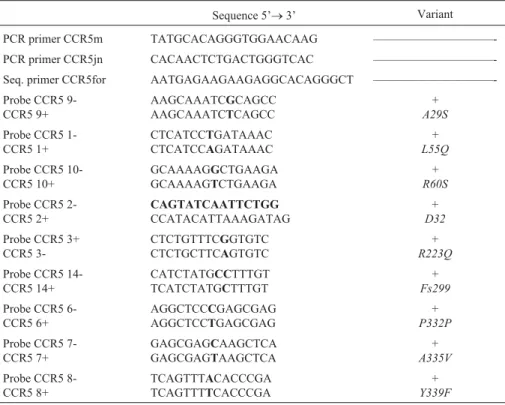
CCR5gene was amplified by PCR as described previously (Boldt and Petzl-Erler, 2002). The product was applied on nylon membranes in the form of dot-blots and allowed to hybridize with sequence-specific oligonucleotide probes (SSOP, Table 2), according to the protocol of the XII Inter-national Histocompatibility Workshop (Fernandez-Viña and Bignon, 1997). Part of the coding region of exon 3 was additionally sequenced using the CCR5rev internal primer in 13 Guarani and 29 Kaingang, one Euro-Brazilian and five Oriental-Brazilian samples. These samples and 59 ad-ditional Guarani and 55 adad-ditional Kaingang samples were also sequenced using the CCR5for internal primer. One Guarani M’bya individual was genotyped only by sequenc-ing. Sequencing reactions were performed with BigDye Terminator version 1.1 chemistry (Applied Biosystems, Foster City, CA). The sequences of the primers and probes are listed in Table 2.
Statistical analysis
Genotype and allele frequencies were obtained by di-rect counting with the aid of the Convert program version 1.1 (Program distributed by the author, CM Probst). The Hardy-Weinberg equilibrium and population homogeneity
Table 2-CCR5PCR primers and sequence-specific probes.
Sequence 5’®3’ Variant
PCR primer CCR5m TATGCACAGGGTGGAACAAG ——————————-PCR primer CCR5jn CACAACTCTGACTGGGTCAC ——————————-Seq. primer CCR5for AATGAGAAGAAGAGGCACAGGGCT ——————————-Probe CCR5
9-CCR5 9+
AAGCAAATCGCAGCC
AAGCAAATCTCAGCC
+ A29S
Probe CCR5 1-CCR5 1+
CTCATCCTGATAAAC
CTCATCCAGATAAAC
+ L55Q
Probe CCR5 10-CCR5 10+
GCAAAAGGCTGAAGA
GCAAAAGTCTGAAGA
+ R60S
Probe CCR5 2-CCR5 2+
CAGTATCAATTCTGG
CCATACATTAAAGATAG
+
D32
Probe CCR5 3+ CCR5
3-CTCTGTTTCGGTGTC
CTCTGCTTCAGTGTC
+
R223Q
Probe CCR5 14-CCR5 14+
CATCTATGCCTTTGT
TCATCTATGCTTTGT
+
Fs299
Probe CCR5 6-CCR5 6+
AGGCTCCCGAGCGAG
AGGCTCCTGAGCGAG
+
P332P
Probe CCR5 7-CCR5 7+
GAGCGAGCAAGCTCA
GAGCGAGTAAGCTCA
+
A335V
Probe CCR5 8-CCR5 8+
TCAGTTTACACCCGA
TCAGTTTTCACCCGA
+
Y339F
PCR: polymerase chain reaction
hypotheses were tested using the approach of Guo and Thompson and the Raymond and Rousset test, respec-tively, in the ARLEQUIN software package version 3.1 (http://cmpg.unibe.ch/software/arlequin3) (Excoffieret al.,
2005). p = 0.05 was adopted as the significance limit.
Results
The CCR5 genotype distributions met the Hardy-Weinberg equilibrium expectations in all populations. The frequency of the most commonCCR5allele varied from 88% to 100% (Table 3). AllelesFs299andP332Pwere not observed in the population samples studied. The other al-leles were seen in at least one population, at frequencies varying from about 0.5% to 5% for most of them, except
D32andR223Q.
Three D32 homozygotes were found among the Euro-Brazilians. The D32heterozygote frequencies were 4.1% (7/172) in Afro-, 15.1% (26/172) in Euro-Brazilians, and 0.9% (1/115) in the Guarani Amerindians. We did not find theCCR5*D32allele in Oriental-Brazilians nor in the Kaingang Amerindians. This allele was more frequent in the Euro-Brazilian sample (9.3%) than in any other sample previously investigated in Latin America (Table 4). The frequency of theD32allele rose to 14.2% in a subsample of 53 German-speaking Euro-Brazilians, whose ancestors came from or joined Mennonite settlements in the past. Two of the three homozygotes and 15 of the 26 heterozy-gotes seen in the Euro-Brazilian sample belonged to this group. Nevertheless, there was no statistically significant difference between the frequency distribution of theCCR5
genotypes of the Mennonite and the non-Mennonite Euro-Brazilians investigated (p = 0.08, exact test of population differentiation).
Allele R223Q was observed in Oriental-Brazilians but not in the other population samples (Table 3). It oc-curred in the heterozygotic state in two of 13 Oriental-Brazilians (heterozygote frequency of 15.4%).
Sequencing analysis of the coding region of exon 3 revealed a new allele in the Guarani (g.3729G>T), causing the substitution of cysteine by phenylalanine at amino acid residue 323 (p.Cys323Phe) in the C-terminal intracellular segment of the protein. Thep.Cys323Pheallele occurred in two heterozygotes out of the 72 Guarani individuals whose DNA was sequenced, which allowed estimating an allelic frequency of 1.4% in the Guarani population. The DNA carrying this variant was reamplified and resequenced to confirm the presence of this new allele. In the Kaingang, se-quencing revealed another new allele (g.2964A>G) caus-ing the substitution of tyrosine by cysteine at the conserved residue 68 (p.Tyr68Cys) in the second transmembrane part of the protein. This allele occurred in five heterozygotes out of 29 sequenced individuals, which allowed estimating a frequency of 10.3% in the Kaingang population. We also confirmed the presence of theR223Qallele in one
zygote out of the 5 Oriental-Brazilians whose exon 3 was sequenced.
Discussion
This is the first study investigating theA29SandR60S
alleles in European-derived populations. Also, alleles other thanD32have not been analysed before in Amerindians.
Based on the CCR5 allelic frequencies in the Chinese, North- and South-American populations (Table 3), it is possible to infer thatA29S, R60S, A335VandY339Fmost likely originated in Africa; L55Q and D32 in Europe;
R223QandFs299in Asia. TheP332Pallele, found only once in one heterozygote Afro-American (Ansari-Lari et al., 1997), was not found in our population samples nor in Table 4-D32allelic frequencies and standard deviations in Latin American populations.
Population n D32freq. Region Reference
Admixed Mexican 212 0.014±0.006 ————, MX (Zunigaet al., 2003)
Amerindian Mayo 70 0
Amerindian Teenek 61 0
Amerindian Mazatecan 61 0.016±0.011
Afro-Jamaican 242 0.01±0.005 ————, JM (Hisadaet al., 2002) Colombian 150 0.027±0.009 Medellin, CO (Diazet al., 2000) Amerindian 172 0.009±0.005 Arequipa, PE (Calzadaet al., 2001) Amerindian Tikuna 191 0 Northwest Amazonas, BR (Lebouteet al., 1999)
Amerindian Baniwa 46 0
Amerindian Kashinawa 29 0 Southwest Amazonas, BR (Lebouteet al., 1999)
Amerindian Kanamari 34 0
Amerindian Tiriyó 180 0 North Amazonas, BR (Grimaldiet al., 2002)
Amerindian Waiampi 221 0
Six Amerindian groups 89 0 North Pará, BR (De Pinho Lott Carvalhaeset al., 2004)
Brazilian 394 0.03±0.006
Afro-Brazilian 67 0.008±0.008
Oriental-Brazilian 111 0
Brazilian 104 0.02±0.01 Recife, Pernambuco, BR (de Souzaet al., 2006) Admixed Brazilian 549 0.026±0.005 Northeast Bahia, BR (Grimaldiet al., 2002) Afro-Brazilian 54 0.019±0.013 Rio de Janeiro, BR (Chies and Hutz, 2003) Brazilian 115 0.056±0.015 São Paulo, BR (Muneratoet al., 2003) Brazilian 100 0.035±0.013 Ribeirão Preto, São Paulo, BR (Passos Jr and Picanço, 1998) Euro-Brazilian 102 0.044±0.014 Paraná, Santa Catarina and Rio
Grande do Sul, BR
(Chies and Hutz, 2003)
Brazilian 127 0.055±0.014 (Kaimen-Macielet al., 2007) Eight Amerindian groups 241 0.013±0.005 (Hunemeieret al., 2005) Afro-Brazilian 172 0.02±0.008 Paraná, BR
Euro-Brazilian 172 0.093±0.016
Oriental-Brazilian 16 0 This work.
Guarani 114 0.004±0.004
Kaingang 160 0
Brazilian 100 0.05±0.015 Londrina, Paraná, BR (Brajão de Oliveiraet al., 2007) Euro-Brazilian 99 0.066±0.018 Santa Catarina, BR (Grimaldiet al., 2002) Euro-Brazilian 59 0.068±0.023 Alegrete, Rio Grande do Sul, BR (Vargaset al., 2006) Afro-Brazilian 13 0.038±0.038
Admixed Brazilian 31 0.064±0.032
Afro-Brazilians 58 0.009±0.009 Rio Grande do Sul, BR (Chies and Hutz, 2003) Amerindian Chiriguano 42 0.012±0.012 Northwest Argentina, AR (Manganoet al., 2001) Argentinean 751 0.03±0.004 ————, AR (Gonzalezet al., 2001) Chilean 62 0.024±0.014 ————, CL (Desgrangeset al., 2001)
screenings of about 700 Afro-Americans, 700 Euro-Ame-ricans and 785 Chinese (Ansari-Lariet al., 1997;
Carring-tonet al., 1997; Zhaoet al., 2005). The presence of theD32
allele in the Guarani seems to be the result of gene flow from Neo-Brazilians, as suggested for Mura and Kaingang in another study (Hunemeieret al., 2005).
The highD32frequency in Euro-Brazilians is similar
to the frequencies found in Central Europe (Stephenset al.,
1998). It is compatible with the greater European compo-nent in the Euro-Brazilian population of the Paraná State, in comparison to other, previously analysed Brazilian popula-tions of predominantly European ancestry (Probst et al.,
2000). TheD32frequency in the Mennonite subsample is
two times higher than in the non-Mennonite Euro-Brazilian subsample and equals the highD32frequencies in North
Europe (Stephenset al., 1998; Yudinet al., 1998). The
fre-quency ofL55Q, another allele with likely European origin,
is three times higher in Mennonite compared to non-Mennonite Euro-Brazilians. The non-Mennonites have Friesian origin (North of Germany and the Netherlands) and exist as a religious Anabaptist group since the second half of the XVI century. The majority of individuals in this subsample are direct descendants from 200 Mennonite families that left their villages in the Ukraine and in Siberia and arrived in South Brazil in 1930 (Pauls Jr., 1976). Thus, a founder or bottleneck effect associated to random genetic drift most probably caused the rise in theD32andL55Qallelic
fre-quencies in this population.
TheR223Qallele is the most frequent variant in the Chinese population. It is equally distributed in HIV-1 in-fected and non-inin-fected Chinese groups and has similar HIV-1 co-receptor activity as the majorCCR5allele (Zhao
et al., 2005). Other populations have thus far not been in-vestigated. We also found this allele among the Orien-tal-Brazilians.
The cysteine residue we found mutated to phenyl-alanine at codon 323 (p.Cys323Phe) in two heterozygote Guarani individuals is not conserved in CCR2, the homolo-gous C-C chemokine-receptor protein with the highest se-quence similarity to CCR5 (75%). The substitution of the same residue by alanine was found to decrease the expres-sion of the CCR5 protein on the cellular membrane by pre-venting receptor palmitoylation (Blanpainet al., 2001). A change in the secondary structure and function may also be expected from the replacement of this residue by phenyl-alanine. In the Kaingang, sequencing revealed another new allele (g.2964A>G) causing the substitution of tyrosine by cysteine at the otherwise conserved residue 68 (p.Tyr68Cys) in the second transmembrane part of the pro-tein. This allele seems to be very common in the Kaingang population and restricted to it. Possible protective effects of both alleles regarding HIV-1 infection and progression to AIDS have to be established in appropriate cohorts attend-ing Amerindian(-derived) populations.
In summary, we studied the distribution of the CCR5 coding region alleles in various Brazilian populations and noticed a highD32frequency in the Euro-Brazilian
popula-tion of the Paraná State in South Brazil. TheD32frequency
is even higher among the Mennonites and is the highest thus far reported for Latin America. We also identified two new codingCCR5 mutations in the Amerindian
popula-tions, whose functional characteristics should be defined and considered in epidemiological investigations about HIV-1 infection and AIDS incidence in Amerindian popu-lations.
Acknowledgments
The subjects of this investigation were informed about the aims of the study and their consent to participate is gratefully acknowledged. This investigation was ap-proved by the Brazilian National Commission for Ethics in Research (CONEP no. 2046). We thank L.A. de Oliveira, A. Weierich and S. Grummes for excellent technical assis-tance. Financial support was provided by the Brazilian Na-tional Counsel of Technological and Scientific Development (Conselho Nacional de Desenvolvimento Científico e Tecnológico – CNPq).
References
Accetturi CA, Pardini R, Novaes Pinto GH, Turcato Jr G, Lewi DS and Diaz RS (2000) Effects of CCR5 genetic polymor-phism and HIV-1 subtype in antiretroviral response in Bra-zilian HIV-1-infected patients. J Acquir Immune Defic Syndr 24:399-400.
Ansari-Lari MA, Liu XM, Metzker ML, Rut AR and Gibbs RA (1997) The extent of genetic variation in the CCR5 gene. Nat Genet 16:221-222.
Blanpain C, Lee B, Tackoen M, Puffer B, Boom A, Libert F, Sharron M, Wittamer V, Vassart G, Doms RW,et al.(2000) Multiple nonfunctional alleles of CCR5 are frequent in vari-ous human populations. Blood 96:1638-1645.
Blanpain C, Wittamer V, Vanderwinden JM, Boom A, Ren-neboog B, Lee B, Le Poul E, El Asmar L, Govaerts C, Vassart G,et al.(2001) Palmitoylation of CCR5 is critical for receptor trafficking and efficient activation of intra-cellular signaling pathways. J Biol Chem 276:23795-23804. Boldt AB and Petzl-Erler ML (2002) A new strategy for
man-nose-binding lectin gene haplotyping. Hum Mutat 19:296-306.
Brajão de Oliveira K, Reiche EM, Kaminami MH, Pelegrinelli Fungaro MH, Estevão D, Pontello R, Franco NT and Wata-nabe MA (2007) Analysis of the CC chemokine receptor 5 delta32 polymorphism in a Brazilian population with cuta-neous leishmaniasis. J Cutan Pathol 34:27-32.
Braun-Prado K, Vieira Mion AL, Farah PN, Culpi L and Petzl-Erler ML (2000) HLA class I polymorphism, as character-ised by PCR-SSOP, in a Brazilian exogamic population. Tissue Antigens 56:417-427.
Brazil following the introduction of antiretroviral therapy. Braz J Infect Dis 9:9-19.
Brumme ZL, Goodrich J, Mayer HB, Brumme CJ, Henrick BM, Wynhoven B, Asselin JJ, Cheung PK, Hogg RS, Montaner JS, et al. (2005) Molecular and clinical epidemiology of CXCR4-using HIV-1 in a large population of antiretroviral-naive individuals. J Infect Dis 192:466-474.
Calzada JE, Nieto A, Beraun Y and Martin J (2001) Chemokine receptor CCR5 polymorphisms and Chagas’ disease cardio-myopathy. Tissue Antigens 58:154-158.
Carrington M, Kissner T, Gerrard B, Ivanov S, O’Brien SJ and Dean M (1997) Novel alleles of the chemokine-receptor gene CCR5. Am J Hum Genet 61:1261-1267.
Chies JA and Hutz MH (2003) High frequency of the CCR5delta32 variant among individuals from an admixed Brazilian population with sickle cell anemia. Braz J Med Biol Res 36:71-75.
De Pinho Lott Carvalhaes FA, Cardoso GL, Hamoy IG, Liu YT and Guerreiro JF (2004) Distribution of CCR5-delta32, CCR2-64I, and SDF1-3’A mutations in populations from the Brazilian Amazon region. Hum Biol 76:643-646. de Souza PR, Arraes LC, Lima Filho JL, Bruneska D, Milanese M
and Crovella S (2006) CCR5 promoter polymorphisms and HIV-1 perinatal transmission in Brazilian children. J Reprod Immunol 69:77-84.
Dean M, Carrington M, Winkler C, Huttley GA, Smith MW, Allikmets R, Goedert JJ, Buchbinder SP, Vittinghoff E, Gomperts E,et al.(1996) Genetic restriction of HIV-1 infec-tion and progression to AIDS by a deleinfec-tion allele of the CKR5 structural gene. Hemophilia growth and development study, multicenter AIDS cohort study, multicenter hemo-philia cohort study, San Francisco City cohort, ALIVE study. Science 273:1856-1862.
Desgranges C, Carvajal P, Afani A, Guzman MA, Sasco A and Sepulveda C (2001) Frequency ofCCR5gene 32-basepair deletion in Chilean HIV-1 infected and non-infected indi-viduals. Immunol Lett 76:115-117.
Diaz FJ, Vega JA, Patino PJ, Bedoya G, Nagles J, Villegas C, Vesga R and Rugeles MT (2000) Frequency of CCR5 delta-32 mutation in human immunodeficiency virus (HIV)-sero-positive and HIV-exposed seronegative individuals and in general population of Medellin, Colombia. Mem Inst Oswaldo Cruz 95:237-242.
Excoffier L, Laval G and Schneider S (2005) Arlequin v. 3.0: An integrated software package for population genetics data analysis. Evol Bioinf Online 1:47-50.
Fernandez-Vina MA and Bignon JD (1997) Primers and oligo-nucleotide probes (SSOP) used for DNA typing of HLA class II alleles. In: Charron D (ed) HLA: Genetic Diversity of HLA Functional and Medical Implication. 1st edition. EDK, Paris, pp 199-215.
Ferraro GA, Mello MA, Sutmoller F, Van Weyenbergh J, Shindo N, Galvao-Castro B and Bou-Habib DC (2001) Biological characterization and chemokine receptor usage of HIV type 1 isolates prevalent in Brazil. AIDS Res Hum Retroviruses 17:1241-1247.
Gonzalez E, Dhanda R, Bamshad M, Mummidi S, Geevarghese R, Catano G, Anderson SA, Walter EA, Stephan KT, Ham-mer MF,et al.(2001) Global survey of genetic variation in CCR5, RANTES, and MIP-1alpha: Impact on the
epidemi-ology of the HIV-1 pandemic. Proc Natl Acad Sci USA 98:5199-5204.
Grimaldi R, Shindo N, Acosta AX, Dourado I, Brites C, de Melo CO, Brito I, Bou-Habib DC and Galvão-Castro B (2002) Prevalence of the CCR5Delta32 mutation in Brazilian popu-lations and cell susceptibility to HIV-1 infection. Hum Genet 111:102-104.
Guerin S, Meyer L, Theodorou I, Boufassa F, Magierowska M, Goujard C, Rouzioux C, Debre P and Delfraissy JF (2000) CCR5 delta32 deletion and response to highly active anti-retroviral therapy in HIV-1-infected patients. AIDS 14:2788-2790.
Hisada M, Lal RB, Masciotra S, Rudolph DL, Martin MP, Car-rington M, Wilks RJ and Manns A (2002) Chemokine recep-tor gene polymorphisms and risk of human T lymphotropic virus type I infection in Jamaica. J Infect Dis 185:1351-1354.
Howard OM, Shirakawa AK, Turpin JA, Maynard A, Tobin GJ, Carrington M, Oppenheim JJ and Dean M (1999) Naturally occurring CCR5 extracellular and transmembrane domain variants affect HIV-1 Co-receptor and ligand binding func-tion. J Biol Chem 274:16228-16234.
Hunemeier T, Neves AG, Nornberg I, Hill K, Hurtado AM, Carnese FR, Goicoechea AS, Hutz MH, Salzano FM and Chies JA (2005) T-cell and chemokine receptor variation in South Amerindian populations. Am J Hum Biol 17:515-518. Kaimen-Maciel DR, Reiche EM, Brum Souza DG, Frota Comini ER, Bobroff F, Morimoto HK, Ehara Watanabe MA, Car-valho DO, Matsuo T, Lopes J,et al.(2007) CCR5-Delta32 genetic polymorphism associated with benign clinical course and magnetic resonance imaging findings in Brazil-ian patients with multiple sclerosis. Int J Mol Med 20:337-344.
Leboute AP, de Carvalho MW and Simões AL (1999) Absence of the deltaccr5 mutation in indigenous populations of the Bra-zilian Amazon. Hum Genet 105:442-443.
Mangano A, Theiler G, Sala L, Capucchio M, Fainboim L and Sen L (2001) Distribution of CCR5-Delta 32 and CCR2-64I al-leles in an Argentine Amerindian population. Tissue Anti-gens 58:99-102.
Mummidi S, Ahuja SS, McDaniel BL and Ahuja SK (1997) The human CC chemokine receptor 5 (CCR5) gene. Multiple transcripts with 5’-end heterogeneity, dual promoter usage, and evidence for polymorphisms within the regulatory re-gions and noncoding exons. J Biol Chem 272:30662-30671. Munerato P, Azevedo ML, Sucupira MC, Pardini R, Pinto GH,
Catroxo M, Souza IE and Diaz RS (2003) Frequency of polymorphisms of genes coding for HIV-1 co-receptors CCR5 and CCR2 in a Brazilian population. Braz J Infect Dis 7:236-240.
Navratilova Z (2006) Polymorphisms in CCL2&CCL5 chemo-kines/chemokine receptors genes and their association with diseases. Biomed Pap Med Fac Univ Palacky Olomouc Czech Repub 150:191-204.
Passos Jr GA and Picanço VP (1998) Frequency of the delta ccr5 deletion allele in the urban Brazilian population. Immunol Lett 61:205-207.
Pauls Jr P (1976) Witmarsum in Paraná. 1st edition. Imprimax, Curitiba, 50 pp.
The Kaingang and the Guarani. Tissue Antigens 41:227-237.
Probst CM, Bompeixe EP, Pereira NF, de O Dalalio MM, Visen-tainer JE, Tsuneto LT and Petzl-Erler ML (2000) HLA poly-morphism and evaluation of European, African, and Amer-indian contribution to the white and mulatto populations from Paraná, Brazil. Hum Biol 72:597-617.
Shioda T, Nakayama EE, Tanaka Y, Xin X, Liu H, Kawana-Tachikawa A, Kato A, Sakai Y, Nagai Y and Iwamoto A (2001) Naturally occurring deletional mutation in the C-terminal cytoplasmic tail of CCR5 affects surface trafficking of CCR5. J Virol 75:3462-3468.
Stephens JC, Reich DE, Goldstein DB, Shin HD, Smith MW, Car-rington M, Winkler C, Huttley GA, Allikmets R, Schriml L, et al.(1998) Dating the origin of the CCR5-Delta32 AIDS-resistance allele by the coalescence of haplotypes. Am J Hum Genet 62:1507-1515.
Suslov KV (2004) Does AID aid AIDS? Immunol Lett 91:1-2. Szwarcwald CL, Bastos FI, Esteves MA and de Andrade CL (2000)
The spread of the AIDS epidemic in Brazil from 1987 to 1996: A spatial analysis. Cad Saúde Pública 16:7-19. Tamasauskas D, Powell V, Saksela K and Yazdanbakhsh K
(2001) A homologous naturally occurring mutation in Duffy and CCR5 leading to reduced receptor expression. Blood 97:3651-3654.
Tsuneto LT, Probst CM, Hutz MH, Salzano FM, Rodriguez-Delfin LA, Zago MA, Hill K, Hurtado AM,
Ribeiro-dos-Santos AK and Petzl-Erler ML (2003) HLA class II diver-sity in seven Amerindian populations. Clues about the ori-gins of the Ache. Tissue Antigens 62:512-526.
Vargas AE, Marrero AR, Salzano FM, Bortolini MC and Chies JA (2006) Frequency of CCR5delta32 in Brazilian populations. Braz J Med Biol Res 39:321-325.
Yudin NS, Vinogradov SV, Potapova TA, Naykova TM, Sitni-kova VV, Kulikov IV, Khasnulin VI, Konchuk C, Vlos-chinskii PE, Ivanov SV, et al. (1998) Distribution of CCR5-delta 32 gene deletion across the Russian part of Eur-asia. Hum Genet 102:695-698.
Zhao XY, Lee SS, Wong KH, Chan KC, Ng F, Chan CC, Han D, Yam WC, Yuen KY, Ng MH,et al.(2005) Functional analy-sis of naturally occurring mutations in the open reading frame of CCR5 in HIV-infected Chinese patients and healthy controls. J Acquir Immune Defic Syndr 38:509-517. Zuniga JA, Villarreal-Garza C, Flores E, Barquera R,
Perez-Her-nandez N, Montes de Oca JV, Cardiel MH, Vargas-Alarcon G and Granados J (2003) Biological relevance of the poly-morphism in the CCR5 gene in refractory and non-refrac-tory rheumatoid arthritis in Mexicans. Clin Exp Rheumatol 21:351-354.
Associate Editor: Francisco Mauro Salzano