A Work Project, presented as part of the requirements for the Award of a Master Degree in Management from the NOVA – School of Business and Economics
Developing Festival Management Studies: How a
framework will further assert this field as an
emancipated management discipline
Sara Salomé Estrada Domingues Ribeiro Lopo
#2680
A Project carried out on the Master in Management Program, under the supervision of: Paulo Faroleiro
2
ABSTRACT
Event management is a field within project management studies that applies its principles and theories to events. These events include sports championships, conferences, fairs, and festivals. Nevertheless, a recent interest has described festivals as a particular type of event that should be studied separately from everything else. In order to further contribute to this idea, a festival management framework was developed, and tested within MOTELX – Lisbon International Horror Film Festival. This paper aims to further assert festival management as an emancipated study field deriving from project management and to provide festival organizers with a robust tool to use in the future.
Keywords: festival, framework, management, project
INTRODUCTION
Project management is a field within management studies that analyzes the application of methods to achieve project objectives and has quickly become a business process affecting every functional unit of an organization, increasingly seen as mandatory for the survival of any organization (Kerzner, 2009). As stated in the Project Management Book of Knowledge (PMBOK), a project is a “series of activities and tasks that have a specific objective to be completed within certain specifications; have defined start and end dates; have funding limits (if applicable); consume human and nonhuman resources (i.e., money, people, equipment); are multifunctional (i.e., cut across several functional lines)” (Kerzner, 2009).
3
on its own with an attempt to develop a separate body of knowledge. But even within the more condensed area of event management, festivals have more recently been discussed as also requiring a more specific structure and theoretical approach. Few authors have yet begun to tackle this issue and attempted to provide a developed and robust festival management framework.
The purpose of this research is to contribute to these efforts and further establish a proved and tried festival management framework by using the Design Science Research Methodology (DSRM). Due to the lack of possibility to implement the framework in a variety of festivals, this method applies a specific problem-solving sequence of activities that allows to evaluate the developed work. The framework was tested within MOTELX – Lisbon International Horror Film Festival to complement the research with a practical analysis. Working directly with the organization and production teams, the framework was analyzed during the preparation months and the days of the festival (see Appendix 1 for a timeline of the work developed). This execution will lead to the concluding observations of the final chapter on how to further enhance the framework for future implementations.
4
RELATED WORK
As defined by Kerzner (2009), projects are deemed multifunctional, since their purpose entails a cross-function common effort within the organization. With this in mind, it is assumed that project management can be applied to a vast variety of fields and industries that set out to implement a novelty within their normal line of work. Common examples are the implementation of new software in the IT industry, building an apartment complex in the construction industry, organizing a conference in the corporate industry, but less common examples include organizing a festival in the cultural industry or an international championship in the sports industry.
The latter examples were more commonly found within the literature relating specifically to events, where project management methodology is also applied. Nevertheless, event management has only been more recently evolving as a recognized field of management and for this reason sources are less abundant. Event management is described as “[...] the planning and production of all types of events, including meetings and conventions, exhibitions, festivals and other cultural celebrations, sport competitions, entertainment spectaculars, private functions, and numerous other special events” (Getz, 2005). This particular industry has been increasingly professionalized, as can be attested by the growing number of event related courses seen in all levels of education, and has continuously searched to become an emancipated study field, a separate area to be considered individually with its own specifications and objectives.
5
may be customized to meet the needs of various cultures, governments, education programs, and organizations” (Rutherford Silvers, 2004). An EMBOK Model was developed as a framework with three dimensions (Domains, Phases, and Processes) and core values that work as principles permeating all aspects of the process and that must be infused throughout all decisions (Rutherford Silvers, 2007).
Unfortunately, this initiative has not been much developed since, giving way to yet another issue within event management literature. The few sources available, and the EMBOK itself, tend to focus on more corporate-oriented events and when these do gravitate towards the cultural side of business, they usually focus on sports events or tourism (Connell, 2012; Jago, Dwyer, Lipman, van Lill & Vorster, 2010; Leonardsen, 2007; O’Toole, 2000; Rutherford Silvers, 2007; Sport Assist). The few articles that tackle other cultural events, however, relate specifically to festival management and these will be the focus of this paper: Andersson & Getz, 2008; Carlsen & Andersson, 2011; Carlsen, Andersson, Ali-Knight, Jarger & Taylor, 2010; Getz, Andersson & Carlsen, 2010; Litvin, Pan & Smith, 2013; Mosely & Mowatt, 2011; Smith, Litvin, Canberg & Tomas, 2010.
6
analysis of the management challenges that festivals face. Even more problematic is the lack of research concerning the variation in the types of festivals, which ultimately leads to variations in management processes (Carlsen and Andersson, 2011). Indeed, while all festivals may be developed in similar fashion, each one will have its own attributes, market conditions, and structural characteristics that will impact management and strategic choices.
RESEARCH PROBLEM
Based mainly on Andersson, Carlsen, and Getz’s studies (2010 & 2011), this paper aims to contribute to event management theory and further develop the field of festival management by providing an answer to the following problem: How to contribute to the study of festivals and further assert this field as an emancipated management discipline?
7
PROPOSAL
The proposed festival management framework will use the five phases developed by the EMBOK based on the project management simplified framework: Initiation – Planning – Implementation – The Event – Closure. These were adapted and complemented by aspects portraying more specifically to the case of festivals, when necessary.
These phases, derived from traditional project management methodology, show a sequence of activities that need to be applied in a determined order to properly carry out the event (Rutherford Silvers, 2007). Firstly, the overall festival needs to be defined during the initiation phase. This is a development phase where goals and objectives will be determined to set the theme for the following phases. Then, planning of the festival can begin, where all the necessary steps and tasks will be defined to ensure a well-organized event. The implementation phase subsequently puts the previously established plan into motion and gathers all necessary resources to achieve the final output. After, comes what the author designates as the event phase but what will be called the festival phase for the purpose of establishing a framework specifically for festival management. This is the phase where the event will actually take place and where the results will be evaluated. Finally, the closure phase will wrap up everything and see the festival come to an end.
8
consideration while carrying out each phase of the framework that will generate all tasks to be developed during the management process.
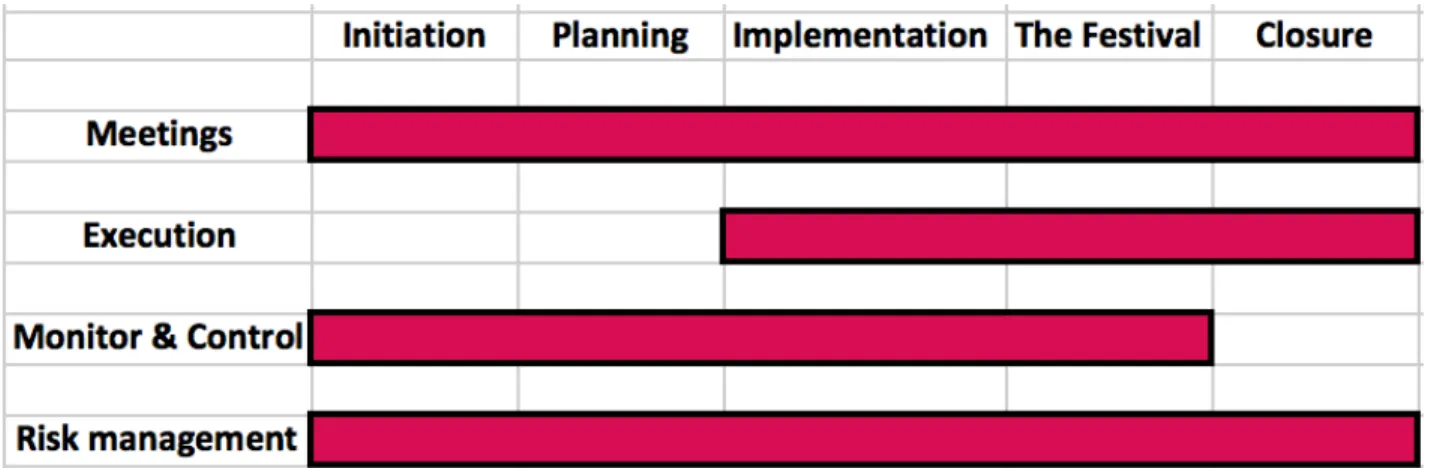
Figure 1 illustrates how the framework is to be applied. The five phases should ideally follow a waterfall model, where each phase immediately follows another in a sequence. However, in practice, the planning and the implementation phase tend to overlap during the process. This means that, very often, some activities will already be put into motion while others are still being developed. When everything is thought-out and prioritized, this poses no difficulty to the organization process.
Figure 1: Festival management framework
9
generally have the possibility to be cancelled or postponed when something goes completely wrong, even though this situation is never ideal; but this is extremely difficult to put into motion for festivals, especially once it has already begun. There are too many things at stake and too many people involved; such extreme situations should only occur under extreme and unavoidable conditions. If something goes wrong, “the show must go on”, as is said, and having a robust risk management plan can avoid big catastrophes.
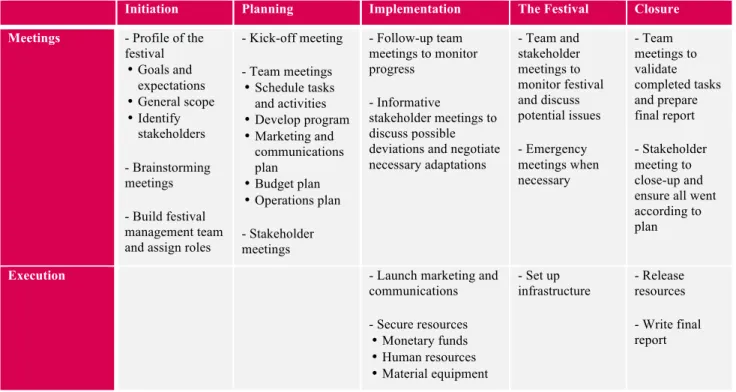
Table 1 details the framework with the different actions that take place within each set of activities. It serves as a guideline that festival organizers can follow to ensure they have thought of all preparatory acts and all possible outcomes. The detailed description of these streams of activities explicitly states what is expected in each phase (see Appendix 2). However, not all festivals are required to follow through every single activity to its full potential. Within each phase, each one will acknowledge and determine what best suits the event and what makes sense to the organization process.
Table 1: Detailed festival management framework
Initiation Planning Implementation The Festival Closure
Meetings - Profile of the festival
•Goals and expectations
•General scope
•Identify stakeholders - Brainstorming meetings - Build festival management team and assign roles
- Kick-off meeting - Team meetings
•Schedule tasks and activities
•Develop program
•Marketing and communications plan
•Budget plan
•Operations plan - Stakeholder meetings
- Follow-up team meetings to monitor progress
- Informative
stakeholder meetings to discuss possible deviations and negotiate necessary adaptations
- Team and stakeholder meetings to monitor festival and discuss potential issues - Emergency meetings when necessary - Team meetings to validate completed tasks and prepare final report - Stakeholder meeting to close-up and ensure all went according to plan
Execution - Launch marketing and
communications - Secure resources
•Monetary funds
•Human resources
•Material equipment
- Set up infrastructure
10 Monitor &
Control
Barriers and Constraints
•The market
•Supply and demand
•Policies and regulations
Barriers and Constraints
•The market
•Supply and demand
•Policies and regulations
- Schedule deviations - Budget deviations
- Monitor festival progress
•Budget deviations
•Schedule deviations - Measure impact
•Festival evaluation
Risk management
- Cultural and community influences • Associations • Government institutions • Neighborhood - Conflict management • Internal conflicts • External conflicts
- Risk management plan
• Potential risks and threats
• Contingency plan
• Uncertainty management - Emergency communication plan - Conflict management
- Compliance and insurance management - Uncertainty
management
• Contingency plan - Change management
• Update festival documentation - Conflict management
- Health and safety management - Uncertainty management • Contingency plan - Change management
• Update festival documentation - Conflict management
- Health and safety management
DEMONSTRATION
The framework was tested within MOTELX that celebrated its 10th anniversary in 2016. Even though most types of festivals have a similar set up process and make use of similar principals, it should be noted that the following interpretation has to be read carefully, as each festival must be aware of its individual needs, which may vary.
11
Because MOTELX has already become a household name in the local festival scene, it is safe to say that it already applies some sort of structure to each new edition but doesn’t yet have a defined framework to follow. It is, therefore, important to notice that many steps of this framework are just naturally already implemented within MOTELX because of the obvious need to apply them to run any type of festival. Hence, the production team can easily retain its current practices and simply add what is lacking to have a more robust structure to follow in the future. The first two preparatory phases, consequently, are relatively short, as the festival is built on the same objectives year after year. The team has by now established a way of developing their festival that works for them, allowing them to implement previously established plans and just making necessary adjustments wherever needed.
This chapter will then focus on the framework’s main activities to draw the main conclusions and, more specifically, on aspects that were new to the organization and had never been implemented before (see Appendix 3 for a detailed execution of the framework, phase by phase).
Work-breakdown structure
12
Risk management plan
A risk management plan was very challenging to implement within MOTELX. No detailed plan had ever existed or been established throughout the years. As is common in most events, problems that can be anticipated may have back up plans prepared during the planning phase, but often the production team will improvise solutions based on past experiences, particularly when problems occur while the festival is already taking place and nothing has been pre-determined. Nevertheless, a risk management plan was still made with a list of all potential threats, rated according to the probability of occurring, and their consequences to the festival (see Appendix 5). This risk assessment considered the existing risks inherent to the festival site, the risks created by the event itself, and the external risks that still need to be managed despite the festival organizer’s lack of control over it. The steps suggested to reduce or mitigate the identified risks are not exhaustive; it should be noted that they were specifically developed for MOTELX and can, therefore, vary according to the different types of festivals. Finally, the plan clearly defines the required functions and resources to be able to implement it. Whoever is considered responsible for coordinating the risk management plan has to make sure all resources are at hand and that everyone knows what to do.
To complement this, an emergency communications plan was also designed to indicate how the organization should communicate according to each emergency situation (see Appendix 6). Once again, the situations depicted are not exhaustive and each festival has to consider which types of circumstances and conditions it relates to.
Festival monitoring
13
office (PMO) meetings and by requesting regular updates on the event production process. Then, there is the festival evaluation managed with a survey that MOTELX hands out every year to its audience in order to get feedback and appraise the experience through its attendants’ eyes (see Appendix 7).
The survey measures personal impacts and assesses the type of audience the festival has, by trying to understand the amount of new public it acquires with each edition in comparison with the audience that returns each year, but also by gathering people’s opinion concerning the program and general organization of the festival (see Appendix 8 for an audience satisfaction chart comparison). With this, the festival is able to know the demographics of their target audience and how they are reacting to the event. The survey also provides a place for spectators to write down their opinions and complaints regarding any aspect of the festival. It also assesses the visibility of the festival, regarding its sponsors and communications, which helps them to evaluate their marketing strategy and measure its strong and weak points. Complementing this review, people’s reactions are also observed through social media by monitoring the number of visits to the festival’s website and social media pages and the interaction within them.
Key performance indicators
14
In the event sector, the KPIs are usually reflected by measuring demand and economic impacts, and by analyzing customer satisfaction and its link to brand loyalty (Brown, Getz, Pettersson, & Wallstam, 2015). MOTELX naturally acknowledged ticket sales, but most importantly audience satisfaction to be tracked through the surveys mentioned above. However, these assessments could benefit from additionally measuring the public’s approval by asking if they liked the new edition of the festival, if they are considering coming back the following year, and if they would recommend it to family and friends. Surveys should also be a means to evaluate whether a new edition met the audience’s expectations or, even better, if it exceeded them for the festival to build on brand loyalty.
Another KPI, greatly correlated to the audience’s satisfaction level, is the return on investment (ROI). It is almost a consequence of it, as the more people are satisfied with the festival, the more they will come and incite others to come, and therefore, the more tickets will be sold and the more revenues will be made. Nevertheless, MOTELX is a festival that has only managed to breakeven throughout its existence and therefore puts a greater emphasis on ticket sales rather than ROI.
Finally, it would also be interesting to look at the dropout rate, the number of attendees compared to the number of people who had initially marked attendance through social media. Sometimes the two numbers are very different and it can be really helpful to understand why there are so many enthusiasts online that don’t translate into actual ticket sales afterwards.
Tracking the execution
15
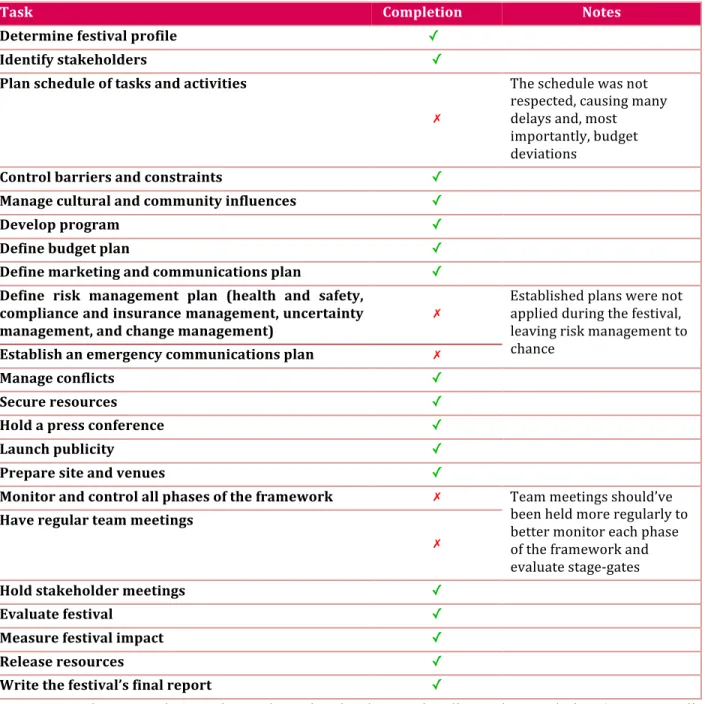
expectations (Brown, Getz, Pettersson, & Wallstam, 2015). The following tables showcase the various enumerating lists of things to do that were used during the festival, starting with a general framework checklist built according to the WBS, giving an overview of what was accurately performed, what needed to be revised, but also what wasn’t applied in this particular festival. Table 2: Framework checklist
Task Completion Notes
Determine festival profile ✓
Identify stakeholders ✓
Plan schedule of tasks and activities
✗
The schedule was not respected, causing many delays and, most importantly, budget deviations
Control barriers and constraints ✓
Manage cultural and community influences ✓
Develop program ✓
Define budget plan ✓
Define marketing and communications plan ✓ Define risk management plan (health and safety,
compliance and insurance management, uncertainty management, and change management)
✗
Established plans were not applied during the festival, leaving risk management to chance
Establish an emergency communications plan ✗
Manage conflicts ✓
Secure resources ✓
Hold a press conference ✓
Launch publicity ✓
Prepare site and venues ✓
Monitor and control all phases of the framework ✗ Team meetings should’ve been held more regularly to better monitor each phase of the framework and evaluate stage-gates
Have regular team meetings
✗
Hold stakeholder meetings ✓
Evaluate festival ✓
Measure festival impact ✓
Release resources ✓
Write the festival’s final report ✓
16
framework. Five gates were identified in the process, where reflective PMO meetings were held to establish best practices and decide how to move forward with the festival (Kerzner, 2009).
First stage-gate: Kick-off meeting
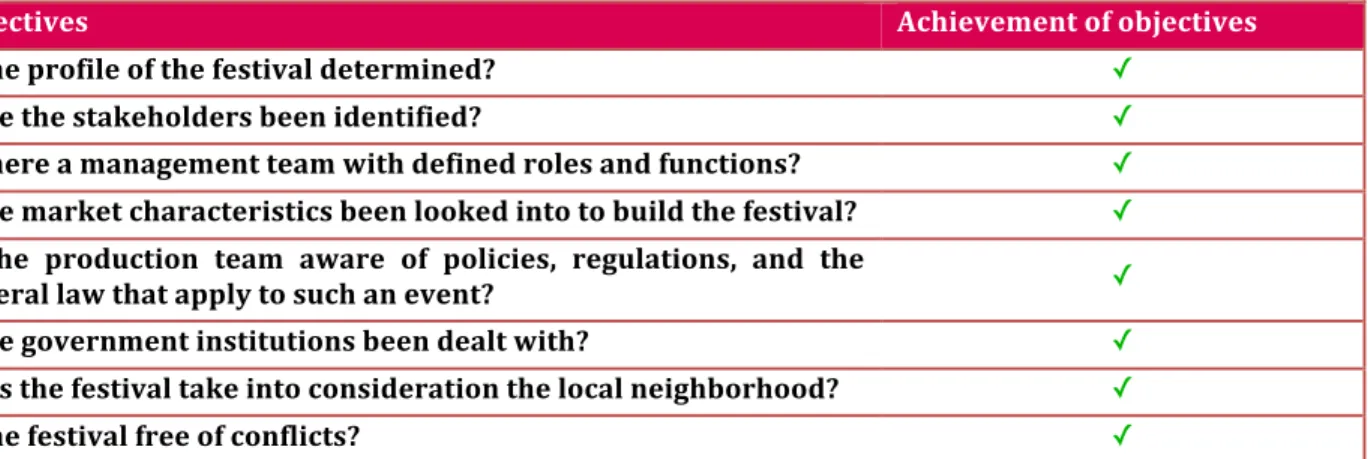
The kick-off meeting reviewed the whole initiation process in order to establish around which principles and characteristics to start the event. This is the first milestone that will determine whether or not the project should move on to the planning phase with the help of the following checklist.
Table 3: Kick-off meeting checklist
Objectives Achievement of objectives
Is the profile of the festival determined? ✓ Have the stakeholders been identified? ✓
Is there a management team with defined roles and functions? ✓
Have market characteristics been looked into to build the festival? ✓ Is the production team aware of policies, regulations, and the
general law that apply to such an event? ✓ Have government institutions been dealt with? ✓
Does the festival take into consideration the local neighborhood? ✓
Is the festival free of conflicts? ✓
Skipping one of these steps may result in future problems or drawbacks for the production team and possibly lead to the cancellation of the event before it even begins. Note, however, that conflicts mentioned here relate to this phase only, as future struggles will certainly still arise in the following phases of the framework.
Second stage-gate: Budget plan
17
Table 4: Budget plan checklist
Objectives Achievement of objectives
Can the festival cover all possible costs? ✓
Are there enough sources of revenue? ✓
Can the festival breakeven? ✓
Can the festival turn a profit? ✗
These are very straightforward and common questions, but carefully revising all costs and sources of revenue will help to see the bigger picture of the financial impact of the festival. The last question can either be answered in the positive or the negative, depending on the festival’s final objective, but it should always breakeven to avoid having costs turn out greater than any possible expected revenue.
Third stage-gate: Securing all resources
Just like the budget plan, the ability to secure all necessary resources is a vital moment in the production of a festival. At this next stage-gate, the PMO looked into what had actually been achieved and if there were going to be any complications.
Table 5: Resources checklist
Objectives Achievement of objectives
Does the festival have all the necessary funds? ✓ Is all the equipment rented/bought? ✗
Are all venues/festival sites ready? ✓
Is the festival staff complete? ✓ Are all artists, guests, and exhibitors confirmed? ✗
Have contingency plans been put into motion? ✗
18
motion, MOTELX decided it could still gather all necessary resources in time and would only deal with possible consequences in the moment using knowledge from past experiences.
Fourth stage-gate: Overview before initiating the festival phase
Before starting the event, one more PMO meeting went through all tasks and activities and determined if something crucial was still missing.
Table 6: Festival checklist
Objectives Achievement of objectives
Barriers and constraints controlled ✓
Cultural and community influences managed ✓
Program completed ✓
Budget plan achieved ✓
Marketing and communications plan launched ✓
Risk management ✗
Emergency communications plan ready for use ✗
Resources secured ✓
Site and venues prepared ✓
On the one hand, certain tasks are essential to increase the chances of the festival’s success and have to be completed by the time this overview takes place. For instance, holding a press conference is crucial to launch the event’s publicity and have the media relay all necessary information to avoid an empty house on opening day. On the other hand, certain tasks may be overlooked, as a risk management plan often is in events.
Fifth stage-gate: Festival closure
19
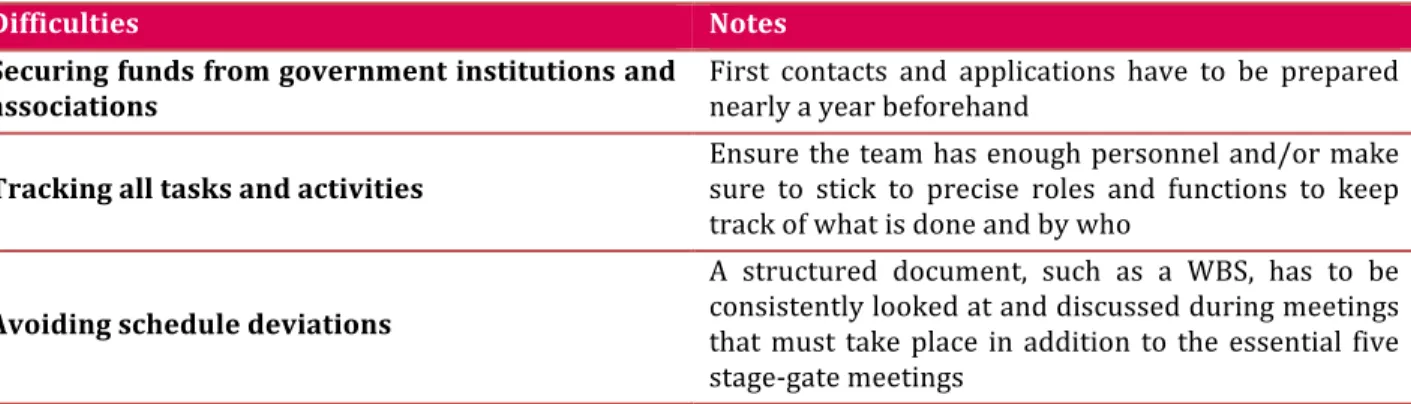
the festival’s final report, a list of the difficulties encountered was also made with some ideas on how to handle these situations better next time.
Table 7: List of difficulties
Difficulties Notes
Securing funds from government institutions and associations
First contacts and applications have to be prepared nearly a year beforehand
Tracking all tasks and activities
Ensure the team has enough personnel and/or make sure to stick to precise roles and functions to keep track of what is done and by who
Avoiding schedule deviations
A structured document, such as a WBS, has to be consistently looked at and discussed during meetings that must take place in addition to the essential five stage-gate meetings
EVALUATION
The framework will now be evaluated based on action research theory developed by Moody & Shanks (2003). The action research process consists of four steps: plan, act, observe, and reflect. First, a plan of action was developed to improve current practices in a flexible manner to allow for unpredictable events, culminating in the developed framework proposed above (cf. Proposal). Then, this plan was acted upon, executed, in this case, within MOTELX. After, the evaluation begins with an observation step to collect feedback and assess outcomes. Finally, based on the observations, the framework will be reflected upon in order to weigh in on what went wrong and what went right, and how to improve the proposal.
20
adaptation, be clear of overlaps of definitions, inclusive of all types of systems – in this case, all types of festivals –, and serve as a model to be implemented in the real world.
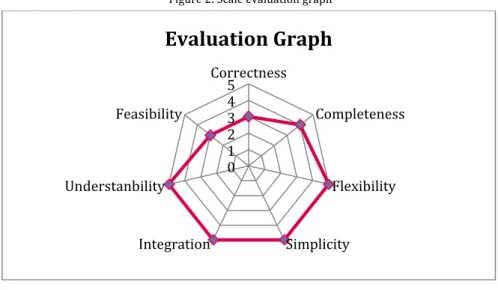
Overall, as shown in the following figure, the framework satisfies all of Moody & Shanks’ quality factors, with some adjustments necessary within, in particular, correctness and feasibility, but also completeness.
Figure 2: Scale evaluation graph
The correctness of the framework is not necessarily being questioned here, but rather it needs to be reviewed. With a festival such as MOTELX, it is hard to implement such a change given the history that they have. The implementation should have been adapted to such a situation where the festival already follows its own established structure. The fact that it wasn’t, made it all the more challenging to evaluate the true effectiveness of the framework.
The most prominent example is the implementation of a risk management plan, which, as already mentioned, is often neglected. Many risks can be anticipated and prepared for, but others, maybe the most important ones, cannot. Take, for instance, the situation concerning the screening of movies during the festival – a lot of preparation goes into negotiating deals with the distributors to ensure a copy makes its way to Lisbon. Despite all this anticipatory planning, many things can
0 1 2 3 4 5
Correctness
Completeness
Flexibility
Simplicity Integration
Understanbility Feasibility
21
still go wrong at the last minute: the copies may never arrive, they may be faulty, the distributors may cancel the authorization to screen the movie, and many other issues may occur. Having a backup plan in case a movie cannot be screened would require the acquisition of backup movies and/or to have a technician on hand at all times, hoping he or she can solve whatever issue arises in due time, which is not always plausible, logistically but above all, financially.
As explained by William J. O’Toole (2000), while risk management is typically in project management a “systematic methodology” that is continuously tested until it has reached its optimal form, it is more of a varied process and event dependent when it comes to events. Keeping in mind that costs and expenses are at the top of MOTELX’s concerns, the risk management plan should have been developed so as to propose contingency tactics that took the financial aspect into consideration and, in this way, be more in sync with the festival’s goals and objectives.
22
Finally, the quality factor of completeness would need to be reviewed to include factors that were overlooked and give more importance to others that were underestimated. The most prominent example of such a situation is related to communication and integration within the festival. It was ingenuously assumed that the different teams involved in the project would be in constant contact with each other. However, it became clear that more interaction between everyone was necessary, in the form of PMO meetings or even informally. Although meetings were scheduled and messages regularly exchanged, there were still some gaps and miscommunication issues that could have been easily avoided. More than once, the organization and the production team were not in sync concerning certain activities and the lack of more regular PMO meetings resulted in several aspects of the event production being forgotten and having to be dealt with in extreme urgency and stress at the last minute.
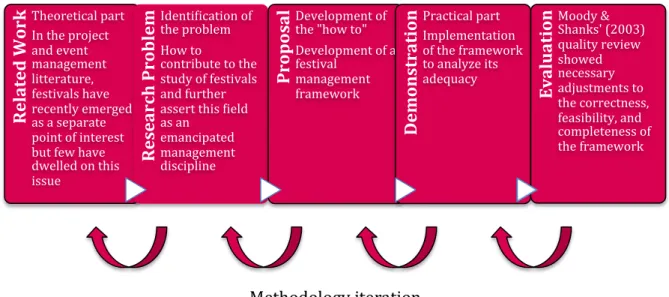
Going back to the DSRM methodology, special attention will have to be given in the proposal and demonstration areas in order to perfect the framework for a future execution, as is outlined in Figure 3.
Figure 3: Design Science Research Methodology
Rel a ted W o r
k Theoretical part
In the project and event management litterature, festivals have recently emerged as a separate point of interest but few have dwelled on this issue R e se a r c h P r o b le
m IdentiXication of the problem
How to
contribute to the study of festivals and further assert this Xield as an emancipated management discipline P r o p o sa l Development of the "how to"
Development of a festival management framework D e m o n st r a ti o
n Practical part
Implementation of the framework to analyze its adequacy Eva lu a ti o
23
Change has to begin in the theoretical part, where the framework will be reviewed following this first implementation experience. The activities included in the different phases have to be revised to improve the feasibility and correctness quality factors, so that the framework can more easily be applicable to any types of festivals and minimize setbacks. This should, consequently, pave the way for a smoother implementation in the practical part. Nevertheless, the iteration also has to be attentive to not overlook or underestimate any aspects of the execution to ensure that everything goes according to plan and avoid the same mistakes.
In the future, the ideal situation is to be able to test and execute the framework among as many festivals as possible, with a great variety of profiles, to build the most complete and correct festival management framework to be applied globally. It would also be interesting to work together with event management softwares, such as Eventival or Eventbrite, to use the framework as a complement or even incorporate it in their system.
CONCLUSION
24
unpredictability. The framework is presented as a means to control this instability by offering festival managers a tool to better structure their organization plan.
This framework was difficult to implement in a festival with such a long history. It seems it would best fit as a starting guideline for anyone looking to set up a festival, benefitting from the experiences of more practiced festivals. Despite being established to stand the test of time and become something to follow along the years, it overlooked and underestimated certain aspects that made it challenging to implement within an already recognized and proven organization system. Iterations need to be done to perfect the theoretical part of the framework, which will in turn provide a more robust and complete structure for further implementations, regardless of the festival’s background.
Bibliography
Andersson, T., & Getz, D. (2008). Stakeholder Management Strategies of Festivals. Journal of Convention & Event Tourism , 9 (3), 199-220.
Brown, S., Getz, D., Pettersson, R., & Wallstam, M. (2015). Event evaluation: definitions, concepts and a state of the art review. International Journal of Event and Festival Management , 6 (2), 135-157.
Carlsen, J., & Andersson, T. D. (2011). Strategic SWOT analysis of public, private and not-for-profit festival organizations. International Journal of Event and Festival Management , 2 (1), 83-97.
Carlsen, J., Andersson, T. D., Ali-Knight, J., Jaeger, K., & Taylor, R. (2010). Festival Management: innovation and failure. International Journal of Event and Festival Management , 1 (2), 120-131.
Connell, J. (2012). Film tourism - Evolution, progress and prospects. Tourism Management , 33, 1007-1029.
Ellert, G., Schafmeister, G., Wawrzinek, D., & Gassner, H. (2015). Expect the unexpected. International Journal of Event and Festival Management , 6 (1), 54-72.
25
Getz, D., Andersson, T., & Carlsen, J. (2010). Festival management studies. International Journal of Event and Festival Management , 1 (1), 29-59.
Jago, L., Dwyer, L., Lipman, G., van Lill, D., & Vorster, S. (2010). Optimising the potential of mega-events: an overview. International Journal of Event and Festival Management , 1 (3), 220-237.
Kerzner, H. (2009). Project Management: A systems approach to planning, scheduling and control (10th ed.). USA: Wiley Editions.
Leonardsen, D. (2007). Planning of Mega Events: Experiences and Lessons. Planning Theory & Practice , 8 (1), 11-30.
Litvin, S., Pan, B., & Smith, W. (2013). Festivals, special events, and the "rising tide". International Journal of Culture, Tourism and Hospitality Research , 7 (2), 163-168.
Moody, D. L., & Shanks, G. G. (2003). Improving the quality of data models: empirical validation of a quality management framework. Information Systems (28), 32.
Mosely, M., & Mowatt, R. (2011). Reconceptualizing and repositioning festival exhibitors within tourism research. International Journal of Event and Festival Management , 2 (3), 254-270. O'Toole, W. J. (2000, July). Towards the Integration of Event Management Best Practices by the Project Management Process. Sidney, Australia.
Project Management Insitute. (2014). Implementing Organizational Project Management: a Practice Guide. USA: Project Management Institute.
Rutherford Silvers, J. (2004, July 31). A Brief History of the International EMBOK. Retrieved March 10, 2016, from EMBOK: http://www.juliasilvers.com/embok/EMBOK%20History.htm Rutherford Silvers, J. (2003, November 19). Budget Development. Retrieved March 10, 2016, from EMBOK: http://www.juliasilvers.com/embok/Guide/ADM/FinancialMgmt/budget.htm Rutherford Silvers, J. (2007). Introduction to EMBOK: The Event Management Body of Knowledge. USA: Event Management Institute.
Smith, W. H., Litvin, S. W., Canberg, A., & Tomas, S. R. (2010). Setting parameters: operational budget size and allocation of resources. International Journal of Event and Festival Management , 1 (3), 238-243.
Sport Assist. Event Planning and Management. USA: Sporttasman.