www.cbpv.org.br/rbpv ISSN 0103-846X (Print) / ISSN 1984-2961 (Electronic)
Doi: http://dx.doi.org/10.1590/S1984-29612015072
Anthelmintic activity of
Leucaena leucocephala
protein
extracts on
Haemonchus contortus
Atividade anti-helmíntica de extratos proteicos de
Leucaena leucocephala
sobre
Haemonchus contortus
Alexandra Martins dos Santos Soares1; Sandra Alves de Araújo1; Suzana Gomes Lopes2; Livio Martins Costa Junior2*
1 Curso de Engenharia Química, Universidade Federal do Maranhão – UFMA, São Luís, MA, Brasil
2 Departamento de Patologia, Universidade Federal do Maranhão – UFMA, São Luís, MA, Brasil
Received May 4, 2015 Accepted August 3, 2015
Abstract
The objective of this study was to evaluate the effects of protein extracts obtained from the plant Leucaena leucocephala
on the nematode parasite Haemonchus contortus. The seeds, shell and cotyledon of L. leucocephala were separated and
their proteins extracted using a sodium phosphate buffer, and named as TE (total seed extract), SE (shell extract) and CE (cotyledon extract). Soluble protein content, protease, protease inhibitory and chitinase activity assays were performed. Exsheathment inhibition of H. contortus larvae were performed at concentrations of 0.6 mg mL–1, and egg hatch assays
were conducted at protein concentrations of 0.8, 0.4, 0.2, 0.1 and 0.05 mg mL–1. The effective concentration for 50%
hatching inhibition (EC50) was estimated by probit. Different proportions of soluble proteins, protease and chitinase were found in TE and CE. Protease inhibitory activity was detected in all extracts. The EC50 of the CE and TE extracts were 0.48 and 0.33 mg mL–1, respectively. No ovicidal effects on H. contortus were detected in SE extracts, and none
of the protein extracts demonstrated larvicidal effects on H. contortus. We therefore conclude that protein extracts of L. leucocephala had a detrimental effect on nematode eggs, which can be correlated with the high protease and chitinase
activity of these extracts.
Keywords: Plant proteins, protease, protease inhibitor, chitinase.
Resumo
O objetivo deste estudo foi avaliar a atividade anti-helmíntica de extratos proteicos de leucena (Leucaena leucocephala) sobre Haemonchus contortus. As sementes, as cascas e os cotilédones foram moídos separadamente e as proteínas extraídas com tampão fosfato de sódio e denominados: TE (extrato total), SE (extrato casca) e CE (extrato cotilédone). O teor de proteínas, atividade proteolítica, inibitória de protease e quitinolítica dos extratos foram verificados, além da ação sobre a eclosão de ovos e desembainhamento larvar de H. contortus. A concentração efetiva para inibição de 50% da eclosão dos ovos (EC50) foi calculada através do probit. Foi demonstrado que TE e CE possuem, em diferentes proporções, proteínas solúveis, protease e quitinase. Atividade inibitória de protease foi encontrada em todos os extratos. A EC50 dos extratos CE e TE foram 0,48 e 0,33 mg de proteína mL–1, respectivamente. O extrato SE não apresentou atividade
sobre a eclosão dos ovos. Os extratos proteicos não apresentaram efeito larvicida sobre H. contortus. Conclui-se que a ação de extratos proteicos de L. leucocephala afetam negativamente a eclodibilidade dos ovos, correlacionando-se com a alta atividade de protease e quitinase dos extratos testados.
Palavras-chaves: Proteínas vegetais, protease, inibidor de protease, quitinase.
*Corresponding author: Livio Martins Costa Junior. Departamento de Patologia, Centro de Pesquisa da Pós-graduação do Centro de Ciências Biológicas e da Saúde – CCBS, Universidade Federal do Maranhão – UFMA, Av. dos Portugueses, 1966, Bacanga, CEP 65080-805, São Luís, MA, Brasil. e-mail: [email protected]
Introduction
Infections with gastrointestinal nematodes are a primary cause of the loss of small ruminant livestock (HOUNZANGBE-ADOTE et al., 2005; CEZAR et al., 2008). The nematode
Haemonchus contortus is considered the most important because
of the extensive damage it has caused to livestock. Controlling these parasites consists primarily of using synthetic anthelmintics (OLIVEIRA et al., 2011), but inappropriate use of anthelmintics has led to an increase in resistant nematode strains (TORRES-ACOSTA & HOSTE, 2008). As such, certain plant compounds have been considered as an alternative for the control of these parasites (EGUALE et al., 2007; BUTTLE et al., 2011).
function is to both store nutrients for germination and growth and act as defense proteins against pathogens, especially proteases, protease inhibitors, and chitinases (CARLINI & GROSSI-DE-SÁ, 2002). It is thought that proteases and chitinases may be have potential nematicidal properties because of their ability to break down important macromolecules that constitute the cuticle of these parasites.
Nematodes feature a morphologically complex cuticle composed of resistant proteins such as collagen, which functions as a protective barrier between the parasite and the external environment (SHAMANSKY et al., 1989; RHOADS & FETTERER, 1990). The cuticle of H. contortus eggs has three layers: an internal layer
composed of lipids with some associated proteins; an intermediate layer composed of chitin fibers surrounded by proteins; and an outer layer composed of proteins and lipids (MANSFIELD et al., 1992).
Different classes of proteases are known to be inactivated by plant proteins, called protease inhibitors (OLIVA et al., 2000). Gastrointestinal nematodes produce a variety of proteases that have different functions during development (RHOADS et al., 2000; WILLIAMSON et al., 2003). Although nematode parasites can utilize protease inhibitors to protect themselves from degradation by host proteases, to facilitate feeding and to manipulate the host response to the parasite (KNOX, 2007), protease inhibitors can also prevent or delay the development of the parasite (IZUHARA et al., 2008), representing a potential biotechnological approach to the study and development of new anthelmintic drugs.
Among the variety of plant species with potential anthelmintic properties, Leucaena leucocephala is prominent. Native to Central
America, Leucaena can be found in many tropical and subtropical regions of the world (LIM, 2012; NEHDI et al., 2014) and is often used as forage for livestock (PRASAD et al., 2011; PANDEY & KUMAR, 2013). Leucaena exhibits anthelmintic properties against both H. contortus (OLIVEIRA et al., 2011) and Trichostrongylus colubriformis (CUNHA et al., 2003).
Many studies have demonstrated the effectiveness of plant extracts in controlling H. contortus, but relatively little research has
been conducted using protein extracts. This study aims to examine the anthelmintic activity of protein extracts of L. leucocephala
on the gastrointestinal nematode H. contortus and to verify the activities of some proteins that could be related to the bioactivity of the extracts against this parasite.
Materials and Methods
Plant material
The seeds of L. leucocephala were commercially acquired (Sementes Caiçara, Brejo Alegre, SP, Brazil) and mechanically ground in a mill. Lipid extraction from the resulting powder was performed with hexane (1:6, w/v) at 25 °C. After two solvent changes per day over two consecutive days, the hexane was removed and the powder was allowed to dry overnight at 25 °C under forced air circulation. The powder was subsequently stored in sealed vials at –4 °C. In addition, the shell and cotyledon were separated, ground and defatted as described for the whole seed.
Protein extraction and quantification
Soluble proteins in the powdered seeds of L. leucocephala were
extracted using a sodium phosphate buffer (PBS, 100 mM, pH 7.0) (1:5 w/v) under constant stirring for 3 h at 4 °C. The suspensions were centrifuged at 12,000 x g for 30 minutes at 4 °C. The resulting
supernatants were centrifuged under the same conditions, with the final supernatants classified as TE (total seed extract), SE (shell extract) and CE (cotyledon extract).
The soluble proteins in TE, SE and CE were quantified according to Bradford (1976), using bovine serum albumin (BSA) as the standard. The protein content was expressed as milligram of protein per gram fresh weigh and was calculated using the following equation:
(
)
(
)
( )∗
( )
Protein content mgP gMF =protein concentration mg/mL
buffer volume mL seed weight g (1)
Protease, protease inhibitor and chitinase activity assays
The total proteolytic activity of L. leucochephala seed extracts was examined using azocasein as a nonspecific substrate (XAVIER-FILHO et al., 1989). One unit of activity (UA) was defined as the amount of enzyme capable of increasing absorbance by 420 nm at 0.01 mL–1 in 60 min.
Cysteine proteinase inhibitor activity was determined by measuring the inhibition of papain activity using benzoyl-DL-arginine-β-naphthylamide (BANA) as substrate (ABE et al., 1992). One unit of inhibitory activity (UI) was defined as the decrease of 0.01 absorbance units at 540 nm mL–1 min–1 compared with the
control (papain activity in the absence of the inhibitor). Determination of chitinase activity consisted of sample capacity in release of n-acetyl-d-glucosamine (NAG) from colloidal chitin by hydrolytic action (BOLLER et al., 1992), expressed in nkat.
Egg hatch assay
H. contortus eggs were recovered from the feces of experimentally infected goats (BIZIMENYERA et al., 2006). Approximately 100 eggs per well–1 were submitted to incubation with protein
extracts from seeds of L. leucocephala in concentrations between 0.05 mg and 0.8 mg of protein mL–1 (mg P–1 mL–1) in quadruplicate.
Protein extracts were diluted in PBS (100 mM, pH 7.0). The assay contained two controls: (i) distilled water; and (ii) PBS (100 mM, pH 7.0) that was used to prepare and dilute protein extracts. The 24-well plates containing different extracts and controls were incubated for 48 h at 27 °C. Hatched larvae (dead or alive) and unhatched eggs were counted under a dissecting microscope at 40× magnification.
Larval exsheathment assay
assay was performed according to Bahuaud et al. (2006). Viable larvae of ages 2 to 3 months were used in the assays. The extracts of the L. leucocephala seeds were tested at the concentration of 0.6 mg P–1 mL–1 in PBS (100 mM, 50 mM NaCl, pH 7.2).
The assay was performed in four replicates, with PBS used as a control. Larvae were incubated with protein extracts and PBS for 3 h at 22 °C. After this period of incubation, larvae were rinsed three times with PBS via centrifugation for 5 minutes at 1000 rcf. Exsheathment was induced by a solution of sodium hypochlorite (2% v/v) and sodium chloride (16.5% w/v) diluted in PBS. The kinetics of larval exsheathment in the different experimental treatments was then monitored by microscopic observation (at 40× magnification). The percentages of exsheathed larvae were identified at 10-minute intervals for 60 minutes.
Statistical analysis
Statistical comparisons of the H. contortus egg hatch assays were assessed using two-way ANOVA with Bonferroni post-tests. The effective concentration for 50% hatching inhibition (EC50) was estimated by probit. Larval exsheathment rates were compared using the ANOVA test. The significance level used in all statistical tests was 0.05, and all analyses were performed using the GraphPad Prism software, v. 6.0 (GraphPad Software, 2007).
Results
Protein content, protease, protease inhibitor and
chitinase assays
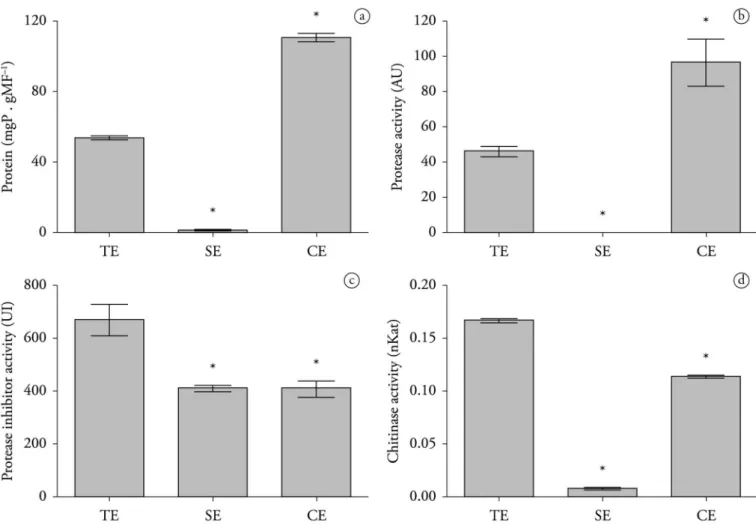
The CE had higher protein content (109.95 mgP gMF–1) than
did the TE (53.30 mgP gMF–1), whereas only a minimal amount
of protein (1.67 mgP gMF–1) was detected in the SE (Figure 1a).
Protease activity was not detected in the SE. However, the enzyme was detected in both the TE (45 UA) and in higher levels in the CE (95 UA) (Figure 1b). Protease inhibitory activity was detected in all prepared extracts, with TE showing higher levels of activity (670 UI) (Figure 1c). Chitinase activities in the TE and CE were 0.16 and 0.11 nkat, respectively. No significant amounts of this enzyme (0.007 nkat) were found in the SE (Figure 1d).
Biological activity on H. contortus
Different protein extracts obtained from seeds of L. leucocephala
exhibited distinct ovicidal effects on H. contortus. Ovicidal efficacy of the TE (99.2% and 56.6% at 0.8 and 0.4 mg mL–1, respectively)
was significantly higher than that of the CE (83.4% at 0.8 mg mL–1).
This difference in efficacy was reflected in the EC50 values of the TE and CE. The EC50 of CE (0.48 mg mL–1, 95% CI: 0.40-0.57)
was significantly greater than that of TE (0.33 mg mL–1, 95%
CI: 0.29-0.38). There were few signs of ovicidal effects against
H. contortus in SE assays at the tested concentrations, however. Higher concentrations of TE and CE (0.6 mg mL–1) were tested
for effects on H. contortus larvae, but cuticular loss rates after
60 minutes did not differ among the control (buffer), TE and CE (98.8%, 98.2% and 95.3%, respectively).
Discussion
Plants have long been studied as potential sources of chemicals for controlling animal and human parasites due to their numerous medicinal and therapeutic properties (HERNÁNDEZ-VILLEGAS et al., 2011). The detrimental effects that H. contortus nematodes have on the development of goats and sheep have led to numerous studies examining the use of plant extracts as nematode control agents (ALONSO-DÍAZ et al., 2008; MARIE-MAGDELEINE et al., 2010; HERNÁNDEZ-VILLEGAS et al., 2011).
Although secondary metabolites have been extensively correlated with nematicidal effects, demonstrating their applicability to controlling the gastrointestinal nematodes of small ruminants, plant proteins represent a novel approach for controlling these parasites (SALLES et al., 2014). The use of therapeutic proteins is one of the fastest growing sectors in the pharmaceutical market and has undergone several generations of development to achieve increasingly viable commercial products. These proteins can be produced at relatively low cost and feature a reduced risk of side effects and high bioavailability (MARTIN, 2006). In the present work, although no soluble proteins were detected in SE, such proteins were detected in TE and CE at rates of 53.30 mgP gMF–1
and 109.95 mgP gMF–1, respectively (Figure 1a).
Little is known about the potential anthelmintic properties of cysteine proteases, but some studies have shown that these enzymes may act on the cuticle of the nematode, causing severe damage and leading to the death of the nematode (PHIRI et al., 2013; LUOGA et al., 2015). Protease inhibitors may also play an important role in the control of nematode parasites by inhibiting the production of proteins necessary for nematode development (LAWRENCE & KOUNDAL, 2002). Both TE and CE displayed proteolytic activity (Figure 1b). Proteases extracted from other plants, including Carica papaya, Ananas comosus and Ficus sp., have previously been shown to be effective against the plant nematodes
Meloidogyne incognita, M. javanica and Globodera rostochiensis, as well as nematodes infecting the rodents Trichuris muris, Protospirura muricola and Heligmosomoides polygyrus (STEPEK et al., 2006,
2007a, b, c).
Chitinase activity was observed primarily in TE and CE assays (Figure 1d). Chitin is an important component of egg shells, and acts as a protective barrier against the external environment (ROGERS & BROOKS, 1977). The main proteins of the cuticle of H. contortus eggs are degraded by the enzymes proteinase K and chitinase (MANSFIELD et al., 1992). Pathogenic fungi and some nematodes use chitinase to break through this protective barrier and penetrate the host (LEGER et al., 1993; HUBER et al., 1991; SHAHABUDDIN et al., 1993). We showed that the TE and CE interfere with H. contortus egg development. The efficiency of the TE and CE coincides with high protease and chitinase activity, which suggests that these enzymes could have potential ovicidal properties.
Still extracts of acetone and water from the aerial components of L. leucocephala showed 90% larvicidal effectiveness against
H. contortus (OLIVEIRA et al., 2011). This method extracted compounds of secondary metabolites, consisting primarily of condensed tannins and other phenolic compounds (CORK & KROCKENBERGER, 1991). The protein extracts used in our study did not exhibit larvicidal effects.
In this study, we observed that protein extracts obtained from
L. leucocephala detrimentally affected nematode eggs, which correlated with the high levels of protease and chitinase activity of these extracts. It is believed that the active mechanism may vary according to the stage of development of the nematode and, therefore, the differences in cuticle and proteins between the eggs and the larvae. Further research should be conducted to determine the ovicidal effects of plant proteins, as well as the active mechanism(s) of these proteins, to discover new approaches for treating gastrointestinal infection in small ruminants by nematodes.
Acknowledgements
References
Abe M, Abe K, Kuroda M, Arai S. Corn Kernel cysteine proteinase inhibitor as a novel cystatin superfamily member of plant origin: molecular cloning and expression studies. Eur J Biochem 1992; 209(3): 933-937. http://dx.doi.org/10.1111/j.1432-1033.1992.tb17365.x. PMid:1425699. Alonso-Díaz MA, Torres-Acosta JFJ, Sandoval-Castro CA, Capetillo-Leal C, Brunet S, Hoste H. Effects of four tropical tanniniferous plant extracts on the inhibition of larval migration and the exsheathment process of Trichostrongylus colubriformis infective stage. Vet Parasitol 2008; 153(1-2): 187-192. http://dx.doi.org/10.1016/j.vetpar.2008.01.011. PMid:18304736.
Bahuaud D, Montellano CMO, Chauveau S, Prevot F, Torres-Acosta F, Fouraste I, et al. Effects of four tanniferous plant extracts on the in vitro exsheathment of third-stage larvae of parasitic nematodes. Parasitology 2006; 132(4): 545-554. http://dx.doi.org/10.1017/S0031182005009509. PMid:16388690.
Bizimenyera ES, Githiori JB, Eloff JN, Swan GE. In vitro activity of Peltophorum africanum Sond. (Fabaceae) extracts on the egg hatching and larval development of the parasitic nematode Trichostrongylus colubriformis. Vet Parasitol 2006; 142(3-4): 336-343. http://dx.doi.org/10.1016/j. vetpar.2006.06.013. PMid:16899339.
Boller T, Gurr SJ, McPherson MJ, Bowles DJ. Biochemical analysis of chitinases and β-1,3-glucanase. In: Gurr SJ, McPherson MJ, Bowles DJ, editors. Molecular plant pathology. New York: IRL Press; 1992. p. 23-29.
Bradford MM. A rapid and sensitive method for the quantitation of microgram quantities of protein utilizing the principle of protein-dye binding. Anal Biochem 1976; 72(1-2): 248-254. http://dx.doi. org/10.1016/0003-2697(76)90527-3. PMid:942051.
Buttle DJ, Behnke JM, Bartley Y, Elsheikha HM, Bartley DJ, Garnett MC, et al. Oral dosing with papaya latex is an effective anthelmintic treatment for sheep infected with Haemonchus contortus.Parasit Vectors 2011; 4(1): 36. http://dx.doi.org/10.1186/1756-3305-4-36. PMid:21406090.
Carlini CR, Grossi-de-Sá MF. Plant toxic proteins with insecticidal properties: a review on their potentialities as bioinsecticides. Toxicon 2002; 40(11): 1515-1539. http://dx.doi.org/10.1016/S0041-0101(02)00240-4. PMid:12419503.
Cezar AS, Catto JB, Bianchin I. Controle alternativo de nematódeos gastrintestinais dos ruminantes: atualidade e perspectivas. Cienc Rural 2008; 38(7): 2083-2091. http://dx.doi.org/10.1590/S0103-84782008000700048.
Cork SJ, Krockenberger AK. Methods and pitfalls of extracting condensed tannins and other phenolics from plants: insights from investigations on Eucalyptus leaves. J Chem Ecol 1991; 17(1): 123-134. http://dx.doi. org/10.1007/BF00994426. PMid:24258438.
Cunha FR, Oliveira DF, Campos VP. Extratos vegetais com propriedades nematicidas e purificação do princípio ativo do extrato de Leucaena leucocephala.Fitopatol Bras 2003; 28(4): 438-441. http://dx.doi. org/10.1590/S0100-41582003000400017.
Eguale T, Tilahun G, Debella A, Feleke A, Makonnen E. In vitro and in vivo anthelmintic activity of crude extracts of Coriandrum sativum against Haemonchus contortus.J Ethnopharmacol 2007; 110(3): 428-433. http:// dx.doi.org/10.1016/j.jep.2006.10.003. PMid:17113738.
GraphPad Software. Prism: data analysis software system. Version 6 [online]. La Jolla; 2007 [cited 2015 July 3]. Available from: http://www.graphpad.com
Hernández-Villegas MM, Borges-Argáez R, Rodriguez-Vivas RI, Torres-Acosta JFJ, Méndez-Gonzalez M, Cáceres-Farfan M. Ovicidal and
larvicidal activity of the crude extracts from Phytolacca icosandra against Haemonchus contortus.Vet Parasitol 2011; 179(1-3): 100-106. http:// dx.doi.org/10.1016/j.vetpar.2011.02.019. PMid:21439732.
Hounzangbe-Adote MS, Paolini V, Fouraste I, Moutairou K, Hoste H. In vitro effects of four tropical plants on three life-cycle stages of the parasitic nematode, Haemonchus contortus.Res Vet Sci 2005; 78(2): 155-160. http://dx.doi.org/10.1016/j.rvsc.2004.05.009. PMid:15563923.
Huber M, Cabib E, Miller LH. Malaria parasite chitinase and penetration of the mosquito peritrophic membrane. Proc Natl Acad Sci USA 1991; 88(7): 2807-2810. http://dx.doi.org/10.1073/pnas.88.7.2807. PMid:2011589.
Izuhara K, Kanaji S, Arima K, Ohta S, Shiraishi H. Involvement of cysteine protease inhibitors in the defense mechanism against parasites. Med Chem 2008; 4(4): 322-327. http://dx.doi.org/10.2174/157340608784872190. PMid:18673143.
Knox DP. Proteinase inhibitors and helminth parasite infection. Parasite Immunol 2007; 29(2): 57-71. http://dx.doi.org/10.1111/j.1365-3024.2006.00913.x. PMid:17241394.
Lawrence PK, Koundal KR. Plant protease inhibitors in control of phytophagous insects. Electron J Biotechnol 2002; 5(1): 93-109. http:// dx.doi.org/10.2225/vol5-issue1-fulltext-3.
Leger RJ, Staples RC, Roberts DW. Entomopathogenic isolates of Metarhizium anisopliae, Beauveria bassiana and Aspergillus flavus produce multiple extracellular chitinase isozymes. J Invertebr Pathol 1993; 61(1): 81-84. http://dx.doi.org/10.1006/jipa.1993.1014.
Lim TK. Edible medicinal and non-medicinal plants, part one: fruits. New York: Springer; 2012.
Luoga W, Mansur F, Buttle DJ, Duce IR, Garnett MC, Lowe A, et al. The relative anthelmintic efficacy of plant-derived cysteine proteinases on intestinal nematodes. J Helminthol 2015; 89(2): 165-174. http://dx.doi. org/10.1017/S0022149X13000692. PMid:24176056.
Mansfield LS, Gamble HR, Fetterer RH. Characterization of the eggshell of Haemonchus contortus - I. Structural components. Comp Biochem Physiol B 1992; 103(3): 681-686. http://dx.doi.org/10.1016/0305-0491(92)90390-D. PMid:1458842.
Marie-Magdeleine C, Mahieu M, D’Alexis S, Philibert H, Archimede H. In vitro effects of Tabernaemontana citrifolia extracts on Haemonchus contortus.Res Vet Sci 2010; 89(1): 88-92. http://dx.doi.org/10.1016/j. rvsc.2010.01.002. PMid:20117808.
Martin P. Beyond the next generation of therapeutic proteins. Protein Eng [online] 2006 [cited 2015 Mar 23]. Available from: http://www. biotech-online.com/uploads/tx_ttproducts/datasheet/beyond-the-next-generation-of-therapeutic-proteins.pdf
Nehdi IA, Sbihi H, Tan CP, Al-Resayes SI. Leucaena leucocephala (Lam.) de Wit seed oil: characterization and uses. Ind Crops Prod 2014; 52: 582-587. http://dx.doi.org/10.1016/j.indcrop.2013.11.021.
Oliva MLV, Souza-Pinto JC, Batista IFC, Araujo MS, Silveira VF, Auerswald EA, et al. Leucaena leucocephala serine proteinase inhibitor: primary structure and action on blood coagulation, kinin release and rat paw edema. Biochim Biophys Acta 2000; 1477(1-2): 64-74. http://dx.doi. org/10.1016/S0167-4838(99)00285-X. PMid:10708849.
Pandey VC, Kumar A. Leucaena leucocephala: an underutilized plant for pulp and paper production. Genet Resour Crop Evol 2013; 60(3): 1165-1171. http://dx.doi.org/10.1007/s10722-012-9945-0.
Phiri AM, Pomerai D, Buttle DJ, Behnke JMB. Developing a rapid throughput screen for detection of nematicidal activity of plant cysteine proteinases: the role of Caenorhabditis elegans cystatins. Parasitology 2013; 141(2): 164-180. http://dx.doi.org/10.1017/S0031182013001364. PMid:24001183.
Prasad JVNS, Korwar GR, Rao KV, Mandal UK, Rao GR, Srinivas I, et al. Optimum stand density of Leucaena leucocephala for wood production in Andhra Pradesh, Southern India. Biomass Bioenergy 2011; 35(1): 227-235. http://dx.doi.org/10.1016/j.biombioe.2010.08.012.
Rhoads ML, Fetterer RH, Romanowski RD. A developmentally regulated hyaluronidase of Haemonchus contortus.J Parasitol 2000; 86(5): 916-921. http://dx.doi.org/10.1645/0022-3395(2000)086[0916:ADRHOH]2.0.CO;2. PMid:11128510.
Rhoads ML, Fetterer RH. Biochemical and immunochemical characterization of 125I-labeled cuticle components of Haemonchus contortus.Mol Biochem Parasitol 1990; 42(2): 155-164. http://dx.doi. org/10.1016/0166-6851(90)90158-I. PMid:2270098.
Roberts FHS, O’Sullivan PJ. Methods for egg counts and larval cultures for strongyles infecting the gastro-intestinal tract of cattle. Aust J Agric Res 1950; 24(1): 99-102. http://dx.doi.org/10.1071/AR9500099.
Rogers WP, Brooks F. The mechanism of hatching of eggs of Haemonchus contortus.Int J Parasitol 1977; 7(1): 61-65. http://dx.doi.org/10.1016/0020-7519(77)90026-1. PMid:558173.
Salles HO, Braga ACL, Nascimento MTSC, Sousa AMP, Lima AR, Vieira LS, et al. Lectin, hemolysin and protease inhibitors in seed fractions with ovicidal activity against Haemonchus contortus.Rev Bras Parasitol Vet 2014; 23(2): 136-143. http://dx.doi.org/10.1590/S1984-29612014050. PMid:25054490.
Shahabuddin M, Toyoshima T, Aikawa M, Kaslow D. Transmission-blocking activity of a chitinase inhibitor and activation of malarial parasite chitinase by mosquito protease. Proc Natl Acad Sci USA 1993; 90(9): 4266-4270. http://dx.doi.org/10.1073/pnas.90.9.4266. PMid:8483942.
Shamansky LM, Pratt D, Boisvenue RJ, Cox GN. Cuticle collagen genes of Haemonchus contortus and Caenorhabditis elegans are highly conserved. Mol Biochem Parasitol 1989; 37(1): 73-85. http://dx.doi. org/10.1016/0166-6851(89)90104-7. PMid:2615789.
Sharma N, Sharma KP, Gaur RK, Grupta VK. Role of chitinase in plant defense. Asian J Chem 2011; 6(1): 29-37.
Stepek G, Lowe AE, Buttle DJ, Duce IR, Behnke JM. In vitro and in vivo anthelmintic efficacy of plant cysteine proteinases against the rodent gastrointestinal nematode, Trichuris muris.Parasitology 2006; 132(5): 681-689. http://dx.doi.org/10.1017/S003118200500973X. PMid:16448585.
Stepek G, Curtis RHC, Kerry BR, Shewry PR, Clark SJ, Lowe A, et al. Nematicidal effects of cysteine proteinases against sedentary plant parasitic nematodes. Parasitology 2007a; 134(12): 1831-1838. http://dx.doi. org/10.1017/S0031182007003289. PMid:17640402.
Stepek G, Lowe AE, Buttle DJ, Duce IR, Behnke JM. The anthelmintic efficacy of plant-derived cysteine proteinases against the rodent gastrointestinal nematode, Heligmosomoides polygyrus, in vivo. Parasitology 2007b; 134(10): 1409-1419. http://dx.doi.org/10.1017/S0031182007002867. PMid:17475089.
Stepek G, Lowe AE, Buttle DJ, Duce IR, Behnke JM. Anthelmintic action of plant cysteine proteinases against the rodent stomach nematode, Protospirura muricola, in vitro and in vivo. Parasitology 2007c; 134(1): 103-112. http://dx.doi.org/10.1017/S0031182006001302. PMid:17032468.
Torres-Acosta JFJ, Hoste H. Alternative or improved methods to limit gastro-intestinal parasitism in grazing sheep and goats. Small Rumin Res 2008; 77(2-3): 159-173. http://dx.doi.org/10.1016/j.smallrumres.2008.03.009.
Williamson AL, Brindley PJ, Knox DP, Hotez PJ, Loukas A. Digestive proteases of blood-feeding nematodes. Trends Parasitol 2003; 19(9): 417-423. http://dx.doi.org/10.1016/S1471-4922(03)00189-2. PMid:12957519.