Population biology of
Eudendrium caraiuru
(Cnidaria, Anthoathecata,
Eudendriidae) from São Sebastião Channel, Southeastern Brazil
Otto M. P. Oliveira1, 2 & Antonio C. Marques2
1. Centro de Biologia Marinha, Universidade de São Paulo, Rod. Dr. Manoel H. do Rego, km 131,5, 11600-000 São Sebastião, SP, Brazil. ([email protected])
2. Departamento de Zoologia, Instituto de Biociências, Universidade de São Paulo, Caixa Postal 11.461, 05422-970 São Paulo, SP, Brazil. ([email protected])
ABSTRACT. The ecology of Eudendrium spp. from the Brazilian coast is poorly known, although it already proved to be useful and important as a tool to solve some taxonomical problems of the genus. The seasonality and reproduction patterns of a population of
Eudendrium caraiuru Marques & Oliveira, 2003 were studied. Data were sampled from test panels immersed in the water off Cabelo Gordo de Dentro beach, in São Sebastião Channel, Southeastern Brazil, from July 1999 to July 2000, every three months. Eudendrium caraiuru was active throughout the study period. Reproductive peaks of the species were regulated by cold and low-salinity water, although part of the population always bore mature gonophores. In addition to morphological differences, ecological differences between E. caraiuru and its similar species, E. glomeratum Picard, 1951, especially from well known populations of the Mediterranean Sea, corroborated that these species are diverse lineages of a unique ancestor.
KEYWORDS. Population biology, ecology, natural history, Eudendrium caraiuru.
RESUMO.Biologia populacional de Eudendrium caraiuru (Cnidaria, Anthoathecata, Eudendriidae) do Canal de São Sebastião, Sudeste do Brasil. O conhecimento acerca da ecologia populacional de Eudendrium spp. para a costa brasileira ainda é incipiente, porém de grande importância para o esclarecimento de problemas taxonômicos, como o que envolve as espécies
Eudendrium caraiuru Marques & Oliveira, 2003 e E. glomeratum Picard, 1951. O presente estudo buscou conhecer os padrões de sazonalidade e reprodução de uma população de E. caraiuru, amostrada em placas de recrutamento submersas na praia do Cabelo Gordo
de Dentro, no canal de São Sebastião, SP, Brasil. As placas foram observadas trimestralmente entre julho de 1999 e julho de 2000.
Eudendrium caraiuru se mostrou uma espécie ativa durante todo o ano, apresentando picos reprodutivos associados ao resfriamento
e queda na salinidade da água, embora apresentasse uma parcela da população com atividade reprodutiva incessante. A constatação de diferenças ecológicas entre E. caraiuru e E. glomeratum, espécie aparentemente cosmopolita de morfologia semelhante, corrobora
a separação destas como linhagens diferentes.
PALAVRAS-CHAVE. Biologia populacional, ecologia, história natural, Eudendrium caraiuru.
Although hydrozoans are an important constituent of benthic communities, only recently have ecological studies focusing on these organisms appeared in the literature, most of them having been published in the last two decades (cf. GILI & HUGHES, 1995). Much of the
knowledge about the ecology of several species accumulated hitherto is restricted to biological notes in faunistic studies (e.g. MILLARD, 1975; WATSON, 1985;
CALDER, 1988).
The hydrozoan family Eudendriidae has many supposed widespread, common and abundant species represented in the benthic macrofauna. Eight species of this family were recorded from the Brazilian coast (cf.
MARQUES, 2001; MARQUES & OLIVEIRA, 2003); six of these
are known from other regions, while E. pocaruquarum
Marques, 1995 and Eudendrium caraiuru Marques &
Oliveira, 2003 are presently only known from the Brazilian coast.
Ecological data of some species of Eudendrium
proved to be important for a systematic approach of the genus (cf. BOERO & FRESI, 1986; MARQUESet al., 2000a,
2000b). The ecology and biology of some common species of Eudendriidae, such as Eudendrium carneum
Clarke, 1882 (viz. WEDLER, 1975; CALDER, 1990, 1993;
CALDER & MAYAL, 1998), E. racemosum (Cavolini, 1785)
(viz. ROSSI, 1964; SOMMER, 1990, 1992; BARANGÉ, 1988;
BARANGÉ & GILI, 1988; BARANGÉet al., 1989; Puce et al.,
2002), and E. ramosum (Linnaeus, 1758) (viz. MERGNER,
1987), were already studied regarding to their distribution related to abiotic factors and bioindicator potential, energetic budget, trophic adaptations, colonial growth, larval dispersal and recruitment, and ontogeny. Mediterranean populations of Eudendrium glomeratum
Picard, 1951 were studied in diverse aspects including population dynamics (BOERO et al., 1986), circannual
cycles (ARILLOet al., 1989; BAVESTRELLO & ARILLO, 1992),
establishment and development of colonies (BAVESTRELLO
& CERRANO, 1992), spatial occupation (BOERO & FRESI,
1986), trophic relationships (BALDUZZIet al., 1989), and
ecological importance as substrata for associated fauna (BAVESTRELLOet al., 1994, 1996).
In the Brazilian coast two ecological studies and one morphometrical study have been carried out on hydrozoans, including eudendriid species, ROSSO &
MARQUES (1997) correlated patterns of distribution of
some hydroid species and abiotic factors for the coast of the State of São Paulo, including E. caraiuru (as E. glomeratum), E. carneum, E. pocaruquarum, and E. ramosum. MIGOTTO et al. (2001) focused on the
Sebastião Channel, including E. caraiuru (as E. glomeratum) and E. carneum. OLIVEIRA et al. (2000)
established morphometric differences between colonies of E. carneum and E. caraiuru (as E. glomeratum) for
Brazil, and compared colonies with specimens from Australia, Bermuda and the Mediterranean Sea.
The aim of the present study was to characterize the population dynamics and aspects of the natural history of a population of E. caraiuru from the São
Sebastião Channel, in Southeastern Brazil, to perform seasonal observations, and to correlate the natural history data with its taxonomical classification.
MATERIAL AND METHODS
The material studied was collected on test panels at Cabelo Gordo de Dentro beach, southern continental region of the São Sebastião Channel (23º49’42’’S, 45º25’16’’W) (viz. MIGOTTOet al., 2001:289, fig. 1). Daily
records of temperature and salinity of the superficial waters were provided by the staff of the Centro de
Biologia Marinha da Universidade de São Paulo. Monthly temperature and salinity means were 21-26ºC and 33-34‰, respectively, in a series of five years before the beginning of this study (Fig. 1). During the study, salinity (Fig. 2) reached minimum values between September and November instead of July to September, as in the historical means.
Populations of E. caraiuru on the test panels were
observed every three months, from July 1999 to July 2000. The specimens grew on eight ceramic plates of 900 cm2,
and on ropes that sustained these plates at about 1.5 m water depth. Three plates were submersed four years before the beginning of the experiment, and another five plates were submersed in May 1999. The plates were transported to the laboratory in trays containing seawater, and colonies were observed and counted under a stereomicroscope. After laboratory observations, plates were submersed in their original positions. Every colony of E. caraiuru higher than 8 mm, even those growing on
ropes, was measured using parameters adopted by OLIVEIRAet al. (2000) except for dry weight, because we
Figs. 1-2. 1, historical monthly means (from 1994 to 1998) of temperature and salinity from superficial waters of Cabelo Gordo de Dentro beach. 2, monthly means (during this study, from May 1999 to July 2000) of temperature and salinity of superficial waters of Cabelo Gordo de Dentro beach.
1
2
(‰)
(ºC)
preferred to use a non-destructive data collection method. The number of hydranths and the presence/absence of gonophores were also measured for each colony.
The hydrozoan colony is difficult to characterize due to asexual reproduction, in which sparse branches may have the same genome, and cannot be easily distinguished using morphological observations. Therefore, we standardized the biomass associated with an erect main stem as an individual colony, even if this stem was connected to another one by a hydrorhiza.
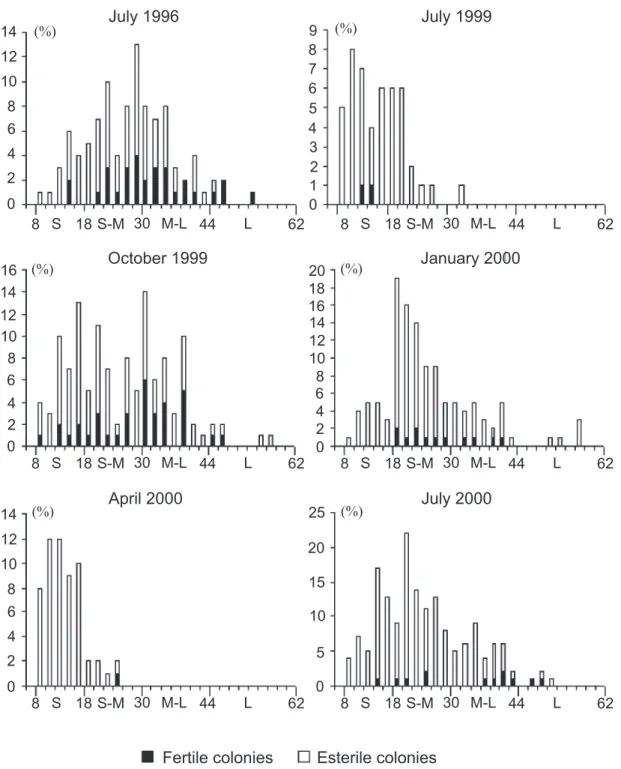
We grouped colonies into four different height classes (Fig. 3): small sized colonies (8-18 mm in height); small-medium sized colonies (18.1-30 mm); medium-large sized colonies (30.1-44 mm); and large sized colonies (over 44.1 mm). Biomass data were estimated using the equation that describes the relation between height and dry weight for E. caraiuru (OLIVEIRAet al., 2000:522, fig. 1).
A further step of analysis was to compare recruitment data on test panels (in the same place and conditions of the present study) obtained during 1994
Fig. 3. Frequency distribution of colonies of Eudendrium caraiuru from São Sebastião Channel (Southeastern Brazil), according to height classes. Each interval of the abscissa is 2.0 mm, except for the first that represents size classes of 0-8.0 mm (S, small sized; S-M, small-medium sized; M-L, medium-large sized; L, large sized).
Fertile colonies
Esterile colonies
8 S 18 S-M 30 M-L 44 L 62 8 S 18 S-M 30 M-L 44 L 62 8 S 18 S-M 30 M-L 44 L 62 8 S 18 S-M 30 M-L 44 L 62 8 S 18 S-M 30 M-L 44 L 62 8 S 18 S-M 30 M-L 44 L 62
Fertile colonies Esterile colonies
April 2000 July 2000
October 1999 January 2000
July 1996 July 1999
(%) (%)
(%) (%)
(%) (%)
0 2 4 6 8 10 14 12
0 5 15
10 20 25 0
6 12 16 14
2 4 10 8
0 6 12 16 14
2 4 10 8 18 20 0
2 4 6 8 10 14 12
0 6
2 4 7
and 1995 (A. E. Migotto & A. C. Marques, unpublished data). The data from that study were from plates one and two month old, submersed monthly into the water (cf.
MIGOTTOet al., 2001).
RESULTS
Eudendriumcaraiuru occurred during all seasons,
across a total of 617 measured colonies (Tab. I). The population was active (i.e. with active and well-developed
hydranths and sometimes gonophores) throughout the year. However, periods of more intense activity were characterized.
Hydrozoans observed in October 1999 exhibited the largest distribution of colony height classes (Fig. 3), and consequently showed a larger range and standard deviation (H in Tab. I). In January 2000 and July 2000, colony heights also occurred in the four classes, but fewer small colonies were represented in January 2000 and large colonies only rarely occurred in July 2000. Only small and small-medium colonies were present in July 1999 and April 2000, with lower standard deviations for these height classes (Tab. I).
During the study period, mean biomass per colony was highest in October 1999 and January 2000 (Tab. I). However, comparing biomass per plate (Fig. 4), January 2000 had smaller values than July 2000.
Colonies bearing mature gonophores occurred throughout the seasons (Tab. II), with October 1999 as the reproductive peak. Hydrozoans from October 1999 and January 2000 were almost all fertile female colonies; however, considering absolute numbers, October 1999 and July 2000 had the highest numbers of mature female gonophores (Tab. II). Data concerning E. caraiuru
recruitment during 1994 and 1995 (Fig. 5) (A. E. Migotto & A. C. Marques, unpublished data) have shown absence of recruitment during the warmer months (January to April 1995). The abiotic parameters (temperature and salinity) collected during the study by MIGOTTOet al. (2001), as
those collected by OLIVEIRAet al. (2000), were similar to
those of the historical means (Fig. 1).
DISCUSSION
Resting stages are common phenomena in hydrozoan life cycles, and are especially related to seasonality. Eudendrium glomeratum, a morphologically
very similar species to which E. caraiuru was previously
assigned (cf. MARQUES & OLIVEIRA, 2003), has resting
stages during the warmer months in the Mediterranean Sea (BOEROet al., 1986; ARILLOet al., 1989; BAVESTRELLO
& ARILLO, 1992). On the other hand, Brazilian populations
of E. caraiuru are active throughout the year, and no
indication of a resting stage was observed in the present study. The three-month gaps between our observations could obscure short period dormant stages of the colonies. However, the biological process of maturation of gonophores demands some time to complete; therefore, the presence of mature gonophores and eggs is an important indicator that resting stages are absent in E. caraiuru.
The population showed growth peaks in October 1999, January 2000, and July 2000, expressed by higher values of height, number of colonies and biomass per colony (Tab. I). OLIVEIRAet al. (2000) also represented a
peak in July of 1996. But in contrast to the study by OLIVEIRAet al. (2000), hydrozoans in July 1999 exhibited
low values of population growth. Historically, temperature and salinity are lower between July and September (Fig. 1) but temperature and salinity during the studied period (1999–2000) were lower between September and November (Fig. 2). The water in the São Sebastião Channel exhibits low salinity and temperature associated with the entrance of a coastal water current coming from the south (Southern Coastal Water, SCW), generally during the coldest months (CASTRO-FILHO, 1990). The
SCW is rich in plankton, and commonly carries waters from the estuarine regions of Cananéia and Santos, in the southern coast of the state of São Paulo. We hypothesize that the SCW possibly increases the stock of potential food items for E. caraiuru and, consequently, increases its populations
and activity. The possible late entrance of SCW in 1999 may explain the lower mean values of population biomass
Table I. Seasonal data of colonies of Eudendrium caraiuru Marques & Oliveira, 2003 from São Sebastião Channel, Southeastern Brazil: mean and standard deviation for H to BPC (BPC, biomass (mg) per colony; H, height (mm); MW, maximum width (mm); N, number of measured colonies; NB, number of branches per colony, including pedicels; RHI, hydranth inactivity rate (%); *, data of July 1996 from OLIVEIRAet al., 2000).
July 1996* July 1999 October 1999 January 2000 April 2000 July 2000
N 100 4 8 126 120 5 8 165
RHI 19.6 21.1 24.5 33.0 21.6 31.0
H 28.2±8.8* 16.7±5.4 26.9±11.0 25.7±9.8 14.6±3.8 23.9±9.7
M W *8.7±4.1* 5.1±3.1 7.9±5.2 9.4±5.7 5.3±2.7 8.6±4.8
NB 19.5±8.0* 3.3±2.0 3.6±2.7 5.7±4.4 2.1±1.3 3.2±2.5
BPC 1.95±1.81 0.53±0.35 1.43±1.15 1.29±1.06 0.39±0.21 1.13±0.92
Table II. Seasonal reproductive data of Eudendrium caraiuru Marques & Oliveira, 2003 from São Sebastião Channel, Southeastern
Brazil: (total number) (FMG, female mature gonophores; FR, fertility rate (% of fertile colonies); MFR, mature female rate (% of mature females per total number of female colonies); SR, sex ratio (females : males)).
July 1999 October 1999 January 2000 April 2000 July 2000
FR 16.7 40.5 33.3 15.5 26.1
SR 87.5:12.5 86.3:13.7 32.5:67.5 22.2:77.8 44.2:55.8
MFR 39.1 97.0 98.1 54.5 74.4
recorded in July 1999 than those in July 2000.
The rate of hydranth inactivity (RHI in Tab. I) is a good indicator of feeding activity. In this case, there was no remarkable difference between seasons (about 70-80% of the hydranths were active and potentially able for prey capture), demonstrating that feeding activity was constant throughout the year.
The differences between the mean number of branches (NB in Tab. I) in this study and that observed by OLIVEIRAet al. (2000) are because the latter considered
pedicels when counting number of branches.
The skewed distribution of colony heights (Fig. 3) suggests the presence of young colonies in the population, e.g., in July 1999 and April 2000. On the other
hand, the low number of small colonies in January 2000 caused the high means of height and biomass per colony observed for this month (Tab. I), and could reflect a decrease of sexual reproduction in the previous months, combined with the establishment of old and resistant colonies.
The high fertility rate (FR) values in October 1999 indicated a reproductive period peak at that time. Although fertility rate and mature female rate (MFR) were lower in July 2000 than in January 2000, this period had a higher absolute number of mature female gonophores (about 3.5 times higher than in January 2000). We believe that the cold water of the SCW in the channel is the factor regulating the sexual reproduction in this species. The higher values of recruitment observed during the coldest months (Fig. 5) support this hypothesis. Moreover, study with other hydroids suggests an important role of water temperature, as in the case of recruitment of Pinauay ralphi (Bale, 1884) during the
winter (cf. MIGOTTOet al., 2001, as Ectopleura ralphi).
Furthermore, recruits of E. caraiuru are probably derived
locally. Species of the genus are known to produce a mucous thread that links the parent colony to the planula, restricting its dispersal (WASSERTHAL & WASSERTHAL,
1973). This biological pattern has not been observed for
E. caraiuru, but occurrence in clumps indicates the
tendency of the larvae to settle near the parent colony. The inversion in the sex ratio (SR) between October 1999 and January 2000 (Tab. II) may be due to agglomeration of planulae forming patches of colonies of the same sex, in which there is a reciprocal attraction of the larvae in their recruitment, a feature already described for other eudendriids (cf. BAVESTRELLO &
CERRANO, 1992).
Alternatively, unisexual colonies may also be derived from asexual reproduction. Asexual reproduction is common in hydroids. In eudendriids, it is common to observe different main stems given off from the same hydrorhiza. In our study, peaks of asexual reproduction could have occurred before peaks of sexual reproduction. For example, sexual reproduction was frequent from July to October 1999, and from April to July 2000 (Fig. 4). Contrarily, during the austral warmer season (January to April) asexual reproduction could have predominated. In accordance, recruitment of E. caraiuru was not observed
at the same location and season during June 1994 and June 1995 (A. E. Migotto & A. C. Marques, unpublished data) (Fig. 5).
BOERO et al. (1986) reported Eudendrium glomeratum from the Ligurian Sea with a reproductive
period occurring from October to January (winter in Northern Hemisphere). Their study indicated that juvenile colonies, derived from the reproductive period of a given year, become sexually mature one year later, after a resting stage period. There was no indication of such pattern for the Brazilian E. caraiuru, as no resting stage was
observed.
In conclusion, Eudendrium caraiuru seems to have
been incorrectly assigned to E. glomeratum (cf. MARQUES
& OLIVEIRA, 2003) since its first record in Brazil. The
present study demonstrates differences in ecological patterns between E. caraiuru and a well knownpopulation
of E. glomeratum from the Mediterranean Sea, supporting
the taxonomic splitting of these species.
Acknowledgements. To Dr. Lea-Anne Henry for reviewing the text, to Dr. Alvaro Migotto and two anonymous referees for several suggestions, and to Luciana Figueiredo, Marcelo Pavani, Maria Paula Fracasso, Martim Ribeiro, and Raphael Viana for their help in fieldwork. This research was supported by FAPESP (Proc. 1989/0625-0; 1991/1599-2; 1991/1600-0; 1995/ 3022-5; 1996/10544-0; 1999/11328-8; 2000/14932-2; 2001/ 02626-7; 2003/02432-3), CNPq (Proc. 300271/2001-8) and CAPES.
Fig. 5. Number of recruits of Eudendrium caraiuru from São
Sebastião Channel (Southeastern Brazil) in ceramic plates submersed in water for 1 and 2 months (A. E. Migotto & A. C. Marques, pers. comm.).
Fig. 4. Seasonal variation in mean of biomass of Eudendrium caraiuru from São Sebastião Channel (Southeastern Brazil) per plates. (Vertical bars means standard deviation)
Jul 1999 Oct Jan Apr Jul 2000
70
60
50
40
30
20
10
0
Miligrams
per
plate
Jun 1994
Jun 1995
Aug Oct Dec Feb Apr
25
20
15
10
5
0
Number
of
recruits
One month submerged plates
REFERENCES
ARILLO, A.; BAVESTRELLO, G. & BOERO, F. 1989. Circannual cycle and oxygen consumption in Eudendrium glomeratum
(Cnidaria, Anthomedusae): studies on a shallow water population. Pubblicazione della Stazione Zoologica di Napoli, I: Marine Ecology 10(4):289-301.
BALDUZZI, A.; BIANCHI, C. N.; BOERO, F.; CATTANEO-VIETTI, R.; PANSINI, M. & SARA, M. 1989. The suspension-feeder communities of a Mediterranean sea cave. Scientia Marina 53(2-3):387-395.
BARANGÉ, M. 1988. Prey selection and capture strategies of the benthic hydroid Eudendrium racemosum. Marine Ecology Progress Series 47:83-88.
BARANGÉ, M. & GILI, J-M. 1988. Feeding cycles and prey capture in Eudendrium racemosum (Cavolini, 1785). Journal of Experimental Marine Biology and Ecology 115:281-293.
BARANGÉ, M.; ZABALA, M.; RIERA, T. & GILI, J-M. 1989. A general approach to the in situ energy budget of Eudendrium racemosum (Cnidaria, Hydrozoa) in the Western Mediterranean. Scientia Marina 53(2-3):423-427. BAVESTRELLO, G. & ARILLO, A. 1992. Irradiance, temperature
and circannual cycle of Eudendrium glomeratum Picard
(Hydrozoa, Cnidaria). Bolletino di Zoologia 59:45-48. BAVESTRELLO, G. & CERRANO, C. 1992. Aggregate colonies in
Eudendrium glomeratum Picard 1952 (Cnidaria, Hydrozoa, Anthomedusae). Scientia Marina 56(4):333-335. BAVESTRELLO, G.; CERRANO, C. & CATTANEO-VIETTI, R. 1994.
Colonies of Eudendrium glomeratum (Cnidaria,
Hydromedusae) as sediment traps on vertical rocky cliffs.
Bollettino dei Musei e degli Instituti Biologici dell´Università de Genova 58-59:125-130.
BAVESTRELLO, G.; CERRANO, C.; CATTANEO-VIETTI, R. & SARÀ, M. 1996. Relations between Eudendrium glomeratum
(Cnidaria, Hydromedusae) and its associated vagile fauna.
Scientia Marina 60(1):137-143.
BOERO, F.; BALDUZZI, A.; BAVESTRELLO, G.; CAFFA, B. & CATTANEO -VIETTI, R. 1986. Population dynamics of Eudendrium glomeratum (Cnidaria: Anthomedusae) on the Portofino
Promontory (Ligurian Sea). Marine Biology 92:81-85. BOERO, F. & FRESI, E. 1986. Zonation and evolution of a
rocky bottom hydroid community. Marine Ecology 7(2):123-150.
CALDER, D. R. 1988. Shallow-water hydroids of Bermuda. The athecate. Life Science Contributions, Royal Ontario Museum 154:1-107.
__. 1990. Seasonal cycles of activity and inactivity in some hydroids from Virginia and South Carolina, USA. Canadian Journal of Zoology 8:442-450.
__. 1993. Local distribution and biogeography of the hydroids (Cnidaria) of Bermuda. Caribbean Journal of Science 29(1-2):61-74.
CALDER, D. R. & MAYAL, E. M. 1998. Dry season distribution of hydroids in a small tropical estuary, Pernambuco, Brazil.
Zoologische Verhandelingen 323:69-78.
CASTRO-FILHO, B. M. 1990. Wind driven currents in the Channel of São Sebastião: winter, 1979. Boletim do Instituto Oceanográfico 38(2):111-132.
GILI, J-M. & HUGHES, R. G. 1995. The ecology of marine benthic hydroids. Oceanography and Marine Biology, an Annual Review 33:351-426.
MARQUES, A. C. 2001. O gênero Eudendrium (Hydrozoa, Anthomedusae, Eudendriidae) no Brasil. Papéis Avulsos de Zoologia 41(22):329-405.
MARQUES, A. C. & OLIVEIRA, O. M. P. 2003. Eudendrium caraiuru sp. n. (Hydrozoa; Anthoathecata; Eudendriidae) from the southeastern coast of Brazil. Zootaxa 307:1-12. MARQUES, A. C.; PEÑA-CANTERO, A. L. & VERVOORT, W. 2000b. Mediterranean species of Eudendrium Ehrenberg, 1834
(Hydrozoa, Anthomedusae, Eudendriidae) with the description of a new species. Journal of Zoology 252:197-213. MARQUES, A. C.; MERGNER, H.; HÖINGHAUS, R.; SANTOS, C. M. D. &
VERVOORT, W. 2000a. Morphological study and taxonomical notes on Eudendriidae (Cnidaria: Hydrozoa: Athecatae/ Anthomedusae). Zoologische Mededelingen 74 (5):75-118.
ME R G N E R, H. 1987. Hydroids as indicator species of environmental factors on coral reefs. In: BOUILLON, J.; BOERO, F.; CICOGNA, F. & CORNELIUS, P. F. S. eds. Modern trends in the systematics, ecology, and evolution of hydroids and hydromedusae. Oxford, Oxford Science Publications. p.185-195.
MIGOTTO, A. E.; MARQUES, A. C. & FLYNN, M. N. 2001. Seasonal recruitment of hydroids (Cnidaria) on experimental panels in the São Sebastião channel, southeastern Brazil. Bulletin of Marine Science 68(2):287-298.
MILLARD, N. A. D. 1975. Monograph on the Hydroida of Southern Africa. Annals of the South African Museum 68:1-513.
OLIVEIRA, O. M. P.; MARQUES, A. C. & MIGOTTO, A. E. 2000. Morphometric patterns of two fouling Eudendrium spp.
(Hydrozoa, Anthomedusae, Eudendriidae) from São Sebastião (SP, SE Brazil). Brazilian Archives of Biology and Technology 43(5):519-526.
PUCE, S.; BAVESTRELLO, G.; ARILLO, A.; AZZINI, F. & CERRANO, C. 2002. Morpho-functional adaptation to suspension feeding in Eudendrium (Cnidaria, Hydrozoa). Italian Journal of Zoology 69:301-304.
ROSSI, L. 1964. Fattori ecologici ed accrescimento in colonie di Eudendrium racemosum (Gmelin). Bollettino di Zoologia 31:891-904.
ROSSO, S. & MARQUES, A. C. 1997. Patterns of intertidal hydrozoan distribution along the coast of São Paulo State, southeastern Brazil. In: INTERNATIONAL CONFERENCE ON COELENTERATE BIOLOGY, 6th, Leiden, 1995. Proceedings... Leiden, Nationaal Natuurhistorisch Museum. p.415-422. SOMMER, C. 1990. Post-embryonic larval development and
metamorphosis of the hydroid Eudendrium racemosum
(Cavolini) (Hydrozoa, Cnidaria). Helgoländer wiss Meeresunters 44:425-444.
__. 1992. Larval biology and dispersal of Eudendrium racemosum (Hydrozoa, Eudendriidae). Scientia Marina 56(2-3):205-211.
WASSERTHAL, L. T. & WASSERTHAL, W. 1973. Ökologische Bedeutung der Schleimsekretion bei den Planula-larven der Hydroidengattung Eudendrium. Marine Biology 22 :341-345.
WATSON, J. E. 1985. The genus Eudendrium (Hydrozoa: Hydroida) from Australia. Proceedings of the Royal Society of Victoria 97:179-221.
WEDLER, E. 1975. Ökologische untersuchungen an hydroiden des felslitorals von Santa Marta (Kolumbien). Helgoländer wiss Meeresunters 27:324-363.