High Prevalence Anti-
Trypanosoma cruzi
Antibodies
,
among Blood
Donors in the State of Puebla, a Non-endemic Area of Mexico
MC Sánchez-Guillén/***, C Barnabé***, JF Guégan***, M Tibayrenc***,
M Velásquez-Rojas, J Martínez-Munguía*, H Salgado-Rosas, E Torres-Rasgado,
MI Rosas-Ramírez**, R Pérez-Fuentes****/
+Laboratorio de Parasitología, Centro de Investigación Biomédica de Oriente *Banco Central de Sangre **Coordinación Delegacional de Epidemiología, Hospital de Especialidades, Centro Médico Nacional Manuel Ávila Camacho, IMSS Puebla,
México ***Centre d’Etude sur le Polymorphisme des Micro-organismes, Institute de Recherche pour le Devélopement, Montpellier, France ****Facultad de Medicina, Benemérita Universidad Autónoma de Puebla, Puebla, México
Blood transfusion is the second most common transmission route of Chagas disease in many Latin American countries. In Mexico, the prevalence of Chagas disease and impact of transfusion of Trypanosoma cruzi -contami-nated blood is not clear. We determined the seropositivity to T. cruzi in a representative random sample, of 2,140 blood donors (1,423 men and 647 women, aged 19-65 years), from a non-endemic state of almost 5 millions of inhabitants by the indirect hemagglutination (IHA) and enzyme linked immunosorbent assay (ELISA) tests using one autochthonous antigen from T. cruzi parasites, which were genetically characterized like TBAR/ME/1997/RyC-V1 (T. cruzi I) isolated from a Triatoma barberi specimen collected in the same locality. The seropositivity was up to 8.5% and 9% with IHA and ELISA tests, respectively, and up to 7.7% using both tests in common. We found high seroprevalence in a non-endemic area of Mexico, comparable to endemic countries where the disease occurs, e.g. Brazil (0.7%), Bolivia (13.7%) and Argentina (3.5%). The highest values observed in samples from urban areas, associated to continuous rural emigration and the absence of control in blood donors, suggest unsuspected high risk of transmission of T. cruzi, higher than those reported for infections by blood e.g. hepatitis (0.1%) and AIDS (0.1%) in the same region.
Key words:Chagas disease - seroprevalence - blood donors - antibodies to Trypanosoma cruzi - autochthonous antigens -Puebla - Mexico
Chagas disease, caused by the protozoan parasite Try-panosoma cruzi, is now ranked as the most serious
para-sitic disease of the Americas with an economic impact far outranking the combined effects of the other parasitic dis-eases such as malaria, schistosomiasis and leishmaniasis (Dias & Schofield 1999).
Current World Health Organization estimation indi-cates about 16 to 18 millions people infected with T. cruzi
(WHO 1991). Sixty percent of them live in urban areas, and about 50% are in a latent period. Therefore, since many infected people are potential blood donors, one can expect that a further 100 millions are at risk of contracting the disease (Schmunis 1991, Moncayo 1992, Moraes-Souza & Bordin 1996, Dias & Schofield 1998).
Following the recent emphasis of public health poli-cies on vector control (Hayes & Schofield 1990), blood transfusion has now become one of the most significant routes for Chagas disease transmission (Dias 1992, Dodd 1998).
This research was supported by a grant from the FOSIZA-CONACYT 960802009.
+Corresponding author and permanent address: Facultad de Medicina, Benemérita Universidad Autónoma de Puebla, 13 Sur 2901, Col. Volcanes, Puebla, México. Fax: +52-222-243.14-44. E-mail: [email protected]
Received 10 December 2001 Accepted 26 June 2002
During the past decades, because of the migration from rural to urban areas, while decreasing the rural popu-lation exposed to infected vectors (Quintero et al. 1990), Chagas disease became frequent in cities and a health problem in a non endemic countries, where it can be trans-mitted vertically and by blood transmission (Schumunis 1999a) or organ transplantation (Carvalho et al. 1997). This,
thus increases the possibility of alternative pathways to disease contamination.
To date, the status of Chagas disease in Mexico is not clear, although an increasing number of cases of Chagas disease has been reported (Cuartero et al. 1967, Velasco-Castrejón & García 1970, Gloss et al. 1990) since this dis-ease was first recognized in 1940 by Mazzotti. Thus, while the National Seroepidemiological Survey (NSS) (Velasco-Castrejón et al. 1992) realized by the official Secretaría de Salud (SSa) showed a prevalence of 1.6%, independent studies carried out, mainly in rural areas, have shown that between 20-30% of the population was infected by the pathogen (Monteon et al. 1989, Tay et al. 1992). More-over, positive blood donors have been detected at per-centages of 0.2-17% of infected people (Goldsmith et al. 1978, Trujillo et al. 1993, Ramos-Echevarria et al. 1993, Rangel et al. 1998). This reports highlights the need for a comprehensible evaluation of the prevalence and risk of transmission of T. cruzi in endemic and non-endemic
ar-eas in Mexico.
In this work we estimated the prevalence of infection by T. cruzi in blood donors living in urban, suburban and
state (Mexico), with almost 5 millions of inhabitants, us-ing two serological tests, i.e. enzyme linked immunosor-bent assay (ELISA) and indirect haemagglutination (IHA), as suggested by World Health Organization (WHO 1991), employing an autochthonous antigen attributed to the genetic group T. cruzi I(Momen 1999).
POPULATION AND METHODS
Study area - The study was carried out in the Puebla
state, which is located in the Southeast region of Mexico (Fig. 1), in a valley up to 1,800 m above the sea level with a warm climate (average annual temperature of 22ºC). The population is composed of around 4,579,810 inhabitants; 60% of them live in rural and suburban conditions, which represents appropriate ecological and socioeconomic con-ditions for the transmission of Chagas disease.
Studied population - Healthy blood donors, from
blood banks of the clinics and hospitals of Instituto Mexicano del Seguro Social (IMSS), Puebla, Mexico, were selected. The criteria included residents of Puebla, aged between 18-65, > 50 kg, health clinically and seronegative to Hepatitis B Virus (HBC), Hepatitis C Virus (HCV), Bru-cella abortus (BrA), Hepatitis B surface antigen (HBsAg),
Venereal Disease Research Laboratory (VDRL) and Hu-man Immunodeficiency Virus (HIV) and without history of immunization, transplantation, menstruation, preg-nancy or lactation, according to the Technical Norm for Banks of Blood protocol (TNBB). Detection of anti-T. cruzi antibodies by the immunoenzymatic assay ELISA
and IHA tests were performed in the Laboratorio de Parasitología, Centro de Investigación Biomédica de Oriente, IMSS, Puebla, México.
In the design of the statistic sample, a stratified model was elaborated. The population was random-stratified
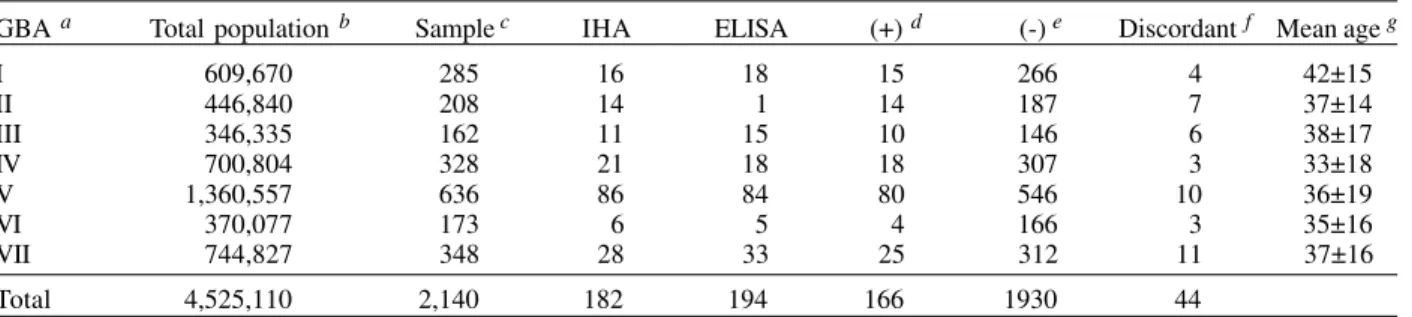
considering as total population 4,579,810 inhabitants, dis-tributed in seven regions, denominated Geostatistic Ba-sic Areas (GBA) (National Institute of Geography Infor-mation, INEGI), that include the 217 municipalities of the state (Fig. 1). This model represents the urban, suburban and rural populations of the state, according to the socioeconomical, political and cultural levels. The sample size was 2,140 individuals, stratified according the popu-lation density in each GBA (Table). The sample was de-termined with an estimated prevalence for T. cruzi
anti-bodies based on data obtained from the NSS, the desired level of precision for national estimates, with a confidence level of 95% and a variation coefficient of 0.3, which cor-responded to a minimal expected prevalence of 0.01 (Velasco-Castrejón et al. 1992). The level of precision was allowed to decrease for the different regions. The rural area was characterized by the lacked of sanitary services and presence of poor housing inhabit and coexistence with domestic and peridomestic animals. The suburban population was identified by the poor-housing situated in peripheral area of big cities and lacked of sanitary ser-vices and finally the urban population included the indi-viduals, living in an area with total sanitary services.
Serum samples - The sanguine samples from blood
donors, were collected of peripherical vein in Vacutainer system, in each selected blood banks of the clinics, hos-pitals, and Banco Central de Sangre, Hospital de Especialidades, Centro Médico Nacional Manuel Ávila Camacho, IMSS, Puebla. The serum was separated by centrifugation (1,200 g for 10 min), it was aliquoted in eppendorf tubes and it was frozen at -4oC and transported to Laboratorio de Parasitología, Centro de Investigación Biomédica de Oriente, IMSS, Puebla where it were stored in freezing (-20º C) until use.
Puebla state
Fig. 1: geographical situation of Puebla state, Mexico, and origin of blood donors considering the GBA (Geostatistics Basic Areas by the INEGI). GAB I: Huauchinango; GAB II: Teziutlán; GAB III: Ciudad Serdán; GAB IV: Cholula; GAB V: Puebla; GAB VI: Izúcar de Matamoros; GAB VII: Tehuacán.
USA
T. cruzi antigen characterization - T. cruzi parasites,
employed as autochthonous antigen, were obtained from a Triatoma barberi specimen collected in the area
local-ity, Puebla, Mexico. The isolated parasites were charac-terized by Multilocus Enzyme Electrophoresis (MLEE), RAPDs and Biodeme like TBAR/ME/1997/RyC-V1 (T. cruzi I).
T. cruzi autochthonous antigen preparation - Total
antigen from the Puebla strain RyC-V1 were obtained as previously reported (Pérez-Fuentes et al. 1998). In brief, the parasites (epimastigotes) were cultured and propa-gated in a liver infusion tryptose medium, supplemented with 10% fetal calf serum while growing at logarithmic phase was harvested, then sonicated in the presence of protease inhibitors, and spun down to 10,000 g x 30 min at 4ºC. The supernatant was used as a crude antigenic ex-tract whose protein concentrations, quantified by the method of Lowry were adjusted to 1 mg/ml and stored at -70ºC.
Serological characterization -Technique of ELISA
-Briefly,polystyrene plaques (Dynatech) were sensitized with the crude antigen extract of epimastigotes at a con-centration of 100 µg/ml in carbonates buffer pH 9.5 and blocked with bovine fetal serum to 1% in PBS-Tween 20 (0.01%). The blood donors and controls sera were diluted 1:100 and incubated by 1 h, washed with PBS. It was em-ployed conjugated human anti-IgG coupled to radish per-oxidase, the colorimetric reaction was developed with orto-phenilen-diamino and peroxide of hydrogen. The reac-tion was stopped and it was reading at 490 nm in ELISA’s reader.
Technique of IHA - The sensitization of the blood red
cells was required for this assay. Ram erythrocytes was used at a concentration of 2.5% in buffer of phosphate pH 7.2, they were mixed with tannic acid at a dilution of 1:60,000 and they were sensitized with autochthonous antigen from T. cruzi at 37ºC for 20 min, they were washed
themselves with PBS pH 7.2 and adjusted at a concentra-tion of 0.2 mg/ml. The problem sera at diluconcentra-tions 1:8, 1:32 and 1:64 were incubated by 2 h to room temperature. The identification of the antibodies was determined by the agglutination presence in the bottom of the wells of the
plate. It was considered the title of 1:8 as infection and 1:32 as confirmatory. All samples were analyzed by tripli-cate and repeated twice.
Positive and negative controls were included in each test. A positive result was defined as titer > 1:32 for the IHA test and > 0.200 for the ELISA. In both assays we employed the autochthonous T. cruzi antigens. Soluble
epimastigote antigen was prepared as previously de-scribed.
RESULTS
A total of 2,140 random blood samples of the seven areas of the Puebla were evaluated for anti T. cruzi
anti-bodies using ELISA and IHA tests. All subjects were > 18 years of age, weight > 50 kg, clinically healthy, and were residents from rural, suburban and urban areas in Puebla. The average age of the individuals was 32 years old rang-ing from 19 to 50 years with a female:male ratio of 1:3. All donors were seronegative for HBC, HCV, (HBsAg), BrA, VDRL and HIV, and all of them fulfilled criteria to Techni-cal Norm of Bank of Blood. Due to the lack of serologic “gold standard” for the diagnostic of Chagas disease, the sera employed in the evaluation were characterized by both matched IHA and ELISA tests. In each case, we tested for antibodies against T. cruzi using epimastigotes
of autochthonous antigens. Of the 2,140 serum samples analyzed, 194 (9.1%) showed antibodies against T. cruzi
with ELISA and 182 (8.5%) for IHA techniques, respec-tively. However, we considered as carriers of T. cruzi
anti-bodies, the 166 (7.7%) individuals (127 men and 39 women, mean age 36.8 ± 16.4), that were seropositive to both as-says, i.e. ELISA and IHA, according to WHO recommen-dations (1991).
Then, the samples were divided (Fig. 2) considering the distribution of seropositive blood donors for T. cruzi
antibodies by both ELISA and IHA tests and according to the stratification in seven district regions proposed by the INEGI.
Table illustrates the distribution of seropositive samples, including positive, negative and discordant re-sults, by studied areas. Prevalence rates were different between urban, suburban and rural origins for patients
TABLE
Distribution of IHA and ELISA test seropositive blood donors according to their geographical origin and total samples
GBA a Total population b Sample c IHA ELISA (+) d (-) e Discordant f Mean age g
I 609,670 285 16 18 15 266 4 42±15
II 446,840 208 14 1 14 187 7 37±14
III 346,335 162 11 15 10 146 6 38±17
IV 700,804 328 21 18 18 307 3 33±18
V 1,360,557 636 86 84 80 546 10 36±19
VI 370,077 173 6 5 4 166 3 35±16
VII 744,827 348 28 33 25 312 11 37±16
Total 4,525,110 2,140 182 194 166 1930 44
tested by IHA (Fisher’s exact test with correction, p = 10-5), by ELISA (p = 2.4 x 10⁻⁴) and by both tests (p = 10 -4). In addition, comparison were also significant between urban and suburban plus rural when plotted together by IHA (p = 10-5), by ELISA (p = 10-5) and by both tests (p = 10-6).
This study shows that the seroprevalence found in blood donors of a non-endemic area of Mexico (7.7%), i.e. the Puebla state, is relatively high, and comparable to those found in endemic states of others countries. These findings strongly contrast with the NSS in Mexico carried out in 1987, and published in 1992, which showed a low prevalence of 1.6%. These differences may be in part at-tributed to the fact that this last study was performed with statistics specifically designed for the characteriza-tion of urban transmissible diseases, such as AIDS, hepa-titis, but not for rural transmissible diseases such as Chagas disease (Velasco-Castrejón et al. 1992). Besides, our findings (7.7%) contrast with the more recent study carried out by the official SSa, that showed only 1.5% of national prevalence and specifically 1.8% from Puebla (Guzmán-Bracho et al. 1998). The discrepancy could be explained in part by the serologic tests employed (we used both ELISA and IHA assays), strain of the parasite used in the antigen preparation (autochthonous antigen), and mainly, by the size (random sample) and characteristic of analyzed population. Thus, in this work was performed in 64,969 blood donors, where approximately 850,000 dona-tions are done yearly, including samples from 18 of the 32 Mexican states, and the study did not rely on any specific statistics.
The antibody based immunoassay play a relevant role as diagnostic tool because of their high sensitivities. In the particular case of Chagas disease, no serologic “gold” standard exists, since detection of T. cruzi-specific
anti-bodies depends on many factors. Nevertheless, IFA is the most commonly used serologic test for Chagas dis-ease and, as result, is widely accepted as the gold stan-dard (Ferreira & Moraes de Avila 1995). Recent reports show that in-house IFA and in-house ELISA were highly concordant (Oelemann et al. 1998). Like is suggested by Organización Panamericana de la Salud (OPS), IHA is a screening technique while ELISA or IFA is for confirma-tory diagnosis with a higher specificity than IHA. In this work, in total agreement with the OPS recommendations that mandatory serology must be implemented in all coun-tries where T. cruzi is endemic by using at least two
sero-logical tests (OPAS 1998), we used two independent tech-niques, i.e. in-house IHA and in-house ELISA with the same antigen, the last assay presented a higher specific-ity to Chagas disease detection (Pérez-Fuentes et al. 1998). However, few countries use more than one test for blood donor screening (Schmunis 1999). A study carried out in 1998 in Cuernavaca (town of Morelos, Mexico) showed a seropositivity in blood donors of 17%, using a commercial ELISA kit in consecutive blood samples from 318 donors (Rangel et al. 1998).
Our findings can be explained in part by the kind of antigen we have used in serologic tests, further studies have suggested that the specificity of different methods depends on the selection of an adequate antigen (Mendes et al. 1997), considering that T. cruzi is polymorphic, and
different parasite strains circulate in different areas (Dias 1992). Then, genetic characterization of T. cruzi parasites
have shown that Mexican stocks belonging to T. cruzi I
and are closely related to each other (Bosseno et al. 2002).
GBA I= 5.2% 16/285
GBA II = 6.7% 14/208
GBA IV = 5.5% 18/328
GBA III = 6.2% 10/162
GBA V = 12.6% 80/636
GBA VII = 7.2% 25/348
GBA VI = 2.3% 41/173
Fig. 2: distribution of blood donors seropositives to antibodies against
Trypanosoma cruzi by both IHA and ELISA tests. The results show
the absolute values and % of seropositives according to the popula-tion density in each Geostatistcs Basic Areas (GBA).
DISCUSSION
While in many Latin American countries, Chagas se-rological tests are mandatory for all blood donors, in Chile (Ministerio da Saúde 1993) and in Mexico (Guzmán-Bracho et al. 1998) this measure is applied only in endemic areas. Furthermore, screening in Mexico is not routinely done in all endemic states (Schmunis 1999b).
The data presented in this work are relevant because they clearly establish the seroprevalence of T. cruzi
In Mexico, most studies have been performed using T. cruzi antigens extracted from strains originating from other
geographical origins, mainly South America, that show different genotypes (Bucio et al. 1999).
Previously, we have shown that assays utilizing com-mercial antigens from other countries are lesser sensitive than using T. cruzi authocthonous antigen in the
diag-nostic of Chagas diseases (Pérez-Fuentes et al. 1998). Recently this finding was demonstrated by other authors (Sánchez et al. 2001).
The specificity of our analysis was to use autochtho-nous antigens from local T. cruzi strains isolated in the
same area and characterized as T. cruzi I, could be
natu-rally reflect locally adapted host immune response against
T. cruzi natural clones circulating in the area.
In Mexico, the infection by T. cruzi is mainly silent.
Thus, like in most countries of Latin America, Chagas dis-ease has become an urban disdis-ease, due to the migration of people from endemic areas to the cities (Moraes-Souza 1999). In this work, although all of individuals were resi-dent of the region in study, the prevalence rate for T. cruzi
antibodies found in the blood donors of urban origin, i.e. Puebla (V Area), were twice higher than those of rural re-gions, where the identification of T. barberi, the insect
vec-tor and the conditions for natural infection and transmis-sion exist (unpublished data, Pérez-Fuentes R et al.). This could be explained by the migration of infected people from rural to urban areas as Puebla, capital city, due to the poor socioeconomic as in many Latin American countries. This could be suggest that urban transmission is now overcom-ing the classical rural transmission.
Many recent reports (Guzmán-Bracho et al. 1998, Dumontiel 1999, Schmunis 1999) show the need for a com-prehensive evaluation of the prevalence and distribution of Chagas disease in Mexico. In the present study, the identification of substantial prevalence of seropositive blood donors to T. cruzi suggests the existence of a high
risk of contamination by blood transfusion. As others have proposed, the routine programs of serologic screen-ing with immunological techniques with high sensibility and specificity definition, i.e. T. cruzi antigens extracted
from local strains, are urgently needed and applied. This should be done in all areas, including those that are con-sidered as non-endemic.
The last years, fortunately the situation has improved in Mexico. The ministry of Health has approved a law about screening for anti-T.cruzi antibodies in the whole
territory. Also, epidemiological surveillance and vector control programs have started to inform regulation (Guzmán-Bracho 2001).
Our results confirm that blood transfusion is an im-portant parameter in Chagas disease transmission in Mexico, besides the classical vectorial transmission. Vec-tor control therefore must be completed by adequate screening measures in all Mexican transfusion centers.
ACKNOWLEDGEMENTS
To the personal from Clínicas Comunitarias and Banco Cen-tral de Sangre del Centro Médico Nacional Manuel Ávila Camacho del Instituto Mexicano del Seguro Social for the facili-ties for this work; to the staff of U.M.R. 9926 C.N.R.S.-I.R.D.
in Montpellier, France for their invitation to come for a postdoctoral fellowship of RPF financed by CONACyT (00208) and MCSG financed by IMSS.
REFERENCES
Bosseno MF, Barnabé C, Magallón-Gastélum E, Lozano-Kasten F, Ramsey J, Espinoza B, Breniére SF 2002. Predominance of Trypanosoma cruzi lineage I in Mexico. J Clin Microbiol 40: 627-632.
Bucio MI, Cabrera M, Segura EL, Zenteno E, Salazar-Schettino M 1999. Identification of immunodominant antigens in Mexican strains of Trypanosoma cruzi. Immunol Invest 28: 257-268.
Carvalho MF, de Franco MF, Soares VA 1997. Amastigotes forms of Trypanosoma cruzi detected in a renal allograft. Rev Inst Med Trop São Paulo39: 223-226.
Cuartero L, Ponce D, Recco R 1967. Cinco nuevos casos de enfermedad de Chagas en Zacatecas y Jalisco, en la Repub-lica Mexicana. Rev Invest Salud Publica Mex 27: 29-32. Dias JC 1992. Epidemiology of Chagas disease. In S Wendel, Z
Brener, ME Camargo, A Rassi (eds), Chagas Disease (American Trypanosomiasis): its Impact on Transfusion and Clinical Medicine, International Society of Blood Transfu-sion, São Paulo, p. 49-80.
Dias JC, Schofield CJ 1998. Controle da transmissão transfu-sional da doença de Chagas na iniciativa de cone sul. Rev Soc Bras Med Trop31: 373-383.
Dias JC, Schofield CJ 1999. The evolution of Chagas disease (American trypanosomiasis). Control after 90 years since Carlos Chagas discovery. Mem Inst Oswaldo Cruz 94 (Suppl. I): 103-121.
Dodd RY 1998. Transmission of parasites by blood transfu-sion. Vox Sang74 (Suppl. 2): 161-163.
Dumontiel E 2001. Update on Chagas disease in Mexico. Salud Publica Mex 41: 359.
Ferreira AW, Moraes de Avila SL 1995. Laboratory diagnosis of Chagas heart disease. São Paulo Med J/RPM 113: 767-771. Gloss G, Barrera MR, Monteon VM, Reyes PA 1990.
Tripanosomiasis americana y cardiopatia chagasica cronica en el Instituto Nacional de Cardiologia Ignacio Chavez. Arch Inst Cardiol Mex60: 261-266.
Goldsmith RS, Zarate R, Kagan I, Cedeño-Ferreira J, Galindo-Vasconcelos M, Antonio-Paz E 1978. El potencial de la transmision en la enfermedad de Chagas por transfusion sanguinea: hallazgos serologicos entre donadores en el estado de Oaxaca. Salud Publica Mex20: 439-444.
Guzman-Bracho C 2001. Epidemiology of Chagas disease in Mexico: an update. Trends Parasitol 17: 372-376. Guzmán-Bracho C, García-García L, Floriani-Verdugo J,
Guerrero-Martínez S, Torres-Cosme M, Ramírez-Melgar C, Velasco-Castrejón O 1998. Riesgo de transmisión de Try-panosoma cruzi por transfusión de sangre en Mexico. Rev Panam Salud Pub4: 94-99.
Hayes RJ, Schofield CJ 1990. Estimación de las tasas de incidencia de infecciones y parasitosis crónicas en base a su prevalencia: la enfermedad de Chagas en América Latina. Bol Oficina Sanit Panam108: 308-316.
Mendes RP, Hoshino-Shimizu S, Moura da Silva AM, Mota I, Heredia RA, Luquetti AO, Leser PG 1997. Serological diag-nosis of Chagas disease: a potential confirmatory assay using preserved protein antigens of Trypanosoma cruzi. J Clin Microbiol35: 1829-1834.
Momen H 1999. Taxonomy of Trypanosoma cruzi: commen-tary on characterization and nomenclature. Mem Inst Oswaldo Cruz 94: 181-184.
Moncayo A 1992. Chagas disease: epidemiology and prospects for interruption of transmission in the Americas. World Health Stat Q45: 276-279.
Monteón VM, Sosa T, Reyes PA 1989. Serological test for American trypanosomiasis: a comparative study. Rev Latinoam Microbiol31: 35.
Moraes-Souza H 1999. Chagas infection transmission control: situation of transfusional transmission in Brazil and other countries of Latin America. Mem Inst Oswaldo Cruz 94 (Suppl. I): 419-423.
Moraes-Souza H, Bordin JO 1996. Strategies for prevention of transfusion associated Chagas disease. Transfus Med Rev 10: 161-170.
OPAS-Organizacion Panamericana de la Salud 1998. Situación de los bancos de sangre en América Latina. 1996: marcadores serológicos para enfermedades transmisibles a donantes de sangre. Bol Epidemiol 19: 11-13.
Oelemann WM, Teixeira MG, Da Costa GV, Borges-Pereira J, De Castro JA, Rodríguez-Coura J, Peralta JM 1998. Evalu-ation of three comercial enzyme-linked immunosorbent as-says for diagnosis of Chagas disease. J Clin Microbiol 36: 2423-2427.
Pérez-Fuentes R, Sánchez-Guillén MC, González-Álvarez C, Monteón VM, Reyes PA, Rosales-Encina JL 1998. Hu-moral nitric oxide levels and antibody immune response of symptomatic and indeterminate Chagas disease patients to commercial and autochthonous Trypanosoma cruzi anti-gen. Am J Trop Med Hyg58: 715-720.
Quintero ZT, Troncoso MC, Arnesi N, Boggio G, Sánchez S 1990. Comportamientos migratorios en dadores de sangre y las probabilidades de transmitirla por medio de la transfusión. Bol Chil Parasitol 24: 88-93.
Ramos-Echevarria AA, Monteón-Padilla VM, Reyes-López PA
1993. Detección de anticuerpos contra Trypanosoma cruzi en donadores de sangre. Salud Publica Mex35: 56-64. Rangel H, Gatica R, Ramos C 1998. Detection of antibodies
against Trypanosoma cruzi in donors from a blood bank in Cuernavaca, Morelos, Mexico. Arch Med Res29: 79-82. Sánchez B, Monteón V, Reyes PA, Espinoza B 2001.
Standard-ization of micro-enzyme-linked immunosorbent assay (ELISA) and western blot for detection of Trypanosoma cruzi antibodies using extracts from mexican strains as anti-gens. Arch Med Res 32: 382-388.
Schmunis GA 1991. Trypanosoma cruzi, the etiologic agent of Chagas disease: status in the blood supply in endemic and non endemic countries. Transfusion 31: 547-557.
Schmunis GA 1999a. Prevention of transfusional Trypanosoma cruzi infection in Latin America. Mem Inst Oswaldo Cruz 94 (Suppl. I): 93-101.
Schmunis, GA 1999b. Risk of Chagas disease through transfu-sions in the Americans. Medicina (B Aires)59 (Suppl. 2): 125-134.
Tay J, Schenone H, Sánchez JT, Robert L 1992. Estado actual de los conocimientos sobre la enfermedad de Chagas en la Republica Mexicana. Bol Chil Parasitol 47: 43-53. Trujillo F, Lozano F, Soto M, Hernández R 1993. Prevalencia
de infeccion a Trypanosoma cruzi en donadores de sangre en el estado de Jalisco, Mexico. Rev Soc Bras Med Trop 26: 89.
Velasco-Castrejón O, García L 1970. Estudio clínico y epide-miológico de un nuevo caso humano de enfermedad de Chagas en la Republica Mexicana. Prensa Med Mex 35: 438. Velasco-Castrejón O, Valdespino JL, Tapia-Conyer R, Salvatierra
B, Guzmán-Bracho C, Magos C, Llausas A, Gutiérrez G, Sepúlveda J 1992. Seroepidemiología de la enfermedad de Chagas en Mexico. Salud Publica Mex 34: 186-196. WHO-World Health Organization 1991. Control of Chagas