Brazilian Journal of Physics, vol. 38, no. 3B, September, 2008 483
Dipole Scattering Amplitude in Momentum Space: Investigating Fluctuations at HERA
E. Basso,∗M. B. Gay Ducati,†E. G. de Oliveira,‡ and J. T. de Santana Amaral§ Instituto de F´ısica, Universidade Federal do Rio Grande do Sul,
Caixa Postal 15051, 91501-970 - Porto Alegre, RS, Brazil (Received on 4 August, 2008)
We extend a recently proposed dipole model which relates the virtual photon-proton cross section to the dipole-proton forward scattering amplitude in momentum space investigating the effects of the gluon number fluctuations. The model interpolates between well known asymptotic behaviours predicted by perturbative QCD from the Balitsky-Kovchegov equation, which describes the rapidity evolution of the dipole-proton scattering amplitude in the mean field approximation. The model was shown to be successful in describing the last HERA data for the case where the strong coupling constantαsis fixed, showing also some important advantages when
compared with other dipole models – all of them in coordinate space – in the literature. Based on the fact that the fluctuations may be important in the small-xevolution and on recent results obtained in coordinate space beyond the mean field approximation, we use this model to parametrize the proton structure function and confront it to HERA data using the average (physical) amplitude – then including fluctuations – within the momentum space framework.
Keywords: Evolution equations; Dipole picture; Scattering amplitudes; DIS and fluctuations
1. INTRODUCTION
The dipole picture [1] is a powerful framework through which it is possible to understand many important features of scattering ane evolution in QCD at high energies. In particu-lar, it allows one to describe the evolution of scattering ampli-tudes in hadronic interactions. In this picture, a gluon can be replaced by a colorless quark-antiquark pair, a dipole, and a gluon-target scattering becomes a dipole-target scattering. If one considers a projectile made of one dipole, which interacts with a dense target, for example, a proton, the evolution of the dipole-proton scattering amplitude is given, in the limit where the number of colorsNc is large, by the so called Balitsky-JIMWLK equations [2,3], which consist of an infinite hierar-chy which relates the one-dipole scattering amplitude with the two-dipole amplitude, whose evolution depends on the three-dipole amplitude and so on.
Of course, to deal with this infinite hierarchy it is not an easy task. However, if one performs a mean field approxima-tion, this set of equations reduces to a single equation which describes the evolution in rapidity Y (the logarithm of the energy) of the one-dipole scattering amplitudeT(,y,Y)of a dipole with a quark and the antiquark whose transverse co-ordinates arexandy. This mean field version of Balitsky-JIMWLK equations is known as BK (Balitsky-Kovchegov) equation [2,4].
From a pioneering analysis of BK equation and its solu-tions [5], it became clear that the high energy evolution in QCD is similar to a reaction-diffusion process in statistical physics. From this correspondence, it has been also realized that the gluon number fluctuations are important in the evo-lution towards high energy (small-x). These fluctuations are
∗Electronic address:[email protected]
†Electronic address:[email protected] ‡Electronic address:[email protected] §Electronic address:[email protected]
not included in the original Balitsky-JIMWLK hierarchy and obviously missed in its mean field version, the BK equation.
The fluctuations have been exhaustively investigated in re-cent years and their effects in the high energy evolution will be discussed in the next sections of this contribution. What one can antecipate is that they dramatically influence the high energy scattering, at least in the case when the strong coupling constantαsis fixed. Among these investigations, one can cite a recent study [6] of the possible implications of the gluon number fluctuations in the measurements of the F2 proton structure function of deep inelastic scattering (DIS) at HERA, through well known models for the dipole-proton cross sec-tion in coordinate space [7,8]. The results show that, although they may be present in the DIS measurements, they seem not to strongly influence the evolution at HERA energies.
In these proceedings we use the first model for the dipole-proton cross section developed in momentum space [9] with fluctuation effects included to fit the last HERA data. This model has shown to be successful in the description of DIS data, specially with heavy quark (charm) contributions in-cluded, by using a mean-field (BK) inspired parametrization for the scattering amplitude, which enters in the expression for the dipole-proton cross section. Some preliminary results are presented and some future expectations on the effects of fluctuations at HERA are discussed.
2. γ∗−pCROSS SECTION IN THE DIPOLE PICTURE
484 E. Basso et al.
dipole-proton cross sectionσdip
σγT,L∗p(Q2,Y) =
Z d2r
Z 1
0
dz¯¯ΨT,L(r,z;Q2)¯¯
2
σdip(r,Y), (1) where the rapidity variableY is defined in terms of the square of the total energy of the process, or the inverse of the Bjorken variablex, byY≡ln 1/x=lnsandris the vector which gives the transverse size of the dipole, composed by a quark and an antiquark which carry a fractionzand 1-zof the momentum of the photon, respectively.
From Eq.(1) it is possible to write theF2structure function through the relation
F2(x,Q2) = Q2 4π2α
em
h
σTγ∗p(x,Q2) +σLγ∗p(x,Q2)i. (2) From the optical theorem, the dipole-proton cross section, which must be modelled, can be expressed in terms of the dipole-proton scattering amplitude hT(r,b)iY at a given im-pact parameterb, where the average is taken over the target wavefunction. The procedure of modellingσdip is not new and among the models in the literature one can cite the GBW (Golec-Biernat and Wusthoff) model [7] and the IIM (Iancu, Itakura and Munier) model [8], which is based on pertur-bative QCD predictions for the scattering amplitudes. Both parametrizations are constructed in the b–independent case, for which the dipole-proton cross section can be written as
σγdip∗p(r,Y) =2πR2phT(r,Y)i, (3) whereRpis the radius of the proton. From now on we will omit the brakets and writeT(r,Y)only to denote the average amplitude. If one Fourier transforms the amplitudeT(r,Y), the dipole-proton cross section can be written in terms of the amplitude in momentum space, ˜T(k,Y). TheF2structure function then takes the form [9]
F2(x,Q2) =
Q2R2pNc 4π2
Z ∞
0 dk
k Z 1
0
dz|Ψ˜(k2,z;Q2)|2T˜(k,Y),(4) where the wavefunction is now expressed in momentum space.
3. THE AGBS MODEL
All the parametrizations for the scattering amplitude cited above are developed in coordinate space, i.e., provide an ex-pression forT(r). However, in a recent publication, a different parametrization was proposed for theσdip, the AGBS model (Amaral, Gay Ducati, Betemps and Soyez) [9], which is ex-pressed in terms of ˜T. This is the first parametrization for the scattering amplitude in momentum space in the literature and will be described in what follows.
The AGBS model interpolates between two asymptotic be-haviors of the scattering amplitude predicted by perturbative QCD in the framework of the mean-field Balitsky-Kovchegov (BK) nonlinear evolution equation [2,4] (in momentum space,
of course). These asymptotic behaviors come from the prop-erties of solutions of BK equation in the saturated (infrared) and dilute regimes, given, respectively, by
˜
T(k,Y)k≪Qs
= c−log
µ k
Qs(Y)
¶
(5)
and
˜
T(k,Y) k≫≈Qs
µ k2
Q2 s(Y)
¶−γc
log
µ k2
Q2 s(Y)
¶
× exp
"
−log
2¡
k2/Q2 s(Y)
¢
2 ¯αχ′′(γc)Y
#
. (6)
HereQs(Y) =exp(λY)is the so called saturation momentum, andλthe saturation exponent, given by
λ=min ¯αχ(γ) γ =α¯
χ(γc) γc
=αχ¯ ′(γc). (7)
where ¯α≡αsNc/πandχ(γ)is the BFKL kernel [10]. For the LO kernel,γc=0.6275...
The interpolation in the AGBS model is done through the following expression for the scattering amplitude
T(k,Y) =
·
log
µ k
Qs
+Qs
k
¶
+1
¸ ¡
1−e−Tdil¢. (8) where
˜
Tdil=exp
· −γclog
µ
k2 Q2
s(Y)
¶
−
L
2−log2(2) 2 ¯αχ′′(γc)Y
¸
(9)
with
L
=log·
1+ k
2
Q2 s(Y)
¸
and Q2s(Y) =k20eλY. (10)
4. PROPERTIES OF THE SCATTERING AMPLITUDES
BK equation is the most simple nonlinear equation which describes the evolution of the scattering amplitude towards the high energy limit, and some of its properties are well known. In particular, it has been shown [5] that this equation admits traveling waves solutions, which are a natural explanation to the geometric scaling observed in theγ∗−pcross section at HERA. The scattering amplitude is a front which travels to-wards higher values of transverse momentakand, at asymp-totic rapidities, depends only on the scaling variable lnk2/Q2
s, lnQ2s being the front position andλits asymptotic velocity.
Brazilian Journal of Physics, vol. 38, no. 3B, September, 2008 485
model χ2/n.o.p k02 (×10−3) λ R(GeV−1) χ′′(γc) D
˜
TAGBS 0.960 3.782±0.301 0.213±0.003 3.576±0.059 4.6903±0.227 0
hT˜AGBSi 0.974 3.601±0.296 0.181±0.004 3.771±0.066 3.959±0.217 1.224
TABLE I: Results from the fit to theF2data, where values of the parameters with their respective errors are indicated, together with theχ2per data point.
When the fluctuations are included, some crucial changes take place in the high energy evolution. Different realizations of the target up to rapidityY generate fronts with different po-sitionsρs≡lnQ2s(Y)/k02. The single event amplitude is still a traveling front, which, at asymptotic rapidities satisfies ge-ometric scaling, but with a speedλ∗ smaller than the corre-spondent mean field prediction.
The saturation scale becomes a random variable with aver-age value and dispersion given, respectively, by
hρsi=exp[λ∗Y], σ2=hρ2si − hρsi2=Dα¯Y. (11) The probability distribution ofρs is approximately Gaussian [12]
PY(ρs)≃ 1
√
πσ2exp
·
−(ρs− hρsi)
2
σ2
¸
(12)
One must then distinguish the single event amplitude from the average amplitude, given by (ρ≡lnk2)
hT(ρ,ρs)i= Z +∞
−∞ dρsPY(ρs)T(ρ,ρs). (13) A crucial consequence of the fluctuations is that, at suffi-ciently high energies, geometric scaling will not be present in the evolution of the average amplitude, but it will be replaced by a new type of scaling, the diffusive scaling [11,13]
hT(ρ,ρs)i=
T
µ
ρ− hρsi
√
DY
¶
, (14)
whereDis the diffusion coefficient.
5. DIS AND FLUCTUATIONS
In Ref. [6], the IIM and GBW models were considered in the presence of fluctuations to reproduce the measurements of F2proton structure function from DIS at HERA [14,15]. For each model, the corresponding parametrization was con-sidered as a single-event amplitude, the average (13) was per-formed and the resulting amplitude replaced into the expres-sion ofF2, with the diffusion coefficient being taken as a free parameter. violating has gained a large improvement after ef-fects, while in the IIM model these improvement was not so large, due explicitly violates the geometric scaling.
In these proceedings, we propose the same investigation done in [6], not in coordinate space, but in momentum space through AGBS model. In this analysis, all the last HERA data
measurements of the proton structure function from H1 Col-laboration [14] and ZEUS ColCol-laboration [15] are fitted. The kinematical range is given by
x ≤ 0.01,
0.045≤ Q2 ≤150 GeV2, (15) which gives a total of 279 data points. The first limit means that we are interested in the high-energy regime of DIS and the second one is low enough to allow an investigation without considering DGLAP corrections. The above range is larger than the one used in [6], then it seems the present analyis is more precise.
Concerning the parameters, we keep fixed ¯α=0.2, which enters into the amplitude through Eq.(7),γc=0.6275, whose value corresponds to the one obtained from the LO BFKL ker-nel, andD=1.224, which is the value found numerically by solving the (1+1) dimensional toy model [16]. The other pa-rameters in the amplitude, λ,k02 andχ′′ are left to be free, as well as the proton radiusRp, which fixes the normalisation of the proton cross section with respect to the dipole-proton amplitude. This analysis includes light quarks only and the value used for their masses ismu,d,s=50 MeV.
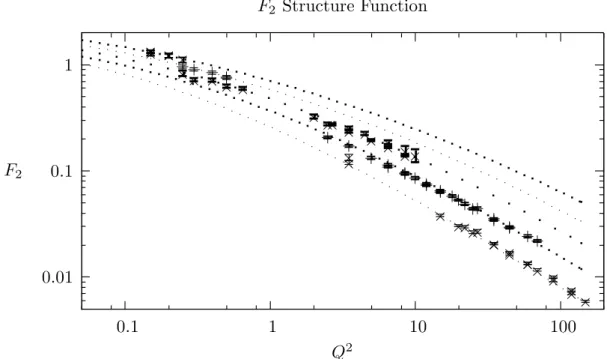
The results of the fit to theF2structure function are shown in Table I, where the parameters and theχ2/n.o.p.(this no-tation meansχ2 per number of points) are presented. In this table we compare the results obtained using the average and the single-event amplitudes. Fig. 1 showsF2as a function of Q2for different values of the rapidityY. One can see that the data are very well fitted by the correspondent curves, as pro-vided by the value of theχ2 obtained by using the average amplitude.
The value for theχ2obtained with the average amplitude is not significantly improved with respect to the case with the single event amplitude. The same happens for the parameters which differ from one analysis to another, but also not sig-nificantly, except the saturation exponentλ, which is smaller when the fluctuations are included, in agreement with theoret-ical predictions. This seems to indicate that, although the fluc-tuations may be present, they are not so important in the ener-gies at HERA, and more, the scaling violations come mainly from the diffusion term present in the scattering amplitude in the dilute regime (6), which is a mean field (BK) asymptotic prediction for the amplitude.
486 E. Basso et al.
0.01
0.1
1
0.1
1
10
100
F
2Q
2F
2Structure Function
×
×
××
×
×
×
×
×
×
××
×
×
××
×
×
×
+
+
+
+ +
++
+
+
+
+
+
++
+
++
++
+
+
++
×
× ×
× ×
×
×× ×
× ×
× ×
×
×
××
++ +
+
+
×
×
× ×
××
FIG. 1: TheF2proton structure function as a function ofQ2for different values of rapidityY. From bottom to top,Y=0,2,4,6,8.
[1] A. H. Mueller, Nucl. Phys. B415, 373 (1994); A. H. Mueller and B. Patel, Nucl. Phys. B 425, 471 (1994); A. H. Mueller, Nucl. Phys. B437, 107 (1995).
[2] I. Balitsky, Nucl. Phys. B 463, 99 (1996) [arXiv:hep-ph/9509348].
[3] J. Jalilian-Marian, A. Kovner, A. Leonidov, and H. Weigert, Nucl. Phys. B 504, 415 (1997) [arXiv:hep-ph/9701284]; E. Iancu, A. Leonidov, and L. D. McLerran, Nucl. Phys. A692, 583 (2001) [arXiv:hep-ph/0011241]; H. Weigert, Nucl. Phys. A 703, 823 (2002) [arXiv:hep-ph/0004044].
[4] Y. V. Kovchegov, Phys. Rev. D60, 034008 (1999) [arXiv:hep-ph/9901281]; Phys. Rev. D 61, 074018 (2000) [arXiv:hep-ph/9905214].
[5] S. Munier and R. Peschanski, Phys. Rev. Lett. 91, 232001 (2003); Phys. Rev. D 69, 034008 (2004); Phys. Rev. D70, 077503 (2004).
[6] M. Kozlov, A. Shoshi, and W. Xiang, JHEP0710, 020 (2007) [arXiv:0707.4142 [hep-ph]].
[7] K. Golec-Biernat and M. Wusthoff, Phys. Rev. D59, 014017 (1999) [arXiv:hep-ph/9807513].
[8] E. Iancu, K. Itakura, and S. Munier, Phys. Lett. B590, 199 (2004) [arXiv:hep-ph/0310338].
[9] J. T. de Santana Amaral, M. B. Gay Ducati, M. A. Betemps, and G. Soyez, Phys. Rev. D 76, 094018 (2007)
[arXiv:hep-ph/0612091].
[10] L. N. Lipatov, Sov. J. Nucl. Phys.23, 338 (1976); E. A. Kuraev, L. N. Lipatov, and V. S. Fadin, Sov. Phys. JETP45, 199 (1977); I. I. Balitsky and L. N. Lipatov, Sov. J. Nucl. Phys. 28, 822 (1978).
[11] E. Iancu and D.N. Triantafyllopoulos, Nucl. Phys. A756, 419 (2005).
[12] C. Marquet, G. Soyez, and B. W. Xiao, Phys. Lett. B639, 635 (2006).
[13] E. Iancu and A.H. Mueller, Nucl. Phys. A730, 494 (2004); A. H. Mueller and A.I. Shoshi, Nucl. Phys. B692, 175 (2004); Y. Hatta, E. Iancu, C. Marquet, G. Soyez, and D. N. Triantafyl-lopoulos, Nucl. Phys. A773, 95 (2006).
[14] C. Adloff et al. [H1 Collaboration], Eur. Phys. J. C 21, 33 (2001) [arXiv:hep-ex/0012053].
[15] J. Breitweget al. [ZEUS Collaboration], Phys. Lett. B 487, 273 (2000) [arXiv:hep-ex/0006013]; S. Chekanovet al.[ZEUS Collaboration], Eur. Phys. J. C 21, 443 (2001) [arXiv:hep-ex/0105090].
[16] E. Iancu, J. T. de Santana Amaral, G. Soyez, and D. N. Tri-antafyllopoulos, Nucl. Phys. A786, 131 (2007).