From the Biology and Physiology Lab of Microorganisms, University of Alfenas – Alfenas/Minas Gerais, Brazil.
Received for publication on October 16, 2002.
USE OF LICIT AND ILLICIT DRUGS AT THE
UNIVERSITY OF ALFENAS
João Evangelista Fiorini, Adriana Luiza Alves, Luciano Resende Ferreira, Celso Maia Fiorini, Sandro Willian Durães, Ricardo Luiz Diniz Santos, Luiz Carlos do Nascimento, Andréa Mantelo Vicente Geraldini and Cássia de Fátima Ortiz
FIORINI JE et al. - Use of licit and illicit drugs at the University of Alfenas. Rev. Hosp. Clín. Fac. Med. S. Paulo 58 (4):199-206, 2003.
This paper reports the study of drug consumption carried out within the population of undergraduate students from 2 colleges of Alfenas, in the state of Minas Gerais state. Both licit and illicit drugs were studied, including alcohol, tobacco, marijuana, cocaine, heroin, crack, inhalants, glue, tranquilizers, stimulants, and others.
METHODOLOGY: The research included a wide bibliographical search and the application of a questionnaire to approximately 23% of the students (total of 6500 students).
RESULTS: A total of 1500 students participated in this investigation. The results demonstrated that there was a significant consumption of both licit and illicit drugs. The pattern of drug consumption in the research sample was similar to other investigations conducted in Brazil and in other countries.
DISCUSSION: It was observed that 55% of the university students use drugs. However, the most surprising finding was that most of the students (88%) answered “yes” to the inquiry, “Have you already tried any type of drug, including alcohol and cigarettes?” The students revealed that they had taken drugs even prior to the admission to the university. The results suggest clearly that the university environment does not necessarily represent the starting point for student drug consumption.
DESCRIPTORS: Drugs. Toxics. University. Students. Youth.
During the past few years, the con-sumption of illicit drugs has been in-creasing considerably among the young Brazilian population. The pre-cocious relationship between drugs and the consumer can be found in several papers in the literature. Among the several factors that account for the growth of distribution and consump-tion of drugs in this country include the psychosocial factors of youth that are related to the search for freedom and fast, easy pleasure1-7.
The individuals involved with the sale and distribution of drugs seek high school and undergraduate students. Studies were performed concerning the influence of gender and age regarding
the consumption of drugs in Brazil; the authors verified that the male population had greater preference for non-prescription drugs, whereas fe-male users tended to prefer psycho-tropic medications. With regard to the correlation between cigarette use and alcohol abuse, the authors found greater consumption in the male popu-lation, with the consumption of alco-hol being more frequent than tobacco use6,7. It was also observed that of 63
people hospitalized for drug abuse, 86% were male, with ages ranging from 12 to 25 years. Except for tobacco and alcohol, marijuana was reported by 66% of the interviewees as the first psychoactive drug used, serving as the starting point for the use of other drugs7. In São Paulo, the incidence of
alcoholism is 8 times greater in adult men, but it has grown faster among the women2,3.
aggres-siveness, convulsion, bronchitis, infer-tility, thirst, hunger, insomnia, nausea, neuronal degeneration, renal failure, and death. Heroin, however, causes drowsiness, pain relief, torpor, miosis, paralysis, and respiratory and cardiac depression19.
From the study of the epidemiol-ogy of the use of volatile solvents since 1940, it was concluded that abuse of this drug is restricted to cer-tain segments of the population, such as ethnic minorities of developing countries8. However, in Latin America,
the use of volatile solvents has spread and has been increasing in the last years, especially among the youth and poor children3,8.
Of the 700 people with ages be-tween 9 and 21 years that were inter-viewed by the “Instituto Brasileiro de Opinião Pública e Estatística (IBOPE)”, 65% reported use of narcot-ics, alcohol, or tobacco. Around 50% of these users reported having tried co-caine, marijuana, and glues before 15 years of age, and 75% used alcohol and cigarettes before this age21.
Studies carried out with 116 pa-tients assisted by the Hospital das Clínicas, Faculty of Medicine, Univer-sity of São Paulo between 1984 and 1988 indicated a considerable increase of cocaine use in the last 2 years of the study9.
The association between the con-sumption of drugs and juvenile delin-quency among university students was studied in Mexico. It was observed that the drug abusers were responsible for significantly more antisocial acts than the non-users. The results from a study involving undergraduate students in-dicated that the drugs most frequently used were marijuana, amphetamines, and inhalants10,11. In Valinhos, São
Paulo, heroin was considered the sec-ond most frequently used drug by the youths, ahead of marijuana and co-caine, according to research con-ducted by the Institute of Psychology
of San Francisco University. Alcohol associated with another drug was in first place13. With regard to violence,
a medical study conducted by the Fed-eral University of São Paulo revealed that in the general population, a larger number of violent acts are related to alcohol and cocaine drug addicts23.
Among students of middle school from Distrito Federal, involving a sam-pling of 1448 students, a question-naire was administered that revealed the prevalence of the use of drugs in the following order: alcohol (67.2%), cigarettes (28.7%), inhalants (13.9%), marijuana (6.1%), and cocaine (1.8%), which was used mainly by males12. In
a study of 370 drug users in Belo Horizonte, the most frequently used drug was marijuana18.
In greater São Paulo in a study of 1069 university students, it was veri-fied that in first place was alcohol use (82%), followed by tobacco (39%), in-halants (28%), marijuana (26%), medi-cations (17%), and cocaine (10%). A greater probability of single male mari-juana users, with a high socioeconomic level, who smoked tobacco and used marijuana for the first time between 13 and 17 years old, was also observed15.
The current study was conducted with the objective of verifying the in-cidence and prevalence of licit and il-licit drugs in the university population from the city of Alfenas, Minas Gerais, and the implications for the city in this context.
MATERIALS AND METHODS
General characterization of the loca-tion where the studies were conducted.
The city of Alfenas, located in the state of Minas Gerais, was chosen be-cause of the large number of students in relation to the total population (above 10%), in addition to its tradi-tion as a college city since 1914. It is
also a magnet for high school students and possesses an active night life. Currently, a total of 30 graduate-level courses are held in Alfenas.
Data Collection
The students were interviewed be-tween the months of May and October of 1999. Students of both genders were from the university classes of the city of Alfenas, with the age group ranging from 18 to 25 years.
Sampling
Among a total of 6500 students, with 5620 students from the Univer-sity of Alfenas and 880 from the School of Pharmacy and Dentistry of Alfenas, 1500 questionnaires were dis-tributed, registering a sampling of 23% of the total university population of the city. These questionnaires were divided proportionally among each institution, course, and period of enrollment and were distributed ran-domly among the students of each class, in agreement with the protocols established for sample stratification, and then were tabulated in percen-tiles24. After answering the
question-naire, students placed the results in an envelope, which was then sealed. The questionnaires did not contain any type of personal identification. Each questionnaire contained 26 items re-lated to whether the university student had already used any drug, the age and school level when the student used the drug for the first time, the drug type, the continuity of the use, and other in-formation (Addendum I).
RESULTS
Fig.1 - Percentile distribution in relation to age (in years-old) of those students who had used drugs for the first time. drugs. The remaining students (88%)
answered affirmatively that they had already used licit or illicit drugs. From this total, 92% had used before the en-trance to the University, with 14% first using before 12 years of age, 45% first using between 13 to15 years of age, 33% between 16 to18 years of age, and 8% after 18 years of age (Fig. 1).
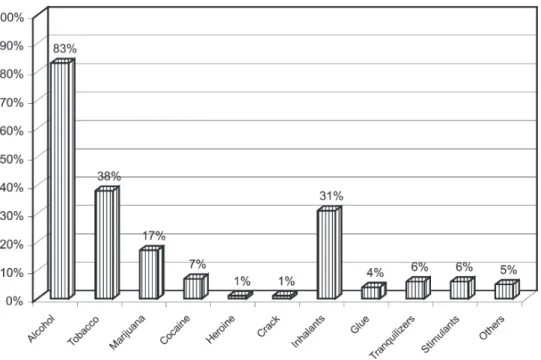
The most commonly used drugs were alcohol, tobacco, and other in-haled drugs, with marijuana being con-sumed by 17% of the interviewees (Fig. 2).
At the time of the interview, the in-terviewed population used the follow-ing drugs, in decreasfollow-ing order: alcohol, tobacco, marijuana, inhalants, and other drugs, on a smaller scale (Fig. 3). Another important factor observed was the type of the student’s living ar-rangement. Forty-eight percent an-swered that they lived in fraternity houses, 22% in hotels or similar, or with colleagues, 19% with relatives, and 11% live alone (Fig. 4).
DISCUSSION
Alfenas is a city located in the south of Minas Gerais, where 2 differ-ent college institutions exist - a private one, the University of Alfenas (UNIFENAS) and a public one, the School of Pharmacy and Dentistry of Alfenas (EFOA) - with a total univer-sity population of approximately 6500 students.
It is known that a paradigm related to the student population, mainly the university student, exists with regard to the use of legalized and illicit drugs22,5,20,6,10,4,14,2,13. Therefore, of 6500
Alfenas college students, 1500 were interviewed, and 12% affirmed that they had never used any type of drug up to the moment of the research.
It was verified that among the stu-dents who answered affirmatively that they had used drugs before, about 92% had used before admission to the uni-versity, especially alcohol and to-bacco. This is information of great rel-evance, since it demonstrates that the university is probably not the starting point for the use of drugs. Of these 92%, 14% affirmed that they had tried drugs before the age of 12, 45% tween 13 and 15 years of age, 33% be-tween 16 and 18 years of age, and only 8% after the age of 18.
These data revealed that most of the university population had tried some type of drug even before reach-ing the legal civil age (78%), which attests to the great susceptibility of adolescents to drugs. Previous data2,6,7
revealed the need for the establishment of preventive programs against the use of drugs in school institutions, with the objective of educating adolescents with regard to the dangerous effects of drug use5.
Some studies conducted in the uni-versity environment and among high school students have demonstrated the dissemination of illicit drugs,
reveal-ing marijuana in first place, followed by cocaine and inhalants1,4,5,16,18. In the
present study, we found that the use of illegal drugs occurred among the terviewees who had used mostly in-haled drugs (31%), followed by mari-juana (17%). However, among the drugs investigated in this study, the percentage who used alcohol and to-bacco was substantially larger than that for all the other drugs, 83% and 38%, respectively. It could be con-cluded that the fact that these drugs are legal considerably facilitates their use. With regard to this matter, the U.S. Food Drug Administration (FDA) has recently recommended that tobacco should be considered an illicit drug, since it possesses substances that can cause addiction.
Fig. 3 - Percentile distribution of the drug type that the students use presently.
Fig. 4 - Percentile distribution of the type of the university students living in Alfenas.
It was observed that 52% of the in-terviewees were female and 48% were male, with 15% from Alfenas and the remaining students originating from several different regions of Brazil, demonstrating a great heterogeneity of the student population of Alfenas, and serving as an indicator of the existence of different habits and cultures among the students.
With regard to the place where the interviewees reside in Alfenas, 48% answered that they live in fraternity houses, 22% in hotels or similar, or with colleagues, 11% live alone, and 19% reside with their relatives. These data demonstrated once again that most of Alfenas university students are coming from other cities, as has been previously described.
In college cities like Alfenas, the increased use of marijuana and co-caine among the students may have 2 explanations: increase of availability and the visibility in society. The me-dia also exerts a great influence in worsening the current picture that has developed among the students. The theme takes evidence in several televi-sion programs that insist on showing youth in scenes using and defending the legalization of marijuana.
The existence of a private and a federal university that now attract more than 7000 college students could explain the increase of drug consump-tion in Alfenas. However this study clearly demonstrated that the use of such drugs had begun before admis-sion to the universities.
Therefore, the “drug problem” in Alfenas, according to the students an-swers, would not be tied to the exist-ence of the universities, but indeed to a global conjuncture of other factors related with the present times.
CONCLUSION
The present research revealed that the consumption of drugs in the city of Alfenas exists, but it is less than what was believed by the local popu-lation. The obtained data revealed im-portant information concerning the time period of the first experience with drugs. Most of the students had al-ready tried drugs in their hometown prior to the entrance at the university. It can be concluded that the university itself is not serving as a nucleus for the promotion of the first use of drugs. It was also observed that the most used
illicit drugs were marijuana and inha-lant. The consumption of alcohol and tobacco was quite high among the stu-dent interviewees. Presently, approxi-mately half of the men and a third of the women use some type of drug, in-cluding alcohol and cigarettes, associ-ated or not with other drugs.
ACKNOWLEDGEMENTS
We thank Dr. Ivan Freitas and Dr. Lélio Moura Lourenço for the helpful suggestions for the completion of this work; Suheir Kamal Genema, Dr. Paulo Márcio de Faria e Silva, and Dr. Vinícius Vieira Vignoli for the revision of the manuscript; Dr. Alexandre Christófaro Silva for the statistical analysis; and the medical students, Mateus Martins Borges, Carlos Maurício Libânio Diniz, Viviane Pulcineli Freitas, Marco Antônio Carvalho, Túlio César Gonçalves, Ana Paula Donnabella Palmieri, Carlos Alexandre Polônio, Rodrigo José Polônio, Rodrigo Soato, Guilherme de Oliveira Cocolicchio and Denise Rezende for collaboration in the ad-ministration of the questionnaires.
RESUMO
FIORINI JE e col. - Uso de drogas lícitas e ilícitas no meio univer-sitário de Alfenas. Rev. Hosp. Clín. Fac. Med. S. Paulo 58(4):199-206, 2003.
Este trabalho relata um estudo so-bre o consumo de drogas realizado em uma população de estudantes em duas
universidades na cidade de Alfenas, no estado de Minas Gerais. Tanto drogas lícitas como ilícitas foram considera-das, incluindo álcool, tabaco, maco-nha, cocaína, heroína, crack, inalantes, cola, tranquilizantes, estimulantes, en-tre outras.
METODOLOGIA: A pesquisa
in-cluiu uma vasta revisão bibliográfica
e a aplicação de um questionário em cerca de 23% dos acadêmicos (total 6.500).
RESULTADOS: Um total de 1.500
seme-lhante a outras investigações realiza-das no Brasil e em outros países.
DISCUSSÃO: Foi verificado que
55% dos universitários realmente uti-lizam drogas. Entretanto, o achado mais surpreendente foi que a maioria dos estudantes (88%) que responderam
“sim” à indagação “Você já experi-mentou algum tipo de droga, incluin-do álcool e cigarros?” espontaneamen-te eles revelaram que consumiam tais drogas, porém antes da admissão na Universidade. Este resultado sugere claramente que o ambiente
universitá-rio não representa necessariamente o ponto de partida para o consumo de drogas.
DESCRITORES: Drogas. Tóxicos. Estudantes universitários. Adoles-centes.
REFERENCES
1 . BARROS RS, MAGALHÃES MP, OLIVEIRA MA, et al.
-Avaliação dos efeitos da maconha por usuários de população infantil. Ciênc Cult 1989; 41: 652-7.
2 . BARROS RS, ALMEIDA SP, MAGALHÃESet al. - Idéias e
imagens suscitadas em estudantes universitários numa pesquisa sobre drogas: uma contribuição ao trabalho preventivo. Bol Psicol 1992; 42: 15-26.
3 . BASTOS FIM, LOPES CS, DIAS PP et al. - Perfil de usuários de drogas I: Estudo de características de pacientes do NEPAD/ UERJ - 1986/1987. Rev ABP - APAL 1988; 10: 47-52. 4 . BERGONZONI PELAEZ G, RICO O, RAMIREZ J et al. - Uso de
drogas entre estudiantes de Cali, Colômbia. Bol Of Sanit Panar 1989; 106: 22-31.
5 . BRENES LSV, HAMMES MF, SOLÉ MTV et al. - Drogas ilícitas entre universitários. Rev AMRIGS 1986; 30: 140-3.
6 . BUCHER R, TOTOGUI ML - Conhecimento e uso de drogas
entre alunos do Brasil. Psicol Teor Pesq 1987; 3: 178-94. 7 . BUCHER R, TOTOGUI ML - Influência de sexo e idade em
consumidores de drogas no Brasil. Psicol Teor Pesq 1988; 4: 12-21.
8 . CARLINI EA, CARLINI COTRIM B, MONTEIRO MG – O uso
de solventes voláteis: aspectos epidemiológicos, médico-psicológicos e experimentais. AMB Rev Assoc Méd Bra 1988; 34: 61-8.
9 . CASTEL S, MALBERGIER A - Farmacodependências: estudo comparativo de uma população atendida em serviço especializado: Rev ABP-APAL 1989; 11: 126-32
10. CASTRO SE, GARCIA ZG, ROJAS E et al. - Conducta antisocial
11. CASTRO SE, GARCIA ZG, ROJAS E et al. - Estudio epidemiológico sobre el uso de drogas y problemas asociados entre la población estudiantil que asiste a los colegios de bachilleres. Salud Ment, 1988b, 11: 35-47.
12. GODOI AM, MUZA GM, COSTA MP et al. - Consumo de substâncias psicoativas entre estudantes de rede privada. Rev Saúde Pública, 1991, 25: 150-6.
13. LEVY C - O Estado de São Paulo, caderno C, 7, 03 de setembro de 1996.
14. MAGALHÃES MP, BARROS RS, OLIVEIRA MA et al. - Padrões
de frequência do uso da maconha por estudantes universitários. Rev ABP-APAL, 1989, 11: 35-40.
15. MAGALHÃES MP, BARROS RS, SILVA MA - Uso de drogas entre universitários: a experiência com maconha como fator delimitante. Rev ABP-APAL, 1991, 13: 97-104.
16. MASUR J, CARLINI COTRIM B - Padrão do uso de drogas psicotrópicas precedendo a internação por dependência. Rev ABP-APAL, 1987, 9: 145-50.
17. MONTEIRO FILHO L, FERRAZ MP, MACHADO NR et al. -Adolescentes cheiradores de cola J Pediatr 1984; 57: 330-2. 18. MURAD JE - Epidemiologia do abuso de drogas em Belo Horizonte, MG, Brasil. Rev Farm Bioquim 1994; 5: 21-30. 19. MURAD JE - Informações sobre drogas, 1994.
20. PLOTINIK R, AZMUS AD, TANNHAUSER N et al. - Utilização de psicotrópicos por estudantes universitários. Rev Psiqui Méd 1986; 20: 109-13.
21. RYDLE C - O Estado de São Paulo, caderno C, 14 de outubro de 1996.
22. SILVA AA, SOUZA CB, MARINI D et al. - Prevalência do uso de
álcool, cigarro e maconha nos alunos da Faculdade de Medicina da Universidade de São Paulo. Arq Coord Saúde Ment Estado de São Paulo 1985; 45: 134-45.
23. TOLEDO JR - Folha de São Paulo, caderno 3, 15 de setembro de 1996.
16. Have your parents used drugs before or do they currently use them?
Yes ( ) No ( ) I don’t have knowledge ( )
17. What’s your relationship with the drugs?
I use frequently and I don’t want to leave them ( ) I use frequently and I want to leave them ( ) I don’t use, but I have wish for them ( ) I use eventually ( )
I live in function of the drugs ( ) Other ( )
18. Do you easily obtain the drugs that you consume? Yes ( ) No ( )
19. How do you get the money for the drugs? I work ( )
I make small thefts ( ) I take my parents’ money ( ) Sells personal objects ( ) I obtain from another sources ( )
20. Do your parents have knowledge that you are a drug user? Yes ( ) No ( )
21. Do you maintain dialogue with your parents about Yes ( ) No ( )
22. Do you have siblings that make use of drugs? Yes ( ) No ( )
23. What is the location where does he frequently make use of drugs:
In its own house ( ) In the school ( ) In the streets ( ) In the friends’ house ( ) In bars and night-clubs ( ) Other ( )
24. Are you aware of the risks that the drugs offer to your health? Yes ( ) No ( ) In terms ( )
25. Do you intend of using drugs? Yes ( ) No ( ) In terms ( )
26. Do you agree with the legalization of the drugs? Yes ( ) No ( ) In terms ( )
Obs.: In case if you want to make any comments, please write in this space:
___________________________________________________________________________________________________________________________________________________________________________________________________________________________
___________________________________________________________________________________________________________________________________________________________________________________________________________________________
___________________________________________________________________________________________________________________________________________________________________________________________________________________________
___________________________________________________________________________________________________________________________________________________________________________________________________________________________
__________________________________________________________________________________________________________________________________________________________________________________________________________________________
___________________________________________________________________________________________________________________________________________________________________________________________________________________________ 01. Gender: male ( ) female ( )
02. Age:______years-old.
03. Race: white ( ) black ( ) other ( )
04. Social Class: A ( ) B ( ) C ( )
05. Procedence: city:
state:
06. Place where he/she lives: With the parents ( ) Hotel/Bed and Breakfast ( ) With colleague ( )
Fraternity house ( ) Alone ( )
07. Scholarity of the father ( ), of the mother ( ) A = 1st degree
B = 2nd degree C = 3rd degree
08. Parents situation: They live together ( ) Divorced ( )
father has passed away ( ) mother has passed away ( )
09. Have you already tried any type of drug including alcohol and/ or cigarette?
Yes ( ) No ( )
10. Do you consider alcohol and/or cigarette as drugs? Yes ( ) No ( )
11. What age have you tried drugs for the first time? (including alcohol and cigarette): ______years-old.
12. In what school level? 1st ( ) 2nd ( ) 3rd ( )
13. What drugs have you already tried?
Alcohol ( ) Tranquilizers ( ) smoking ( ) Stimulants ( ) Loló ( ) Marijuana ( ) glues ( ) Cocaine ( ) Crack ( ) Heroine ( ) Inhalant ( ) Other ( )
14. Presently, are you using any drugs? (including alcohol and cigarette) Yes ( ) No ( )
15. If you use any drugs, what have lead you to do that? The companions ( )
Aware of what it causes ( ) Lack of better life option ( ) He/she riots against family ( ) He/she riots for the injustices ( )
Search for partners problems solutions ( ) Other ( )
ADDENDUM I