Brazilian Journal of Physics, vol. 34, no. 2B, June, 2004 647
Diluted Magnetic Ga
1
−
x
Mn
x
N Alloys: A First-Principles Study
R. de Paiva
1, J. L. A. Alves
2, R. A. Nogueira
1, J. R. Leite
3, and L. M. R. Scolfaro
31
Departamento de F´ısica, Universidade Federal de Minas Gerais, CP 702, 30.161-970 Belo Horizonte, MG, Brazil
2
DCNAT-UFSJ, CP 110, 36.300-000 S˜ao Jo˜ao del Rei, MG, Brazil
3
Instituto de F´ısica, USP, CP 66318, 05389-970 S˜ao Paulo, SP,Brazil
Received on 31 March, 2003
The utilization of the quantum properties of the electron spin wave function will allow the development of a new class of devices. The problem is still controversial and unsettled, even qualitatively, especially for concentrated spin systems such as 3d metals and their alloys. The variety of crystal structures of 3d metals makes difficult the direct comparison between the experimental results and the theoretical conclusions. On the account of this difficulty, substitutional alloys with the same crystal structure, especially face-centered cubic alloys, have been investigated extensively. In this work the properties of diluted Ga1
−xMnxN (x = 0.0630; 0.0315) alloys
are calculated in the zinc-blende phase, within the framework of the density functional theory, using the full-potential linearized augmented plane wave (FLAPW) method and the local density approximation (LDA). The alloys are simulated using 32-atom and 64-atom large unit cells, containing one substitutional Mn atom for a Ga atom. The calculations are spin-polarized and we analyze band structures, density of states and total magnetizations. A half-metallic state is predicted ata0 ∼4.45A. The majority-spin band has a rather sharp˚ peak, characteristic of a narrow band, while the minority-spin has a gap. The total magnetization of the cell is 4.00µBwhich does not change with the Mn concentration. The valence band is ferromagnetically coupled with the Mn atoms, and the spin splitting is not linearly dependent on the Mn concentration.
1
Introduction
Half-metals are defined as magnetic materials showing a band gap at the Fermi energy for one spin direction [1]. As a consequence, the electric conduction has contribution only from charge carriers of one spin direction. The possibility of the combined use of both properties, charge and spin, of the electrons suggests many semiconductor devices such as spin qubits [2], spin valves [3], spin-field-effect transistors [4], among others, having applications in quantum comput-ing or spintronics. The aim nowadays in experimental and theoretical research in this area is to find materials that can be high-efficient sources of charge carriers with well defined spin [5]. A candidate material would be ferromagnetic zinc-blende MnAs [6,7] which suffers from some experimen-tal and theoretical drawbacks [5,8]. Other candidates, the diluted magnetic semiconductor alloys Ga1−xMnxN have
been under debate in connection with the detailed mecha-nism which originate their ferromagnetism, and their half-metallic character [9-15]. The injection of spin-polarized charge carriers into semiconductors was achieved success-fully for electrons, employing magnetic semiconductors based on BexMnyZn1−x−ySe [16]. On the other hand the
hole injection in conventional semiconductors like GaAs is much less favorable because of the spin-orbit splitting of the top of the valence band. These spin-orbit effects are, in prin-ciple, reduced in lighter semiconductors like GaN or AlN. Accordingly, there are starting searches for half-metallic ni-trides nowadays [1,17]. Another aspect to be taken into ac-count is that spin electronics requires control over the spin
direction of the charge carriers injected into devices, what may be facilitated by the ability of the nitrides to change easily from a low spin state to a high spin state under the action of an applied magnetic field. In the present paper we presentab initiototal-energy-all-electron spin-polarized-density-functional calculations for the electronic structure of the diluted magnetic semiconductor alloys Ga1−xMnxN,
with realistic x=0.063 and x=0.031, in the ordered zinc-blende ferromagnetic phase. We find that the majority-spin system is half-metallic and the minority-spin system is iso-lating, the alloys being, therefore, candidates for application
inspintronics.
2
Theoretical Framework
648 R. de Paivaet al.
(Mn). The Rkmax parameter, which defines the basis set size in the FP-LAPW method, was taken as 7.0 and the an-gular momentum l=10 for the expansions inside the spheres. The total energy and eigenvalues were converged to 10−5eV,
and 10−4eV, respectively. The calculations were performed
with spin-polarized potentials in order to analyze the ferro-magnetic phases of the alloys. The lattice parameter used were determined by using the V`egard’s law, ao= 4.45 ˚A
(x=0.063), ao= 4.46 ˚A (0.031) as applied to the binary
com-ponents GaN (ao=4.47 ˚A) and MnN (ao=4.19 ˚A), whose
lat-tice parameters were obtained by total-energy minimization using the same theoretical approach. We analyze the band structures, density of states, the Fermi level and the mag-netic moments.
3
Results and Discussion
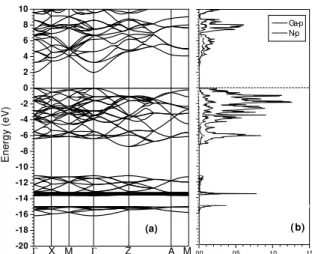
In Fig. 1 we show, for comparison, the band structure and density of states for bulk GaN using a 32-atom unit cell, the LDA approach and the equilibrium lattice parameter
a= 4.47A. One first notes the folding of the bands due to˚ the large unit cell we used. The Ga-3d states are low-lying around –13.5 eV, below the top of the valence band. The direct band gap atΓisEg=1.98 eV. As shown by the partial
density of states curves, the top of the valence band is dom-inated by Ga-4p and N-2p states. In Fig. 2 we show the spin-polarized band structure diagram for Ga0.94Mn0.06N
calculated in the LDA approach at the lattice parameter
ao=4.45 ˚A. In Fig. 3 we display the density of states for both alloys,x= 0.063andx= 0.031. Except for the presence of
the Mn-3d bands, the band structures look like those of the non-magnetic GaN shown in Fig. 1. The introduction of Mn atoms do not polarize the valence band appreciably. The majority-spin system exhibit a gap of energy inside which two bands appear, corresponding to the Mn-3d states, both about 0.6 eV wide, one close to the top of the valence band ∼0.33 eV and the other located around 1.4eV above the top of the valence band. The important feature is that the Fermi level falls inside this last band. It is apparent from Fig. 3 that the Mn-3d and N-2p states interact and dominate the spin-polarization effects. By its side, the minority-spin system exhibit an empty gap of about 2.3 eV, being isolating, with the Fermi level falling at mid-gap. The Mn atoms introduce a noticeable polarization of the bottom of the conduction band, due to the presence of the Mn-3d related states.
As expected, one can see in Fig. 3 that the Mn-3d bands get thinner when the concentration x is diminished. The overall effect of introducing the Mn atom into the GaN semi-conductor is the presence of a spin-polarization with the appearance of a partially occupied band in the gap of the majority-spin system. This band has some dispersion along some directions of the Brillouin zone and this is an impor-tant detail for the alloys to behave properly as half-metallic, as the Fermi level runs across the band.
-20 -18 -16 -14 -12 -10 -8 -6 -4 -2 0 2 4 6 8 10
(a)
M A Z
Γ
M X
Γ
En
e
rg
y
(
e
V)
0.0 0.5 1.0 1.5 ( b ) Ga-p N-p
Figure 1. (a) Band structure for zinc-blende GaN at the LDA en-ergy minimum (ao=4.47 ˚A); (b) Partial density of states showing the contributions of Ga-p and N-p states.
Figure 2. Spin-polarized band structure of Ga0.94Mn0.06N at
ao=4.45 ˚A. The horizontal line correspond to the Fermi level.
Figure 3. Spin-polarized density of states for (a) Ga0.94Mn0.06N
and (b) Ga0.97Mn0.03N. The thick lines correspond to the Mn-3d
states. The horizontal line refers to the Fermi level.
Brazilian Journal of Physics, vol. 34, no. 2B, June, 2004 649
the majority-spin diagram. Their calculations and analysis are underway. With respect to the magnetization, by the very way we made the calculations, having only one Mn atom per unit cell, the phase calculated is ferromagnetic. The magnetic moment found was 4.00µBfor both x=0.063 and
x=0.031, showing that the magnetization of the cell does not change with the Mn concentration. On the other hand we found the local magnetic moments as 3.16µB(Mn), 0.11µB
(Ga) and 0.186µB(N). These results show that the interac-tion of the Mn atoms with the valence band is ferromagnetic. The coupling tends to be independent ofx.
4
Conclusion
We performed spin-polarized calculations and analyzed the band structures, density of states and magnetizations of zinc-blende, ferromagnetic Ga0.94Mn0.06N and Ga0.97Mn0.03N.
A half-metallic state is predicted at ao=4.45 ˚A. The
majority-spin band has a rather sharp peak, characteristic of a narrow band, while the minority-spin has a gap. The total magne-tization of the cell is 4.00µB which does not change with the concentration. Both the valence and conduction bands are ferromagnetically coupled to the Mn atoms and the spin splittings are not linearly dependent on the Mn concentra-tion.
Acknowledgements
The authors are grateful to the Brazilian agencies CNPq, FAPEMIG and CAPES for financial support, and to CENAPAD-MG-CO for the computational support.
References
[1] C. M. Fang, G. A. de Wijs, and R. A. de Groot, J. of Appl. Phys.91, 8340 (2002).
[2] G. Burkard, D. Loss, and D. P. Di Vincenzo Phys. Rev. B59, 2070 (1999)
[3] G. Prinz, Science282, 1660 (1998).
[4] S. Datta and B. Das, Appl. Phys. Lett.56(7), 665(1990).
[5] M. Jain, L. Kronik, and J. R. Chelikowsky. V. V. Godlevsky, Phys. Rev. B64, 245205 (2001).
[6] M. Shirai, T. Ogwa, I. Kitagawa, and N. Suzuki, J. Magn. Magn. Mater.177-181, 1383 (1998).
[7] See our other paper in this issue and references there in.
[8] S. Sanvito and N. A. Hill, Phys. Rev. B62, 15553 (2000).
[9] Y. Ohno, D. K. Young, B. Beschoten, F. Matsukura, H. Ohno, and D. D. Awschalom, Nature402, 790 (1999).
[10] G. Schmidt, D. Ferrand, L. W. Molenkamp, A. T. Filip, and B. J. van Wees, Phys. Rev. B62, R4790 (2000)
[11] D. P. Di Vincenzo, Science270, 255 (1995).
[12] T. Dietl, H. Ohno, F. Matsukura, J. Cib`ert, and D. Ferrand, Science287, 1019 (2000).
[13] H. Akai, Phys. Rev. Lett.81, 3002 (1998).
[14] S. Sanvito, P. Ordej´on, and N. A. Hill, Phys. Rev. B 63, 165206 (2001)
[15] M. Jain, L. Kronik, and J. R. Chelikowsky, Phys. Rev. B64, 245205 (2001).
[16] R. Fiederling, M. Keim, G. Reuscher, W. Ossau, G. Schmidt, A. Waag, and L. W. Molenkamp, Nature402, 787 (1999).
[17] L. Kronik, M. Jain, and J. R. Chelikowsky , Phys. Rev. B66, 041203 ( R ) (2002).
[18] P. Hohenberg and W. Kohn, Phys. Rev.136, B864 (1964); W. Kohn and L. J. Sham, ibid.140, A 1133 (1965).
[19] P. Blaha, K. Schwarz, G. K. H. Madsen, D. Kvasnicka, and J. Luitz, Techn. Universit¨at Wien, Austria, 2001. ISBN 3-9501031-1-2.