Influence of the Black Hole Rotation on Accretion Discs and Jets
in Active Galaxies: the Case of NGC 1068
Anderson Caproni, Zulema Abraham,
Instituto de Astronomia, Geof´ısica e Ciˆencias Atmosf´ericas, Universidade de S˜ao Paulo, R. do Mat˜ao 1226, Cidade Universit´aria, CEP 05508-900, S˜ao Paulo, SP, Brazil;
and Herman J. Mosquera Cuesta∗
Instituto de Cosmologia, Relatividade e Astrof´ısica (ICRA-BR), Centro Brasileiro de Pesquisas F´ısicas, R. Dr. Xavier Sigaud 150, CEP 22290-180, Rio de Janeiro, RJ, Brazil
(Received on 14 October, 2005)
Although we do not observe directly black holes in the Universe, their presence has been inferred in several astrophysical systems, from galactic to extragalactic scales. In this work, we will restrict our focus in the possible signatures of the presence of Kerr black holes in active galactic nuclei, one of the most powerful sources in the Universe. Particularly, we will discuss how jet/accretion disc precession and their directional stability can be used to trace the accretion disc properties as well as the black hole spin in the Seyfert galaxy NGC 1068.
I. INTRODUCTION
A fraction of galaxies in the Universe exhibit an unusual release of energy from their central regions; such objects are known as active galactic nuclei (AGNs). This class contains quasars, BL Lac objects and Seyfert galaxies and is basically characterized by high luminosity (1035-1041W) from radio to X-rays wavelengths (some cases to TeV energies), produced in a small volume (<1 pc3). Their spectra show the
pres-ence of several optical emission lines associated to several chemical elements, which contrasts to the normal galaxies, detected predominantly in absorption. Variability of the con-tinuum and/or the emission lines are often observed in time-scales from days to years.
It is a well-accepted idea in the astrophysical community that the center of an AGN harbours a supermassive black hole surrounded by an accretion disc. The accretion process of the disc material onto the black hole is believed to be the main source of the copious energy production, even though the complete understanding of this process has not been achieved up to now; several theoretical models have been proposed to explain the characteristics of the accretion mechanism (e.g., Ref. 1). Numerical simulations also have been carried on in order to tackle the non-linearity of the differential equations that rule the accretion disc (e.g., Ref. 2).
Not rarely, there is ejection of bipolar collimated structures from the innermost part of the AGN known as jets. Some jets are accelerated to high speeds, exceeding ninety percent of the light speed in many cases [3].
Some AGNs exhibit distortions in the jet morphology, such as changes in its direction of propagation on the plane of the sky (e.g., Ref. 4), as well as in the apparent proper motion (e.g., Ref. 5). Those odd aspects can be generated by jet pre-cession, since it introduces a periodic time variation of the
∗Also at Abdus Salam International Centre for Theoretical Physics, Strada
Costiera 11, Miramare 34014, Trieste, Italy.
jet viewing angle in relation to the line-of-sight [4, 6–10]. In the case of Seyfert galaxies, precession was detected from the variability of double-peaked Balmer lines produced in the ac-cretion disc (e.g., Ref. 11).
The existence of a warped accretion disc in the Seyfert 2 galaxy NGC 1068 has been inferred from the kinematics of the maser spots at parsec-scales from very long baseline ra-dio interferometry (e.g., Ref. 12). Warping and disc/jet pre-cession can be produced in a supermassive black hole binary system wherein the primary accretion disc precesses because of torques induced by the secondary black hole, whose or-bital plane does not coincide with that of the accretion disc [9, 10, 13, 14].
In this work, we will focus our attention on another feasi-ble scenario to produce warp and precession of the disc: the Bardeen-Petterson effect [15]. A general introduction about this mechanism will be presented in Section II. A brief de-scription about the Seyfert 2 galaxy NGC 1068, as well as the application of the Bardeen-Petterson formalism to this source is made in Section III. Conclusions are presented in Section IV.
II. THE BARDEEN-PETTERSON EFFECT
Frame dragging produced by a Kerr black hole causes pre-cession of a particle if its orbital plane is inclined in relation to the equatorial plane of the black hole. The precession angular velocityΩLTdue to the Lense-Thirring effect is given by [16]:
ΩLT=
2G c2
JBH
r3 , (1)
whereGis the gravitational constant,cis the light speed,ris the radial distance from the black hole andJBHis the angular
ϕ
BP
R
out
R
ms
R
d
2H
BH
J&
n
z
z
MBH
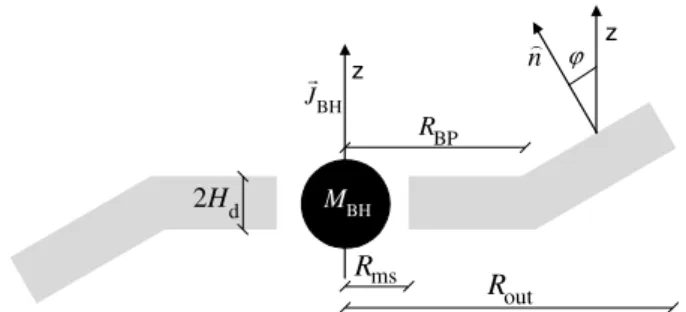
FIG. 1: Schematic representation of the Bardeen-Petterson effect. An accretion disc with inner and outer radiusRms andRout respec-tively, having a semi-thicknessHdand misaligned initially by an an-gleϕin relation to the angular momentum of The black holeJBH and massMBH, will be warped by the Bardeen-Petterson effect. The transition radius between the portion of the disc that is aligned and misaligned with the black hole’s equator is known as the Bardeen-Petterson radiusRBP.
its maximal velocity. The spin-induced precession formalism has been successfully applied to supermassive black holes in AGNs and SgrA*, the centre of our Galaxy [17].
The combined action of the Lense-Thirring effect and the internal viscosity of the accretion disc forces the alignment between the angular momenta of the Kerr black hole and the accretion disc. This is known as the Bardeen-Petterson
ef-fect [15] and usually afef-fects only the innermost part of the disc, while its outer parts tend to remain in its original con-figuration, due to the short range of the Lense-Thirring effect. The transition radius between these two regimes is known as Bardeen-Petterson radiusRBP, shown schematically in Fig. 1,
and its exact location depends mainly on the physical proper-ties of the accretion disc [18–22].
A rough estimate ofRBP can be obtained comparing the
time-scales for Lense-Thirring precession and warp transmis-sion through the disc [23] that, on the other hand, will de-pend on how the warps are being communicated along it. If they are transmitted diffusivelyRdifBP=ν2(RBPdif)/ΩLT(RdifBP),
whereν2 is the viscosity acting on the perpendicular
direc-tion to the disc, related to the disc viscosityν1measured in
the horizontal plane. If the time-scale for the warp evolu-tion is similar to that for the evoluevolu-tion of the surface den-sity,ν1∼ν2; otherwise ν2∼ f(α)ν1, where f(α)is a
func-tion of the dimensionless viscosity parameterαintroduced by [1]. For typical parameters of AGNs, it is expectedν2≫ν1
[24], so that the Bardeen-Petterson radius is substantially re-duced in this case. In this work, we will follow [25], adopting
f(α) =2(1+7α2)/[α(4+α2)].
Assuming the zero torque inner boundary condition at the marginally stable orbitRms, considered hereafter the inner
ra-dius of the accretion disc, the viscosityν1can be written as:
ν1=−
˙ M 2πΣd(r)
dlnΩd(r)
dlnr −1
1−
Rms
r 2Ω
d(Rms)
Ωd(r)
, (2)
where ˙Mis the accretion rate,Σdis the surface density of the
accretion disc integrated over the semi-thickness of the disc HdandΩdis the angular velocity of the disc.
On the other hand, the Bardeen-Petterson radius can be estimated in the wave-like regime using RwBP =
cs(RwBP)/ΩLT(RwBP), wherecs is the sound-cross speed of the
disc, defined as:
cs(r) =
−ΓdlnΩd(r)
dlnr
ν1(r)Ωd(r)
α , (3)
whereΓis the politropic index of the equation-of-state of the gas (we have assumedΓ=5/3 in this work). The transition from the diffusive to wave-like regime occurs at a radiusRT
whereα∼Hd/r[26].
The time-scale for the black hole to align its angular mo-mentum with that of the accretion disc was firstly estimated by [27], assuming that each mass element accreted by the black hole carries an orbital angular momentum corresponding to that found at the Bardeen-Petterson radius. [28] obtained an analytic solution to the equations that control the warp evo-lution in the case of a disc with constant surface density and
calculated the alignment time-scale. [23] generalizes the re-sults found by [28] to a power-law viscosity. Such studies suggest that the alignment time-scale can be estimated using:
Talign=JBH
dJBH
dt −1
sinϕ, (4)
whereϕ is the inclination angle between the normal of the outer parts of the disc and the spin axis of the black hole. The time derivative ofJBHhas the form [23]:
dJBH
dt =−2πsinϕ Z Rout
RBP
ΩLT(r)Ld(r)rdr, (5)
where Rout is the outer radius of the disc and Ld(r) =
III. BARDEEN-PETTERSON EFFECT: WARPING AND PRECESSING THE ACCRETION DISC OF NGC 1068
In this section, we will discuss how to constrain the physi-cal properties of the accretion disc and/or the black hole spin in the case of a Bardeen-Petterson disc, using NGC 1068 as example.
A. NGC 1068 and its accretion disc parameters
The Seyfert 2 galaxy NGC 1068 is located at a distance of 14.4 Mpc [29]. Its central engine is obscured by a dust torus, which was recently spatially resolved by mid-infrared inter-ferometric observations [30], in which it was detected a distri-bution of warm dust in a parsec-scale structure, surrounding a smaller hot source (probably the accretion disc).
Very long baseline interferometry of NGC 1068 at radio wavelengths reveals a complex jet-like structure, essentially composed by four discrete components at sub-arc-seconds scale labeled as S2, S1, C and NE (e.g., Ref. 12). The com-ponent S1 is probably associated with the thin accretion disc that surrounds a black hole while the other structures are pos-sibly related to jet components (e.g., Ref. 12). The radio jet orientation change with the core distance, bending towards the northeast direction, specially at component C. At larger scales, extended lobes are observed, with the northeast lobe having a conical shape, similar to a bow shock structure produced by jet-environment interaction [31].
The nuclear region of NGC 1068 has been also investigated through H2O and OH maser emission (Refs. 12, 32), with the
brightest H2O maser spots coinciding with the radio
contin-uum component S1 [33]. The maser emission seems to orig-inate from a sub-Keplerian rotating disc with inner and outer radius corresponding to ∼0.65 and 1.1 pc respectively, en-closing a mass of∼107M⊙within its inner radius [32, 34].
The departure from Keplerian motions has been attributed to a massive accretion disc that dilutes the gravitational field of the black hole [35, 36].
A very interesting result from maser observations is that the maser disc is not completely aligned with the major axis of the component S1 (e.g., Ref. 12). Indeed, they reveal a maser dis-tribution similar to a warped disc, with the inner parts almost perpendicular to the jet and aligned to the major axis of S1, but deviating from this configuration as the core distance in-creases. Recently, [12] proposed a configuration in which the thin hot disc (S1) is perpendicular to the radio jet, while the misaligned maser disc points towards the parsec-scale dusty-torus.
B. Bardeen-Petterson radius and alignment time-scale
From the analysis of the rotation curve of the maser emis-sion in NGC 1068, [35] and [36] determined a mass of about 1.2×10⁷and 8×10⁶ M⊙respectively for the supermassive black hole. [12] found a lower limit of∼7×1037W for the
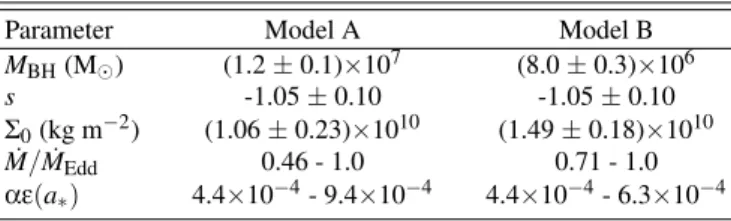
TABLE I: Physical parameters of the accretion disc of the Seyfert 2 galaxy NGC 1068.
Parameter Model A Model B
MBH(M⊙) (1.2±0.1)×107 (8.0±0.3)×106
s -1.05±0.10 -1.05±0.10
Σ0(kg m−2) (1.06±0.23)×1010 (1.49±0.18)×1010 ˙
M/M˙Edd 0.46 - 1.0 0.71 - 1.0
αε(a∗) 4.4×10⁻⁴- 9.4×10⁻⁴ 4.4×10⁻⁴- 6.3×10⁻⁴
bolometric luminosityLbolof NGC 1068 to reproduce the
ob-served free-free emission. We will consider that such bolo-metric luminosity extends from this value to the Eddington luminosity.
We also assumed a power-law surface density for the accre-tion disc (integrated over the scale height of the accreaccre-tion disc) Σ(r) =Σ0(r/Rg)s, withs=−1.05 [35] andRg=GMBH/c2,
the gravitational radius. The constantΣ0was determined from
the mass of the discMd, integratingΣ(r)from the inner radius
to the outer radius of the disc.
Limits to theα-parameter (multiplied by the accretion effi-ciencyε(a∗)) were found combining Eq. (8) of [36] with the values of bolometric luminosity, which is displayed together other disc parameters in Table 1. In our analysis, we have con-sidered two different models, labelled as A and B (see Table 1), referring respectively to the parameters derived from [35] and [36].
The maser velocities present signatures of sub-Keplerian motion; however, at the radius in which it occurs the disc an-gular momentum becomes negligible, such that in Eq. (3) we used the relativistic Keplerian angular velocityΩK:
ΩK(r) =
c3 GMBH
r
Rg
3/2
+a∗ −1
. (6)
In order to estimate the Bardeen-Petterson radius, we should first know where is located the transition radius be-tween the diffusive and wave regimes that, as seen in previous section, will depend on the aspect ratioHd/r. This quantity
was derived following [37]:
Hd(r)
r =
1 r
Hnsg(r)Hsg(r)
H2
nsg(r) +Hsg2(r)
(7)
whereHnsg=cs/ΩdandHsg=c2s/(πGΣd).
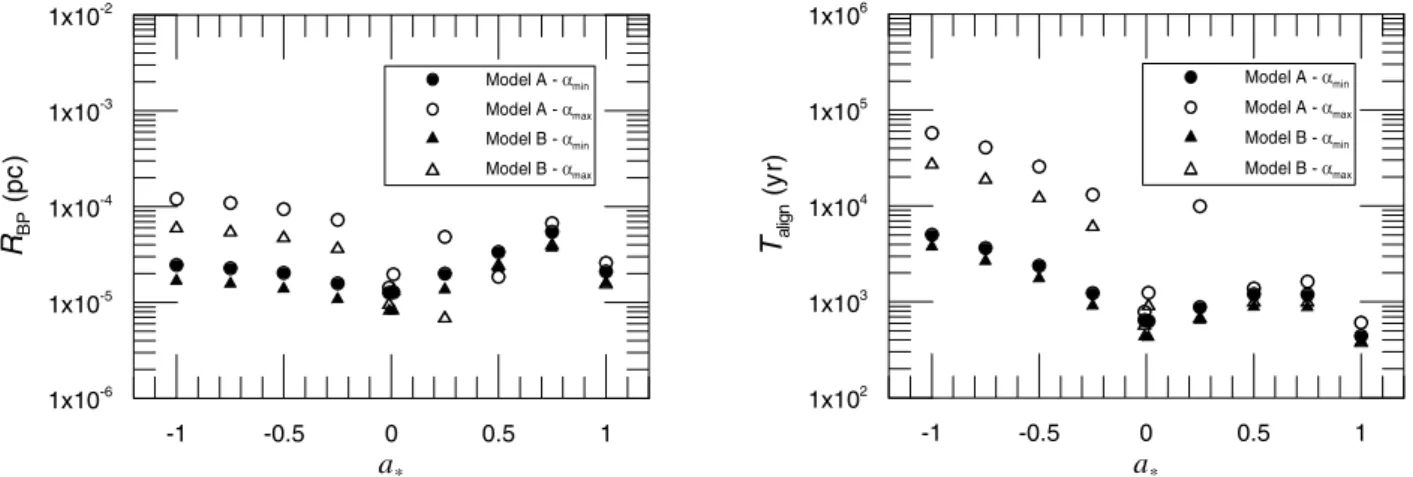
We performed calculations of the Bardeen-Petterson radius for the disc models A and B listed in Table 1, considering several values of the black hole spin. The results show that the Bardeen-Petterson radius for NGC 1068 depends weakly on the accretion rate, being limited by the variation of the black hole spin andαparameters; typically, the Bardeen-Petterson radius ranges from 10−5 to 10−4 pc (about 20 and 200 Rg respectively), as shown in left panel of Figure 2.
-1 -0.5 0 0.5 1
a*
1x102
1x10³
1x10⁴
1x10⁵
1x10⁶
Tal
ig
n
(y
r)
-1 -0.5 0 0.5 1
a*
1x10-6
1x10⁻⁵
1x10⁻⁴ 1x10⁻³ 1x10⁻²
RBP
(pc
)
Model A - αmin Model A - αmax Model B - αmin Model B - αmax
Model A - αmin Model A - αmax Model B - αmin Model B - αmax
FIG. 2:Left panel: Bardeen-Petterson radius as a function of the black hole spin for NGC 1068. Each point corresponds to the mean value of
RBPconsidering the limits of minimum and maximum accretion rate. Circles and triangles refer respectively to the models A and B. Filled symbols are related to the lower value ofα-parameter, while open ones to its upper value. Right panel: Time-scale for alignment between accretion disk and the black hole’s equator, using the same nomenclature for the symbols.
larger than that from model B. It can be interpreted as a con-sequence of the dependency of the Lense-Thirring effect with the squared black hole mass, which is larger for model A. Fur-thermore, fixing a particular model and a black hole spin, we note that the larger theα-parameter is the larger the Bardeen-Petterson radius is, which is induced by the more efficient cou-pling between consecutive disc annuli due to increase of disc viscosity. Another aspect seen in Figure 2 is a bump-like fea-ture arounda∗=0.75. It is the net result of the decrease of the Lense-Thirring effect and the increase of the inner radius of the accretion disc with the decrement of the black hole spin. We calculated the alignment time-scale as a function of the black hole spin by solving the integral given in Eq. (5), us-ing as integration limits the Bardeen-Petterson radius and an arbitrary outer radius. The results, which are independent of the outer radius value, due to the rapid decrease of the angular momentum density of the disk, are presented in the right panel of the Figure 2.
Our estimates of the alignment time-scale are ranged ap-proximately from 100 to 105yr, shorter than the lifetime of the kilo-parsec radio jet of NGC 1068 (≤1.5×10⁵yr; Ref. 38), which must not be so different of the lifetime of the AGN activity. Therefore, our results indicate that the Bardeen-Petterson effect can perfectly warp the inner part of the ac-cretion disc within its AGN lifetime.
An additional constraint for the alignment time-scale in NGC 1068 can be obtained from its jet morphology. If the ac-cretion disc is forced to align completely with the black hole, we should observe a progressive change in the jet direction. Indeed, there is a clear variation in the position angle among discrete features along the jet (e.g., Ref. 12). In fact, an expo-nential time variation for the inclination angle between black hole spin and the jet direction, as well as for the precession periodPprecis claimed by [28]:
ϕ(t) =ϕ0e−(t−t0)/Talign (8)
Right Ascension Offset (arcsec)
Declination Offset (arcsec)
0.6
0.4
0.2
0.0
-0.2
-0.4
0.4 0.2 0.0
C
S1
S2 NE
FIG. 3: Snapshot of the variation in the jet orientation due to the Bardeen-Petterson effect. Parsec-scale jet of NGC 1068 at 1.4 GHz [12], represented by the contour map seen in the figure. Solid line indicates the model prediction from Eq. (8) consideringθ=80 deg,
vjet=0.17c,t0=9800 yr,Talign=7580 yr,ϕ0=40 deg andη= 17 deg.
Pprec(t) =P0e−(t−t0)/Talign (9)
whereϕ0 andP0 are, respectively, the inclination angle and
precession period at timet0when the disk was formed.
who analysed the influence of jet precession on the relativistic jet of 3C 120. Unfortunately, only limits to the jet velocity of NGC 1068 are actually known, which ranges approximately from 0.01 to 0.17c(e.g., Ref. 31, 39). This range assures that we can neglected any relativistic correction in our approach (e.g., time-delay effect).
To project the jet motion on the plane of the sky, we in-troduced two additional parameters: the viewing angle of the jet in relation to the line of sightθ, assumed to be larger than sixty degrees (a very conservative limit for NGC 1068; e.g., Ref. 34), and the position angle of black hole spin axis on the plane of the skyη. We show in Figure 3 a direct comparison between our model and the parsec-scale jet for θ=80 de-grees,vjet=0.17c,t0=9800 yr,Talign=7580 yr,ϕ0=40 deg
andη=17 deg. Our simple kinematic approach reproduces quite well the position of the jet components C and NE and the counterjet component S2.
Repeating this procedure to other values ofθandvjet
con-strained by the observations we found that 14 deg ≤η≤ 20 deg, 9600≤t0(yr)≤1.7×10⁵, 7500≤Talign(yr)≤1.3×
105and 25 deg≤ϕ0≤45 deg. The limits forTalignimposed
by jet geometry are perfectly compatible with those calculated from Eq. (4).
IV. CONCLUSIONS
The Bardeen-Petterson effect can be responsible for changes in the accretion disc/jet direction along the time,
pro-ducing warps and precession. Such mechanism arises from the frame dragging produced by a Kerr black hole whose its rotation axis is not parallel with that of the accretion disc.
In this work, we explored the consequences of the Bardeen-Petterson effect to probe the physical characteristics of the ac-cretion disc and the black hole in the nuclear region of the Seyfert 2 galaxy NGC 1068, constraining our analysis to the interferometric radio continuum and maser observations avail-able in the literature.
Using an analytical approach, similar to that suggested by [28] and [23], we calculated the Bardeen-Petterson radius and the alignment time-scale between the accretion disc and the equator plane of the black hole for different values of the black hole spin. We found that the Bardeen-Petterson radius is roughly limited between 10−5and 10−4pc, while the align-ment time-scale ranges from about 100 to 105yr. Those es-timates are perfectly compatible with the upper limit to AGN lifetime of NGC 1068 (≤1.5×10⁵yr).
We also showed that the location of each jet component of NGC 1068 is well described by a simple kinematic model, in which jet inlet direction varies with time due to the alignment and precession of the disc. From this approach, we found that the alignment time-scale must be between 7500 and 1.3× 10⁵years, in order to reproduce correctly the jet component
positions.
Acknowledgments
This work was supported by the Brazilian Agencies FAPESP and CNPq.
[1] N. I. Shakura, R. A. Sunyaev A&A,24, 337 (1973).
[2] J. P. De Villiers, J. F. Hawley, and J. H. Krolik ApJ,599, 1238 (2003).
[3] J. A. Zensus ARA&A,35, 607 (1997).
[4] A. C. Gower and J. B. Hutchings ApJ,258, L63 (1982). [5] Z. Abraham, E. A. Carrara, J. A. Zensus, and S. C. Unwin
A&AS,115, 543 (1996).
[6] Z. Abraham and E. A. Carrara ApJ,496, 172 (1998). [7] Z. Abraham and G. E. Romero A&A,344, 61 (1999). [8] Z. Abraham A&A,355, 915 (2000).
[9] A. Caproni and Z. Abraham ApJ,602, 625 (2004a). [10] A. Caproni and Z. Abraham MNRAS,349, 1218 (2004b). [11] T. Storchi-Bergmann, R. N. da Silva, and J. P. Halpern, et al.
ApJ,598, 956 (2003).
[12] J. F. Gallimore, S. A. Baum, and C. P. O’Dea ApJ,613, 794 (2004).
[13] J. I. Katz ApJ,478, 527 (1997).
[14] G. E. Romero, L. Chajet, Z. Abraham, and J. H. Fan A&A,360, 57 (2000).
[15] J. M. Bardeen and J. A. Petterson ApJ,195, L65 (1975). [16] D. C. Wilkins PRD,5, 814 (1972).
[17] A. Caproni, H. J. Mosquera Cuesta, and Z. Abraham ApJ,616, L99 (2004).
[18] S. Kumar and J. E. Pringle MNRAS,213, 435 (1985). [19] P. B. Ivanov and A. F. Illarianov MNRAS,285, 394 (1997). [20] R. P. Nelson and J. C. B. Papaloizou MNRAS,315, 570 (2000). [21] S. H. Lubow, G. I. Ogilvie, and J. E. Pringle MNRAS,337, 706
(2002).
[22] P. C. Fragile and P. Anninos ApJ,623, 347 (2005). [23] P. Natarajan and P. J. Armitage ApJ,506, L97 (1999). [24] P. Natarajan and J. E. Pringle MNRAS,309, 961 (1998). [25] G. I. Ogilvie MNRAS,304, 557 (1999).
[26] J. C. B. Papaloizou and D. N. C. Lin ApJ,438, 841 (1995). [27] M. J. Rees Nature,275, 516 (1978).
[28] P. A. G. Scheuer and R. Feiler MNRAS,282, 291 (1996). [29] J. Bland-Hawthorn, J. F. Gallimore, L. J. Tacconi, E. Brinks,
S. A. Baum, R. R. J. Antonucci, and G. N. Cecil ApSS,248, 9 (1997).
[30] W. Jaffe, et al. Nature,47, 429 (2004).
[31] A. S. Wilson and J. S. Ulvestad ApJ,319, 105, (1987). [32] L. J. Greenhill, C. R. Gwinn, R. Antonucci, and R. Barvainis
ApJ,472, L21 (1996).
[33] J. F. Gallimore, S. A. Baum, C. P. O’Dea, and E. Brinks, A. Pedlar ApJ,462, 740 (1996a).
[34] J. F. Gallimore, C. Henkel, S. A. Baum, I. S. Glass, M. J. Claussen, M. A. Prieto, and A. Von Kap-herr ApJ,556, 694 (2001).
[35] J.-M. Hur´e A&A,395, L21 (2002).
[36] G. Lodato and G. Bertin A&A,398, 517 (2003). [37] P.J. Sakimoto and F. Coroniti ApJ,247, 19 (1981).
[38] A. Capetti, D. Axon, F. Macchetto, A. Marconi, and C. Winge, ApJ,516, 187 (1999).