©Revista Brasileira de Fisioterapia
O
RIGINALA
RTICLETranslation of the Children Helping Out –
Responsibilities, Expectations and Supports
(CHORES) questionnaire into
Brazilian-Portuguese: semantic, idiomatic, conceptual and
experiential equivalences and application in normal
children and adolescents and in children with
cerebral palsy
Tradução do questionário Children Helping Out – Responsibilities, Expectations
And Supports (CHORES) para o português - Brasil: equivalências semântica,
idiomática, conceitual, experiencial e administração em crianças e adolescentes
normais e com paralisia cerebral
Maíra Amaral1, Rebeca L. Paula1, Adriana Drummond2, Louise Dunn3, Marisa C. Mancini2,4
Abstract
Background: The participation of children with disabilities in daily chores in different environments has been a therapeutic goal shared by both parents and rehabilitation professionals, leading to increased demand for instrument development. The Children Helping Out: Responsibilities, Expectations and Supports (CHORES) questionnaire was created with the objective of measuring child and teenager participation in daily household tasks. Objectives: To translate the CHORES questionnaire into Brazilian Portuguese, evaluate semantic, idiomatic, experiential, and conceptual equivalences, apply the questionnaire to children and teenagers with and without disabilities, and test its test-retest reliability. Method: Methodological study developed through the following stages: (1) translation of the questionnaire by two different translators; (2) synthesis of translations; (3) back-translation into English; (4) analysis by an expert committee to develop the pre-final version; (5) test-retest reliability; (6) administration to a sample of 50 parents of children with and without disabilities. Results: The CHORES translation was validated in all stages. The implemented adaptations aimed to improve the understanding of the instrument’s content by families of different socioeconomic and educational levels. The questionnaire showed strong consistency within a 7 to 14-day interval (ICCs=0.93 a 0.97; p=0.0001). After application, there was no need to change any items in the questionnaire. Conclusions: The translation of the CHORES questionnaire into Brazilian Portuguese offers a unique instrument for health professionals in Brazil, enabling the documentation of child and teenager participation in daily household tasks and making it possible to develop scientific investigation on the topic.
Keywords: assessment; translation; participation; children; home; rehabilitation.
Resumo
Contextualização: A participação de crianças com deficiência nas ocupações diárias em diferentes contextos tem sido uma
meta terapêutica compartilhada por pais e profissionais da área de reabilitação, gerando crescente demanda na elaboração de instrumentação. O Children Helping Out: Responsibilities, Expectations and Supports (CHORES) foi desenvolvido com o objetivo de
1Occupational Therapist , Belo Horizonte, MG, Brazil
2Department of Occupational Therapy, School of Physical Education, Physical Therapy and Occupational Therapy, Universidade Federal de Minas Gerais (UFMG), Belo Horizonte, MG, Brazil 3Department of Occupational Therapy and Pediatrics, University of Utah, Salt Lake City, Utah, Estados Unidos da América
4Graduate Program in Rehabilitation Science, School of Physical Education, Physical Therapy and Occupational Therapy, UFMG, Belo Horizonte, MG, Brazil
516
Introduction
Participation of children with disabilities in daily chores has been an indicator of social inclusion as well as a therapeutic goal shared by parents and rehabilitation professionals1. his
con-struct has been incorporated into the professional language and scientiic literature2, increasing interest in the availability of
spe-ciic instruments focused on its evaluation in diferent contexts3.
Access and use of these instruments by healthcare profes-sionals allows the improvement of clinical practice and devel-opment of scientiic research, making the evaluation process systematic and objective, addressing the intervention and al-lowing the documentation of the patient’s progress throughout treatment. However, most of these instruments are developed in English-speaking countries, and their use in other lan-guages requires a translation process involving both linguistic and cultural adaptations. he use of this procedure has been thoroughly adopted in the rehabilitation area4-8, enabling the
comparison of results with those of international studies9 and
requiring less time, expense, and work compared to the cre-ation of new tools10.
Several studies that use standardized tests evaluate the participation of children with diferent health conditions in contexts such as school11-15 and community15-20. Leung et al.11
used School Function Assessment (SFA) to compare the school participation of children with developmental delay and chil-dren with normal development. Orlin et al.20, in turn,
investi-gated the efect of gross motor function on the participation of children with cerebral palsy in recreational activities, using as measure of participation the test Children’s Assessment of Participation and Enjoyment (CAPE).
Besides school and community environments, the context of the home is also a reference for the child population and it is valued by the parents21. Dunn22 comments on the importance
of the participation of children in household activities for their global development and the acquisition of a variety of behav-iors and skills required for an independent life. Other studies corroborated this argument by documenting that, due to a regular participation of the child in these activities, there was improvement in self-control abilities23, development of
pro-so-cial behaviors24, and a decrease in behavior-related problems25.
In general, the instruments that report on children’s par-ticipation in the context of the home usually consider it in con-junction with the participation in school and in the community (Child and Family Follow-up Survey - CFFS)26 and with other
activities, such as recreational and leisure activities (CAPE)27.
hus, the participation of children in household activities is evaluated in a generic way, supplying little information on the daily routine at home and hindering the development of goals and of a more speciic therapeutic plan. herefore, there is a need for tools that speciically assess the participation of chil-dren with disabilities in their home routine.
Children Helping Out: Responsibilities, Expectations and Supports (CHORES) was developed with the objective of mea-suring, from the parents’ perspective, the participation of school-age children and adolescents in activities in the context of the home22. his instrument provides information on
chil-dren’s involvement in the routine of domestic activities, and it allows the documentation of changes over time. CHORES has been used to document the domestic participation of children with Attention Deicit Disorder and Hyperactivity Disorder (ADHD)28,29 and of youths with multiple disabilities30. he
origi-nal version was published in the English language and, to date, there is no Brazilian Portuguese version, hindering its use in the country.
he aims of the present study were to translate the CHORES questionnaire into Brazilian Portuguese, evaluate semantic, idiomatic, experiential, and conceptual equivalences, apply it
mensurar a participação de crianças e adolescentes na rotina domiciliar. Objetivos: Traduzir o questionário CHORES para a língua portuguesa - Brasil, avaliar as equivalências semântica, idiomática, experiencial e conceitual, administrá-lo em crianças e adolescentes com e sem deficiência e testar a confiabilidade teste-reteste. Método: Estudo metodológico desenvolvido nos seguintes estágios: (1) tradução do questionário por dois tradutores diferentes; (2) síntese das traduções; (3) retrotradução para o inglês; (4) análise por comitê de especialistas para desenvolver a versão pré-final; (5) confiabilidade teste-reteste; (6) administração em uma amostra de 50 pais de crianças com e sem deficiência. Resultados: A tradução do CHORES foi validada em todos os estágios. As adaptações implementadas visaram a promover a compreensão do conteúdo por famílias de diferentes níveis socioeconômicos e escolaridade. O questionário apresentou forte consistência no intervalo de 7 a 14 dias (ICCs= 0,93 a 0,97; p=0,0001). Após a administração, não houve necessidade de modificação de item do questionário. Conclusões: A versão traduzida do CHORES para o português disponibiliza um instrumento inédito para os profissionais da saúde no Brasil, permitindo a documentação da participação de crianças e adolescentes na rotina doméstica e viabilizando pesquisa científica sobre o tema.
Palavras-chave: avaliação; tradução; participação; crianças; domicílio; reabilitação.
CHORES Original Version
Stage 1: Inicial Translation T1 Version T2 Version
T1-2 Version Stage 2: Translations’
Synthesis
Back-Translation Version Stage 3: Back-Translation
Stage 4: Expert Committee Pre-final Version
Stage 5: Test Translated and Adaptated Version to children with and without disabilities, and test its test-retest reliability, seeking to provide an understandable and speciic instrument that describes children’s participation in typical activities in the context of the home.
Method
Study design
he methodological study of the translation of the CHORES instrument was authorized by the author and followed the guidelines presented by Beaton et al.31, which propose ive stages
to carry out the translation in the sequence shown in Figure 1. In the irst stage, the original version of CHORES was trans-lated by two translators luent in English, resulting in two ver-sions, T1 and T2. In the second stage, these two versions were synthesized to produce version T1-2. In the third stage, version T1-2 was translated back into the original language by a fourth person who resided in the United States for 15 years and who did not have access to the original version of CHORES. In the fourth stage, an expert committee, composed by a method-ologist and two occupational therapists, combined the version T1-2 and the back-translated version, eliminating discrepan-cies and producing the pre-inal version of CHORES, tested in the ifth stage of translation.
During the entire translation process, the researchers looked for the equivalence between the original and translated versions in terms of the essence of the content, rather than the literal translation of words (semantic equivalence), and in terms of the
concept of the evaluated phenomenon (conceptual equivalence), the colloquialisms and linguistic expressions (idiomatic equiva-lence), and cultural experience (experiential equivalence)5,31.
Participants
he pre-inal version of the CHORES translation was ap-plied to a sample of 50 parents of children and adolescents. his sample was composed of 25 parents of children with cerebral palsy (CP), recruited by convenience at a charitable rehabilita-tion institurehabilita-tion, located in Belo Horizonte/MG, and 25 parents of children with normal development (ND) who were recruited by convenience in Belo Horizonte and rural cities of Minas Gerais. he sample size for administration of the instrument was based on the recommendations of Beaton et al.31, who
sug-gest a group of 30 to 40 individuals.
he inclusion criterion for all children and adolescents was age between six and 14 years. Children who had mild and moderate levels of gross motor function and manual ability (I, II, and III) according to the expanded and revised Gross Motor Function Classiication System (GMFCS-ER)32 and the Manual
Ability Classiication System (MACS)33 were included in the CP
group. Such levels are considered compatible with the perfor-mance of domestic activities proposed by CHORES. Children and adolescents with uncorrected sensory impairment (hear-ing and visual), with pervasive developmental disorders, and who underwent invasive surgery and/or were hospitalized prior to the interview were excluded from the study.
Instrumentation
CHORES
he questionnaire evaluates the participation of children and adolescents in domestic tasks. It is divided into four parts: application instructions, items related to the household tasks, a semi-structured interview about the values and beliefs of the parents regarding the children’s participation in these tasks, and demographic information about the children and their caregivers.
he instrument is composed of 34 items that evaluate func-tional tasks, divided into two subscales: self-care, composed of 13 domestic tasks, and family care, composed of 21 tasks22.
he self-care tasks involve looking after the child’s needs and belongings in his or her own space, while the family care tasks involve looking after the needs and belongings of the other members of family and of the common home space34. Each
item is scored on one of two types of response scales: a di-chotomous response scale (yes/no) for the items regarding the
Figure 1. Summary of the methodology used in the process of the
CHORES translation.
518
child’s performance and a six-point Likert scale for the items related to the level of care taken by the child in the task (6=own initiative, 5=with verbal suggestion, 4=with supervision, 3=with some help, 2=with a lot of help, 1=unable to perform the task, and 0=not expected to perform the task). hus, the CHORES questionnaire generates six types of scores, i.e. performance in the self-care and family care subscales and total performance, besides the scores of assistance in the two subscales and the score for total assistance22. his instrument showed high levels
of reliability and validityin a study that investigated its psycho-metric properties22.
Sociodemographic questionnaire
his questionnaire was created with the objective of col-lecting information on the descriptive variables of the sample, such as age, gender, parent education, relationship of the re-spondent with the child, and family structure. his question-naire also captured the parents’ opinion on the clarity of the CHORES items as well as on the diiculty in understanding and the pertinence of the content. he Brazil Economical Classiication Criteria (2008) of the Brazilian Association of Re-search Companies (ABEP)35 was used in order to document the
socioeconomic level of the families participating in the study.
Procedures
Participants were informed about the objectives of the study. After agreeing with the procedures, parents and children over seven years of age, when capable, were asked to sign an informed consent form. he parents answered the translated questionnaire and were then interviewed to verify if they un-derstood the meaning of the items. hey were asked to rate each item of the instrument on a dichotomous scale (clear/ unclear). When the parents chose “unclear”, they were asked to rephrase the command in a way that made it clear36. he
interviews were performed at the most convenient location for the participants and lasted on average 30 minutes.
his study was approved by the Research Ethics Committee of Universidade Federal de Minas Gerais (UFMG), Belo Hori-zonte, MG, Brazil, protocol ETIC 0384.0.203.000-10.
Statistical analysis
Indexes of frequency, central tendency (mean), and dis-persion (standard deviation) were used to describe the vari-ables age and gender. Family structure was described by the socioeconomic level and the number of siblings at home.
Respondents were characterized according to the relation-ship with the child/adolescent, age, and education. Chi-square tested the frequency distribution of the children of both groups in the respective categories of each descriptive variable.
Test-retest reliability was investigated by administering the CHORES twice, with an interval of seven to 14 days between the administrations, in a subgroup of 13 children, ive having ND and eight having CP. he analysis was carried out using the Intraclass Correlation Coeicient (ICC).
he program Statistical Package for Social Sciences (SPSS), version 19.0 was used for all analyses. he signiicance level and the conidence interval were set at α=0.05 and 95%, respectively.
Results
Translation of CHORES: semantic, idiomatic,
conceptual, and experiential equivalences
During the translation process of CHORES, some discrep-ancies between the translated and the original versions in the four parts of the test were observed. In the initial part, research-ers identiied the need to add complementary information to the test instructions in what refers to the scoring criteria.
Regarding the content of the instrument items, the transla-tors identiied discrepancies in 17 of the 34 items. he expert committee reiterated the need to provide examples during the application of the questionnaire for items 4 (“Picks up area shared by others”), 6 (“makes self a snack”), 7 (“makes self a cold meal”), 31 (“Organizes own belongings for after-school events”) and 33 (“runs errand”). Table 1 shows the items of CHORES in its original and translated versions, highlighting the divergent items during the translation process.
With regard to the demographic information shown in the inal part of the questionnaire, there was divergence in the ques-tions related to the race/ethnicity and education of the child’s caregivers, as will be discussed later.
Administration of CHORES
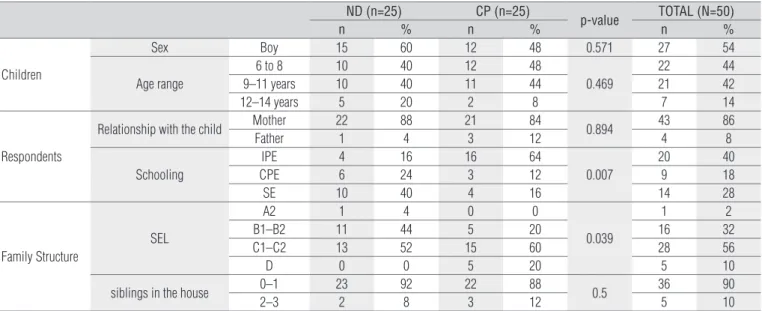
12 and 14. Forty-three volunteers (86%) were the children’s mothers, and the remaining volunteers were distributed as parents (8%, n=4) and others (6%, n=3). Most of the interview-ees had incomplete primary education (40%, n=20), followed by complete secondary education (28%, n=14), complete pri-mary education (18%, n=9), complete tertiary education (8%, n=4), no education (4%, n=2), and incomplete secondary and tertiary education (2%, n=1 each). Most of the children (90%, n=45) were an only child or they have only one brother/sister at home. Most families (30%, n=15) received the classiication C1, according to ABEP, corresponding to a monthly mean income of one thousand one hundred and ninety-ive real (R$ 1.195,00), followed by C2 (26%, n=13, mean income of R$ 726.00), B2 (22%, n=11, mean income of R$ 2.013,00), B1 and D (10%, n=5 each,
mean income of R$ 3,479.00 and R$ 485.00, respectively) and A2 (2%, n=1, mean income of R$ 6,564.00).
here was no diference between groups regarding the dis-tributions by age group, gender, relationship of the respondent to the child, number of siblings at home, and clarity of the items of CHORES. However, the children with CP were from families with lower education and lower socioeconomic levels, compared to the group of children with ND.
As seen in Figure 2, forty-nine interviewees (98%) reported that all items contained in CHORES were clear and that there was no diiculty in understanding them. Only one interviewee of the group of children with ND believed that item 31 (“Or-ganizes own belongings for after-school events”) was unclear. However, the respondent refused to rewrite it, stating that,
Table 2. Sample’s descriptive statistics (stage 5).
ND (n=25) CP (n=25)
p-value TOTAL (N=50)
n % n % n %
Children
Sex Boy 15 60 12 48 0.571 27 54
Age range
6 to 8 10 40 12 48
0.469
22 44
9–11 years 10 40 11 44 21 42
12–14 years 5 20 2 8 7 14
Respondents
Relationship with the child Mother 22 88 21 84 0.894 43 86
Father 1 4 3 12 4 8
Schooling
IPE 4 16 16 64
0.007
20 40
CPE 6 24 3 12 9 18
SE 10 40 4 16 14 28
Family Structure
SEL
A2 1 4 0 0
0.039
1 2
B1–B2 11 44 5 20 16 32
C1–C2 13 52 15 60 28 56
D 0 0 5 20 5 10
siblings in the house 0–1 23 92 22 88 0.5 36 90
2–3 2 8 3 12 5 10
ND: normal development; CP: cerebral palsy; IPE: incomplete primary education; CPE: complete primary education; SE: secondary education; SEL: social economic level.
Table 1. Discrepancies between the translated version and the original version found in the CHORES items during the process of translation.
CHORES –original version CHORES – translated version
1. Cleans up after own play 1. Guarda os próprios brinquedos depois de brincar # 2. Picks up own bedroom 2. Arruma o próprio quarto #
3. Makes own bed 3. Arruma a própria cama #
4. Picks up area shared by others 4. Arruma área compartilhada com outros * # 6. Makes self a snack 6. Prepara seu próprio lanche (1) * # 7. Makes self a cold meal 7. Prepara refeições frias (2) para si mesmo * # 8. Prepares part of a cold meal for the family 8. Prepara parte de uma refeição fria (2) para a família 9. Makes self a hot meal 9. Prepara refeições quentes (3) para si mesmo # 10. Prepares part of a hot meal for the family 10. Prepara parte de uma refeição quente (3) para a família 11. Sets or clears the table 11. Arruma ou tira a mesa #
12. Brings in or puts away groceries 12. Traz ou guarda as compras de supermercado # 17. Puts own laundry in hamper 17. Coloca a própria roupa suja no local determinado # 22. Sweeps or vacuums own room 22. Varre ou passa pano no próprio quarto #
24. Sweeps or vacuums home 24. Varre ou passa pano na casa # 30. Organizes own belongings for school 30. Organiza seu material escolar #
31. Organizes own belongings for after-school events 31. Organiza seus pertences para eventos extra-escolares * # 33. Runs errand 33. Cumpre afazeres fora de casa *
520
A: Is this CHORES item
clear to you? activities belong to yourB: Do these CHORES family routine?
C: Do you identify any other task that belong to your family routine and is not included in the CHORES?
CLEAR 30 25 20 15 10 5 0 25 24 1 0 CP ND 25 25 CP ND 30 25 20 15 10 5 0 25 20 15 10 5 0 CP ND NOT CLEAR NO YES YES NO 21 24 1 4 cleans backyard washes porch
after reading it again and hearing the examiner’s explanation, it became understandable. All interviewees reported that the items of the instrument are representative of the domestic activities performed routinely by the family, and 10% (n=5) identiied other routine activities that were not included in CHORES, particularly “cleans backyard “ and “washes porch”.
Reliability
he test-retest reliability was assessed for each CHORES score, showing levels over 0.90 and evidencing strong consis-tency of the test when administered at intervals of up to 14 days37 (Table 3).
Discussion
he process of translating an instrument requires stan-dardized and predeined techniques and procedures aimed at the systematization of actions to produce a reliable measure with valid content5,38. he translation of CHORES was validated
in all stages of the structure proposed by Beaton et al.31; the
adaptations implemented in the translated version of the test sought to promote understanding of the content and its ad-aptation in order to ofer information on the participation of children and adolescents with and without disabilities in daily household tasks.
he translation process aimed to prioritize words and ex-pressions that best represent the test situation, considering the proposals of the instrument and the social and cultural reality of most of the Brazilian population5. hus, the translated version
used simple language representative of the evaluated construct, reaching semantic, idiomatic, conceptual, and experiential equivalences between the original instrument and the transla-tion31. he translation of the word “help” in the instructions
for test application exempliies this statement. he translators opted for the word “ajuda” in the translated version, instead of the words “assistência” and “auxílio”, because its use is more prevalent in the colloquial language of the Brazilian people.
he comments inserted in the CHORES instructions aimed to further explain the score criteria of some items and they were deemed necessary by the researchers based on the administra-tion of the quesadministra-tionnaire, when the examiner faced situaadministra-tions that were not covered in the instructions of the original version. For instance, if the child performs the appraised task indepen-dently only part of the time, the examiner should opt for the per-formance score “no “, since the child’s participation in the task is not routine. When the item deals with objects or speciic tasks that do not match the family routine, such as “dries the dishes” or “takes care of plants”, the option of assistance score that should be marked is “I do not expect that from my child “.
In relation to the diferences observed in the CHORES items, the researchers looked for the translation that best corresponds to the domestic tasks performed in Brazil. For ex-ample, the Portuguese word “arruma”, widely used in everyday language of domestic tasks, was chosen as the translation for three words/expressions in the original language of the instru-ment: “picks up”, “makes” and “sets”, corresponding to items 2, 3, 4, and 11, which refer to “picks up own bedroom”, “makes own bed”, “picks up area shared by others”, and “sets or clears the table”, respectively. At the same time, the word “makes” was also translated as “prepara” when it referred to meals (items 6, 7, and 9). he words/expressions “cleans up” and “organizes” in items 1, 30, and 31 were represented by the single word “orga-niza”. In item 12, we opted to translate “groceries” for “compra de supermercado”, considering a larger inclusion of this expres-sion in comparison with “mantimentos”, literal translation of the word. Another example is in the literal translation of the item 17 (“Puts own laundry in hamper”), where the word “cesto” was replaced by the expression “local determinado”, which
Table 3. Test-retest reliability indices, 95% confidence interval and p-value. CHORES scores ICC (95%) Confidence Interval p-value SCP 0.94 0.790–0.980 0.0001 FCP 0.95 0.819–0.983 0.0001
P 0.96 0.855–0.987 0.0001
SCA 0.97 0.900–0.991 0.0001 FCA 0.93 0.766–0.978 0.0001
A 0.97 0.898–0.990 0.0001
SCP: self-care performance; FCP: family care performance; P: performance; SCA=self-care assistance; FCA: family care assistance; A: assistance; ICC: Intraclass Correlation Coefficient.
Figure 2. Questions to the participants regarding the clarity and relevance of
the CHORES content during stage 5 of the translation process.
better corresponds to the reality of Brazilian families. For this same reason, in items 22 (“Sweeps or vacuums own room”) and 24 (“Sweeps or vacuums home”), we opted to substitute the ac-tion of “vacuum” with “mop”.
We also evaluated the need for providing examples in items 4 (“Picks up area shared by others”), 6 (“makes self a snack”), 7 (“makes self a cold meal”), 31 (“organizes own belongings for af-ter-school events”) and 33 (“runs errand”). In item 4, we found the need to exemplify the rooms of the home that are usually shared by the family members. It is necessary to investigate, however, if the respondents have those rooms in their home and if they correspond to areas of common access among the residents. In items 6 and 7, there was a need to diferentiate between the terms “snack” and “cold meal”, since the latter is not very common in Brazilian culture. he irst word refers to fast meals, such as bread and butter, cookies, sandwiches. he second refers to a cold dish (lunch or dinner) such as a salad. he solution found by the researchers was to add a footnote to the items related to meals and snacks, distinguishing the criteria used to evaluate them. In items 31 and 33, the expert committee deemed it necessary to exemplify the after-school events, such as language classes, and the tasks performed out of home, such as going to the bakery.
Regarding the demographic information, the original version of CHORES proposed the characterization of the child’s race/eth-nicity in ive categories (African American – not Hispanic origin; white – not Hispanic; Asian – Paciic Islands; Hispanic and Native American). his information was considered inappropriate for the Brazilian reality, given the intensity of the country’s miscegenation that hinder categorization. herefore, the researchers chose to remove this classiication in the translated version.
Another change considered necessary by the committee was the inclusion of three educational options: “unschooled”, “incomplete primary education”, and “complete primary educa-tion”. hese insertions were necessary due to a great contingent of the Brazilian population in these educational conditions.
After the administration, it was not necessary to modify any CHORES items given that there was no report of lack of clarity of the content by more than 20% of the participants36.
It is worth noting that the translated version was understood by the parents and caregivers despite the diference in edu-cational and socioeconomic level between the groups, which suggests that the instrument addresses these diferences com-monly found in the Brazilian population. It is also noteworthy that 10% of the parent interviewees pointed out the absence
of two routine family activities that were not included in the CHORES questionnaire: “cleans backyard “and “washes porch”. It is believed that the spontaneous eligibility of these activities deserves attention by future users of this instrument.
he high levels of test-retest reliability found in the present study (ICC total scores of performance and assistance were 0.95 and 0.96, respectively) corroborate the test-retest reliability levels of the original instrument (0.92 and 0.88, respectively)22,
indicat-ing that the translated version shows excellent stability. In other words, the parents provide consistent reports of the children’s par-ticipation in domestic tasks. Nevertheless, the translated CHORES questionnaire was applied to children with CP and ND, whereas the original instrument was administered to children with ADHD.
he translation of a measure of participation of children with and without disabilities in tasks performed exclusively in the context of the home is of great relevance to clinical prac-tice and to scientiic research. It provides a snapshot of the children’s experience in their domestic routine as well as the variability of family values, while allowing comparative studies and improving documentation of the performance and gradual level of assistance provided to children and adolescents as a result of both development and intervention strategies.
In the present study, the translation stages were carefully followed and the semantic, idiomatic, conceptual, and expe-riential discrepancies were solved by the expert specialists, aiming at the cultural adaptation of CHORES. he administra-tion of the pre-inal version showed that it is a clear and com-prehensible tool for families with diferent socioeconomic and educational levels. he translated version ofers a new instru-ment to health and rehabilitation professionals in the country.
Acknowledgments
To all the children and families who agreed to participate in this study.
522
References
1. Law M, King G, King S, Kertoy M, Hurley P, Rosenbaum P, et al. Patterns of participation in recreational and leisure activities among children with complex physical disabilities. Dev Med Child Neurol. 2006;48(5):337-42. PMID: 16608540, DOI: 10.1017/S001.216.2206000740.
2. Hemmingsson H, Jonsson H. An occupational perspective on the concept of participation in the international classification of functioning, disability and health-some critical remarks. Am J OccupTher. 2005;59(5):569-76. PMID: 16268024.
3. Eyssen IC, Steultjens MP, Dekker D, Terwee CBA. Systematic review of instruments assessing participation: challenges in defining participation. Arch Phys Med Rehabil. 2011;92(6):983-97. PMID: 21621675, DOI: 10.1016/j.apmr.2011.01.006.
4. Miyamoto S, Lombardi Junior I, Berg KO, Ramos LR, Natour J. Brazilian version of the Berg balance scale. Braz J Med Biol Res. 2004;37(9):1411-21. DOI: 10.1590/S0100-879X200.400.0900017.
5. Mancini MC. Inventário de Avaliação Pediátrica de Incapacidade (PEDI) - manual da versão brasileira adaptada. Belo Horizonte (MG): Editora UFMG; 2005.
6. Souza AC, Magalhães LC, Teixeira-Salmela LF. Cross-cultural adaptation and analysis of the psychometric properties in the Brazilian version of the Human Activity Profile. Cad Saúde Pública. 2006;22(12):2623-36. DOI: 10.1590/S0102-311X200.600.1200012.
7. Hiratuka E, Matsukura TS, Pfeifer LI. Cross-cultural adaptation of the Gross Motor Function Classification System into Brazilian-Portuguese (GMFCS). Rev Bras Fisioter. 2010;14(6):537-44. DOI: 10.1590/S1413.355.5201000.060.0013.
8. Martins J, Napoles BV, Hoffman CB, Oliveira AS. The Brazilian version of Shoulder Pain and Disability Index - translation, cultural adaptation and reliability. Rev Bras Fisioter. 2010;14(6):527-36. DOI: 10.1590/S1413.355.5201000.060.0012.
9. The WHOQOL GROUP. The Word Health Organization Quality of Life Assessment (WHOQOL): position paper from the World Health Organization. Soc Sci Med. 1995;41(10):1403-9. PMID: 8560308, DOI: 10.1016/0277-9536(95)00112-K.
10. Guillemin F, Bombardier C, Beaton D. Cross-cultural adaptation of health-related quality of life measures: literature review and proposed guidelines. J Clin Epidemiol. 1993;46(12):1417-32. PMID: 8263569, DOI: 10.1016/0895-4356(93)90142-N.
11. Leung GPK, Chan CCH, Chung RCK, Pang MYC. Determinants of activity and participation in preschoolers with developmental delay. Res Dev Disabil. 2011;32(1):289-96. PMID: 21036536.
12. Mancini MC, Coster W. Functional predictors of school participation by children with disabilities. Occup Ther Int. 2004;11(1):12-25. PMID: 15118768.
13. Schenker R, Coster W, Parush S. Neuroimpairments, activity performance, and participation in children with cerebral palsy mainstreamed in elementary schools. Dev Med Child Neurol. 2005;47(12):808-14. PMID: 16288670.
14. Simeonsson RJ, Carlsonoe D, Huntington GS, McMillen JS, Brent JL. Students with disabilities: a national survey of participation in school activities. Disabil Rehabil. 2001;23(2):49-63. PMID: 11214716.
15. Law M, Petrenchik T, King G, Hurley P. Perceived environmental barriers to recreational, community, and school participation for children and youth with physical disabilities. Arch Phys Med Rehabil. 2007;88(12):1636-42. PMID: 18047879, DOI: 10.1016/j.apmr.2007.07.035.
16. Engel-Yeger B, Jarus T, Anaby D, Law M. Differences in patterns of participation between youths with cerebral palsy and typically developing peers. Am J Occup Ther. 2009;63(1):96-104. PMID: 19192732.
17. Hammal D, Jarvis SN, Colver AF. Participation of children with cerebral palsy is influenced by where they live. Dev Med Child Neurol. 2004;46(5):292-8. PMID: 15132258, DOI: 10.1017/ S001.216.2204000489.
18. Mihaylov SI, Jarvis SN, Colver AF, Beresford B. Identification and description of environmental factors that influence participation of children with cerebral palsy. Dev Med Child Neurol. 2004;46(5):299-304. PMID: 15132259, DOI: 10.1017/S001.216.2204000490.
19. Voorman JM, Dallmeijer AJ, Schuengel C, Knol DL, Lankhorst GJ, Becher JG. Activities and participation of 9- to 13-year-old children with cerebral palsy. Clin Rehabil. 2006;20(11):937-48. PMID: 17065537, DOI: 10.1177/026.921.5506069673.
20. Orlin MN, Palisano RJ, Chiarello LA, Kang L-J, Polansky M, Almasri N, et al. Participation in home, extracurricular, and community activities among children and young people with cerebral palsy. Dev Med Child Neurol. 2010;52(2):160-6. PMID: 19549198, DOI: 10.1111/j.1469-8749.2009.03363.x
21. Cohn E, Miller LJ, Tickle-Degnen L. Parental hopes for therapy outcomes: Children with sensory modulation disorders. Am J Occup Ther. 2000;54(1):36-43. PMID: 10686625
22. Dunn L. Validation of the CHORES: a measure of school-aged children’s participation in household tasks. Scand J Occup Ther. 2004;11(4):179-90.
23. Baumrind D. Harmonious parents and their preschool children. Dev Psychol. 1971;4(1 Pt 1):99-102. DOI: 10.1037/h0030373.
24. Grusec JE, Goodnow JJ, Cohen L. Household work and the development of concern for others. Dev Psychol. 1996;32(6):999-1007. DOI: 10.1037/0012-1649.32.6.999.
25. Moore KA, Chalk R, Scarpa J, Vandivere S. Familiy streghts: often overlooked, but real. Child Trends. 2002:1-8. Available from: http://www.childtrends.org/Files//Child_ Trends-2002_08_01_RB_FamilyStrengths.pdf.
26. Bedell GM. Developing a follow-up survey focused on participation of children and youth with acquired brain injuries after discharge from inpatient rehabilitation. NeuroRehabilitation. 2004;19(3):191-205. PMID: 15502253.
27. King GA, Law M, King S, Hurley P, Hanna S, Kertoy M, et al. Measuring children’s participation in recreation and leisure activities: construct validation of the CAPE and PAC. Child Care Health Dev. 2006;33(1):28-39. PMID: 17181750.
28. Dunn L, Coster WJ, Orsmond GI, Cohn ES. Household task participation of children with and without attentional problems. Phys Occup Ther Pediatr. 2009;29(3):258-73. PMID: 19842855, DOI: 10.1080/019.426.30903008350.
29. Dunn L, Coster WJ, Cohn ES, Orsmond GI. Factors associated with participation of children with and without ADHD in household tasks’. Phys Occup Ther Pediatr. 2009;29(3):274-94. PMID: 19842856, DOI: 10.1080/019.426.30903008327.
30. Harr N, Dunn L, Price P. Case study on effect of household task participation on home, community, and work opportunities for a youth with multiple disabilities. Work. 2011;39(4):445-53. PMID: 21811033, DOI: 10.3233/WOR-2011-1194.
31. Beaton D, Bombardier C, Guillemin F, Ferraz MB. Guidelines for the process of cross-cultural adaptation of self-report measure. Spine (Phila Pa 1976). 2000;25(24):3186-91. PMID: 11124735.
32. Palisano RJ, Rosenbaum P, Bartlett D, Livingston MH. Content validity of the expanded and revised Gross Motor Function Classification System. Dev Med Child Neurol. 2008;50(10):744-50. PMID: 18834387.
33. Eliasson AC, Krumlinde-Sundholm L, Rösblad B, Beckung E, Arner M, Öhrvall AM, et al. The Manual Ability Classification System (MACS) for children with cerebral palsy: scale development and evidence of validity and reliability. Dev Med Child Neurol. 2006;48(7):549-54. PMID: 16780622.
34. White LK, Brinkerhoff DB. Children’s work in the family: its significance and meaning. J Marriage Fam. 1981;43(4):789-98.
35. ABEP - Associação Brasileira de Empresas de Pesquisa – 2008. Dados com base no Levantamento Sócio Econômico – 2005 – IBOPE. [cited 2012 Mar 05]. Available from: www.abep.org.
36. Sousa VD, Rojjanasriat W. Translation, adaptation and validation of instruments or scales for use in cross-cultural health care research: a clear and user-friendly guideline. J Eval Clin Pract. 2011;17(2):268-74. PMID: 20874835, DOI: 10.1111/j.1365-2753.2010.01434.x.
37. Portney LG, Watkins MP. Foundations of clinical research: applications to practice. 2nd ed. New
Jersey (NJ): Prentice Hall Health; 2000.