A
RTIGOO
RIGINAL Revista Brasileira de FisioterapiaEffects of an educational back care program
on Brazilian schoolchildren’s knowledge
regarding back pain prevention
Efeitos de um programa educacional de cuidados com a coluna sobre o nível de
conhecimento de escolares brasileiros quanto à prevenção de dor na coluna vertebral
Fabiana A. Foltran1, Roberta F. C. Moreira1, Mariana O. Komatsu2, Mariana F. Falconi2, Tatiana O. Sato1,2
Abstract
Background: Children are often exposed to ergonomic risk factors at school. Thus, the school is a potential environment for developing musculoskeletal disorders and implementing back care programs. Objectives: To evaluate the effect of an educational program on schoolchildren’s knowledge regarding back pain prevention. Methods: 392 students from 4th to 8th grade from a Brazilian state school took part
in the study; 114 students (30%) were evaluated at follow-up. The back care program included pre- and post-intervention assessments and a follow-up assessment, as well as theoretical and practical lessons. The time interval between the pre- and post-intervention assessments was 9 weeks, and between the post-intervention and follow-up assessments, it was 2 years. Statistical analysis included non-parametric ANOVA tests. Significance level was set at 5% (p<0.05). Results: There was a significant increase (p<0.001) between pre- (3.6±2.9) and post-intervention (7.5±2.2) scores and a significant decrease in the follow-up score (5.1±2.5). However, the follow-up score was still significantly higher (p<0.001) than the pre-intervention score. The rate of correct answers in the post-intervention assessment increased for all questions, and some of them were still high at follow-up. Significant differences were identified for the comparison between grades, with the 8th grade
being significantly different from the other grades. Conclusion: The back care program showed an increase in the level of knowledge of Brazilian schoolchildren. Two years after the intervention, students still retained ergonomic concepts. Although the program has limitations, theoretical knowledge acquisition is the first step towards adopting healthy postural habits to prevent back pain.
Registration number: ACTRN12610000703000.
Keywords: posture;intervention studies; primary prevention; students; physical therapy.
Resumo
Contextualização: As crianças estão expostas a um conjunto de fatores de risco ergonômicos na fase escolar. Tais fatores tornam a escola um ambiente propício ao desenvolvimento de alterações musculoesqueléticas, assim como para a implementação de programas de cuidados com a coluna vertebral. Objetivo: Avaliar os efeitos de um programa educacional de cuidados com a coluna sobre o nível de conhecimento de escolares brasileiros quanto à prevenção de dor na coluna vertebral. Métodos: Trezentos e noventa e dois estudantes da 4ª à 8ª série de uma escola estadual participaram do estudo, sendo que 114 deles (30%) foram avaliados no follow up. O programa foi composto por avaliações pré, pós-intervenção e follow up, por aulas teóricas e práticas. O intervalo entre as avaliações pré e pós-intervenção foi de nove semanas e, entre a avaliação pré e o follow up, foi de dois anos. A análise estatística incluiu ANOVA não-paramétrica e o nível de significância foi de 5%. Resultados: Houve diferença significativa no nível de conhecimento (p<0,001) entre as avaliações inicial (3,6±2,9), final (7,5±2,2) e no followup (5,1±2,5), sendo que a pontuação no follow up foi significativamente superior à do pré-teste. Foi encontrada diferença significativa entre as séries, sendo que a 8ª série atingiu pontuação maior que as demais (p<0,05). Conclusão: O programa preventivo proporcionou aumento no nível de conhecimento dos estudantes, mesmo após dois anos de sua implementação. Embora o programa tenha limitações, a aquisição de conhecimento é o primeiro passo para a adoção de hábitos posturais saudáveis para a prevenção de dores na coluna vertebral.
Registro de ensaio clínico: ACTRN12610000703000.
Palavras-chave: postura; estudos de intervenção; prevenção primária; estudantes; fisioterapia.
Received: 06/15/2011 – Revised: 11/30/2011 – Accepted: 12/07/2011
1 Postgraduate Program in Physical Therapy, Universidade Federal de São Carlos (UFSCar), São Carlos, SP, Brazil 2 Physical Therapy Department, UFSCar, São Carlos, SP, Brazil
Correspondence to: Tatiana de Oliveira Sato, Departamento de Fisioterapia, UFSCar, Rodovia Washington Luiz, km 235, CEP 13565-905, São Carlos, SP, Brasil, e-mail: [email protected]
Introduction
he prevalence of back pain among children and ado-lescents varies between 3 and 74%1-5. his variation can be
attributed to the population and the diagnostic criteria considered6-8. During school years, children spend one third
of their waking hours at school9, an environment that can
expose them to ergonomic risk factors including carrying heavy backpacks, sitting postures for prolonged periods, and inadequate furniture10-13. hus, the school is a potential
envi-ronment for developing musculoskeletal disorders, as well as implementing back care programs14.
Various postural deviations, especially of the spine, origi-nate during childhood and adolescence12,15-16, which is a
pe-riod of rapid musculoskeletal development (growth spurt) and when the spine is more susceptible to deformities17.
Some authors report a high prevalence of back pain in adults18
and previous history of back pain as a predisposing factor for future symptoms7,9,19-21. It has also been reported that a
large percentage of symptomatic adults had their irst back pain symptoms during adolescence or before their thirties22.
Healthy postural habits adopted during daily activities may protect the spine from overload and prevent postural devia-tions that may lead to pain. However, a lack of knowledge and adequate instruction during childhood may result in inad-equate postural habits, which in turn may lead to structural deformations and pain in adulthood23.
Educational initiatives are essential for schoolchildren. Providing information to this population will help them to ind local and individual solutions for ergonomic risks24. For
the working population, educational programs combined with adjustable furniture showed improvements in worksta-tion set-up25,26. In contrast, providing adjustable furniture does
not mean postural improvement for adults if an instruction program is not provided and periodically reinforced27 and vice
versa. hus, both actions are important for back pain preven-tion. Unfortunately, school furniture design is a problem that goes unrecognized by educational managers, and health prac-titioners only have preventive programs and orientation as tools to deal with this problem during childhood.
As proposed by Prochaska and DiClemente’s Stages of Change Model28, to change an unhealthy habit, knowledge
should be acquired about the consequences of doing things in an undesirable way. Behavioral changes are an intentional process and comprehend diferent stages. he initial stages (pre-contemplation, contemplation, and preparation for ac-tion) include changes in the cognitive process. During these stages, it is important to encourage measures that increase the level of knowledge regarding the pros and cons related to behavioral change.
To our knowledge, ergonomic problems affecting schoolchildren are disregarded in the majority of schools. The national literature reports only two studies carried out in this environment29,30, one of them being specific
to backpack risk29 and the other to sitting posture30 risk.
International studies found good results for educational preventive programs conducted in Israel24, Belgium14,20,31,32,
United States17, and Japan33.
hus, this study aimed to describe the implementation of a multifactorial back care program and to evaluate the efects of this back care program on the level of knowledge of spine care among students from 4th to 8th grade from a public school in a
city in the interior of the state of São Paulo, Brazil.
Methods
Subjects and settings
A physical therapist from the municipal health department initiated contact with the school that belonged to her coverage area of basic health care. After this contact, the staf of Univer-sidade Federal de São Carlos (UFSCar), São Carlos, SP, Brazil, visited the school to propose the back care program, and the principal approved its implementation.
Four hundred and eighty subjects from 4th to 8th grade from
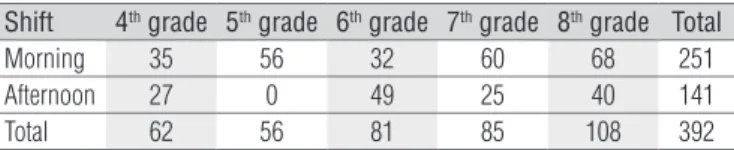
a public school in the interior of São Paulo state, Brazil, were invited and voluntarily agreed to participate in the study. hree hundred and ninety two students completed the pre- and post-intervention assessments (dropout rate of 18%). he students were aged 9 to 16, including 197 (50.3%) female and 195 (49.7%) male students. he distribution of students in shifts and grades is shown in Table 1.
his study followed National Health Council Resolution 196/96 on ethical issues and was approved by the Ethics Com-mittee of UFSCar (approval number 039/2009).
Instrument
A pilot test was initially carried out with students from 1st to
8th grades and teachers to make the questions suitable for the
students’ comprehension level. During this test, we found that the questionnaire was not suitable for 1st to 3rd grades, since
the students did not understand its content. hus, only 4th to
Shift 4th grade 5th grade 6th grade 7th grade 8th grade Total
Morning 35 56 32 60 68 251
Afternoon 27 0 49 25 40 141
Total 62 56 81 85 108 392
Table 1. Distribution of students in shifts and grades.
8th grade students took part in the program. he questionnaire
was adapted from national34,35 and international31 literature
and, whenever possible, illustrations were included. Consider-ing that eight out of ten questions were based on identiica-tion of correct postures in illustraidentiica-tions, we considered that an extensive validation and cross-cultural adaptation was not required for the use of this questionnaire. he questions are shown in Appendix 1.
Procedures
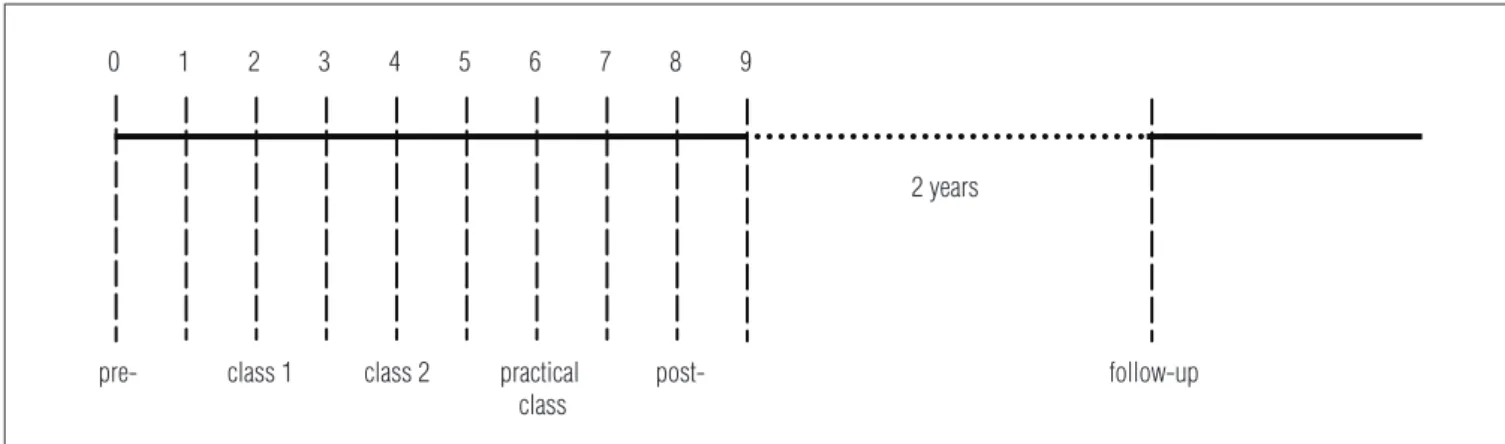
he program comprised 6 phases: pre-intervention assessment, lesson 1, lesson 2, practical lesson (contest), post-intervention as-sessment, and two-year follow-up assessment. he questionnaires were applied in the classroom during regular school hours. Every student received a copy of the questionnaire, which was answered with the help of a physical therapist who read it out loud and answered any questions raised by the students. he time interval between the pre- and post-intervention assessments was 9 weeks, and between the post-intervention and follow-up assessments, it was 2 years (Figure 1). he back care program comprehended three meetings, two oral presentations, and one practical lesson of approximately 50 minutes each, conducted in three consecutive weeks. he irst presentation was on spine anatomy and physiol-ogy including a model of a human skeleton, vertebrae, interver-tebral discs, muscles, ligaments, nerves, as well as their location and function descriptions. Topics related to physiological curves of the spine and deviations, such as scoliosis, hyperkyphosis, and hyperlordosis, were also presented.
The second presentation was on the correct sitting pos-ture during school and leisure activities and how to choose the correct furniture and the correct standing position (shoulder, hip, and feet alignments). The following topics were also discussed with the students: how to lift and trans-port objects correctly; risk postures for developing spinal deviations; and recommendations on how to use school
backpacks, including the best way to carry them, the ideal size, the importance of using both shoulder straps, and the maximum recommended load.
In both presentations, visual aids to illustrate the topics and practical demonstrations were used. At the end of each presentation, the students answered oral questions related to what was taught to improve their learning achievements.
Following these presentations, there was a competition including 9 tasks so the students could apply the principles they had studied in a real situation. he lesson content was similar for children from 4th to 8th grade, however, the
lan-guage and examples were adapted according to age through analogies to everyday situations. For children, we compared intervertebral discs to an onion, ligaments were associated with adhesive tape, and so on. For adolescents, we asked if they had back symptoms or postural deviations, how they carried heavy boxes, etc.
Data analysis
he data were tabulated as follows: questions correctly answered scored 1, unanswered questions scored 0, and those incorrectly answered scored -1. he one point deduction was given to incorrect answers to discourage students from guess-ing when they did not know the answer. he proportion of correct, incorrect, and no answers was calculated for each question in the pre- and post-intervention assessments.
Each student was given a total score by adding up the scores of the individual questions, and the average score of each grade was calculated. his procedure was conducted for the pre- and post-intervention assessments. he values obtained were compared to identify possible diferences between the average scores before and after the intervention.
he statistical analysis included Levene’s test for ho-moscedasticity and the Shapiro-Wilks test for normality. Since the data did not meet the parametric ANOVA criteria,
0 1 2 3 4 5 6 7 8 9
follow-up 2 years
pre- class 1 class 2 practical class
post-Figure 1. Timeline scheme for the back care program application.
pre- and post-intervention scores as well as follow-up results were compared using the Friedman test with Dunn’s post hoc
to identify which dif erences were signii cant. h e Kruskal-Wallis test (non-parametric ANOVA) was applied to check existing dif erences among school grades with Dunn’s post hoc to identify which dif erences were signii cant. h e chi-square test was applied to verify the association between individual questions and grade. All analyses were carried out in the software SPSS (version 11.5), and the signii cance level was set at 5% (p<0.05).
Results
Table 2 shows that the proportion of correct answers in-creased in the post-intervention assessment for all questions. At follow-up, the proportion of correct answers was slightly lower than post-intervention results for the majority of the questions, except for questions 1 and 2.
Questions 1 and 2 showed the highest increase between the pre- and post-intervention assessments (57% and 52%, respectively). However, these questions also showed the low-est proportion of correct answers and a high percentage of incorrect answers at follow-up. h e highest proportion of no answers was observed for question 1. Question 2 showed the highest proportion of incorrect answers in all assessments. It is also worth mentioning that the number of incorrect answers decreased between the pre- and post-intervention assessments, except for question 1, which presented a 17% increase in wrong answers. Questions 5, 6, 9, and 10 showed the highest decrease in incorrect answers, and this reduction varied from 18 to 33%.
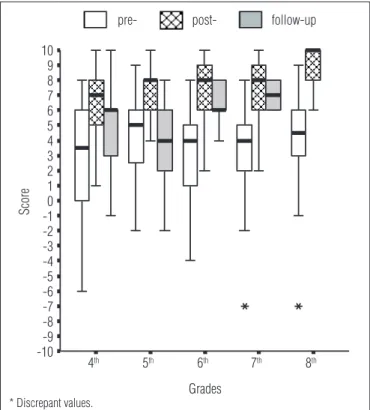
h ere was a signii cant dif erence between the pre-inter-vention (3.6±2.9), post-intervention (7.5±2.2), and follow-up (5.1±2.5) scores, coni rmed by the Friedman test (P<0.001). Figure 2 shows the scores between grades in the pre- and
post-intervention assessments and in the follow-up assess-ment. h ere was higher data dispersion in the pre-intervention assessment when compared to the post-intervention assess-ment. In the latter, students of all grades increased their scores, and the 8th grade in particular achieved a median of 10, i.e. half
of the group obtained the maximum score. h e Kruskal-Wallis test showed dif erences among the grades in the post-interven-tion assessment (p<0.001), and Dunn’s multiple comparisons test identii ed dif erences between the 8th grade and the other
grades (p<0.05 for all comparisons). For questions 1 and 2, the chi-square test showed an association (p<0.05) between cor-rect answers and grade.
Grades
8th
7th
6th
5th
4th
Score
10 9 8 7 6 5 4 3 2 1 0 -1 -2 -3 -4 -5 -6 -7 -8 -9 -10
pre- post- follow-up
* Discrepant values.
Figure 2. Box-plot of the scores obtained by each grade in the pre-intervention, post-pre-intervention, and follow-up assessments.
Correct answer Incorrect answer No answer
Pre- Post- Follow-up Pre- Post- Follow-up Pre- Post- Follow-up
Q1 0.8 57.9 34.2 7.4 24.7 55.3 91.8 17.3 10.5
Q2 8.9 61.2 22.8 49.7 34.7 74.6 41.3 4.1 2.6
Q3 92.9 99.0 100.0 6.6 0.8 0 0.5 0.3 0
Q4 82.9 98.7 97.4 15.1 1.3 2.6 2.0 0 0
Q5 77.3 97.4 97.4 20.7 2.3 2.6 2.0 0.3 0
Q6 67.6 92.9 89.5 24.7 5.1 9.6 7.7 2.0 0.9
Q7 58.9 74.0 70.2 30.1 20.4 28.1 11.0 5.6 1.8
Q8 81.1 97.2 88.6 16.1 1.3 11.4 2.8 1.5 0
Q9 71.4 92.6 86.8 25.3 6.6 13.2 3.3 0.8 0
Q10 54.3 91.1 61.4 41.6 8.9 38.6 4.1 0 0
Table 2. Percentage of correct, incorrect, and no answers for each question before and after the educational program.
Discussion
he results of the present study showed that students im-proved their questionnaire score, demonstrating the eicacy of oral presentations and practical lessons to improve their level of back care knowledge even after a long period, as the two-year follow-up results indicated.
Diferences between grades in the post-intervention assess-ment were identiied, indicating that the score was higher among the 8th grade students. One possible explanation is that the
pro-posed intervention was more appropriate for these students. It is likely that the more advanced stage of cognitive development of this group and their better ability to concentrate helped them to connect the topics presented to their daily activities, resulting in a better performance in the post-intervention assessment. Fur-thermore, events such as previous pain experience among these students and their family members, as well as concerns about aesthetic postural aspects may have contributed to the better content assimilation by the students of this grade.
Steele, Dawson and Hiller36 indicated that further studies
should be conducted to control confounding factors, such as students’ age. he comparison between grades showed the importance of this confounding factor, partially showed by the chi-square association between grade and correct answers for questions 1 and 2. hus, it is important that health profession-als who work in schools pay attention to this aspect to achieve better results with the development of back care programs.
Considering the individual analysis of each question, it can be observed that the questions related to spinal anatomy and pathol-ogy (Q1 and Q2) and the question related to the maximum back-pack load (Q7) showed the lowest proportion of correct answers and highest proportion of no answers. A possible explanation for these results would be associated with the higher complex-ity of these topics. Question 1 demanded greater attention from the students to correctly understand how it should be answered. Question 2 was ambiguous because, depending on the considered plane (sagittal or frontal), students could come up with diferent answers. Question 7 implied a percentage calculation that may have contributed to the higher proportion of incorrect answers, as the students have diiculty with mathematics37.
Questions related to handling of school materials (5, 6, 8, 9, and 10) and to sitting posture (3 and 4) showed the highest decrease in incorrect answers and the highest rate of correct an-swers. hese questions included subjects close to the students’ reality and illustrations that enabled them to understand better.
he results of similar intervention studies14,35 show a lower
tendency for correct answers for most of the questions directly compared to those of the present study. he greater diferences between the studies were found for those questions related to handling of materials and spinal curves.
Although the proposed program increased the students’ level of knowledge, it does not necessarily lead to a positive postural behavior change. he inadequate facilities at most Brazilian state schools hinder the success of interventions as the one pre-sented here. he furniture is standard size and does not meet the needs of the students’ anthropometric characteristics, which vary signiicantly according to age, gender, and stage of physical development38,39 and due to the high rate of miscegenation of the
Brazilian population. Adapting school furniture for an extremely heterogeneous population is challenging.
he limitations of this study are the lack of postural behav-ior measurement and the absence of a control group. he latter is a methodological limitation always considered in quality assessments of the studies included in systematic reviews36.
his study did not include a control group for ethical and methodological reasons. For ethical reasons, the program was applied to all students enrolled at the school, providing pos-tural orientation to all of them. he inclusion of a control group would raise methodological questions. If the control group was selected at the same school, “contamination” between groups could occur as the students could talk each other regarding the back care program, leading to biased results. In contrast, a control group from another school would have to be similar in terms of geographical, social, economic, and cultural levels.
he follow-up assessment allowed us to discover that the knowledge acquired could be retained over time. hese results indicate that this type of intervention has the potential to pro-duce long-term efects on the students involved in the project. Initiatives such as these, which include the implementation of a back care program, are very well accepted by students and teachers and should be developed by physical therapists or other health practitioners to become part of the regular curriculum.
Conclusion
he back care program contributed to an increase in the level of knowledge of spinal anatomy and physiology, adequate postures and furniture, and handling of school materials and other loads. his improvement in the level of knowledge was maintained for 2 years and was higher among the 8th grade
students. his program can be conducted at schools by health practitioners who aim to prevent back pain in adults.
Acknowledgements
his work was funded by grants from Conselho Nacional
de Desenvolvimento Cientíico e Tecnológico (CNPq Proc. N.
476524/08-3), Brasília, DF, Brazil.
Score your back care knowledge
Q1- Identify the spine deviations in the illustrations. Q2- How many curves does the spine have?
Q3- Identify which is the best sitting posture for studying. Q4- Which furniture is best suited for the child’s size? Q5- What is the best way to carry a backpack?
Q6- What is the correct way to organize school materials in your backpack? Q7- What is the maximum load you can carry in your backpack?
Q8- Which is the correct way to lift an object from the floor?
Q9- Which is the correct way to take a heavy object and put it in another place? Q10- What is the best way to carry a medium-sized box?
Appendix 1. Back care questionnaire adapted for the present study.
References
1. Masiero S, Carraro E, Celia A, Sarto D, Ermani M. Prevalence of nonspecific low back pain in schoolchildren aged between 13 and 15 years. Acta Paediatr. 2008;97(2):212-6.
2. Sato T, Ito T, Hirano T, Morita O, Kikuchi R, Endo N, et al. Low back pain in childhood and adolescence: a cross-sectional study in Niigata City. Eur Spine J. 2008;17(11):1441-7.
3. Murphy S, Buckle P, Stubbs D. Classroom postural and self-reported back and neck pain in schoolchildren. Appl Ergon. 2004;35(2):113-20.
4. Kovacs F, Gestoso M, Gil del Real MT, López J, Mufraggi N, Méndez JI. Risk factors for non-specific low back pain in schoolchildren and their parents: a population based study. Pain. 2003;103(3):259-68.
5. Watson KD, Papageorgiou AC, Jones GT, Taylor S, Symmons DP, Silman AJ, et al. Low back pain in schoolchildren: occurrence and characteristics. Pain. 2002;97(1-2):87-92.
6. Rodriguez DP, Poussaint TY. Imaging of back pain in children. AJNR Am J Neuroradiol. 2010;31(5):787-802.
7. van Gent C, Dols JJ, De Rover CM, Hira Sing RA, de Vet HC. The weight of schoolbags and the occurrence of neck, shoulder, and back pain in young adolescents. Spine (Phila Pa 1976). 2003;28(9):916-21.
8. Burton AK, Clarke RD, McClune TD, Tillotson KM. The natural history of low back pain in adolescents. Spine (Phila Pa 1976). 1996;21(20):2323-8.
9. Limon S, Valinsky LJ, Ben-Shalom Y. Children at risk: Risk factors for low back pain in the elementary school environment. Spine (Phila Pa 1976). 2004;29(6):697-702.
10. Milanese S, Grimmer K. School furniture and the user population: an anthropometric perspective. Ergonomics. 2004;47(4):416-26.
11. Harreby M, Nygaard B, Jessen T, Larsen E, Storr-Paulsen A, Lindahl A, et al. Risk factors for low back pain in a cohort of 1389 Danish school children: an epidemiologic study. Eur Spine J. 1999;8(6):444-50.
12. Parcells C, Stommel M, Hubbard RP. Mismatch of classroom furniture and student body dimensions: empirical findings and health implications. J Adolesc Health. 1999;24(4):265-73.
13. Rodrigues S, Montebelo MIL, Teodori RM. Plantar force distribution and pressure center oscillation in relation to the weight and positioning of school supplies and books in student’s backpack. Rev Bras Fisioter. 2008;12(1):43-8.
14. Geldhof E, Cardon G, De Bourdeaudhuij I, De Clercq D. Back posture education in elementary schoolchildren: stability of two-year intervention effects. Eura Medicophys. 2007;43(3):369-79.
15. Detsch C, Luz AMH, Candotti CT, Oliveira DS, Lazaron F, Guimarães LK, et al. Prevalência de alterações posturais em escolares do ensino médio em uma cidade no Sul do Brasil. Rev Panam Salud Pública. 2007;21(4):231-8.
16. Penha PJ, Casarotto RA, Sacco ICN, Marques AP, João SMA. Qualitative postural analysis among boys and girls of seven to ten years of age. Rev Bras Fisioter. 2008;12(5):386-91.
17. Feingold AJ, Jacobs K. The effect of education on backpack wearing and posture in a middle school population. Work. 2002;18(3):287-94.
18. Ferreira GD, Silva MC, Rombaldi AJ, Wrege ED, Siqueira FV, Hallal PC. Prevalência de dor nas costas e fatores associados em adultos do Sul do Brasil: estudo de base populacional. Rev Bras Fisioter. 2011;15(1):31-6.
19. Brattberg G. Do pain problems in young school children persist into early adulthood? A 13-year follow-up. Eur J Pain. 2004;8(3):187-99.
20. Cardon G, De Clercq D, De Bourdeaudhuij I, Breithecker D. Sitting habits in elementary schoolchildren: a traditional versus a “Moving School”. Patient Educ Couns. 2004;54(2):133-42.
21. Harreby M, Neergaard K, Hesselsøe G, Kjer J. Are radiologic changes in the thoracic and lumbar spine of adolescents risk factors for low back pain in adults? A 25-year prospective cohort study of 640 school children. Spine (Phila Pa 1976). 1995;20(21):2298-302.
22. Papageorgiou AC, Croft PR, Thomas E, Ferry S, Jayson MI, Silman AJ. Influence of previous pain experience on the episode incidence of low back pain: results from the South Manchester Back Pain Study. Pain. 1996;66(2-3):181-5.
23. Hanvold TN, Veiersted KB, Waersted M. A prospective study of neck, shoulder, and upper back pain among technical school students entering working life. J Adolesc Health. 2010;46(5):488-94.
24. Heyman E, Dekel H. Ergonomics for children: an educational program for elementary school. Work. 2009;32(3):261-5.
25. Amick BC 3rd, Robertson MM, DeRango K, Bazzani L, Moore A, Rooney T, et al. Effect of office ergonomics intervention on reducing musculoskeletal symptoms. Spine (Phila Pa 1976). 2003;28(24):2706-11.
26. Robertson M, Amick BC 3rd, DeRango K, Rooney T, Bazzani L, Harrist R, et al. The effects of an office ergonomics training and chair intervention on worker knowledge, behavior and musculoskeletal risk. Appl Ergon. 2009;40(1):124-35.
27. Verbeek J. The use of adjustable furniture: evaluation of an instruction programme for office workers. Appl Ergon. 1991;22(3):179-84.
28. Prochaska JO, DiClemente CC, Norcross JC. In search of how people change: Applications to addictive behaviors. Am Psychol. 1992;47(9):1102-14.
29. Fernandes SMS, Casarotto RA, João SMA. Efeitos de sessões educativas no uso das mochilas escolares em estudantes do ensino fundamental I. Rev Bras Fisioter. 2008;12(6):447-53.
30. Zapater AR, Silveira DM, Vitta A, Padovani CR, Silva JCP. Postura sentada: a eficácia de um programa de educação para escolares. Ciênc Saúde Coletiva. 2004;9(1):191-9.
31. Cardon G, De Clercq D, De Bourdeaudhuij I. Effects of back care education in elementary schoolchildren. Acta Paediatr. 2000;89(8):1010-7.
32. Geldhof E, Cardon G, De Bourdeaudhuij I, De Clercq D. Back posture education in elementary schoolchildren: a 2-year follow-up study. Eur Spine J. 2007;16(6):841-50.
33. Noda W, Tanaka-Matsumi J. Effect of a classroom-based behavioral intervention package on the improvement of children’s sitting posture in Japan. Behav Modif. 2009;33(2):263-73.
34. Rebolho MCT, Cardinali VA. Posturinha e sua Turma: Harmonia com a postura. São Paulo, SP: Scortecci Editora; 2007.
35. Almeida LC. O Tiro da bruxa: postura correta, corpo saudável. Belo Horizonte, MG: Editora Saraiva; 2004.
36. Steele EJ, Dawson AP, Hiller JE. School-based interventions for spinal pain: a systematic review. Spine (Phila Pa 1976). 2006;31(2):226-33.
37. Ministério da Educação. Fracasso escolar no Brasil: Políticas, programas e estratégias de combate ao fracasso escolar. Brasília, 2005.
38. Panagiotopoulou G, Christoulas K, Papanckolaou A, Mandroukas K. Classroom furniture dimensions and anthropometric measures in primary school. Appl Ergon. 2004;35(2):121-8.
39. Jeong BY, Park KS. Sex differences in anthropometry for school furniture design. Ergonomics. 1990;33(12):1511-21.