Short Report
0103 - 5053 $6.00+0.00
*e-mail: [email protected]; [email protected]
Copper Catalyzed Cross-Coupling Reactions of Diaryl Ditellurides with
Potassium Aryltrifluoroborate Salts
Diego Alves,*,a Jesus M. Pena,a Adriano S. Vieira,a Giancarlo V. Botteselle,a Rafael C. Guadagnina and Hélio A. Stefani*,a,b
aDepartamento de Farmácia, Faculdade de Ciências Farmacêuticas, Universidade de São Paulo,
05508-900 São Paulo-SP, Brazil
bDepartamento de Biofísica, Universidade Federal de São Paulo, 04023-062 São Paulo-SP, Brazil
Apresentamos aqui resultados das reações de acoplamento de diteluretos de diarila com sais de ariltrifluoroborato de potássio, usando quantidades catalíticas de Cu(OAc)2 e bipiridina, em
uma mistura de DMSO/H2O, sob ar atmosférico. Estas reações de acoplamento são gerais e são realizadas com diteluretos de diarila e sais de ariltrifluoroborato de potássio contendo substituintes neutros, retiradores e doadores de elétrons, fornecendo os correspondentes teluretos de diarila não simétricos em rendimentos de bons a excelentes.
We present here results of the cross-coupling reaction of diaryl ditellurides with potassium aryltrifluoroborate salts using a catalytic amount of Cu(OAc)2 and bypiridine in DMSO/H2O under air atmosphere. This cross-coupling reaction is general and was performed with diaryl ditellurides and potassium aryltrifluoroborate salts bearing electron-withdrawing, electron-donating and neutral substituents, affording the corresponding unsymmetrical diaryl tellurides in good to excellent yields.
Keywords:tellurium, trifluoroborate salts, copper catalysis
Introduction
Chalcogenide compounds have become attractive synthetic targets because of their chemo-, regio-, and stereoselective reactions,1-4 used in a wide variety of
functional groups, thus avoiding protection group chemistry and resulting in useful biological activities.5-7 Therefore,
many classes of organotellurium compounds have been prepared and studied to date and aryl- or vinylic tellurides are certainly the most useful and promising compounds in view of their usefulness in organic synthesis.8-11 A large
number of methodologies have been reported to prepare these compounds.4,9-11 However, limited synthetic methods
are reported to synthesize unsymmetrical diaryl tellurides. In recent years, a transition-metal-catalyzed reaction of diaryl dichalcogenides with aryl halides or boronic acids has become a versatile tool for synthesis of unsymmetrical diaryl chalcogenides.12-17 Recently, Taniguchi12 described the
preparation of numerous unsymmetrical organotellurides
by reaction of organoboronic acids with ditellurides via
cleavage of Te-Te bond by a copper catalyst.
In the context of organoboron reagents, significant advances have been made in the use of these compounds as coupling partners in a number of transition-metal mediated reactions.18,19 The organoboron compounds most frequently
employed are boronic acids and boronate esters, but these compounds have some drawbacks; among them, we can mention the low stability, very high price of some reagents and high sensitivity to air and moisture. To solve these problems, the use of potassium organotrifluoroborates, as the organoboron coupling partner, has some advantages in comparison to boronic acids and boronic esters, such as being more nucleophilic, stable on air, crystalline as solids and easily prepared.20-22
The use of potassium aryltrifluoroborate salts in the synthesis of unsymmetrical diaryl chalcogenides was reported by Wang and co-workers.15 However, only one
of potassium organotrifluoroborate salts22-29 prompted us
to explore in detail a general procedure to access various unsymmetrical diaryl tellurides by a copper catalyzed cross-coupling reaction of diaryl ditellurides with potassium aryltrifluoroborate salts (Scheme 1).
Results and Discussion
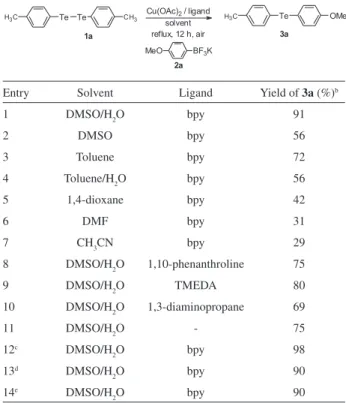
Our initial studies have focused on the development of an optimum set of reaction conditions. In this way, di-(p-tolyl) ditelluride 1a and potassium p-methoxyphenyltrifluoroborate 2a were used as standard substrates. Thus, a mixture of diaryl ditelluride 1a (0.25 mmol) and trifluoroborate 2a (0.5 mmol), utilizing DMSO/H2O (2:1) as a solvent, was refluxed with different copper catalysts, using bipyridine (bpy) as ligand, in air (Table 1). As shown in Table 1, different catalysts of copper(I) and copper(II) were tested, displaying a moderated to good catalytic activity, and the best result was obtained using Cu(OAc)2/bpy (5 mol%), giving the desired product 3a in excellent yield (Table 1, entry 6). When the reaction was performed in absence of catalyst and ligand, only traces of the desired product 3a were obtained (Table 1, entry 10).
We observed that the influence of the solvent was important for the coupling success. The reaction mixture of diaryl ditelluride 1a and trifluoroborate 2a using Cu(OAc)2/ bpy (5 mol%) was refluxed with different solvents and the results are summarized in Table 2. Optimal results were achieved using a mixture of DMSO/H2O (2:1) as solvent (Table 2, entry 1). When using DMSO, toluene and a mixture of toluene/H2O (Table 2, entries 2-4) moderate yields were obtained, while other solvents such as 1,4-dioxane, DMF and CH3CN (Table 2, entries 5-7) gave poor yields of the desired product 3a.
When the reaction was carried out with other ligands such as 1,10-phenanthroline, TMEDA and 1,3-diaminopropane or without ligand, a decrease in the yield of product 3a was observed (Table 2, entries 8-11).
The use of catalyst in an amount of 10 mol% yielded 98% of 3a (Table 2, entry 12). Fortunately, when the amount of catalyst was reduced from 5 to 1 mol%, excellent yields of product 3a were obtained (Table 2, entries 13 and 14).
Careful analysis of the optimized reactions revealed that the optimum conditions for this coupling reaction were found to be the use of Cu(OAc)2/bpy (1 mol%) as the catalytic system, diaryl ditelluride 1a (0.25 mmol), potassium aryltrifluoroborate salt 2a (0.5 mmol), and a
Scheme 1. General scheme for the cross-coupling reaction.
Table 1. Study of the catalyst effect on the cross-coupling reactiona
Entry Copper Catalyst (5 mol%) Yield of 3a (%)b
1 CuI 77
2 CuCl 72
3 CuBr 72
4 CuCN 80
5 CuCl2·2H2O 75
6 Cu(OAc)2 91
7 CuSO4·5H2O 78
8 CuO 69
9 Cu(OTf)2 64
10c - trace
aReactions performed in the presence of 1a (0.25 mmol), 2a (0.5 mmol),
5 mol% of catalyst/bpy, in DMSO (1 mL) and H2O (0.5 mL); bYields are
given for isolated products; cWithout catalyst and ligand.
Table 2. Reaction conditions optimizationa
Entry Solvent Ligand Yield of 3a (%)b
1 DMSO/H2O bpy 91
2 DMSO bpy 56
3 Toluene bpy 72
4 Toluene/H2O bpy 56
5 1,4-dioxane bpy 42
6 DMF bpy 31
7 CH3CN bpy 29
8 DMSO/H2O 1,10-phenanthroline 75
9 DMSO/H2O TMEDA 80
10 DMSO/H2O 1,3-diaminopropane 69
11 DMSO/H2O - 75
12c DMSO/H
2O bpy 98
13d DMSO/H
2O bpy 90
14e DMSO/H
2O bpy 90
aReactions performed in the presence of 1a (0.25 mmol), 2a (0.5 mmol),
5 mol% of Cu(OAc)2/Ligand and solvent (1 mL); bYields are given for
isolated products; c10 mol% of Cu(OAc) 2/bpy;
d3 mol% of Cu(OAc) 2/
mixture of DMSO/H2O (2:1, v/v) as a solvent. The reaction mixture was refluxed for 12 h under air atmosphere, affording the desired diaryl telluride 3a with 90% yield.30
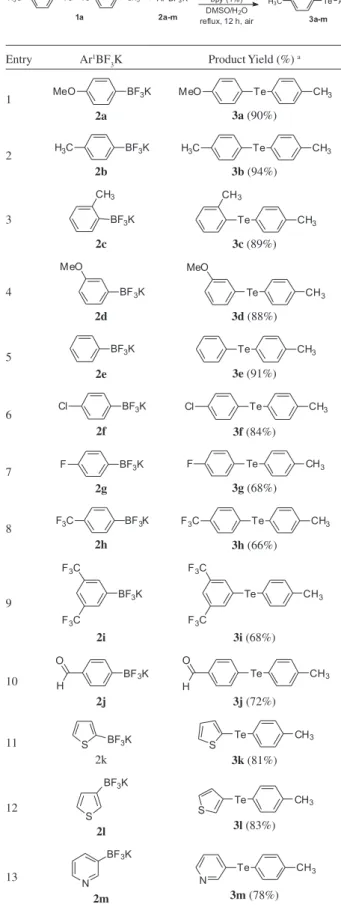
In order to demonstrate the efficiency of this protocol, we explored the generality of our method reacting others potassium aryltrifluoroborate salts 2a-m with diaryl ditelluride 1a and these results are summarized in Table 3. Table 3 shows that the reaction worked well for a range of potassium aryltrifluoroborate salts. These results revealed that the reaction is sensitive to the electronic effect of the aromatic ring in the potassium aryltrifluoroborate salt. For example, trifluoroborate salts 2a-e, bearing electron-donating and electron-neutral groups at the aromatic ring, gave better yields than the trifluoroborates bearing electron-withdrawing groups (Table 3, entries 1-5 versus 6-10). When we used potassium heteroaryltrifluoroborate salts 2k-m, the desired products were obtained in good yields (Table 3, entries 11-13).
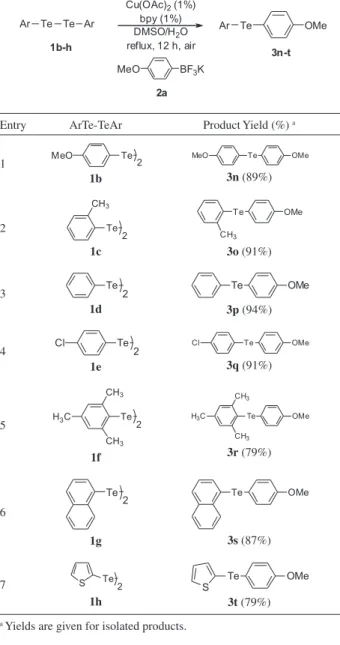
In an attempt to broaden the scope of our methodology, the possibility of performing the reaction with other diaryl ditellurides was also investigated (Table 4). Potassium trifluoroborate 2a was cross-coupled efficiently with a variety of ditellurides 1b-h. A decrease in the reaction yield was observed using hindered or heteroaryl ditellurides 1f-h (Table 4, entries 5-7).
We believe that the mechanism of this cross-coupling reaction is in accordance with the proposed by Tanigushi,12
using organoboronic acids analogues. It seems that the reaction requires DMSO/H2O and oxygen of air to oxidize the copper intermediates and promote the reaction.
The compounds obtained by this protocol appear highly promising as intermediates in the preparation of more complexes molecules. In the last decade, Uemura31
described the use of symmetrical diaryl tellurides utilizing Heck palladium catalyzed cross-coupling and the two symmetrical aryl groups of telluride were transferred to various alkenes. For instance, the resulting unsymmetrical diaryl tellurides should be particularly useful intermediates in this type of reaction. In this way, compound 3a was coupled with ethyl acrylate, using the conditions described by Uemura31 (Scheme 2).
In this reaction, unsymmetrical diaryl telluride 3a transfers the two different aryl groups to ethyl acrylate, giving two products of cross-coupling 4a and 4b in excellent yields.32
Conclusions
We have explored in details the cross-coupling reaction of diaryl ditellurides with potassium aryltrifluoroborate salts using a catalytic amount of Cu(OAc)2/bpy in a mixture
Table 3. Coupling products using diaryl ditelluride 1a and potassium aryl trifluoroborate salts 2a-m
Entry Ar1BF
3K Product Yield (%) a
1
2a 3a (90%)
2
2b 3b (94%)
3
2c 3c (89%)
4
2d 3d (88%)
5
2e 3e (91%)
6
2f 3f (84%)
7
2g 3g (68%)
8
2h 3h (66%)
9
2i 3i (68%)
10
2j 3j (72%)
11
2k 3k (81%)
12
2l 3l (83%)
13
2m 3m (78%)
of DMSO/H2O under air atmosphere and established a new route to obtain unsymmetrical diaryl tellurides in good to excellent yields. Subsequent Heck cross-coupling reactions of compound 3a with alkenesproceed smoothly in excellent yields and transfer the two different aryl groups from diaryl tellurides. Studies of the Heck reactions are under investigation and will be reported in due course.
Supplementary Information
Supplementary information, with extra experimental and characterization data, is available free of charge at http://jbcs.sbq.org.br, as PDF file.
Acknowledgments
The authors would like to thank Conselho Nacional de Desenvolvimento Científico e Tecnológico (CNPq) and Fundação de Amparo à Pesquisa do Estado de São Paulo (FAPESP) (Grants 07/56659-0 and 07/59404-2) for financial support.
References
1. Wirth, T., ed. In Topics in Current Chemistry: Organoselenium Chemistry, Springer-Verlag: Heidelberg, 2000, p. 208. 2. Krief, A. In Comprehensive Organometallic Chemistry II; Abel,
E. V.; Stone, F. G. A.; Wilkinson, G.; eds.; Pergamon Press: New York, 1995, vol. 11, ch. 13.
3. Paulmier, C. In Selenium Reagents and Intermediates in Organic Synthesis; Baldwin, J. E.; ed.; Pergamon Press: Oxford, 1986, Organic Chemistry Series 4.
4. Petragnani, N.; Stefani, H. A.; Tellurium in Organic Synthesis, 2nd ed., Academic Press: London, 2007.
5. Nogueira, C. W.; Zeni, G.; Rocha, J. B. T.; Chem. Rev. 2004,
104, 6255.
6. Mugesh, G.; du Mont, W.-W.; Sies, H.; Chem. Rev. 2001, 101, 2125.
7. Parnham, M. J.; Graf, E.; Prog. Drug. Res. 1991, 36, 9. 8. Zeni, G.; Braga, A. L.; Stefani, H. A.; Acc. Chem. Res. 2003,
36, 731.
9. Zeni, G.; Ludtke, D. S.; Panatieri, R. B.; Braga, A. L.; Chem. Rev. 2006, 106, 1032.
10. Petragnani, N.; Stefani, H. A.; Tetrahedron2005, 61, 1613. 11. Comasseto, J. V.; Ling, L. W.; Petragnani, N.; Stefani, H. A.;
Synthesis1997, 373.
12. Taniguchi, N.; J. Org. Chem.2007, 72, 1241. 13. Taniguchi, N.; Synlett2006, 1351.
14. Taniguchi, N.; Onami, T.; J. Org. Chem.2004, 69, 915. 15. Wang, L.; Wang, M.; Huang, F.; Synlett2005, 2007. 16. Fukuzawa, S.; Tanihara, D.; Kikuchi, S.; Synlett2006, 2145. 17. Kumar, S.; Engman, L.; J. Org. Chem.2006, 71, 5400. 18. Suzuki, A. In Metal-Catalyzed Cross-Coupling Reactions;
Diederich, F.; Stang, P. J., eds.; Wiley-VHC: Weinheim, 1998. 19. Lloyd-Williams, P.; Giralt, E.; Chem. Soc. Rev. 2001, 30, 145. 20. Molander, G. A.; Ellis, N.; Acc. Chem. Res. 2007, 40, 275. 21. Darses, S.; Genêt, J.-P.; Chem. Rev. 2008, 108, 288.
22. Stefani, H. A.; Cella, R.; Vieira, A. S.; Tetrahedron 2007, 63, 3623.
Table 4. Coupling products using diaryl ditellurides 1b-h and potassium aryltrifluoroborate salt 2a
Entry ArTe-TeAr Product Yield (%) a
1
1b 3n (89%)
2
1c 3o (91%)
3
1d 3p (94%)
4
1e 3q (91%)
5
1f 3r (79%)
6
1g 3s (87%)
7
1h 3t (79%)
a Yields are given for isolated products.
23. Cella, R.; Cunha, R. L. O. R.; Reis, A. E. S.; Pimenta, D. C.; Klitzke, C. F.; Stefani, H. A.; J. Org. Chem. 2006, 71, 224. 24. Cella, R.; Stefani, H. A.; Tetrahedron 2006, 62, 5656. 25. Stefani, H. A.; Cella, R.; Dörr, F. A.; Pereira, C. M. P.; Zeni G.;
Gomes, M. Jr.; Tetrahedron Lett. 2005, 46, 563.
26. Cella, R.; Orfão, A. T. G.; Stefani, H. A.; Tetrahedron Lett.
2006, 47, 5075.
27. Cella, R.; Venturoso, R. C.; Stefani, H. A.; Tetrahedron Lett. 2008, 49, 16.
28. Vieira, A. S.; Ferreira, F. P.; Fiorante, P. F.; Guadagnin, R. C.; Stefani, H. A.; Tetrahedron 2008, 64, 3306.
29. Vieira, A. S.; Fiorante, P. F.; Zukerman-Schpector, J.; Alves, D.; Botteselle, G. V.; Stefani, H. A.; Tetrahedron2008, 64, 7234. 30. General procedure for the cross-coupling reaction of diaryl
ditellurides with potassium aryltrifluoroborates: To a round-bottomed flask containing diaryl ditelluride (0.25 mmol), potassium aryltrifluoroborate salt (0.5 mmol), Cu(OAc)2 (1 mol%) and bpy (1 mol%), DMSO (1 mL) and H2O (0.5 mL) were added. The reaction mixture was allowed to stir at reflux for 12 h. After this time, the solution was cooled to room temperature, diluted with dichloromethane (20 mL) and washed with saturated aqueous NH4Cl (3 × 20 mL). The organic phase was separated, dried over MgSO4 and concentrated under vacuum. The residue was purified by flash chromatography on silica gel using ethyl acetate/hexane as the eluent. Selected spectral and analytical data for p-Methoxyphenyl-p-tolyl-telluride(3a):Yield: 0.146 g (90%). 1HNMR (CDCl
3, 300
MHz): δ 7.69 (d, J 8.5 Hz, 2H), 7.53 (d, J 7.8 Hz, 2H), 7.02 (d, J 7.8 Hz, 2H), 6.79 (d, J 8.5 Hz, 2H), 3.80 (s, 3H), 2.32 (s, 3H). 13C NMR (CDCl
3, 75 MHz): δ 159.64, 140.36, 137.25,
137.02, 130.10, 115.26, 111.21, 103.48, 54.96, 20.96. MS (relative intensity) m/z: 328 (28), 198 (100), 183 (74), 155 (25), 91 (23), 65 (17). HRMS calc. for C14H14OTe: 328.0107. Found: 328.0111.
31. Nishibayashi, Y.; Cho, C. S.; Uemura, S.; J. Organomet. Chem. 1996, 507, 197.
32. General procedure for the Heck cross-coupling reaction of unsymmetrical diaryl telluride (3a) with ethyl acrylate:Into a two-necked 25 mL round-bottomed flask containing PdCl2 (0.05 mmol), AgOAc (2.00 mmol) and unsymmetrical diaryl telluride 3a (0.50 mmol), dry methanol (10 mL), Et3N (2.00 mmol) and ethyl acrylate (1.00 mmol) were added. After stirring for 8 h at 25 °C, the heterogeneous reaction mixture was filtered. The filtrate was poured into brine (60 mL) and extracted with ethyl acetate (3 × 20 mL). The organic phase was separated, dried over MgSO4 and concentrated under vacuum. The residue was purified by flash chromatography on silica gel using ethyl acetate/hexane as the eluent.
Received: July 23, 2008
Web Release Date: March 20, 2009
Supplementary Information
0103 - 5053 $6.00+0.00*e-mail: [email protected]; [email protected]
Copper Catalyzed Cross-Coupling Reactions of Diaryl Ditellurides with
Potassium Aryltrifluoroborate Salts
Diego Alves,*,a Jesus M. Pena,a Adriano S. Vieira,a Giancarlo V. Botteselle,a
Rafael C. Guadagnina and Hélio A. Stefani*,a,b
aDepartamento de Farmácia, Faculdade de Ciências Farmacêuticas, Universidade de São Paulo,
05508-900 São Paulo-SP, Brazil
bDepartamento de Biofísica, Universidade Federal de São Paulo, 04023-062 São Paulo-SP, Brazil
General informations
All air-sensitive and/or water-sensitive reactions were carried out under nitrogen atmosphere with dry solvents and anhydrous conditions. Standard syringe techniques were applied for transfer of dry solvents and some air-sensitive reagents; needles were introduced into reaction vessels through a rubber septum. The reactions were monitored by TLC carried out on Merck silica gel (60 F254) by using UV light as visualizing agent and 5% vanillin in 10% H2SO4 and heat as developing agents. Merck silica gel (particle size 0.040-0.063 mm) was used for flash chromatography. THF was distilled from sodium-benzophenone before use. NMR spectra were recorded with Bruker DPX 300 (300 MHz) instrument using CDCl3 as solvent and calibrated using tetramethylsilane as internal standard. Chemical shifts are reported in d (ppm) relative to (CH3)4Si for 1H and CDCl
3 for
13C NMR. Coupling constants
(J) are reported in Hertz. Mass spectra (MS) were measured on a Shimadzu GCMS-QP5050A mass spectrometer. The
HRMS spectra were measured on a Bruker Daltonics Micro TOF (direct inlet probe).
Experimental
General procedure for the cross-coupling reaction of diaryl ditellurides with potassium aryltrifluoroborates
General procedure for the Heck cross-coupling reaction of unsymmetrical diaryl telluride (3a) with ethyl acrylate
Into a two-necked 25 mL round-bottomed flask containing PdCl2 (0.05 mmol), AgOAc (2.00 mmol) and unsymmetrical diaryl telluride 3a (0.50 mmol), dry methanol (10 mL), Et3N (2.00 mmol) and ethyl acrylate
Description of the products
4-Methoxyphenyl-p-tolyl-telluride (3a)
Yield: 90%. 1HNMR (CDCl
3, 300 MHz): d 7.69 (d, J 8.5 Hz, 2H), 7.53 (d, J 7.8 Hz, 2H), 7.02 (d, J 7.8 Hz, 2H), 6.79 (d, J 8.5 Hz, 2H), 3.80 (s, 3H), 2.32 (s, 3H).
13C NMR (CDCl
3, 75 MHz): d 159.64, 140.36, 137.25,
137.02, 130.10, 115.26, 111.21, 103.48, 54.96, 20.96. MS (relative intensity) m/z: 328 (28), 198 (100), 183 (74), 155 (25), 91 (23), 65 (17). HRMS calculated for C14H14OTe: 328.0107. Found: 328.0111.
Bis-(p-Tolyl)-telluride (3b)
Yield:94%.1HNMR (CDCl
3, 300 MHz): d 7.57 (d, J
7.7 Hz, 4H), 7.01 (d, J 7.7 Hz, 4H), 2.33 (s, 6H). 13C NMR
(CDCl3, 75 MHz): d 139.2 (2C), 136.9 (4C), 131.4 (4C), 110.7 (2C), 22.0. MS (relative intensity) m/z: 312 (34), 182 (100), 167 (72), 91 (59), 65 (36). HRMS calculated for C14H14Te: 312.0157. Found: 312.0169.
p-Tolyl-o-tolyl-telluride (3c)
Yield: 89%. 1HNMR (CDCl
3, 300 MHz): d 7.64 (d, J
7.5 Hz, 2H), 7.49 (d, J 7.5 Hz, 1H), 7.13-7.22 (m, 2H), 7.07 (d, J 7.5 Hz, 2H), 6.93 (t, J 7.5 Hz, 1H), 2.40 (s, 3H), 2.36 (s, 3H). 13C NMR (CDCl
3, 75 MHz): d 141.4, 139.5 (2C),
138.1, 136.4, 130.6 (2C), 129.3, 127.7, 126.7, 119.7, 109.6, 25.8, 21.3. MS (relative intensity) m/z: 312 (54), 220 (10), 182 (38), 167 (100), 91 (81), 65 (40). HRMS calculated for C14H14Te: 312.0157. Found: 312.0167.
3-Methoxyphenyl-p-tolyl-telluride (3d)
Yield: 88 %. 1HNMR (CDCl
3, 300 MHz): d 7.63 (d, J
7.8 Hz, 2H), 7.18-7.22 (m, 1H), 7.15-7.17 (m, 1H), 7.07 (s, 1H), 7.03 (d, J 7.8 Hz, 2H), 6.76 (d, J 7.5 Hz, 1H), 3.72 (s, 3H), 2.32 (s, 3H). 13C NMR (CDCl
3, 75 MHz): d 159.6,
138.7 (2C), 137.9, 130.2 (2C), 129.9, 129.2, 122.2, 115.8, 113.1, 109.9, 55.0, 21.0. MS (relative intensity) m/z: 328 (28), 198 (100), 167 (23), 155 (17), 91 (36), 77 (17), 65 (21). HRMS calculated for C14H14OTe: 328.0107. Found: 328.0118.
Phenyl-p-tolyl-telluride (3e)
Yellow oil: Yield: 91%. 1HNMR (CDCl
3, 300 MHz):
d 7.61 (d, J 7.8 Hz, 2H), 7.19-7.24 (m, 3H), 7.15 (d, J 7.8 Hz, 2H), 7.00 (t, J 7.8 Hz, 2H), 2.30 (s, 3H). 13C NMR
(CDCl3, 75 MHz): d 138.6 (2C), 137.9, 137.1 (2C), 130.3 (2C), 129.2 (2C), 127.3, 115.1, 110.1, 21.0. MS (relative intensity) m/z: 298 (31), 168 (100), 167 (83), 153 (20), 91 (39), 77 (24), 65 (25). HRMS calculated for C13H12Te: 298.0001. Found: 298.0018.
4-Chlorophenyl-p-tolyl-telluride (3f)
Yield: 84%. 1HNMR (CDCl
3, 300 MHz): d 7.60 (d, J
7.2 Hz, 2H), 7.49 (d, J 7.2 Hz, 2H), 7.11 (d, J 7.2 Hz, 2H), 7.02 (d, J 7.2 Hz, 2H), 2.31 (s, 3H). 13C NMR (CDCl
3, 75
MHz): d139.4, 138.9 (2C), 138.5 (2C), 134.0, 130.6 (2C), 129.6 (2C), 113.0, 110.0, 21.3. MS (relative intensity) m/z: 332 (31), 202 (100), 167 (62), 91 (48), 65 (33). HRMS calculated for C13H11ClTe: 331.9611. Found: 331.9627.
4-Fluorophenyl-p-tolyl-telluride (3g)
Yield: 68%. 1HNMR (CDCl
3, 300 MHz): d 7.65 (d, J
7.8 Hz, 2H), 7.56 (d, J 7.5 Hz, 2H), 7.02 (d, J 7.8 Hz, 2H), 6.88 (d, J 7.5 Hz, 2H), 2.31 (s, 3H). 13C NMR (CDCl
3,
75 MHz): d 164.5, 161.2, 140.1 (2C), 138.0 (2C), 130.5 (2C), 117.2 (2C), 110.5, 108.6, 21.3. MS (relative intensity) m/z: 316 (35), 186 (100), 165 (13), 91 (47), 65 (32). HRMS calculated for C13H11FTe: 315.9907. Found: 315.9918.
4-(Trifluoromethyl)-phenyl-p-tolyl-telluride (3h)
Yield: 66%. 1HNMR (CDCl
3, 300 MHz): d 7.72 (d, J
7.8 Hz, 2H), 7.60 (d, J 7.8 Hz, 2H), 7.37 (d, J 7.5 Hz, 2H), 7.11 (d, J 7.5 Hz, 2H), 2.37 (s, 3H). 13C NMR (CDCl
3,
75 MHz): d 140.0 (2C), 139.1, 138.0, 135.8 (2C), 130.8 (2C), 126.2, 125.8 (2C), 121.6, 109.1, 21.3. MS (relative intensity) m/z: 366 (43), 236 (97), 221 (17), 167 (67), 126 (16), 91 (100), 65 (61). HRMS calculated for C14H11F3Te: 365.9875. Found: 365.9890.
3,5-Bis-(trifluoromethyl)-phenyl-p-tolyl-telluride (3i)
Yield: 68%. 1HNMR (CDCl
3, 300 MHz): d7.90 (s,
2H), 7.72 (d, J 7.8 Hz, 2H), 7.67 (s, 1H), 7.12 (d, J 7.8 Hz, 2H), 2.38 (s, 3H). 13C NMR (CDCl
3, 75 MHz): d140.0 (2C),
139.7, 135.4 (2C), 132.1, 131.7 (2C), 130.1 (2C), 121.0, 118.4, 108.5, 21.3. MS (relative intensity) m/z: 434 (29), 304 (54), 235 (24), 219 (16), 91 (100), 65 (67). HRMS calculated for C15H10F6Te: 433.9748. Found: 433.9748.
4-Formylphenyl-p-tolyl-telluride (3j)
Yield: 72%. 1HNMR (CDCl
3, 300 MHz):d 9.88 (s,
1H), 7.73 (d, J 7.5 Hz, 2H), 7.51-7.60 (m, 4H), 7.12 (d, J 7.5 Hz, 2H), 2.37 (s, 3H). 13C NMR (CDCl
3, 75 MHz): d
2-Thiophenyl-p-tolyl-telluride (3k)
Yield: 81%. 1HNMR (CDCl
3, 300 MHz): d 7.50 (d, J
8.1 Hz, 2H), 7.44-7.47 (m, 2H), 7.01 (d, J 8.1 Hz, 2H), 6.96 (dd, J 5.2, 3.6 Hz, 1H), 2.29 (s, 3H). 13C NMR (CDCl
3, 75
MHz): d 141.3, 137.8, 136.2 (2C), 134.6, 130.1 (2C), 128.8, 111.9, 100.6, 20.9. MS (relative intensity) m/z: 304 (30), 174 (100), 141 (11), 91 (25), 65 (27). HRMS calculated for C11H10STe: 303.9565. Found: 303.9579.
3-Thiophenyl-p-tolyl-telluride (3l)
Yield: 83%. 1HNMR (CDCl
3, 300 MHz): d 7.47-7.49
(m, 2H), 7.19-7.22 (m, 2H), 7.17 (s, 1H), 6.96 (d, J 7.8 Hz, 2H). 13C NMR (CDCl
3, 75 MHz): d 137.9, 137.4,
137.0 (2C), 136.2, 133.4, 130.2 (2C), 126.8, 110.6, 104.1, 21.0. MS (relative intensity) m/z: 304 (30), 174 (100), 141 (17), 91 (40), 65 (29). HRMS calculated for C11H10STe: 303.9565. Found: 303.9582.
3-Pyridinyl-telluride (3m)
Yield: 78%. 1HNMR (CDCl
3, 300 MHz): d 8.78 (s,
1H), 8.43 (d, J 6.5 Hz, 1H), 7.87 (d, J 6.5 Hz, 1H), 7.61 (d, J 7.8 Hz, 2H), 7.01-7.12 (m, 1H), 6.99 (d, J 7.8 Hz, 2H), 2.32 (s, 3H). 13C NMR (CDCl
3, 75 MHz): d 156.4, 148.3,
144.3, 139.1 (2C), 138.0, 130.7 (2C), 124.6, 113.0, 109.0, 21.2. MS (relative intensity) m/z: 299 (35), 169 (100), 91 (58), 65 (33), 51 (21). HRMS calculated for C12H11NTe: 298.9953, Found: 298.9971.
Bis-(4-Methoxyphenyl)-telluride (3n)
Yield: 89 %. 1HNMR (CDCl
3, 300 MHz): d7.64 (d, J
6.2 Hz, 4H), 6.77 (d, J 6.2 Hz, 4H), 3.76 (s, 6H). 13C NMR
(CDCl3, 75 MHz): d159.7 (2C), 139.7 (4C), 115.4 (4C), 104.3 (2C), 55.2 (2C). MS (relative intensity) m/z: 344 (24), 214 (93), 199 (100), 171 (21), 107 (19), 63 (24). HRMS calculated for C14H14O2Te: 344.0056, Found: 344.0067.
4-Methoxyphenyl-o-tolyl-telluride (3o)
Yield: 91%. 1HNMR (CDCl
3, 300 MHz): d 7.68 (d, J
8.5 Hz, 2H), 7.23 (d, J 7.5 Hz, 1H), 7.05-7.14 (m, 2H), 6.88 (t, J 7.5 Hz, 1H), 6.76 (d, J 8.5 Hz, 2H), 3.76 (s, 3H), 2.34 (s, 3H). 13C NMR (CDCl
3, 75 MHz): d 160.2, 141.9 (2C),
140.8, 135.3, 129.4, 127.4, 126.7, 120.3, 115.7 (2C), 102.5, 55.2, 25.4. MS (relative intensity) m/z: 328 (61), 220 (25), 198 (100), 183 (51), 91 (74), 65 (47). HRMS calculated for C14H14OTe: 328.0106, Found: 328.0123.
4-Methoxyphenyl-phenyl-telluride (3p)
Yield: 94%. 1HNMR (CDCl
3, 300 MHz): d 7.71 (d, J 8.7 Hz, 2H), 7.54 (dd, J 7.8, 1.5 Hz, 2H), 7.11-7.23 (m, 3H), 6.77 (d, J 8.7 Hz, 2H), 3.76 (s, 3H). 13C NMR
4-Methoxyphenyl-4-chlorophenyl-telluride (3q)
Yield: 91%. 1HNMR (CDCl
3, 300 MHz): d 7.70 (d, J
8.7 Hz, 2H), 7.44 (d, J 8.1 Hz, 2H), 7.11 (d, J 8.1 Hz, 2H), 6.78 (d, J 8.7 Hz, 2H), 3.78 (s, 3H). 13C NMR (CDCl
3, 75
MHz): d 160.3, 141.5 (2C), 137.8 (2C), 133.8, 129.8 (2C), 115.7 (2C), 113.8, 103.2, 55.3. MS (relative intensity) m/z: 348 (29), 218 (100), 203 (51), 175 (24), 63 (19). HRMS calculated for C13H11ClOTe: 347.9570, Found: 347.9587.
4-Methoxyphenyl-mesityl-telluride (3r)
Yield: 79%. 1HNMR (CDCl
3, 300 MHz): d 7.33 (d, J 8.4 Hz, 2H), 6.95 (s, 2H), 6.68 (d, J 8.4 Hz, 2H), 3.75 (s, 3H), 2.52 (s, 6H), 2.27 (s, 3H). 13C NMR (CDCl
3, 75
MHz): d 159.1, 145.2 (2C), 139.1, 137.3 (2C), 127.5 (2C), 118.8, 115.4 (2C), 104.7, 55.1, 29.4 (2C), 21.0. MS (relative intensity) m/z: 356 (100), 248 (65), 226 (74), 211 (61), 119 (97), 91 (76), 77 (61), 65 (27). HRMS calculated for C16H18OTe: 356.0419, Found: 356.0435.
4-Methoxyphenyl-(1-naphthalenyl)-telluride (3s)
Yield: 87%. 1HNMR (CDCl
3, 300 MHz): d 8.04 (d, J 7.5 Hz, 1H), 7.73-7.78 (m, 3H), 7.68 (d, J 8.1 Hz, 2H), 7.46-7.52 (m, 2H), 7.19-7.24 (m, 1H), 6.75 (d, J 8.1 Hz, 2H), 3.76 (s, 3H). 13C NMR (CDCl
3, 75 MHz): d 160.0,
140.9 (2C), 136.4, 135.5, 133.7, 130.8, 128.7, 128.6, 126.7, 126.5, 126.2, 118.8, 115.6 (2C), 103.0, 55.1. MS (relative intensity) m/z: 364 (21), 234 (100), 219 (40), 127 (33), 77 (14). HRMS calculated for C17H14OTe: 364.0106, Found: 364.0135.
2-Thiophenyl-4-methoxyphenyl-telluride (3t)
`
Yield: 79%. 1HNMR (CDCl
3, 300 MHz): d 7.57 (d, J
7.8 Hz, 2H), 7.36-7.39 (m, 2H), 6.88 (dd, J 5.1, 3.3 Hz, 1H), 6.69 (d, J 7.8 Hz, 2H), 3.69 (s, 3H). 13C NMR (CDCl
3, 75
MHz): d 159.8, 140.9, 139.0 (2C), 134.5, 129.0, 115.4 (2C), 105.2, 101.6, 55.2. MS (relative intensity) m/z: 320 (27), 190 (100), 175 (89), 147 (31), 63 (18). HRMS calculated for C11H10OSTe: 319.9514, Found: 319.9535.
(E)-Ethyl 3-p-tolylacrylate (4a)
Yield: 47%. 1HNMR (CDCl
3, 300 MHz): d7.65 (d, J 16.0 Hz, 1H), 7.39 (d, J 8.1 Hz, 2H), 7.28 (d, J 8.1 Hz, 2H), 6.42 (d, J 16.0 Hz, 1H), 4.25 (q, J 7.3 Hz, 2H), 2.33 (s, 3H), 1.26 (t, J 7.3 Hz). 13C NMR (CDCl
3, 75 MHz): d
167.0, 144.5, 134.4, 130.2, 128.8 (2C), 128.0 (2C), 118.3, 60.5, 24.3, 14.5. MS (relative intensity) m/z: 190 (24), 117 (45), 91 (23).
(E)-Ethyl 3-(4-methoxyphenyl)acrylate (4b)
Yield: 47%. 1HNMR (CDCl
3, 300 MHz):d7.60 (d, J 16.2 Hz, 1H), 7.37 (d, J 8.3 Hz, 2H), 7.25 (d, J 8.3 Hz, 2H), 6.40 (d, J 16.2 Hz, 1H), 4.23 (q, J 7.3 Hz, 2H), 3.67 (s, 3H), 1.25 (t, J 7.3 Hz). 13C NMR (CDCl
3, 75 MHz): d