The health sector is not always the victim of violence. Unfortunately sometimes it can become an agent of violence as well. This is the case when medical or paramedical person-nel impose certain procedures or hospitalization, when the medical knowledge adopts an attitude of superiority relative to the presumed ignorance of the patient, or simply when for different reasons large sectors of the population are deprived of the right to health services. These possible types of violen-ce also deserve to be studied and understood so that the necessary steps can be taken to address them.
The fact that violence is complex should not be an excuse for remaining passive. It is not merely a question of one more fatality to learn to live with; it is a social reality whose historical trend can be changed and controlled. Since it goes beyond the limits of any one sector, the effort must be made, as has been pointed out, at all levels and across the board in different areas. Among these sectors, health should have a major role in reversing the situation described, as well as that
which is not specifically reported but learned about more and more each day through reports, accusations, and investiga-tions in different countries of child abuse and violent acts against women, the elderly, and workers. Interdisciplinary efforts, specific and rigorous research, individual and institu-tional changes in attitude from the local up to the nainstitu-tional and international levels, redefinition of policies, allocation of resources, reorganization of services, interinstitutional initia-tives, and assignment of priority to the subject are some of the actions that should be undertaken by the sector forthwith as its contribution to conscience and as society's response to the challenge being posed by violence throughout the Americas.
(Source: Dr. Saúl Franco Agudelo, Health Manpower Development Program, and the Mental Health Subprogram, Program of Health of Adults, PAHO.)
lj\WYT)D
.. : 1'1i11ED1
ED
Dengue Hemorrhagic Fever in Venezuela
Introduction
An epidemic of dengue hemorrhagic fever (DHF) was reported by Venezuela during December 1989. The first labo-ratory documented case occurred in a 3 1/2 year-old girl who died on 25 October 1989 in Maracay, State of Aragua. Retros-pectively however, deaths due to DHF may have occurred in September, among young adults from the State of Portuguesa. New cases of DHF were recognized in November in Maracay and subsequently they were reported from most states and from Caracas Federal District, the capital of Venezuela. In early December the Ministry of Health initiated the epidemio-logic surveillance of dengue and DHF throughout the country and clinical specimens were routinely collected for laboratory investigation of dengue etiology. As a result of this, dengue
virus serotypes 1, 2 and 4 were isolated from blood of sick persons.
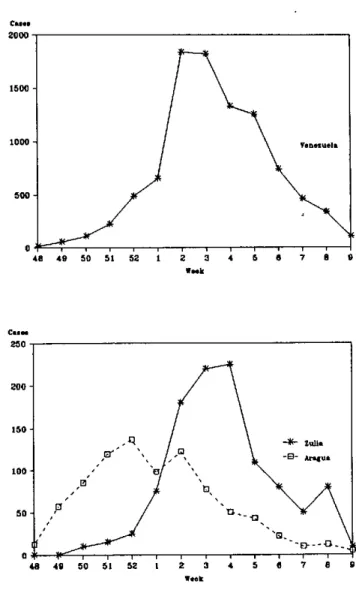
During the period from 2 December 1989 through 17 April 1990 a total of 12,220 dengue cases were reported of which 3,108 were DHF cases. Recognition of DHF cases was based on criteria for clinical diagnosis of DHF/DSS established by WHO(1). There were 73 deaths. Dengue cases were reported from all 23 states and territories with the exception of Tachira State. Cases of DHF were reported from 17 of 20 states, the Federal District and from one of the two Venezuelan Federal Territories. Nevertheless, most DHF reports originated in the Federal District (1,137 cases) and from the States of Aragua (804 cases), Zulia (377 cases), Miranda (266 cases), Carabo-bo (130 cases), Barinas (112 cases) and Falcon (98 cases). The remaining states reported from 2 to 71 DHF cases.
7
Fifty-two percent of the deaths (38/73) were reported by the Federal District and two States (Aragua and Carabobo). Ap-proximately 2/3 of cases (8,132/12,220) occurred among children under 14 years of age. The age of fatal cases had similar distribution: 67% of deaths were children 0-14 years old. The youngest case was a 22 days old baby who died in
Maracay.
The overall case-fatality rate was 0,6% (73/12,220) but among DHF cases the rate was of 2.3%. Most hospitalizations of suspected DHF cases occurred in Maracay and Caracas.
Preliminary analysis of the temporal distribution of cases suggests that the outbreak peaked towards the end of January 1990. The distribution of cases over time by State shows that the epidemic moved from east to west (Figure 1). The Vene-zuelan Government officially declared the end of the epide-mic as of 17 April 1990.
Clinical Features
Data collected from patients hospitalized at the Hospital Central of Maracay showed that petechiae/echymoses were the most common hemorrhagic manifestations (70%), follo-wed by epistaxis (26%); gum bleeding, upper gastrointestinal hemorrhage and melena were seen in less than 10% of cases. The number of shock cases has not been reported.
At the Children's Hospital, Caracas, petechiae were also the most frequent hemorrhagic manifestations (66%); throm-bocytopenia was reported in 29% of hospitalized cases, he-moconcentration in 23% and hepatomegaly in 19% (reported during the Intemational Symposium on Dengue, Caracas, April 1990).
Etiology
Through April 1990, 20 dengue virus isolates were repor-ted by the National Institute of Hygiene, Caracas. Most isolates belonged to serotype 2 (12), six were serotype 4 and two were dengue-1. The 20 isolates were obtained from a total of 60 inoculated samples. None of these isolates came from fatal cases. Nevertheless immunocytochemical studies con-ducted at the United States Army Medical Research Institute of Infectious Diseases (USAMRIID), Fort Detrick, Mary-land, with formalin fixed tissues of fatal cases revealed the presence of dengue-2 antigen in the liver of four patients.
Vector Control
Aedes aegypti control measures were implemented soon after DHF cases were recognized in Maracay. Such measures included selective insecticide spraying inside houses of areas where DHF cases occurred, environmental sanitation, ULV application of malathion using truck mounted equipment and ULV aerial spraying of malathion. The last measure was used mainly in Maracay and Caracas, using helicopters from the Venezuelan Air Force, with the support of the Vector Control
Figure 1. Dengue cases by epidemiological week. Venezuela, Aragua and Zulia States,
1989-1990.
C.el.
2000-
15001000
-500.
48 49 50 51 52
C... 250
-1 2 4 5
V.k
7 8 9
Week
Sourcc: Minislry of Health and Social Action, Venzuela.
Unit, United States Navy, Jacksonville, Florida. Clean-up operations and chemical treatment of breeding sites were also implemented. An ample public information campaign was undertaken by the Ministry of Health aimed at educating the population about the disease and its vector and seeking for its cooperation to achieve source reduction of Aedes aegypti. The successful reduction of infestation is considered to be related to the integrated approach used.
8
This is the second large outbreak of DHF in theAmericas. The first one occurred in Cuba in 1981 and resulted in a considerable impact(2). A lthough the magnitude of the Vene-zuelan DHF epidemic was smaller than the one in Cuba, it
illustrates the increased risk of dissemination of DHF in this Region. Such risk rests on several factors of which undoub-tedly the increase of areas infested by Aedes aegypti and the densities of the vector plays a major role.
References
(1) Dengue haemorrhagic fever: diagnosis, treatment and control. World Health Organization, Geneva, 1986.
(2) Dengue haemorrhagic fever/dengue shock syndrome: lessons from the Cuban epidemic, 1981. Bull. WHO 67(4):375-380, 1989.
(Source: Communicable Diseases Program, PAHO.)
Paralytic Shellfish Poisoning (Red Tide)
Between October and December 1989 an outbreak of pa-ralytic poisoning from the ingestion of shellfish (PSP) affec-ted the entire Central American isthmus and Mexico.
In El Salvador 106 cases and three deaths were reported. Most of the occurrences were in La Perla, but cases were also reported in Santa Tecla, El Zonte, and Mizata Canton. Epide-miological investigation associated the cases to the ingestion of clams. These mollusks, which were examined in the Food and Drug Control Laboratory of Guatemala's Ministry of Public Health and Social Welfare, were positive for saxitoxins in concentrations of over 10,000 mouse units/100g.
In Mexico 99 cases were registered, four of which died. In Guatemala, despite preventive measures, 7 cases of poisoning were reported in Las Lisas, Santa Rosa, all of which recovered without sequelae.
In all the countries of the isthmus the population had been alerted; in Guatemala and El Salvador the shellfish harvesting was prohibited. Samples were collected for toxicological tests and epidemiological surveillance was either instituted or reactivated.
The Guatemalan Ministry of Health is convening a subre-gional meeting on the subject, to be held in October 1990, which will bring together representatives from the Central American countries and Mexico, along with other intematio-nal experts, to exchange experiences in preventing and con-trolling the effects of red tide. This initiative includes even
the participation of fishing cooperatives and fishermen's unions.
(Source: Boletin Epidemiológico Nacional Ministry of Pu-blic Health and Social Welfare, Guatemala, Vol. 24, 1989.)
Editorial Note
Red tide is the popular term for sudden abundant growth of unicellular organisms in the sea. Red tides are usually produced by dinoflagellates, whose development process is governed by specific biological and hydrographic factors. These organisms are capable of producing saxitoxins, which are highly toxic for other organisms, vertebrate and inverte-brate, that are sensitive to them. The toxic dinoflagellates include the following genera: Gonyaulax, Protogonyaulax, Ptysodiscus, and Pyrodinium. Red tides are not necessarily toxic, nor do they always stain the water around them.
When it occurs as a natural phenomenon, red tide also incurs heavy economic losses. There can be mass mortality in fish and other marine species. It is necessary to close down the harvesting and marketing of fish and shellfish. Shrimp exports may also be affected.
Paralytic poisoning from shellfish is produced in humans by the ingestion of bivalves that have accumulated toxins in their systems as a result of filtration feeding processes. The cases may be mild or fatal, depending on the amount of toxin ingested.
9
l P 0- ' -