INTRODUCTION
Ceramic bodies used for whiteware loor tiles fabrication are normally composed of a complex mixture of different raw materials [1-4]. In addition to silica, alumina and alkaline oxides, which are basic components for this class of products, iron compounds, carbonates, organic matter and sulfur may also be present. However, these other non-basic materials should not be present in amounts higher than the limits established for the industrial practice [5]. The raw materials can be grouped in two classes: plastic and non-plastic. The plastic raw materials are essentially the clays and the kaolin that have, as their main function, to supply plasticity and to provide adequate mechanical strength for
both, the green and dried body pieces. In addition, the plastic materials must present favorable rheological properties for an eficient wet milling stage [4].
Among the non-plastic raw materials, feldspars, talc and quartz are the most used. All of them decrease the plasticity, facilitate the deloculation, enhance the packing and increase the permeability of the pieces. During the iring stage, the feldspars act as a lux supplying alkaline oxides (K2O + Na
2O) [3, 4, 6-8]. Others luxes that are also used in partial or total substitution for feldspars are philite, phonolite, nepheline and granite. Talc is introduced in low amounts to increase the lux of the body through eutectic formation with alkaline feldspars [9, 10]. During the iring stage, the quartz has the function of balancing the ratio between SiO2
Effect of kaolinitic clays from the State of Rio de Janeiro in the
composition of whiteware loor tile bodies
(
Efeito de argilas cauliníticas do Estado do Rio de Janeiro na
composição de massa de pavimento cerâmico de base clara)
C. M. F. Vieira, L. A. Peçanha Jr., S. N. Monteiro
Advanced Materials Laboratory - LAMAV, State University of the North Fluminense - UENF Av. Alberto Lamego, 2000, Campos dos Goytacazes, RJ, 28015-602, Brazil
Abstract
This work presents an investigation that was undertaken for three types of kaolinitic clays from the State of Rio de Janeiro, Brazil, with a potential use in whiteware loor tiles bodies. Different compositions prepared by mixing the three clays with other materials such as kaolin, quartz, philite, potash feldspar and talc, were investigated and compared with an industrial ceramic body for whiteware loor tiles (group BIIa). Physical and mechanical properties such as linear shrinkage, water absorption and lexural strength were evaluated in pressed specimens ired at temperatures varying from 1025 to 1225 oC. The microstructure of the specimens was studied by X-ray diffraction, scanning electron microscopy and mercury porosimetry. The results indicated that the prepared compositions presented microstructural characteristics, specially the pore size distribution, and technological properties that are compatible with low-porosity ceramic tiles. However, they also display characteristics, such as an excessive plasticity and high loss on ignition, that could generate problems during the industrial processing.
Keywords: ceramic tiles, clay, kaolinite.
Resumo
Este trabalho apresenta uma investigação sobre três tipos de argilas cauliníticas do Estado do Rio de Janeiro, Brasil, com potencial uso em massas de pavimentos cerâmicos de base clara. Diferentes composições, preparadas através da mistura das três argilas
com outros materiais, tais como quartzo, ilito, feldspato potássico e talco, foram investigadas e comparadas com uma massa
cerâmica industrial de pavimento de base clara (grupo BIIa). Propriedades físicas e mecânicas tais como retração linear, absorção
de água e tensão de ruptura à lexão foram avaliadas em corpos de prova prensados e queimados em temperaturas variando
de 1025 a 1225 oC. A microestrutura das amostras foi avaliada por difração de raios X, microscopia eletrônica de varredura e
porosimetria de mercúrio. Os resultados indicaram que as composições preparadas apresentam características microestruturais, especialmente a distribuição de tamanho de poro, e propriedades tecnológicas que são compatíveis com revestimentos cerâmicos de
baixa porosidade. Entretanto, as composições também apresentam características, tais como uma excessiva plasticidade e elevada
perda de massa, que podem gerar problemas durante o processamento industrial.
and Al2O
3 in other to favor the formation of mullite [11]. It increases the refractoriness and, in general, also increases the expansion coeficient of the body and so decreasing the linear shrinkage [4]. Quartz, with small particle size in the range of 10-30 µm, improves the mechanical strength. By contrast, larger-sized quartz particles tend to decrease the mechanical strength due to the susceptibility to micro-cracks formation. This is a consequence of the allotropic transformation, which results in volumetric change at temperatures around 573 oC [12-15]. Low amounts of carbonates such as calcite and dolomite are also used to increase the luxing action and enhance the moisture expansion.
The objective of this work was to evaluate the use of three types of kaolinitic clays from the State of Rio de Janeiro as potential raw materials for whiteware loor tiles composition.
EXPERIMENTAL PROCEDURE
The three clays in the present investigation were collected from the municipal areas of Silva Jardim and Campos dos Goytacazes, both located in the State of Rio de Janeiro. The clays were denoted as white (Silva Jardim), black (Campos) and carolinho (Campos). The other raw materials, such
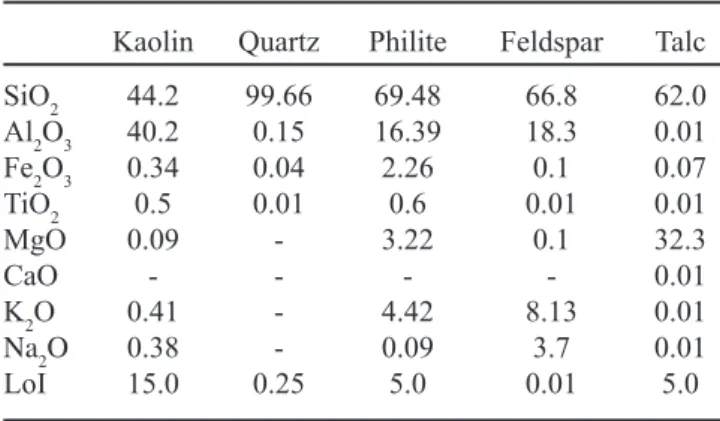
as kaolin, quartz, philite, potash feldspar and talc were obtained from mining facilities outside the State of Rio de Janeiro. Table I shows the chemical composition of these raw materials.
The three clays were initially characterized in terms of their mineralogical composition by X-ray diffraction (XRD), chemical composition, X-ray luorescence (XRF) and by the plasticity limits according to Brazilian standards [16,17]. The XRD of randomly-oriented powder was carried out in a Seifert model URD 65, diffractometer, equipped with a graphite monochromator operating with Cu-Kαradiation for a 2θ range from 5º to 40º. The XRF was conducted in a Philips PW 2400 equipment.
Three experimental body compositions named X1, X2 and X3 were prepared varying the amount of clays while maintaining the amount of other materials constant. The raw materials were mixed according to the selected amounts shown in Table II.
For a comparative study, an industrial body IB, used in the fabrication of whiteware loor tiles (group BIIa), was obtained from a ceramic industry in S. Paulo. This typical industrial body was elaborated from a mixture of plastic kaolinitic clays, ilitic clay, philite, talc and calcite [4].
The experimental bodies were initially wet-milled in porcelain pots during two hours. The slurries were then sieved through 325 mesh (44 µm) and allowed to dry at 110 oC until 8% of humidity was achieved. The powder was screened through a 20 mesh (820 µm) sieve.
Rectangular specimens measuring 114.3 x 25.4 x 10 mm3 were prepared by uniaxial pressing in the range of 25 to 30 MPa to assure that all specimens would have a bulk density of 1.97 ± 0.03 g/cm3. This was intended to guarantee that the degree of compactness of the bodies was always the same and did not inluence the microstructure and, consequently, the evaluated properties. Initially, specimens were dried at 110 oC until a constant weight was achieved and then ired at temperatures in the range of 1025 to 1225 oC. A controlled heating rate of 10 oC/min was maintained up to the desired temperature, at which each specimen was left for 6 min. The cooling was performed by natural convection after turning the furnace off and leaving the specimen inside. The evaluated properties were water absorption, linear shrinkage Kaolin Quartz Philite Feldspar Talc
SiO2 44.2 99.66 69.48 66.8 62.0
Al2O3 40.2 0.15 16.39 18.3 0.01
Fe2O3 0.34 0.04 2.26 0.1 0.07
TiO2 0.5 0.01 0.6 0.01 0.01
MgO 0.09 - 3.22 0.1 32.3
CaO - - - - 0.01
K2O 0.41 - 4.42 8.13 0.01
Na
2O 0.38 - 0.09 3.7 0.01
LoI 15.0 0.25 5.0 0.01 5.0 Table I - Chemical composition of the industrial raw materials (wt.%).
[Tabela I - Composição química das matérias-primas industriais (% em peso).]
Raw materials
Compositions white black carolinho kaolin quartz philite feldspar talc clay clay clay
A 35 - - 5 5 35 15 5
B 15 10 10 5 5 35 15 5
C - 17.5 17.5 5 5 35 15 5
Table II - Prepared bodies (wt.%).
and lexural strength. The water absorption was determined according to standard procedure [18]. The linear shrinkage was obtained by the length of the samples before and after the iring stage using a caliper with precision of ± 0.01 mm. The lexural rupture strength was determined by the three point bending test in a universal Instron 5582 machine, following standard procedures [19].
Microstructural analysis of the experimental and industrial ceramic bodies was performed in specimens ired at 1175 oC.
The fracture surface of a few selected ired samples was studied by scanning electron microscopy (SEM) using a Zeiss model DSM 962 equipment. A pore size distribution between 0.00648 to 8.8884 µm was obtained by mercury intrusion porosimetry, using a contact angle of 140o, in an Autoscan 33 Quantachrome Porosimeter. Major crystalline phases were determined by XRD in sectioned pieces, collected from the center of ired specimens, according to the previously described parameters employed for the unired materials.
RESULTS AND DISCUSSION
Characteristics of the clays
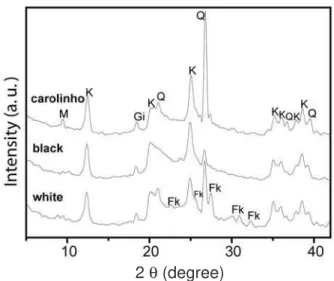
Fig. 1 shows the XRD patterns of the raw materials. These diffraction patterns indicate that all clays are predominantly kaolinitic. The presence of quartz as well as a micaceous mineral and gibbsite is also observed as common constituents for all clays. Potash feldspar peaks were only signiicant in the white clay.
Table III presents the chemical composition of the three clays. It should be noted that all clays display higher contents of SiO2 and Al2O
3. The SiO2/Al2O3 ratio indicates the amount of clay minerals i.e., those with particle size < 2 µm, present in the clays. The SiO2/Al2O
3 ratio of 1.96 in the carolinho clay, suggests a greater amount of sand as compared to the white, 1.72, and black, 1.67, clays. The relatively lower amount of Fe2O
3 in the white clay is an indication that this clay is more adequate to the fabrication of ceramic products with lighter color. The white clay has also the greater amount of K2O, which conveniently forms a liquid phase that contributes to densiication at high temperatures. The amount of TiO2, similar in all clays, is considered normal
but may cause a yellowish color that is not satisfactory for whitewares. The loss on ignition (LoI) is an indicative of the relative proportion between plastic and non-plastic compounds in the clay. The higher LoI value for the black clay is due to its high amounts of clay minerals. Moreover, the greater contribution from organic carbon (0.72%) could also add to the LoI of the black clay and result in black core defects in the inal ceramic product. Another factor related to the relatively larger value of LoI for all clays is the existence of gibbsite (aluminum hydroxide) indicated by the XRD, as shown in Fig. 1.
The general evaluation of the results presented in Table III is that all compositions are typical of kaolinitic clays. In terms of a potential for whiteware loor tiles production the white clay can be considered the most suitable one.
Table IV shows the plasticity of all investigated clays given by the Atterberg limits. The lower plastic limit (LPL) is associated with the minimum amount of water that is needed to a clay attends a convenient plastic state. The upper plastic limit (UPL) is related to the amount of water for which the clay behaves like a low viscosity luid and, therefore, cannot be formed by extrusion or pressing. The plasticity index
Figure 1: XRD patterns of the clays. Fk = potash feldspar; K = kaolinite; M = micaceous mineral; Q = quartz.
[Figura 1: Difratogramas de raios X das argilas.Fk = feldspato potássico; K = caulinita; M = mineral micáceo; Q= quartzo.]
Clays SiO2 Al2O3 Fe2O3 TiO2 MgO CaO K2O Na2O LoI C *
white 52.10 30.30 1.76 1.25 0.30 0.13 3.34 0.30 10.20 0.06 black 48.73 29.20 2.22 1.61 0.58 0.41 0.61 0.27 16.34 0.72 carolinho 54.27 27.71 3.51 1.27 0.88 0.27 1.88 0.35 10.26 0.06 Table III - Chemical composition of the clays (wt.%).
[Tabela III - Composição química das argilas (% em peso).]
*C = organic carbon
(PI) corresponds to the difference between the UPL and the LPL values. The greater the PI is, the higher the clay’s plasticity will be. In practice, this indicates that more water can be added to the clay without changing its plasticity state. Suitable PI values for clay used in ceramic tiles vary form 10 to 25% [3]. Comparing the PI values in Table IV, it might be concluded that they are above the recommended limit.
Characteristics of the bodies
Table V presents the chemical compositions of both, the prepared experimental bodies and the industrial body, IB. When IB is compared to the experimental bodies, it shows lower amounts of Al2O3 and higher Fe2O3 and CaO contents. The large amount of Fe2O3 is mainly due to the industrial use of ilitic luxing clays, which normally have an iron oxide concentration above 5 wt.%. The large amount of CaO is due to the calcite in the body composition. When calcite is added into the vitriied tiles composition, it acts as a whitener material and decreases the vitriication temperature [20]. However, the experimental bodies show greater Na2O and MgO contents. The potash feldspar with 3.7% of sodium oxide used in these X bodies is responsible for the larger amount of Na2O. The talc, added to form a low temperature eutectic with the potash feldspar, was the main reason for a larger MgO content.
For the speciic purpose of whiteware loor tiles, the experimental bodies are within the chemical speciications. However, for stoneware porcelain tiles (group BIa) that require pronounced whiteness, the experimental bodies have excessive Fe2O3 content when compared to industrial formulation for group BIa products [21]. An up-grade of these bodies would require the elimination of the carolinho
clay with 3.51% of Fe2O
3. Moreover, the philite should be totally replaced by feldspar.
Technological properties of the compositions
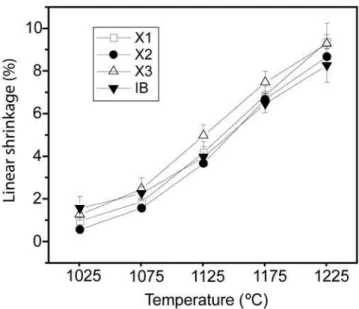
Fig. 2 presents the behavior of the linear shrinkage as a function of the iring temperature for all investigated bodies. It can be seen that they all show similar behavior with a comparatively greater increment in the linear shrinkage above 1075 oC. This can be attributed to the formation of a liquid phase that ills the porosity and promotes the approximation of the particles.
Fig. 3 presents the water absorption as a function of the iring temperature for all investigated bodies. It should be remembered that the water absorption can be used to evaluate the sintering process of ceramics and has an important role in the classiication of ceramic tiles [21]. In this igure one can see that all bodies show a decrease in the water absorption with increasing temperature. This is a consequence of the
Atterberg limits
Clays LPL UPL PI
white 27 59 32
black 33 81 48
carolinho 24 51 27
Figure 2: Linear shrinkage of the bodies as a function of the iring temperature.
[Figura 2: Retração linear das massas em função da temperatura de queima.]
Table IV - Plasticity of the clays (%). [Tabela IV - Plasticidade das argilas (%).]
Compositions SiO2 Al2O3 Fe2O3 TiO2 MgO CaO K2O Na2O LoI
X1 62.87 21.10 1.44 0.68 2.87 0.05 3.96 0.71 6.33 X2 62.75 20.74 1.67 0.71 2.95 0.09 3.54 0.71 6.95 X3 62.66 20.46 1.83 0.74 3.02 0.12 3.22 0.71 7.42 IB 62.77 19.04 2.62 1.16 2.11 1.89 3.84 0.26 6.13 Table V - Chemical composition of the studied bodies (wt.%).
reduction in the open porosity associated with both, solid state and liquid phase formation sintering processes [22]. The latter predominates at higher temperatures. It should be noticed that IB presents the lowest values of water absorption up to approximately 1150 oC. Above this, bodies X2, X3 and IB show similar values of water absorption. In particular, body X1 shows the greatest water absorption above 1110 oC, which can be attributed to its more refractory behavior. In spite of the larger luxing K2O content of this body, the high percentage of Al2O3 is apparently causing its refractoriness. Moreover, X1 presents the lowest Fe2O3 content, Table V, which could also act as a luxing agent if transformed to FeO [23].
Fig. 3 also indicates the intervals of water absorption associated with the different classiication for ceramic loor tiles groups [21]. With the exception of body X1, the others present values of water absorption within the speciication for whiteware loor tiles at temperatures normally employed by industries.
Fig. 4 presents the lexural rupture strength as a function of the iring temperature for all investigation bodies. It should be reminded that the mechanical strength is strongly dependent on the microstructure, especially on defects such as pores and cracks. Furthermore, together with the water absorption, it also has an important role in the classiication of loor tiles [21]. Fig. 4 shows that all bodies present an increase in strength with iring temperature. The only exception is IB at 1225 oC, possibly due to the frequently occurring phenomenon of overiring. Nevertheless, the industrial body displays the highest values of strength at all temperatures. This behavior, up to 1150 oC, can be attributed to a lower porosity, as discussed in terms of the data from Fig. 3. Beyond 1150 oC, the level of porosity in IB is similar to those in X2 and X3, and the greater strength of IB could be attributed to the amount and type of phases in the
Figure 3: Water absorption of the bodies as a function of iring temperature.
[Figura 3: Absorção de água das massas em função da temperatura de queima.]
bodies. At these higher temperatures mullite and residual quartz crystals dispersed in a vitreous matrix are expected to be formed. This aspect will be later discussed in the present paper.
Fig. 4 also indicates the intervals of strength associated with the different types of groups for ceramic loor tiles [21]. All investigated bodies are within the ranges of strength required for the classiied groups of ceramic tiles at temperatures similar to those employed by industries.
Microstructure of the bodies
A microstructural analysis was carried out only for bodies ired at 1175 oC, which is a typical temperature employed by industries in the production of BIb group ceramics, such as whitewares. This analysis was performed by XRD to identify the crystalline phases, mercury porosity to evaluate the open porosity, and SEM to observe the fracture surfaces.
Fig. 5 shows the pore size distribution of different bodies ired at 1175 oC. One should notice that the X1 material presents, comparatively, the greatest volume of open pores. This explains the largest value of water absorption, Fig. 3, at that iring temperature. It could also be seen in Fig 5 that the IB material has pores with larger sizes. This result is apparently related to preferred removal of smaller pores at the beginning of the sintering process [24].
Figs. 6a to 6d show the fracture surface of different bodies ired at 1175 oC. The main feature in these igures is the presence of well-distributed small pores in the structure. In particular, it is relevant to note that the X1 body prepared with white clay, Fig. 6a, apparently displays a greater porosity. This is in agreement with corresponding results on Hg porosimetry and water absorption.
Figure 4: Flexural strength of the bodies as a function of iring temperature.
[Figura 4: Tensão de ruptura à lexão das massas em função da temperatura de queima.]
Temperature (ºC)
Figure 5: Accumulated pore-size distribution curves of the bodies.
[Figura 5: Curvas de distribuição de tamanho de poros das massas.]
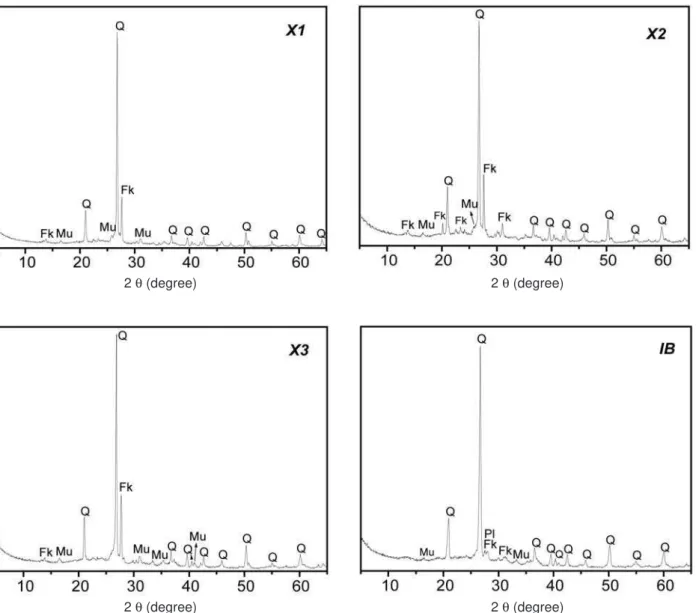
Fig. 7 shows the XRD pattern of different bodies ired at 1175 oC. In general, all bodies present similar crystalline phases. The identiied common phases were quartz, potash feldspar and mullite. While the irst two are residual phases from the raw materials mineralogical composition, the mullite comes from the metakaolinite decomposition around 950 oC. In the spectrum of IB material a plagioclase, probably albite due to the elevated amount of CaO, was also detected. In scientiic investigations performed at temperatures above 1150 oC, it is a common feature for clayey bodies to have a microstructure formed by mullite crystals and residual quartz [25]. However, the presence of potash feldspar, found at 1175 oC in Fig. 7, is a clear indication that this level of temperature was not enough to promote its complete dissolution. In principle this dissolution should have occurred around 1150 oC through an incongruent melting [8]. In this respect, the lesser intensity of the potash feldspar XRD peaks in IB is apparently a consequence of its higher amount of glassy phase, contributing to elevate the mechanical strength.
(c)
(c)
Figure 6: SEM micrographs of the fracture surface of the compositions ired at 1175 oC. (A) X1; (B) X2; (C) X3; (d) industrial body IB.
CONCLUSIONS
A technological and scientific investigation on the possibility of using three typical kaolinitic clays from the state of Rio de Janeiro, Brazil, in ceramic bodies to fabricate whiteware floor tiles has led to the following conclusions: in a large scale production, the refractory characteristics of all clays are responsible for the comparatively poorer properties of the fired ceramics. Their excessive plasticity can also result in problems at the forming stage and make it difficult to achieve the required body permeability.
In particular, the high weight loss of the black clay can be associated with defects in the inal product such as
Figure 7: XRD patterns of the bodies ired at 1175 oC. Fk = potassic feldspar; Mu = mullite; Q = quartz; Pl = plagioclase. [Figura 7: Difratogramas de raios X das massas queimadas a 1175 °C. Fk = feldspato potássico; Mu = mulita; Q = quartzo; Pl = plagioclásio.]
voids, cracks and dimensions out of speciications. The high amount of Fe2O3 of the carolinho clay can result in undesired color for the ceramic support. The white clay appears to be the most adequate, among the three, to be used in whiteware loor bodies although it may cause excessive water absorption at elevated temperatures.
In a general analysis, the experimental bodies presented similar characteristics, as well as similar properties and microstructures to an industrial body normally used for whitewares loor tiles in Brazil.
ACKNOWLEDGMENTS
The authors would like to thank CNPq, CAPES, FAPERJ and TECNORTE/FENORTE.
2 θ (degree) 2 θ (degree)
REFERENCES
[1] A. E. Benlloch, J. L. A. Albaro, J. E. E. Navarro, Bol. Soc. Esp. Ceram. Vidr. 20 (1981) 17.
[2] J. E. E. Navarro, J. L. A. Albaro, Técnica Cerámica 91
(1981) 119.
[3] E. Sanchéz, J. Garcia, F. Ginés, F. Negre, Cerâmica Industrial 1 (1996) 13.
[4] A. Barba, V. Beltrán, C. Feliu, J. García, F. Ginés, E. Sánchez, V. Sanz, Materias primas para la fabricación de soportes de baldosas cerámicas, Instituto de Tecnologia Cerámica-AICE, Castellón (1997) p. 291.
[5] D. Minichelli, G. Polizzotti, Tile & Brick Int.9 (1993) 141.
[6] N. M. Kruglitsky, B. M. Datsenko, B. I. Moroz, Ceram. Int. 10 (1984) 78.
[7] A. A. Mostafa, E. H. Sallam, H. El Didamony, D. M. Ibrahim, Tile & Brick Int. 10 (1994) 340.
[8] G. P. Emiliani, F. Corbara, Tecnología Cerámica - La Lavorazione, Gruppo Editoriale Faenza Editrice, Faenza (1999) p. 97.
[9] D. M. Ibrahim, A. A. Khalil, S. M. H. Naga, Nepheline syenite-talc low temperature vitriied bodies, Ceram. Int. 7 (1981) 69.
[10] T. K. Mukhopadhyay, M. Das, S. Ghosh, S. Chakrabarti, S. Ghatak, Ceram. Int. 29 (2003) 587.
[11] G. Bifi, Porcelain stoneware - Production manual and methods of use, Gruppo Editoriale Faenza Editrice S. p. A., Faenza (1999) p. 304.
[12] S. I. Warshaw, R. Seider, J. Am. Ceram. Soc. 50 (1967) 337.
[13] Y. Kobayashi, O. Ohira, Y. Ohashi, E. Kato, J. Am.
Ceram. Soc. 75 (1992) 1801.
[14] V. Kilikoglou, G. Vekinis, Y. Maniatis, Acta Metall. Mater. 43(1995) 2959.
[15] S. Maity, B. K. Sarkar, J. Eur. Ceram. Soc. 16(1996) 1083.
[16] Associação Brasileira de Normas Técnicas (ABNT), Determinação do limite de plasticidade de solos, NBR 6459-84, Rio de Janeiro (1984).
[17] Associação Brasileira de Normas Técnicas (ABNT), Determinação do limite de liquidez de solos, NBR 7180-84, Rio de Janeiro (1984).
[18] American Society for Testing and Materials (ASTM), Water Absorption, Bulk Density, Apparent Porosity, and Apparent Speciic Gravity of Fired Whiteware Products, C 373-72 (1972).
[19] American Society for Testing and Materials (ASTM), Flexural Properties of Ceramic Whiteware Materials, C 674-77 (19674-77).
[20] V. Beltrán, E. Sánchez, J. García-Ten, E. Ginés, Técnica Cerámica 241 (1996) 114.
[21] Associação Brasileira de Normas Técnicas (ABNT), Placas Cerâmicas para Revestimento - especiicação e métodos de ensaio, NBR – 13818, Rio de Janeiro (1997). [22] O. Delbrouck, J. Janssen, R. Ottenburgs, P. Van Oyen, W. Viaene, Appl. Clay Sci. 8 (1993) 187.
[23] M. P. Abajo, Manual Sobre Fabricación de Baldosas Tejas y Ladrillos, Beralmar, S. A., Terrassa (2000) p. 22. [24] M. J. Ortz, A. Escardino, J. L. Amorós, F. Negre, Appl. Clay Sci. 8 (1993) 193.
[25] T. K. Mukhopadhyay, M. Das, S. Ghosh, S. Chakrabarti, S. Ghatak, Ceram. Int. 29(2003) 587.
![Fig. 3 also indicates the intervals of water absorption associated with the different classiication for ceramic loor tiles groups [21]](https://thumb-eu.123doks.com/thumbv2/123dok_br/18892409.425389/5.892.76.429.108.422/indicates-intervals-absorption-associated-different-classiication-ceramic-groups.webp)