Rev. Bras. Prev., Curitiba, Paraná. v.11 n.1, p.35-58, Janeiro-Junho. 2020. 35
e-ISSN: 2317-0158
HOW FGTS WOULD BECOME AN EFFICIENT DEFINED CONTRIBUTION RETIREMENT PLAN INVESTING IN SELFIES. A SOLUTION FOCUSED ON
FUTURE REAL INCOME
ALEXANDRE VITORINO*
Mestrado Profissional pela UNIFESP
DOI: http://dx.doi.org/10.21902/rbp.v11i1.4436 ABSTRACT
This article proposes changes in the General Fund for Length of Service (FGTS) rules based on Relative Asset Pricing Model (RAPM) theory, having a New Brazilian Government Bond (NBGB), based on SeLFIES (Standard of Living Indexed, Forward-starting, Income-only Securities), as its main asset. This proposal results from an inductive research of Brazilian Laws ruled mandatory investments of Defined Contribution (DC) plans in the past.
This article is divided in seven sections. Firstly, it is explained why the creation of a modern capitalization retirement system for Brazilian workers is important. The second section presents examples of laws and historical facts about Government influence in investments made by Brazilian DC plans in the past, their financial insufficiency, and the volatility in pension real values. In the third section is an assessment of the FGTS current structure. In the forth section is shown the first step of the proposed solution: the creation of the New Brazilian Government Bond (NBGB), based on SeLFIES (Standard-of-Living, Forward-starting, Income-only Securities) The next section is presented the second step of the solution, modifying the FGTS rules in order to invest mainly in NBGB. The sixth section shows some practical advantages of the FGTS/NBGB model. The last section treats about uncovered risks of FGTS/NBGB model.
Key words: SeLFIES, Retirement, FGTS and Social Security.
* Firstly, I would like to retribute Brazilian Tax Payers, which afforded my studies at UNIFESP, with this article.
Thanks for support and attention from Prof. PhD Álvaro Machado Dias and Profª. PhD Heloísa Hollnagel. I am grateful to Professor Ph.D. Arun Muralidhar for his comments and useful explanations. I would like to thank also Prof. Rui Seybert P. Ferreira for his important contributions.
I. Why a DC plan is important for Brazilians
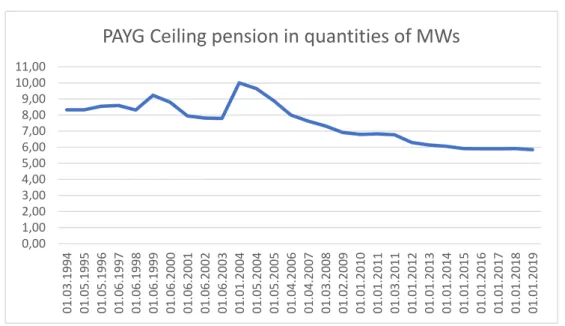
Giambiani and Sidone (2018) estimated Pay-As-You-Go (PAYG) pension ceiling should be lowered even more to a range between three to five Minimum Wages (MWs) in order to reaches its long run sustainability. Nowadays, Brazilian PAYG ceiling represents 5,8 MWs. So, lowering the PAYG ceiling is part of the long run solution for the PAYG sustainability. This effect can be partly seen, measuring the Brazilian PAYG pension ceiling in terms of quantity of minimum wages (MW), showed in Figure 1. It has decreased since the monetary reform of 1994. Figure 1:
Figure 1: PAYG ceiling pension in the quantity of MWs (1994 to 2019)
0,00 1,00 2,00 3,00 4,00 5,00 6,00 7,00 8,00 9,00 10,00 11,00 01.03.1994 01.05.1995 01.05.1996 01.06.1997 01.06.1 99 8 01.06.1999 01.06.2000 01.06.2 00 1 01.06.2002 01.06.2003 01.01.2 00 4 01.05.2004 01.05.2005 01.04.2006 01.04.2007 01.03.2008 01.02.2009 01.01.2010 01.01.2011 01.03.2011 01.01.2012 01.01.2013 01.01.2014 01.01.2015 01.01.2016 01.01.2017 01.01.2018 01.01.2019
PAYG Ceiling pension in quantities of MWs
Source: Ministério da Previdência Social and
http://www.consultor-online.com/2015/06/o-valor-do-salario-de-beneficio-pago-no-inss-desde-1994.html, in 19th Oct 2019. Calculation plotted by author.
Social Security (SS) actuarial unbalance is a problem for many countries and the replacement rate forecast is not encouraging. Second Soto (2017), the average replacement rate forecast for the Organization for Economic Co-operation and Development (OECD) member countries, may decrease from current 35% to 20% in 2060. Also to keep the replacement rate at 35%, a larger part of public expenditure channeled to retirements and pensions. In OECD countries, average SS expenditure was 4% of the GDP in 1990 and raised
Rev. Bras. Prev., Curitiba, Paraná. v.11 n.1, p.35-58, Janeiro-Junho. 2020. 37
to 9% in 2015. The researcher concludes that future generations will have to work longer and save more.
In 2019, Brazilian SS expenditure will reach 64,8% of total Government Expenditure, accordingly Brasil (2019a). The SS expenditure represented 14,6% of Brazilian GDP in 2018, but only 12% of Brazilians has 65 years old or more. To have an idea of the Brazilian SS unbalance, German SS expenditures represents 10% of GDP, having a elder population around 32%.
This unbalance would get even worse if nothing was done. The 2019 PAYG reform, in approval process by the Brazilian Congress, is a starting point to equate this unbalance, because the Brazilian populational dynamic is challenger for the SS actuarial equilibrium. The dependency rate official forecast shows an increase from 47% in 2010, to 67% in 2060 (Brasil, 2018).
Despite the fact that PAYG pension ceiling pension is broadly known (R$ 6.101,06 for 2020), representing 5,83 MWs, a relevant part of higher income workers haven’t engage to a complementary retirement plan. It seems a typical case of myopia which is measured in Brasil (2017a). This survey gives an idea of myopia and procrastination among Brazilian citizens in terms of a DC plan engagement.
It was applied the Toolkit Survey to 2002 people, between 9th and 13th of Abril 2015. As showed in Appendix 1, the MW in 2015 was R$ 788,00 and the PAYG ceiling R$ 4663,76. The survey appointed only 8,6% of interviewed, having a monthly income between 5 to 10 MWs (R$ 3940 to R$ 7880) , were contributing for complementary retirement plan. In the range of 10 to 20 MWs (R$ 7880 to R$ 15760), this ratio increased to 16%. It is an impressive low rate, since the RGPS ceiling pensions was 5,92 MWs at that time.
Resuming, the PAYG system is inefficient for a reposition rate represents more than 5 MWs. Second Brazilian Internal Revenue Service report, in Brasil (2017b), there were around 29 million tax payers1 in 2016, and 13 million declared a month income higher than 5 MWs.
Milton Friedman (1990) accused PAYG systems with increasing deficits as the biggest Ponzii scheme on earth, because this unbalanced arrangements cannot guarantee an expected replacement rate in the future. Given the scenario, police makers must to present a solution for the retirement saving increasing.
II. How Government influenced DC plans investment decisions
One point not yet covered properly is why Brazilian DC plans failed in the past, despite pioneering. In the early times of the Brazilian Reign, retirement income was obtained through specific laws to some well connected individuals, a personal concession from the Emperor, approved by Senate. In the first half of XIX century, Emperor D. Pedro II had stimulated the creation of Montepio Institutes, in collective DC regime . Most of them had their financial resources exhausted due to precarious actuarial calculations and frauds (only MongeralAegon is still in the market, it has been operated since 1832).
The Montepio crisis demanded a State Council meeting, in 17th July of 1883, where Viscount of Muritibaii declared that haircuts in pensions would not be considered a contractual breach (Brasil, 1883). It was the solution found for the insolvency problems of troubled institutes.
In 1923, the Eloy Chaves Law, established the first Retirement and Pension Funds (Caixas de Aposentadoria e Pensão - CAPs). CAPs were sponsored by companies individually, mostly state owned ones. Actuarial unbalances forces to the CAPs unification in Retirement and Pension Institutes (Institutos de Aposentadoria e Pensões - IAPs ), starting in 1933, still as collective DC plan. The IAPs were sponsored by workers categories and had a different contribution scheme. While CAPs were funded by employee and employers, the IAPs received contributions from companies, workers and Government.
In 1966, IAPs were unified again but this time in single national bureau, the Social Security National Institute (Instituto Nacional de Previdência Social – INPS). The consolidations of such DC plans took place partially to solve financial insufficiency and rules unification. Figure 2 shows the reserves over expenses of CAPs and IAPs down trend between 1923 and 1965.
Rev. Bras. Prev., Curitiba, Paraná. v.11 n.1, p.35-58, Janeiro-Junho. 2020. 39
Figure 2: Reserves over expenses of CAPs and IAPs (1923 – 1965)
Source: Oliveira e Teixeira (1989, p. 351). Data from Table IX. Plotted by the author. Initially, the INPS had continue as a tripartite capitalization system, in a collective DC plan, but it became a PAYG regime in the same year it was stablished (1966). A change in the regulation allowed the National Treasury to cover eventual INPS financial deficits, which were imminent.
This article focuses on Government influence on investments decisions rather than loose concession rules, but the asset liability management (ALM) were jeopardized on both sides. Looses benefit concession rules, disregarding fair contributions, were used systematically as a gear for Government popularity improvement. An example was the abolishment of a minimum age to retirement in 1966 by the Congress, with support of the Brazilian President. Only in 2019 the minimum age was reintroduced in the SS Reform.
The using of financial reserves to fund public policies directly, far from fair market condition, or even below the actuarial hurdle rate, were not rare. Investments were made some times in a very poor credit conditions, without guarantees or insurances. Medical care system and housing programs received large amounts form CAPs and IAPs. Actuarial deficits were hidden by financial surpluses, especially in times of engagement increasing.
Focusing in the DC plans investment decision mandatory rules, it is evident the using of its reserves to create a cross subsidy system, allocating resources below even the inflation rate (Oliveira and Teixeira,1989). Law-decree 574/38 forced to invest in Banco do Brasil bonds to finance agrobusiness activity; Law-decree 3077/41 ruled investments in Banco do Brasil time deposits at 5% p.y. (less than the inflation rate); Law-decree 1834/39 forced to invest in loans to pulp and paper industry at 7% p.y., in a minimum fifteen year tenor (less than the inflation rate).
In Teixeira (1997), is mentioned IAPs were also “invited” to participate of Brazilian City urban development, building huge fancy houses and business buildings, which would be rented afterwards. There is no evidence of actuarial rates and liquidity requirements analyses prior investing. IAPs were forced to invest in state owned companies’ shares like the Companhia Siderúrgica Nacional in 1941 (steel company). We can intuit that these investment, being mandatory, were far from fair market conditions.
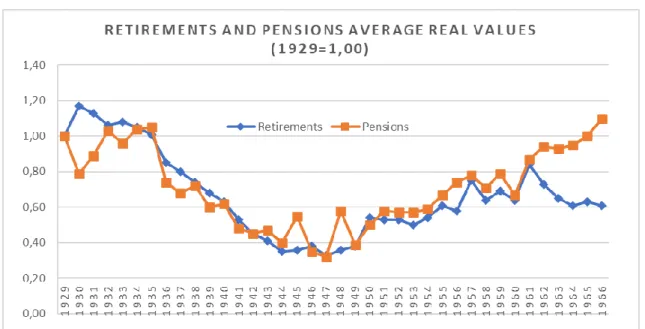
Consequently, CAPs and IAPs could not maintain the real retirement income of their participants. In Oliveira and Teixeira (1989), there is an analyze of the real income volatility for retirees and pensioners between 1929 and 1966, plotted on Graphic 3. It was pointed a decrease of nearly 60% in the real value of retirements and pensions paid between 1929 and 1940 by the analyzed capitalization systems. The values paid in pensions came back to their 1929 real value only in 1966. The retirement values did not recover themselves completely, reaching 60% of the 1929 real values, in 1966. Pension values corresponded around 25% of the total amount paid by the DC plans, while retirement was 75% of the values.
Figure 3: CAPs and IAPs retirement and pension real values.
Rev. Bras. Prev., Curitiba, Paraná. v.11 n.1, p.35-58, Janeiro-Junho. 2020. 41
The Montepios’ asset liability mismatch had to be solved by nominal haircut, because annual inflation in the Imperial period were around 1%. Between 1929 and 1965 inflation rate hit two digits2 in several times, creating a room for adjustment in real values.
Brazil currently has a particular structure, the FGTS, that should perform as a capitalization retirement plan and unemployment insurance integrated. It was created in 1966, through Institutional Act 2 (Ato Institucional 2 - AI-2), by the Military Regime, as a counterpart of the extinction of the worker’s 10-year employment stability. FGTS is a compulsory saving in tax free individual accounts. Employees have to deposit monthly 8% of formal workers’ salary in FGTS individual accounts. Withdraws are permitted mostly in cases of: (i) down payment for the first residence, (ii) unemployment, (iii) retirement, (iv) when worker reaches the age of 65 years old and, (v) some specific diseases. FGTS does not offer any deaccumulation instruments, it pays a slump sum in the retirement event withdrawn. Unfortunately FGTS became a cheap source for public policy financing mainly to low income housing programs and sewing project finance for municipalities , repeating partially CAPs and IAPs modus operandi. As expected in cases of crossed subsidy environment, the FGTS profitability is controlled. It has been kept far below from other investment alternatives commonly offered by retail banks.
III. What is wrong with FGTS?
Firstly, FGTS is a “mandatory right” of Brazilian formal workers, guaranteed by the Constitution. Given its low profitability, it has been a privilege not to participate.
FGTS deposits has been remunerated by the Referential Rate (Taxa Referencial - TR) plus 3% p.y. since 1992. TR is calculated by BACEN, being the resultant of average rate for 30 days time deposits of the thirty largest banks operating locally, less an unveiled reducer factor. TR has been flat (zero) since September 2017 (exoterically!).
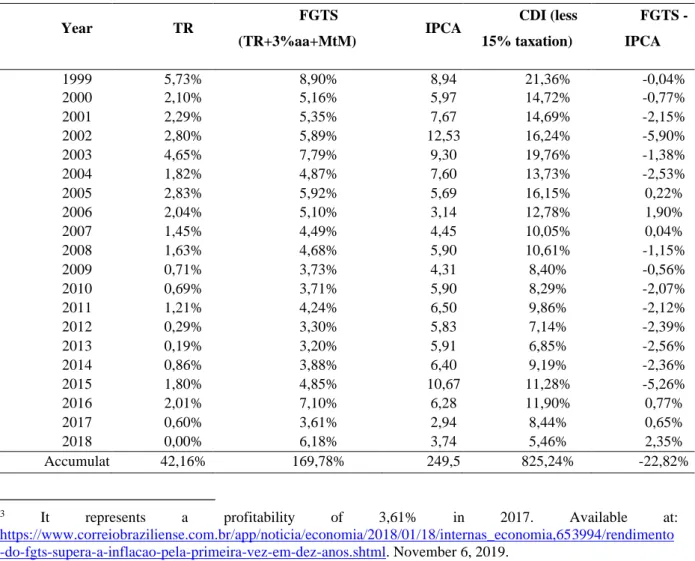
The TR+3%aa profitability has ran below the inflation rate systematically since 1999, as showed in Table 2. In order to enhance the FGTS profitability, since 2017, deposits has been remunerated also by the FGTS mark to market (MtM) results, plus TR+3%aa. Regarding the
2 For an analysis of Brazilian inflation rate from 1930 to 1989, please see: Munhoz, Décio G. (1997): Inflação
Brasileira: Os ensinamentos desde a crise dos anos 30, Economia Contemporanea n. 1 – Jan-Jul., at: http://www.ie.ufrj.br/images/pesquisa/publicacoes/rec/REC%201/REC_1.1_03_Inflacao_brasileira_os_ensiname ntos_desde_a_crise_dos_anos_30.pdf, on 5th of November of 2019.
year of 2017, 50% of the MTM results were distributed to depositors. It represented an extra profitability3 of +1,72%. In 2018 there was a change in the law and it was distributed 100% of the MtM, representing around +3% on TR+3%p.y. regular profitability4.
These extra profitability helped the FGTS performance to overcame the Índice de Preços ao Consumidor Amplo5 (IPCA) in 2017 and 2018, as shown in Table 1. In terms of investment opportunity, in example, FGTS performed far below the Interbank Overnight Loan (Certificado de Depósitos Interbancários- CDI), even considering 15% taxation6, from 1999 to 2017. Only in 2018, due to the MtM results, FGTS had a higher performance comparing to the CDI.
Table 1: FGTS, IPCA and CDI performances from 1999 to 2019
Year TR FGTS (TR+3%aa+MtM) IPCA CDI (less 15% taxation) FGTS - IPCA 1999 5,73% 8,90% 8,94 % 21,36% -0,04% 2000 2,10% 5,16% 5,97 % 14,72% -0,77% 2001 2,29% 5,35% 7,67 % 14,69% -2,15% 2002 2,80% 5,89% 12,53 % 16,24% -5,90% 2003 4,65% 7,79% 9,30 % 19,76% -1,38% 2004 1,82% 4,87% 7,60 % 13,73% -2,53% 2005 2,83% 5,92% 5,69 % 16,15% 0,22% 2006 2,04% 5,10% 3,14 % 12,78% 1,90% 2007 1,45% 4,49% 4,45 % 10,05% 0,04% 2008 1,63% 4,68% 5,90 % 10,61% -1,15% 2009 0,71% 3,73% 4,31 % 8,40% -0,56% 2010 0,69% 3,71% 5,90 % 8,29% -2,07% 2011 1,21% 4,24% 6,50 % 9,86% -2,12% 2012 0,29% 3,30% 5,83 % 7,14% -2,39% 2013 0,19% 3,20% 5,91 % 6,85% -2,56% 2014 0,86% 3,88% 6,40 % 9,19% -2,36% 2015 1,80% 4,85% 10,67 % 11,28% -5,26% 2016 2,01% 7,10% 6,28 % 11,90% 0,77% 2017 0,60% 3,61% 2,94 % 8,44% 0,65% 2018 0,00% 6,18% 3,74 % 5,46% 2,35% Accumulat ed 42,16% 169,78% 249,5 4% 825,24% -22,82%
3 It represents a profitability of 3,61% in 2017. Available at:
https://www.correiobraziliense.com.br/app/noticia/economia/2018/01/18/internas_economia,653994/rendimento -do-fgts-supera-a-inflacao-pela-primeira-vez-em-dez-anos.shtml. November 6, 2019.
4 It represents a profitability of 6,18% in 2018. Available at:
http://agenciabrasil.ebc.com.br/economia/noticia/2019-08/maior-rendimento-do-fgts-exige-atencao-na-hora-do-saque. November 6, 2019.
5 IPCA is a well known Consumer Price Index. It has been used by Brazilian Central Bank (BACEN) for the
Inflation Target System since it started in 1999. FOCUS Report is weekly released by BACEN with the market average forecast for IPCA among other macroeconomics indicators.
6 Brazilian taxation on fixed income instruments depends on investment tenor: 22,5% until 180 days, 20%
between 181 and 260 days, 17,5% between 361 and 720 days, and 15% for investments longer than 721 inclusive. For retirement saving instruments comparation commonly it is used 15% taxation.
Rev. Bras. Prev., Curitiba, Paraná. v.11 n.1, p.35-58, Janeiro-Junho. 2020. 43
Source: BACEN and Bloomberg. FGTS calculations by the author.
The FGTS MtM deserves a remark. The FGTS balance sheet showed R$ 529 billion in December 2018. (http://www.fgts.gov.br/Pages/sobre-fgts/relatorio-demonstracao.aspx, in 19th October 2019). It had around R$ 28 billion in cash, R$ 93 billion in government bonds and R$ 50 billion in securities, all these investments could be easily marked to market. Nonetheless, FGTS invested around R$ R$ 351 billion in credit operations to municipalities and government social programs (credit conditions are not disclosure), being difficult to assess their fair prices. The FGTS MtM has no transparency since the conditions of each operation is partially disclosure.
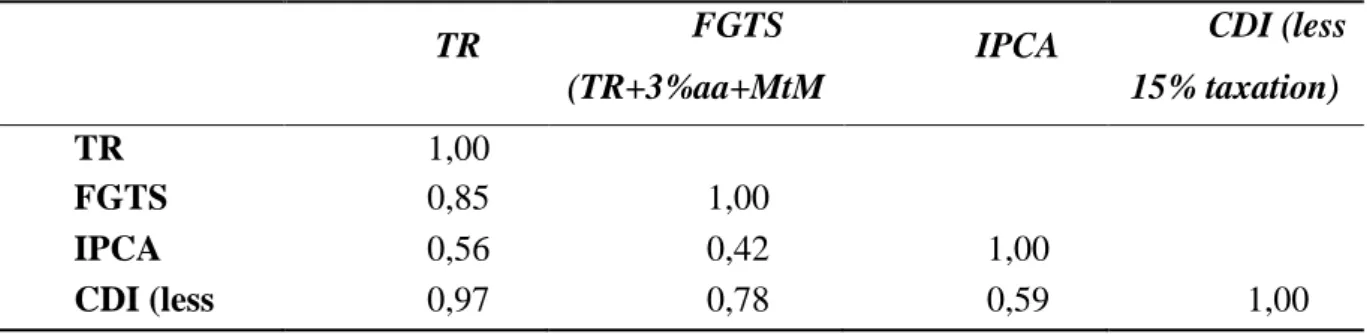
TR, as an index for retirement saving, is also inappropriate considering the RAPM perspective. The Pearson correlation between TR and IPCA measured in terms of annual changes between 1999 and 2018 is 0,56, as showed in Table 2. TR showed 0,97 correlation with the overnight interbank loan rate (CDI) in the same period. So, TR is much more correlated to short term risk free interest rate than inflation rate. It means that FGTS reflects a Capital Asset Pricing Model (CAPM) type model, rather RAPM.
Table 2: Pearson correlation of annual changes (1999 to 2018)
TR
FGTS (TR+3%aa+MtM
)
IPCA CDI (less
15% taxation) TR 1,00 FGTS (TR+3%aa+MtM ) 0,85 1,00 IPCA 0,56 0,42 1,00 CDI (less 15% taxation) 0,97 0,78 0,59 1,00
Source: BACEN and Bloomberg. Calculation by the author using Excel.
IV. Solution - Step 1: Proposal of a New Brazilian Government Bond (NBGB)
As demonstrated by CAPs and IAPs cases, it is extremely important to construct a optimal portfolio in full capitalized plan to hedge its two phases: accumulation and decumulation of real values (in case of SeLFIES accumulation and decumulation of “units of consumption”).
It is not the minimization of the present value volatility of the retirement saving portfolio that matters. In the first phase, the portfolio should target on future real income maximization. In decumulation phase there is another target: the minimization of the real
income volatility. These two different investment targets require a completely different risk management than the conventional ones. The short term interest rate is not risk free, it is a full risk one, as defended by Merton (2014).
Normally people don’t save money for pleasure, but to accomplish a future commitment. The RAPM states that savings become less risky when they are linked to the price change of the future commitment. In case of retirement, savings should be linked to life standard indexes, searching for a purchase power maintenance. In this case, diversification doesn’t bring necessarily a safer position for savers.
In Martellini, Merton and Muralidhar (2018) and Merton (2014) there is a proposal of a new fixed income instrument linked to inflation rate. It used the concept that inflation rate as the risk free benchmark to retirement savings. Accordingly to the researchers, retirement savers should invest in a new Government Bond, linked to a well know general price index, unifying the accumulation and decumulation phases in a single instrument. This new government bond wouldn’t make any coupon until the year of the bondholder retirement from there, it pays principal amount adjusted by inflation rate, for 20 years. Such security is called Retirement Bond (RB).
In Kobor and Muralidhar (2018), and Muradilhar, Ohashi and Shin (2016) there is a variant of the Retirement Bond, the Standard-of-Living indexed Forward-starting Income-only Securities (SeLFIES). Both securities have similar structures in terms of amortization payments. While RBs is linked to a well known consumer price index, SeLFIES would be linked to the per capita consumption expenditure indicator. Inflation hedges against wealth volatility, and a per capita consumption index hedges life standard. Why? Because inflation rate measures price changes in fixed basket of goods and services, but pre capita consumption captures instantly changes in consumer behavior. In appendixes 1 and 2 there are calculations of annual changes of Brazilian Nominal Families’ Consumption Expenditures Changes divided by total population and IPCA.
In Brazilian case, the NTN-B (Nota do Tesouro Nacional série B - linked to IPCA) has been issued since 2005 and nowadays it represents almost 50% of the bonds sold by Tesouro Direto (direct sales program for individuals), and around 25% of the Brazilian National Debt outstanding, accordingly to Brasil (2019b). IPCA and the household consumption are calculated by Instituto Brasileiro de Geografia e Estatistica (IBGE). IPCA is released monthly, while household consumption is released quarterly, and it is not so popular among
Rev. Bras. Prev., Curitiba, Paraná. v.11 n.1, p.35-58, Janeiro-Junho. 2020. 45
investors, but the NTN-B and Tesouro Direto success could be the key for the success of a new Brazilian SeLFIES launching. Brazilian financial market is deeply developed and open for innovation.
This new NBGB is a mixing of the technology already exists for NTN-B and SeLFIES proposal. Once these securities would be sold at a market price, but having a face value of R$10,00, as designed by Merton, Muralidhar and Vitorino (2020). Workers could figure their purchasing power in terms of his future month welfare complement, multiplying the number of securities held by the ratio of 1/n, where n is the number of amortizing months. In this case, the NBGB would amortize in 250 months just to simplify calculations, so 1/n = 1/250 = 0,04.
It is just to multiply the quantity of NBGB held times 0,04 to give an idea of the real retirement income for the 250 months after retirement year. So, if the worker would like to have a month complementary pension of R$ 400 in real values, he should acquire 10.000 quantities of NBGBs. Imagine he would start to work at 25 and retires at 65 years old, he has to save until reach the quantity of 10.000 bonds until the age he would like to retire. It is a mix of Target Date and Income Saving investment.
Savers have to choose the year he would like to retire in order to invest in the specific NBGB maturity, in the right quantity . The ungrateful task of figuring the optimal saving rate or the construction of efficient portfolios would be not necessary any more.
The selling price of NBGB would be fixed in the Government Bonds regular weekly auctions made by the BACEN. The Tesouro Direto program trades in a competitive narrow bid ask environment. Investment funds and insurance companies would also invest in NBGB, in order to make their asset liability management. Table 3 shows indicatives prices released daily by Associação Brasileira das Entidades dos Mercados Financeiro e de Capitais (ANBIMA), for NTN-Bs, so it can be observed how tight are the bid and offer prices, indicating an efficient market.
Table 3: Indicative Prices for NTN-Bs
Maturity Date Bid Offer Indicative Rate
15/08/2020 0,7 4% 0,71 % 0,72% 15/05/2021 0,8 0% 0,78 % 0,79% 15/08/2022 1,4 0% 1,38 % 1,38% 15/03/2023 1,6 7% 1,64 % 1,65% 15/05/2023 1,6 7% 1,65 % 1,65% 15/08/2024 2,0 9% 2,07 % 2,08%
15/08/2026 2,4 6% 2,44 % 2,45% 15/08/2028 2,6 9% 2,66 % 2,67% 15/08/2030 2,7 9% 2,76 % 2,77% 15/05/2035 2,9 9% 2,96 % 2,97% 15/08/2040 3,2 1% 3,17 % 3,19% 15/05/2045 3,3 1% 3,29 % 3,30% 15/08/2050 3,3 1% 3,29 % 3,30% 15/05/2055 3,3 1% 3,27 % 3,29%
Source: ANBIMA. Available at: https://www.anbima.com.br/pt_br/informar/taxas-de-titulos-publicos.htm, on 29th of October, 2019.
The creation of a new Government Bond can be done by Ordinary Law, requiring 50% plus one vote of the total Congressmen. A Constitution Amended needs 3/5 of the Congress to be approved.
V. Solution - Step 2: Proposal of a New FGTS/NBGB model
Tax exemption vehicles have an important rule for the DC plans regulatory mark. In US, there are two important examples: 401(k) account and Individual Retirement Account (IRA). In Canada, there is the Tax Free Saving Accounts. Chilean model is based in Administradoras de Fondos de Pension (AFP). Unfortunately, still remains the efficient portfolio dilemma and the future income forecast challenge.
Even modern proposal of capitalization plan based in tax free account for Brazilian workers, presented by Weintraub, Lorenzoni and Ludovico (2017), doesn’t cover totally the construction of efficient portfolios. The vehicle was named Individual Retirement Plan or Plano Individual de Aposentadoria (PIA), but it was designed to invest its deposits mainly in existing Government Bonds.
PIA would be a better alternative than the current complementary retirement plans offered to Brazilian workers, although a full capitalization plan research should go further in the portfolio proposals. The NBGB would fit it in terms of asset liability management to any capitalization plan, since it would become almost a full hedged vehicle.
Changing specific laws would permit that FGTS channels the worker monthly deposit amounts to an specific NBGB maturity, matching retirement savings and future complementary real income expectation.
Rev. Bras. Prev., Curitiba, Paraná. v.11 n.1, p.35-58, Janeiro-Junho. 2020. 47
A positive point of the FGTS/NBGB model is that it could be construct by ordinary laws, there is no need of Constitutional Amendment. It means that Government needs 50% plus one vote in the Congress, not two thirds as Constitutional changes demands.
Basically the following laws should be changed: Law 8036/90, turning flexible the FGTS 8% aliquot and allowing future cash flow discounts and easing withdrawn rules, and Law 9116/17, limiting the FGTS Conseil to deliberate on ALM matters.
VI. Advantages of FGTS/NBGB Model
Resuming, the new FGTS/NBGB could address simultaneously several important issues that inhibit the retirement saving increasing:
(i) It creates a strong barrier against populist using of DC plan reserves as observed in many cases involving CAPs, IAPs and currently, FGTS investments.
(ii) FGTS profitability would become a competitive alternative of investment for the long run savers, reflecting market conditions, making sense the using of “nudges” (Thaler, 2018) and especial programs like Save More Tomorrow (Benartzi and Thaler, 2007);
(iii) A new per capita consumption index would substitute TR increasing the probability of reaching a desired complementary real future standard of living,
(iv) It enhances the credit conditions for FGTS depositors since National Treasury will be the primary repayment source;
(v) It creates a simple vehicle for accumulation and deaccumulation phases; (vi) It would be a democratic and cheap alternative for a DC plan;
(vii) It provides flexibility to the current mandatory 8% aliquot contribution, avoiding the proved mistake of “one size fits all” (Table 5);
(viii) The simple calculation of quantity of bonds held times 0,04 is a more understandable proxy for the 20 years complementary real future income for financial illiterate savers than other savings alternatives;
(ix) It permits an efficient use of financial market for savers since the future cash flow predictability will facilitate discount credit operation (Vise, 2004);
(x) The future coupons discount would be a secondary source of unemployment insurance (Stiglitz and Yun 2005);
(xi) It could cover informal workers through voluntary contribution based on income tax return;
(xii) It would create the environment for more sophisticated products as NBGB held could be partially exchanged for lifetime income instruments or other types of insurances like medical care;
(xiii) SeLFIES cash flows match with infrastructure projects financing (it is a mirror in fact), and;
(xiv) NBGB prices would be transparent since it would be traded as any other Government Bond.
(xv) Retirement plan risk would be measured in terms of future real income volatility.
FGTS/NBGB system, being a market solution, could stimulate deposits of high net worth individuals. The current fixed 8% contribution aliquot may be not sufficient for the higher income workers and too high for the lower income ones, regarding certain levels of desired reposition rate, as showed by the results of a basic simulation, in Table 4.
The real PAYG ceiling real value used in the simulation was R$ 6000 per month (near the current R$ 6101,06). The annual salary is thirteen times the month one, and it was kept constant in real terms for simplification. Contributions start continuously at 25 years old and the worker retires at the age of 65. The replacement rates in the simulation, are for retirement income from 65 to 85 years old (month PAYG ceiling plus NBGB coupons). The FGTS contribution was channeled entirely for investment in NBGB, linked to IPCA, sold at par.
Table 4: Saving rate and complementary retirement income in FGTS/NBGB model (real income measured by IPCA between 65 and 85 years old)
Replace ment Rate
Target
Optimum saving rate by levels of month salary (R$)
10.000 15.000 20.000 25.000 30.000 35.000 100.000 40% 0,00% 0,00% 4,81% 7,69% 9,62% 10,99% 16,35% 50% 0,00% 4,81% 9,62% 12,50% 14,42% 15,80% 21,15% 60% 0,00% 9,62% 14,42% 17,31% 19,23% 20,60% 25,96% 70% 4,81% 14,42% 19,23% 22,12% 24,04% 25,41% 30,77% 80% 9,62% 19,23% 24,04% 26,92% 28,85% 30,22% 35,58% 90% 14,42% 24,04% 28,85% 31,73% 33,65% 35,03% 40,38%
Rev. Bras. Prev., Curitiba, Paraná. v.11 n.1, p.35-58, Janeiro-Junho. 2020. 49
Source: Calculation by the author.
Table 5 demonstrated that a new FGTS could captured voluntarily higher saving amounts from the top wages, because these privileged workers must to save a larger part of their income if they want to reach a certain planned reposition rate. As an evidence, for attractive tax exemption vehicles as such 401(k) and Canadian Tax Frees Saving Accounts, the Internal Revenue Service has to define a maximum annual investment. On the other hand, lower income workers, already covered by the Brazilian PAYG ceiling could save less than mandatory 8% aliquot, permitting facultative deposits.
Despite all the financial simulations, even required in long term saving as retirement plans, the FGTS/NBGB plan, based on SelFIES, would be called as a paternalist libertarian public policy (Thaler and Sunstein, 2003), for two main reasons. Firstly, the FGTS/NBGB forces people to explicit their choices of when to retire and their desired standard of living. Secondly, it is simple, trackable, avoiding inferior choices and inconsistencies. This system provides traffic signs to financial illiterate people, and in fact, turning them less dependent of Government in the future.
Two events related to DC plans could also be avoided using FGTS/NBGB plan, one in US in 2008 and Chile protests recently. Benartzi and Thaler (2007) explain how long term investment decisions as DC plan contributions (or not) are made, mostly using heuristics rules, that tends to a bad delivery.
During 2008, Dow Jones index felt around 30% and 401(k) and IRA investors were near the decumulation starting point, had to flat their positions in order to acquire annuities. Depending of the asset allocation between bonds and equities (not related to future standard of living), a permanent reduction in the future income from annuities occurred. A complementary retirement system having SeLFIES as its main asset, with a regulation based on the volatility of real future retirement income, would offer more protection to the saver, specially near to the retirement age.
Chile is another example of lack of communication between wealth and retirement standard of living in complementary plans, creating a room for inconsistent choices. It has been noticed that Chileans are angry about the poor results of their contribution for the AFP system. In Table 5 it is shown that in September 2019, 10.145 Chileans have retired due to age. Focusing un the statistics of 20 to 25 years of engagement, it is reported an average
month retirement income from DC plan of 4,98 UFs. In 31/10/2019, the Unidad de Fomento7 (UF) value was $ 28.065,35, so the income from AFP plan is equivalent to $139.763. It is represents USD 193, being 47% of the Chilean MW of USD 414.
Table 5: Engagement, contribution and pension by Chilean AFPs – September 2019
Years of engagement
Quantity of new pensioners
Pension from DC Plan Contribution Density
Average Median Average Median
> 0 y <=1 year 919 0,23 0,04 0,04 0,02 > 1 y <=5 1.673 0,66 0,29 0,17 0,10 > 5 y <=10 1.457 1,34 0,69 0,32 0,25 >10 y <=15 1.217 2,23 1, 35 0,46 0,39 >15 y <=20 1.031 3,35 2,14 0,57 0,52 >20 y <=25 875 4,98 3,31 0,69 0,65 >25 y <=30 950 8,29 5,01 0,79 0,77 >30 y <=35 1.040 11,24 7,49 0,89 0,89 >35 y <=40 914 19,33 13,44 0,97 0,98 S/I (4) 69 4,45 3,62 - - TOTAL 10.145 5,06 1,80 0,50 0,49
Source: Superintendencia de Pensiones. New pensioners due to age: Quantity (1), Average pension from DC Plans in UFs (2), Contribution density (3) by years of contribution (September 2019. Available at:
http://www.spensiones.cl/apps/centroEstadisticas/paginaCuadrosCCEE.php?menu=sci&menu N1=pensypape&menuN2=nuepenmes, 31/10/2019.
Recent protests against AFP system took the streets of Santiago, because the retirement income is less than the Chilean MW in most cases. Observing the average density of
7 Unidad del Fomento (UF) means unit of promotion in a sense of development. It was created in 1967 to be
used a unit of account for loans to infrastructure projects. It is linked to the Chilean consumer price index. Its value is available at https://valoruf.cl/, in 29th of October, 2019.
Rev. Bras. Prev., Curitiba, Paraná. v.11 n.1, p.35-58, Janeiro-Junho. 2020. 51
contribution8 for the same year of engagement range of 20 to 25 years of engagement, it is shown 0,69. It means that in average, the Chilean savers of this range contributed 69% of the month they were in the program. It represents 17,25 years of effective contribution for the top of range savers (25 years of engagement). Unfortunately, the internal revenue rate required to a 17,25 years of contribution for a desired retirement income is higher than normal market opportunities.
The unpredictably of the future standard of living generated by DC plans creates a room for unpleasant surprises for financially illiterate people, and it is explored politically by opposition parties, blaming the system for low pension results.
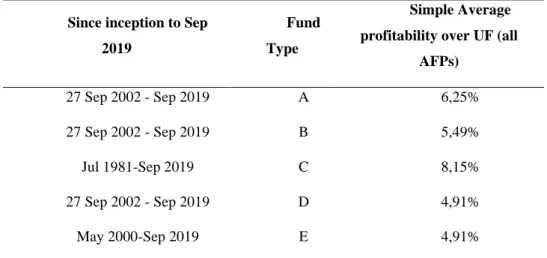
Table 6 shows the average profitability over UF since inception of the five types of funds available in AFP system. Apparently, the less than expected income is due to insufficient contribution. But how could Chileans know that?
Table 6: Simple average of profitability over UF of all AFPs by fund types
Since inception to Sep 2019
Fund Type
Simple Average profitability over UF (all
AFPs) 27 Sep 2002 - Sep 2019 A 6,25% 27 Sep 2002 - Sep 2019 B 5,49% Jul 1981-Sep 2019 C 8,15% 27 Sep 2002 - Sep 2019 D 4,91% May 2000-Sep 2019 E 4,91%
Source: Superintendencia de Pensiones, at:
https://www.spensiones.cl/apps/rentabilidad/getRentabilidad.php?tiprent=FP&template=0, in 31st of October, 2019. Calculations by the author.
VII. Uncovered Risk of NBGB/FGTS model
Despite the benefits presented, there are still uncovered risks. These risk were divided in two groups: intrinsic and political risks. There are intrinsic risks of FGTS/NBGB model:
(i) a general per capita consumption index may not reflect the change of living cost of a particular family;
(ii) longevity risk is not covered by a security that amortizes in 250 months time; (iii) such model do may not make sense in a negative real interest rate environment.
There were the political risks involving inflation linked bonds in Brazil, especially during times of pricing control and debt restructuring, and it can be repeated in any other indicator calculated by Government. During the 80’s, there were some breaches in the domestic bond market as a part of economic plans to curb hyperinflation, as follows:
(i) Government interference on index calculations; (ii) price expurgations by force of the law (“tablitas”); (iii) forced debt maturity lengthening .
Conclusions
Police makers have to promote and protect the retirement savings, in order to avoid even more government dependency in the future. Retirement saving is an important property right, and there is no a second chance to form a secure retirement real income. Full capitalization plan is an opportunity to not depend totally on the State, if the regulatory mark is robust. Capitalization plans require adequate investments, otherwise they fail.
Unfortunately, the absence of efficient investment instruments and the convenient interpretation of portfolio diversification, have created an environment where populist using of retirement plan reserves has prospered in Brazil through CAPs, IAPs and now FGTS.
In the last 20 years, FGTS low profitability has subsidized investments in real estate, sewing and infrastructure projects. Government has a cheap finance source in expense of a efficient complementary retirement system. It may affect negatively national saving in the long run.
In fact, Brazilian society is missing the opportunity not creating a robust complementary system to the RGPS., because an increase in retirement plan deposits should create a virtuous cycle on the whole domestic economy. Long run savings can be used not only to finance infrastructure projects, but any other long run investments could boost productivity as in education and new technologies. If the allocation mechanism works efficiently, productivity
Rev. Bras. Prev., Curitiba, Paraná. v.11 n.1, p.35-58, Janeiro-Junho. 2020. 53
may increase, elevating GDP growth and increasing the SS sustainability. The transformation of FGTS in a competitive capitalization plan will be only possible with the elimination of current cross subsidies mechanism.
It is important to reinforce that the FGTS/NBGB model proposed doesn’t prevent the using of retirement savings to finance public policies. The NBGB (based on SeLFIES) cash flows fit perfectly to the project finance financing as mentioned above. The point is, nowadays, FGTS depositors are exposed directly to the project finance and municipality risks, without any insurance against poor performance or delinquency. These risks were hidden by the low profitability offered by FGTS. In a low interest rate environment as Brazil experiments now, Government cannot count on this subsidized funding any more.
NBGB has Government Budget as primarily repayment source, not have direct exposure to projects or municipalities. Government can use the procedures obtained by NBGB issues to capitalize agencies and state owned development banks9, and theses vehicles in turn, would finance infrastructure projects assuming the embedded risks of these operations. This credit enhancement may put away Viscount of Muritiba ghost.
Longevity and different consumption per capita rates of each family are uncovered risks by the FGTS/NBGB model, but it could be an opportunity to insurance companies because new products could be developed. Insurance companies could offer exchange between NBGB and life time income instrumentsiii, in order to cover longevity risk, with different indexes, linked to medical costs, educations fees and so on. In Chile, in example, these complicated operations of investing in annuities and lifetime income instruments are made by electronic auctions, facilitating worker’s decision.
Another important point can be improved is that currently FGTS doesn’t permit an efficient use of the domestic financial market. Workers have a mandatory saving of 8% of their month income that yields roughly around inflation rate. They access local credit market paying higher rates even offering real warranties as vehicles. Brazilian families will have a powerful instrument to plan their futures with the FGTS /NBGB model. Despite uncovered risk, it is an advance, and being flexible, can be reviewed without Constitutional Amended necessity.
9 Nowadays Brazil has three Federal Development Banks: Banco Nacional de Desenvolvimento Econômico e
Social (BNDES), Banco da Amazônia (BASA) and Banco do Nordeste (BNB). There are two federal government owned banks: Banco do Brasil, very important in agrobusiness financing and Caixa Econômica Federal, very important in the real estate financing.
Finally, SeLFIES opens a discussion about the bond / equity portfolio for all proposals. Long term investment decisions requires innovation in terms of safe indexers, cash flow match and trackability. Innovative financial instruments, designed to help people when they really need should be rule, not the exception.
References
Benartzi, S., Thaler, R. H.: Heuristics and Biases in Retirement Savings Behavior. Journal of Economic Perspectives, 21(3), 81-104, 2007. Available at: .
https://pubs.aeaweb.org/doi/pdf/10.1257/jep.21.3.81. October 30th, 2019.
Brasil: Senado Federal. Ata da reunião do terceiro Conselho de Estado, de 17 de julho de 1883 (1883). Available at: https://www.senado.leg.br/publicacoes/anais/pdf/ACE/ATAS11-Terceiro_Conselho_de_Estado_1880-1884.pdf.July 30th, 2019.
Brasil: Banco Central (BACEN): Série Cidadania Financeira, Estudo sobre Educação, Proteção e Inclusão, n. 5 – Competência em educação financeira: descrição de resultados da pesquisa da Rede Internacional de Educação Financeira adaptada e aplicada no Brasil.
(2017a). . Available at:
https://www.bcb.gov.br/content/cidadaniafinanceira/Documents/publicacoes/serie_cidadania/ serie_cidadania_financeira_pesquisa_infe_br_%200443_2017.pdf. October 20th, 2019.
Brasil: Receita Federal do Brasil – Grandes Números IRPF – Ano Calendário 2016,
Exercício 2017. Dezembro (2017b). Available at:
http://receita.economia.gov.br/dados/receitadata/estudos-e-tributarios-e-aduaneiros/estudos-e-estatisticas/11-08-2014-grandes-numeros-dirpf/estudo-gn-irpf-ac-2016.pdf. October 20th, 2019.
Brasil: Instituto Brasileiro de Geografia e Estatística (IBGE) - Projeções da população por sexo e idade para o Brasil - grandes regiões e unidades (2018). Available at:
https://www.ibge.gov.br/estatisticas/sociais/populacao.html, July 30th, 2019.
Brasil: Ministério da Economia: Nova Previdência – Comissão Especial (2019a). Available at: http://sa.previdencia.gov.br/site/2019/05/apresentacao_alterada-1.pdf. October 27, 2019.
Brasil: Ministério da Economia - Tesouro Nacional. Relatório Mensal da Dívida – Agosto de 2019. (2019b). Available at: http://www.tesouro.fazenda.gov.br/relatorio-mensal-da-divida. October 5th, 2019.
Rev. Bras. Prev., Curitiba, Paraná. v.11 n.1, p.35-58, Janeiro-Junho. 2020. 55
Friedman, M: The biggest Ponzi Scheme on Earth. Hoover Digest, (2), (1999). Available at:
https://www.hoover.org/research/biggest-ponzi-scheme-earth. July 30th, 2019.
Giambiagi, F. e Sidone, O. J. G.: A reforma da previdência e o teto do Regime Geral de Previdência Social, BNDES, Textos para discussão, n. 121, p. 9-25, (2018). Available at:
https://web.bndes.gov.br/bib/jspui/handle/1408/14294. October 27th, 2019.
Kobor, A., Muralidhar, A.: How a new bond can greatly improvement retirement security. The Management Journal, Investment and Wealth Institute, (2018). Available at:
https://papers.ssrn.com/sol3/papers.cfm?abstract_id=3148747. October 3, 2019.
Martellini, L., Merton, R. C.; Muralidhar, A.: Pour la création “d’obligations retraite”, Jornal Le Monde, on 7th of April 2018, (2018). Available at:
https://www.lemonde.fr/idees/article/2018/04/06/pour-la-creation-d-obligations-retraite_5281686_3232.html. October 12, 2019.
Merton, R. C.: The Crisis in Retirement Planning. Harvard Business Review, July-August 2014 issue, 1401-1407, (2014). Available at: https://hbr.org/2014/07/the-crisis-in-retirement-planning. July 30, 2019.
Merton R. C., Muralidhar, A. e Vitorino, A.: SeLFIES pode ajudar país renovar previdência complementar. Jornal Valor Ecônomico. Brasil (2020). 24th of January of 2020. Available at: https://valor.globo.com/financas/coluna/selfies-pode-ajudar-pais-renovar-previdencia-complementar.ghtml. 24th, of January 2020.
Muralidhar A., Ohashi K., Shin S.: The Most Basic Missing Instrument in Financial Markets: The Case for ForwardStarting Bonds 2016. The Most Basic Missing Instrument in Financial Markets: The Case for Forward Starting Bonds. Journal of Investment Consulting 16, no. 2:
34–47, (2106). Available at: https://poseidon01.ssrn.com/delivery.php?ID=85909511706606412510612211611809811202 306902508409002202908012312307407507302607508504504300701702504302607010412 107107002601504600202703500009601112400109512611509706805000806411100600208 7002102007124098087092119115095114015086069108112082013082125120&EXT=pdf. November 20th, 2019.
Oliveira, J. A. A., Teixeira, S. M. F.: (Im)previdência social: 60 anos de história da previdência no Brasil. (2nd ed.). Petrópolis, Brasil: Ed. Vozes, (1989). Available at:
http://cebes.org.br/site/wp-content/uploads/2013/10/Im-previdencia-social-60-anos-hist%C3%B3ria.pdf. October 10th, 2019.
Soto, M.. Pension Shock. International Monetary Fund - Finance & Developement. 54 (2), (2017). Available at: https://www.imf.org/external/pubs/ft/fandd/2017/06/soto.htm. October 27th, 2019.
Stiglitz, J. E. and Yun, J. Integration of unemployment insurance with retirement insurance. Journal of Public Economics, n. 89, p. 2037-2067. (2008).
Available at:
https://www.researchgate.net/publication/222539011_Integration_of_Unemployment_Insuran ce_with_Retirement_Insurance. January 12th, 2020.
TEIXEIRA, Ib: Como Brasília arruinou a previdência social. Revista Conjuntura Econômica, Rio de Janeiro, v. 51, n. 3, p. 43-45, mar. 1997. Available at:
http://bibliotecadigital.fgv.br/ojs/index.php/rce/article/view/37536. October 3rd, 2019.
Thaler, R. H.: Nobel Prize Lecture, From cashews to Nudges: The Evolution of Behavioral Economics. American Economic Review, 108(6), 1265-1287, 2018 . Available at:
https://pubs.aeaweb.org/doi/pdf/10.1257/aer.108.6.1265, October 30th, 2019.
Thaler, R. and Sunstein, C.. (2003). Libertarian Paternalism. American Economic Review. 93.
175-179. Available at:
https://www.researchgate.net/publication/4719322_Libertarian_Paternalism. July 30th 2019. Vise, David A. (2004). “A Card to Borrow Your Future: Can Access to Credit Encourage
Savings?” Washington Post. October 24th. Available at:
http://www.washingtonpost.com/wpdyn/articles/A56183-2004Oct23.html. February 14th, 2020.
Weintraub, A. B. V., Lorenzoni, O. and Ludovico, G.: Poupança Individual de Aposentadoria – PIÁ. Revista Brasileira de Previdência, 2017.
i A Ponzi scheme (referring to the Italian-American financial criminal Charles Ponzi) is a fraudulent investment operation based in a pyramid model. It involves a promised payment of high abnormally incomes (profits) to investors at the expense of money paid by investors that arrive later instead of income generated by any real business.
ii Manuel Vieira Tosta (1807-1896) Baron, Viscount and Marquis of Muritiba. He was Minister of War, Minister of Justice and state councilor, in addition to Senator between 1851 and 1889.
iii This exchange is given by the equilibrium rate between an fixed income (annuity) and a lifetime income instrument: RV = A / (1-Q):
where A represents the interest rate of an annuity, RV is the interest rate of a lifetime income instrument, and (1-Q) is the probability of staying alive between the purchase date of the annuity and its expiration.
Rev. Bras. Prev., Curitiba, Paraná. v.11 n.1, p.35-58, Janeiro-Junho. 2020. 57
Appendix 1:
Table 1: PAYG ceiling and MW – 1994 to 2018 - (R$)
Date PAYG cieling (A)
MW (B) A / B 01.03.1994 R$583 R$70 8,33 01.05.1995 R$833 R$100 8,33 01.05.1996 R$958 R$112 8,55 01.06.1997 R$1.032 R$120 8,60 01.06.1998 R$1.082 R$130 8,32 01.06.1999 R$1.255 R$136 9,23 01.06.2000 R$1.328 R$151 8,80 01.06.2001 R$1.430 R$180 7,94 01.06.2002 R$1.562 R$200 7,81 01.06.2003 R$1.869 R$240 7,79 01.01.2004 R$2.400 R$240 10,00 01.05.2004 R$2.509 R$260 9,65 01.05.2005 R$2.668 R$300 8,89 01.04.2006 R$2.801 R$350 8,00 01.04.2007 R$2.894 R$380 7,62 01.03.2008 R$3.039 R$415 7,32 01.02.2009 R$3.219 R$465 6,92 01.01.2010 R$3.467 R$510 6,80 01.01.2011 R$3.690 R$540 6,83 01.03.2011 R$3.690 R$545 6,77 01.01.2012 R$3.916 R$622 6,30 01.01.2013 R$4.159 R$678 6,13 01.01.2014 R$4.390 R$724 6,06 01.01.2015 R$4.664 R$788 5,92 01.01.2016 R$5.190 R$880 5,90 01.01.2017 R$5.531 R$937 5,90 01.01.2018 R$5.646 R$954 5,92 01.01.2019 R$5.839 R$998 5,85
Source: Ministério da Previdência Social and http://www.consultor-online.com/2015/06/o-valor-do-salario-de-beneficio-pago-no-inss-desde-1994.html, in 19th Oct 2019. Calculation by author.
Appendix 2: Annual changes: Families’ Consumption Expenditures Changes and IPCA Table 1: Families’ Consumption Expenditures Changes and IPCA (2002 – 2018)
FCE-IBGE Proxy for PCC
FCE (A) Population (B) Proxy PCC (A/B) IPCA
2001 843.500,68 172.385.826,00 2002 921.536,01 174.632.960,00 7,85% 12,53% 2003 1.062.460,42 176.871.437,00 13,83% 9,30% 2004 1.178.695,00 181.581.024,00 8,06% 7,60% 2005 1.313.295,91 184.184.264,00 9,84% 5,69% 2006 1.456.215,55 186.770.562,00 9,35% 3,14% 2007 1.628.756,01 183.989.711,00 13,54% 4,45% 2008 1.857.510,04 189.612.814,00 10,66% 5,90% 2009 2.065.033,19 191.480.630,00 10,09% 4,31% 2010 2.340.167,00 190.747.855,00 13,76% 5,90% 2011 2.637.814,00 192.379.287,00 11,76% 6,50% 2012 2.956.834,00 193.946.886,00 11,19% 5,83% 2013 3.290.422,00 201.032.714,00 7,36% 5,91% 2014 3.638.404,00 202.768.562,00 9,63% 6,40% 2015 3.835.193,00 204.450.649,00 4,54% 10,67% 2016 4.026.013,00 206.081.432,00 4,14% 6,28% 2017 4.193.879,69 207.660.929,00 3,38% 2,94% 2018 4.392.357,40 208.494.900,00 4,31% 3,74% Accumulated 330,54% 181,21% Average 8,97% 6,27% Standart Deviation 3,41% 2,56%
Source: IBGE, Bloomberg and BACEN. Calculations by the author. Note: Families’ Consumption Expenditures available at: https://seriesestatisticas.ibge.gov.br/series.aspx?vcodigo=ST27. November 6, 2019. IPCA available at: https://www.ibge.gov.br/estatisticas/economicas/precos-e-custos/9256-indice-nacional-de-precos-ao-consumidor-amplo.html?=&t=series-historicas, November 6, 2019.