Ide ntificatio n and characte rizatio n o f
the two-component NtrY/NtrX
re gulatory
syste m in
Az osp irillum
b rasilense
Departamentos de 1Bioquímica e Biologia Molecular, and
2Farmacologia, Universidade Federal do Paraná, Curitiba, PR, Brasil
M.L. Ishida1,
M.C. Assumpção1,
H.B. Machado2,
E.M. Benelli1,
E.M. Souza1 and
F.O . Pedrosa1
Abstract
Two Azospirillum brasilense open reading frames (ORFs) exhibited homology with the two-component NtrY/NtrX regulatory system from Azorhizobium caulinodans. These A. brasilense ORFs, located downstream to the nifR3ntrBC operon, were isolated, sequenced and characterized. The present study suggests that ORF1 and ORF2 corre-spond to the A. brasilense ntrY and ntrX genes, respectively. The amino acid sequences of A. brasilense NtrY and NtrX proteins showed high similarity to sensor/kinase and regulatory proteins, respectively. Analysis of lacZ transcriptional fusions by the ß-galactosidase assay in Escherichia coli ntrC mutants showed that the NtrY/NtrX proteins failed to activate transcription of the nifA promoter of A. brasilense. The ntrYX operon complemented a nifR3ntrBC deletion mutant of A. brasilense for nitrate-dependent growth, suggesting a possible cross-talk between the NtrY/X and NtrB/C sensor/regulator pairs. Our data support the existence of another two-component regulatory system in
A. brasilense, the NtrY/NtrX system, probably involved in the regula-tion of nitrate assimilaregula-tion.
Co rre spo nde nce
F.O . Pedrosa
Departamento de Bioquímica e Biologia Molecular, UFPR Caixa Postal 19046 81531-990 Curitiba, PR Brasil
Fax: + 55-41-266-2042 E-mail: fpedrosa@ bio.ufpr.br
Research supported by CNPq and PRO NEX/FINEP.
Received O ctober 9, 2001 Accepted April 1, 2002
Ke y words
•Azospirillum brasilense
•Two-component regulatory system
•Nitrogen regulation
•ntrYX genes
•ntrBC genes
Intro ductio n
The ntrYX genes were identified and se-quenced and their probable physiological func-tion was characterized in Azorhizobium caulinodans ORS571 (1). In this symbiotic nitrogen-fixing bacterium, the NtrY and NtrX proteins constitute a two-component regula-tory system apparently involved in nitrogen fixation and metabolism (1). The NtrY protein was homologous with sensor transmembrane proteins while NtrX exhibited a high degree of homology with positive regulatory proteins,
such as NtrC. The expression of the ntrYX
operon was depressed in an ntrC mutant grown in the presence of nitrate, suggesting a possible interaction between the ntrYX/ntrBC systems in A. caulinodans (1). A. caulinodansntrC or
ntrX mutants were also unable to activate the expression of the nifA gene, implying that NtrC and NtrX proteins could be involved in
trans-cription initiation from ntr-dependent promot-ers (1). The ntrYX genes were also found in other microorganisms such as Acetobacter diazotrophicus (Gluconacetobacter diazotro-phicus) (2), Caulobacter crescentus (3), Sino-rhizobium meliloti (4), Mesorhizobium loti
(5), Rickettsia prowazekii (6), Neisseria me-ningitidis (7) and Zymomonas mobilis (8). The function of these genes in these bacteria re-mains unknown.
Regulation of nitrogen fixation in Azo-spirillum brasilense, a free-living bacterium, is still under investigation. Pedrosa and Yates (9) suggested a mechanism of regulation similar to that observed in Klebsiella pneu-moniae after they isolated a nifA (FP10) and two ntrC (FP8 and FP9) mutants, which were unable to fix nitrogen. However, Liang et al. (10), sequencing the A. brasilense nifA
gene, did not find NtrC-binding sites or a
σ54-type promoter in the upstream region of this gene. An essential region for nifA pro-moter activity was identified between nucleo-tides -67 and -47 from the nifA transcription start site (11). A sequence resembling a σ70 recognition site occurs in this region and may constitute the nifA gene promoter (11). Oxygen inhibited expression of the nifA gene, but only partial repression by ammonium was observed (10). On the other hand, when oxygen and ammonium were present repres-sion of nifA expression reached high levels (80-90%) (11). In glnB mutants of A. brasi-lense the NifA protein is synthesized in an inactive form, suggesting the involvement of the PII protein in the regulation of NifA activity by ammonia (12). In the presence of ammonia, NifA is in an inactive form since its N-terminal domain has been suggested to auto-inhibit its activity (13). On the other hand, under ammonium-limiting conditions, the PII protein was necessary to maintain the NifA protein in the active form, apparently by preventing the N-terminal inhibition. The mechanism by which PII prevents N-termi-nal inhibition under conditions of ammonia limitation is still unknown.
The NtrB/NtrC system in A. brasilense is involved in regulation of nitrate utilization (9,14,15), switch-off of nitrogenase by am-monium (9,16) and (methyl) amam-monium transport (17). Deletion or mutation of the
ntrBC genes did not abolish nitrogenase ac-tivity but reduced it to half of that observed in the wild-type strain (14,15), suggesting the probable involvement of a second sys-tem in the regulation of nitrogen fixation.
In the present study, we found the ntrYX
genes in A. brasilense located downstream from the nifR3ntrBC operon. The genes were sequenced completely and the translation start codon of the ntrX gene was shown to overlap the 3' end of the ntrY gene. Their gene products were highly homologous to the NtrY and NtrX proteins from other or-ganisms. The ntrYX genes complemented a
nifR3ntrBC deletion mutant of A. brasilense
for nitrate-dependent growth.
Mate rial and Me thods
Bacte rial strains and plasmids
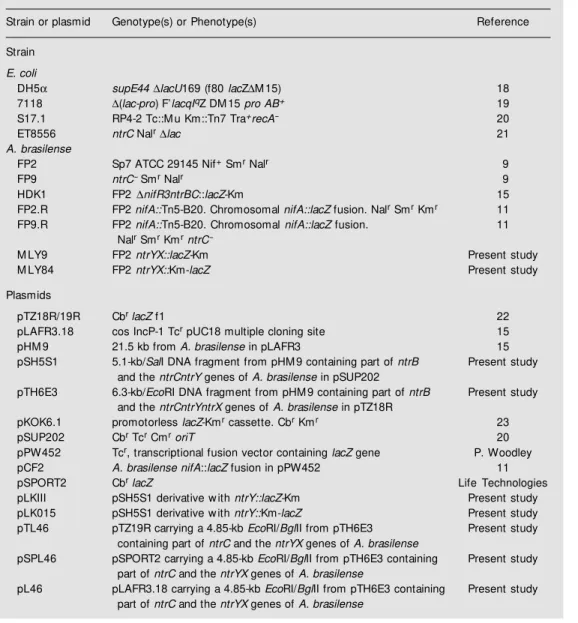
The bacterial strains and plasmids used in the present study are listed in Table 1.
Plasmid pTH6E3 was constructed by cloning an EcoRI fragment of 6.3 kb con-taining part of ntrB and the whole of ntrC,
ntrY and ntrX genes into pTZ18R. The 5.1-kb SalI fragment from pTH6E3 was subse-quently cloned into pSUP202, producing pSH5S1. The Km-lacZ cassette from pKOK6.1 was then inserted into the NsiI site of pSH5S1 in both orientations, producing plasmids pLKIII and pLK015 (Figure 1 and Table 1). To construct pL46 the 4.85-kb BglII/
EcoRI fragment from pTH6E3 was cloned into pLAFR3.18 digested with BamHI and
EcoRI (Table 1). In this construction, the
ntrC gene lacks its N-terminal region and its orientation of transcription is opposite to that of the lacZ promoter, and the ntrYX
Me dia and growth conditions
Escherichia coli was grown in Luria-Bertani medium (24) at 37ºC and 200 rpm. A. brasilense strains were grown at 30ºC in liquid or semi-solid NFbHPN medium (15). The an-tibiotics used were ampicillin (200 µg/ml), chloramphenicol (30 µg/ml), kanamycin (50 µg/ml), nalidixic acid (10 µg/ml), tetracycline (10 µg/ml), and streptomycin (100 µg/ml). Nitrate-dependent growth in A. brasilense was monitored in liquid NFbHPN medium con-taining 10 mM NaNO3 for 24 h at 30ºC.
Analytical assays
ß-Galactosidase activity was determined as described by Miller (25) in E. coli cultures grown in liquid NFDM (26). The nitrogen source was NH4Cl (20 mM) and serine (100 µg/ml) was added to cultures without ammo-nium. The NFDM medium was supplemented with 50 µg/ml L-glutamine and 1 mM IPTG.
A. brasilense cultures were grown in NFbHPN medium under conditions of am-monium deficiency (5 mM L-glutamate) or excess (20 mM NH4Cl).
Table 1. Bacterial strains and plasmids.
Strain or plasmid Genotype(s) or Phenotype(s) Reference
Strain
E. coli
DH5α supE44∆lacU169 (f80 lacZ∆M 15) 18
7118 ∆(lac-pro) F’lacqIqZ DM 15 pro AB+ 19
S17.1 RP4-2 Tc::M u Km::Tn7 Tra+recA- 20
ET8556 ntrC Nalr∆lac 21
A. brasilense
FP2 Sp7 ATCC 29145 Nif+ Smr Nalr 9
FP9 ntrC- Smr Nalr 9
HDK1 FP2 ∆nifR3ntrBC::lacZ-Km 15
FP2.R FP2 nifA::Tn5-B20. Chromosomal nifA::lacZ fusion. Nalr Smr Kmr 11
FP9.R FP2 nifA::Tn5-B20. Chromosomal nifA::lacZ fusion. 11
Nalr Smr KmrntrC
-M LY9 FP2 ntrYX::lacZ-Km Present study
M LY84 FP2 ntrYX::Km-lacZ Present study
Plasmids
pTZ18R/19R Cbr lacZ f1 22
pLAFR3.18 cos IncP-1 Tcr pUC18 multiple cloning site 15
pHM 9 21.5 kb from A. brasilense in pLAFR3 15
pSH5S1 5.1-kb/SalI DNA fragment from pHM 9 containing part of ntrB Present study and the ntrCntrY genes of A. brasilense in pSUP202
pTH6E3 6.3-kb/EcoRI DNA fragment from pHM 9 containing part of ntrB Present study
and the ntrCntrYntrX genes of A. brasilense in pTZ18R
pKOK6.1 promotorless lacZ-Kmr cassette. Cbr Kmr 23
pSUP202 Cbr Tcr CmroriT 20
pPW452 Tcr, transcriptional fusion vector containing lacZ gene P. Woodley
pCF2 A. brasilense nifA::lacZ fusion in pPW452 11
pSPORT2 Cbr lacZ Life Technologies
pLKIII pSH5S1 derivative w ith ntrY::lacZ-Km Present study
pLK015 pSH5S1 derivative w ith ntrY::Km-lacZ Present study
pTL46 pTZ19R carrying a 4.85-kb EcoRI/BglII from pTH6E3 Present study
containing part of ntrC and the ntrYX genes of A. brasilense
pSPL46 pSPORT2 carrying a 4.85-kb EcoRI/BglII from pTH6E3 containing Present study part of ntrC and the ntrYX genes of A. brasilense
DNA manipulations and se que ncing
Isolation of plasmid DNA, gel electro-phoresis and cloning experiments were car-ried out as described by Sambrook et al. (24). The 4.85-kb BglII/EcoRI fragment de-rived from pTH6E3, containing the A. brasi-lensentrYX genes, was cloned into the vec-tor pSPORT2 producing plasmid pSPL46 (Table 1). The inserted fragment was fully sequenced in both directions. Double-stranded DNA was sequenced with the Thermosequenase kit (Amersham Pharma-cia Biotech, Uppsala, Sweden) or the Big Dye kit (Applied Biosystems ABI 310
se-quencer, Foster City, CA, USA). The data-base was searched using the Blast program (27) and DNA or protein sequences were compared using the Clustal W program (28). The sequences of A. brasilense ntrY and
ntrX were deposited at the EMBL-GenBank under the accession number AF426449.
Re sults and D iscussion
Ide ntification and se que ncing of the
ntrYX ge ne s
The 4.85-kb insert of plasmid pSPL46 was fully sequenced and showed the
pres-pTH6E3
pSH5S1
pL46
ntrB ntrC ntrY ntrX lacZ
ES G 1.50 kb N S E
1.50 kb 4.85 kb
lacZ-Km
pLK015
pLKIII
3.65 kb 1.45 kb
ntrB ntrC ntrY
ntrC ntrY ntrX
lacZ
S G N S
G N S E
4.85 kb Figure 1. Genetic and physical
maps of the DNA region contain-ing the ntrBC/ntrYX genes of Azospirillum brasilense. The
vec-tors of plasmid pTH6E3, pSH5S1 and pL46 are pTZ18R, pSUP202 and pLAFR3.18, respectively. Vector maps are not show n. Plasm ids pLKIII and pLK015 w ere used to produce mutants M LY9 and M LY84, respectively, and contained the lacZ::Km
cas-sette inserted into the NsiI site
of ntrY in the direction indicated.
Restriction enzym es are: E,
EcoRI; G, BglII; N, NsiI, and S, SalI.
ence of two complete open reading frames (ORF1 and ORF2) downstream from the
nifR3ntrBC operon. ORF1 contains 2331 nucleotides plus the stop codon TGA, and has a high G + C content in the third base position (89.3%), characteristic of A. brasi-lense genes (29). The probable start codon was located 183 bp downstream from the
ntrC gene termination codon, with a poten-tial ribosome-binding site (GGA) 3 bp up-stream from the ATG initiation codon. This ORF1 translated into a hydrophobic
poly-peptide of 777 amino acids, with a high degree of identity with the NtrY protein of A. caulinodans (41%) and of C. crescentus
(40%).
Analysis of the A. brasilense NtrY pro-tein hydropathy graph (Figure 2), determined according to Kyte and Doolittle (30), re-vealed four hydrophobic regions in the N-terminus equivalent to the putative trans-membrane regions of A. caulinodans NtrY (1), and to those of the E. coli and Salmo-nella typhimurium chemoreceptor proteins
4
3
2
1
0
-1
-2
-3
-4
4
3
2
1
0
-1
-2
-3
-4
A
B
hydrophobic
hydrophilic
420 440 460 480 360 380 400
300 320 340 240 260 280
180 200 220 120 140 160
60 80 100 0 20 40
420 440 460 480 360 380 400
300 320 340 240 260 280
180 200 220 120 140 160
60 80 100 0 20 40
Figure 2. A, Hydrophobicity
graph of the N-terminal region of the NtrY proteins from Azo-rhizobium caulinodans (A;
EM BL-GeneBank accession number X63841) and from Azo-spirillum brasilense (B). Arrow s
indicate the equivalent putative transmembrane regions. The hydropathy profiles w ere deter-mined according to Kyte and Doolittle (30).
hydrophobic
A
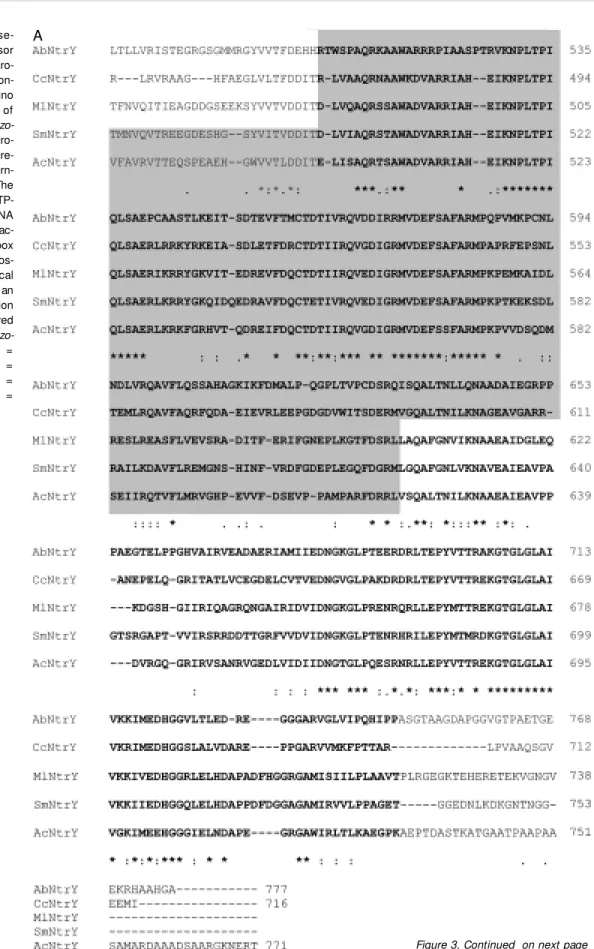
Figure 3. A, Amino acid se-quence comparison of sensor domains from different NtrY pro-teins. The sensor region is con-tained in the grey box. B, Amino acid sequence comparison of
Azospirillum brasilense and Azo-rhizobium caulinodans NtrX pro-teins. The boxes show the re-ceiver domain (a) and helix-turn-helix DNA-binding motif (d). The dotted boxes represent: ATP-binding site (underlined), RNA polymerase σ54 factor
interac-tion domain (c). The black box and the arrow indicate the phos-phorylation site (b). Identical amino acids are indicated by an asterisk, conserved substitution by a colon, and semi-conserved substitution by a dot. Ac = Azo-rhizobium caulinodans; Ab =
Azospirillum brasilense; Cc =
Caulobacter crescentus; Sm =
Sinorhizobium m elilot i; M l =
M esorhizobium loti.
B
a b
c
tein of A. brasilense, Asp 54 (14). The A. brasilense NtrX protein displays structural domains characteristic of the regulator part-ner of two-component regulatory systems, namely the receiver domain, the ATP-bind-ing catalytic domain, the RNA polymerase
σ54 factor interaction domain and the helix-turn-helix DNA-binding motif. The degree of identity of the receiver, ATP-binding and RNA polymerase σ54 factor interaction do-mains of the NtrX protein of A. brasilense
was on average 31%, while that of the helix-turn-helix DNA-binding motif was 89% to homologous proteins of A. caulinodans, C. crescentus, M. loti and S. meliloti. These data indicate that the ntrYX loci of A. brasi-lense may constitute a two-component regu-latory system in which NtrY could serve as a sensor and NtrX as a regulator protein.
A σ70-type promoter was identified 26 bp upstream from the start codon of NtrY (TTGGCA-N18-TATCAT). Machado et al. (15) sequenced the N-terminal region of NtrY downstream from the ntrC gene and reported constitutive promoter activity located in the intergenic region in an E. coli background. These results suggest that the ntrYX operon is expressed from its own promoter although readthrough from an upstream promoter can-not be ruled out due to the absence of a transcription terminator sequence down-stream from the ntrC gene.
Effe ct of the ntrYX ge ne products on the
e xpre ssion of an A. brasilensenifA fusion
in an E. coli mutant strain
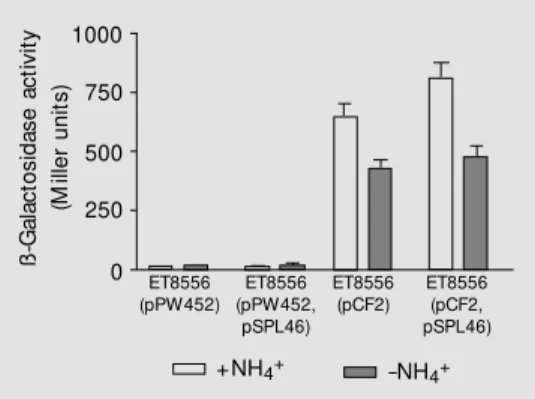
E. coli ET8556 (ntrC-) transformants con-taining plasmid pCF2 (A. brasilense pnifA:: lacZ fusion with its native promoter) alone or together with plasmid pSPL46 (A. brasi-lensentrYX genes expressed from their own promoter) were assayed for ß-galactosidase activity, under conditions of ammonium de-ficiency or excess. The results showed that the presence of the ntrYX genes had no effect on the expression of thepnifA::lacZ (pCF2)
Table 2. Effect of ntrYX genes on the expression of chromosomal nifA::lacZ fusions in
Azospirillum brasilense strains.
Strain and plasmid ß-Galactosidase activity (M iller units)
20 mM NH4Cl 5 mM L-glutamate
FP2 (w ild type) 1.6 ± 0.4 2.8 ± 0.3
FP9 (ntrC mutant) 1.1 ± 0.1 2.1 ± 0.2
FP2.R (nifA::lacZ chromosomal) 50.6 ± 3.9 144.0 ± 7.2
FP2.R (pL46) 56.8 ± 4.3 174.7 ± 19.1
FP9.R (ntrC, nifA::lacZ chromosomal) 50.9 ± 6.9 140.6 ± 28.1
FP9.R (pL46) 81.9 ± 6.9 163.3 ± 11.0
Cultures w ere grow n in liquid NFbHPN medium in the presence (20 mM ) or absence of NH4Cl, for 24 h. L-glutamate (5 mM ) w as added to cultures grow n in the absence of
NH4Cl. Expression of the nifA::lacZ chromosomal fusion w as determined by ß-galac-tosidase activity. The results are the average of three independent experiments run in duplicate ± SD.
(31,32). The C-terminus of the A. brasilense
NtrY protein (Figure 3A) showed a high degree of identity (35%) with the conserved C-termini of homologous proteins from A. caulinodans, C. crescentus, M. loti and S. meliloti.
ORF2 encoded a 466-amino acid protein with a high degree of identity (52%) to A. caulinodans NtrX (Figure 3B), and a lower identity (32%) to NtrC proteins of other organisms including A. brasilense. The as-partic acid residue at position 53 in the A. brasilense NtrX is probably the site of phos-phorylation, since it is conserved in all NtrX proteins (Figure 3B). This site is equivalent to the phosphorylation site of the NtrC
pro-ß -G al ac to si da se a ct iv ity (M ill er u ni ts ) 1000 750 500 250 0 ET8556 (pPW452) ET8556 (pPW452, pSPL46) ET8556 (pCF2) ET8556 (pCF2, pSPL46)
+NH4+ -NH4+
Figure 4. Expression of the nifA
promoter in the presence of the NtrY/NtrX proteins in an ntrC
-Escherichia coli strain ET8556. The cultures w ere grow n for 24 h in NFDM minimal medium. The nitrogen source w as NH4Cl (20
fusion (Figure 4), suggesting that the NtrY/ NtrX proteins are not involved in the expres-sion of the nifA promoter in A. brasilense
(Figure 4). Previous results showed that there is an active promoter immediately upstream from the ntrY gene (15).
Effe ct of ntrYX ge ne s on the e xpre ssion
of chromosomal nifA::lacZ fusions in
A. brasilense strains
A. brasilense FP2.R (nifA::lacZ) and FP9.R (ntrC, nifA::lacZ) transconjugants containing pL46 (ntrYX expressed from its own promoter) were grown under condi-tions of ammonium deficiency or excess, and assayed for ß-galactosidase activity. No effect of the ntrYX genes was observed in either of the Azospirillum strains (Table 2), consistent with the results for the E. coli
ET8556 background. The data suggested that the NtrY/NtrX pair has no effect on the expression of the nifA promoter in A. brasi-lense. The function for this regulatory pair in this organismis different from the proposed involvement in nitrogen metabolism in A. caulinodans (1). Our findings agree with those of Kaminski and Elmerich (33) who disputed the functions ascribed to the NtrY/ NtrX proteins of A. caulinodans by Pawlowski et al. (1).
Atte mpts to construct ntrY mutants of
A. brasilense
Plasmids carrying Km cassette insertions in the ntrY genes in both orientations were constructed (Figure 1; Table 1). The wild-type A. brasilense strain FP2 was transformed with plasmids pLKIII and pLK015 in sepa-rate experiments and plated onto a selective medium containing kanamycin plus ammo-nium chloride (20 mM) to isolate ntrY mu-tants. Transformants resistant to kanamycin and sensitive to chloramphenicol (MLY9 and MLY84, respectively), indicating that the mutated gene had recombined into the
chromosome by double-crossover events, were isolated and analyzed by hybridization. The hybridization results (data not shown) showed that the Km cassette was inserted into the chromosome of these mutants, how-ever, at a site different from the ntrY gene. These results were surprising since this method of mutagenesis had previously yielded ntrBC mutants of A. brasilense (15). The reasons for our failure to obtain A. bra-silense ntrY or ntrX mutantsare not known. It is possible that NtrY and/or NtrX have pleiotropic effects affecting metabolic path-ways involved in cell survival.
The ntrYX ge ne s comple me nt the Nar
-phenotype of an A. brasilense nifR3ntrBC
m utant
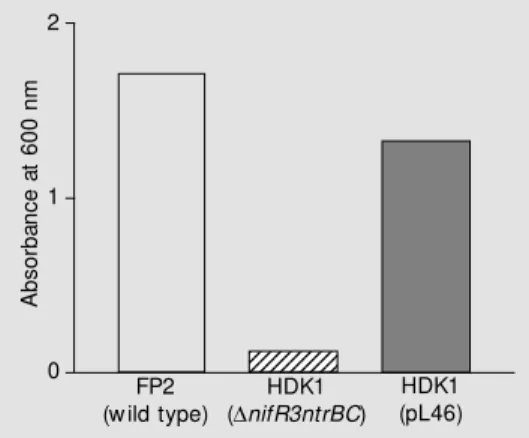
The A. brasilense nifR3ntrBC deletion mutant (HDK1) failed to grow on nitrate as sole nitrogen source and was complemented by the ntrBC genes (15). The same mutant HDK1 was complemented for nitrate-de-pendent growth by the A.brasilense ntrYX
genes carried by plasmid pL46 (Figure 5). Taken together, these results corroborate pre-vious observations that suggested that in A. brasilense the ntrYX pair was interchange-able with the ntrBC pair with respect to nitrate-dependent growth (34).
In this study, we sequenced and identi-fied the ntrYX genes asa second two-compo-nent system in A. brasilense. The A.
brasi-Figure 5. Complementation of the Nar- phenotype of an Azo-spirillum brasilense nifR3ntrBC
mutant. The cultures w ere incu-bated for 24 h in liquid NFbHPN medium w ith 10 mM NaNO3 as
the sole nitrogen source. Ni-trate-dependent grow th w as de-termined by absorbance of the culture at 600 nm. The results are from a representative experi-ment.
A
bs
or
ba
nc
e
at
6
00
n
m
2
1
0
FP2 (w ild type)
HDK1 (∆nifR3ntrBC)
HDK1 (pL46)
Re fe re nce s
1. Paw low ski K, Klosse U & De Bruijin FJ (1991). Characterization of a novel Azorhi-zobium caulinodans ORS571 tw o-compo-nent regulatory system, NtrY/NtrX, in-volved in nitrogen fixation and metabo-lism. M olecular and General Genetics, 231: 124-138.
2. M eletzus D, Zellermann E-M & Kennedy C (1998). Identification and characteriza-tion of the ntrcBC and ntrYX genes in
Acetobacter diazotrophicus. In: Elmerich C, Kondorosi A & New ton WE (Editors),
Biological Nitrogen Fixation for the 21st Century. Kluw er Academic Publishers, Dordrecht, The Netherlands, 125-126. 3. Nierman WC, Feldblyum TV, Laub M T et
al. (2001). Complete genome sequence of Caulobacter crescentus. Proceedings of the National Academy of Sciences, USA, 98: 4136-4141.
4. Capela D, Barloy-Hubler F, Gouzy J et al. (2001). Analysis of the chromosome se-quence of the legume symbiont Sinorhi-zobium meliloti strain 1021. Proceedings of the National Academy of Sciences, USA, 98: 9877-9882.
5. Kaneko T, Nakamura Y, Sato S et al. (2000). Complete genome structure of the nit rogen-f ixing sym biot ic bact erium
M esorhizobium loti. DNA Research, 7: 331-338.
6. Andersson SG, Zomorodipour A, Anders-son JO, Sicheritz-Ponten T, Alsmark UC, Podow ski RM , Naslund AK, Eriksson AS, Winkler HH & Kurland CG (1998). The genome sequence of Rickettsia prow a-zekii and the origin of mitochondria. Na-ture, 396: 133-140.
7. Tettelin H, Saunders NJ, Heidelberg J et al. (2000). Complete genome sequence of Neisseria meningitidis serogroup B strain M C58. Science, 287: 1809-1815. 8. Lee HJ & Kang HS (1999). Sequence
anal-ysis of 42B11 fosmid clone of Zymomo-nas mobilis ZM 4. EM BL-GenBank
data-base protein accession No. AAD53895 at <hhtp://w w w .ncbi.nlm.nih.gov/> 9. Pedrosa FO & Yates M G (1984).
Regula-tion of nitrogen fixaRegula-tion (nif) genes of Azo-spirillum brasilense by nifA and ntrC
(glnG) type genes. FEM S M icrobiology Letters, 23: 95-101.
10. Liang YY, Kaminski PA & Elmerich C (1991). Identification of a nifA-like regula-tory gene of a Azospirillum brasilense Sp7
expressed under conditions of nitrogen fixation and in the presence of air and ammonia. M olecular M icrobiology, 5:
2735-2744.
11. Fadel-Picheth CM T, Souza EM , Rigo LU, Funayama S, Yates M G & Pedrosa FO (1999). Regulation of Azospirillum brasi-lense nifA gene expression by ammonium
and oxygen. FEM S M icrobiology Letters,
179: 281-288.
12. Liang YY, De Zamarocky M , Àrsene F, Pasquelin A & Elmerich C (1992). Regula-tion of nitrogen fixaRegula-tion in Azospirillum brasilense Sp7: involvement of nifA, glnA
and glnB gene products. FEM S M icrobiol-ogy Letters, 100: 113-120.
13. Àrsene F, Kaminski PA & Elmerich C (1996). M odulation of NifA activity by PII
in Azospirillum brasilense: Evidence for a regulatory role of the NifA N-terminal do-main. Journal of Bacteriology, 178: 4830-4838.
14. Liang YY, Àrsene F & Elmerich C (1993). Characterization of the ntrBC genes of
Azospirillum brasilense Sp7: their involve-ment in the regulation of nitrogenase syn-thesis and activity. M olecular and General Genetics, 240: 188-196.
15. M achado HB, Yates M G, Funayama S, Rigo LU, Steffens M BR, Souza EM & Pe-drosa FO (1995). The ntrBC genes of Azo-spirillum brasilense are part of a nifR3 -like-ntrB-ntrC operon and are negatively regulated. Canadian Journal of M icrobiol-ogy, 41: 674-684.
16. Zhang Y, Burris RH, Ludden PW & Rob-erts GP (1994). Posttranslation regulation of nitrogenase activity in Azospirillum bra-silense ntrBC mutants: ammonium and anaerobic sw itch-off occurs through inde-pendent signal transduction pathw ays.
Journal of Bacteriology, 176: 5780-5787. 17. Van Dommelen A, Keijers V,
Vanderley-den J & De Zamaroczy M (1998). (M ethyl) ammonium transport in the nitrogen-fix-ing bacterium Azospirillum brasilense. Journal of Bacteriology, 180: 2652-2659. 18. Hanahan D (1983). Transformation of
Escherichia coli w ith plasmids. Journal of M olecular Biology, 166: 557-580. 19. M essing J, Gronenborn B, M uller-Hill B &
Hopschneider PH (1977). Filamentous coliphage M 13 as a cloning vehicle: inser-tion of a HindII fragment of the lac
regula-tory region in M 13 replicative form in vi-tro. Proceedings of the National Academy of Sciences, USA, 74: 3642-3646.
20. Simon R, Prieffer U & Puhler A (1983). A broad host range mobilization system for
in vitro genetic engineering: transposon mutagenesis in Gram-negative bacteria.
BioTechnology, 1: 784-791.
21. M acNeil T, Roberts GP, M acNeil D & Tyler B (1982). The products of glnL and glnG
are bifunctional regulatory proteins. M o-lecular and General Genetics, 188: 325-333.
22. M ead DA, Szczesna-Skoropa E & Kemper B (1986). Single-stranded DNA “ blue” T7 promoter plasmid: a versatile tandem pro-moter system for cloning and protein en-gineering. Protein Engineering, 1: 67-74. 23. Kokotek W & Lotz W (1989). Construction
of a lacZ-kanamycin-resistance cassete, useful for site-directed mutagenesis and as a promoter probe. Gene, 84: 467-471. 24. Sambrook J, Fritsch EF & M aniatis T (1989). M olecular Cloning: A Laboratory M anual. 2nd edn. Cold Spring Harbor Laboratory, New York, NY, USA.
lense NtrY protein contains probable trans-membrane segments located in its N-termi-nus and may be involved in sensing the extracellular nitrogen concentration. The NtrX protein is suggested to be a transcrip-tional activator of alternative nitrogen as-similation pathways such as nitrate in A. brasilense. The ntrYX genes, similar to the
nifR3ntrBC operon, are apparently not re-quired for the expression of the nifA gene in
A. brasilense (11,14,15).
Ackno wle dgm e nts
25. M iller JH (1992). A Short Course in Bacte-rial Genetics: A Laboratory M anual and Handbook for Escherichia coli and Related Bacteria. Cold Spring Harbor Laboratory Press, New York, NY, USA.
26. Dixon R, Kennedy C, Kondorosi A, Krishnapillai V & M errick M (1977). Complementation analysis of Klebsiella pneumoniae mutants defective in nitro-gen fixation. M olecular and General Ge-netics, 29: 189-198.
27. Altschul SF, M adden TL, Schäffer AA, Zhang J, Zhang Z, M iller W & Lipman DJ (1997). Gapped BLAST and PSI-BLAST: a new generation of protein database search programs. Nucleic Acids Research,
25: 3389-3402.
28. Thompson JD, Higgins DG & Gibson TJ (1994). CLUSTAL W: improving the
sensi-tivity of progressive multiple sequence alignment through sequence w eighting, position-specific gap penalties and w eight matrix choice. Nucleic Acids Research, 22: 4673-4680.
29. Fani R, Allota G, Bazzicalupo M , Ricci F, Schipani C & Polsinelli M (1989). Nucleo-tide sequence of the gene encoding the nitrogenase iron protein (nifH) of Azospi-rillum brasilense and identification of a region controlling nifH transcription. M o-lecular and General Genetics, 220: 81-89. 30. Kyte J & Doolittle RF (1982). A simple method for displaying the hydropathic character of a protein. Journal of M olecu-lar Biology, 157: 105-142.
31. Krikos A, M utoh N, Boyd A & Simon M I (1983). Sensory transducers of Esche-richiacoli are composed of discrete
struc-tural and functional domains. Cell, 33: 615-622.
32. Russo AF & Koshland DE (1983). Separa-tion of signal transducSepara-tion and adaptaSepara-tion functions of the aspartate receptor in bac-terial sensing. Science, 220: 1016-1020. 33. Kaminski PA & Elmerich C (1998). The
control of Azorhizobium caulinodansnifA
expression by oxygen, ammonia and by the HF-I-like protein, NrfA. M olecular M i-crobiology, 28: 603-613.
34. Vitorino JC, Steffens M BR, M achado HB, Yates M G, Souza EM & Pedrosa FO (2001). Potential roles for the glnB and
ntrYX genes in Azospirillum brasilense.
FEM S M icrobiology Letters, 201: