2
Perspective as a Cross-genre Tendency in
3
Experimental Music
4 Q 1 R I C C A R D O W A N K E
5 Centre for the Study of the Sociology and Aesthetics of Music–CESEM, Faculdade de Ciências Sociais e Humanas, Universidade Nova de 6 Lisboa, Av. de Berna, 26 C, 1069-061 Lisbon, Portugal
7 Email: [email protected]
8 This article proposes a perspective on certain practices within 9 experimental music based on a particular understanding 10 of sonic materialism. By tracing correlations and marking 11 divergences between post-spectralism, minimalism, electro-12 acoustic music, glitch and IDM’s offshoots, this article reflects 13 onsound-in-itself, the conception of space and time in music, 14 poietics, perceptual and cultural factors, and suggests that 15 there is a particular understanding of sonic materialism–
16 which I termecstatic-materialism–that is rooted in a synthesis 17 of perception, theory and embodied actions.
18 This perspective explores a new expressivity of sound in 19 which the sound itself is the point of convergence for creative 20 impulses and perceptual motives, sound being the common 21 territory between composer and listener. By developing the 22 idea of an ecstatic-sonic-materialism, various works across 23 different genres can be brought together according to this 24 mutual convergence on sound that embodies acoustic proper-25 ties, intimate traces, external and corporeal experiences.
26 1. INTRODUCTION
27 Compositional and perceptual studies have recently 28 tended to absorb all conventional parameters of music, 29 such as timbre, harmony, noise and spectrum, into a 30 detailed but unified understanding ofsound(Solomos 31 2013). Musical compositions are being conceived, 32 performed and perceived by approaching the sound
33 world as a complex whole rather than as an area
34 having distinct and separately structured dimensions. 35 A number of theoretical and creative works propose 36 a description of a sonic materialism in which the 37 attention moves towards sound-in-itself. Philosopher
38 Christoph Cox has animated the debate on the
39 materiality of sound, discussing a new theoretical stage 40 capable of going beyond representation and signifi
ca-41 tion (Cox 2011). The composer Fausto Romitelli has 42 insisted on the need to include materiality in musical 43 practices: these activities should be enriched by the 44 contribution of practical experience in order to
45 develop a complex organism with a metabolism,
46 carnality, density, thickness and grain character 47 (Romitelli 2001). Döbereiner, criticising the idea of a
48
living character of sound, claims that sound-in-itself is
49
accessible only through composition, and that the
50
materiality of sound belongs neither to the subject
51
nor to the object but remains in compositional
52
practices ‘as material (re)configurings of the world’ 53
(Döbereiner 2014).
54
I recently proposed a sonic correlation between
55
contemporary instrumental and post-spectralist pieces
56
and several offshoots of glitch-electronic and IDM
57
(Wanke 2015). I believe these convergences have to do
58
with a common focus on the sound-in-itself, providing
59
access to a sonic materialism from different directions.
60
Correspondences between figures such as Georg
61
Friedrich Haas, Giovanni Verrando and Bernhard
62
Lang, and performers coming from independent scenes
63
such as Pan Sonic, Autechre and Raime concern a
64
common focus on the sound-in-itself and its intrinsic
65
characteristics and show similar choices such as the use
66
of complex spectra and periodic movements within
67
globally rich and sculptural textures (Wanke 2015).
68
The sound, continuous or discrete, is conceived as
69
a dense, tactile and three-dimensional matter that is
70
moulded as if it were a physical substance. This idea of
71
sound, which recalls Scelsi’s definition of spherical 72
sound (Scelsi 2006), touches both stable materialist
73
and unstable ecstatic concepts in an apparent
self-74
contradiction. Scelsi’s sound is profound and vibrant; 75
it is typical of an exploration of the inner extent of
76
sound itself, but is also characterised by its being
77
intuitive and enigmatic as an almost mystical material.
78
It behaves as if it were a living entity, typical of
79
its nature, it is concrete (i.e. material) yet unstable
80
(i.e. ecstatic).
81
This cross-genre viewpoint that I call the
ecstatic-82
materialist (E-M) perspective is defined by specific
83
musical characteristics. Some of them coincide with
84
the main concepts expressed by spectralism,
mini-85
malism and musique concrète, while others emerge as
86
typical only of this multi-genre perspective, marking it
87
out within the variegated panorama of today’s music. 88
By discussing these characteristics, that is, the
materi-89
alist approach to sound, the conception of time and
90 space, and the compositional and perceptual aspects, 91 this article postulates the presence of an ecstatic-92 materialist domain by evidencing similarities among 93 distant currents and disclosing crucial differences 94 between contiguous styles.1
95 2. THE ECSTATIC-MATERIALIST
96 PERSPECTIVE
97 Abraham Moles, in his seminal book on information 98 theory (Moles 1968), presents two different theories 99 that describe our perception of the external world: the 100 theory of scanning and the theory of form. Thefirst 101 asserts that perception derives a message from the 102 scanning of various distinct elements, perceiving them 103 as a collection of separate elements, while the theory of 104 form states that the message arrives as a unified form– 105 a series of elements perceived as a whole unit and not 106 as a collection. Moles shows different possible synth-107 eses of these theories, but this dual representation is 108 useful in making clear crucial aspects of the ecstatic-109 materialist perspective.
110 Certain practices within electroacoustic music2 111 conceive the structuring of a piece in a way that 112 appears comparable to the theory of scanning. These 113 methods proceed from a conception of various 114 elements, mainly differentiated by their morphology, 115 to acomposingof a complex combination. A theory of 116 a morphology of sounds has been developed not only 117 for academic studies but also within the fields of 118 perception and composition (Smalley 1997). Typo-119 and spectro-morphologies open up to processes based 120 on articulation and construction using distinct sonic 121 elements in collections.
122 In contrast, the E-M approach embodies the theory 123 of form. Compositional methods as well as perceptual 124 approaches are integrated processes in which compo-125 ser and listener search for a unified sonic matter. The 126 composer creates the sound as a single entity to be 127 developed. There is often an intentional limitation of 128 the sonic material and the music does not progress 129 according to a functional design. Listeners approach 130 the sound perceiving a single body that evolves. Sound 131 is then a form conceived and appreciated as a whole 132 and explored through its complex characteristics.
133
In addition to this parallel with the theory of form,
134
the dual vision of thisecstatic-materialismrests mainly
135
on a particular conception of sound and its positioning
136
as the locus of convergence of composer and listener
137
within various frameworks and contexts.
138
It is amaterialismbecause both author and listener
139
within this perspective intend to explore the substance
140
of sound-in-itself, its consistency and presence, to
141
confront dense masses and examine the constitutive
142
elements of raw sonic matter. Materialist sound serves
143
itself, but in embracing subjective experiences and
144
extra-musical elements as part of the listening and
145
creative processes it calls to a reality and carnality
146
that it conveys through the expressivity of pure sound.
147
Furthermore, it is an ecstatic materialism: for the
148
composer, this refers to the unstable, ephemeral and
149
personal nature of sound, its liminal aural
characteri-150
stics and its intimate relation with time and evolution;
151
E-M sound is to be understood as not just a sonic
152
substance but also as an unstable and transitory
153
experience. For the listener, ecstatic concerns the
154
liberty to move within the intrinsic characteristics of
155
sound: to freely associate insights,fleeting impressions
156
and to penetrate an author’s sense of sound.
157
Sound is the common ground between creator and
158
recipient in which the vital impact of raw sound and its
159
intimate temporality and spaciousness incorporate the
160
extra-musical and bodily aspects. Therefore, sound is
161
both tangible, as physical material, and volatile, due
162
to its ephemeral behavior in perception.
163
With the E-M perspective, the vision of music that
164
claims an impersonal and scientific investigation of
165
and approach to sound, detached from everyday life
166
and ‘purified’ from extra-sonic traits, is left behind.
167
Composers that fall within the E-M perspective convey
168
elements of practical experience (Romitelli, Pan Sonic)
169
and intimate discovery (Grisey, Scelsi) through sonic
170
possibilities so that their music, even if it is founded
171
mainly on research into purely sonic aspects and
172
maintains a dramaturgy and a personal touch.
173
Listeners, each within their own context, are engaged
174
in a rich listening experience, free in their
interpreta-175
tions and sensations: they are faced with pure aural
176
stimuli and, as a result of a specific cultural and
aes-177
thetic framework of communication, they get involved
178
in intuitions and personal exchanges. Perception is far
179
from normalised and automated, it is a captivating and
180
inclusive sonic engagement that unfolds as an open,
181
personal, unique and thoroughly involved
participa-182
tion, as a synthesis of temporary feelings and
183
sociocultural habits.
184
In presenting a series of examples from contemporary
185
instrumental music, post-spectralism, minimalism
186
and electronic-glitch, I delineate this cross-genre E-M
187
perspective by focusing on musical perception and
188
conception, aural references, and extra-musical content,
189
showing that several details frequently overlap, being 1It is worth clarifying that the aesthetic and musical perspectives
from various contexts examined in this article represent extreme cases of a panorama in which many more moderate stances exist. Taking polarised examples helps in demonstrating clear differences and key details.
2The term‘electroacoustic’is a
190 essentially part of a single transversal vision of sound 191 across several currents of today’s music, and belonging 192 to both composer and listener.
193 3. SOUND
194 Some practices within electroacoustic music, that is, 195 those coming out of musique concrète, acousmatic 196 music and sonic art, have started from the concept of
197 reduced listening and have gradually moved towards
198 the inclusion of several mimetic aspects (Emmerson 199 1986; Landy 2007) whilst still drawing on the Schaef-200 ferian definition of ‘sound object’. Some composers 201 and scholars have criticised and developed this concept 202 into that of ‘event’ or‘image’, enhancing the debate
203 around phenomenology (Bayle 1989; Kim-Cohen
204 2009; Voegelin 2010; O’Callaghan 2010; Bonnet 205 2012), but still the legacy of musique concrète has led 206 to a particular aesthetic and musical syntax. From a 207 very general point of view, this aesthetic is grounded 208 in the idea of composing the sound (composer,
209 développer), creating a number of finite aural events
210 combined together according to their morphology 211 to constitute complex sonic arrangements. Horacio 212 Vaggione states:‘[t]he compositional, it seems to me, 213 would be anything but articulable.… To compose is 214 then equivalent to generating genuinely singular events
215 and articulating them in larger and larger groups
216 without losing the sense of these singularities’(Vaggione 217 1998: 154; italics in original).3
218 The parallel with Moles’s theory of scanning lies 219 exactly in the‘sense of these singularities’: pieces are 220 built from units and elaborated through functional 221 relationships that are operational within different 222 domains (e.g. spectral, dynamic, temporal or spatial). 223 This approach reaches a significant complexity of 224 musical syntax that is intended to be perceived as an 225 interconnected structure, a kind of language. Sound 226 here is complex, elaborated, sometimes deceptive and 227 ambiguous, multifaceted and to some extent functional 228 and representational. Electroacoustic composers, such 229 as Bernard Parmegiani and Denis Smalley, compose 230 sonic events and arrange them in terms of relations, 231 successions and differences.
232 On the other hand, within the E-M perspective
233 I am considering, sound is not composed (composé, 234 développé), it isposed(posé,déployé). I emphasise here 235 the double parallelism, highlighted in the case of Scelsi 236 and spectral music (cf. Murail and Bériachvili), 237 between composing and posing(or de-posing) on the
238 one hand, and between developing and deploying
239 (arraying) on the other. Sound is created and left to
240
unfold: the author conceives a unique form and
241
proceeds to discover and disclose it (Grisey 2008;
242
Ferguson 2007: 117). Sound, then, evolves and
243
assumes organic characteristics (Bériachvili 2008).
244
Even in the case of electronic music, for instance in
245
some pieces by Pan Sonic, sound is natural,
246
primordial, ancestral and instinctive. Mika Vainio and
247
Ilpo Väisänen’s sound is raw, radical, textural and 248
material, whether it is continuous or discrete. They
249
shape a sound, manipulating its spectral range, partials
250
and dynamics to achieve a sonic material that has a
251
physical impact on the ear. They frequently exploit
252
acoustic interferences based on the exploration of the
253
auditory phenomenon of critical bands and, due to the
254
pervasive effect of aural beatings, their sound gives the
255
sensation that a concrete imprint has been left behind.
256
These characteristics are typical of continuous musical
257
episodes made up of sustained and overlapping tones
258
that build as a kind of material thickening, layering
259
up in perception.
260
When discrete sounds are employed, each piece (or
261
episode) within the E-M perspective proceeds by
deve-262
loping families of sounds in such a way as to create an
263
internal natural coherence in which each aspect is part of
264
an integrated form. The tendency ofconvergenceis often
265
present: different sonic events balance each other,
266
occasionally recur (periodically or not) and do not
267
progress as a fast succession of many different sound
268
types. It is common tofind a couple of elements that are
269
continuously repeated and that work as a support for
270
other discrete elements, strengthening the musicalflow,
271
as in the case of IDM artists such as Pole (Stefan Betke)
272
and Peder Mannenfeld. In general, the repetition of
273
sound elements, both continuous and discrete, could be
274
rhythmic (e.g. IDM, glitch), hypnotic, cyclic (e.g. drone
275
music, spectralism) or sporadic (e.g. glitch).
276
The concept of sound in E-M pieces is far from being
277
that of an immutable entity; sound could exist as
278
continuous or discrete episodes, but as an organic
sub-279
stance it forms, thickens and changes even whilst being
280
always present–sound isposedand its presence is almost 281
atemporal, yet it continues to change. Sound could be
282
absent but its essence could still be perceptible,
expand-283
ing the present out to the horizons of linear perception
284
(Bergson 1998), as Solomos perceptively describes in the
285
case of Scelsi’s String Quartet no 4 (1964):‘not only do 286
I hear things at every listening, moreover, it is always
287
difficult for me to know if what I hear (or believe to hear)
288
is “there”(in the score or in the recording) or whether 289
I imagine it’(Solomos 2013: 261).4This appreciation of 290
what I term the ecstaticcombines the eternal and the
291
temporary, an eternity contained in an instant with
292
impressions that are temporary:‘the D chord appears set
3‘Le composable, à ce qu’il me semble, ne serait autre chose que l’articulable. … Composer équivaut donc à générer de véritables évènements singuliers et à les articuler dans des ensembles de plus en plus grands sans perdre le sens de ces singularités’(my translation).
293 for eternity. But it is a light eternity, as if suspended: 294 some ears will never perceive this chord, because it is 295 constantly subject to interference, worked upon by 296 unfamiliar notes’(Solomos 2013: 263).5Within this E-M 297 perspective, sound is simultaneously permanent (i.e. 298 material) and ephemeral (i.e. ecstatic).
299 The distinction I made earlier between posing and 300 composingsound could be related to the epistemological 301 debate between the intuitive and the axiomatic posi-302 tions, in which the former is generally ascribed to Cage’s 303 idea of‘leaving the sound to be’while the latter asserts 304 the poietic intention to compose the sound (e.g. 305 Xenakis) (Solomos 2013: 355). However, within the 306 E-M outlook, the presence and the intention of the 307 author are essential aspects; pieces such as the String 308 Quartet no 2 of Haas or Pan Sonic’sKeskeisvoimareflect 309 this characteristic (Verrando 2012: 195; Wanke 2015): 310 these composers impose embodied movements onto 311 the music, such as attacks, contrasts, vibrations, inter-312 ferences; such that the impression given is of a material 313 that is far from being autonomous or self-developing. 314 The sound artist Richard Chartier examines min-315 uscule, unprocessed, ‘nonreferential and precultural’ 316 sonic elements (Demers 2010: 76) whose nature is 317 so impersonal and neutral that they appear to some 318 degree distant. In exploring the inaudible and micro-319 sonic world, Chartier sometimes appears to reach 320 the coldness of scientific objectivity that sets his work 321 slightly apart from the perspective that I propose. 322 Within the E-M thinking, the author manipulates and 323 engraves the sound, signalling its presence in a way that 324 makes the sound vibrant and vivid even during slow 325 evolutions. For example, in an apparently similar way 326 to Chartier, Eliane Radigue, inTrilogie De La Mort, 327 creates extremely gradual transformations of almost 328 static blocks of sound that hold a sort of internal reso-329 nance and movement, describing linear and curved 330 fluctuations that seem to mimic human breathing. 331 The authors that exemplify the E-M perspective 332 forge a quasi-permanent sound; handling frequencies, 333 noises, dynamic contrasts as well as fluctuating and 334 enveloping textures, they explore the instability of 335 sound from liminal aspects (spectralists) to inter-336 ferences and collisions (glitch music) in a way that 337 allows the music to pass through transitory moments 338 and explore imperceptible flaws and illusory rifts of 339 sound, evolving within a personal timeflow.
340 4. TIME
341 Time in music has always been a fundamental subject 342 in compositional, perceptual and theoretical studies. 343 This dimension has taken on a great importance in the
344
last century, during which some composers renewed
345
the seemingly primordial role of sustained and
346
continuous sounds (e.g. Xenakis, Ligeti, Scelsi,
347
Grisey), and others studied the effect of repetitive
348
structures (e.g. minimalists).
349
Temporality in spectralism and minimalism has
350
been explored through the use of repetitive structures
351
creating hypnotic reiterations, periodic profiles or
352
continuous shapes. One could associate these figures
353
with the idea of flat evolutions where, based on
354
Kramer’s definitions (Kramer 1988), the concepts of
355
linearity and verticality of time lie more with the
356
perception of music over time than with the shape
357
of musical episodes themselves. He then associates
358
minimalist and spectralist visions of time with the
359
concept of‘verticality’(Kramer 1988: 55).
360
Kramer’s definition is very useful for a general
361
distinction, but some terms of his exposition do not
362
work properly in many cases (Bériachvili 2010: 100). In
363
particular, the parallel between the lack of teleology
364
and the absence of organisation and hierarchy does not
365
always hold. Many works of spectralism and
minim-366
alism contain long musical passages that are
sub-367
stantially undifferentiated, but their development
368
follows a strong dramaturgy creating musical forms
369
that are ordered and organised.
370
There is a substantial, continuous gradation from
371
pure linearity to extreme examples of verticality in
372
music.6 Within this range, many composers utilise
373
repetition as a means of playing with a listener’s
374
perception, and so it seems important to reconsider the
375
meaning of adjectives such as linear, narrative, cyclic
376
or teleological. Scelsi’s Quattro Pezzi, for example,
377
shows a sense of dramatic construction (such as the
378 ‘tension/resolution’ schema) typical of the Western
379
musical tradition together with unconventional sonic
380
metres commonly found in Eastern practices
381
(Menesson 2008). Despite Kramer’s idea, there is in
382
this piece a sort of expectation and structural
hier-383
archy, the musical time is not linear but a progression
384
of sound flow is discernible. There is a narrative but
385
not a teleological profile (i.e. directionality): the
lis-386
tener is absorbed (or immersed) into a sonicdiscourse.
387
In the case of the more recent in vain by Georg
388
Friedrich Haas, musical time (and consequently the
389
listener) moves at different rates: the succession
390
of episodes with diverse profiles (e.g. circular, flat,
391
accelerating), each one composed of repeated motifs,
392
opens up to different temporalities and therefore to
393
different perceptual dimensions.
394
I argue that authors such as Grisey, Scelsi, Radigue
395
and Haas belong to the E-M vision and explore an idea
396
of time that is internal and organic, intimate and vital.
5‘l’accord de ré semble se
fixer pour l’éternité. Mais c’est une éternité légère, comme en suspens: certaines oreilles n’entendront jamais cet accord, car il est sans cesse parasité, travaillé par des notes étran-gères’(my translation).
397 Bériachvili talks about the breath and the vibration of 398 Scelsi’s sound, and Scelsi himself talked about the 399 ‘right sound’(suono giusto) that needs the right time to 400 develop. Grisey founded his research on Bergson’s 401 notion of duration (durée), in which the music is an 402 expression of time and the musical material is a mani-403 festation of pure duration (son-durée). Music is an 404 organicprocessin which the sound is an‘être vivant’, 405 notfixed but ever becoming (Solomos 2003). Bergson’s 406 inner time cannot be expressed as a line, and in 407 Grisey’s music this idea of innermost time is realised 408 through a distortion of a sound’s perspective (Hervé 409 2004) and through the process of revealing: from 410 human dimension (microphonic) towards universal
411 dimension (macrophonic).
412 In discussing these dualities, between personal/ 413 universal and subjective/objective, an interesting 414 parallel between Xenakis and Grisey reveals that 415 these two composers similarly capture the emergence 416 of sound through ‘fullness’ and ‘presence’ (Solomos 417 2003). Their musicalfigures leave nothing behind; their
418 compositions reject absence and are characterised 419 by a continuity of matter and fusion of components 420 (cf. Moles’s theory of form) that achieves a unique 421 presence (‘un art de la présence’; Solomos 2003).
422 Sound in the music of Scelsi (from 1959) is
423 concerned with a personal journey and an internal 424 sense of time: the music of the Italian composer holds a 425 sort of ‘warm’ and gravitational centre (Scelsi 2006: 426 145; Bériachvili 2008; Solomos 2012). This concept 427 of Scelsi’s intimate tension merges with the notion 428 previously proposed of E-M sound as organic and 429 vital. Solomos suggests a sort of bio-morphology for 430 Grisey’s and Scelsi’s visions (Solomos 2013: 272): the 431 former achieves the fusion of form and material 432 through theprocess, while in the case of the latter this 433 convergence is fulfilled as a private encounter at the
434 centre of sound (‘au cœur du son’; Solomos 2012). Both
435 composersfind this unification in the sound, the return 436 to it through repetition, as an integral phenomenon 437 in which sound is a living entity. Cyclic forms and 438 repetition define several aspects of our life (e.g. repro-439 ductive cycles) and regular recurrences such as heart-440 beat, breathing, walking and sleeping. All these shapes 441 encompass the idea of the return to the original state 442 and constitute ‘one of our most basic patterns for 443 experiencing and understanding temporality’(Johnson
444 1987: 121).
445 Within the E-M perspective, time could be seen as 446 vertical, cyclic, intimate, organic, vital: this sense of time 447 gives timefor sound to develop. Music is characterised 448 by its permanent presence and movement towards the 449 private dimensions of perception rather than by any 450 linear correspondence to chronometric time.
451 On the other hand, time conception in early
452 minimalism shares several aspects with the E-M
453 perspective but differs in several essential points.
454
Structuralist minimalists (Reich, Glass) typically work
455
with linear units (i.e. groups of notes) continuously
456
reiterated and perceivedverticallyover time, exploring
457
profiles more than textures. In contrast, materialist
458
minimalists (Young, Tenney) use musical practices
459
similar to those of spectralist and avant-garde artists,
460
such as the minute exploration of sustained
neigh-461
bouring frequencies (Corbett 2000). They achieve
462
different results from the spectral composers in terms
463
of how the notions of ‘stasis’, ‘teleology’ and‘ direc-464
tionality’are realised. But in some cases their aesthetic 465
could be considered to be within E-M:figures such as
466
Phill Niblock, Eliane Radigue and Alvin Lucier
467
represent good examples of this correspondence.
468
Special attention should be taken when considering
469
the notion of time in electroacoustic music. It is not
470
possible to cover all typologies of this vast field of
471
music, but it can be observed that the central focus
472
within certain streams on composing sound directly
473
affects musical syntax and temporal evolution. Sound
474
is structured as interlaced events and, as previously
475
mentioned, this functional arrangement could be
cre-476
ated within the spectral domain as well as in spatial
477
and temporal dimensions. For instance, a 360º multi-478
channel piece could construct a virtual scenery in
479
which a sound reverberates with a specific delay
480
defining the geometry of space. In this case, the listener
481
is immersed in a simulated reality with a corresponding
482
time-frame. When this temporal simulation is
dis-483
turbed by sounds of a different nature, holding, for
484
instance, different delay times, the perceiver is puzzled
485
and moved towards different temporal dimensions.
486
In some cases, listeners are immersed in a
multi-487
dimensional sonic design in which temporality appears
488
to progress at different rates. Horacio Vaggione, for
489
instance, presents his granular synthesis by introducing
490
different temporalities (micro- and macro-scale) that
491
depend on the morphology of sound (Solomos 1998,
492
2013: 403–14). When the succession of different sonic 493
events is very fast, a listener’s immersion within a 494
coherent sonic space is more difficult and the
percep-495
tion of the temporal flow becomes more confused. In
496
these cases, a listener is not immersed in a unique aural
497
landscape and the succession of finite events tends to
498
bring temporal perception back to chronometric time.
499
Sonic objects could be defined by their relationship
500
with time (i.e. a sound that begins, develops and ends)
501
such that theirfiniteness is part of their nature. Thus,
502
their combination within a non-coherent simulation
503
pushes the listener to perceive them in chronometric
504
time: objects are arranged in mutual relations and they
505
are perceived distinctly, finitely, pushing the listener
506
out of an immersive virtual reconstruction.
507
The immense aural potential of electroacoustic
508
music therefore leads some practices to touch on
509
certain notions of E-M vision (e.g.
verticality-510
511 other movements move towards a completely opposite 512 aesthetic (e.g. narrative,figurative).
513 5. SPACE
514 Spatial features of music have been deeply developed 515 within electroacoustic music in which spatial aural 516 characteristics are studied from both internal and 517 external points of view: sounds are combined, overlap 518 and occupy discrete sections of both spectral and 519 physical space.
520 The E-M perspective instead concentrates
521 exclusively on the internal space of sound: spectral 522 space enlarges and reduces based on sound’s 523 evolution, sound exists within a compactspace-matter 524 (espace-matière) in which sound expresses ‘its colors, 525 light effects, tactile sensations … all properties of a 526 physical matter’(Bériachvili 2010: 12). Space-matter, 527 as one of many notions of musical space, is defined by 528 Bériachvili as the extent to which sound possesses a 529 quasi-objective presence and material nature: it is the 530 place of palpable qualities of sound, its volume, its 531 density and grain (2010: 32).
532 Historically, spatialisation has been developed in 533 various ways. On the one hand, Stockhausen elevated 534 it as a‘proper’parameter of music (together with pitch, 535 duration, timbre, dynamic) by integrating spatial 536 elements within combinatory and serial designs. On 537 the other hand, Xenakis used spatialisation to explore 538 architecture and enhance the impact of his pieces. 539 Figures such as Chion, Bayle and Parmegiani 540 introduced the design of virtual spaces: using a very 541 large sonic palette, they constructed complex sounds 542 and simulated aural spaces for perception.7
543 The E-M vision restricts its research to sound-in-544 itself in a way that all external considerations are 545 reflected back into internal aspects of sound. The
546 immersive listening (Solomos 2013: 235–78) often 547 invoked in many manifestations of multichannel 548 diffusion here exists as a demand that listening move 549 into sound: the immersion arises primarily in a sonic 550 sense rather than a spatial sense. Pieces of the E-M 551 perspective do not necessarily ask for a multi-552 directional experience (though it is not excluded, as in 553 the case of Haas’s String Quartet no 3, in which the 554 performers are placed in the four corners of the room 555 with the audience in the centre), rather they solicit the 556 listener to descend or enter into the internal space of 557 sound (i.e. space-matter), simply by listening to a sonic 558 source (be it natural, stereo or multichannel). The 559 reification of space here occurs within the listener’s 560 insight into the sound rather than the physical space. It 561 is hard to exactly locate this space-matter: is it within
562
our cochlea? Does it exist virtually as a synthesis of
563
infinite reflections of sound waves during listening? It is
564
not crucial for this study to identify the location of the
565
space-matter, however, it is important to perceive and
566
recognise it within music as a distinct manifestation
567
of space beyond the physical layout or location of
568
sound sources.
569
Some composers, such as Scelsi and Haas, focus on
570
the space-matter, developing a sort of aesthetic of the
571
consistency of sound. The exploration of space-matter
572
relates to the suspension of Kramer’s temporal
573
linearity and moves towards the reality of theinstant.
574
Space-matter is, in fact, where the inner characteristics
575
of sound and short-time phenomena occur during an
576 ‘apparent present’ (Bériachvili 2010: 41; Solomos
577
2013: 250). The music that extends this present towards
578
a larger scale (i.e. an eternal instant) is actually based
579
on static constructions, such as the repetition of
580
elements, the use of sustained and interacting tones,
581
and slow progressions (Wanke 2015). Those genres of
582
music that use these practices enhance the exploration
583
of the inner characteristics of sound. For instance,
584
pieces such as Scelsi’s Okanagon (1968) and
Parme-585
giani’sOndes Croisées(1976) show differences not only
586
in terms of material (i.e. acoustic and electronic)
587
and construction but also more fundamentally in a
588
different approach to sound.
589
Alvin Lucier’s music – in particular the pieces
590
written for electronic and traditional instruments–is
591
of interest here as it expands on the behaviour of sound
592
waves within a physical space. But Lucier incorporates
593
this behaviour within the sound material of the piece
594
and not as a supplementary element of manipulation
595
concerning the external physical layout of
perfor-596
mance (Wanke 2016): the frequency interactions
597
between electronic and acoustic contours in Two
598
Circles (2012) act as veritable three-dimensional
599
explosions within the sonic space-matter and not in
600
the physical space. Lucier’s approach is far from sound
601
design and his intention is not to re-create virtual sonic
602
environments, rather his music reveals characteristics
603
of the space through sound; it explores space within the
604
boundaries of sound, almost as a sonic phenomenon.
605
To summarise, while, in electroacoustic and
606
acousmatic music, space– be it physical, designed or
607
virtual–is an element of design, movement and
recon-608
struction, in the E-M perspective proposed here, the
609
concept of space converges on a unique dimension: the
610
inner spaciousness of sound. This domain is the realm of
611
intrinsic aural properties that occur out of time.
612 6. MUSICAL COMMUNICATION: CREATION
613 AND PERCEPTION
614
Musical communication is a multifaceted concept that
615
rests on different aspects of creation and
per-616
ception, and encompasses sociocultural systems and 7Cf. for example Michel Chion’s relation between inner and outer
617 technologies. Many currents of experimental music 618 aim to engage the listener in an immersive listening 619 experience that could be at times corporeal (e.g. noise, 620 minimal techno), hypnotic (e.g. drone music), ecstatic 621 (e.g. glitch, sound art, spectralism), visual and 622 multidimensional (e.g. acousmatic).8 Listening as 623 understood from the E-M perspective is a sort of
624 grasping of the space-matter and the intrinsic
625 characteristics of sound. However, this E-M perspec-626 tive is cross-genre and encompasses pieces from 627 post-spectralism and minimalism, as well as from 628 glitch-electronic music, IDM and minimal techno, in 629 which different aesthetics display divergent purposes 630 and expectations. Thus, exploring the question of 631 musical communication in this setting involves exa-632 mining potential modes of creation and perception, 633 defining movements and actions.
634 Artists included in the E-M perspective mainly
635 operate within their own cultural environment: they 636 use techniques typical of their context but do not 637 necessarily expand on referential formulas; rather, they 638 focus on the characteristics of sound.9The presence of 639 models typical of each genre could be seen as the 640 means through which the authors lay claim to a vitality 641 of musical experimentation beyond the canons of 642 mainstream and institutional contexts, expanding 643 the modalities and contexts of communication for 644 experimental art forms.
645 On the other hand, cross-cultural influences abound 646 in current musical scenes and so the importance of a 647 firm distinction between musical contamination and 648 metabolisation is crucial to avoid oversimplification 649 (Romitelli and Denut 2005): Aphex Twin and Florian
650 Hecker draw on Xenakian stochastic synthesis
651 (Haworth 2010), and Romitelli and his colleagues have 652 written music including interventions by Pan Sonic. 653 These authors express themselves through their own 654 musical language but are the proof of the vitality of 655 genres: they are able to respond to stimuli from other 656 contexts and elaborate on them in their own environ-657 ments. The E-M perspective lives precisely in these 658 connections as a sign of a shared sensitivity towards 659 the sound-in-itself.
660 Moreover, the use of technology deeply impacts the 661 nature of creative and perceptual practices. For 662 instance, spectralists and electroacoustic sound artists 663 explore the acoustics and psychoacoustics of sound
664
through spectral analysis, moving from the rules
665
of physics towards elements of musical grammar
666
(Verrando 2012). On this matter, Romitelli found that
667
a crucial dilemma for a composer today is to make
668
technology personal and functional for one’s own 669
creative requirements, avoiding the completely
auto-670
mated control of technology that leads to a uniformity
671
in music (Romitelli 2001). Pieces belonging to the E-M
672
aesthetic match this idea of music that tends not to be
673
representative of the technical equipment used.
Tech-674
nology, be it a question of new lutherie techniques,
675
electronic devices or software, is a tool used to achieve
676
a result: it is handled and often treated as if it were a
677
handcrafted object. For instance, Haas’s in vain for 678
24 instruments shows quite well how careful
orches-679
tration can avoid revealing instrumental roles and can
680
instead subordinate these to a global sonic result, in the
681
same way that Pan Sonic’sKeskeisvoimauses a limited 682
analogue filtering and stereo spatialisation in a way
683
that creates a coherence among scattered sonic
684
elements towards a global idea of sound.
685
More generally, a simple principle governs these
686
methods: the larger the palette used to compose,
687
the greater the exploration of the relations between
688
elements (i.e. horizontal development); limiting
com-689
positional material, reducing the degree of freedom,
690
favours focusing on the intrinsic qualities of those
691
elements. This simplification does not imply that many
692
composers do not employ a variety of strategies to
693
enquire into the intrinsic qualities of sound. Xenakis,
694
for instance, has explored technological, spatial and
695
sonic aspects; he borders on the E-M paradigm when
696
he explores the consistency and density of sound
697
masses, or in his conception of an almost physical sonic
698
presence (‘plénitude sonore’; Solomos 2003). On the 699
other hand, his sound is complex, sometimes created
700
through stochastic processes; even if it holds a sort of
701
atemporal fullness, it iscomposedof sonic elements of
702
different nature so as to achieve a global sound that
703
reflects a non-organic naturalism (Solomos 2003;
704
Bériachvili 2008).
705
The creative process within the E-M perspective is a
706
movement towards sound as an act of discovery:
707
creation is not a simple record of the conducts of sound
708
previously tested but rather, as Grisey makes clear
709
(2008: 84), it is an insight into sound, its disclosure and
710
opening. Musical creation is a violent act aiming to set
711
free the latent that is hidden in the sound (Manfrin
712
and Piras 2003; Grisey 2008: 84). Romitelli has also
713
claimed that musical practices must incorporate
714
practical experience in order to repossess reality and
715
matter and to reinstate the role of the author, their
716
decisions, intentions and personal traits: all contribute
717
in creating a living, corporeal, violent entity (Romitelli
718
2005a, 2005b). In other words, Romitelli tries to create
719
a new efficacy in the expressivity of sound by
incor-720
poratingexperience. This concept relates to the notion 8The apparent paradox in associating acousmatic with a visual
lis-tening experience lies in the fact that the acousmatic, more than other genres, has developed a morphological syntax able, within certain practices, to reconstruct virtual sceneries and portraits, capturing listeners within a pictorial simulation.
721 of the active and raw character of sound and expands 722 into a new concept of‘experience’, articulated by Mark 723 Johnson, that includes ‘basic perceptual, motor-724 program, emotional, historical, social and linguistic 725 dimensions’ (Johnson 1987: xvi). I would extend 726 this definition of ‘experi-ence’ and its domains of 727 pertinence to the adjective ‘experi-mental’, and 728 associate this meaning to the ecstatic-materialism in
729 experimental music: E-M music is experimental in
730 terms of how it encompasses practical research, driving 731 forces and choices that allow the inclusion of extra-732 musical aspects as imprints on the sound material. 733 Music of this kind conveys these extra-sonic aspects 734 through a return to sound-in-itself, its expressivity and 735 physical presence.
736 Therefore, as in a circular process, pieces of the
737 experimental E-M domain begin from the sound
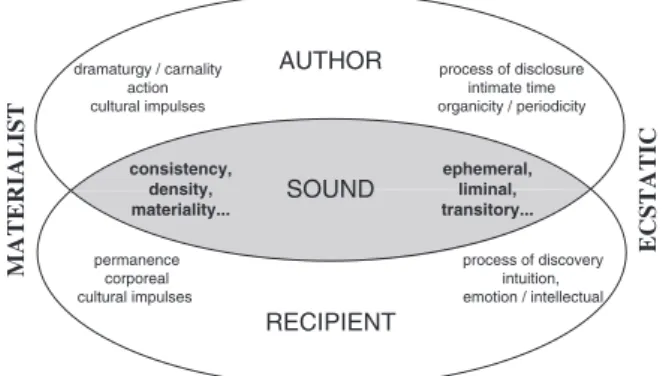
738 (material), evoke the external and converge on the 739 real through sound. They focus on sound and 740 stimulate materialist and ecstatic sonic potentials 741 (e.g. consistency, density, graininess, sonic transients 742 and apparent overtones at the threshold of audibility); 743 further, sound recounts intentions, processes and 744 discoveries that come from the experience of both 745 creator and recipient, thus enlarging on intuitions, 746 dramaturgy, movement-related and cultural stimuli. 747 But sound continues to be the medium and locus 748 of expression and contact, and so from this frame 749 of external references sound recalls the material 750 and embodies the real (Figure 1). Sound exists as a 751 territory of convergence between author and 752 listener and it reaffirms itself within its internal space, 753 its time and the experience of it. In this way, thesound, 754 viewed as the irreducible connection between creator 755 and recipient within various contexts, is the key 756 element for the cross-genres nature of the E-M 757 perspective.
758 Concerning musical communication, one leading 759 stance in the current debate on the materiality of sound 760 revolves around the non-representativeness of sonic 761 events (e.g. Cox 2011) that are directed towards the 762 sound-in-itself. Within my proposition, sound-in-itself 763 appears directly accessible when compositions are 764 primarily developed using sound’s intrinsic properties, 765 and I repeatedly observed that the presence of func-766 tional constructions, for instance, distance these pieces 767 from the E-M perspective. Thus, it seems logical to 768 favour an anti-representational premise in defining this 769 ecstatic-materialism. Even so, E-M communication 770 goes beyond the purely phenomenological and sen-771 sorial experience: the music of Georg Friedrich Haas, 772 Riccardo Nova, Peder Mannerfelt or Mika Vainio 773 defends a musical grammar typical of their genres, but 774 each moves towards the sound-in-itself from different 775 directions, making choices, using codes, ingraining 776 personality, conveying subjectivity, intimacy, violence 777 and practical motives.
778
In other words, E-M does not only inhabit the
779
compositional process (Döbereiner 2014), but extends
780
to the idea of apotentialof sonic matter that is at times
781
present as a transcendent character of sound (Scelsi),
782
a process of disclosure through duration (Grisey), a
783
physical substance concretely shaped (Pan Sonic), or
784
a bloody organism with a metabolism, carnality and
785
grain (Romitelli). However, as Döbereiner criticises
786
the non-dialectical vision of sound that is exclusively
787
seen as matter-energy, vital in itself, I also go further
788
by picturing the sound as the convergence of the
789
participants’realities on a pure sonic matter.
790 7. CONCLUSIONS
791
The E-M approach focuses on sound-in-itself, the
792
meeting in sound of composer and listener, the
co-793
existence of the quasi-atemporal materiality and the
794
fugitive perception of sound. It is a unified concept
795
in which corporeal reactions, innermost discovery
796
and personalexperiencecome together within the pure
797
sonic element.
798
Several movements or figures within today’s
799
experimental music may come close to the E-M vision
800
and match different characteristics of this perspective.
801
There are no clear boundaries that limit this
cross-802
genre proposition and the points discussed above work
803
as parameters to evaluate a sort of degree of affiliation
804
with ecstatic-materialism.
805
Ecstatic-materialism emerges from similarities
806
(e.g. aural, poietic, perceptual) across several genres of
807
music that go beyond techniques and
instrumenta-808
tions, allowing us as listeners, musicians and scholars
809
to approach compositions of G. Verrando, M. Momi,
810
G. F. Haas, B. Lang and pieces of Pan Sonic, Miles
811
Whittaker, Oscar Powell, Oren Ambarchi and Peder
812
Mannerfelt from a fresh point of view: considering
813
their common focus on inner qualities of sound and
814
recognising cultural patterns as models of
commu-815
nication. In presenting this transversal outlook, I hope to stimulate debates and connect didactic and
MATERIALIST
ECSTATIC
AUTHOR
SOUND
RECIPIENT
permanence corporeal cultural impulses
process of discovery intuition, emotion / intellectual dramaturgy / carnality
action cultural impulses
process of disclosure intimate time organicity / periodicity
consistency, density, materiality...
ephemeral, liminal, transitory...
Figure 1. Visual representation of the E-M model of
816 academic contexts in order to propose new strategies to 817 deal with the rapid changes in our musical culture.
818 REFERENCES
819 Bayle, F. 1989. Image-of-Sound, or I-Sound: Metaphor/
820 metaform.Contemporary Music Review4(2): 165–70. 821 Bergson, H. 1998. Durée Et Simultanéité a Propos de La 822 Théorie D’Einstein [1922]. Paris: Presses Universitaires
823 de France.
824 Bériachvili, G. 2008. La Poétique Du Son Dans L’oeuvre de 825 Giacinto Scelsi (À Propos Del Quattro Pezzi per Orches-826 tra et Au-Delà). In P. A. Castanet (ed.)Giacinto Scelsi 827 Aujourd’hui. Paris: Publication Cdmc.
828 Bériachvili, G. 2010.L’espace Musical: Concept et Phénomène
829 à Travers L’avant-Garde Des Années 1950–60
(Stock-830 hausen, Xenakis, Ligeti...). Rouen: Université de Rouen.
831 Bonnet, F. J. 2012. Les Mots et Les Sons. Un Archipel
832 Sonore. Paris: Éditions de l’éclat.
833 Chouvel, J.-M. and Solomos, M. 1998.L’espace, Musique/ 834 philosophie. Paris: L’Harmattan.
835 Corbett, J. 2000. Experimental Oriental: New Music and
836 Other Others. In G. Born and D. Hesmondhalgh (eds.)
837 Western Music and Its Others: Difference, Representation,
838 and Appropriation in Music. Berkeley: University of
839 California Press.
840 Cox, C. 2011. Beyond Representation and Signification:
841 Toward a Sonic Materialism.Journal of Visual Culture
842 10(2): 145–61.
843 Demers, J. 2010. Listening Through Noise: The Aesthetics
844 of Experimental Electronic Music. Oxford: Oxford
845 University Press.
846 Döbereiner, L. 2014. How to Think Sound in Itself? Towards
847 a Materialist Dialectic of Sound. Proceedings of the
848 Electroacoustic Music Studies Network Conference.
849 Berlin, Germany, 10–14 June.
850 Emmerson, S. 1986.The Language of Electroacoustic Music.
851 London: Macmillan.
852 Ferguson, S. 2007. Review of Models and Artifice: The 853 Collected Writings of Tristan Murail.Circuit: Musiques
854 Contemporaines17(1): 115–20.
855 Grisey, G. 2008. Écrits: Ou L’invention de La Musique 856 Spectrale, ed. Guy Lelong (Paris: MF Éditions.
857 Haworth, C. 2010. Xenakian Sound Synthesis: Its Aesthetic
858 and Influence on ‘Extreme’ Computer Music. In
859 M. Goddard, B. Halligan and N. Spelman (eds.)Resonances.
860 Noise and Contemporary Music. London: Bloomsbury.
861 Hervé, J.-L. 2004. Formes et Temporalité Dans Les
Der-862 nières Oeuvres de Gérard Grisey. In D. Cohen-Levinas
863 (ed.)Le Temps de l’Écoute. Gérard Grisey Ou La Beauté
864 Des Ombres Sonores. Paris: L’Harmattan.
865 Johnson, M. 1987.The Body in the Mind: The Bodily Basis of
866 Meaning, Imagination, and Reason. Chicago: University
867 of Chicago Press.
868 Kim-Cohen, S. 2009.In the Blink of and Ear. Towards a
Non-869 Cochlear Sonic Art. New York: Continuum.
870 Kramer, J. D. 1988.The Time of Music: New Meanings, New 871 Temporalities, New Listening Strategies. Munich: Schirmer/
872 Mosel Verlag GmbH.
873 Kurth, E. 2006. Ernst Kurth: Selected Writings, ed.
874 L. A. Rothfarb, Cambridge: Cambridge University Press.
875
Landy, L. 2007.Understanding the Art of Sound Organiza-876 tion. Cambridge, MA: MIT Press.
877
Manfrin, L. and Piras, M. 2003. Spettromorfologia, Durata
878
E Differenza: La Presenza Di Bergson Nel Pensiero
879
Musicale Di Gérard Grisey.Rivista Italiana Di Musico-880 logia38(1): 75–117.
881
Menesson, C. 2008. Scelsi, Le Temps Ou La Respiration Du
882
Son. In P. A. Castanet (ed.)Giacinto Scelsi Aujourd’hui.
883
Paris: Publication Cdmc.
884
Moles, A. 1968.Information Theory and Esthetic Perception.
885
Urbana, IL: University of Illinois Press.
886
O’Callaghan, C. 2010. Sounds: A Philosophical Theory. 887
Oxford: Oxford University Press.
888
Romitelli, F. 2001. Il Compositore Come Virus. Milano 889 Musica. In Percorsi di musica d’oggi – Il pensiero e
890 l’espressione. Aspetti del secondo Novecento musicale in
891 Italia. Milan: Teatro alla Scala, www.milanomusica.org/
892
it/sezione-festival/presentazione/approfondimenti/10-non-893
categorizzato/festival/109-scritti.html (accessed 14
894
September 2017).
895
Romitelli, F. 2005a. Pour Une Pratique Visionnaire:
Entre-896
tien Avec Danielle Cohen-Levinas. In A. Arbo (ed.)Le 897 Corps Électrique. Voyage Dans Le Son de Fausto
Romi-898 telli. Paris: L’Harmattan.
899
Romitelli, F. 2005b. Résonances. In A. Arbo (ed.)Le Corps 900 Électrique. Voyage Dans Le Son de Fausto Romitelli.
901
Paris: L’Harmattan.
902
Romitelli, F. and Denut, E. 2005. Produire Un écart.
903
Entretien Avec Eric Denut. In A. Arbo (ed.) Le Corps 904 Électrique. Voyage Dans Le Son de Fausto Romitelli.
905
Paris: L’Harmattan.
906
Scelsi, G. 2006. Les Anges Sont Ailleurs... Textes et Inédits 907 Recueillis et Commentés Par Sharon Kanach. Arles: Actes Sud.
908
Smalley, D. 1997. Spectromorphology: Explaining
Sound-909
shapes.Organised Sound2: 107–26.
910
Solomos, M. 1998. L’Espace Composable. Essais Sur La 911 Musique et La Pensée Musical d’Horacio Vaggione. Paris:
912
L’Harmattan.
913
Solomos, M. 2003. Pour Une Filiation Xenakis-Grisey ?. In
914
M. Solomos (ed.) Iannis Xenakis, Gérard Grisey. La 915 Métaphore Lumineuse. Paris: L’Harmattan.
916
Solomos, M. 2012. Deux visions de la‘vie intérieure du son’: 917
Scelsi et Xenakis. In M. Solomos and C. Pellegrini (eds.)
918 Scelsi Incombustible. Filigrane. Musique, esthétique,
919 sciences, société. http://revues.mshparisnord.org/filigrane/
920
index.php?id=504 (accessed 14 September 2017).
921
Solomos, M. 2013.De La Musique Au Son. L’émergence Du 922 Son Dans La Musique Des XXe-XXIe Siècles. Rennes:
923
Presse Universitaires de Rennes.
924
Vaggione, H. 1998. L’Espace Composable. Sur Quelques 925
Catégories Opératoires Dans La Musique
Électro-926
acoustique. In M. Solomos and J-M. Chouvel (eds.)
927 L’espace. Musique/Philosophie. Paris: L’Harmattan.
928
Verrando, G. 2012. La Nuova Liuteria. Orchestrazione, 929 Grammatica, Estetica. Milan: Suvini Zerboni.
930
Voegelin, S. 2010.Listening to Noise and Silence: Towards A 931 Philosophy of Sound Art: Toward a Philosophy of Sound
932 Art. New York: Continuum.
933
Wanke, R. 2015. A Cross-Genre Study of the (Ec)Static
934
Perspective of Today’s Music.Organised Sound20: 331–39. 935
Wanke, R. 2016. Program notes to Alvin Lucier – Two 936 Circles, performed by AlterEgo. CD. Mode Records.