Revista Brasileira de Hematologia e Hemoterapia
Brazilian Journal of Hematology and Hemotherapy
w w w . r b h h . o r g
Original article
Homocysteine and vitamin B
12
status and iron
deficiency anemia in female university students
from Gaza Strip, Palestine
Mahmoud Mohammed Sirdah
a,∗, Maged M. Yassin
b,
Sabreen El Shekhi
b, Abdel Monem Lubbad
b aAl Azhar University-Gaza, Gaza, PalestinebIslamic University-Gaza, Gaza, Palestine
a r t i c l e
i n f o
Article history:
Received 4 October 2013 Accepted 19 November 2013 Available online 3 April 2014
Keywords:
Anemia Iron-deficiency Microcystis
Hyperhomocysteinemia
a b s t r a c t
Objective:Nutritional deficiencies are very significant to the overall health of humans at all ages and for both genders, yet in infants, children and women of childbearing age these deficiencies can seriously affect growth and development. The present work is aimed to assess homocysteine and vitamin B12status in females with iron deficiency anemia from
the Gaza Strip.
Methods:Venous blood samples were randomly collected from 240 female university students (18–22 years old) and parameters of the complete blood count, serum ferritin, homocysteine and vitamin B12were measured. Statistical analysis included the t-test and
analysis of variance (ANOVA) using the IBM SPSS software (version 18). Statistical signifi-cance was set forp-values <0.05.
Results:The results revealed that 20.4% of the students have iron deficiency anemia. The mean serum vitamin B12level in females with iron deficiency anemia (212.9±62.8 pg/mL)
was significantly lower than in normal controls (286.9±57.1 pg/mL) and subjects with microcytic anemia and normal ferritin (256.7±71.1 pg/mL). Significantly higher serum homocysteine levels were reported in the iron deficiency anemia group (27.0±4.6mol/L)
compared to normal controls (15.5±2.9mol/L) and in subjects with microcytic anemia
and normal ferritin (18.1±2.7mol/L). Statistically significant negative correlations were
reported for serum homocysteine with serum ferritin, vitamin B12, hemoglobin, and
hema-tocrit levels.
Conclusion:Important associations were found between serum homocysteine and markers of iron deficiency. Monitoring homocysteine levels might be essential to understand the development of different clinical conditions including anemia. It seems necessary to con-duct prospective trials to determine whether treating anemia ameliorates homocysteine levels.
© 2014 Associac¸ão Brasileira de Hematologia, Hemoterapia e Terapia Celular. Published by Elsevier Editora Ltda. All rights reserved.
∗ Corresponding author at: Biology Department, Al Azhar University-Gaza, PO Box 1277, Gaza, Palestine.
E-mail address:[email protected](M.M. Sirdah).
http://dx.doi.org/10.1016/j.bjhh.2014.03.005
Introduction
Iron deficiency anemia (IDA) is the most common type of nutritional anemia in the world; it significantly affects individ-uals of all ages and economic groups in both developing and developed countries with very staggering international esti-mates. The World Health Organization (WHO) believes that about one-third of the world’s population (more than 2 billion people) is anemic, mostly due to iron deficiency.1,2 Despite
worldwide economic and scientific development together with the international efforts and campaigns to combat the prevalence of IDA, there has been little impact on the world-wide prevalence, which remains high and challenging. The WHO reports more troubling prevalences of IDA in develop-ing countries showdevelop-ing that one in every two pregnant woman and 30–40% of preschool children are likely to be anemic, mainly due to iron deficiency.3In Palestine, IDA is recognized
as an important health problem and different studies involv-ing different age groups and both genders have underscored the magnitude of IDA as a major public health challenge for improving the health status especially in refugee camps and among vulnerable at-risk groups.4–7The consequences of
ane-mia are not limited to poor pregnancy outcomes, impaired physical and cognitive development, and increased risk of morbidity in children8–10but affect national productivity and
economics.11–13
Vitamin B12 deficiency, which is common in
wealth-ier countries, principally among the elderly, is even more prevalent in poorer populations worldwide.14
Hyperhomo-cysteinemia, an elevated circulating total homocysteine concentration, is influenced by genetic and dietary factors such as deficiencies of the enzymes or vitamin cofactors in the homocysteine metabolic pathway.15
Hyperhomocysteine-mia is a strong and independent risk factor for coronary atherosclerosis and cerebrovascular disorders and strokes.16
Hyperhomocysteinemia could be attributed to low concen-trations of vitamin B12.17–19Moreover, hyperhomocysteinemia
and/or low folate and vitamin B12concentrations are potential
risk factors for poor pregnancy outcomes and neurocognitive performance.17,20,21
The aim of the present work was to assess homocysteine and vitamin B12status in female university students with iron
deficiency anemia aged 18–22 years from the Gaza Strip. To the best of our knowledge, after searching published scientific works, the present work could be the first that directly investi-gates the association between the levels of body iron, vitamin B12and homocysteine.
Methods
The present cross-sectional descriptive study enrolled 240 randomly selected female students, between 18 and 22 years old, in the Islamic university in Gaza. The sample size was cal-culated for a level of precision of±7% and a 95% confidence level.22According to these calculations at least 200 female
stu-dents should be included; this number was increased to 240. About 5 mL of venous blood [2.5 mL in K3
ethylenediamine-tetraacetic acid (EDTA) tubes and 2.5 mL in serum tubes] were collected from each subject to perform a complete blood count (CBC) using a Sysmex XE-2100 hematology analyzer, and to determine the levels of vitamin B12, serum ferritin, and serum
homocysteine using commercially available kits. Anthropo-metric characteristics were measured and body mass index was calculated.
Descriptive statistics, frequencies, central tendencies, and statistical analysis tests such ast-test and analysis of variance test (ANOVA) were used to clarify the relationship between the research variables. The IBM SPSS software (version 18, IBM Corporation, Somers, NY) was used in the statistical analysis.
Results
The present study comprised 240 female university students aged 18–22 years. Complete blood count analysis revealed microcytic red blood cells (RBCs) with a mean corpuscular vol-ume (MCV) <80 fl in 30.0% (72/240) of the screened subjects. On assessing iron stores using the serum ferritin test, 20.4% (49/240) of all screened females had low levels concomitant to reduced hemoglobin (Hb <12 g/dL) and thus were suffering from iron deficiency anemia while 9.6% (23/240) were micro-cytic but with normal iron stores. The subjects of this study were categorized into three groups: iron deficiency anemia (n= 49), microcytic with normal serum ferritin (n= 23), and 20 normocytic non-anemic female students (MCV = 80–96 fl; Hb≥12.0 g/dL) who were randomly selected as a normal con-trol group. The age and anthropometric characteristics of the study subjects are presented inTable 1which shows no signifi-cant differences in the mean age and weight of the students in the three groups, while females of the iron deficiency anemia group were shorter than the females in the other groups.
The serum levels of ferritin, vitamin B12and homocysteine
of the different groups are shown in Table 2. Apart from the significant reduction of serum ferritin, females in the IDA group had significantly lower levels of vitamin B12 and
Table 1 – Age and anthropometric measurements of the study subjects.
Anthropometric measurements IDA (n= 49) Microcytic normal ferritin (n= 23) Normal control (normocytic) (n= 20) P-valuea
Mean±SD Mean±SD Mean±SD
Age 19.6±1.3 20.1±1.5 20.0±1.7 0.369
Weight (kg) 59.0±8.5 60.4±9.9 59.2±12.2 0.842
Height (cm) 159.6±4.7 164.0±5.9 161.7±5.9 0.006
Body mass index 23.1±3.0 22.4±3.5 22.5±4.2 0.674
IDA, iron deficiency anemia; SD, standard deviation.
Table 2 – Serum ferritin, vitamin B12and homocysteine levels of the different study groups.
Biochemical analysis IDA (n= 49) Microcytic normal ferritin (n= 23) Normal control (normocytic) (n= 20)
P-value
Mean±SD Mean±SD Mean±SD
Serum ferritin (ng/mL) 5.1±2.7 25.1±10.5 NA <0.001a
Vitamin B12(pg/mL) 212.9±62.7 256.7±71.1 286.9±57.1 <0.001b Homocysteine (mol/L) 27.0±4.6 18.1±2.7 15.45±2.9 <0.001b
IDA, Iron deficiency anemia; NA, Not available; SD, Standard deviation.
a Independentt-test.
b ANOVA.
Table 3 – Hematological parameters of the study subjects.
Hematological parameter IDA (n= 49) Microcytic normal ferritin (n= 23) Normal control (n= 20) P-valuea
Mean±SD Mean±SD Mean±SD
WBC (×109L–1) 6.53±1.98 7.73±1.82 8.07±2.1 0.005
RBC (×1012L–1) 4.45±0.39 4.56±0.41 4.72±0.36 0.015
Hb (g/dL) 10.5±1.13 11.5±1.49 12.42±0.99 <0.001
Hct (%) 32.4±2.4 34.4±3.0 35.9±2.4 <0.001
MCV (fl) 73.1±5.4 75.1±5.5 84.8±3.8 <0.001
MCH (pg) 23.8±2.8 25.1±3.1 29.3±1.1 <0.001
MCHC (g/dL) 32.4±1.9 33.1±2.2 34.6±0.91 <0.001
PLT (×109L–1) 280.2±70.6 307.0±75.3 310.1±45.2 0.137
IDA, iron deficiency anemia; WBC, white blood cell count; RBC, red blood cell count; Hb, hemoglobin; Hct, hematocrit; MCV, mean corpuscular volume; MCH, mean corpuscular hemoglobin; MCHC, mean corpuscular hemoglobin concentration; PLT, platelet count; SD, standard deviation.
a ANOVA.
significantly higher levels of homocysteine compared to the other two groups. The decrements in vitamin B12 and
increments in homocysteine of the IDA group were 25.8% and 74.8%, respectively compared to the control group.
The CBC analysis revealed significantly lower values except for the platelet count in IDA subjects compared to the con-trol group (Table 3). The mean reductions in hemoglobin and hematocrit (Hct) levels in the IDA group were 15.5% and 9.7%, respectively compared to controls. Some significant dif-ferences were also reported between IDA subjects and the microcytic anemia with normal ferritin group.
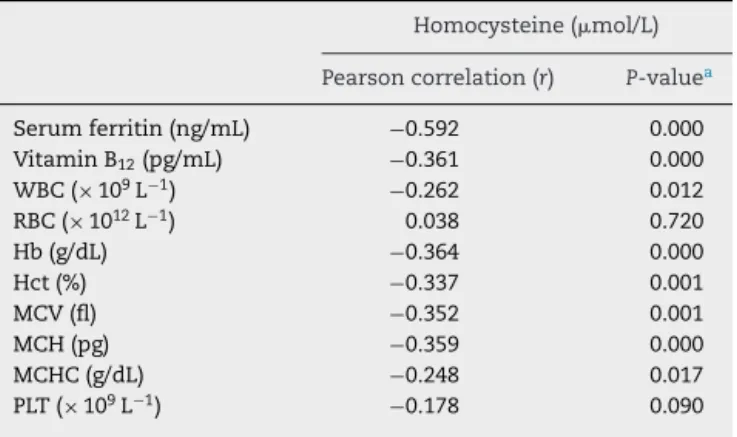
Table 4 – Homocysteine level in relation to serum ferritin of the study population.
Homocysteine (mol/L)
Pearson correlation (r) P-valuea
Serum ferritin (ng/mL) −0.592 0.000 Vitamin B12(pg/mL) −0.361 0.000 WBC (×109L−1) −0.262 0.012
RBC (×1012L−1) 0.038 0.720
Hb (g/dL) −0.364 0.000
Hct (%) −0.337 0.001
MCV (fl) −0.352 0.001
MCH (pg) −0.359 0.000
MCHC (g/dL) −0.248 0.017
PLT (×109L−1) −0.178 0.090
WBC, white blood cell count; RBC, red blood cell count; Hb, hemoglobin; Hct, hematocrit; MCV, mean corpuscular volume; MCH, mean corpuscular hemoglobin; MCHC, mean corpuscular hemoglobin concentration; and PLT, platelet count.
a ANOVA.
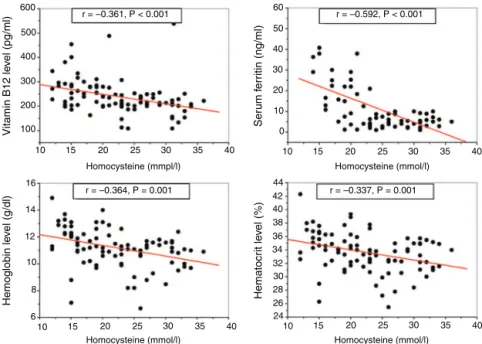
Analyses using the Pearson correlation coefficient revealed a significant correlation between the serum homocysteine level and other hematological and biochemical parameters as shown inTable 4. Among these important correlations are the negative correlation of homocysteine with vitamin B12 and
the IDA biomarkers such as serum ferritin, hemoglobin and hematocrit (Figure 1).
Discussion
Nutritional deficiencies are very significant to the overall health of humans at all ages and for both genders, however in some age groups (infants and children, and women of childbearing age) these deficiencies can be graver and then the growth and development may be seriously hindered by shortages of essential vitamins or nutrients.23IDA,
character-ized by microcytic RBC, is the commonest nutritional anemia worldwide affecting people in developing as well as developed countries.11 Although vitamin B
12 deficiency is common in
rich countries, particularly among the elderly, it is much more widespread in poorer populations around the world.14
More-over, several scientific reports have associated hyperhomo-cysteinemia with different medical conditions and nutritional deficiencies.16To the best of our knowledge this work may be
the first that directly investigates the association between the levels of body iron, vitamin B12and homocysteine.
600 60
50
40
30
20
44 42 40 38 36 34 32 30 28 26 24 10
0
16
14
12
10
8
6 500
400
300
200
r = –0.361, P < 0.001 r = –0.592, P < 0.001
r = –0.337, P = 0.001 r = –0.364, P = 0.001
Homocysteine (mmpl/l) Homocysteine (mmol/l)
Homocysteine (mmol/l) Homocysteine (mmol/l)
Hemoglobin le
vel (g/dl)
Vitamin B12 le
vel (pg/ml)
Ser
um f
e
rr
itin (ng/ml)
Hematocr
it le
ve
l (%)
100
10 15 20 25 30 35 40 10 15 20 25 30 35 40
10 15 20 25 30 35 40
10 15 20 25 30 35 40
Figure 1 – Pearson correlation coefficient analysis of homocysteine with vitamin B12and iron deficiency anemia biomarkers.
of IDA today could be due to a drop in socioeconomic status related to the local political climate and restrictions that have seriously affected the economics of the Gaza Strip over the last seven years.6,24Additionally, another fraction (9.6%) of study
subjects were found to have microcytic anemia with normal iron stores possibly caused by genetic factors.25
A very interesting finding of the present study is the sig-nificantly increased homocysteine levels found in IDA cases compared to the other study groups: 74.5% and 49.2% higher than control and microcytic groups, respectively. It is worth-while to mention that it seems that no previous studies have directly investigated the homocysteine level in IDA, but hyper-homocysteinemia has been reported in anemic cases due to hereditary factors26 and in vegetarians, particularly among
vegans.27Elevated homocysteine levels had been found to be
associated with low hemoglobin levels in the elderly (85 years old).16Unfortunately iron levels were not determined in these
elderly individuals, and then the etiology of anemia could be different. The present study revealed a low level of vitamin B12in IDA subjects. It is not uncommon to find iron deficiency
associated with vitamin B12 deficiency or other nutritional
deficiencies. However, the combined iron and vitamin B12
defi-ciencies could aggravate the clinical condition.28,29
Significant correlations were found between serum homo-cysteine levels on one hand and different blood parameters and indices on the other. This study reports on significant cor-relations between homocysteine and biomarkers of IDA (Hb, Hct, serum ferritin); unluckily no published study investigated these correlations, thus, further large scale investigations should be performed to evaluate the correlations at different IDA stages and in different risk groups. Nasri and Baradaran reported a positive correlation of homocysteine with Hb and Hct in Pakistani hemodialyzed anemic patients with end-stage renal disease, however these patients had high iron stores.30
The significant correlations between the serum levels of homocysteine, serum ferritin, and vitamin B12in the present
study are very clear and stress the need for future studies with in-depth investigations to identify any associations related to the clinical picture not only of microcytic cases but related to other hematological disorders. The significant inverse correla-tion (r=−0.592;p-value = 0.001) reported here between serum homocysteine and serum ferritin levels was not reported before in any studies. The association between elevated homo-cysteine levels and reduced free vitamin B12 was previously
reported by Miller et al., who assumed this elevation was an early marker for the development of vitamin B12deficiency.31
The significant inverse correlation between serum homocys-teine and vitamin B12reported in this study is concomitant to
what has been published previously.32–34
Although this study found significant associations between different variables, as with all cross-sectional descriptive designs, direct evidence of a temporal relationship between exposure and outcome is generally not provided; this should be considered a primary limitation of all cross-sectional descriptive designs.35
Conclusion
Iron deficiency anemia is a serious health problem among females of childbearing age, with the prevalence of IDA being almost three-fold higher in this study than in one with a similar population of the same region 11 years ago. Increased homocysteine levels are associated with serum ferritin, IDA biomarkers and vitamin B12, and so monitoring homocysteine
serum homocysteine as a biomarker of the early stages of iron deficiency in different high-risk IDA groups and to determine whether treating anemia ameliorates the homocysteine level.
Conflicts of interest
The authors declare no conflicts of interest.
r e f e r e n c e s
1. International Nutritional Anemia Consultative Group. INACG Symposium. 12 March 1999, Durban South Africa.
Washington, DC: ILSI Research Foundation; 2000. p. 1–60. 2. Stoltzfus R. Defining iron-deficiency anemia in public health
terms: a time for reflection. J Nutr. 2001;131:565S–7S. 3. FAO/WHO. Preventing micronutrient deficiencies. ICN Fact
Sheet No. 1. Supporting paper of the International Conference on Nutrition. 1992.
4. Sirdah MM, El-Agouza IM, Abu Shahla AN. Possible ameliorative effect of taurine in the treatment of iron-deficiency anaemia in female university students of Gaza. Palest Eur J Haematol. 2002;69:236–42.
5. Abdeen Z, Greenough G, Shahin M, Tayback M. Nutritional assessment of the West Bank and Gaza Strip. Jerusalem, Palestine: Al-Quds University Publication; 2003. 6. Radi SM, El-Sayed NA, Nofal LM, Abdeen ZA. Ongoing
deterioration of the nutritional status of Palestinian preschool children in Gaza under the Israeli siege. East Mediterr Health J. 2013;19:234–41.
7. Selmi A, Al-Hindi A. Anaemia among school children aged 6–11 years old in Gaza Strip. Palest Ann Alquds Med. 2011;7:27–32.
8. Gangopadhyay R, Karoshi M, Keith L. Anemia and pregnancy: a link to maternal chronic diseases. Int J Gynaecol Obstet. 2011;115 Suppl. 1:S11–5.
9. Pasricha SR. Anaemia in pregnancy – not just iron deficiency. Acta Haematol. 2013;130:279–80.
10. Pasricha SR, Drakesmith H, Black J, Hipgrave D, Biggs BA. Control of iron deficiency anemia in low- and middle-income countries. Blood. 2013;121:2607–17.
11. WHO. Iron deficiency anemia assessment prevention and control: a guide for program managers. Geneva, Switzerland: World Health Organization; 2001.
12. Food and Agriculture Organization of the United Nations (FAO). The state of food insecurity in the world. 6th ed. Italy: Rome; 2004.
13. Stein AJ, Qaim M. The human and economic cost of hidden hunger. Food Nutr Bull. 2007;28:125–34.
14. Allen LH. How common is vitamin B-12 deficiency? Am J Clin Nutr. 2009;89:693S–6S.
15. Katre P, Bhat D, Lubree H, Otiv S, Joshi S, Joglekar C, et al. Vitamin B12and folic acid supplementation and plasma total
homocysteine concentrations in pregnant Indian women with low B12and high folate status. Asia Pac J Clin Nutr.
2010;19:335–43.
16. den Elzen WP, Westendorp RG, Frölich M, de Ruijter W, Assendelft WJ, Gussekloo J. Vitamin B12and folate and the
risk of anemia in old age: the Leiden 85-Plus Study. Arch Intern Med. 2008;168:2238–44.
17. Yajnik CS, Deshpande SS, Lubree HG, Naik SS, Bhat DS, Uradey BS, et al. Vitamin B12deficiency and
hyperhomocysteinemia in rural and urban Indians. J Assoc Physicians India. 2006;54:775–82.
18. Dhonukshe-Rutten RA, Pluijm SM, de Groot LC, Lips P, Smit JH, van Staveren WA. Homocysteine and vitamin B12status
relate to bone turnover markers, broadband ultrasound attenuation, and fractures in healthy elderly people. J Bone Miner Res. 2005;20:921–9.
19. Herrmann W, Schorr H, Obeid R, Geisel J. Vitamin B-12 status, particularly holotranscobalamin II and methylmalonic acid concentrations, and hyperhomocysteinemia in vegetarians. Am J Clin Nutr. 2003;78:131–6.
20. Veena SR, Krishnaveni GV, Srinivasan K, Wills AK, Muthayya S, Kurpad AV, et al. Higher maternal plasma folate but not vitamin B-12 concentrations during pregnancy are associated with better cognitive function scores in 9- to 10- year-old children in South India. J Nutr. 2010;140:1014–22.
21. WHO. Folate and vitamin B12 deficiencies: proceedings of a WHO technical consultation held 18–21 October, 2005, in Geneva, Switzerland. Introduction. Food Nutr Bull. 2008;29 2 Suppl.:S1–246.
22. Glenn ID. Sampling the evidence of extension program impact. Program evaluation and organizational development. IFAS, University of Florida; 2013. PEOD-5. Available from:
http://edis.ifas.ufl.edu/pd005[cited 04.10.13].
23. Tulchinsky H. Micronutrient deficiency conditions: global health issues. Pub Health Rev. 2010;32:243–55.
24. WHO. Initial health assessment report: Gaza strip. WHO Regional Office for the Eastern Mediterranean; 2012. Available from:http://www.emro.who.int/palestine[cited 04.10.13]. 25. Camaschella C. How I manage patients with atypical
microcytic anaemia. Br J Haematol. 2013;160:12–24. 26. Pandey K, Dubay P, Bhagoliwal A, Gupta N, Tyagi G.
Hyperhomocysteinemia as a risk factor for IUGR. J Obstet Gynaecol Ind. 2012;62:406–8.
27. Elmadfa I, Singer I. Vitamin B-12 and homocysteine status among vegetarians: a global perspective. Am J Clin Nutr. 2009;89:1693S–8S.
28. Beyan C, Kaptan K, Beyan E, Turan M. The platelet count/mean corpuscular hemoglobin ratio distinguishes combined iron and vitamin B12deficiency from
uncomplicated iron deficiency. Int J Hematol. 2005;81:301–3. 29. Song SM, Bae KW, Yoon HS, Im HJ, Seo JJ. A case of anemia
caused by combined vitamin B12and iron deficiency
manifesting as short stature and delayed puberty. Kor J Pediatr. 2010;53:661–5.
30. Nasri H, Baradaran A. Association of serum homocysteine with anemia in maintenance hemodialysis patients. Pak J Nutr. 2005;4:414–7.
31. Miller A, Slingerland DW, Hall CA, Chu RC. Food-bound B12
absorption and serum total homocysteine in patients with low serum B12levels. Am J Hematol. 1998;59:42–5.
32. Garcia AA, Day AG, Zanibbi K, Zunzunegui MV. Long-term effects of folic acid fortification and B-vitamin
supplementation on total folate, homocysteine,
methylmalonic acid and cobalamin in older adults. Can J Public Health. 2008;99:428–33.
33. Hall MN, Liu X, Slavkovich V, Ilievski V, Pilsner JR, Alam S, et al. Folate, cobalamin, cysteine, homocysteine, and arsenic metabolism among children in Bangladesh. Environ Health Perspect. 2009;117:825–31.
34. Moghaddasi M, Mamarabadi M, Mohebi N, Razjouyan H, Aghaei M. Homocysteine, vitamin B12 and folate levels in Iranian patients with multiple sclerosis: a case control study. Clin Neurol Neurosurg. 2013;115:1802–5.