rev bras hematol hemoter.2 0 1 4;3 6(3):180–183
Revista Brasileira de Hematologia e Hemoterapia
Brazilian Journal of Hematology and Hemotherapy
w w w . r b h h . o r g
Original article
Normal lymphocyte immunophenotype in an
elderly population
Sâmia Macedo Queiroz Mota Castellão Tavares
a,∗, Wilame de Lima Bravo Junior
b,
Metton Ribeiro Lopes e Silva
baFaculdade Leão Sampaio (FALS), Juazeiro do Norte, CE, Brazil bLaboratório de Análises Clínicas Vicente Lemos, Crato, CE, Brazil
a r t i c l e
i n f o
Article history:
Received 27 March 2013 Accepted 2 February 2014 Available online 4 April 2014
Keywords:
Elderly
Lymphocyte count Immunophenotyping Immunity
Disease
a b s t r a c t
Objective:The aim of this work was to evaluate the lymphocyte immunophenotype in an elderly population.
Methods:This study enrolled 35 over 60-year-old volunteers and a control group composed of 35 young adults. The study included elderly without diseases that might affect the function-ing of the immune system. These individuals were consulted by doctors and after a physical examination, laboratory tests were performed using a Beckman Coulter®flow cytometer. The GraphPad Prism computer program was employed for statistical analysis with the level of significance being set forp-values <0.05.
Results:There is a statistically significant reduction in the number of lymphocytes (CD8+, CD2+and CD3+cells) in the elderly compared to young adults. These low rates are explained by changes attributed to aging and may be partly responsible for the reduction in the cellular immune response, lower proliferative activity and the low cytotoxicity of lymphocytes.
Conclusion:These parameters showed greater impairment of adaptive immunity in the elderly population and can therefore explain the greater fragility of the aged body to devel-oping diseases.
© 2014 Associac¸ão Brasileira de Hematologia, Hemoterapia e Terapia Celular. Published by Elsevier Editora Ltda. All rights reserved.
Introduction
The immune system is our first line of defense against for-eign agents. These invaders, viruses, bacteria and fungi, can be moderately aggressive, such as those responsible for the common cold or more harmful such as in meningitis or tuber-culosis. However, this system has several internal control
∗ Corresponding author at: Rua Dr. Miguel Lima Verde, 513, Centro, 63100-060 Crato, CE, Brazil. E-mail address:[email protected](S.M.Q.M.C. Tavares).
mechanisms that prevent the development of infections. The defense mechanisms range from mechanical protection to complex cellular and molecular mechanisms.1
Innate immunity acts as a first line of organism defense. The innate immune system consists of several components. First, the epithelial barrier prevents infections and if this defense is destroyed, a group of phagocytic cells are activated, including monocytes, macrophages and neutrophils.2
http://dx.doi.org/10.1016/j.bjhh.2014.03.021
rev bras hematol hemoter.2 0 1 4;3 6(3):180–183
181
In addition, the immune system can elicit another type of response called the adaptive immune system, which is also effective but slower and longer lasting. Its main characteris-tics are immune memory and specificity. In acquired immune responses, lymphocytes, classified into two basic categories as T lymphocytes and B lymphocytes, act to destroy pathogens.3
With aging, the elderly are affected more by infections and are more likely to develop cancer than younger individuals. These clinical problems are attributed, at least in part, to the aging of the immune system, immunosenescence, which is associated with an imbalance in the immune function.4
One theoretical basis to explain the aging process is that the immune activity, similar to most other physiological func-tions, declines with age.5Conversely, studies have shown that
there is an increase of natural killer (NK) cells with increas-ing age. The real cause of this increase remains unknown, but it is believed that this compensates for the decline in T-cell response.6
Neutrophils, important cells of innate immunity, do not respond efficiently in the mobilization process of the elderly when the hematopoietic system is under stress, for example, during chemotherapy and in severe prolonged infections. In these circumstances, the process of migration of neutrophils from the bone marrow into the systemic circulation is not as active as in youth people.7 Moreover, studies with different
age groups demonstrated a significant decline in the phago-cytic ability of neutrophils against bacteria as well as in the number of bacteria engulfed with advancing age.8
Research has shown that aging is accompanied by progres-sive changes in the composition of lymphocyte subsets (CD4 and CD8) in lymphoid tissues, with changes associated to T-cell function including those in relation to cytokine secretion.6
One of the major changes in the immune response in respect to the senescence system is the reduction of virgin T cells and increase in memory clones, in other words, CD4+
and CD8+memory T cells expand while CD4+and CD8+virgin
T cells gradually decrease with aging.9
An evaluation of the immune system may help to develop interventions in the elderly to avoid health problems that would eventually affect the independence of these individ-uals. Thus, early treatment may revert damage that under other circumstances would become irreversible.10
Objective
The aim of this study was to evaluate the profile of the normal lymphocyte immunophenotypes in a population of healthy elderly people.
Methods
This research is a descriptive study of lymphocyte immunophenotyping in an elderly population. Therefore, participants should be at least 60 years old and as healthy as possible.
Interviewers visited more than 200 homes to ascertain whether any of the residents were over 60 years old. They explained the purpose of the research and invited those who were interested to participate in the study.
The study group was selected by the Geriatrics Department, University Hospital Walter Cantídio (UHWC) of the Univer-sidade Federal do Ceará (UFCE). For the physical evaluation, physicians requested basic biochemical tests, including com-plete blood count, total cholesterol, triglycerides, blood sugar, and creatinine in order to better assess each individual. After this evaluation, the study enrolled 35 of 200 elderly, who were physically healthy and had normal results for all these exams.
Informed consent was obtained from all participants and the study was approved by the Research Ethics Committee of the UFCE.
Thus, the population consisted of 61- to 92-year-old indi-viduals of both genders and without chronic diseases, such as rheumatoid arthritis and systemic lupus erythematosus. Moreover the participants did not have acute infections such as colds and viruses, mental disability or had been diagnosed with depressive syndrome.
Individuals with autoimmune diseases, or other problems that may impair the immune system and those suffering from renal failure, severe heart disease or anemia were excluded from the study. Other exclusion criteria were the use of corti-costeroids or immunosuppressive medications.
A control group of randomly chosen young adults was also created mainly of companions of patients who were waiting to be consulted at HUWC. Controls were submitted to the same tests as the study group and only those with normal results were enrolled in the study.
Blood samples were collected by venipuncture using sterile disposable equipment in a tube with 5 mL of ethylenedi-aminetetraacetic acid (EDTA) as anticoagulant. This sample was used to perform immunophenotyping (markers of lym-phocytes) with all tests being carried out on the same day the blood was drawn to guarantee the results.
The investigation of the immunophenotype was made using a Beckman Coulter® flow cytometer to obtain counts
and percentages of the subpopulations of lymphocytes. Following the manufacturer’s instructions, 100 mL of whole blood were incubated for 15 minutes with a combination of labeled monoclonal antibodies (10 mL each) in the dark at room temperature. Monoclonal antibodies, of the same brand as the flow cytometer, were conjugated with specific fluo-rochromes. After incubation, the samples were subjected to lysis using a standard reagent (OptiLyse®C).
Cells with the different markers (CD3, CD4, CD8, CD2, CD19) were counted using a technique that has been described previously11. Data are reported as absolute numbers and
per-centages.
The GraphPad Prism computer program (version 5.0) was used for statistical analysis. The Mann–Whitney test was employed for nonparametric values and Student’st-test for parametric values, with the level of statistical significance for all tests being set forp-values <0.05.
Results
182
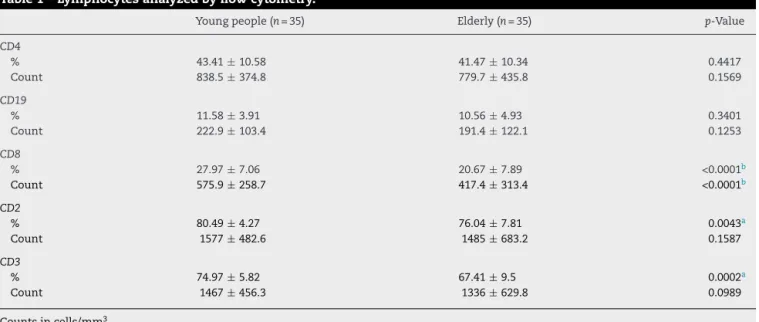
rev bras hematol hemoter.2 0 1 4;3 6(3):180–183Table 1 – Lymphocytes analyzed by flow cytometry.
Young people (n= 35) Elderly (n= 35) p-Value
CD4
% 43.41±10.58 41.47±10.34 0.4417
Count 838.5±374.8 779.7±435.8 0.1569
CD19
% 11.58±3.91 10.56±4.93 0.3401
Count 222.9±103.4 191.4±122.1 0.1253
CD8
% 27.97±7.06 20.67±7.89 <0.0001b
Count 575.9±258.7 417.4±313.4 <0.0001b
CD2
% 80.49±4.27 76.04±7.81 0.0043a
Count 1577±482.6 1485±683.2 0.1587
CD3
% 74.97±5.82 67.41±9.5 0.0002a
Count 1467±456.3 1336±629.8 0.0989
Counts in cells/mm3.
Results are reported as means±standard deviation.
a Student’st-test.
b Mann–Whitney test.
The percentages of the lymphocytes with the CD8+, CD2+,
and CD3+ markers were significantly lower in the group of
elderly than in the young adult control group. Moreover the absolute number of lymphocytes with the CD8+marker was
significantly lower in the elderly than in young adults.
Discussion
The present study evaluated the immunophenotype of lym-phocytes to identify possible changes that accompany aging. A decrease in the relative numbers of cells expressing the CD2+
and CD3+markers were observed in the elderly compared to
young individuals. Moreover, decreases in both relative and absolute numbers were seen for lymphocytes with the CD8+
marker.
The absolute values (cells/mm3) are calculated indirectly
from the value obtained for the total lymphocyte count and the percentage for each of the different subpopulations. It is known that absolute values of subpopulations char-acterize the biological condition of each individual better than the total lymphocyte count. It is also known that the
absolute values of lymphocyte subpopulations characterize the biological condition of each individual better than the rel-ative values (percentages) and so these are used in the clinical practice.
The work of Mazari and Lesourd in 1998, which evaluated 11 healthy elderly people, found a mean count of 1957 cells/mm3
and 91.5% for CD2+ lymphocytes.12 In this study, the mean
count was 1485 cells/mm3and 76.04% for the elderly group.
This difference may be due to several factors, for example, the monoclonal antibodies used or because the population samples are from different regions.
We found no studies that show statistically significant dif-ferences for the percentages of the different subpopulations of lymphocytes in elderly subjects compared to young adults. A study of the elderly by Sansoni et al.13in 2008 evaluated
lymphocyte subpopulations and found a drop in the abso-lute number of CD3+, CD4+and CD8+cells. In relation to our
study, lower values in the absolute number of lymphocytes were found only in the subpopulation of CD8+cells. Perhaps,
if the study had a larger study sample a statistically signifi-cant difference may also have been found for CD3+ cells as
thep-value (0.0989) was close to the cut-off of 0.05.
Table 2 – Values of the surface markers of lymphocytes.
Young people (n= 35) Elderly (n= 35)
Minimum value
Maximum value
Mean Median Minimum
value
Maximum value
Mean Median
CD2 69.8 86.7 80.49 80.8 62.2 89.8 76.04 76.9
CD3 34.4 36.0 74.97 75.7 34.4 34.6 67.41 68.2
CD4 29.0 86.2 43.41 40.5 26.5 65.0 41.47 39.5
CD8 17.1 45.8 27.97 26.0 11.5 42.1 20.67 17.1
CD19 6.0 20.0 11.58 11.2 3.9 22.8 10.56 8.9
rev bras hematol hemoter.2 0 1 4;3 6(3):180–183
183
Lesourd and Conde-Martins14 reported that a drop in
CD8+lymphocytes, even though modest, is significantly more
important than a drop in CD4+cells.
Conclusion
A decrease of immune cells was observed in healthy elderly people compared with young adults, especially in relation to lymphocytes with the CD8 phenotype. Thus, the lower numbers of lymphocytes in the elderly may affect the body’s defenses and simple illnesses such as viruses may have seri-ous consequences in this population. These values might serve as a reference for the normal aged population in our region.
These results show greater impairment of adaptive immu-nity in the elderly and may well justify a greater fragility of the elderly to diseases such as cancer.
Conflicts of interest
The authors declare no conflicts of interest.
r e f e r e n c e s
1. Janeway CA, Travers P, Walport M, Shlomchik MJ.
Immunobiology: the immune system in health and disease. 6th ed. New York: Garland Science Publishing; 2005. p. 823.
2. Roitt I, Brostoff J, Male D. Imunologia. 5th ed. São Paulo: Manole; 1999. p. 423.
3. Sharon J. Imunologia Básica. 1st ed. Rio de Janeiro: Guanabara Koogan; 2000. p. 267.
4. Della Bella S, Bierti L, Presicce P, Arienti R, Valenti M, Saresella M, et al. Peripheral blood dendritic cells and monocytes are differently regulated in the elderly. Clin Immunol.
2007;122:220–8.
5. Papaleo NM. Gerontologia: A velhice e o envelhecimento em visão globalizada. 1st ed. São Paulo: Atheneu; 1999. p. 524. 6. Santos FS. Update on the immunosenescence: humoral and
cell-mediated immunity. Rev Bras Med. 2003;60:782–7. 7. Crighton MH, Puppione AA. Geriatric neutrophils:
implications for older adults. Semin Oncol Nurs. 2006;22:3–9. 8. Pawelec G. Immunosenescence comes of age. EMBO Rep.
2007;8:220–3.
9. Vasto S, Malavolta M, Pawelec G. Age and immunity. Immun Ageing. 2006;3:1–6.
10. Kanaan S, Garcia MA. Alterac¸ões laboratoriais e hormonais em geriateria. J Bras Med. 2005;89:12–24.
11. Herzenberg LA, Parks D, Sahaf B, Perez O, Roederer M, Herzenberg LA. The history and future of the fluorescence. Activated cell sorter and flow cytometry: a view from Stanford. Clin Chem. 2002;48:1819–27.
12. Mazari L, Lesourd BM. Nutritional influences on immune response in healthy aged persons. Mech Ageing Dev. 1998;104:25–40.
13. Sansoni P, Vescovini R, Fagnoni F, Biasini C, Zanni F, Zanlari L, et al. The immune system in extreme longevity. Exp Gerontol. 2008;43:61–5.