Marília Silveira Faeda
I, Márcia Galan Perroca
III Hospital de Base de São José do Rio Preto. São José do Rio Preto, São Paulo, Brazil.
II Faculdade de Medicina de São José do Rio Preto, Department of Specialized Nursing. São José do Rio Preto, São Paulo, Brazil.
How to cite this article:
Faeda MS, Perroca MG. Conformity of nurse prescribing to care needs: nurses’ understanding. Rev Bras Enferm [Internet]. 2017;70(2):400-6. DOI: http://dx.doi.org/10.1590/0034-7167-2016-0107
Submission: 04-07-2016 Approval: 11-02-2016
ABSTRACT
Objective: investigate the understanding of nurses on nurse prescribing conformity to the care needs of hospitalized patients and factors associated with that conformity. Method: a descriptive study, with a quantitative approach, was conducted at 20 in-patient units of a teaching hospital in the state of São Paulo. The participants (N=139) answered a semi-structured questionnaire. Results: For 43 (30.9%) nurses, nurse prescribing is always in line with patients’ care needs. The fi elds of body care and elimination, skin and mucosa care and investigation and monitoring were the most frequently addressed. Conclusion: in the perception of most nurses, nurse prescribing does not conform with patients’ health heeds. The establishment of strategies to improve prescribing quality is recommended, as well as the development of permanent qualifi cation programs and the systematic use of instruments for assessment of patients’ care demands regarding nursing.
Descriptors: Nursing Care; Nursing Process; Documentation; Patient Care Planning; Nursing Assessment.
RESUMO
Objetivo: investigara concepção de enfermeiros sobre a conformidade da prescrição de enfermagem às necessidades de cuidados de pacientes hospitalizados e fatores associados a esta conformidade. Método: estudo descritivo, com abordagem quantitativa, realizado em 20 unidades de internação de um hospital de ensino do estado de São Paulo. Os participantes (N=139) responderam a um questionário semiestruturado. Resultados: para43 (30,9%) enfermeiros, as prescrições de enfermagem encontram-se, sempre, alinhadas às necessidades cuidativas dos pacientes. As áreas de Cuidado Corporal e Eliminações, Cuidados com Pele e Mucosas e Investigação e Monitoramento foram as mais abordadas. Conclusão:na percepção da maioria dos enfermeiros não há conformidade da prescrição de enfermagem com as necessidades de cuidados dos pacientes. Recomenda-se a implementação de estratégias para aprimorar a qualidade das prescrições, bem como o desenvolvimento de programas de qualifi cação contínua e a utilização sistemática de instrumentos de avaliação da demanda de atenção do paciente em relação à enfermagem.
Descritores: Cuidados de Enfermagem; Processos de Enfermagem; Documentação; Planejamento de Assistência ao Paciente; Avaliação em Enfermagem.
RESUMEN
Objetivo: investigar la concepción de enfermeros sobre conformidad de prescripción de enfermería a necesidades de atención de pacientes hospitalizados y factores asociados a tal conformidad. Método: estudio descriptivo, con abordaje cuantitativo, realizado en 20 unidades de internación de hospital de enseñanza del estado de São Paulo. Los participantes (N=139) completaron cuestionario semiestructurado. Resultados: para 43 (30,9%) enfermeros, las prescripciones de enfermería estuvieron siempre alineadas a las necesidades de cuidado de los pacientes. Las áreas de Cuidado Corporal y Eliminaciones, Cuidado de Piel y Mucosas e Investigación y Monitoreo fueron las más abordadas. Conclusión: según visión de la mayoría de enfermeros, no hay conformidad de prescripción de enfermería con necesidades de atención de los pacientes. Se recomienda implementación de estrategias para mejorar la calidad de las prescripciones, cualquier otro desarrollo de programas de califi cación continuada y utilización sistemática de instrumentos de evaluación de demanda de atención del paciente referentes a enfermería.
Descriptores: Atención de Enfermería; Procesos de Enfermería; Documentación; Planifi cación de Atención al Paciente; Evaluación en Enfermería.
Conformity of nurse prescribing to care needs: nurses’ understanding
Conformidade da prescrição de enfermagem às necessidades de cuidados: concepção de enfermeiros
Conformidad de la prescripción de enfermería a las necesidades de atención: concepción de enfermeros
RESEARCH
INTRODUCTION
The consolidation of care quality has been garnering interest in the nursing scenario. Its adequate assessment requires keeping record of a set of precise information on the health state of pa-tients(1). These documents support care planning(2) through nurse prescribing (NP).
In order for NP to be employed as an instrument to ensure patients’ well-being and decrease harms resulting from lack of care(3), it is important that its components be individualized and always up-to-date(4). Difficulties for nurses to identify nec-essary information to instrumentalize the work process and nursing care cause, frequently, collection and retention of an information set that does not correspond to care needs(3).
Studies have shown that there is lack of prescribing ade-quacy to patients’ care needs(5), in addition to them not be-ing daily assessed and validated(6). Frequently, this lack of adequacy results from lack of personnel for serving patients, from limited infrastructure for nursing practice or lack of en-gagement and/or lack of appreciation by these professionals when conducting the nursing process(6). Still, other interfering factors that have been reported are work overload(4) and lack of use of instruments capable of supporting the identification of care areas in need of greater nursing attention(7).
Although the incorporation of the Patient Classification In-strument happens slowly in the field of clinical and manage-ment practice(8), it is of the utmost importance(8-10). This tool supports the identification of patients’ care needs and favors both planning and assessment of the care process(11).
The electronic recording of prescriptions is positive, be-cause it promotes care standardization(12), data organization, directing nursing actions, and saves time(13). However, it has also caused a number of problems, since the use of comput-er systems without employing clinical and critical thinking makes nursing actions automatic and repetitive, which inter-feres on decision making and care quality(14).
Therefore, this study was conducted to investigate the nurses’ understanding of nurse prescribing conformity to the care needs of hospitalized patients and factors associated with that conformity. It aims to answer the following questions: Is nurse prescribing being performed according to patients’ care needs? Which care practices are not being included? Which factors interfere in their creation? Learning the perception of nurses on the factors involved in performing NP enables the definition of strategies for care that is centered on care needs.
METHOD
Ethical aspects
The investigation began after approval by the research eth-ics committee of the researched institution and signing of a free and informed consent form by the participants.
Study design, setting and period
This descriptive quantitative study was conducted at a teach-ing hospital with extra capacity located in a city in the state of São Paulo, at 20 in-patient units, comprising two medical clinics,
two surgery clinics and 16 specialized units (cardiology/hema-tology (n=1), palliative care (n=1), infectious/parasitic diseases (n=1), emergency (n=2), gynecology/obstetrics (n=1), neuro/ orthopedics (n=1), pediatrics (n=3), transplantation (n=1), in-tensive care (n=5)). At this institution, nursing care is conducted through a Nursing Process and its stages are recorded in an elec-tronic database, going through the stages of data collection, di-agnosis, prescribing and evolution in nursing. Nursing diagno-ses are used to support intervention selection in this field. Data were collected from February to June, 2015.
Population or sample
All nurses who worked directly with patient care (n=207) at the mentioned institution were contacted. A total of 139 (67.1%) agreed to participate.
Study protocol
The professionals answered a semi-structured question-naire comprising two parts:
1. Professional profile and unit data: demographic data (age and gender), professional (experience and qualifi-cation) and the units’ characteristics (number of workers and prescribing occurrences per nurse, among others); 2. Nurses’ perception of prescribing: aspects related to
prescribing conformity to patients’ care needs, nurs-ing care that is usually included, satisfaction with the creation and quality of prescribing and facilitating and restrictive factors in their creation process. This part contained open-ended questions (how patient care needs are assessed; care aspects considered in the cre-ation of NP; adequacy to care necessities) and three Likert scales (quality aspects; satisfaction level with time, quantity and form; and included care) with five points, with 33 frequency statements (options ranging from never to always) and satisfaction level (dissatis-fied up to extremely satis(dissatis-fied).
The questionnaire content was validated by five doc-tors of nursing and three nurses, who analyzed each item’s objectivity, clarity and pertinence. Agreement varied from 95% to 98%, showing that the instrument is capable of measuring the concept at hand. After being answered at the pre-testing phase by 16 nurses who practiced direct patient care, it underwent internal confidence testing, which result-ed in a Cronbach’s Alpha of 0.80, considerresult-ed good.
Analysis of results and statistics
RESULTS
A total of 139 nurses participated in the study, mostly wom-en 127 (83%) aged 31 (SD=21; variation 23-55).Mean time of professional practice was six years (SD = 5, variation 1-21) and mean time of practice at the researched unit was five years (SD = 4, variation 1-18). Nurses worked morning shifts (n = 72), afternoon shifts (n = 61) and night shifts (n = 6). As for professional qualification, two graduated in nursing, three un-derwent further training, 129 unun-derwent lato sensu graduate programs (with the most frequent specialties being: urgency and emergency, pediatrics and neonatal, and ICU), two held master’s degrees and one held a PhD degree in nursing.
(SD=0.5, variation 1-1.25) nurses/shift and 5.5 (SD=1.5, vari-ation 3.0-8.5) nursing aides/technicians per shift. (Table 1).
In relation to the frequency of NP, 109 (78.4%) nurses prescribed sometimes and 30 (21.6%) daily. The majority - 122 (87.8%) - reported prescribing generally in the night shift, whereas 121 (87.0%) were based on care needs assess-ments and 18 (13.0%) on symptoms presented by each health harm. To assess care demands related to nursing (there was more than one answer), there were 65 (47%) nursing visits, 24 (17%) subjective care complexity assessments, 18 (13%) medical diagnoses and 86 (62%) anamnesis at admission.
For 43 (30.9%) nurses, nurse prescribing is always in line with the patients’ healing needs; for 72 (52.1%), this occurs only sometimes, whereas 24 (17%) believe they are not in line. Of the total sample, 121 (87.3%) claim that this inad-equacy results from incorrect usage of digital prescribing fea-tures, such as copying, adding and deleting items.
When asked about facilitating factors for prescribing, par-ticipants mentioned: nursing visits 50 (38.2%); rounds 34 (24%); anamnesis 20 (14.4%); digital records 18 (12.3%); and communication among members of the multi-professional team 17 (11.1%).Regarding factors with a negative influence (restrictive), they mentioned: time available for prescribing 58 (42%); shift interruptions 32 (23%); work overload 30 (21.5%); excessive documentation and routines to follow 13 (9%); and underappreciation of nurse prescribing 6 (4.5%).
Nursing care practices observed in NP are presented in Table 2. Some items that call attention are anthropometric measure-ments, vital signs assessment, oxygen therapy, stoma care, periph-eral venous puncture and skin and wounds 5 (5-5) each. Among the less prescribed procedures are assessment of effectiveness of administered drugs 1 (1-2) and feeding patients warm food 1 (1-1). The areas body care and elimination, skin and mucosa care and investigation and monitoring received the highest scores.
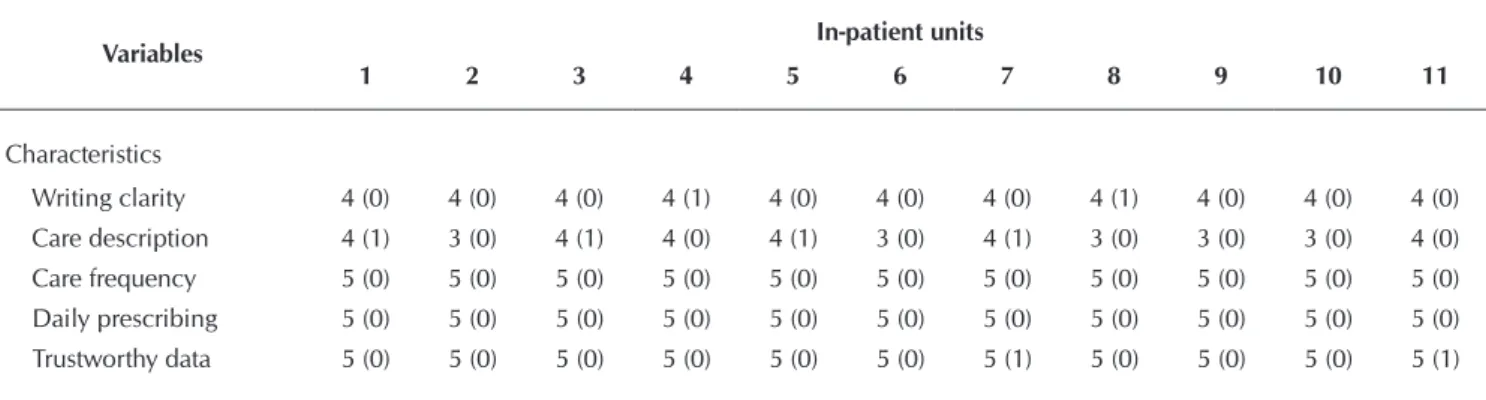
The nurses’ degree of satisfaction demonstrated medians ranging from 5 (5-5) for description of care frequency, daily pre-scribing, provision of trustworthy data to 1 (1-3) for the amount of NP/shift and 1 (1-2) for time available for prescribing (Table 3). The nurses’ perception of the characteristics of NP ranged from 3 (0) for care description to 5 (0) for description of care fre-quency, daily prescribing and provision of trustworthy data. The lowest value 1 (0) was found for satisfaction with amount of NP/ shift and time available for prescribing, and the highest values 5 (0) were obtained for digital prescribing at all units (Table 4). Table 1 – Distribution of nursing personnel by work shift and
in-pa-tient unit, São José do Rio Preto, São Paulo, Brazil, 2015
UNITS
Nurses/ shift M (SD)
Aides and technicians/shift
M (SD)
Patients/ nurse/shift
M (SD)
Medical clinic 2.3 (0.5) 7.5 (0.5) 33.9 (15.7)
Surgery clinic 2.3 (0.5) 7.0 (1.0) 26.7 (12.5)
Cardio/hematology 2.5 (0.8) 8.5 (0.5) 29.1 (8.2)
Palliative care 1.0 (0.0) 3.0 (0.0) 8.0 (0.0)
Infectious/parasitic diseases 1.0 (0.0) 5.0 (0.8) 18.0 (1.0)
Emergency 1.6 (0.7) 5.3 (2.6) 20.6 (8.1)
Gynecology/obstetrics 1.3 (0.5) 4.0 (0.0) 20.0 (5.6)
Neuro/orthopedics 1.3 (0.5) 5.0 (0.0) 16.7 (4.7)
Pediatrics 1.5 (0.7) 5.3 (0.5) 15.9 (6.3)
Transplantation 1.3 (0.5) 4.3 (0.5) 20.8 (5.9)
Intensive care 2.0 (0.8) 6.0 (1.0) 9.6 (0.8)
Total 1.6 (0.5) 5.5 (1.5) 19.9 (7.4)
Note: * M(SD): Mean (standard deviation).
Table 2 – Frequency of nursing care practices mentioned in nurse prescribing according to the nurses’ reports, São José do Rio Preto, São Paulo, Brazil, 2015
Care needs Nurse prescribing Md (Q1-Q3)
Investigation and monitoring Anthropometric measurements 5 (5-5)
Application of measurement scales (Braden, Morse and Glasgow) 3 (3-3)
Vital signs verification 5 (5-5)
Effectiveness assessment of administered drugs 1 (1-2)
Oxygen therapy 5 (5-5)
Clearing of air ways 3 (2-4)
To be continued According to the nurses, the unit has a predominance of
pa-tients demanding intensive care (ICU), semi-intensive care (emer-gency, palliative care, cardio/hematology and neuro/orthopedics), intermediate care (medical clinic, infectious/parasitic diseases, pe-diatrics, transplantations and surgical clinics) and minimal care (gynecology/obstetrics).
Table 3 – Aspects of prescribing and satisfaction of nurses according to the process of prescribing per work shift (medians and quartiles), São José do Rio Preto, São Paulo, Brazil, 2015
Variables Morning
Md (Q1-Q3)
Afternoon Md (Q1-Q3)
Night Md (Q1-Q3)
Total Md (Q1-Q3)
Characteristics
Writing clarity 4 (4-4) 3 (3-4) 4 (4-4) 4 (4-4)
Care description 4 (3-4) 3 (3-3) 4 (3-4) 4 (3-4)
Care frequency 5 (5-5) 5 (5-5) 5 (5-5) 5 (5-5)
Daily prescribing 5 (5-5) 5 (5-5) 5 (5-5) 5 (5-5)
Trustworthy data 5 (5-5) 5 (5-5) 5 (4-5) 5 (5-5)
Satisfaction
Quality 3 (3-3) 2 (1-3) 3 (2-3) 3 (3-3)
Amount of NP/shift 1 (1-3) 2 (1-3) 1 (1-1) 1 (1-3)
Time 1 (1-2) 1 (1-2) 1 (1-1) 1 (1-2)
Digitalization 5 (5-5) 5 (5-5) 5 (5-5) 5 (5-5)
Note: NP = Nurse prescribing; Md = Median; Q1-Q3 = quartiles 1 and 3; Score 1 = lowest agreement; Score 5 = highest agreement.
Care needs Nurse prescribing Md (Q1-Q3)
Body care and elimination Diaper change or placement of urinals 4 (4-5)
Probe care 4 (4-4)
Stoma care 5 (5-5)
Peripheral and central venous puncture care 5 (5-5)
Hygiene needs assistance 4 (4-4)
Oral hygiene 3 (3-4)
Skin and mucosa care Skin/wound care 5 (5-5)
Lying position change every two hours 3 (3-4)
Nutrition and hydration Water balance control - intake and output 4 (4-5)
Feeding patient warm food 1 (1-1)
Offering food for patients to feed themselves 3 (3-4)
Locomotion and activity Walking three times/day or as prescribed 2 (2-2)
Therapy Drug administration in the 30-minute period before or up to one hour after prescribed time 2 (1-3)
Emotional support Emotional support to patient/family 3 (3-4)
Health education Patient training on diseases, clinical-laboratory exams and diagnosis exams 2 (2-2)
Note: Md = Median; Q1-Q3 = Quartiles 1 and 3; Score 1 = lowest frequency; Score 5 = highest frequency.
Table 2 (concluded)
Table 4 – Aspects of prescribing and satisfaction of nurses according to prescribing processes per in-patient units - Md (IR) - São José do Rio Preto, São Paulo, Brazil, 2015
Variables In-patient units
1 2 3 4 5 6 7 8 9 10 11
Characteristics
Writing clarity 4 (0) 4 (0) 4 (0) 4 (1) 4 (0) 4 (0) 4 (0) 4 (1) 4 (0) 4 (0) 4 (0)
Care description 4 (1) 3 (0) 4 (1) 4 (0) 4 (1) 3 (0) 4 (1) 3 (0) 3 (0) 3 (0) 4 (0)
Care frequency 5 (0) 5 (0) 5 (0) 5 (0) 5 (0) 5 (0) 5 (0) 5 (0) 5 (0) 5 (0) 5 (0)
Daily prescribing 5 (0) 5 (0) 5 (0) 5 (0) 5 (0) 5 (0) 5 (0) 5 (0) 5 (0) 5 (0) 5 (0)
Trustworthy data 5 (0) 5 (0) 5 (0) 5 (0) 5 (0) 5 (0) 5 (1) 5 (0) 5 (0) 5 (0) 5 (1)
DISCUSSION
The need to periodically monitor nursing records, includ-ing nurse prescribinclud-ing, to find non-conformities and to es-tablish correctional measures has been highlighted in litera-ture(15). This study verified the nurses’ understanding of nurse prescribing adequacy to patients’ needs, aiming to identify facilitating and restrictive factors. It found that only 30.9% of the studied professionals believed that they are always in line with the patients’ healing needs. Studies concerning nurs-ing documentation(3,6) usually analyze whether NP items are adequately filled in and do not investigate the satisfaction of needs, which hampers comparisons.
Work overload was mentioned by 30 (21.5%) nurses as a restrictive factor for that alignment, since it limits the time available to satisfy patient care demands. At the studied in-stitution, night shift nurses are responsible for patient assess-ment and the unit’s nurse prescribing. In addition to prescrib-ing, they also monitor their co-workers activities. In this work shift there are, generally, admissions of patients with high time demands. Nurse prescribing divided in-between shifts or del-egated to the night shift has been considered a choice that compromises quality, since it has been frequently conducted as a routine, with repeated interventions unrelated to patient needs(16). Thus, the inadequacy of the night shift for creating NP is highlighted because of the lower number of profession-als on-duty, in comparison to the other shifts, and the volume of activities to be completed. Lack of time was mentioned by 72% of nurses as cause for NP lacking in quality(6).
The excessive amount of documents and routines to be con-ducted has also been identified in this study as interfering as-pects in NP compliance to care needs. The high number of ad-ministrative activities demanded by institutions and the nurses’ efforts to meet them take their focus away from patient care(17).
It might be asked, in this practice scenario, how it is pos-sible for nurses to individually monitor patients for identifica-tion of needs and prescribing that is adequate for care. Knowl-edge of clinical conditions, establishment of bonds between patients/families and active participation in the planning and execution of the care process are all crucial to make the as-sessment process more efficient(7).
The low appreciation given to NP, although mentioned by few participants, is a worrying element. It seems that the professionals have not been acting proactively, with aims to
individualized care that guarantees precise interventions for unique nursing care(6). It is necessary for health institutions to promote nurses’ awareness on the importance of NP creation and to establish qualification programs so that the nursing pro-cess happens correctly.
Although the documents concerning systematization of nursing care are in digital form at the researched institution, which favors work focus, the participating nurses believe that the previous day’s prescribing is reproduced without updates and, therefore, care needs are partially satisfied. Therefore, digital records are revealed as tools that do not force daily as-sessments of patients’ needs and clinical assessment of their health state, which makes this important process fragile and mechanic.Priority interventions for each diagnosis are not de-fined, and established diagnoses, which should accordingly base the prescribing, are not considered, taking NP away from the real care needs of patients.
When nurses input the nursing actions into the computer system using the copy and paste feature, there is the possibil-ity of including non-validated data on patients’ statuses. Fail-ure to use clinical thinking influences decision making and interferes in care quality(14). However, if correctly employed, digital records make it possible to direct nursing action(18) and frequently review care plans and necessary changes(19), aspects that favor communication in multi-disciplinary teams, clinical thinking and relevant decision making(20).
Nurses reported that they assess care demands through nursing visits, subjective assessments of care complexity, medical diagnoses and anamnesis during admission. The systematic use of tools to detect patient care needs, such as the Patient Classification Instrument, has been widely recom-mended(8-9,11). Although the Patient Classification Instrument has been originally created to help calculate nursing person-nel, it is a powerful tool to guide nurses’ decisions when planning care(8-9). It was found that assessments conducted employing this instrument reached further areas of care when compared to those in which the instrument was not used(7).
These study’s findings reveal that care involving health ed-ucation for patients/families, walking and assessment of drug effectiveness is being rarely prescribed. Lack of attention for certain care areas by the nursing team, such as educational actions, walking assistance and body care, has been report-ed(21). Body care, however, was mentioned by nurses as one of the areas most frequently addressed by NP. However, it is
Variables In-patient units
1 2 3 4 5 6 7 8 9 10 11
Satisfaction
Quality 2 (0) 2(1) 3 (1) 3(0) 3 (0) 3 (1) 2(1) 3 (0) 3 (0) 3 (1) 3 (0)
Amount of NP/shift 1 (1) 1 (0) 1 (2) 1 (2) 1 (1) 1 (1) 1 (2) 1 (0) 1 (0) 1 (1) 1 (1)
Time available 1 (0) 1 (1) 1 (1) 1 (1) 1 (1) 1 (1) 1 (0) 1 (1) 1 (1) 1 (1) 1 (1)
Digitalization 5 (0) 5 (0) 5 (1) 5 (0) 5 (0) 5 (0) 5 (0) 5 (0) 5 (0) 5 (0) 5 (0)
Note: IR = (Q3-Q1); Score 1 lowest agreement/satisfaction; Score 5 highest agreement/satisfaction; 1. Medical clinic; 2. Surgical clinic; 3. Cardio/hematology; 4. Palliative care; 5. Infectious/parasitic diseases; 6. Emergency; 7. Gynecology/obstetrics; 8. Neuro/orthopedics; 9. Pediatrics; 10. Transplantation; 11. Intensive care; NP = Nurse prescribing.
important to emphasize that, in isolation, NP does not guaran-tee the performance of a given care action.
Nurses’ satisfaction was noticed regarding the provision of trustworthy data and the digital form of NP. These aspects, however, are ambiguous. High agreement for both was found, whereas only 18% of professionals believe that the digital system is a facilitator for NP and, also that only 30.9% consider they are in line with patients’ care needs. The high amount of prescribing per nurse and shift, the little time to do them and their final qual-ity were pointed as factors that generate dissatisfaction.
Thus, the authors suggest the implementation of strategies to strengthen facilitating factors and minimize restrictive ones, such as a new outlook from nursing managers on prescribing distribution per nurse and per shift as a way to favor nurse/ patient interaction(22), the use of critical thinking (nursing di-agnosis) and decision making centered on patient care needs through the use of instruments.
To obtain quality nurse prescribing, some hospitals have adopted measures to identify and improve situations that inter-fere in the execution and documentation of care, such as the
creation of medical records analysis commissions, audits and qualification programs focused on the systematization of nurs-ing care(6). However, it is necessary to also assess prescribing conformity according to patient care demands, an aspect that has not always been contemplated.
A limiting factor for this study was the fact that it was con-ducted at a single hospital institution, whose care context and work process can differ from other healthcare settings. Although there was not total adherence from the nurses, the findings rep-resent the perception of most of them (67.1%). Further studies are recommended to broaden knowledge on this theme.
CONCLUSION
In the perception of most nurses, nurse prescribing does not conform to patients’ health needs. In order for nurses to offer care centered on real or potential health problems, in addition to pa-tient safety, strategies such as permanent qualification programs, as well as the systematic use of instruments for assessment of pa-tient care needs concerning nursing should be implemented.
REFERENCES
1. Backes DS, Zamberlan C, Freitas HB, Colomé J, Souza MT, Costenaro RS. Del cuidado previsible al cuidado complejo de en-fermería. Enferm Glob[Internet]. 2014[cited 2015 Jun 19];13(36):275-81. Available from: http://revistas.um.es/eglobal/article/ viewFile/178931/165771
2. Souza MFG, Santos ADB, Monteiro AI. O processo de enfermagem na concepção de profissionais de Enfermagem de um hospital de ensino. Rev Bras Enferm[Internet]. 2013[cited 2015 Sep 16];66(2):167-73. Available from: http://www.scielo.br/pdf/reben/v66n2/03.pdf
3. Versa GLGS, Inoue KC, Nicola AL, Matsuda LM. Influência do dimensionamento da equipe de enfermagem na qualidade do cuidado ao paciente crítico. Texto Contexto Enferm[Internet]. 2012[cited 2015 Sep 16];20(4):796-802. Available from: http://www.scielo.br/ pdf/tce/v20n4/20.pdf
4. Freitas JS, Silva AEBC, Minamisava R, Bezerra ALQ, Sousa MRG. Quality of nursing care and satisfaction of patients attended at a teaching hospital. Rev Latino-Am Enfermagem[Internet]. 2014[cited 2015 Jun 19];22(3):454-60. Available from: http://www. scielo.br/pdf/rlae/v22n3/0104-1169-rlae-22-03-00454.pdf
5. Kalisch BJ. Weaver SJ. Salas E. What does Nursing Teamwork Look Like? a qualitive study. J Nurs Care Qual. 2009; 24:298-307.
6. Franco MTG, Akemi EN, D´Inocento M. Evaluation of the nursing records in the medical records of patients hospitalized in an internal medicine unit. Acta Paul Enferm[Internet]. 2012[cited 2015 Sep 16];25(2):163-70. Available from: http://www. scielo.br/pdf/ape/v25n2/en_a02v25n2.pdf
7. Perroca MG, Jericó MC, Paschoal JVL. Identification of care needs of patients with and without the use of a classification instru-ment. Rev Esc Enferm USP[Internet]. 2014[cited 2015 Sep 16];48(4):625-31. Available from: http://www.scielo.br/pdf/reeusp/ v48n4/pt_0080-6234-reeusp-48-04-625.pdf
8. Perroca MG. Development and Content Validity of the New Version of a Patient Classification Instrument. Rev Latino-Am Enfermagem[Internet]. 2011[cited 2015 Jun 19];19(1):58-66. Available from: http://www.scielo.br/pdf/rlae/v19n1/pt_09.pdf
9. Sola FC, José GM, Judith MM, Peredo GMH, Gabriel GM, Ponce ML. Desarrollo y validación de un instrumento para la evalu-ación inicial de enfermeira. Rev Esc Enferm USP[Internet]. 2012[cited 2015 Sep 16];46(6):1415-22. Available from: http:// www.scielo.br/pdf/reeusp/v46n6/en_19.pdf
10. Santos WN. Systematization of nursing care: the historical context, the process and obstacles to deployment. J Manag Prim Health Care [Internet]. 2014[cited 2015 Jun 19];5(2):153-8. Available from: http://www.jmphc.com/ojs/index.php/01/article/ download/197/144
11. Perroca MG. The new version of a patient classification instrument: assessment of psychometric properties. J Adv Nurs[Internet]. 2013[cited 2015 Sep 16];69(8):1862-8. Available from: http://www.ncbi.nlm.nih.gov/pubmed/23157307
13. Blair W, Smith B. Nursing documentation: frameworks and barriers. Contemp Nurse[Internet]. 2012[cited 2015 Jun 19];41(2):160-8.Available from: http://www.ncbi.nlm.nih.gov/pubmed/22800381
14. Kelley TF, Brandon DH, Docherty SL. Electronic Nursing Documentation as a Strategy to Improve Quality of Patient Care. J Nurs Scholarsh[Internet]. 2011[cited 2015 Sep 16];43(2):154-62.Available from: http://www.ncbi.nlm.nih.gov/pubmed/21605319
15. Santos SP, Tanaka LH, Gusmão A, Abreu RGS, Carneiro IA, Carmagnani MIS. Avaliação dos registros de enfermagem em hemote-rapia de um hospital geral. Av Enferm[Internet]. 2013[cited 2015 Sep 16];(1):103-12. Available from: http://www.scielo.org.co/ pdf/aven/v31n1/v31n1a10.pdf
16. Harada MJCS, Chanes DC, Kusahara DM, Pedreira MLG. Safety in medication administration in pediatrics. Acta Paul Enferm[Internet]. 2012[cited 2015 Jun 19];25(4):639-42. Available from: http://www.scielo.br/pdf/ape/v25n4/en_25.pdf
17. Peres AM, Freitas LJ, Calixto RC, Martinez RJR, Sanjuan QA. Conceções dos enfermeiros sobre planejamento, organização e gestão de enfermagem na atenção básica: revisão integrativa. Rev Enf Ref[Internet]. 2013[cited 2015 Jun 19];serIII(10):153-60. Available from: http://www.scielo.mec.pt/pdf/ref/vserIIIn10/serIIIn10a18.pdf
18. Ribeiro JC, Ruoff AB, Baptista CLBM. Computerization of Nursing Care System: advances in care management. J Health Info[Internet]. 2014[cited 2015 Sep 16];6(3):75-80. Available from: http://pesquisa.bvs.br/aps/resource/pt/lil-729190
19. Bonfim D, Laus AM, Fugulin FMT, Gaidzinski RR. Comparação entre as intervenções de enfermagem realizadas e os registros em sistema informatizado para atenção básica. Acta Paul Enferm[Internet]. 2013[cited 2015 Oct 21];26(4):401-408. Available from: http://www.scielo.br/pdf/ape/v26n4/en_v26n4a16.pdf
20. Dal Sasso GTM, Barra DCC, Paese F, Almeida SRW, Rios GC, Marinho MM. Computerized nursing process: methodology to establish associations between clinical assessment, diagnosis, interventions, and outcomes. Rev Esc Enferm USP[Internet]. 2013[cited 2015 Jun 19];47(1):242-249. Available from: http://www.scielo.br/pdf/reeusp/v47n1/en_a31v47n1.pdf
21. Kalisch BJ, Tschannen D, Lee KH. Missed Nursing Care, Staffing, and Patient Falls. J Nurs Care Qual[Internet] 2012[cited 2015 Oct 21];27:6-12. Available from: http://journals.lww.com/jncqjournal/Abstract/2012/01000/Missed_Nursing_Care,_Staffingand_Patient_Falls.2.aspx