798
Revisão
ISSN 0102-695X Received 1 October 2008; 5 November 2008
* E-mail: [email protected]
Revista Brasileira de Farmacognosia Brazilian Journal of Pharmacognosy 18 (Supl.): 798-819, Dez. 2008
Plants with anticonvulsant properties - a review
Lucindo J. Quintans Júnior,*
,1Jackson R.G.S. Almeida,
2Julianeli T. Lima,
2Xirley P.
Nunes,
2Jullyana S. Siqueira,
1Leandra Eugênia Gomes de Oliveira,
3Reinaldo N. Almeida,
3Petrônio F. de Athayde-Filho,
3José M. Barbosa-Filho
31
Departamento de Fisiologia, Universidade Federal de Sergipe, Campus Universitário “Prof. Aloísio de
Campos”, 49100-000 São Cristóvão-SE, Brazil,
2
Laboratório de Pesquisa do Vale do São Francisco, Universidade Federal do Vale do São Francisco, Caixa
Postal 252, 56306-410 Petrolina-PE, Brazil,
3
Laboratório de Tecnologia Farmacêutica, Universidade Federal da Paraíba, Caixa Postal 5009, 58051-970
João Pessoa-PB, Brazil
RESUMO: “Uma revisão de plantas com propriedades anticonvulsivantes”. Cerca de um
terço dos pacientes epilépticos não conseguem ter um tratamento adequado com as drogas anticonvulsivantes atuais. Nesse sentido, as plantas medicinais surgem como uma fonte promissora de novas moléculas químicas com propriedades biológicas apreciáveis. Muitas plantas ou produtos de origem naturais têm sido propostos para o tratamento de várias patologias, tais como: epilepsia, diabetes, ansiedade, depressão, dentre outras. O presente trabalho realizou um extenso levantamento na literatura especializada de plantas medicinais com propriedades anticonvulsivantes. Um total de 355 espécies vegetais foi identifi cado, sendo 16 plantas encontradas na fl ora brasileira, com indicação para o tratamento de quadros convulsivos. Características como nome da espécie, família, partes utilizadas, país do estudo e /ou publicação, métodos e referências foram sumarizados. Além disso, os principais apectos dos modelos animais mais utilizados no estudo de plantas/substâncias com propriedades anticonvulsivantes foram revisados. Mais de 170 referências foram consultadas.
Unitermos: Plantas medicinais, Produtos naturais, convulsão, atividade anticonvulsivante,
modelos animais, revisão.
ABSTRACT: Seizures are resistant to treatment with currently available anticonvulsant
drugs in about 1 out of 3 patients with epilepsy. Thus, there is a need for new, more effective anticonvulsant drugs for intractable epilepsy. However, nature is a rich source of biological and chemical diversity and a number of plants in the world have been used in traditional medicine remedies, i.e., anticonvulsant, anxiolytic, analgesic, antidepressant. This work constitutes a literature review on medicinal plants showing anticonvulsant properties. The review refers to 16 Brazilian plants and a total 355 species, their families, geographical distribution, the utilized parts, method and references. Some aspects of research on medicinal plants and a brief review of the most common animal models to discover antiepileptic drugs are discussed. For this purpose over 170 references were consulted.
Keywords: Medicinal plants, Natural products, convulsion, anticonvulsant properties, animal
models, review.
INTRODUCTION
Epilepsy is one of the most common diseases
of the brain, affecting at least 50 million persons
worldwide (Scheuer & Pedley, 1990). Epilepsy is a
chronic and often progressive disorder characterized by
the periodic and unpredictable occurrence of epileptic
seizures which are caused by an abnormal discharge of
cerebral neurons. Many different types of seizures can
be identifi ed on the basis of their clinical phenomena
(Löscher, 1998). Seizures are fundamentally divided
into two major groups: partial and generalized. Partial
(focal, local) seizures are those in which clinical or
799
Plants with anticonvulsant properties - a reviewRev. Bras. Farmacogn. Braz J. Pharmacogn.
of onset and electroencephalographic (EEG) features
(Commission, 2003).
The discovery of novel antiepileptic drugs
(AEDs) relies upon the preclinical employment of
animal models to establish effi cacy and safety prior to the
introduction of the AEDs in human volunteers (Löscher
& Schmidt, 2006). Clearly, the more predictive the
animal model for any given seizure type or syndrome,
the greater the likelihood that an investigational AED
will demonstrate effi cacy in human clinical trials (Smith
et al., 2007).
Mind-altering drugs, especially plants, have
always fascinated human beings. Surrounded by mystic
superstitions, magic thoughts and religious rituals, they
have always occupied man’s attention. Among the plants
used by humans, those able to alter the conscience and the
sensorium have drawn special consideration. However,
the challenge of trying to unravel the mechanisms of
action on mood, humor, cognition, ensorium, etc., led to
an inconvenience: to ignore, or to face as low priority,
the fact that plants could also have benefi cial properties
to treat mental disease and some psychic ailments
(Carlini, 2003; Carlini et al., 2006).
Furthermore, as most of the plants were fi rst
used by the so-called primitive cultures, their occasional
use by the White occidental culture was relegated to a
second plan, being considered as sorcerer’s therapeutics.
Until recently, very little attention was given by the
scientifi c community to the benefi ts, as accepted by folk
medicine and the medicinal properties of the natural
product (Barbosa-Filho et al., 2006a). In addition, nature
is a rich source of biological and chemical diversity. The
unique and complex structures of natural products cannot
be obtained easily by chemical synthesis. A number
of plants in the world have been used in traditional
medicine remedies (Barbosa-Filho et al., 2006b; Funke
& Melzig, 2006; Saúde-Guimarães & Faria, 2007; Agra
et al., 2007 and 2008; Veiga-Junior, 2008).
Thus, many plants were known for their
anticonvulsant activity. Various phytochemical and
pharmacological studies have been carried out on these
anticonvulsant plants (Chauhan et al., 1988; Nsour et
al., 2000).
In a previous paper this research group has
reviewed crude plant extracts and chemically defi ned
molecules with potential antitumor activity for mammary
(Moura et al., 2001), cervical (Moura et al., 2002) and
ovarian neoplasias (Silva et al., 2003), as inhibitors of
HMG CoA reductase (Gonçalves et al., 2000), central
analgesic activity (Almeida et al., 2001), employed in
prevention of osteoporosis (Pereira et al., 2002), for the
treatment of Parkinson’s disease (Morais et al., 2003),
with antileishmanial (Rocha et al., 2005), hypoglycemic
(Barbosa-Filho et al., 2005), and antiinfl ammatory
activity (Falcão et al., 2005, Barbosa-Filho et al., 2006c),
inhibitors of the enzyme acetylcholinesterase
(Barbosa-Filho et al., 2006a), inhibitors of the angiotensin
converting enzymes (Barbosa-Filho et al., 2006b),
giardicidal (Amaral et al., 2006), and antileprotic
activity (Barbosa-Filho et al., 2007).
The aim of this article is to given an
up-to-date review on plants with anticonvulsant properties
and realized a brief review of the most common animal
models to discover antiepileptic drugs.
MATERIAL AND METHODS
The keywords used for this review were
Epilepsy, Plants, Animal models, Anticonvulsant,
Natural product and antiepileptic. The search perfound
using Chemical Abstracts, Biological Abstracts,
Web of Science, ScienceDirect and the data bank of
the University of Illinois at Chicago, NAPRALERT
(Acronym for NAtural PRoducts ALERT), updated to
December 2006. From the literature search, all plants/
herbal preparations that are used ethnomedically to
treat epilepsy or those which have been tested for
anticonvulsant activity are included in this review. The
references obtained were later consulted.
RESULTS AND DISCUSSION
Over 170 references were found in which plants
have been tested for their anticonvulsant activity in in
vivo/in vitro studies or clinical studies. Review refers
to 355 species, their families, geographical distribution,
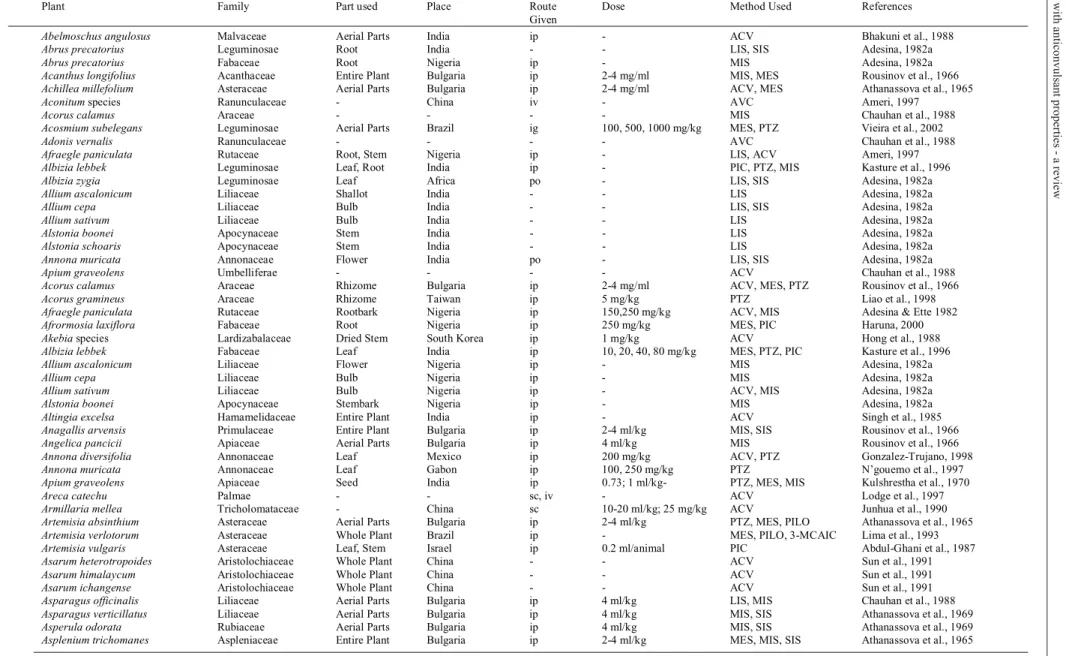
the utilized parts and methods (see Table 1).
The 20th century has witnessed considerable
progress in anticonvulsant drug development (Loscher
& Schmidt, 1994). The major drugs in clinical use, i.e.
phenytoin, carbamazepine, valproate, benzodiazepines,
ethosuximide, phenobarbital and primidone, were
developed and introduced between 1910 and 1970 and
will be referred to as ‘old drugs’ or ‘fi rst generation’ drugs
in the following. After a hiatus of over 20 years, several
new anticonvulsant drugs, i.e., vigabatrin, gabapentin,
felbamate, lamotrigine, oxcarbazepine, tiagabine and
topiramate, have been introduced into clinical practice,
referred to as ‘new drugs’ or ‘second generation’ drugs
in the following. More recent anticonvulsants which are
in preclinical or clinical development will be referred to
as ‘third generation’ drugs (Löscher, 1998).
In the other hand, approximately 70% of patients
with epilepsy are well controlled by monotherapy
with currently available antiepileptic drugs. Another
5-10% of patients are stabilized by the addition of
another antiepileptic drug but there remains over 20%
of patients whose seizures are not controlled (Richens
& Perucca, 1993). Therefore, phytomedicines can
potentially play an important role in the development
of new antiepileptic drugs to pharmacoresistent patients
(Nsour et al., 2000).
800
Lucindo J. Quintans Júnior, Jackson R.G.S. Almeida, Julianeli T. Lima, et al.
Rev. Bras. Farmacogn. Braz J. Pharmacogn. 18 (Supl.): Dez. 2008
et al., 1965 and 1969; Dhar et al., 1968 and 1973;
Adesina, 1982a; Chauhan et al., 1988 and Nsour et al.,
2000) were previously published with regards to plants
with anticonvulsant properties.
In fact, current world-wide interest in traditional
medicine has led to rapid development and studies of
many remedies employed by various ethnic groups of
the world. The information is recorded in alphabetical
order of plant scientifi c name, family, part used, route of
administration, dose, method and reference, as showed
in Table 1 that summary of the plants which have been
tested or reported for anticonvulsant properties.
Among those medicinal plants are found to
possess anticonvulsant activity in animal models and/or
folk medicine, include: Abelmoschus angulosus,
Allium
sativum, Artemisia spp,
Cannabis sativa, Cinchona
offi
cinalis, Egletes viscosa,
Icacina trichantha,
Magnolia grandifl ora, Plumbago zeylanica and others.
However, a recent study with Brazilian Northeastern
plants showed proexcellent results for the species
Bauhinia outimouta,
Rauvolfi a ligustrina
and
Ximenia
americana
(Quintans-Júnior et al., 2002). In our review
13 Brazilian plants were cited: Acosmium subelegans,
Artemisia verlotorum, Centella asiatica,
Cymbopogon
citratus, Erythrina velutina, Erythrina mulungu,
Hippeastrum vittatum, Lanata microphylla, Licaria
puchury-major, Lippia alba, Nepeta cataria, Passifl ora
alata
and
Xylopia
spp.
Among those plants tested, a number of
them (from different families) are found to possess
anticonvulsant activity. While in most cases, the active
constituents are yet to be found, for those where the
active components are known, they belong to different
chemical classes. However, previous studies showed
that some natural plant coumarins and triterpenoids
exhibit anticonvulsant properties (Chaturvedi et al.,
1974; Nsour et al., 2000).
In addition, the history of drug discovery showed
that plants are highly rich sources in the search for new
active compounds and they have become a challenge to
modern pharmaceutical industry. Many synthetic drugs
owe their origin to plant-based complementary medicine
(Howes et al., 2003; Orhan et al., 2004).
A number of animal models have demonstrated
utility in the search for more effi cacious and more
tolerable AEDs. In fact, the models employed in the
early phase of AED discovery are highly predictive
of subsequent effi cacy in easy-to-manage generalized
and partial epilepsy (Smith et al., 2007). Thus, animal
models more employed were leptazole-induced seizure
(LIS), maximal electroshock seizure (MES),
metrazole-induced seizures (MIS), picrotoxin-metrazole-induced convulsions
(PIC), pilocarpine (PILO), pentylenetetrazole (PTZ) and
strychnine-induced seizures (SIS). However, MES, PIC
and PTZ seizure models continue to represent the three
most widely used animal seizure models employed in
the search for new AEDs (While et al., 2002).
This review only briefl y mention the most
common animal methods for evaluating of the plants
with anticonvulsant properties and medicinal plants
studies to epilepsy described in literature. More
information, seen an excellence reviews by Mello et
al. (1986), Fisher (1989), Meldrum (1997), Nsour et al.
(2000) and Smith et al. (2007).
Animals models for testing anticonvulsant drugs
(Screening)
Since the Landmark identifi cation of the
anticonvulsant properties of phenytoin in 1936 by virtue
of its ability to protect against electroshock-induced
convulsions in the cat (Putman & Merritt, 1937) the
majority of novel AEDs have been identifi ed through
screening in animal models of epilepsy.
The National Institutes of Health (NIH)/
American Epilepsy Society (AES) Models II Workshop,
held in 2002, described the “ideal” epilepsy model
as one that refl ects similar pathophysiology and
phenomenology to human epilepsy. Seizures should
evolve spontaneousl after a postinsult latent period
or in a developmental time frame consistent with the
human condition. Furthermore, the ideal model should
display a pharmacological profi le that is resistant to at
least two of the existing AEDs (Stables et al., 2003).
Finally, the ideal model would be amenable to
high-throughput screening. Given the highly heterogeneous
nature of seizure disorders in humans, the complexity of
the seizure phenotypes, and the syndromes involved, the
reality is that it is highly unlikely that any one animal
model will ever predict the full therapeutic potential of
an investigational AED. Therefore, investigational AEDs
are currently evaluated in a battery of syndrome-specifi c
model systems. As specifi c models are developed (and
the drugs they identify are validated clinically), they are
integrated into the existing discovery process to better
identify more effective antiseizure and potentially
antiepileptic therapies. Moving beyond the symptomatic
treatment of epilepsy, the goal of most basic and clinical
scientists in epilepsy research is to identify therapies
capable of preventing, delaying, or modifying the
disorder (Smith et al., 2007).
The fact that preclinical models used for
identifi cation and development of novel drugs have been
originally validated by ‘old’ drugs, i.e. conventional
anticonvulsants, may explain that several of the new
drugs possess mechanisms which do not differ from
those of the standard drugs .
The MES and PTZ tests
801
Plants with anticonvulsant properties - a reviewRev. Bras. Farmacogn. Braz J. Pharmacogn.
Schmidt, 1988). The maximal electroshock seizure test,
in which tonic hindlimb seizures are induced by bilateral
corneal or transauricular electrical stimulation, is
thought to be predictive of anticonvulsant drug effi cacy
against generalized tonic-clonic seizures, while the
pentylenetetrazole test, in which generalized myoclonic
and clonic seizures are induced by systemic (usually
s.c. or i.p.) administration of convulsant doses of PTZ,
is thought to represent a valid model for generalized
absence and/or myoclonic seizures in humans (Löscher,
1998).
Everett and Richards (1944) demonstrated that
both trimethadione and phenobarbital, but not phenytoin
(PHT), were able to block seizures induced by the
GABA
A-receptor antagonist PTZ. Soon thereafter,
Lennox (1945) demonstrated that trimethadione was
effective at attenuating petit mal (i.e., absence epilepsy)
attacks but was ineffective intreating or worsening grand
mal seizures (i.e., generalized tonic-clonic seizures).
The positive results obtained in the PTZ seizure
test were historically considered suggestive of potential
clinical utility against generalized absence epilepsy,
based largely on the fi nding that drugs active in the
clinic against spike-wave seizures (e.g., ethosuximide,
trimethadione, valproic acid, the benzodiazepines) were
effective at blocking clonic seizures induced by PTZ
(Smith et al., 2007).
MES and PTZ tests provide some insight into
the ability of a given drug to penetrate the blood-brain
barrier and exert a central nervous system (CNS) effect.
Indeed, both models are nonselective with respect to
mechanism and therefore are well suited for screening
anticonvulsant activity, as neither model assumes that
the pharmacodynamic activity of a particular drug is
dependent on its molecular mechanism of action (Smith
et al., 2007).
The pilocarpine (PILO) and kainate (KAI) test
Pilocarpine and kainate models replicate
several phenomenological features of human temporal
lobe epilepsy and can be used as animal preparations
to understand the basic mechanisms of epileptogenesis
(Turski et al., 1983; Ben-Ari, 1985; Turski et al., 1989).
Local or systemic administration of PILO and KAI in
rodents leads to a pattern of repetitive limbic seizures
and status epilepticus, which can last for several hours
(Cavalheiro et al., 1982; Leite et al., 2002).
The brain damage induced by status epilepticus
in such preparations may be considered an equivalent of
the initial precipitating injury event, usually a prolonged
febrile convulsion, which is commonly found in patients
with mesial temporal lobe epilepsy (Leite et al., 2002).
Indeed, neuropathological changes such as
neuron loss in several hippocampal subfi elds and
reorganization of mossy fi bers into the molecular layer
of the fascia dentata are observed in both models and are
similar to hippocampi from patients with hippocampal
sclerosis (Mello et al., 1993; Mathern et al., 1995). This
abnormal synaptic reorganization has been suggested
to be an anatomical substrate for epileptogenesis
(Buckmaster & Dudek, 1997).
Thus, for AED studies in PILO and KAI models,
sequential analysis will enable to build precise and
reliable correlations between pharmacological effects
on seizure behavior and involved brain substrates (Leite
et al., 2002).
Chemical kindling model
Those animal models previously cited are
convenient but does not mimic spontaneous seizures
occurring in the epileptic brain (Meldrum & Rogawski,
2007). Indeed, kindling model has been widely studied
both as a tool for understanding chronic epileptogenesis
and as a model for testing AEDs with a potential for
treating complex partial seizures. This model is too
laborious for use as a primary screening procedure,
yet it is clear that it consistently identifi es compounds
with therapeutic potential in complex partial seizures
(Löscher & Schmidt, 2006).
The kindling model of epileptogenesis,
originally described by Goddard et al. (1969), is
characterized by the development of persistent reduction
in seizures threshold after a repeated administration of
subconvulsant doses of stimulant drugs, such as cocaine,
carbamylcholine and pentylenetetrazole (PTZ) (Fabisiak
& Schwark, 1982). A well-established model in epilepsy
research is PTZ-kindling of mice and rats.
PTZ may cause seizures by inhibitory chloride
ion channel associated with GABA
Areceptors (Meldrum
& Nilsson, 1976). The mechanism underlying kindling
are nowadays still not completely understood (Rössler
et al., 2000). As PTZ has been shown to interact with
the GABA neurotransmitter and the GABA receptor
complex (Löscher & Schmidt, 1988), On the other
hand, investigations concerning the biochemistry
of glutamate, especially modifi cations in glutamate
binding after electrical kindling, showed increased
glutamate release and increased receptor density in
target neurons populations (Cincotta et al., 1991). Other
studies provided evidence that AMPA and NMDA
receptors are involved in the initiation of seizures and
their propagation (Velisek et al., 1995) and that NMDA
receptors antagonists retard the development of kindling
(Becker et al., 2001). Although, little is known about
the changes of the glutamatergic neuronal transmission
after chemical kindling induced by repeated applications
of initially subconvulsive doses of PTZ (Rauca et al.,
2000), however, alters in glutamatergic system may not
be the main factor but one of several possibilities.
802
Lucindo J. Quintans Júnior, Jackson R.G.S. Almeida, Julianeli T. Lima, et al.
Rev. Bras. Farmacogn. Braz J. Pharmacogn. 18 (Supl.): Dez. 2008
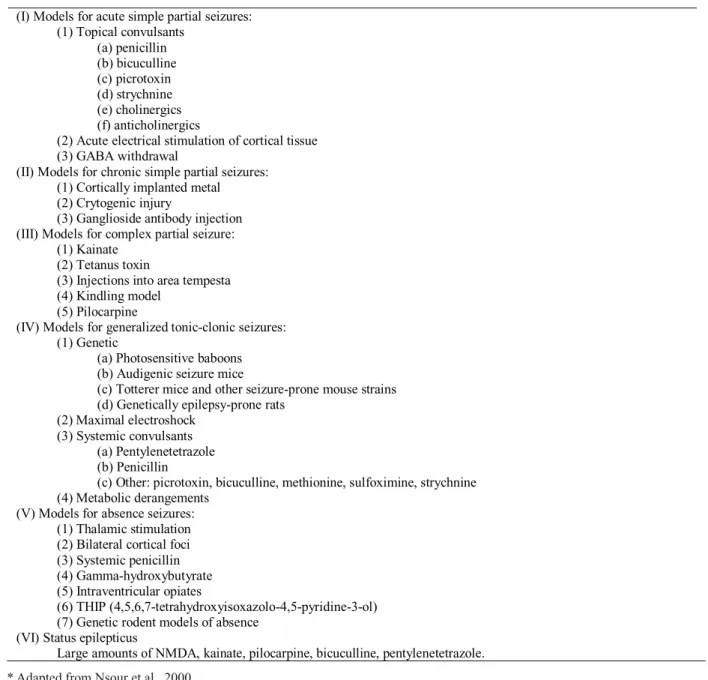
Summary of the common methods used to
evaluation anticonvulsant properties of the medicinal
plants and AED as showed in Table 2.
In fact, all currently available drugs are
anticonvulsant (anti-seizure) rather than antiepileptic.
The latter term should only be used for drugs which
prevent or treat epilepsy and not solely its symptoms.
The goal of therapy with an anticonvulsant drug is to
keep the patient free of seizures without interfering with
normal brain function (Löscher, 1998). The selection of
an anticonvulsant drug is based primarily on its effi cacy
for specifi c types of seizures and epilepsy (Mattson,
1995).
CONCLUSION
Plants with anticonvulsant properties - a review
Rev
. Bras. Farmacogn.
Braz J. Pharmacogn.
18 (Supl.): Dez. 2008
Plant Family Part used Place Route
Given
Dose Method Used References
Abelmoschus angulosus Malvaceae Aerial Parts India ip - ACV Bhakuni et al., 1988
Abrus precatorius Leguminosae Root India - - LIS, SIS Adesina, 1982a
Abrus precatorius Fabaceae Root Nigeria ip - MIS Adesina, 1982a
Acanthus longifolius Acanthaceae Entire Plant Bulgaria ip 2-4 mg/ml MIS, MES Rousinov et al., 1966
Achillea millefolium Asteraceae Aerial Parts Bulgaria ip 2-4 mg/ml ACV, MES Athanassova et al., 1965
Aconitum species Ranunculaceae - China iv - AVC Ameri, 1997
Acorus calamus Araceae - - - - MIS Chauhan et al., 1988
Acosmium subelegans Leguminosae Aerial Parts Brazil ig 100, 500, 1000 mg/kg MES, PTZ Vieira et al., 2002
Adonis vernalis Ranunculaceae - - - - AVC Chauhan et al., 1988
Afraegle paniculata Rutaceae Root, Stem Nigeria ip - LIS, ACV Ameri, 1997
Albizia lebbek Leguminosae Leaf, Root India ip - PIC, PTZ, MIS Kasture et al., 1996
Albizia zygia Leguminosae Leaf Africa po - LIS, SIS Adesina, 1982a
Allium ascalonicum Liliaceae Shallot India - - LIS Adesina, 1982a
Allium cepa Liliaceae Bulb India - - LIS, SIS Adesina, 1982a
Allium sativum Liliaceae Bulb India - - LIS Adesina, 1982a
Alstonia boonei Apocynaceae Stem India - - LIS Adesina, 1982a
Alstonia schoaris Apocynaceae Stem India - - LIS Adesina, 1982a
Annona muricata Annonaceae Flower India po - LIS, SIS Adesina, 1982a
Apium graveolens Umbelliferae - - - - ACV Chauhan et al., 1988
Acorus calamus Araceae Rhizome Bulgaria ip 2-4 mg/ml ACV, MES, PTZ Rousinov et al., 1966
Acorus gramineus Araceae Rhizome Taiwan ip 5 mg/kg PTZ Liao et al., 1998
Afraegle paniculata Rutaceae Rootbark Nigeria ip 150,250 mg/kg ACV, MIS Adesina & Ette 1982
Afrormosia laxiflora Fabaceae Root Nigeria ip 250 mg/kg MES, PIC Haruna, 2000
Akebia species Lardizabalaceae Dried Stem South Korea ip 1 mg/kg ACV Hong et al., 1988
Albizia lebbek Fabaceae Leaf India ip 10, 20, 40, 80 mg/kg MES, PTZ, PIC Kasture et al., 1996
Allium ascalonicum Liliaceae Flower Nigeria ip - MIS Adesina, 1982a
Allium cepa Liliaceae Bulb Nigeria ip - MIS Adesina, 1982a
Allium sativum Liliaceae Bulb Nigeria ip - ACV, MIS Adesina, 1982a
Alstonia boonei Apocynaceae Stembark Nigeria ip - MIS Adesina, 1982a
Altingia excelsa Hamamelidaceae Entire Plant India ip - ACV Singh et al., 1985
Anagallis arvensis Primulaceae Entire Plant Bulgaria ip 2-4 ml/kg MIS, SIS Rousinov et al., 1966
Angelica pancicii Apiaceae Aerial Parts Bulgaria ip 4 ml/kg MIS Rousinov et al., 1966
Annona diversifolia Annonaceae Leaf Mexico ip 200 mg/kg ACV, PTZ Gonzalez-Trujano, 1998
Annona muricata Annonaceae Leaf Gabon ip 100, 250 mg/kg PTZ N’gouemo et al., 1997
Apium graveolens Apiaceae Seed India ip 0.73; 1 ml/kg- PTZ, MES, MIS Kulshrestha et al., 1970
Areca catechu Palmae - - sc, iv - ACV Lodge et al., 1997
Armillaria mellea Tricholomataceae - China sc 10-20 ml/kg; 25 mg/kg ACV Junhua et al., 1990
Artemisia absinthium Asteraceae Aerial Parts Bulgaria ip 2-4 ml/kg PTZ, MES, PILO Athanassova et al., 1965
Artemisia verlotorum Asteraceae Whole Plant Brazil ip - MES, PILO, 3-MCAIC Lima et al., 1993
Artemisia vulgaris Asteraceae Leaf, Stem Israel ip 0.2 ml/animal PIC Abdul-Ghani et al., 1987
Asarum heterotropoides Aristolochiaceae Whole Plant China - - ACV Sun et al., 1991
Asarum himalaycum Aristolochiaceae Whole Plant China - - ACV Sun et al., 1991
Asarum ichangense Aristolochiaceae Whole Plant China - - ACV Sun et al., 1991
Asparagus officinalis Liliaceae Aerial Parts Bulgaria ip 4 ml/kg LIS, MIS Chauhan et al., 1988
Asparagus verticillatus Liliaceae Aerial Parts Bulgaria ip 4 ml/kg MIS, SIS Athanassova et al., 1969
Asperula odorata Rubiaceae Aerial Parts Bulgaria ip 4 ml/kg MIS, SIS Athanassova et al., 1969
Asplenium trichomanes Aspleniaceae Entire Plant Bulgaria ip 2-4 ml/kg MES, MIS, SIS Athanassova et al., 1965
804
Lucindo J. Quintans Júnior
, Jackson R.G.S.
Almeida, Julianeli
T. Lima, et al.
Rev
. Bras. Farmacogn.
Braz J. Pharmacogn.
18 (Supl.): Dez. 2008
Atractylodes lancea Asteraceae Rhizome Japan po 250, 500 mg/kg MES Yamahara et al., 1977
Astragalus centralpinus Leguminosae - - ip - HIC Chauhan et al., 1988
Atractylodes lancea Asteraceae - China ip 500 mg/kg MIN, PTZ, PIC Chiou et al., 1997
Baccharis serraefolia Asteraceae Leaf Mexico ip 200 mg/kg PIZ, SIS Tortoriello et al., 1996
Basslla alba Basellaceae Leaf, Stem India po - LIS, SIS Adesina, 1982a
Basslla ruba Basellaceae Leaf, Stem India po - LIS, SIS Adesina, 1982a
Bauhinia outimouta Fabaceae Whole Plant Brazil ip 150 mg/kg PTZ Quintans-Júnior et al., 2002
Berberis lycium Berberidaceae Root India ip 25 mg/kg MES Dhar et al., 1968
Boerhavia diffusa Nyctaginaceae Leaf Nigeria ip 2 mg/kg ACV, PTZ, MES, MIS Akah & Nwambie, 1993
Bupleurum chinense Apiaceae Entire Plant China ip - ACV Wu & Yu, 1984
Bupleurum falcatum Apiaceae Root China/Japan ip, po 1,5 mg/kg ACV Narita et al., 1982
Butea monosperma Fabaceae Flower India ip 50, 200 mg/kg MES, PTZ, SIS Kasture et al., 2000
Buthus martensii Buthidae Venom China - - ACV Liu et al., 1989
Cadia rubra Fabaceae Leaf Madagascar ip 100 mg/kg PTZ Pieretti et al., 1993
Caesalpinia bonduc Leguminosae Root, Stem - - - LIS, SIS Adesina, 1982a
Caesalpinia bonducella Fabaceae Leaf Nigeria ip - MES, MIS, SIS Adesina, 1982a
Calliandra portoricensis Leguminosae Root, Stem Nigeria ip 100, 300 mg/kg LIS, MIS, SIS Akah & Nwaiwu 1988
Cannabis sativa Cannabinaceae Whole Plant Bulgaria ip,po, sc 2-4 ml/kg ACV, PTZ, MES, KID Dantas, 2005; Dwivedi & Harbison, 1975
Canscora decussata Gentianaceae Whole Plant - po - ACV Dikshit et al., 1972
Capparis baduca Capparaceae - - - - ACV Adesina, 1982a
Capsella bursa-pastoris Brassicaceae Entire Plant Bulgaria ip 2-4 ml/kg MES, MIS Rousinov et al., 1966
Capsicum annum Solanaceae Flower - - - LIS, SIS Adesina, 1982a
Carica papaya Caricaceae Root Nigeria - 20, 100 mg/kg MES, LIS, SIS Chauhan et al., 1988
Carthamus tinctorius Asteraceae Flower Japan sc 10 mg/kg MIS Kasahara et al., 1989
Casimiroa edulis Rutaceae Leaf Mexico po, sc 10, 100 mg/kg MES, MIS Adesina 1982a; Ruiz et al.,
1995
Cassia siamea Fabaceae Leaf Thailand ip - MIS, SIS Arunlakshana, 1949
Centella asiatica Apiaceae Aerial Part,
Entire Plant
Nigeria, India, Brazil
ip -, 500 mg/kg LIS, PTZ, SIS Chauhan et al., 1988; Sudha
et al. 2002; De Lucia et al., 1997
Cerbera odollam Apocynaceae Leaf Vietnam ip 10 mg/kg PTZ Hien et al., 1991
Chaerophyllum bulbosum Apiaceae Aerial Part Bulgaria ip 2-4 ml/kg MES, MIS, SIS Rousinov et al., 1966
Chelidonium majus Papaveraceae Aerial Part França ip 9.5 mg/kg MES, PTZ Mahe et al., 1978
Chrysanthemum indicum Asteraceae Flower, Stem Bulgaria ip 0.25 mg/kg MÊS, SIS Lashev et al., 1981
Cimicifuga dahurica Ranunculaceae Root Russia ip - SIS Nikol-Skaya & Shreter, 1961
Cimicifuga simplex Ranunculaceae Rhizome China - 0.5, 1, 2 mg/kg MIS, SIS Shibata et al., 1980
Cinnamomum cassia Lauraceae Bark China po 2 mg ACV Narita et al., 1982
Cinnamomum loureirii Lauraceae Bark China po 0.3% ACV, MIS Sugaya et al., 1978
Cinnamomum zeylanicum Lauraceae Bark China po 1 mg/kg ACV Sugaya et al., 1988
Cinchona officinalis Rubiaceae - - - - ACV Chauhan et al., 1988
Cissampelos pareira Menispermaceae Root Nigeria ip - MIS, LIS, SIS Adesina, 1982a
Cistus villosus var.tauricus Cistaceae Aerial Part Bulgaria ip 4 ml/kg MES, MIS, SIS Athanassova et al., 1969
Citrus aurantifolia Rutaceae Peel, Flower - - - LIS, SIS Adesina, 1982a
Citrus aurantium Rutaceae Peel - ip 800 mg/kg LIS, SIS Adesina, 1982a
Citrus bergamia ssp. vulgaris Rutaceae Flower Italy ip 20,40 mg/kg PTZ Occhiuto et al., 1995
Clausena anisata Rutaceae Root, Stem Nigeria ip 150, 250 mg/kg MIS, PTZ, SIS Makanju, 1983
Cleome cileata Capparidaceae Leaf Nigeria ip 55, 68 mg/kg MES, PTZ Akah et al., 1993; 1997
Clerodendrum colebrookianum Verbenaceae Leaf India ip 40 mg/kg SIS Gupta et al., 1998
Plant Family Part used Place Route
Given
Plants with anticonvulsant properties - a review
Rev
. Bras. Farmacogn.
Braz J. Pharmacogn.
18 (Supl.): Dez. 2008
Cnestis ferruginea Verbenaceae Rootbark Ivory Coast ip 0.7 mg/kg SIS Declume et al., 1984
Cnestis glabra Connaraceae - - - - ACV Chauhan et al., 1988
Cocculus hirsutus Menispermaceae Root, Stem India ip 100 mg/kg MES, MIS Das et al., 1964
Cola acuminata Sterculiaceae - - - - LIS, SIS Adesina, 1982a
Connarus wightii Connaraceae Aerial Part India ip 165 mg/kg SIS Dhar et al., 1973
Consolida orientalis Ranunculaceae Aerial Part Bulgaria ip 4 ml/kg MES, MIS, SIS Athanassova et al., 1969 Convolvulus arvensis Convolvulaceae Aerial Part Bulgaria ip 4, 44 ml/kg ACV, MIS, SIS Chauhan et al., 1988, Convolvulus hirsutus Convolvulaceae Aerial Part Bulgaria ip 4 ml/kg MIS, SIS Athanassova et al., 1969
Convolvulus pluricaulis Convolvulaceae Entire Plant India ip - ACV, MES Sharmaxvn et al., 1965
Convolvulus suendermannii Convolvulaceae Aerial Part Bulgaria ip 4 ml/kg MIS, SIS Athanassova et al., 1969
Coptis chinensis Ranunculaceae Rhizome South Korea - 1 mg/kg ACV Hong et al., 1988
Corydalis cava Papaveraceae Aerial Part Bulgaria ip 2-4 ml/kg, 4 mg/kg MES Athanassova et al., 1965
Crassostrea gigas Ostreidae - Japan po 10% ACV Bac et al., 1998
Croton zehntneri Euphorbiaceae Branches Brazil - 20,80 mg/kg ACV, PIC, SIS Bernardi et al., 1991
Coyledon orbiculata Crussalaceae - South Africa ip 50-400 mg/kg ACV, PIC, PTZ Amabeoku et al., 2007
Cryptotympana atrata Cicadidae Skin Taiwan ig 0.5 mg/kg PIC Hsieh et al., 1991
Cucurbita pepo Cucurbitaceae - Nigeria - - LIS, SIS Adesina, 1982a
Cuminum cyminum Apiaceae Fruit Iran ip 0.5 ml/mg MES, PTZ Sayyah et al., 2002
Curcuma amada Zingiberaceae Rhizome India ip 500 mg/kg MES Bhakuni et al., 1969
Curcuma aromatica Zingiberaceae Root China Ig, po -, 2.5 mg ACV Li, 1987
Cuscuta chinensis Convolvulaceae Entire Plant China ig 1 mg/kg ACV Akbar et al., 1985a
Cyathea nilgirensis Cyatheaceae Aerial Part India ip 0.25 mg/kg MES Dhawan et al., 1977
Cylista scariosa Fabaceae Root India ip 500 mg/kg SIS Dhar et al., 1968
Cymbopogon citratus Gramineae Leaf Brazil po, ip - ACV Carlini et al., 1986
Cynanchum otophyllum Asclepiadaceae Rhizome China ip 12.5 mg/kg ACV Pei et al., 1981
Cynodon dactylon Gramineae Leaf Nigeria ip 600 mg/kg MES, MIS, PTZ Akah et al., 1997
Cyperus articulatus Cyperaceae Rhizome L. America po 50-2000 mg/kg AVC Ngo Bum et al., 1996
Cyperus rotundus Cyperaceae Root Nigeria ip - LIS, SIS Adesina, 1982a
Cystophora moniliformis Cystoseiraceae Thallus Australia - - ACV Spence et al., 1979
Cystoseira usneoides Cystoseiraceae Thallus Spain ip 6.25 mg/kg ACV Vazquez-Freire et al., 1995
Delphinium consolida Ranunculaceae Aerial Parts Bulgaria ip 4 ml/kg AVC, MIS, SIS Nsour et al., 2000
Delphinium denudatum Ranunculaceae Root Pakistan ip 400, 600, 800 mg/kg ACV, PIC, PTZ, SIS Raza et al., 2001
Desmodium adscendes Leguminosae Leaf Africa ip 300 mg/kg PTZ N’gouemo et al., 1996
Dictamnus albus Rutaceae Entire Plant Bulgaria sc 2-4ml/kg ACV Athanassova et al., 1965
Digitalis ferruginea Scrophulariaceae Entire Plant Bulgaria sc 2-4 ml/kg ACV, MES Athanassova et al., 1965
Digitalis lanata Scrophulariaceae Entire Plant Bulgaria sc 2-4 ml/kg ACV, MES Athanassova et al., 1965
Dillenia indica Dillenciaceae Leaf India ip 400 mg/kg MES Bhakuni et al., 1969
Diospyros kaki Ebenaceae Calix Japan - - ACV Fukuda & Shibata, 1994
Diospyros peregrine Ebenaceae Entire Plant India - - ACV Singh et al., 1985
Duboisia leichhardtii Solanaceae - - - - AVC Nsour et al., 2000
Dunaliella tertilecta Dunaliellaceae - Spain - - ACV Laguna et al., 1990
Echinacea purpurea Asteraceae - - - - AVC Nsour et al., 2000
Echium vulgare Boraginaceae Aerial Parts Bulgaria ip 4 ml/kg ACV, MES, MIS, SIS Nsour et al., 2000,
Egletes viscosa Asteraceae Flower Brazil ig - PTZ Souza et al., 1998
Elaeocarpus ganitus Elaeocarpaceae Entire Plant/Fruit India ip 1.2, 100 mg/kg MES, MIS Bhattacharya et al., 1975 Dasgupta et al., 1984
Elettaria cardamomum Zingiberaceae Seed India ig 3, 10 mg/kg ACV Shukia et al., 1987
Eryngiumfoetidum Apiaceae Leaf Jamaica ip 3 ml/kg PIC Simon, 1986
Erythroxylum spp. Erythroxylaceae Leaf - - - MIS Adesina, 1982a
Plant Family Part used Place Route
Given
806
Lucindo J. Quintans Júnior
, Jackson R.G.S.
Almeida, Julianeli
T. Lima, et al.
Rev
. Bras. Farmacogn.
Braz J. Pharmacogn.
18 (Supl.): Dez. 2008
Erythraea centaurium Gentianaceae Aerial Parts Bulgaria ip 2-4 ml/kg CZIZ Athanassova et al., 1965
Erythrina velutina Fabaceae Stem Bark Brazil ip 200-400 mg/kg PTZ, SIS Vasconcelos et al., 2007
Erythrina mulungu Fabaceae Stem Bark Brazil ip 200-400 mg/kg PTZ, SIS Vasconcelos et al., 2007
Euphorbia antiquorum Euphorbiaceae Whole Plant India ip 40 mg/kg MIS Dey et al., 1968
Euphorbia dracunculoides Euphorbiaceae Entire Plant India ip 500 mg/kg ACV, MES Bhakuni et al., 1969
Euphorbia hirta Euphorbiaceae Whole Plant - ip - ACV Lanhers et al., 1996
Euphorbia pilulifera Euphorbiaceae Whole Plant - - - ACV Chauhan et al., 1988
Euphorbia tirucalli Euphorbiaceae Aerial Part India ip 250 mg/kg ACV, MIS Dhar et al., 1968
Evolvulus nummularius Convolvulaceae Entire Plant India ip 40, 100 mg/kg MES, MIS Dey et al., 1968; Chatterjee 1964
Ferula gummosa Apiaceae Seed Iran ip 55, 198.3 mg/kg MES, PTZ Sayyah et al., 2002
Galeopsis ladanum Lamiaceae Aerial parts poland ip 200 mg/kg PTZ Czarnecki et al., 1993
Galicia spp. Galiaceae - - - - ACV Chauhan et al., 1988
Galium cruciata Rubiaceae - - - - ACV Chauhan et al., 1988
Galium sylvaticum Rubiaceae Aerial Parts Bulgaria ip 4 ml/kg MIS, SIS Chauhan et al., 1988,
Galphimia glauca Malpighiaceae Aerial Parts Mexico ip 500 mg/kg ACV, LIS, SIS Tortoriello et al., 1992
Galphimia glauca Malpighiaceae Aerial Parts Mexico ip - ACV Tortoriello, 1993
Ganoderma lucidum Ganodermataceae Fruit Japan sc 300 mg/kg PTZ, SIS Kasahara et al., 1987
Garcinia mangostana Clusiaceae Fruit - - - ACV Kurukawa et al., 1997
Gastrodia elata Orchidaceae - China 5, 10, 20, 500 mg/kg ACV, KAI Chen, 1977; Chauhan et al.,
1988, Hsieh et al., 2001
Geranium rotundifolium Geraniaceae Aerial Parts Bulgaria ip 4 ml/kg MES, MIS, SIS Athanassova et al., 1969
Ginkgo biloba Ginkgoaceae Rhizome Africa po - ACV Rodriguez, 1993
Gleditsia officinalis Fabaceae Fruit China ig - ACV Yen, 1977
Glycyrrhiza glabra Fabaceae Rhizome Korea - 1 mg/kg ACV Hong et al., 1988
Grewia hirsuta Tiliaceae Entire Plant India ip 500 mg/kg SIS Bhakuni et al., 1971
Gymnosporia falconeri Celastraceae Aerial Parts India ip 500 mg/kg MIS Bhakuni et al., 1971
Haplophyllum perforatum Rutaceae Seed - - - CZIC, LIS Chauhan et al., 1988
Haplophyllum locosum Rutaceae Seed - - - CZIC, LIS Chauhan et al., 1988
Haplophyllum spp Rutaceae - - - - ACV Chauhan et al., 1988
Hedera rhombea Araliaceae Leaf South Korea ip 0.1 mg/kg SIS Lee et al., 1992
Helianthus annuus Asteraceae Flower Bulgaria - 2-4 ml/kg CZIZ, MES Athanassova et al., 1965
Heracleum sibiricum Umbelliferae - - - - MES, PTZ, CZIC, SIS Chauhan et al., 1988
Heracleum vericillatum Umbelliferae - - - - MES, PTZ, CZIC, SIS Chauhan et al., 1988
Herpestris monniera Scrophulariaceae - - - - PTZ Chauhan et al., 1988
Hippeastrum vittatum Amarillydaceae Bulbs Brazil ip - Silva et al., 2006
Holarrhena floribunda Apocynaceae Leaf Nigeria ip - MES, PTZ Akah et al., 1997
Hoslundia opposita Lamiaceae Leaf Nigeria ip 50, 354, 398 mg/kg MES, PTZ Akah et al., 1993
Humulus lupulus Cannabaceae - Switzerland ip 250, 500 mg/kg PTZ Lee et al., 1993
Hypericum perforatum Hypericaceae Whole Plant Greece ip - PTZ Ozturk et al., 1996
Icacina trichantha Icacinaceae Tuber Nigeria ip 80, 100, 400 mg/kg ACV, PTZ, SIS Asuzu et al., 1990
Ipomoea stans Convolvulaceae Wood Mexico iv - MES, PTZ Contreras et al., 1996
Iris kamaonensis Iridaceae Entire Plant India ip 375 mg/kg MES Dhawan et al., 1977
Jatropha curcas Euphorbiaceae Root - - - LIS, SIS Adesina, 1982a
Jatropha gossypiifolia Euphorbiaceae Root, Leaf - - - LIS, SIS Adesina, 1982a
Juniperus macropoda Cupressaceae Fruit India ip 100 mg/kg ACV Mishra et al., 1989
Kalanchoe crenata Crussalaceae Leaf Cameroon ip 150, 300 mg/kg PTZ, SIS Nguelefack et al., 2006
Khaya grandifoliola Meliaceae Stembark Nigeria ip 50 mg/kg ACV Awe te al., 1997
Kochia prostrate Chenopodiaceae - - - - SIS Chauhan et al., 1988
Plant Family Part used Place Route
Given
Plants with anticonvulsant properties - a review
Rev
. Bras. Farmacogn.
Braz J. Pharmacogn.
18 (Supl.): Dez. 2008
Lactuca sativa Asteraceae Seed Egypt po 2.5 ml/kg PTZ Said et al., 1996
Lantana camara Verbenaceae Root, Leaf - iv - LIS, SIS Chauhan et al., 1988
Lantana microphylla Verbenaceae Leaf Brazil - - LIS, SIS Adesina, 1982a
Laurus nobilis Lauraceae Leaf Iran ip 10 ml/kg ACV Sayyah et al., 2002
Lavandura stoechas Lamiaceae Flower Africa ip 600 mg/kg PTZ Gilani et al., 2000
Ledebouriella seseloides Apiaceae Root China - - ACV Yen, 1977
Leea indica Leeaceae Leaf India ip 125 mg/kg SIS Dhar et al., 1968
Leonotis leonurus Lamiaceae Leaf South Africa ip 200 mg/kg ACV Beinvenu et al., 2002
Leonurus cardiaca Lamiaceae Aerial Parts Bulgaria ip 2-4 ml/kg ACV, MES, SIS Adesina, 1982a
Lettsomia setosa Convolvulaceae Aerial Parts India ip 500 mg/kg MES Bhakuni et al., 1971
Licaria puchury-major Lauraceae Dried Seed Brazil ip 200 mk/kg MES Carlini et al., 1983
Lippia alba Verbenaceae Leaf Brazil ip 200 mg/kg, 1g/kg SIS, PIC Barros Viana et al., 2000
Lobelia inflata Campanulaceae Leaf Sclotand po 10 ml ACV Bhakuni et al., 1971
Lobophytum species Alcyoniidae - Australia - - MIS Baird-Lambert et al., 1980
Lonchocarpus sericeus Leguminosae Root - - - LIS, SIS Chauhan et al., 1988
Luvunga scandens Rutaceae - India ip 100 mg/kg ACV Mishra et al., 1988
Lycium species Solanaceae Rootbark South Korea - 1 mg/kg ACV Hong et al., 1988
Magnolia grandiflora Magnoliaceae Seed Mexico ig 10 mg/kg MES Ramirez et al., 1998
Magnolia officinalis Magnoliaceae Bark China,Japan ip - ACV Watanabe et al., 1983
Magnolia obovata Magnoliaceae - - - - SIS, PIC Chauhan et al., 1988
Marsilea rajasthanesis Marsileaceae - - - - ACV Chauhan et al., 1988
Marrubium peregrinum Lamiaceae Aerial Parts Bulgaria ip 4 ml/kg MES, MIS Athanassova et al., 1965
Marrubium vulgare Lamiaceae Leaf, Flower Bulgaria ip 2-4 ml/kg ACV, CZIC, MES Chauhan et al., 1988,
Maprounea africana Euphorbiaceae Leaf Congo ip - ACV, MES, PTZ, PIC N’gouemo et al., 1994a
Matricaria chamomilla Asteraceae Flower Bulgaria ip 2-4 ml/kg CZIC, MES, PIC Athanassova et al., 1969
Matricaria recutita Asteraceae Flower USA, Europe iv - PTZ Viola et al., 1995
Maytenus spp. Celastraceae Leaf Brazil ip, po - TCES, PTZ Oliveira et al., 1991
Melia azedarach Meliaceae Root Bark Nigeria ip - MIS, SIS Adesina, 1982a
Melothria maderaspatana Cucurbitaceae Aerial Parts India - - ACV Sinha et al., 1997
Mentha piperita Lamiaceae Leaf - po 0.7, 10 ml/kg ACV Leslie, 1978
Mentha suaveolens Lamiaceae Leaf Spain ip 200 mg/kg ACV Moreno et al., 2002
Mikania cordata Asteraceae Aerial Parts Spain ip 400 mg/kg MES Moreno et al., 2002
Mitragyna africana Rubiaceae Stembark Nigeria ip 400 mg/kg SIS Aji et al., 2001
Momordica balsamina Cucurbitaceae Leaf Nigeria ip - LIS, SIS Adesina, 1982a
Momordica charantia Cucurbitaceae Leaf, Flower Nigeria ip - LIS, SIS Adesina, 1982a
Moringa oleifera Moringaceae Root Nigeria - - LIS, SIS Adesina, 1982a
Moringa pterygosperma Moringaceae Root Nigeria ip - MIS, SIS Adesina, 1982a
Nardostachys jatamansi Valerianaceae Rhizome India ip - ACV Debelmas et al., 1976
Nepeta cataria Lamiaceae Leaf Brazil In ration 10 % PTZ, SIS Massoco et al., 1995
Nerium oleander Apocynaceae Leaf Pakistan ip 50 mg/kg ACV Zia et al., 1995
Newboldia leavis Bignoniaceae Leaf Nigeria ip 100, 145, 186 mg/kg MES, PTZ Olajide et al., 1997
Nicotiana tabacum Solanaceae Leaf Nigeria ip - LIS, MIS, SIS Chauhan et al., 1988
Notopterygium incisum Apiaceae Root China ig - ACV Yen, 1977
Ocimum americanum Lamiaceae Leaf Nigeria ip - LIS Adesina, 1982a
Ocimum basilicum Lamiaceae Leaf Nigeria ip - LIS Adesina, 1982a
Ocimum canun Lamiaceae Leaf Thailand ig 20-50 mg SIS Ketusingha et al., 1950
Ocimum gratissimum Lamiaceae Leaf Nigeria ip - LIS, SIS Adesina, 1982a
Ocimum sanctum Lamiaceae Entire Plant India - 1mg ACV Sakina et al., 1990
Oplopanax elatus Araliaceae Root China - - ACV Qu et al., 1984
Plant Family Part used Place Route
Given
808
Lucindo J. Quintans Júnior
, Jackson R.G.S.
Almeida, Julianeli
T. Lima, et al.
Rev
. Bras. Farmacogn.
Braz J. Pharmacogn.
18 (Supl.): Dez. 2008
Ostrea species Ostreidae - Japan ig 1 mg/kg PTZ Tsuda et al., 1998
Pachyma species Polyporaceae Fruit South Korea - 1 mg/kg ACV Hong et al., 1988
Paconia radiz Paconiaceae Root Japan po - ACV Tsuda et al., 1997
Paeonia alba Paeoniaceae Root South Korea ig 800 mg/kg ACV Hung et al., 1983
Paeonia albiflora Paeoniaceae Root China po 6 mg ACV Narita et al., 1982
Paeonia albiflora Paeoniaceae Root Japan ig 100 mg/kg PTZ Sugaya et al., 1991
Paeonia emodi Paeoniaceae Root India Ig 10 mg/kg MIES, MIS Ahmad et al., 1981
Paeonia japonica var. pilosa Paeoniaceae Root South Korea ip 2, 20 mg/kg PIC, SIS Hong et al., 1979
Paeonia rubra Paeoniaceae Root South Korea ip 1 mg/kg ACV Hong et al., 1988
Palisota ambigua Commelinaceae Leaf Gabon ip 50 mg/kg PTZ N’gouemo et al., 1994b
Panax ginseng Araliaceae Root, Leaf China ip 100, 200 mg/kg MIS, PIC Takagi, 1977; Mitra et al.,
1996
Patrina intermedia Valerianaceae - - - - SIS Chauhan et al., 1988
Passiflora alata Passifloraceae Dried Leaf Brazil ip 75, 150 mg/kg MIS Oga et al., 1984
Passiflora incarnata Passifloraceae Leaf Italy ip 160 mg/kg PTZ Speroni et al., 1988
Pausinystalia yohimbe Rubiaceae Bark - ip - ACV Chermat et al., 1979
Persea indica Lauraceae Leaf Canary Islands - 2 mg/kg PTZ Mazzanti et al., 1993
Phaeodactylum tricoenutum Fragilaricaceae - Spain ip 150 mg/kg PTZ Laguna et al., 1990
Picnomon acarna Asteraceae - - - - ACV Chauhan et al., 1988
Picrorhiza kurroa Scrophulariaceae Entire Plant India - 500 mg/kg MIS Debelmas et al., 1976
Pimpinella anisum Apiaceae Fruit Bulgaria ip 2-4 ml/kg SZIC, MES Athanassova et al., 1969
Pinellia ternata Araceae Tuber China po 5 mg ACV Narita et al., 1982
Piper guineense Piperaceae Flower Nigeria ip - MIS, NMDLAIC Abila et al., 1993
Piper logum Piperaceae Fruit China ip 3.4, 263.4 mg/kg ACV, MES, PIC, PTZ Pei, 1983
Piper methysticum Piperaceae Flower Fiji ip 140 mg/kg SIS Klohs et al., 1959
Piper nigrum Piperaceae Flower China ip 2 mg/kg ACV, NMDLAIC Hu & Davies, 1997
Piscidia erythrina Fabaceae Bark USA ip 900 mg/kg PTZ Klohs et al., 1959
Pistacia integerrima Anacardiaceae - India ip 1 ml/kg PTZ Ansari et al., 1993
Pithecellobium samon Leguminosae - - - - PIC Chauhan et al., 1988
Plectranthus amboinicus Lamiaceae Entire Plant Cuba ip - ACV Buznego et al., 1999
Plumbago zeylanica Plumbaginaceae Root Nigeria ip - LIS Adesina, 1982a
Polygala sabulosa Polygalaceae Whole Plant Brazil ip 250, 500, 1000 mg/kg PTZ Duarte et al., 2007
Polypodium vulgare Polypodiaceae Root India ip 100 mg/kg MES, PTZ Mannan et al., 1989
Portucala oleracea Portulacaceae Whole Plant - ip - LIS, SIS Adesina, 1982a
Prunus spinosa Rosaceae Fruit India ig 1.5 mg/kg PTZ Mannan et al., 1989
Psidium guyanensis Myrtaceae Leaf Brazil po - PTZ, PIC, SIS Santos et al., 1997
Psidium pohlianum Myrtaceae Leaf Brazil ig 400 mg/kg PTZ Santos et al., 1996
Pterocarpus santalinus Fabaceae Stem India - - MES Mehta et al., 1979
Qingyangshen Asclepiadaceae Root China ip - KAI, ACV Kuang et al., 1991; Guo &
Kuang, 1993
Rauvolfia ligustrina Apocynaceae Root, Aerial Brazil ip, po 125, 250 mg/kg PTZ, PIC, SIS Quintans-Júnior et
al.,2002;2007
Rauvolfia schueli Apocynaceae - - - - ACV Adesina, 1982a
Rauvolfia serpentina Apocynaceae Root, Stem Bark India - - ACV Adesina, 1982a
Rauvolfia tetraphylla Apocynaceae Entire Plant India ip 500 mg/kg MES Bhakuni et al., 1969
Rauvolfia vomitoria Apocynaceae Root Nigeria - - LIS, MIS, SIS Sokomba et al., 1986
Rehmannia glutinosa Scrophulariaceae Root South Korea - 1 mg/kg ACV Hong et al., 1988
Rheum officinale Polygonaceae Rhizome China - - ACV Yen, 1977
Rhodiola rosea Crassulaceae - - sc - SIS Aksenova et al., 1966
Plant Family Part used Place Route
Given
Plants with anticonvulsant properties - a review
Rev
. Bras. Farmacogn.
Braz J. Pharmacogn.
18 (Supl.): Dez. 2008
Ricinus communis Euphorbiaceae Root Nigeria ip - MIS, LIS Adesina, 1982a
Rosmarinus officinalis Lamiaceae Entire Plant Israel ip 0.2 ml PIC Abdul-Ghani et al., 1987
Rubus brasiliensis Rosaceae Entire Plant Brazil Ip 300 mgkg ACV Nogueira et al., 2000
Rubus ellipticus Rosaceae Leaf India - - MES Rana et al., 1990
Ruta chalepensis Rutaceae Aerial Parts Mexico ip 450 mg/kg PTZ Aguilar-Santamaria et al.,
1996
Roylea elegans Lamiaceae - - ip - ACV Chauhan et al., 1988
Ruta chalepensis Rutaceae Leaf Usa, Mexico ip - MES, PTZ Aguilar-Santamaria et al.,
1996
Ruta graveolens Rutaceae Aerial Parts Bulgaria ip 2-4 ml/kg CZIC, MES Athanassova et al., 1969
Salvadora persica Salvadoraceae Stem Italy im 500 mg/kg ACV Monforte et al., 2002
Salvia guaranitica Lamiaceae Aerial Parts Latin America ip - ACV Viola et al., 1997
Salvia haematodes Lamiaceae Root India ig 500 mg/kg MES Akbar et al., 1984a
Salvia nemorosa Lamiaceae Aerial Parts Bulgaria ip 4 ml/kg MÊS, MIS, SIS Athanassova et al., 1965
Salvia nemorsa Lamiaceae Leaf Japan po ACV Sugaya et al., 1988; 1997
Salvia guaranitica Lamiaceae Aerial Parts Latin America ip - ACV Viola et al., 1997
Salvia sclarea Lamiaceae Aerial Parts Bulgaria ip 4 ml/kg MIS, SIS Athanassova et al., 1965
Salvia transsylvanica Lamiaceae Aerial Parts Egypt - 500, 1000 mg/kg ACV, PTZ Maklad et al., 1997
Sapindus trifoliatus Sapindaceae Seed India - - MES Gupta et al., 1996
Satureja clinopodium Lamiaceae Aerial Parts Bulgaria Ip 4 ml/kg MÊS, MIS, SIS Athanassova et al., 1965
Schisandra chinensis Schisandraceae Fruit South Korea ip - ACV Baek et al., 2000
Scolopendra subspinides Scolopendridae Entire Plant South Korea ip 1.7 mg/kg PIC, SIS Hong, 1976
Scutellaria baicalensis Lamiaceae Root China po 3 mg ACV Narita et al., 1982
Securidaca longepedunculata Polygalaceae Leaf Nigeria ip 50, 10 mg/kg LIS Ojewole, 2000
Senecio fuchsii Asteraceae Entire Plant Bulgaria - - MIS Stoyanov et al., 1981
Senecio jacobaea Asteraceae Entire Plant Bulgaria sc 2-4 ml/kg MES, MIS Athanassova et al., 1969
Sepia officinalis Seppidae - India - - ACV Reddy et al., 1994
Sesbania grandiflora Fabaceae Leaf India ig 25, 50, 100 mg/kg MES Kasture et al., 2002
Solanum americana Solanaceae Leaf, Flower Nigeria ip - ACV, LIS Adesina, 1982a
Solanum gilo Solanaceae Flower Nigeria ip - LIS Adesina, 1982a
Solanum indicum Solanaceae Entire Plant Nigeria ip 40 mg/kg LIS, MIS, SIS Dey et al., 1968; Adesina,
1982a
Solanum khasianum Solanaceae Entire Plant India ip 250 mg/kg MES Dhar et al., 1968
Solanum macrocarpon Solanaceae Leaf, Flower Nigeria ip - LIS, SIS Adesina, 1982a
Solanum melongena Solanaceae Leaf, Flower Nigeria ip - LIS, SIS Adesina, 1982a
Solanum nigrum Solanaceae Flower Nigeria/Mexico ip 255 mg/kg PTZ, MIS, LIS, SIS Adesina 1982a; Perez et al. 1998
Solanum torvum Solanaceae Flower Nigeria ip - LIS Adesina, 1982a
Sphencostylis stenocarpa Fabaceae Seed Nigeria ip 60 mg/kg LIS Asuzu, 1986
Spondias monbin Anacardiaceae Flower Nigeria ip - LIS, SIS Adesina, 1982a
Stenochilaena palustris Blechnaceae Entire Plant India ip 375 mg/kg SIS Dhar et al., 1973
Swertia purpurascens Gentianaceae Entire Plant India ip 100 mg/kg MES, MIS Dhar et al., 1973
Symphytum officinale Boraginaceae Root Bulgaria ip 2-4 ml/kg CZIC, MES Athanassova et al., 1969
Syzygium cumini Myrtaceae Seed Brazil ig - PTZ De Lima et al., 1998
Tabernaemontana pandacaqui Apocynaceae Stem Thailand ip 50 mg/kg PTZ Taesotikul et al., 1998
Talinum triangulare Portulacaceae Flower - - - LIS, SIS Adesina, 1982a
Taraxacum spp Asteraceae - - - - ACV Chauhan et al., 1988
Teclea simplifolia Rutaceae - - - - ACV Chauhan et al., 1988
Ternstroemia pinglei Theaceae Flower Mexico ip 450, 850 mg/kg PTZ, SIS Aguilar-Santamaria et al.,
1996
Plant Family Part used Place Route
Given
810
Lucindo J. Quintans Júnior
, Jackson R.G.S.
Almeida, Julianeli
T. Lima, et al.
Rev
. Bras. Farmacogn.
Braz J. Pharmacogn.
18 (Supl.): Dez. 2008
Tetrapleura tetraptera Fabaceae Arillus, Fruit Nigeria ip - LIS, MIS, PTZ Nwaiwu & Akah, 1986,
Adesina & Sofowora, 1979
Tetraselmis suecica Chlamydomonadaceae - - ip 400 mg/kg PTZ Laguna et al., 1993
Thalictrum thumbergii Ranunculaceae - - - - ACV Chauhan et al., 1988
Thalictrum hernandezii Ranunculaceae - - - - ACV Chauhan et al., 1988
Theobroma cacao Sterculiaceae Seed Usa po - ACV Marcus et al., 1997
Tilia species Tiliaceae Aerial Parts Bulgaria ip 2-4 ml/kg MES Athanassova et al., 1969
Trema guineensis Ulmaceae Leaf Gabon ip 0.3, 1 mg/kg PTZ, MÊS, PIC, KAI N’gouemo et al., 1994a
Trema orientalis Ulmaceae - - - - MIS Chauhan et al., 1988
Triticum aestivum Poaceae Seed Japan - - ACV Tsuda et al., 1986
Uncaria rhynchophylla Rubiaceae - China, -, ip 1, 70 mg/kg KAI, PTZ Hsieh et al., 1999
Uncaria sinensis Rubiaceae - - - - ACV Chauhan et al., 1988
Valeriana angustifolia Valerianaceae Leaf Austria ip 2.05, 2.20, 2.50 mg/kg MIS Pfeifer et al., 1953
Valeriana fauriei Valerianaceae Root Japan ig 17.2 ACV Yoshitomi et al., 2000
Valeriana jatamansi Valerianaceae Root Nepal - 500 mg/kg SIS Debelmas et al., 1976
Valeriana latifolia Valerianaceae Leaf Austria ip 2.10 mg/kg MIS Pfeifer et al., 1953
Valeriana officinalis Valerianaceae Rhizome France - 50 mg/kg ACV Fehri et al., 1991
Valeriana sambucifolia Valerianaceae Root Austria ip 2.35 mg/kg MIS Pfeifer et al., 1953
Vanda roxburghii Orchidaceae Entire Plant India ip 500 mg/kg MES Bhakuni et al., 1969
Veratrum viride Liliaceae - - - - ACV Chauhan et al., 1988
Vernonia gratiosa Asteraceae Aerial Parts Taiwan ip 3 mg/kg PIC, PTZ, SIS Hyou et al., 2001
Vinca erecta Apocynaceae - - - - ACV Chauhan et al., 1988
Vitex negundo Verbenaceae Leaf India ip 0.15 mg/kg LIS, SIS Gupta et al., 1990
Viscum capense Loranthaceae Stem South Africa ip 50, 400 mg/kg NMDLAIC, PTZ Amabeoku et al., 1998
Vithania ashvagandha Solanaceae Root India ip - ACV Prasad et al., 1968
Withania somnifera Solanaceae Entire Plant India - - ACV Singh et al., 1985
Xylopia spp Annonaceae - Brazil ip - LIS, SIS Adesina, 1982a
Xylopia aethiopica Annonaceae - Brazil ip - LIS, SIS Adesina, 1982a
Xylopia carminative Annonaceae - Brazil ip - LIS, SIS Adesina, 1982a
Xylopia frutescens Annonaceae - Brazil ip - LIS, SIS Adesina, 1982a
Xylopia grandiflora Annonaceae - Brazil ip - LIS, SIS Adesina, 1982a
Xylopia sericea Annonaceae - Brazil ip - LIS, SIS Adesina, 1982a
Ximenia americana Olacaceae Whole Plant Brazil ip 150 mg/kg PTZ Quintans-Júnior et al., 2002
Zea mays Gramineae - - - - LIS, SIS Adesina, 1982a
Zingiber officinale Zingiberaceae Rhizome Japan - - ACV Sugaya et al., 1978
Ziziphus jujuba Rhamnaceae Fruit Japan ip 2-4 mg/kg PTZ Tsuda et al., 1986
Plant Family Part used Place Route
Given
811
Plants with anticonvulsant properties - a reviewRev. Bras. Farmacogn. Braz J. Pharmacogn.
(I) Models for acute simple partial seizures: (1) Topical convulsants
(a) penicillin (b) bicuculline (c) picrotoxin (d) strychnine (e) cholinergics (f) anticholinergics
(2) Acute electrical stimulation of cortical tissue (3) GABA withdrawal
(II) Models for chronic simple partial seizures: (1) Cortically implanted metal (2) Crytogenic injury
(3) Ganglioside antibody injection (III) Models for complex partial seizure:
(1) Kainate (2) Tetanus toxin
(3) Injections into area tempesta (4) Kindling model
(5) Pilocarpine
(IV) Models for generalized tonic-clonic seizures: (1) Genetic
(a) Photosensitive baboons (b) Audigenic seizure mice
(c) Totterer mice and other seizure-prone mouse strains (d) Genetically epilepsy-prone rats
(2) Maximal electroshock (3) Systemic convulsants
(a) Pentylenetetrazole (b) Penicillin
(c) Other: picrotoxin, bicuculline, methionine, sulfoximine, strychnine (4) Metabolic derangements
(V) Models for absence seizures: (1) Thalamic stimulation (2) Bilateral cortical foci (3) Systemic penicillin (4) Gamma-hydroxybutyrate (5) Intraventricular opiates
(6) THIP (4,5,6,7-tetrahydroxyisoxazolo-4,5-pyridine-3-ol) (7) Genetic rodent models of absence
(VI) Status epilepticus
Large amounts of NMDA, kainate, pilocarpine, bicuculline, pentylenetetrazole. Table 2. Common methods used to induce convulsion in animal models*.
812
Lucindo J. Quintans Júnior, Jackson R.G.S. Almeida, Julianeli T. Lima, et al.
Rev. Bras. Farmacogn. Braz J. Pharmacogn. 18 (Supl.): Dez. 2008
REFERENCES
Abdul-Ghani AS, El-Lati SG, Sacaan AI, Suleiman MS, Amin RM 1987. Anticonvulsant effects of some Arab medicinal plants. Int J Crude Drug Res 25: 39-43. Abila B, Richens A, Davies JA 1993. Anticonvulsant effects
of extracts of the West African black pepper, Piper guineense.J Ethnopharmacol 39: 113-117.
Adesina SK, Sofowora EA 1979. The isolation of an anticonvulsant glycoside from Tetrapleura tetraptera.
Planta Med 36: 270-271.
Adesina SK 1982a. Studies on some plants used as anticonvulsants in Amerindian and African traditional medicine.Fitoterapia 53: 147-162.
Adesina SK, Ette EI 1982b. The isolation and identifi cation of anticonvulsant agents from Clausena anisata and Afraegle paniculata.Fitoterapia 53: 63-66.
Agra MF, França PF, Barbosa-Filho JM 2007. Synopsis of the plants known as medicinal and poisonous in Northeast of Brazil. Rev Bras Farmacogn 17: 114-140.
Agra MF, Silva KN, Basílio IJLD, França PF, Barbosa-Filho JM 2008. Survey of medicinal plants used in the region Northeast of Brazil. Rev Bras Farmacogn 18: 472-508.
Aguilar-Santamaria L, Tortoriello J 1996. Anticonvulsant and sedative effects of crude extracts of Ternstroemia pringlei and Ruta chalepensis. Phytother Res 10:
531-533.
Ahmad M, Tariq M, Afaq SH, Asif M 1981. A pharmacological study on udesaleeb (Paeonia emodi Linn.): a unani
anticonvulsant drug. Bull Islamic Med 1: 444-447.
Aji BM, Onyeyili PA, Osunkmo UA. 2001. The central nervous effects of Mitragyna africanus (Willd) stembark extract in rats. J Ethnopharmacol 77: 143-149. Akah PA, Nwaiwu JI 1988. Anticonvulsant activity of root
and stem extracts of Calliandra portoricensis. J Ethnopharmacol 22: 205-210.
Akah PA, Nwambie AI 1993. Nigerian plants with anti-convulsant property. Fitoterapia 64: 42-44.
Akah PA, Nwambie AI, Gamaniel KS, Wambebe C 1997. Experimental study of the anticonvulsant used for treatment of infantile convulsion in Nigeria. Brain Res Bull 44: 611-613.
Akbar S, Nisa M, Tariq M. 1985a. A study on CNS depressant activity of Salvia haematodes Wall. Int J Crude Drug Res 22: 41-44.
Akbar S, Nisa M, Tariq M 1985b. CNS depressant activity of
Cuscuta chinensis Lamm. Int J Crude Drug Res 23: 91-94.
Aksenova RA, Zotov MI, Nekhoda MF, Cherdyntsev SG 1966. Stimulating and adaptogenic effects of a refi ned preparation of Rhodiola rosea Rhodosin. Stimulyatory Tsent Nerv Sist (Ed:Saratikov As) Izd Tomsk Univ Tomsk 77.
Almeida RN, Navarro DS, Barbosa-Filho JM 2001. Plants with central analgesic activity. Phytomedicine 8:
310-322.
Amabeoku GJ, Leng MJ, Syce MA 1998. Antimicrobial and anticonvulsant activites of Viscum capense. J Ethnopharmacol 61: 237-241.
Amabeoku GJ, Green I, Kabatende J 2007. Anticonvulsant activity of Cotyledon orbiculata L. (Crassulaceae)
leaf extract in mice. J Ethnopharmacol 112:
101-107.
Amaral FMM, Ribeiro MNS, Barbosa-Filho JM, Reis AS, Nascimento FRF, Macedo RO 2006. Plants and chemical constituents with giardicidal activity. Rev Bras Farmacogn 16 (Supl.): 696-720.
Ameri A 1997. Inhibition of rat hippocampal excitability by the Aconitumalkaloid, 1-benzoylnapelline, but not by napelline. Eur J Pharmacol 335: 145-152.
Ansari SH, Ali M, Qadry JS 1993. Essential oils of Pistacia integerrima galls and their effect on the central
nervous system. Int J Pharmacogn 31: 89-95. Arunlakshana C 1949. Pharmacological study of the leaves of
Cassia siamea. Siriraj Hosp Gaz 1: 434-444.
Asuzu IU 1986. Pharmacological evaluation of the folklore use of Sphenostylis stenocarpa. J Ethnopharmacol 16: 263-267.
Asuzu IU, Ugwueze EE 1990. Screening of Icacina trichantha extracts for pharmacological activity. J Ethnopharmacol 28: 151-156.
Athanassova S, Shopova S, Roussinov K 1965. Pharmacological studies of Bulgarian plants with a view to their anti-convulsive effect. Acad Bulg Sci 18: 691-694. Athanassova S, Shopova S, Roussinov K, Markova M 1969.
Pharmacological studies of Bulgarian plants with a view to their anticonvulsive effect. Izv Inst Fiziol Bulg Akad Nauk 12: 205-216.
Awe SO, Olajide OA, Adeboye JO, Makinde JM 1997. Pharmacological evaluation of Khaya grandifoliola
methanolic extract. J Pharm Res Dev 2: 20-23.
Bac P, Pages N, Dhalluin S, Tapiero H 1998. Protective effect ofCrassostrea gigas extract on audiogenic seizures in magnesium defi cient mice. Biomed Pharmacother 52: 162-165.
Baek NI, Han JT, Ahn EM, Park JK, Cho SW, Jeon SG, Jang JS, Kim CK, Choi SY 2000. Isolation of anticonvulsant compounds from the fruits of Schizandra chinensis
Baili.Han’guk Nonghwa Hakhoe Chi 43: 72-77. Baird-Lambert J, Dunlop RW, Jamieson DD 1980.
Anticonvulsant activity of a novel diterpene isolated from a soft coral of Thegenus lobophytum. Arzneim-Forsch 30: 964-967.
Barbosa-Filho JM, Vasconcelos THC, Alencar AA, Batista LM, Oliveira RAG, Guedes DN, Falcão HS, Moura MD, Diniz MFFM, Modesto-Filho J 2005. Plants and their active constituents from South, Central, and North America with hypoglycemic activity. Rev Bras Farmacogn 15: 392-413.
Barbosa-Filho JM, Medeiros KCP, Diniz MFFM, Batista LM, Athayde-Filho PF, Silva MS, Cunha EVL, Almeida JRGS, Quintans-Júnior LJ 2006a. Natural products inhibitors of the enzyme acetylcholinesterase. Rev Bras Farmacogn 16: 258-285.
Barbosa-Filho JM, Martins VKM, Rabelo LA, Moura MD, Silva MS, Cunha EVL, Souza MFV, Almeida RN, Medeiros IA 2006b. Natural products inhibitors of the angiotensin converting enzyme (ACE). A review between 1980-2000. Rev Bras Farmacogn 16: 421- 446.