ISSN 0102-695X DOI: 10.1590/S0102-695X2012005000116 Received 28 Jun 2012 Accepted 14 Aug 2012 Available online 9 Oct 2012
factorial design
Ana R. M. Costa-Machado, Jairo K. Bastos, Luís A. P. de
Freitas
*Departamento de Ciências Farmacêuticas, Faculdade de Ciências Farmacêuticas de Ribeirão Preto, Universidade de São Paulo, Brazil.
Abstract: The Copaifera langsdorffii Desf., Fabaceae, is a Brazilian native tree, known as copaiba, which oil is commonly used in folk medicine as muscle relaxant, wound healing, antiseptic and anti-inflammatory to respiratory and urinary tracts. Despite of the wide use of the oil of Copaifera species, scientific works related to the study of its leaves are rarely found. In fact, processes for flavonoid extraction from C. langsdorffii leaves have not been studied yet leaving a wide field to be investigated. In this work, the 25-2 fractional factorial design was selected in order
to study how the factors of a dynamic maceration process influence the responses of total flavonoids, total phenols, quercetrin and afzelin contents, and antioxidant activity in extracts from C. langsdorffii leaves. The results demonstrated that the significant factors studied were the drug load in extractor, the ethanol/water ratio and the stirring speed whereas the temperature and the extraction time were not significant. In conclusion, this study allowed visualizing which factors were considered the most important in copaiba leaves dynamic maceration and their effect in extract antioxidant activity. Furthermore, this technological study gives directions to optimize future extraction experiments from C. langsdorffii.
Keywords: design of experiments dynamic maceration extraction phenolic compounds
Introduction
The Copaifera genus belongs to the botanic family Fabaceae Lindl. Copaifera species are distributed along South and Central America and with some occurrence in occidental Africa. In Brazil, there are more than twenty species found all over the territory. The Copaifera genus receives different designations around the world and in Brazil it is known as copaíba (Veiga-Júnior, 2005; Carvalho, 2004).
In spite of the wide use of the Copaifera species, scientific works to evaluate its biological activities, to elucidate its phytochemistry and to develop technological data are mainly targeted to the oil (Basile et al., 1988; Cascon & Gilbert, 2000; Gomes et al., 2008; Silva-Medeiros & Vieira, 2008; Santos et al., 2011) and technological studies related to its leaves are rare.
The Copaifera langsdorffii Desf. is a Brazilian native tree which oil, extracted from the tree trunk, is widely used in folk medicine as muscle relaxant, wound healing, antiseptic and anti-inflammatory to respiratory and urinary tracts (Veiga-Júnior, 2005; Carvalho, 2004).
According to the literature, the oil of the C.
langsdorffii contains chemical constituents as mainly tetracyclics diterpenes of the series: kauran as kaurenoic and kauranoic acids, clerodan as hardwickiic acid and labdanic as copalic acid besides sesquiterpenes (Ferrari et al., 1971; Ohsaki et al., 1994; Cascon & Gilbert, 2000; Maciel et al., 2002; Veiga-Júnior, 2005). The composition of C. langsdorffii dried leaves fractions presents the amino acid N-methyl-trans-4-hydroxy-L-prolin and other studies demonstrate the presence of 6 to 10% of phenolic compounds (Langenheim et al., 1986a,b; Figliuolo et al., 1987; Macedo & Langenheim, 1989a,b).
Sousa et al. (2012) identified the flavonoids quercetin-3-O-rhamnoside (quercetrin) and kaempferol-3-O-rhamnoside (afzelin) in fractions of hydroalcoholic extracts obtained from the leaves of C. langsdorffii and these compounds were used to develop and validate a HPLC method.
renal cells.
The extraction process is an important step to the plant extract standardization. In fact, it is inluenced by several factors such as the drug particle size, the drug state - whether dried or fresh - the drug bulk, solvent nature, solvent mixture in different ratios, solvent volume, temperature, agitation, pH and extraction time (Prista et al., 1995; List & Schmidt, 1989; Chirinos et al., 2007). However, the process of phenolic compounds extraction and of other constituents of the C. langsdorfii leaves hasn’t been studied yet leaving a wide ield to be investigated.
In this context, the design of experiments (DOE) is a powerful instrument to generate, apply and interpret scientific experiments in an effective way. It allows relating different parameters of the extraction to the amount of a substance or a group of substances that are of interest (Markom et al., 2007; Lu et al., 2011; Noriega et al., 2012). It offers the maximum information about how the factors influence the response evaluated while requiring minimum investment and time (Li, 2003; Noriega et al., 2012).
So, the purpose of this work was to study the inluence of the extraction factors on the total lavonoids, total phenols, quercetrin and afzelin contents in the extracts from C. langsdorfii leaves using the dynamic maceration method. Besides the chemical composition, the antioxidant activity of the extracts was also evaluated.
Materials and Methods
Plant material
The assessment to the leaves of the Copaifera langsdorffii Desf., Fabaceae, tree were authorized by the government agencies (CGEN 40/2012) and were collected in the region of Ribeirão Preto, SP, Brazil (21º15’S, 47º16’W, altitude 748 m) in September, 2009. A voucher specimen (SPFR 10120) was deposited in the herbarium of the Faculdade de Filosofia, Ciência e Letras of Ribeirão Preto, University of São Paulo.
The herbal material was cleaned and dried in ventilated atmosphere of 30±5 ºC temperature, milled in a cutting mill to obtain particles between 0.5 to 1.0 mm and stored in a closed plastic bag in fresh and dried environment at the temperature of 25 °C until its use.
Design of experiment
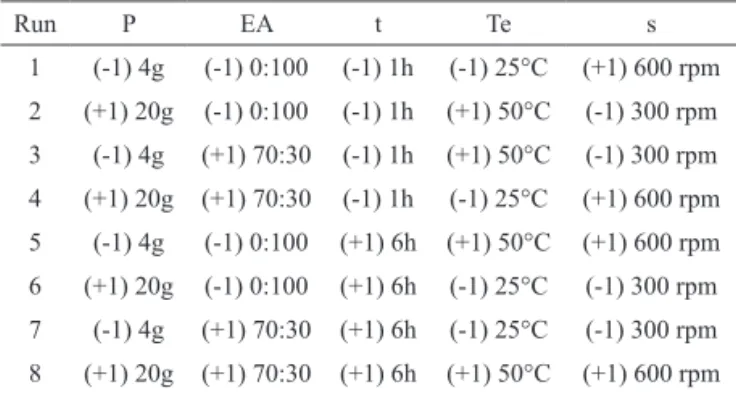
During this study, the 25-2 fractional factorial design was used (Table 1) resulting in eight experimental runs. The factors selected to the study were drug load in extractor, P (g), ethanol/water ratio, EA (%), extraction time, t (h), extraction temperature, Te (°C) and stirring speed, s (rpm). The levels used on the design were high (+1) and low (-1). The 25-2 fractional factorial matrix
was built based on a 23 full factorial matrix where the factors drug load (P), ethanol/water ratio (EA) and extraction time (t) fill its three columns. The signal of the next column, for extraction temperature (Te), was built by multiplying the signals of the factors P and EA in previous columns. The same procedure was used to obtain signals of the stirring speed column multiplying the signals of the factors P, EA and t (Myers, 2003; Barros-Neto et al., 1996).
The responses (yi) evaluated were: total flavonoids, TF (mg/mL), total phenolics, TP (g/mL), quercetrin, Q (mg/mL) and afzelin, A (mg/mL) content and antioxidant activity as inhibition concentration of 50% of DPPH, IC50 (mg/mL).
The estimative of effects (ef) to each factor of the fractional factorial design containing n runs and yi responses was calculated by the equation 1. This equation allows evaluating the intensity of the effects and their significance.
2
)
1
(
)
1
(
1 1
n
y
y
ef
n
i
n
i i i
∑
∑
= =
−
−
+
=
Extraction procedure
The extraction method used was the dynamic maceration (List & Schmidt, 1989). According to the design of experiment, eight experimental runs, each one presenting an extraction condition, were evaluated. Before the extraction experiments, the drug swelling index was determined for water and ethanol 70° GL allowing the contact between solvent/drug during 24 h. The amount of solvent retained (absorbed) was 5 mL and 4 mL per gram of drug for water and ethanol 70° GL, respectively. The values of absorbed solvent were then used to calculate the total solvent volume, water or ethanol 70° GL, needed to allow collecting one hundred milliliter of extract considering the two levels of drug load studied. By this way, was added 120 and 200 mL of water to 4 g and 20 g of drug load, respectively. To the ethanol 70 °GL, 116 and 180 mL was added to 4 and 20 g of drug load, respectively. To the extraction procedure, 250 mL sealed Erlenmeyer flasks were used for the extraction experiments using a 15-sample magnetic stirrer with digital speed control. The stirrer speed was calibrated with an optical tachometer TO404 (OpthoTako Ltd). The 15-sample extraction flasks were kept in a thermostatic air bath with digital temperature control AB-15 (Labmaq do Brasil Ltda, SP).
So, for example, the first experiment from Table 1 was run with 4 g of the drug load, 120 mL of water in a 250 mL sealed Erlenmeyer flask, for 1 h, at 25 °C and stirring speed of 600 rpm. This procedure
Equation 1
repeated to each experimental run following the design of experiment shown in Table 1. Finally, the extraction mixture was filtered with the help of a cotton piece and a qualitative filter paper, resulting in one hundred milliliters of extract for further evaluation.
Table 1. Fractional factorial design 25-2 used to study the C.
langsdorffii extraction considering drug load (P), ethanol/ water ratio (EA), extraction time (t), extraction temperature (Te) and stirring speed (s).
Run P EA t Te s
1 (-1) 4g (-1) 0:100 (-1) 1h (-1) 25°C (+1) 600 rpm
2 (+1) 20g (-1) 0:100 (-1) 1h (+1) 50°C (-1) 300 rpm
3 (-1) 4g (+1) 70:30 (-1) 1h (+1) 50°C (-1) 300 rpm
4 (+1) 20g (+1) 70:30 (-1) 1h (-1) 25°C (+1) 600 rpm
5 (-1) 4g (-1) 0:100 (+1) 6h (+1) 50°C (+1) 600 rpm
6 (+1) 20g (-1) 0:100 (+1) 6h (-1) 25°C (-1) 300 rpm
7 (-1) 4g (+1) 70:30 (+1) 6h (-1) 25°C (-1) 300 rpm
8 (+1) 20g (+1) 70:30 (+1) 6h (+1) 50°C (+1) 600 rpm
Total flavonoid assay
The method of complexation with 2% aluminum chloride in methanol was applied to quantify the total lavonoid content using quercetin (batch 109H0882, Sigma-Aldrich Co., St. Louis, USA) as a standard. The samples were diluted in methanol to obtain a concentration total lavonoid of 8 µg/mL and were analyzed at the wavelength of 425 nm in a spectrophotometer UV mini-1240 (Shimadzu Co., Kyoto, Japan). The analyses were performed in triplicate (Costa et al., 2011).
Total phenols assay
Total phenols content was estimated by a colorimetric assay based on the same procedure realized by Rocha et al (2012) and described by Waterman & Mole (2004) with some modifications. The samples were diluted in distilled water to obtain a concentration of 5 µg/mL of total phenols. The concentration of 5% v/v of Folin-Denis and 10% v/v sodium carbonate (35% w/v) reagents were added to the samples. After the addition of the reagents, the solutions were kept in the dark at room temperature for 30 min and the absorbance was read at the wavelength of 760 nm in a spectrophotometer UV mini-1240 (Shimadzu Co., Kyoto, Japan). Gallic acid (batch 0503873, Vetec Ltda, São Paulo, Brasil) was used as a standard. The analyses were performed in triplicate.
High performance liquid chromatography
A LC-20AT chromatograph (Shimadzu Co., Kyoto, Japan) with diode array SPC-M20A working at
the 254 nm and a Shim-Pack CLC-ODS (M) column (4.6 mm x 250 mm, particle diameter of 5 µm and pore diameter of 100 Å) were used in the high performance liquid chromatography analysis (HPLC). The mobile phase was composed of two solutions, methanol and a formic acid aqueous solution (0,1% w/v, pH 2.7), that were bombed to the chromatograph in gradient (Figure 1), operating in a flow rate of 0.8 mL/min. The method was validated by determination of the following parameters: specificity/selectivity, linearity, repeatability, reproducibility, accuracy, detection and quantification limits, according to Anvisa (2003).
Figure 1. Gradient of the mobile phase used in the chromatographic analysis. Blue line is methanol and red line is formic acid solution (0.1% v/v pH=2.7).
Depending on the total flavonoid results obtained previously, each extract was weighted from 0.25 to 2.5 g in a 10 mL volumetric flask and dissolved in 5 mL of methanol using an ultrasound bath (Unique, Indaiatuba, Brasil). Fifty microliters of a 4 mg/mL coumarin solution was added as internal standard and the volume was completed with milli-Q water. The samples were filtered in 0,45 µm (Millipore Co., Billerica, USA) prior to the analysis.
The compounds selected for quantification were quercetin-3-O-rhamnoside (quercetrin) (batch 00017171-016, ChromaDex, Irvine, USA) and kaempferol-3-O-rhamnoside (afzelin) isolated and identified in the Pharmacognosy Laboratory of the Faculdade de Ciências Farmacêuticas de Ribeirão Preto, University of São Paulo.
DPPH scavenging activity
Statistical analysis
The total flavonoids, total phenolics, quercetrin and afzelin contents as well as the antioxidant activity results were statistically analyzed by the variance analysis (ANOVA) by the software Minitab 14.0 version (Minitab, State College, USA). In all analyses, a 5% significance level was considered.
Results and Discussion
Initially, because of the wide number of possible extraction factors to be evaluated and the lack of knowledge about the importance of the factor effects upon Copaifera langsdorfii Desf., Fabaceae, extraction, the 25-2 fractional factorial design was selected. This design guides the survey on which factors are more important in the extraction process and was used to evaluate ive extractive parameters (Myers, 2003).
The 25-2 fractional factorial is a resolution III design. This kind of design allows evaluating clearly the main effects and does not confound them with other main effects. By the other hand, the resolution III designs may confound the main effects with the two-factor or higher interactions. So, is important to have in mind that the main effects were regarded herein and the interactions were negligible (Montgomery, 2004). The focus on main effects and lower-order interactions for the purpose of screening can be partially justiied by the Hierarchical Ordering Principle, which says that main effects and lower-order interactions are likely to be more important than higher-order interactions (Chakraborty et al., 2009).
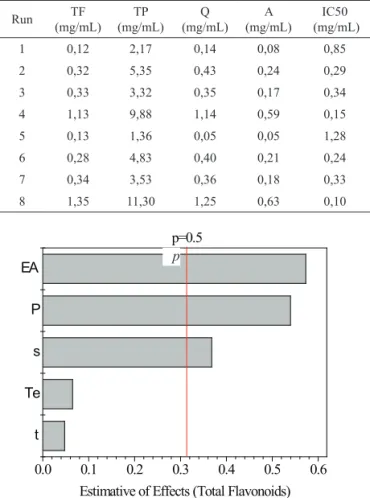
Based on literature references (Pizarro et al., 2006; Sheibani & Ghaziaskar, 2008; Liao et al., 2008; Pompeu et al., 2009), the factors chosen to this study were: drug load in extractor, P (g), ethanol/water ratio, EA (%), extraction time, t (h), extraction temperature, Te (°C) and stirring speed, s (rpm). The 25-2 fractional factorial design is a quarter fraction of a five factor and two-level full factorial design, resulting in eight experimental runs. The responses (yi) evaluated were: total flavonoids, TF (mg/mL), total phenolics, TP (g/mL), quercetrin, Q (mg/mL) and afzelin, A (mg/ mL) content and antioxidant activity as inhibition concentration of 50% of DPPH, IC50 (mg/mL). The results of the responses are presented in Table 2.
The estimative of effects and the statistical analysis allowed evaluating if the factors were
significant to the responses as well as observing how impacting they were. The estimative of effects was calculated for each factor by using the equation 1 and the results are presented in Figures 2 to 6. The results obtained, in a general way, showed that the factors that influenced less the responses were the extraction time (t) and the extraction temperature (Te) followed by the stirring speed (s).
Table 2. Results to the fractional factorial design 25-2 considering the responses: total lavonoids (TF), total phenols (TP), quercetrin content (Q), afzelina content (A) and inhibitory concentration (IC50).
Run TF (mg/mL)
TP (mg/mL)
Q (mg/mL)
A (mg/mL)
IC50 (mg/mL)
1 0,12 2,17 0,14 0,08 0,85
2 0,32 5,35 0,43 0,24 0,29
3 0,33 3,32 0,35 0,17 0,34
4 1,13 9,88 1,14 0,59 0,15
5 0,13 1,36 0,05 0,05 1,28
6 0,28 4,83 0,40 0,21 0,24
7 0,34 3,53 0,36 0,18 0,33
8 1,35 11,30 1,25 0,63 0,10
t Te s P EA
0.0 0.1 0.2 0.3 0.4 0.5 0.6
p=0.5
Estimative of Effects (Total Flavonoids)
Figure 2. Paretto diagram demonstrating the significance of the studied factors on total flavonoids (p=0.05).
The literature reports divergent results in relation to the temperature in extractive methods (Moure et al., 2001). Generally, the increase of the temperature tends to favor the extraction because of the increase in the: solute solubility, diffusion coefficient and dielectric constant of water (Pinelo et al., 2006). The temperature range from 25 to 50 °C adopted in this work was probably narrow or not wide enough to reveal the effect of solute solubility on the extraction efficiency. However, it must be noted that the chosen temperature range was adequate since processes that use higher temperatures can be expensive; moreover there is the possibility of degradation of phenolic
control Abs
sample Abs
control Abs
Inhibition
n m
n m nm
517 517
517 )
(
% = − nm Equation 2
p
compounds on temperature beyond 50 °C (Cacace & Mazza, 2003).
t Te s EA P
0.0 1.0 2.0 3.0 4.0 5.0 p=0.5
Estimative of Effects (Total Phenols)
Figure 3. Paretto diagram demonstrating the significance of the studied factors on total phenols (p=0.05).
Te t s EA P
-0.1 0.0 0.1 0.2 0.3 0.4 0.5 0.6 p=0.5
Estimative of Effects (Quercetrin content)
Figure 4. Paretto diagram demonstrating the significance of the studied factors on quercetrin content (p=0.05).
t Te s EA P
-0.05 0.00 0.05 0.10 0.15 0.20 0.25 0.30 p=0.5
Estimative of Effects (Afzelin content)
Figure 5. Paretto diagram demonstrating the significance of the studied factors on afzelin content (p=0.05).
The extraction time (t) must be mainly considered in extractive methods which are guided by equilibrium concentration, such as the dynamic maceration. In this kind of methods there is a minimum time required for the solvent to swell and hydrate the
plant material, solubilize the chemical constituents inside the cells and diffuse them in the solvent (Prista et al., 1995).
t Te s EA P
-0.4 -0.2 0.0 0.2 0.4 0.6 0.8
p=0.5
Estimative of Effects (IC50)
Figure 6. Paretto diagram demonstrating the significance of the studied factors on antioxidant activity, IC50 (p=0.05).
In this study, the extraction time (t) was also not significant probably because the agitation allowed the rapid homogenization of the solute in the solvent. Besides, the equilibrium between solvent and solute probably occurred in a time shorter than 1 hour. In fact, the literature reports that other factors as temperature and stirring speed can influence the extraction time (Prista et al., 1995).
The stirring speed (s) was one of the most significant factors for all responses. It is related to the convective mass transfer from drug to solvent and is theoretically expected based on the concept of boundary layer and film resistance (List & Schmidt, 1989). A thin layer of solvent that keeps direct contact to the drug particles is called boundary layer and is completely saturated with chemical constituents of the drug. In static extraction methods, the limiting layer is wide and the chemicals constituents extraction from the plant cell depends only on the diffusion/osmotic coefficient (List & Schmidt, 1989). However, an extraction method with agitation results in convective effects, with decrease in the boundary layer, and thus chemical constituents mass transfer to the solvent (Jacques et al., 2007; Prista et al., 1995; List & Schmidt, 1989).
In general, the responses presented a positive value for the estimative of effects. It is an indicative that they were directly proportional to the factors, in other words, the higher the value of the factors, the higher the responses. This result is coherent to the literature when considering the significant factors: P, EA and s and shows that the ranges chosen for this study were adequate. The increase in P from 4 to 20 g resulted in significant increase in phenols, flavonoids, quercetrin and afzelin contents in the extracts, showing that solvent was not saturated for higher P. Moreover, p
p
p
higher concentrations of ethanol in hydroalcoholic solutions facilitate the extraction of total flavonoids and phenols. Also, higher stirring speed can favor the extraction of these substances (Huang et al., 2009; Pinelo et al., 2006; List & Schmidt, 1989). These results can give directions to further experimental work on the extraction from copaiba leaves, and for refinement of the responses of P, EA and s using response surface methodology.
Otherwise, in spite of the fact that the extract antioxidant activity or inhibitory concentration of 50% of DPPH (IC50) was not affected by any of the factors, it was possible to observe negative values of the estimative of effects for the P and EA. It means that higher levels of P and EA resulted in lower IC50 meaning higher antioxidant activity. This indicates the most of the extract antioxidant activity is probably related to the chemical constituents analyzed in this work, TP, TF, Q and A, since their contents in extracts increase with P and EA.
Conclusion
In conclusion, this study allowed visualizing which factors were the most important to the evaluated responses: total flavonoids, total phenolics, quercetrin, and afzelin content and antioxidant activity as inhibition concentration of 50% of DPPH. The factors drug load, ethanol/water ratio and extraction time were the most important and might be used to the optimization of the extraction. Therefore, this was an initial technological study to optimize future extraction experiments from C. langsdorffii leaves.
Acknowledgment
The authors are grateful to Apis Flora Indl. Coml. LTDA, FINEP, FAPESP, CNPq and CAPES for the support.
References
Anvisa 2003. Resolução RE n° 899, 29 de maio de 2003. "Guia para validação de métodos analíticos e bioanalíticos”. Brasília: Diário Oficial da União.
Barros-Neto B, Scarminio IS, Burns RE 1996. Planejamento e otimização de experimentos. Campinas, Unicamp. Basile AC, Sertié JAA, Freitas PCD, Zanini AC 1988.
Anti-inflamatory activity of oleoresin from Brazilian Copaifera. J Ethnopharmacol 22: 101-109.
Brancalion APS, Oliveira RB, Sousa JPB, Groppo M, Berretta AA, Barros ME, Boim MA, Bastos JK 2012. Effect of hydroalcoholic extract from Copaifera langsdorfii leaves on urolithiasis induced in rats. Urol Res doi 10.1007/s00240-011-0453-z.
Cacace JE, Mazza G 2003. Mass transfer process during extraction of phenolic compounds from milled berries. J Food Eng 59: 379-389.
Carvalho JCT 2004. Fitoterápicos antiinflamatórios: aspectos químicos, farmacológicos e aplicações terapêuticas. Ribeirão Preto: Tecmedd.
Cascon V, Gilbert B 2000. Characterization of the chemical composition of oleoresins of Copaifera guianensis Desf., Copaifera duckei Dwyerand Copaifera multijuga Hayne. Phytochemistry 55: 773-778. Chakraborty B, Collins LM, Strecher VJ, Murphy SA 2009
Developing multicomponent interventions using fractional factorial designs. Statist Med 28: 2687-2708.
Chirinos R, Rogez H, Campos D, Pedreschi R, Larondelle Y 2007. Optimization of extraction conditions of antioxidant phenolic compounds from mashua (Tropaeolum tuberosum Ruíz & Pavón) tubers. Sep Purif Technol 55: 217-225.
Costa ARM, Marquiafável FS, Vaz MMOL, Rocha BA, Bueno PCP, Amaral PLM, Barud HS, Berreta-Silva AA 2011. Quercetin-PVP K25 solid dispersions: preparation, thermal characterization and antioxidant activity. J Therm Anal Calorim 104: 273-278.
Ferrari M, Pagnoni UM, Pelizzoni F, Lukes V, Ferrari G 1971. Terpenoids from Copaifera langsdorffi. Phytochemistry 10: 905-907.
Figliuolo R, Naylor S, Wang J, Langenheim JH 1987. Unusual nonprotein imino acid and its relationship to phenolic and nitrogenous compounds in Copaifera. Phytochemistry 26: 3255-3259.
Gomes NM, Rezende CM, Fontes SP, Hovell AMC, Landgraf RG, Matheus M E, Pinto AC, Fernandes PD 2008. Antineoplasic activity of Copaifera multijuga oil and fractions against ascitic and solid Ehrlich tumor. J Ethnopharmacol 119: 179-184.
Huang W, Xue A, Niu H, Jia Z, Wanga J 2009. Optimised ultrasonic-assisted extraction of flavonoids from Folium eucommiae and evaluation of antioxidant activity in multi-test systems in vitro. Food Chem 114: 1147-1154.
Jacques RA, Freitas LS, Pérez VF, Dariva C, Oliveira AP, Oliveira JV, Caramão EB 2007. The use of ultrasound in the extraction of Ilex paraguariensis leaves: a comparison with maceration. Ultrason Sonochem 14: 6-12.
Langenheim JH Macedo CA, Ross MK, Stubbebline WH 1986a. Leaf development in the tropical leguminous tree Copaifera in relation to microlepidopteran herbivory. Biocheml Syst Ecol 14: 5l-59.
Langenheim JH, Convis CL, Macedo CA, Stubbebline WH 1986b. Hymenaea and Copaifera leaf sesquiterpenes in relation to lepidopteran herbivory in southeastern Brazil. Biocheml Syst Ecol 14: 41-49.
1364-1378.
Liao Z-G, Wang G-F, Liang X-L, Zhao G-W, Jiang Q-Y 2008. Optimization of microwave-assisted extraction of active components from Yuanhu zhitong prescription. Sep Purif Technol 63: 424-433.
List PH, Schmidt PC 1989. Phytopharmaceutical technology. Londres: Heyden & Son Limeted.
Lu C-L, Li Y-M, Fu G-Q, Yang L, Jiang J-G, Zhu L, Lin F-L, Chen J, Lin Q-S 2011. Extraction optimization of daphnoretin from root bark of Wikstroemia indica (L.) C. A. and its anti-tumor activity tests. Food Chem 124: 1500-1506.
Macedo CA, Langenheim JH 1989a. A further investigation on leaf sesquiterpenes variation in relation to herbivory in two Brazilian populations of Copaifera langsdorffi. Biochem Syst Ecol 17: 207-216.
Macedo CA, Langenheim JH 1989b. Microlepdopteran herbivory in relation to leaf sesquiterpenes in Copaifera langsdorffi adult trees and their seedling progeny in a Brazilian woodland. Biochem Syst Ecol 17: 217-224.
Maciel MAM, Pinto AC, Veiga-Júnior VF, Grynberg NF, Echevarria A 2002. Plantas medicinais: a necessidade de estudos multidisciplinares. Quim Nova 25: 429-438.
Markom M, Hasan M, Ramli W, Daud W, Singh H, Jahim JM 2007. Extraction of hydrolysable tannins from Phyllanthus niruri Linn.: effects of solvents and extraction methods. Sep Purif Technol 52: 487-496. Montgomery DC 2004. Design and analysis of experiments.
New York: Wiley.
Moure A, Cruz JM, Franco D, Dominguez JM, Sineiro JS, Dominguez H, Nuñez MJ, Parajo JC 2001. Natural antioxidants from residual sources. Food Chem 72: 145-171.
Myers WR 2003. Response surface methodology. Encycl Biopharm Stat 1: 858-869.
Noriega P, Mafud DF, Souza B, Soares-Scott M, Rivelli DP, Barros SBM, Bacchi EMB 2012. Applying design of experiments (DOE) to flavonoid extraction from Passiflora alata and P. edulis. Rev Bras Farmacogn 22: 1119-1129.
Ohsaki A, Yan LT, Ito S, Edatsugi H, Iwata D, Komoda Y 1994. The isolation and the in vivo potent antitumor activity of cleoredane diterpenoid from the oleoresin of the Brazilian medicinal plant, Copaifera langsdorffii Desfon. Bioorg Med Chem Lett 4: 2889-2892. Pinelo M, Sineiro J, Nuñez MJ 2006. Mass transfer during
continuous solid-liquid extraction of antioxidants from grape byproducts. J Food Eng 77: 57-63. Pizarro C, González-Sáiz JM, Pérez-del-Notario N 2006.
Multiple response optimisation based on desirability functions of a microwave-assisted extraction method for the simultaneous determination of chloroanisoles
and chlorophenols in oak barrel sawdust. J Chromatogr A 1132: 8-14.
Pompeu DR, Silva EM, Rogez H 2009. Optimisation of the solvent extraction of phenolic antioxidants from fruits of Euterpe oleracea usin response surface methodology. Bioresour Technol 100: 6076-6082. Prista LN, Alves AC, Morgado R. 1995. Tecnologia
farmacêutica. Lisboa: Calouste Gulbenkian.
Rocha BA, Rodrigues MR, Bueno PCP, Costa-Machado ARM, Vaz MMOL, Nascimento APN, Barud HS, Berretta-Silva AA 2012. Preparation and thermal characterization of inclusion complex of Brazilian green propolis and hydroxypropyl-β-cyclodextrin: increased water solubility of the chemical constituents and antioxidant activity. J Therm Anal Calorim 108: 87-94.
Santos AO, Costa MA, Ueda-Nakamura T, Dias-Filho BP, Veiga-Júnior VF, Lima MMS, Nakamura CV 2011. Leishmania amazonensis: effects of oral treatment with copaiba oil in mice. Exp Parasitol 129: 145-151.
Sheibani A, Ghaziaskar HS 2008. Pressurized fluid extraction of pistachio oil using a modified supercritical fluid extraction and factorial design for optimization. LWT 41: 1472-1477.
Silva-Medeiros R, Vieira G 2008. Sustainability of extraction and production of copaiba (Copaifera multijuga Hayne) oleoresin in Manaus, AM, Brazil. For Ecol Manag 256: 282-288.
Sousa JPB, Brancalion APS, Junior MG, Bastos JK 2012. A validated chromatographic method for the determination of flavonoids in Copaifera langsdorffii by HPLC. Nat Prod Commun 7: 25-28.
Veiga-Júnior VF 2005. Copaifera sp Linné. In: Amaral ACF, Simões EV e Ferreira JLP Coletânea científica de plantas de uso medicinal. Rio de Janeiro: Fiocruz. Waterman PG, Mole S 2004. Analysis of phenolic plant
metabolites. London: Blackwell Scientific Publications.
Yokozawa T, Dong E, Kawai Y, Gemba M, Shimizu M 1999. Protective effects of some flavonoids on the renal cellular membrane. Exp Toxicol Pathol 51: 9-14.
*Correspondence
Luís Alexandre Pedro de Freitas
Departamento de Ciências Farmacêuticas, Faculdade de Ciências Farmacêuticas de Ribeirão Preto, Universidade de São Paulo
Avenida do Café, s/n, 14040-903 Ribeirão Preto-SP, Brazil [email protected]