REVISTA
BRASILEIRA
DE
ANESTESIOLOGIA
PublicaçãoOficialdaSociedadeBrasileiradeAnestesiologiawww.sba.com.br
SCIENTIFIC
ARTICLE
Effects
of
different
levels
of
end-expiratory
pressure
on
hemodynamic,
respiratory
mechanics
and
systemic
stress
response
during
laparoscopic
cholecystectomy
Oznur
Sen
a,∗,
Yasemin
Erdogan
Doventas
baMinisteryofHealthHasekiTrainingandResearchHospital,DepartmentofAnaesthesiologyandReanimation,Istanbul,Turkey bMinisteryofHealthHasekiTrainingandResearchHospital,DepartmentofBiochemistryDepartment,Istanbul,Turkey
Received9June2015;accepted17August2015 Availableonline12April2016
KEYWORDS PEEP;
Hemodynamic; Respiratory
mechanicsandstress
response
Abstract
Objective:General anesthesia causes reduction of functional residual capacity. And this decreasecan lead toatelectasis andintrapulmonary shuntingin thelung.In this study we wanttoevaluatetheeffectsof5and10cmH2OPEEPlevelsongasexchange,hemodynamic,
respiratorymechanicsandsystemicstressresponseinlaparoscopiccholecystectomy.
Methods:American SocietyofAnesthesiologistI---IIphysicalstatus43 patientsscheduled for laparoscopic cholecystectomywere randomlyselected toreceiveexternalPEEPof5cmH2O
(PEEP5group)or10cmH2OPEEP(PEEP10group)duringpneumoperitoneum.Basal
hemody-namic parameterswere recorded,andarterial bloodgases(ABG) andbloodsampling were doneforcortisol,insulinandglucoselevelestimationstoassessthesystemicstressresponse beforeinductionofanesthesia.Thirtyminutesafterthepneumoperitoneum,therespiratory andhemodynamicparameterswererecordedagainandABGandsamplingforcortisol,insulin, andglucoselevelswererepeated.Lastlyhemodynamicparameterswererecorded;ABGanalysis andsamplingforstressresponselevelsweretakenafter60minutesfromextubation.
Results:There werenostatistical differencesbetween thetwo groupsabouthemodynamic andrespiratoryparametersexceptmeanairwaypressure(Pmean).Pmean,complianceandPaO2;
pHvalueswerehigherin‘PEEP10group’.Also,PaCO2valueswerelowerin‘PEEP10group’.
Nodifferenceswere observedbetween insulinandlacticacidlevelsinthetwo groups.But postoperativecortisollevelwassignificantlylowerin‘PEEP10group’.
Conclusion:Ventilation with 10cmH2O PEEP increases compliance and oxygenation, does
notcausehemodynamicandrespiratory complicationsandreduces thepostoperative stress response.
©2016SociedadeBrasileiradeAnestesiologia.PublishedbyElsevierEditoraLtda.Thisisan openaccessarticleundertheCCBY-NC-NDlicense(
http://creativecommons.org/licenses/by-nc-nd/4.0/).
∗Correspondingauthor.
E-mail:[email protected](O.Sen).
http://dx.doi.org/10.1016/j.bjane.2015.08.015
PALAVRAS-CHAVE PEEP;
Hemodinâmica;
Mecânicarespiratória
erespostaaoestresse
Efeitosdediferentesníveisdepressãoexpiratóriafinalsobreahemodinâmica, mecânicarespiratóriaerespostasistêmicaaoestressedurantecolecistectomia laparoscópica
Resumo
Objetivo: Aanestesiageralcausaareduc¸ãodacapacidaderesidualfuncionaleessadiminuic¸ão podelevaràatelectasiapulmonareshuntintrapulmonar.Nesteestudopretendemosavaliaros efeitosdeníveisde5e10cmH2Odepressãoexpiratóriafinalpositiva(PEEP)sobreastrocas
gasosas,hemodinâmica,mecânicarespiratóriaerespostaaoestressesistêmicoem colecistec-tomialaparoscópica.
Método: Quarenta e três pacientes, estado físico ASA I-II, agendados para colecistectomia laparoscópica,foramselecionadosaleatoriamenteparareceberPEEPa5cmH2O(grupoPEEP-5)
ouPEEPde10cmH2O(grupoPEEP-10)duranteopneumoperitônio.Osparâmetros
hemodinâmi-cosforamregistrados,gasometriaarterialecoletadesangueforamrealizadasparaestimativa dosníveisdecortisol,insulinaeglicoseparaavaliararespostaaoestressesistêmicoantesda induc¸ãoanestésica.Trintaminutosapósopneumoperitônio,osparâmetroshemodinâmicose respiratóriosforamregistradosnovamenteegasometriaeamostragemparaosníveisdecortisol, insulinaeglicoseforamrepetidos.Eosúltimosparâmetroshemodinâmicosforamregistrados, análiseeamostragemdegasometriapara osníveis derespostaaoestresseforamrealizadas após60minutosdaextubac¸ão.
Resultados: Nãohouvediferenc¸aestatísticaentredoisgruposquantoaosparâmetros hemod-inâmicoserespiratórios,excetopressãomédiadasviasaéreas(Pmédia).OsvaloresdePmédia,
complacência,PaO2edopH forammaioresnogrupoPEEP-10.Tambémosvalores dePaCO2
forammenoresnogrupoPEEP-10.Nãoforamobservadasquaisquerdiferenc¸asentreosníveis deinsulinaedeácidolácticonosdoisgrupos.Porém,oníveldecortisolnopós-operatóriofoi significativamentemenornogrupoPEEP-10.
Conclusão:Ventilac¸ãocomPEEPde10cmH2Oaumentaacomplacênciaeaoxigenac¸ão,não
causa hemodinâmica e complicac¸ões respiratórias e reduz a resposta ao estresse no pós-operatório.
©2016SociedadeBrasileiradeAnestesiologia.PublicadoporElsevierEditoraLtda.Este ´eum artigo OpenAccess sobumalicenc¸aCCBY-NC-ND(
http://creativecommons.org/licenses/by-nc-nd/4.0/).
Introduction
Generalanesthesiacausesreductionoffunctionalresidual capacity(FRC) due todecreased inspiratory muscletone, increasedabdominalpressureandalteredthoracicvolume.1
Changingtheerectpositiontothesupinepositioncausesa lossofabout20%FRC,andinductionofanesthesiacausesa further loss of 10%.2 Also, the increasedabdominal
pres-sure during laparoscopic procedures results in additional loss of FRC. This decrease in FRCcan lead to atelectasis andformationofintrapulmonaryshuntinginthedepended lungregions.3Perioperativeatelectasisaffectsgasexchange
andisacceptedasamajorcausefordevelopmentof post-operative hypoxia.4 Ventilation with lower tidal volume
andapplicationof positiveend-expiratorypressure(PEEP) improve outcome in acute respiratory distress syndrome (ARDS)andhasbecomearoutinestrategyforthetreatment ofthepatientwithARDS.5However,recent meta-analyses
have sustained that ventilation during general anesthesia withlowertidalvolumesandPEEPcanalsobenefitpatients without ARDS.6 Also,application of PEEP has been shown
tobeeffectiveinpreventingatelectasisduringanesthesia. PEEP is a frequentlyemployed strategyin anesthesiology, but it has capacity to harm as well as to yield benefi-cialoutcomes.7 Depending on the PEEP level, a decrease
in cardiac output (CO) can be induced through increased
intrathoracicpressure(ITP)andreducedventricularpreload andsystemicvenousreturnpressuregradient.8
This study was undertaken to evaluate the effects of different PEEP levels on gas exchange, hemodynamics and stress response in the settings of increased intra-abdominalpressure(IAP)createdbyCO2pneumoperitoneum
forlaparoscopiccholecystectomy.
Methods
Thisprospectiverandomizedstudywasconductedwiththe approval of the institute’s research and ethics commit-teeandafterobtaining writteninformedconsentfrom43 patients, aged 18---65 years and of American Society of Anesthesiologist (ASA) I---II physical status, scheduled for laparoscopiccholecystectomy.Patientswithmorbidobesity (BMImorethan 30kgm−2)or historyof diabetes mellitus,
endocrine,respiratory,cardiopulmonaryand cerebrovascu-lardiseases were excluded fromthestudy.Also,only the casesadmittedtothetheateruntil11:00A.M.wereincluded inthisstudy.Thepatientswererandomlyselected,by open-ing sealed envelopes, to receive either external PEEP of 5cmH2O(PEEP5group,n=20)orexternalPEEPof10cmH2O
In the operating theater, baseline electrocardiogram (ECG), heart rate (HR), systolic arterial pressure (SAP), diastolic arterial pressure (DAP), mean arterial pressure (MAP),hemoglobinoxygen saturation(SpO2)andend-tidal
carbon dioxide (ETCO2) were recorded using a
multipa-rametermonitor. Baselinearterialbloodgases(ABG)were measuredandbloodsamplingwasdoneforcortisol,insulin andglucoselevelestimationstoassess thesystemicstress response. Anesthesia was induced by 2mgkg−1 propofol,
2gkg−1 fentanyl citrate, and 0.6mgkg−1 rocuronium
bromide. Anesthesia was maintained with 1.0 MAC of sevoflurane in a mixture of 50% oxygen and air and the ventilator was set with8mLkg−1 tidal volumecalculated
using the predicted body weight and 12min respiratory rate with an I:E ratio of 1:2 at fresh gas flow 1Lmin−1.
The ‘PEEP5group’received5cmH2O PEEP,andthe‘PEEP
10 group’ received 10cmH2O PEEP level. Before
pneu-moperitoneum, HR, MAP, ETCO2, Ppeak, Pplato, and Pmean
were recorded. Pneumoperitoneum was created by CO2
insufflationandIAPwassettobemaintainedat14mmHg−1
bymeans ofanautomaticinsufflator.Thirtyminutesafter thepneumoperitoneum, therespiratoryandhemodynamic parameterswererecordedagainandABGandsamplingfor cortisol,insulin, glucoselevelswere repeated.Anesthesia was maintained until the end of surgery, neuromuscular blockade wasantagonizedwithsugammadexand tracheal extubation was carried out when the patient was fully awake. Recording of hemodynamic parameters and ABG, and sampling for cortisol, insulin, glucose levels were repeatedforthelasttimeat60minafterextubation.
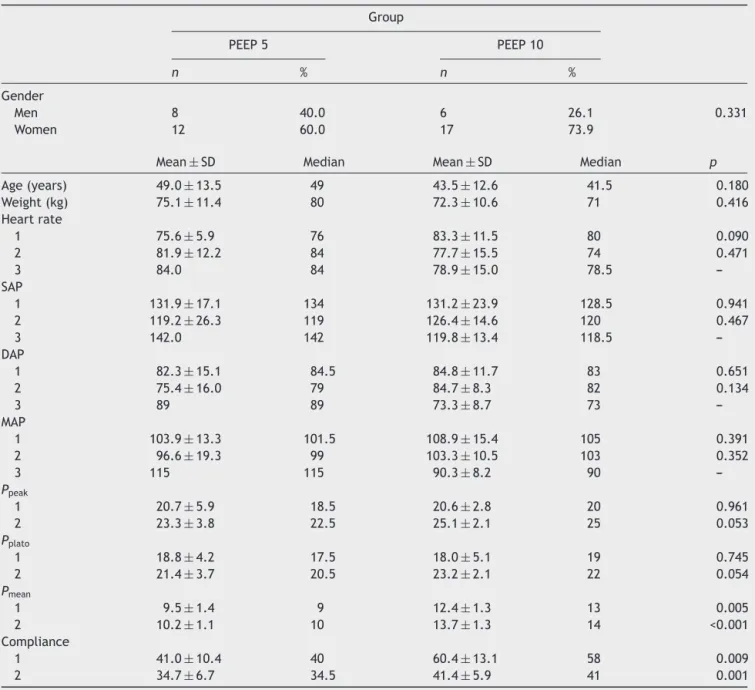
Table1 Beforeandduringthepneumoperitoneumtime.
Group
PEEP5 PEEP10
n % n %
Gender
Men 8 40.0 6 26.1 0.331
Women 12 60.0 17 73.9
Mean±SD Median Mean±SD Median p
Age(years) 49.0±13.5 49 43.5±12.6 41.5 0.180
Weight(kg) 75.1±11.4 80 72.3±10.6 71 0.416
Heartrate
1 75.6±5.9 76 83.3±11.5 80 0.090
2 81.9±12.2 84 77.7±15.5 74 0.471
3 84.0 84 78.9±15.0 78.5
---SAP
1 131.9±17.1 134 131.2±23.9 128.5 0.941
2 119.2±26.3 119 126.4±14.6 120 0.467
3 142.0 142 119.8±13.4 118.5
---DAP
1 82.3±15.1 84.5 84.8±11.7 83 0.651
2 75.4±16.0 79 84.7±8.3 82 0.134
3 89 89 73.3±8.7 73
---MAP
1 103.9±13.3 101.5 108.9±15.4 105 0.391
2 96.6±19.3 99 103.3±10.5 103 0.352
3 115 115 90.3±8.2 90
---Ppeak
1 20.7±5.9 18.5 20.6±2.8 20 0.961
2 23.3±3.8 22.5 25.1±2.1 25 0.053
Pplato
1 18.8±4.2 17.5 18.0±5.1 19 0.745
2 21.4±3.7 20.5 23.2±2.1 22 0.054
Pmean
1 9.5±1.4 9 12.4±1.3 13 0.005
2 10.2±1.1 10 13.7±1.3 14 <0.001
Compliance
1 41.0±10.4 40 60.4±13.1 58 0.009
2 34.7±6.7 34.5 41.4±5.9 41 0.001
Statisticalanalysis
WindowsprogramSPSS15.0wasusedforthestatistical
anal-ysisoftheresults.Descriptivestatisticsweregiveninterms
ofnumbersandpercentagesfor categoricalvariables,and
interms of themean, standarddeviation andthemedian
for the numerical variables. Comparison of two
indepen-dentgroupsofvariableswascarriedoutusingtheStudent
ttestwhenmeetingthenormaldistributioncriteria,orby
theMann---WhitneyUtestwhenthesecriteriawerenotmet.
Relationship betweennumericalvariableswasassessedby
meansoftheSpearmanCorrelationAnalysis.Thedifferences
betweencategorical variableswere evaluatedbythe
Chi-squareanalysis.Statistical ˛(alpha)significancelevelwas
acceptedwiththep-valuebelow0.05.
Results
Physicalcharacteristicsanddemographicparametersofthe
twopatient groups were closely comparable. Also, there
werenostatisticallysignificantdifferencesbetweenthetwo
groupswithrespecttothehemodynamic parameters(HR,
SAP,DAP,andMAP)andtherespiratoryparametersofPpeak
andPplato levels.Butthemeanairwaypressure(Pmean)and
compliancelevelswerestatisticallyhigherinPEEP10group
beforeandduringthepneumoperitoneumtime(Table1).
The meanETCO2 levelsweresamefor thetwogroups.
Althoughnodifferenceswereobservedin thePaO2values
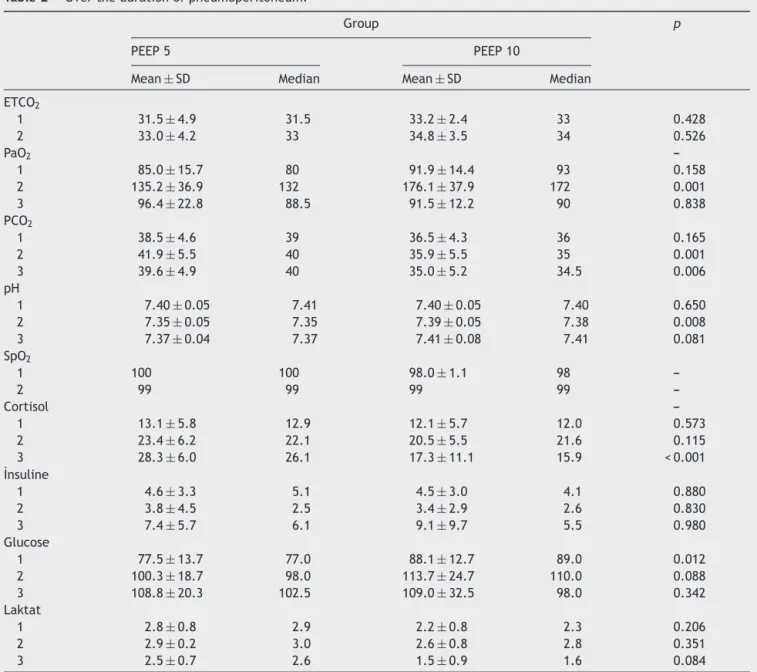
betweenthetwogroupspreoperativelyandinthe postop-erativeperiod,thevalueswerehigherinthe‘PEEP10group’ overthe durationof pneumoperitoneum(Table 2,Fig.1). Beforepneumoperitoneum and during pneumoperitoneum
Table2 Overthedurationofpneumoperitoneum.
Group p
PEEP5 PEEP10
Mean±SD Median Mean±SD Median
ETCO2
1 31.5±4.9 31.5 33.2±2.4 33 0.428
2 33.0±4.2 33 34.8±3.5 34 0.526
PaO2
---1 85.0±15.7 80 91.9±14.4 93 0.158
2 135.2±36.9 132 176.1±37.9 172 0.001
3 96.4±22.8 88.5 91.5±12.2 90 0.838
PCO2
1 38.5±4.6 39 36.5±4.3 36 0.165
2 41.9±5.5 40 35.9±5.5 35 0.001
3 39.6±4.9 40 35.0±5.2 34.5 0.006
pH
1 7.40±0.05 7.41 7.40±0.05 7.40 0.650
2 7.35±0.05 7.35 7.39±0.05 7.38 0.008
3 7.37±0.04 7.37 7.41±0.08 7.41 0.081
SpO2
1 100 100 98.0±1.1 98
---2 99 99 99 99
---Cortisol
---1 13.1±5.8 12.9 12.1±5.7 12.0 0.573
2 23.4±6.2 22.1 20.5±5.5 21.6 0.115
3 28.3±6.0 26.1 17.3±11.1 15.9 <0.001
˙Insuline
1 4.6±3.3 5.1 4.5±3.0 4.1 0.880
2 3.8±4.5 2.5 3.4±2.9 2.6 0.830
3 7.4±5.7 6.1 9.1±9.7 5.5 0.980
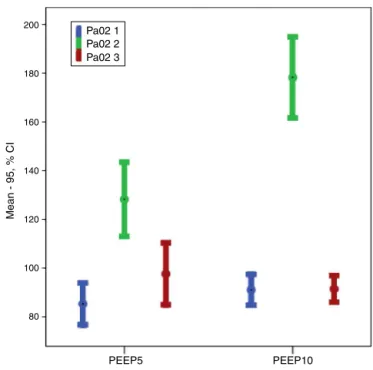
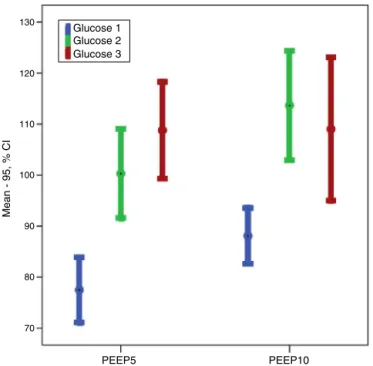
Glucose
1 77.5±13.7 77.0 88.1±12.7 89.0 0.012
2 100.3±18.7 98.0 113.7±24.7 110.0 0.088
3 108.8±20.3 102.5 109.0±32.5 98.0 0.342
Laktat
1 2.8±0.8 2.9 2.2±0.8 2.3 0.206
2 2.9±0.2 3.0 2.6±0.8 2.8 0.351
3 2.5±0.7 2.6 1.5±0.9 1.6 0.084
200
180
160
140
120
100
PEEP5 Pa02 1 Pa02 2 Pa02 3
Mean - 95, % CI
PEEP10 80
Figure1 ChangesinPaO2levels(PaO21,preoperativetime;
PaO22,peroperativetime;PaO23,postoperativetime).
time,PaCO2valueswerelowerin‘PEEP10group’(Table1,
Fig.2).MeanpHvaluesofthe‘PEEP10group’werehigher thanthoseofthe‘PEEP5group’(p<0.01)(Table2,Fig.3). Postoperativemeancortisollevelofthe‘PEEP10group’was significantlylowerthanthat oftheothergroup(p<0.001) (Table2,Fig.4).Nodifferenceswereobservedbetweenthe insulinandlacticacidlevelsthetwogroups.Preoperative glucoselevelofthe‘PEEP10group’washigherthanthatof the‘PEEP5group’(p<0.05)(Table2,Fig.5).
44
42
40
38
36
34
32
PEEP5
Mean - 95, % CI
PC02 1 PC02 2 PC02 3
PEEP10
Figure 2 Changes in PaCO2 levels (PaCO2 1, preoperative time; PaCO2 2, peroperative time; PaCO2 3, postoperative time).
7450
7425
7357
7350
7325 7400
PEEP5
Mean - 95, % CI
PH 1 PH 2 PH 3
PEEP10
Figure3 ChangesinpHlevels(pH1,preoperativetime;pH 2,peroperativetime;pH3,postoperativetime).
Discussion
This studyaimedtodemonstrate theeffectsof the appli-cation of 5cmH2O PEEP versus 10cmH2O PEEP during
pneumoperitoneum in laparoscopic abdominal surgery on any improvement on oxygenation and compliance, pre-vention of atelectasis and the differences in changes in therespiratory,hemodynamicparametersandthesystemic stressresponse.
Recent reports have demonstrated that application of PEEPduringgeneralanesthesia,especiallyforlaparoscopic surgery,improvescomplianceandoxygenation.9Inastudy
30
25
20
15
10
PEEP5
Mean - 95, % CI
Cortizol 1 Cortizol 2 Cortizol 3
PEEP10
130
Glucose 1 Glucose 2 Glucose 3
PEEP5
Mean - 95, % CI
PEEP10 120
110
100
90
80
70
Figure5 Changesinglucoselevels(Glucose1,preoperative time;Glucose2,peroperativetime;Glucose3,postoperative timevalues).
to evaluate the effect on cerebral oxygen saturation of 0cmH2O PEEP and of 10cmH2O PEEP application during
laparoscopic cholecystectomy, Hyun etal.concluded that 10cmH2OPEEPusagesavedcerebraloxygensaturation
with-outadverse effectsonhemodynamicstability.10 Inanother
study,employing14,8and14mmHg−1IAPpressure,
respec-tively, on groups given 0, 5 and 10cmH2O PEEP, they
observedthatapplicationofPEEPatthecorrespondingIAP helped maintain CO2 elimination and improved
oxygena-tionwithouthemodynamicdisturbance.11Furthermore,the
reviewbytheCochraneCollaborationgroupon postopera-tivemortalityandpulmonarycomplicationswithand with-out useof PEEP has suggested, albeitinconclusively, that PEEPimprovespostoperativeatelectasisandoxygenation.12
On the other hand, the PROVHILO trial with 900 cases of open abdominal surgery under general anesthe-sia with 8mLkg−1 tidal volume and recruitment, using
either 2cmH2O PEEP or 12cmH2O PEEP, did not
demon-stratesignificantdifferencesbetweenthetwogroupswith respecttopostoperative pulmonary complicationsdespite thehigherpreoperativeoxygenationvaluesinthe12cmH2O
PEEP group, and the greater need of oxygenation by the 2cmH2O PEEP group. They concluded that elevated PEEP
andrecruitment maneuver in open abdominalsurgery did not protect against pulmonary complications and mortal-ity,anddefendedtheventilationstrategywithoutlowtidal volume,lowlevelPEEPandrecruitment.13
Whenlevelsof0,5,10and15cmH2OPEEPwereapplied
in cardiacsurgery, it wasreportedthat asthePEEP level wasincreased,respiratorysystemtotalresistanceand elas-ticrecoilweredecreased;oxygenationandCO2elimination
increased;deadspaceandshuntingweredecreased;arterial oxygencontent,oxygenconsumptionandtheoxygen extrac-tionratewereincreaseddespitetheprogressivereduction inthecardiacindex;andnodifferencesinthemean
arte-rialbloodpressurewasdemonstrablebetweenthedifferent PEEPgroups.Itwasconcludedthatalthoughapplicationof PEEPabovethe10cmH2OPEEPlevelincreasedoxygenation,
itshouldbe cautiouslyappliedespeciallyin patients with marginalcardiacfunctionduetocontractilitydisturbances orhypovolemia.14Danieletal.,afterevaluatingtheeffects
of5,8and10cmH2OPEEPapplicationsonthedurationof
mechanicalventilation aftercoronaryarterybypass graft-ing surgery, reported a significantly shortened ventilation timeinthe10cmH2OPEEPgroup.15Karstenetal.evaluated
regional ventilation using electrical impedance tomogra-phyon32patientsundergoinglaparoscopiccholecystectomy eitherwith0(zero)cmH2OPEEP (theZEEPapplication) or
10cmH2O PEEP. They reported that recruitment
maneu-verand10cmH2OPEEPapplicationinlaparoscopicsurgery
improvedoxygenationandcorrectedcompliance.9Thesame
group of authors investigated the effects of 0, 3, 5, 7 and10cmH2OPEEPapplicationduringrobot-assisted
laparo-scopic radical prostate surgery on the hemodynamic and respiratoryparameters.TheyreportedthatHRandMAP val-ues did notvary with the PEEP level, but the PaO2 level
wassignificantlylowintheZEEPgroupofpatientsandmost elevated inthe 10cmH2O PEEP group. Onepatientin the
10PEEPgrouphadsubcutaneousemphysemaresolvedafter cessationoftheinsufflation.Theyconcludedthat applica-tion of 7cmH2O PEEP resulted in significant oxygenation
augmentation without excessive peak airway pressure or depression of hemodynamic parameters during prolonged laparoscopicsurgery.16
Inourstudy,we observedthat duringthe pneumoperi-toneum period, PaO2, compliance, Pmean, and pH levels
werehigher in the 10cmH2O PEEP group as compared to
the5cmH2OPEEPgroup.Although5cmH2OPEEPpreserved
oxygenationduringpneumoperitoneum,10cmH2OPEEP
pro-duced a significant improvement in oxygenation. Similar observations were made by Andrea et al. during laparo-scopic gynecological surgery. PEEP application resulted in recruitmentinthealveoli,improvingcardiacandpulmonary functions and thereby improving oxygenation, enhancing CO2washoutandinhibitionofthevasoconstrictorreflex.
It was argued that while 5cmH2O of PEEP acted as a
shieldagainstthenegativecardiopulmonaryeffectsinduced bypneumoperitoneum,10cmH2OofPEEPactuallyimproved
the effects.17 Although the most common complications
of high PEEP application are observed in the hemody-namicparameters, especiallyin hypovolemic patients, on including respiratory effects such as barotrauma, we did notencounterhemodynamicorrespiratorycomplicationsin ourseriesofpatients. Inpatientsundergoinglaparoscopic inguinal hernia surgerywithapplication of 8mLkg−1 tidal
volumewith0,5 and10cmH2O PEEP,end-expiratory lung
volume(EELV),measuredwiththenitrogen wash-out/wash-in method using electrical impedance tomography, was increasedduringapplication of10cmH2OPEEP whichalso
homogenizedventilationdistribution.18
We observed, when evaluating the effects of 5 and 10cmH2OPEEPapplicationonthesystemicstressresponse,
that preoperative blood glucose levels, although signifi-cantlyelevated,werestillwithinthephysiologicallimitsin the10cmH2OPEEP group,while thecortisollevelwas
couldnotfindanotherstudyintheliteratureontheeffects ofPEEPlevelonthesystemicstressresponseparametersto beabletomakedirectcomparisonsontheresults.
However, in studies evaluating the inflammatory response, it was found out that PEEP was beneficial at high inspiratory pressure and caused some stress, but imposedonlymoderatestressatlowinspiratorypressure.19
Weingartenetal.comparedtheeffectsof‘lowtidalvolume withhigh (12cmH2O) PEEP’ application versus ‘high tidal
volume with ZEEP (0cmH2O PEEP) application’ on the
systemicinflammatory responseparametersIL-6and IL-8, andfoundnodifferencesbetweenthetwogroups.Butthe perioperative oxygenation of the ‘low tidal volume and 12cmH2O PEEP’ group wasincreased and lung mechanics
were muchbetter.20 In our study,the observation of low
postoperativecortisol levelswith10cmH2O PEEP
applica-tionmayberelatedtobetterperoperativeoxygenationand compliance.
Conclusion
We believe that during laparoscopic cholecystectomy surgery,ventilation with10cmH2OPEEP increases
compli-ance and oxygenation does not cause hemodynamic and respiratory complications and reduces the postoperative stressresponsewiththisstudy.
Conflicts
of
interest
Theauthorsdeclarenoconflictsofinterest.
References
1.Meninger D, Byhahn C, Westphal K. Positive end-expiratory pressureimprovesarterialoxygenationduringprolonged pneu-moperitoneum.ActaAnaesthesiolScand.2005;49:778---83.
2.LumbAB,NunnJF.Respiratoryfunctionandribcagecontribution toventilationinbodypositioncommonlyusedduring anesthe-sia.AnesthAnalg.1991;73:422---6.
3.HardmanJG, ArtkenheadAR.Estimating alveolardeadspace fromthealveolartoend-tidalCO2gradient:amodeling
analy-sis.AnesthAnalg.2003;97:1845---51.
4.HedenstiernaG,EdmarkL.Theeffectsofanesthesiaand mus-cle paralysis onthe respiratorysystem. Intensive CareMed. 2005;31:1327---35.
5.PetrucciN,DeFeoC.Lungprotective strategyfor theacute respiratory distress syndrome. Cochrane Database Syst Rev. 2013;2:CD003844.
6.Serpa Neto A, Cardoso SO, Manetta JA, et al. Associa-tion between use of lung-protective ventilation with lower tidalvolumes and clinicaloutcomes among patientswithout acute respiratory distress syndrome: a meta-analysis. JAMA. 2012;308:1651---9.
7.TerragniPP,RosbochG,TealdiA,etal.Tidalhyperinflation dur-inglowtidalvolumeventilationinacuterespiratorydistress syndrome.AmJRespirCritCareMed.2007;175:160---6.
8.Russo A, Marana E, Viviani D, et al. Diastolic function: the influence ofpneumoperitoneum and Trendelenburg position-ing during laparoscopic hysterectomy. Eur J Anaesthesiol. 2009;26:923---7.
9.Karsten J, Luepschen H, Grossherr M, et al. Effect of PEEP onregionalventilationduringlaparoscopicsurgerymonitored byelectricalimpedancetomography.ActaAnaesthesiolScand. 2011;55:878---86.
10.Hyun JK, Sun KP, Kyung CL, et al. High positive end-expiratorypressurepreservescerebraloxygensaturationduring laparoscopiccholecystectomyunderpropofolanesthesia.Surg Endosc.2013;27:415---20.
11.Pankaj K, Yamini S, Ravishankar M, et al. Cardiorespiratory effectsofbalancingPEEPwithintra-abdominalpressureduring laparoscopiccholecystectomy.SurgLaparoscEndoscPercutan Tech.2014;24:232---9.
12.FabionaTB,AldemarAC,CelioFS.Postoperativeend-expiratory pressure (PEEP) during anaesthesia for prevention of mor-talityand postoperative pulmonary complications. Cochrane DatabaseSystRev.2014.Art.No:CD007922.
13.The PROVE Network Investigators for the Clinical Trial Net-work of the European Society of Anaesthesiology. High versus low positive end-expiratory pressure during general anaesthesiafor open abdominal surgery (PROVHILO trial): a multicenter randomised controlled trial. Lancet. 2014;384: 495---503.
14.AulerJOC,CarmonaMJC,BarbasCV,etal.Theeffectsof pos-itiveend-expiratorypressureonrespiratorysystemmechanics andhemodynamicsinpostoperativecardiacsurgerypatients. BrazJMedBiolRes.2000;33:31---42.
15.Daniel LB, Vinicius JSN, Thiago EPB, et al. Effects of posi-tiveend-expiratorypressureonmechanicalventilationduration aftercoronary artery bypass grafting: a randomizedclinical trial.AnnThoracCardiovascSurg.2014;20:773---7.
16.HeeJL,KyoSK,JiSJ,etal.Optimalpositiveend-expiratory pressureduringrobot-assistedlaparoscopicradical prostatec-tomy.KoreanJAnesthesiol.2013;65:244---50.
17.AndreaR,EnricoDS,AlessandroS,etal.Positiveend-expiratory pressureduringlaparoscopy:cardiacandrespiratoryeffects.J ClinAnesth.2013;25:314---20.
18.JulienB,CeciliaM,PhilippeJC,etal.Impactofextraperitoneal dioxide carbon insufflation on respiratory function in anes-thetizedadults:apreliminarystudyusingelectricalimpedance tomographyand wash-out/wash-intechnic.AnesthPain Med. 2015;5:e22845.
19.Meier T, Lange A, Papenberg H, et al. Pulmonary cytokine responses duringmechanical ventilation of noninjured lungs with and without end-expiratory pressure. Anesth Analg. 2008;107:1265---75.