“A Matter of Time: Phases of Customer Co-Creation
Community Participation and Their Impact on Customer
Behavior”
Master Thesis
Double Degree NOVA SBE & Maastricht University Name: Armin Schriewer
Student number: i6052632 (UM) and 1409 (NOVA SBE) Email: [email protected]
Supervisor NOVA SBE: Prof. Dr. Luis Filipe Lages
Supervisor Maastricht University: Prof. Dr. Dominik Mahr Second Reader Maastricht University: Elizabeth Aguirre Lopez Maastricht, 6th of January 2014
ii
Official statement of original thesis
By signing this statement, I hereby acknowledge the submitted thesis titled:
“A Matter of Time: Phases of Customer Co-Creation Community Participation and Their Impact on Customer Behavior”
to be produced independently by me, without external help.
Wherever I paraphrase or cite literally, a reference to the original source (journal, book, report, etc.) is given.
By signing this statement, I explicitly declare that I am aware of the fraud sanctions as stated in the Education and Examination Regulations (EERs) of the SBE.
Place: Maastricht Date: 06.01.2014 Name: Armin Schriewer
Study program: Double Degree Program NOVA & Maastricht University
iii
Abstract
Despite the growing relevance of co-creating customer communities only little scientific evidence is available on their impact on transactional behavior of participants. Previous research has mostly used self-reported data or distinguished only between during and pre-community phases obtaining mixed results. However, the author proposes that co-creating community activity takes place in five distinguishable phases and changes in transactional behavior are limited to certain phases. Using 33 months of transactional data of a Dutch online auction provider a study was conducted covering all five phases of the community co-creation process from community planning over community set-up, co-development and co-testing to post-launch. The overall results indicate mixed effects of community participation on the different transactional variables during the co-creation process. Community participation had positive effects on auctions listing behavior at the community set-up, co-development and post-launch phases, whereby the number of auctions listed peaked during the community set-up phase. These results suggest that the impact on transactional behavior differs between co-creation phases and different psychological mechanism limited to certain phases might trigger the respective changes.
iv
Table of Contents
Abstract ... iii
List of Illustrations ... vi
List of Tables ... vii
List of Abbreviations ... viii
1. Introduction ... 1
2. Theoretical background and hypothesis ... 5
From producer innovation to co-creation ... 5
2.1. Co-creation communities ... 7
2.2. Phases in the co-creation process ... 10
2.3. Transactional impact during the co-creation process ... 12
2.4. 3. Methodology ... 17 Research design ... 17 3.1. Research setting ... 18 3.2. Data collection and preparation ... 19
3.3. Transactional data ... 20
3.3.1. Community activity data ... 23
3.3.2. Post-community survey ... 24 3.3.3. Measurements ... 24 3.4. 4. Data analysis ... 27 Outlier detection ... 27 4.1. Mixed between-within subjects ANOVA ... 27
4.2. Mixed ANOVA co-creation phases ... 28
4.2.1. Mixed ANOVA beta testing timeframes ... 33
4.2.2. Mixed ANOVA results / Hypotheses test summary ... 37
4.3. Supplementary analysis: Customer attitude and transactional behavior ... 38
4.4. 5. Discussion ... 42
Transactional behavior during co-creation phases ... 42
5.1. Transactional behavior during beta testing timeframes ... 44 5.2.
v Results of the supplementary analysis ... 45 5.3. 6. Conclusion ... 47 Theoretical contributions ... 47 6.1. Managerial implications ... 48 6.2.
Limitations and further research ... 50 6.3.
Reference List ... ix Appendix ... xv
vi
List of Illustrations
Figure 1: Phases in the co-creation process ... 11
Figure 2: Research model ... 18
Figure 3: Visualization of data segmentation according to co-creation phases ... 21
Figure 4: Visualization of data segmentation according to beta testing timeframes ... 23
Figure 5: Group means of transactional variables during co-creation phases ... 32
vii
List of Tables
Table 1: Different community types and definitions in the academic literature ... 9
Table 2: Overview groups and sample sizes ... 19
Table 3: Data segmentation according to co-creation phases ... 21
Table 4: Data segmentation according to beta testing timeframes ... 22
Table 5: Measurements of the supplementary analysis ... 25
Table 6: Measurements transactional behavior ... 26
Table 7: Sample size before and after outlier detection ... 27
Table 8: Results summary of mixed ANOVAs ... 37
Table 9: Hypotheses testing results ... 37
Table 10: Stepwise regression results "overall customer satisfaction with Marktplaats" ... 40
Table 11: Stepwise regression results "recommendation intention" ... 40
viii
List of Abbreviations
Ads Auctions listed ANOVA Analysis of variance
Asq Questions asked to vendors Bids Biddings placed
CCC Co-creation communities C2C customer-to-customer Ftr Payments send via PayPal GLM General linear model
LIWC Linguistic inquiry and word count MROC Market research online community NPD New product development
OCC Online customer communities ROI Return on investment
1
1. Introduction
Customer co-creation can help to develop products and services that offer superior value to customers and decrease development costs and economic risks for companies (Alam, 2002; C. Baldwin, Hienerth, & Von Hippel, 2006; Lau, Tang, & Yam, 2010; Marchi, Giachetti, & de Gennaro, 2011; A. F. Payne, Storbacka, & Frow, 2007). Although the idea of customer co-creation is not a very recent development many aspects of integrating customers into companies’ innovation processes are still not yet well understood (Hoyer, Chandy, Dorotic, Krafft, & Singh, 2010). Nevertheless, customer co-creation increasingly replaces the previously typical producer driven innovation model by allowing customers and companies to both play active roles in determining the final innovation outcome by selecting elements of a new product or service (O'Hern & Rindfleisch, 2010). Several studies have examined how customer co-creation can contribute to companies’ new product development processes and overall success (C. Y. Baldwin & von Hippel, 2010; Füller, Bartl, Ernst, & Mühlbacher, 2006; Hoyer et al., 2010; McAlexander, Schouten, & Koenig, 2002), resulting in practitioners and academics placing great trust and expectations on it (Antorini & Muñiz, 2013; Hemetsberger & Reinhardt, 2004; Keinz, Hienerth, & Lettl, 2012).
One way for companies to communicate with their customers and integrate them into their innovation processes is by using so-called user communities (Collinson, 2010; Dahlander & Frederiksen, 2012; Franke, Keinz, & Schreier, 2008; Mitrović, Paltoglou, & Tadić, 2010) or customer communities (Manchanda, Packard, & Pattabhiramaiah, 2012; Pitta & Fowler, 2005). Typically these kinds of communities are set up in an online environment; in the following they will be referred to as online customer communities (OCC). The individual settings and functionalities of OCCs can differ from case to case but typically customers who join the community are able to communicate with each other through posts in discussion forums, express suggestions and ideas as well as rate ideas generated by other users or company employees. This form of integrating customers is boosted by the trend of digitalization as well as increased usage of the internet in general and social media in
2 particular. Since it enables companies to communicate in an interactive and cost efficient way with their customers (Antorini & Muñiz, 2013), an increasing number of companies is taking advantage of OCCs. Such communities can either be operated and owned by the company itself or by a third-party (e.g. Facebook).
Recently academics and practitioners have raised doubts about the benefits of using third-party hosted OCCs regarding insufficient ROI (Return on investment) due to the comparably low engagement of participants. A study conducted by the Ehrenberg-Bass Institute reveals that only approximately 1% of fans of the biggest brands on Facebook are actually actively engaging with the brand (Creamer, 2012). Additionally, the commonly stated lack of control over negative word-of-mouth (WOM) can be even more severe for third-party hosted communities. As a result more and more companies are now operating their own OCCs and expressing high levels of confidence in this tool (Manchanda et al., 2012). Despite this fact only very little academic research has been conducted to assess the impact of community participation on transactional behavior. (Algesheimer, Borle, Dholakia, & Singh, 2010; Manchanda et al., 2012; McAlexander et al., 2002).
However, assessing the impact community participation might have on transactional behavior is critical in order to determine the economic benefits of operating OCCs. Due to the fact that customer community participants show high levels of engagement with the firm’s products and brand (McAlexander et al., 2002), it is possible that community participation not only positively influences beneficial customer behavior in general, such as the mutual support of each other (Bagozzi & Dholakia, 2006b), but also the direct transactional behavior of the individual community participants. Despite its importance, the available academic research on this issue is mostly grounded on surveys and the usage of self-reported data on purchase intentions and willingness to pay (Porter & Donthu, 2008; Srinivasan, Anderson, & Ponnavolu, 2002).
To the author’s best knowledge only three scientific studies (Algesheimer et al., 2010; Manchanda et al., 2012; Zhu, Dholakia, Chen, & Algesheimer, 2012) have been using actual behavioral data to
3 determine the impact of customer community participation on transactional behavior and revealed mixed results. Those studies were also conducted to assess the impact of participation in the more typical ongoing customer communities aiming mostly on a general increase in engagement through social interaction (Algesheimer, Dholakia, & Hermann, 2004; Casaló, Flavián, & Guinalíu, 2007).
Nevertheless, studying co-creation communities with a limited duration and the focus on co-creating one or several closely connected innovations can offer certain advantages over studying the typical on-going community type. Certainly, such a focused community undergoes different phases similar to a general New Product Development (NPD) process until the final innovation is ready to be launched. By examining the transactional behavior throughout this whole process valuable insights into the dynamic nature of the underlying mechanisms that trigger changes in transactional behavior could be obtained. As a result this study intends to find new insights on the following research question:
What are the transactional behavior effects of community engagement during different co-creation phases?
In addition to this general research question the following sub-questions will be answered in order to address the overall research question and gain further insights.
1.) Is there a difference in transactional behavior between community participants and comparable non-participants during the co-creation process?
2.) Does the difference in transactional behavior vary among different stages in the co-creation process?
3.) Does communicating about the existence of a customer co-creation community have an influence on the transactional behavior of non-participants?
Answering these questions can reveal important insights for academics and practitioners alike and can further enhance this previously underrepresented area of research on customer community engagement. First, it might reveal reasons for the mixed results obtained by previous scientific
4 studies, thereby advancing the understanding of changes in transactional behavior. Moreover, the understanding of the exact timing of behavioral changes enables managers to better assess and interpret the overall impact of customer community engagement. Finally, examining if communication about co-creation efforts changes transactional behavior of non-participants can also help to maximize the positive effects of providing customer communities.
Subsequent to this introductory chapter, the following chapters are structured in the following order: First, the theoretical background of the research study will be discussed to derive hypotheses to guide the further research efforts (chapter 2). Next, the research design, setting and methodology will be explained (chapter 3). Afterwards, the previously developed hypotheses will be tested in the data analysis chapter and the results of the statistical tests will be presented (chapter 4). Further, the results will be discussed (chapter 5). Finally the author will highlight theoretical as well as managerial implications of the findings, present limitations of this study and suggestions for further research (chapter 6).
5
2. Theoretical background and hypothesis
From producer innovation to co-creation
2.1.
“Innovation distinguishes between a leader and a follower” (Steve Jobs)
Following Steve Jobs’ line of reasoning, innovation is increasingly becoming one of the major concerns for managers worldwide in order to establish and maintain their companies’ competitiveness and profitability (Kanter, 2006). As a result, other ways of innovating apart from the classical producer-driven innovation gain further attention. Although the dominant way of innovating has been the producers’ model, in which the most important innovations would originate from profit-driven producers and user innovation only plays an unimportant part, it becomes increasingly obvious that this is just one way to innovate among others (C. Y. Baldwin & von Hippel, 2010). In addition to the producer and profit-driven innovation model there are at least two other ways of organizing innovation activity namely the innovation by users, both companies and individuals, as well as a collaborative open innovation model. Whereas user innovations are innovations that are developed through individuals or firms for their own usage, open collaborative innovations are developed through a number of individual innovators who openly share their contribution to the overall innovation. Very common examples for the latter are open source software programs such as the operating system “Linux” or the internet browser “Mozilla”.
Previously, generating and developing new products and services was almost exclusively done by the companies’ employees themselves and customers were only seen as a source of information that can help producers to find and develop marketable innovations (Poetz & Schreier, 2012). However, by engaging customers into the innovation process and letting them take over active parts that were previously reserved for company employees (Antorini & Muñiz, 2013), customers can co-create important knowledge that is beneficial for the innovative processes within the firm (Fuchs & Schreier, 2011; Mahr, Lievens, & Blazevic, 2013; Nambisan & Nambisan, 2008; von Hippel, 2009). Particularly,
6 co-creation refers to the collaborative creation of value by combined efforts of companies and customers in which both parts play active roles in determining the final outcome by selecting elements of a new product or service (O'Hern & Rindfleisch, 2010; Prahalad & Ramaswamy, 2004). Many studies have shown potential benefits of customer co-creation on several levels and many researchers claim that we are in the middle of a paradigm shift towards primarily co-created innovations (Keinz et al., 2012). For example, customers can help by increasing the product fit to customer needs through integrating their unique knowledge of their own needs and preferences into the product and service development (Alam, 2002; Antorini & Muñiz, 2013; Poetz & Schreier, 2012). Since successful new product development (NPD) depends on a good understanding of customer needs (Hauser, Tellis, & Griffin, 2006; Ogawa & Piller, 2006) and identification of potential markets in advance (Antorini & Muñiz, 2013), companies can reduce the economic risks of launching new products. As a result, companies can realize productivity gains through increased effectiveness of their innovative activities (Hoyer et al., 2010). Furthermore, companies can make use of the creative capabilities of their customers in order to identify previously unknown needs without having to spend a lot of resources (Hoyer et al., 2010; Ind & Coates, 2013), thus increasing efficiency of the innovation efforts. One successful example is the co-creation effort of Lego and enthusiastic customers which led to the development of numerous very successful products such as the LEGO Mindstroms and LEGO Modular Building series (Antorini & Muñiz, 2013).
Apart from these benefits for the customers and producers engaging in particular co-creation efforts, academic studies have shown that social welfare is very likely to be increased by those kinds of innovative activities as well (Henkel & von Hippel, 2005). Consequently, it is not surprising that more and more companies look for new ways of incorporating their customers more actively into their innovation processes. There are several ways of how to do so and academics have devoted substantial attention towards several different ways of facilitating an open and user-centered innovation process (Chesbrough, 2003). Common approaches are the development of customization toolkits to empower users to innovate themselves (Franke et al., 2008; von Hippel, 2001), the focus
7 on cooperation with and incorporation of heavily involved and highly innovative so called “lead-users” (Franke, Von Hippel, & Schreier, 2006; Hienerth & Lettl, 2011) as well as making use of virtual communities (Heiskanen, Hyysalo, Kotro, & Repo, 2010; Schau, Muniz Jr, & Arnould, 2009). However, previous academic research has obtained mixed results of co-creation efforts on participating customers’ behaviors. Therefore additional research is necessary to gain a better understanding.
Co-creation communities
2.2.
Virtual communities can serve several kinds of purposes and usages to both the users and the providers or owners of the virtual platforms the communities are acting on. There is a wide range of virtual communities available ranging from discussion boards to online multiplayer games such as “World of Warcraft” or “Second Life” (Spaulding, 2010). Communities in general tend to be build based on commonality of their members such as origin, occupation, interests or devotion to a brand (McAlexander et al., 2002). Because virtual communities can vary in several dimensions such as brandorientation, funding and governance (Wirtz et al., 2013), different community types have been the subject of academic studies using various definitions (Chan & Lee, 2004). As a result there is also not a clear and widely accepted terminology available. In Table 1 a collection of the most common community definitions and terms in connection to customer co-creation and innovation activities can be found.
However, for the purpose of this study one important distinction is the differentiation between communities of interest and brand focused communities. Communities of interests bring together members that match on their interest on specific topics or fields of interest without a particular focus on an individual company or brand (Armstrong & Hagel, 2000; Kannan, Chang, & Whinston, 2000). On the contrary, according to Muniz and O’Guinn (2001) a brand community is ”a specialized, non-geographically bound community, based on a structured set of social relations among admirers of a brand” (p. 412). Brand communities enable companies to closely monitor and connect to their customers (Kozinets, 2002) and are believed to increase customer engagement and loyalty
8 (Armstrong & Hagel, 1997; Brodie, Ilic, Juric, & Hollebeek, 2013; Casaló et al., 2007; Fournier & Lee, 2009). Often they are set up as discussion boards or chat rooms aimed at enabling several beneficial behaviors to develop through increased engagement and customer-to-customer (C2C) contact. Hereby, C2C communication in brand communities offers several not directly innovation related benefits such as reduced customer support costs (Bagozzi & Dholakia, 2006a; Williams & Cothrel, 2000) and usage of word-of-mouth (WOM) communication for marketing purposes (Algesheimer et al., 2004; Brown, Broderick, & Lee, 2007). In fact, complementing the companies’ innovation activities is just one motivation among others meaning that sometimes virtual brand communities are only seen as a way to increase sales by spreading information about the brand, quality, price, and customer experiences (Huang & Farn, 2009).
Apart from these benefits of brand communities primarily resulting from social interaction between customers, there is also the possibility for companies to make use of online brand communities as a focused way of fostering innovative product or service developments. Such communities have been referred to as user-inclusive innovation communities (Heiskanen et al., 2010) or virtual new product development projects (Füller, 2006) in previous research publications. Such brand-related online innovation communities can vary in their exact structure and setting and represent one way of organizing co-creation efforts between customers and companies. In general, innovation communities can provide useful structure and tools to foster organized cooperation and have proven to increase both speed and effectiveness of innovation activities from development up to the diffusion of innovations (von Hippel, 2009). Often similar communities set up by companies try to fulfill a mixture of several of the beforehand mentioned functions from stimulating C2C communication, over gathering of customer insights up to foster co-creation activities. In addition to that, they are mostly set up as open platforms in which all customers who want to are able to engage in without being limited in time, aiming at an ongoing process. Nevertheless, there are also community set-ups which aim at co-creating one or several closely connected innovations. For instance the market research online communities (MROCs) that are operated by innovative market
9 research companies such as InSites Consulting in which only previously selected and invited customers are able to participate and that only exist for limited timeframe. Although those communities have been the topic of research studies (Ludwig et al., Forthcoming; Willems, De Ruyck, & Schillewaert, 2013) they can provide additional valuable insights in respect to the transactional impact of customer participation in co-creation activities.
Table 1: Different community types and definitions in the academic literature
Name Author
Brand community (McAlexander et al. (2002); Muniz Jr. and
O’Guinn (2001); Schau et al. (2009))
Global brand community Cova, Pace, and Park (2007)
(Virtual) Lead user community (Hienerth and Lettl (2011); Mahr and Lievens (2012))
Online customer / User community
(Antorini and Muñiz (2013); Chan and Lee (2004); Manchanda et al. (2012); Pitta and Fowler
(2005))
User community
(Collinson (2010); Dahlander and Frederiksen (2012); Franke et al. (2008); Ludwig et al.
(Forthcoming); Mitrović et al. (2010))
User-inclusive innovation community Heiskanen et al. (2010)
Virtual / Online brand community (Brodie et al. (2013); Noble, Noble, and Adjei (2012); Wirtz et al. (2013))
Virtual / Online community
(Dholakia, Bagozzi, and Pearo (2004); Huang and Farn (2009); Mathwick, Wiertz, and De Ruyter
(2008); Porter and Donthu (2008); Sanchez-Franco and Rondan-Cataluña (2010); Spaulding
(2010)) Brown et al. (2007); Janzik and Raasch (2011); Kozinets (2002))
Virtual end user community Frey and Lüthje (2011)
10
Phases in the co-creation process
2.3.
Due to the fact that co-creation is a broad and diverse process whose specific characteristics can vary widely depending on internal and external factors there is no distinctive description of the community based co-creation process to be found in the literature, yet. Previous research has largely used the NPD process as a starting point and basis for discussion and analysis of co-creation efforts. Schulze and Hoegl (2006) differentiate the NPD mainly in two parts, the “concept phase” and “development phase”. In the concept phase initial product ideas are translated into product specifications in terms of product features, target markets and market positioning (Benedetto, 1999). In the development phase, the previously gathered product specifications are developed into prototype designs and technical solutions as well as tests are carried out (Cooper, Edgett, & Kleinschmidt, 2000). Similar to this Sawhney, Verona, and Prandelli (2005) differentiate between front-end and back-end phases which are corresponding to the concept and development phases in their individual parts. The difference between both approaches is that Sawhney et al. (2005) incorporate the ideation in the front phase whereas the ideation is left out by Schulze and Hoegl (2006). The most holistic description is used by Hoyer et al. (2010), suggesting the four phases ideation, product development, commercialization and post-launch. However, it is acknowledged by all authors that all these phases are not always easy to differentiate and follow clearly after each other, rather they are providing a rough and general segmentation of the NPD process.
As this study aims at exploring the transactional impact during the creation process of closed co-creation communities with a limited scope and duration, the phases of the general co-co-creation process can be derived partially building upon the previously explained approaches to NPD. However, adjustments have to be made especially because of the different approaches of both processes. The NPD process attempts to describe the necessary steps that have to be taken to develop an innovation whereas the co-creation process also describes the different stages of community building and its working processes. As a result, there are also important elements to be
11 considered previously to the actual co-creation activity in order to plan and design a positive relationship experience for community participants leading to effective co-creation activities (A. Payne, Storbacka, Frow, & Knox, 2009). However, during all phases the participants fulfill different roles similar to the three customer roles in the NPD process according to Nambisan (2002) namely: customer as a resource, customer as a co-creator and customer as a user. Certainly, the roles can vary from phase to phase and also within particular phases. They do not strictly follow after each other and are not mutually exclusive. Additionally, it has also been emphasized in the academic literature that the community participants also fulfill different roles at the same time and thus differ also from each other in terms of their individual role within the community (Moeller, Ciuchita, Mahr, Odekerken-Schröder, & Fassnacht, 2013).
Figure 1: Phases in the co-creation process
The community planning phase represents the time before the community is created, announced and users might be selected for later community participation. The future co-creation community participants are at that point in time regular customers and are not involved in any structured and firm organized co-creation effort.
The community set-up phase refers to the timeframe in which users are contacted and invited to prescreening surveys, informed about the possibility to join as well as selected for their future participation in the co-creation community. At the same time the virtual environment is developed and implemented to enable a productive community experience. In case of selective closed communities, participants are informed about their ability to participate.
Community planning
Community set-up
12 The co-development phase represents the actual community timeframe including most of the activities referring to the concept and development phase of the NPD process according to Schulze and Hoegl (2006). The exact and detailed process depends hereby heavily on the type of co-creation goal, degree of structure, timeframe and ways of communication within the community. Activities in this phase can range from the assessment of needs, gathering of initial ideas, development of product or service specification and technical solutions up to first prototypes. The role of the participants is mostly defined as a resource for ideation and co-creator for design and development (Nambisan, 2002).
The co-testing phase takes part after the main community timeframe and could also be referred to as beta testing phase in which the developed product or service will be extensively tested and improved until it is ready to market and gets introduced to the general marketplace. The participant’s role is now shifting to be focused on the role of a user by testing the product and giving support and feedback.
The post-launch phase is the phase in which the co-produced product or service is finally available on the general marketplace and community participants as well as the company can evaluate its success in the real business environment. However, it is not uncommon - especially for certain products or services such as software programs or technical equipment - to further improve the product to compensate for previously unidentified issues and imperfections.
These five phases represent the approximate distinction between phases with individual main focuses in terms of goals and roles taken over by the participants. However, as for the NPD phases the co-creation phases are not always clearly discriminable and exhaustive.
Transactional impact during the co-creation process
2.4.
Despite the fact that co-creation in general and OCCs in particular have already been the focus of numerous research studies there are still important knowledge gaps to be found. For instance, only
13 limited research has been conducted on the changes of transactional behavior that participation in a customer communities might trigger for the respective participants (Manchanda et al., 2012). Using self-reported data, Algesheimer et al. (2004) and Porter and Donthu (2008) explored that community participation increases loyalty and purchase intentions among participants. In addition to that, research suggests that customer participation in OCCs is a factor that can be linked to increased purchase intentions and willingness to pay (Srinivasan et al., 2002). Still, only very limited research has been conducted using actual behavioral data rather than self-reported purchase and willingness to pay intentions. To the author’s best knowledge only three studies have examined this area of research using actual behavior data.
Most recently, Manchanda et al. (2012) gained interesting results aiming to isolate the incremental customer expenditures generated through community participation. Their findings suggest the existence of a significant increase in post-launch expenditures, so-called “social dollars”, of customers participating in a community of a large North American retailer operating both on- and offline stores. Furthermore, the data suggests that social dollars are moderated by the extent of customer’s participation within the community. In a different context Algesheimer et al. (2010) conducted a study aiming at exploring the behavioral changes of new community members in an online community owned and operated by eBay Germany. Their findings reveal mixed effects on transactional variables after joining the community and suggest that participating buyers and sellers generally become more selective and efficient in their behavior. Specifically, they found no impact on the number of bids placed and a negative impact on the number of auctions listed. Whereas Zhu et al. (2012) concluded after a series of laboratory experiments and using the same eBay Germany dataset used by Algesheimer et al. (2010) that community participation increases risk taking and seeking tendencies due to perceived support by other community members.
The results of these studies suggest that there is no universally valid transactional impact of community participation and that it might differ based on the type of the community and business the company owning the community is operating in. Moreover, the impact on transactional behavior
14 might also differ between transactional variables depending on the respective underlying mechanism that triggers the potential changes. However, due to the lack of specific academic evidence so far it will be assumed in this study that transactional behavior is represented through each of the four transactional variables - bids places (Bids.), auctions listed (Ads.), questions asked to sellers (Asq.) and payments sent using PayPal (Ftr.) - in the same way. Furthermore, the available academic research has not explored if there is a dynamic nature behind any potential change in behavior for community participants. However, this question is particularly important when it comes to the use of the timely limited and innovation focused co-creation communities. As previously discussed the process and effects of such communities might differ from the effects of the more commonly researched OCCs.
Nevertheless, similar null to negative effects to the ones obtained by Algesheimer et al. (2010) could be expected at least during the active participation in the community. A possible explanation is that the high intensity and degree of cognitive attention towards the brand and company during this kind of community participation might lead to the initially counterintuitive negative effect. Similar effects have been reported by Larson, Redden, and Elder (2013) showing that exposition to pictures of food actually decreases the enjoyment of consuming these and similar foods. Their findings suggest that sensory simulations is an important mechanism underlying satiation indicating that evaluations of food can have a similar effect to actual consumption (Larson et al., 2013). The same mechanism could be involved in community engagement, especially in an innovation context which attracts people with a hunger for innovation and newness and isn’t necessarily typical for customers in general. In this context participating by discussing and evaluating design and functionalities suggestions can have the same effect as using the actual homepage hence decreasing actual usage of the “real” product or service. The short term characteristic of co-creation communities could even lead to a further enhancement of negative effects due to the likelihood of a higher intensity of participation and engagement in such communities. In addition to that, the development of a new product or service might also decrease the desire and satisfaction received by using the previous old
15 product or service following the phenomenon of sensory-specific satiety researched by Rolls, Rolls, Rowe, and Sweeney (1981).
Following this line of reasoning the following is hypothesized:
H1: Participation in a co-creation community decreases the number of (a) bids placed / (b) auctions listed / (c) questions asked to sellers / (d) payments sent using PayPal during the actual community
participation.
Still this negative effect could diminish after the end of the active community participation. Nevertheless, there is also the possibility that it might not go back to the previous level at once or even at all. On the contrary, there could be also a positive effect due to the better fit of the newly designed product or service to the individual customers’ desires and needs. As a result, previously co-creating participants could be prone to increased behaviors towards their co-developed product or service after this is actually launched. This corresponds to the theory of psychological ownership which postulates that the investment of an individual’s ideas, skills, and energy causes the individual to develop feelings of ownership the object (Pierce, Kostova, & Dirks, 2001). Ownership is also believed to increase satisfaction, commitment and performance within organizations (van Dyne & Pierce, 2004). Therefore community participants that feel a high degree of ownership of the co-created good could also be more committed to the brand and its products leading to increased transactions. All these points are leading to the following hypothesis:
H2: The launch of the co-created product or service increases the number of (a) bids placed / (b) auctions listed / (c) questions asked to sellers / (d) payments sent using PayPal of customers who
were involved in the co-creation efforts.
Frequently stated benefits that are commonly used to explain changes in transactional behavior and other positive effects such as change in attitudes after joining an OCC are informational benefits and social benefits (Algesheimer et al., 2010; Casaló et al., 2007; Huang & Farn, 2009; Madupu & Cooley, 2010; Manchanda et al., 2012; Shang, Chen, & Liao, 2006). Informational benefits are for example
16 receiving enhanced information about a brand as well as its products and services. Social benefits are benefits such as personal utility derived from consuming content generated by other participants as well as receiving feedback on self-created content (Algesheimer et al., 2004; Balasubramanian & Mahajan, 2001; Mathwick et al., 2008; Porter & Donthu, 2008). Manchanda et al. (2012) reported that the observed social dollar was moderated by both the informational as well as the social benefits whereas informational benefits had the weaker effect. Receiving information about the content and process of co-creation efforts for actually not participating customers might offer some form of the weaker informational benefits for them. In addition to that, non-participants who receive information shouldn’t exhibit the negative effects hypothesized from the sensory-specific satiety for H1. Therefore the following is hypothesized:
H3: Receiving information about existing co-creation efforts increases the number of (a) bids placed / (b) auctions listed / (c) questions asked to sellers / (d) payments sent using PayPal of
17
3. Methodology
This section provides an overview of the research design and data collection processes. First, the general research design is introduced. Next, the research setting as well as data collection and preparation is presented. Finally, measurements used in the analysis are presented and explained.
Research design
3.1.
To assess the impact of community participation of consumers on transactional behavior during the whole co-creation process, a longitudinal research design was chosen and transactional data before, during and after a co-creation community was tracked and recorded for analysis. The benefit of choosing a timely limited and on one goal focused co-creation community is that it enables an analysis of the isolated dynamic effects of one particular co-creation effort. In order to cover all five phases of the previously outlined co-creation process 33 months of transactional data represented through four transactional variables were gathered for analysis for community participants (G1), beta testers (G2) as well as a control group of regular customers (G3). To statistically detect significant differences in transactional behavior between groups and over time, mixed between-within analyses of variance (ANOVAs) were used. The underlying rationale and a description of this statistical tool are given in greater detail in chapter 4.
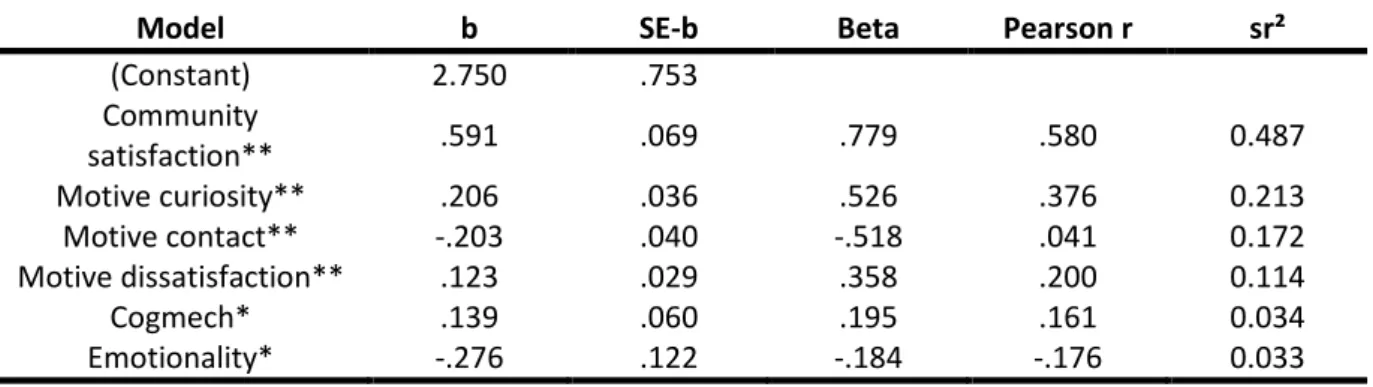
Supplementary to this major part, community activity data, consisting out of an linguistic inquiry and word count (LIWC) analysis and participation intensity data, as well as a post-community survey were used to indicative identify predictors of community participants’ attitudes and transactional behavior. The supplementary analysis was conducted using a statistical stepwise regression procedure. As for the previously mentioned mixed ANOVAs, the underlying rational and a description of this statistical tool are given in greater detail in chapter 4.
Figure 2 provides an overview over the general research model used, including the sampled groups, data available for analysis as well as the respective statistical analysis approach.
18
Figure 2: Research model
Research setting
3.2.
Aiming for an analysis of transactional data covering the whole timeframe of one co-creation process the basis for this analysis is built by the data from the “Aurora” co-creation community operated by InSites Consulting and Marktplaats (eBay Netherlands). Marktplaats was founded in 1999 as an online auction website and acquired in 2004 by eBay. Therefore it is technically the Dutch equivalent of eBay, the world’s largest online auction hosting company. InSites Consulting is an international operating consultancy specialized on marketing research through analysis of customer needs and fostering of co-creation in online communities. In 2011, eBay decided to change the design and functionalities of the Marktplaats website and rebuild it from scratch. For that purpose the “Aurora” community was created to take advantage of customer insights and co-create the new website together with current Marktplaats customers. “Aurora” was a closed co-creation community for the
19 limited duration of 11 weeks between September and November 2011. In total, 178 customers were invited to join, post and comment on ideas ranging from design to functionality.
Data collection and preparation
3.3.
In order to being able to cover the whole timeframe of the co-creation community and compare the transactional data of participants, transactional data on four variables was collected for three different groups (see Table 2). Moreover, as a part of a supplementary analysis a follow-up survey on community participants and a linguistic analysis of all posts within the co-creation community using the LIWC software were conducted. In addition to that, the community participation data, e.g. number of posts and page visits, were recorded for analysis.
Due to the fact that not all of the initially 178 invited customers participated in the final community, the dataset had to be screened for errors and several dummy variables and Marktplaats moderators were removed leaving the transactional data of 149 invited participants available for further analysis. Afterwards, active participants were separated from non-active participants. In total, 119 customers logged in at least once to the “Aurora” community and will therefore be referred to in the following as participants. The reason for treating some participants that did not post during the community also as active participants stems from the fact that they logged in several times and therefore have been exposed to the content of the community activity. However, they may be defined as lurkers but will be included for this analysis. This is also consistent with the participation definition used by Algesheimer et al. (2010) for a similar study conducted on eBay Germany.
Table 2: Overview groups and sample sizes
Group Sample Size (N)
Community participants (G1) 119
Beta testers (G2) 500
20
Transactional data
3.3.1.
The transactional data of the above illustrated groups was collected for analysis. In order to compare the obtained results for external effects such as general change in transactional behavior due to changes in the economic development and the final website, community participants’ behavior will be compared to the transactional behavior of a random sample of 500 so-called beta testers (G2) and 499 normal users (G3) during the same timeframe.
Beta testers (G2) and community participants (G1) were recruited out of the same pool of customers chosen by their transactional behavior in both seller and buyer behaviors and thus comparable to each other. To ensure that not only very heavy users were invited to those groups they were chosen out of three groups in terms of low, medium and high behavior. Regular customers (G3) represent the average typical customer without especially high usage or engagement with the firm.
Community participants (G1) received the treatment of participating in the community during the community timeframes, as well as being able to assess the new beta website during the co-testing phase (see co-creation phases on p. 19). Beta testers (G2) were able to use the newly designed website, as the outcome of the co-creation community efforts, earlier than the normal customers (see Beta testing phases p.21) and were able to access videos of community participants talking about their activity in the co-creation community as well as give feedback and thus help improve the beta version successively. Regular customers (G3) received no particular treatment apart from being able to read about the co-creation efforts in publicly available press releases and newspaper articles.
The transactional data for these three groups includes the monthly aggregate number of four key variables: auctions created (Ads.), bids placed (Bids.), questions asked to vendors (Asq.) as well as payments send via PayPal (Ftr.). These four variables represent important measurements for Marktplaats and were therefore chosen to be used to reflect the transactional impact community participation might have. The available data covers the timeframe from January 2011 until October 2013 on those four variables. Since the available data of October 2013 doesn’t represent a full month
21 it was removed from the dataset. Hence, there are 33 months of transactional data available. The monthly data were allocated based on the following two different time segmentations:
Co-creation phases: The complete data covering the whole timeframe of 33 months was divided to represent the five phases of the co-creation process outlined in chapter two. The phase after the launch of the new website, e.g. post-launch, was divided into two separate timeframes to allow a better comparability of TF 1 and TF 5.1 due to the same length of 7 months. TF 5.1 will be used as the main representative for the post-launch phase.
Table 3: Data segmentation according to co-creation phases
Timeframe Co-creation phase Duration
TF 1 Pre-community phase 7 months
TF 2 Announcement phase 1 months
TF 3 Co-creation phase 3 months
TF 4 Co-testing phase 12 months
TF 5.1 Post-launch (phase 1) 7 months
TF 5.2 Post-launch (phase 2) 3 months
Figure 3: Visualization of data segmentation according to co-creation phases
0 50 100 150 200 250 300 201101 201104 201107 201110 201201 201204 201207 201210 201301 201304 201307 TF1 TF2 TF3 TF4 TF5.1 TF5.2
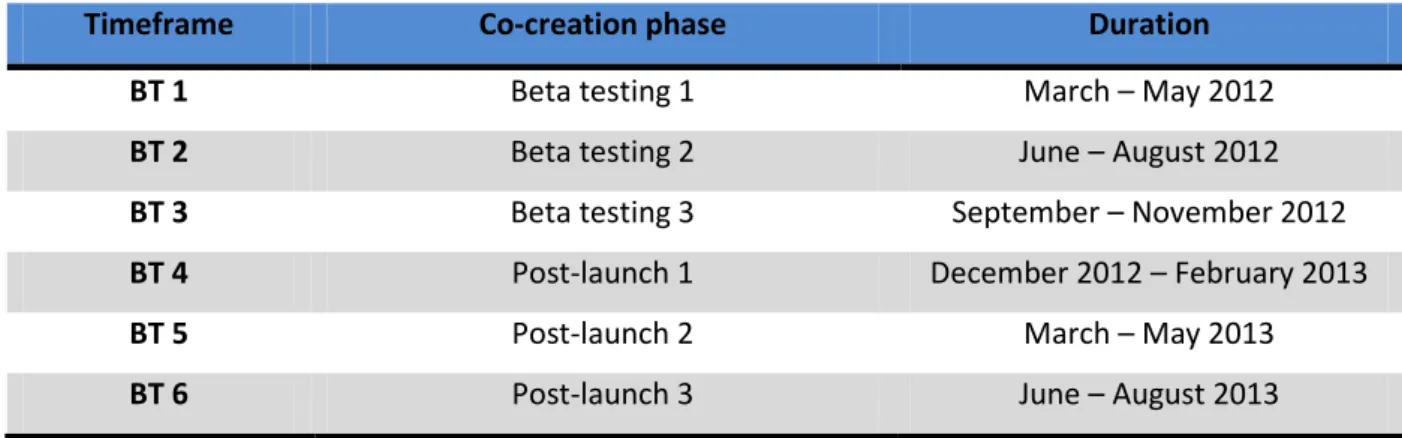
22 Beta testing phases: In order to assess if receiving information about the co-creation efforts impacts the transactional behavior of non-participants, the time segmentation of transactional data had to be adjusted to reflect the beta testing timeframe. This is mainly due to the fact that the previously used co-creation timeframes reflect the timeframes community participants (G1) underwent and don’t exactly match the intervention beta testers (G2) received. Community participants (G1) ended their community engagement in November 2011 and were able to access to beta version of the new website and submit further feedback until the final launch in December 2012. Therefore, the timeframe between end of community and final launch is correctly described as co-testing phase for community participants (G1). However, for beta testers (G2) the co-testing timeframe (in this case named beta-testing timeframe) started at March 2012 (so four months later than community participants G1) with the invitation of beta testers to test the new platform and receiving of videos about community participants co-creation efforts. Therefore, different timeframes had to be used to adequately capture the intervention of receiving information about community participants’ co-creation efforts. The phase ended with the final implementation and launch of the final website to the public in December 2012. To ensure that also small and dynamic effects can be detected the beta testing timeframe and post-launch phases of beta testers (G2) were each segmented in three timeframes each with a duration of three months (BT 1 – BT 6).
Table 4: Data segmentation according to beta testing timeframes
Timeframe Co-creation phase Duration
BT 1 Beta testing 1 March – May 2012
BT 2 Beta testing 2 June – August 2012
BT 3 Beta testing 3 September – November 2012
BT 4 Post-launch 1 December 2012 – February 2013
BT 5 Post-launch 2 March – May 2013
23
Figure 4: Visualization of data segmentation according to beta testing timeframes
Community activity data
3.3.2.
In addition to the transactional data available, a LIWC analysis using LIWC2007 was conducted to analyze the emotional and cognitive processes expressed of every single active participant in all posts during the whole timeframe of the “Aurora” community. The LIWC tool was developed by Pennebaker, Chung, Ireland, Gonzales, and Booth (2007) and is a thesaurus-based computer software that assigns written texts on a word by word basis to 82 pre-defined and tested linguistic dimensions. The final LIWC scores represent the percentage of words that match each of the 82 dimensions. Thereby LIWC is providing an efficient and effective method for studying emotional, cognitive, structural and process components present in written texts and speeches in several different languages (Pennebaker et al., 2007). During the 11 week timeframe of the community 5,858 posts consisting out of 279,855 words were recorded for analysis. The data was checked for errors and posts from moderators were removed. Subsequently the data was manually converted to meet the LIWC format standards. All posts were matched to the respective participants and only the data of the 119 active participants was included in the further analysis. Furthermore, the community activity data from active participants was collected including number of total posts, number of page views and number of page visits.
0 50 100 150 200 250 300 201101 201104 201107 201110 201201 201204 201207 201210 201301 201304 201307 BT 1 BT 2 BT 3 BT 4 BT 5 BT 6
24
Post-community survey
3.3.3.
As a part of a supplementary analysis a post-community questionnaire was conducted to indicatively identify predictors of community participants’ attitudes and transactional behavior. For that purpose, a post-community survey was developed and sent out to the 119 active participants at November 4th and was online available for two weeks until November 18th. Due to the fact that most participants are from the Netherlands the questionnaire had to be developed in Dutch. An English translation can be found in the appendix. In total 43 surveys were completed and valid (response rate of 36.1%).
Measurements
3.4.
The following two tables provide an overview about the measurements used for the main and supplementary analysis. The survey includes several other measurements that have not been used for this particular study but were of great interest to InSites Consulting and Marktplaats and therefore included in the post-community survey to minimize the frequency of surveys. The measurements were mostly based on previously published academic literature and only minimally adjusted due to translations.
The transactional behavior is represented by the four transactional variables presented in Table 6. The two most important transactional variables from the business perspective are without a doubt the number of biddings placed on auctions (Bids.) and the number of auctions listed (Ads.). However, for this study it is assumed that all four variables will respond in the same direction, signaling a general increase or decrease in transactional behavior.
The measurements for the supplementary analysis can be found in Table 5. Cronbach Alphas were calculated for constructs measured with more than one item. All constructs are above the commonly accepted 0.7 threshold recommended by Nunnally (2010) and thus acceptable for further analysis.
25
Table 5: Measurements of the supplementary analysis
Variable Measure Data Source Cronbach’s
Alpha Reference
Overall customer satisfaction
One item on a 10 point Likert scale
Post-community
survey -
(Gustafsson, Johnson, & Roos,
2005) Feeling of closeness to company Degree of overlap between customer and Marktplaats identity Post-community survey -
(Aron, Aron, & Smollan, 1992) Recommendation
intention
One item on a 10-point Likert scale
Post-community
survey - (Reichheld, 2003)
Motive to join: Contact with other
users
One item on a 10-point Likert scale
Post-community
survey - (Füller, 2006)
Motivation to join: Compensation
One item on a 10-point Likert scale
Post-community
survey - (Füller, 2006)
Motivation to join: Show Ideas
One item on a 10-point Likert scale
Post-community
survey - (Füller, 2006)
Motivation to join: Gain Knowledge
One item on a 10-point Likert scale
Post-community
survey - (Füller, 2006)
Motivation to join: Intrinsic Innovation
One item on a 10-point Likert scale
Post-community
survey - (Füller, 2006)
Motivation to join: Dissatisfaction
One item on a 10-point Likert scale
Post-community
survey - (Füller, 2006)
Motivation to join: Curiosity
One item on a 10-point Likert scale
Post-community
survey - (Füller, 2006)
Satisfaction with the community
One item on a 10-point Likert scale
Post-community survey - Authors contribution Ownership of results Three items on a 5-point Likert scale
Post-community
survey 0.85
(Peck & Shu, 2009) Subjective change
on each of the four transactional
variables
Four separate items on a 5-point Likert scale Post-community survey - Authors contribution Participation Intensity # of total postings / # of page views / # of page visits Community activity data - (Nambisan & Baron, 2007) Emotionality % of affective processes of total word count LIWC Analysis 0.97 (Tausczik & Pennebaker, 2009) Cognitive processes % of cognitive processes of total word count LIWC Analysis 0.97 (Tausczik & Pennebaker, 2009) Social processes % of social processes
of total word count LIWC Analysis 0.97
(Tausczik & Pennebaker,
26
Table 6: Measurements transactional behavior
Variable Measure Data Source
Biddings placed on auctions # of biddings placed (Bids) Transactional data Auctions listed # of auctions listed (Ads) Transactional data Questions asked to vendors # of questions asked (Asq) Transactional data Payments send via PayPal # of payments send via PayPal (Ftr) Transactional data
27
4. Data analysis
This chapter presents the objective results of the conducted statistical tests as well as the tests of the previously developed hypotheses. First, the general outlier detection approach is discussed. Afterwards the results of the eight conducted analyses of variance (ANOVAs) are presented, followed by the results of the supplementary regression analyses of community activity data and survey results. All analyses were conducted using IBM SPSS 21.
Outlier detection
4.1.
First the overall dataset was checked for outliers that may affect the following statistical tests. Due to the fact that very few heavy users typically display very extreme transactional behavior datasets with values on the combined scores above three standard deviations above the respective group mean on any transactional variable were excluded. That corresponds to common approaches to deal with outliers that could affect the conducted statistical tests (Pallant, 2010).
Table 7: Sample size before and after outlier detection
Group Initial sample size New sample size Percentage excluded
Community participants (G1) 119 104 12,6 %
Beta-testers (G2) 500 437 12,6 %
Regular customers (G3) 499 450 9,81 %
Mixed between-within subjects ANOVA
4.2.
An analysis of the descriptive statistics of the three groups revealed that the group of the regular users (G3) significantly differs from the two other groups of community participants (G1) and beta testers (G2). Detailed descriptive statistics about the three groups can be found in the appendix. The differences are likely to be a result of the selection procedure for community participants and beta testers that lead to an overrepresentation of heavy and medium users in the groups G1 and G2
28 compared to the overall average represented by G3. Therefore the following analysis is mainly focused on finding differences between the two comparable groups G1 and G2. The data of G3 mainly serves to detect overall changes in transactional behavior and put the behavioral changes of the two more comparable groups in perspective. The data of all three groups was taken into consideration prior to all analyses and interpretations of results. In order to examine if the transactional behavior of community participants (G1) differs from the transactional behavior of beta testers (G2), at some point of time mixed between-within subjects analyses of variance (mixed ANOVAs) were conducted. A mixed ANOVA combines the approaches of both a between-subjects design to compare different groups with a within-subjects design to compare different conditions or points in time (Tabachnick & Fidell, 2007). As a result two independent variables were used: Group belonging served as the between-subjects variable and time as the within-subjects variable. The mixed ANOVA examine whether there are any significant main effects for each of the two independent variables as well as if there is a significant interaction effect between them. The main effects for the between subjects variable “group belonging” describes if there is a statistical significant difference in the transactional behavior for the two groups. The main effect for the within subjects variable “time” describes if there is a statistically significant change in the transactional behavior over time. Finally, the interaction effect states if there is a statistically significant difference in transactional behavior over time for the two groups (Pallant, 2010).
Mixed ANOVA co-creation phases
4.2.1.
Primarily, mixed ANOVAs were conducted based on the data segmentation representing the previously identified co-creation phases (Pre-community phase, Announcement phase, Co-creation phase, Co-testing phase, Post-launch Phase 1 and 2).
A mixed ANOVA was conducted to assess the impact of community participation on participants’ transactional bidding behavior (bids) across all periods of the co-creation process. The transactional variables were non-normally distributed for each group as assessed by Shapiro-Wilk test (all variables
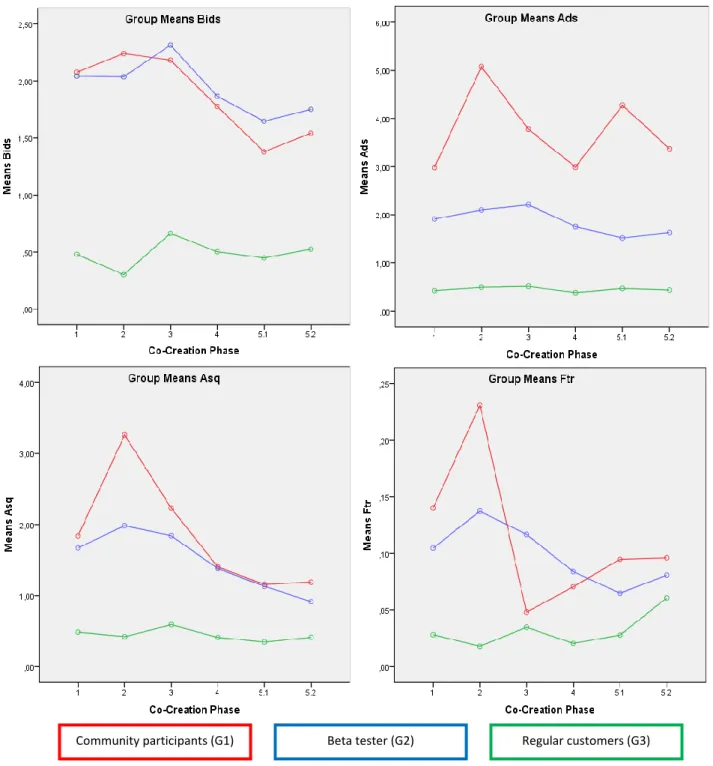
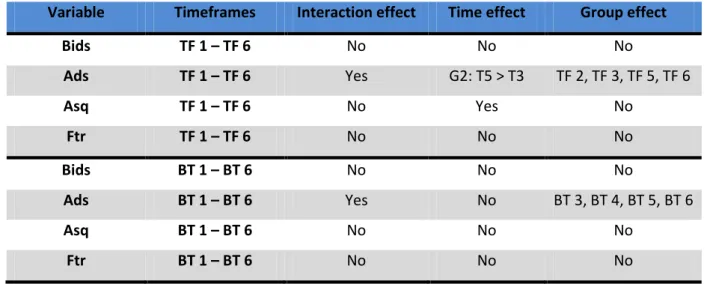
29 p < .05). However, due to the fact that ANOVAs are quite robust to violations of normality and the sample sizes are quite high (n > 30), the ANOVA should provide a valid result (Pallant, 2010). The assumption of sphericity was violated as assessed by Mauchly’s test of sphericity (p < .0005). Therefore, the multivariate test statistic was used as suggested by Stevens (2002). The homogeneity of covariances was violated as assessed by a Box’s Test (p < .0005), however due to the fact that violations are often ignored because this statistic is very sensitive (Pallant, 2010), it is assumed that it is safe to proceed with caution. The homogeneity of error variances was not violated as assessed by Levene’s Test (all timeframes p > 0.05). There was no significant interaction between community participation and time, Wilks’ Lambda = .99, F (5,535) = 0.149, p = .98, partial ƞ² = .001. There was also no substantial main effect for time, Wilks’Lambda = .98, F (5, 535) = 1.562, p = .169, partial ƞ² = 0.014. The main effect comparing the two groups was not significant, F (1, 539) = 0.51, p = .822, partial ƞ² = .002, suggesting no difference in the transactional bidding behavior for the two different groups.
A mixed ANOVA was conducted to assess the impact of community participation on participants’ transactional auction listing behavior (ads) across all periods of the co-creation process. The transactional variables were non-normally distributed for each group as assessed by Shapiro-Wilk test (all variables p < .05). The assumption of sphericity was violated as assessed by Mauchly’s test of sphericity (p < .0005). Therefore, the multivariate test statistic was used. The homogeneity of covariances was violated as assessed by a Box’s Test (p < .0005). The assumption of homogeneity of error variances was violated as assessed by Levene’s Test (all timeframes p < 0.05). However, as ANOVAs are reasonably robust to violations of this assumption (Stevens, 2002) it is assumed that it is safe to proceed with caution. There was a significant interaction between community participation and time, Wilks’ Lambda = .976, F (5,535) = 2.627, p=.023, partial ƞ² =.024. A significant interaction result implies that the impact of one variable is influenced by the level of the second variable and simply reporting the simple main effects can be misleading (Pallant, 2010). Therefore, the effects for time and group have to be tested separately using a univariate General Linear Model (GLM). The
30 GLM approach was chosen over the one-way ANOVA approach because it also reports effect sizes. There were no statistically significant differences in auction listing behavior between the two groups at T1, F (1, 539) = 3.448, p = .064, partial ƞ² = .006 and T4, F (1, 539) = 3.305, p = .007, partial ƞ² = .006. However there was a statistically significant increased auction listing behavior between the two groups for T2, F (1, 539) = 13.877, p < .0005, partial ƞ² = .025, T3, F (1,539) = 5.105, p = .024, partial ƞ² = .009, T5.1, F (1, 539) = 10.896, p = .001, partial ƞ² = .020, and T5.2, F (1,539) = 6.066, p = .014, partial ƞ² = .011. There was no statistically significant effect of time on auction listing behavior (ads), for community participants (G1), Wilks’ Lambda = .932, F (5, 99) = 1.444, p = .215, partial ƞ² = .068. There was a statistically significant effect of time on auction listing behavior (ads) for beta testers (G2), Wilks’ Lambda = .969, F (5, 432) = 2.728, p = .019, partial ƞ² = .031. For the beta testers (G2), auction listing behavior was statistically increased between T3 and T5.1 (M = .694, SE = .196, p = .007).
A mixed ANOVA was conducted to assess the impact of community participation on participants’ question to sellers asking behavior (asq) across all time periods of the co-creation process. The transactional variables were non-normally distributed for each group as assessed by Shapiro-Wilk test (all variables p < .05). The assumption of sphericity was violated as assessed by Mauchly’s test of sphericity (p < .0005). Therefore, the multivariate test statistic was used. The homogeneity of covariances was violated as assessed by a Box’s Test (p < .0005). The homogeneity of error variances was not violated as assessed by Levene’s Test (all timeframes p > 0.05) except for T2 (p = .015). There was no significant interaction between community participation and time, Wilks’ Lambda = .983, F (5,535) = 1.853, p = .101, partial ƞ² = .0017. There was a main effect for time, Wilks’ Lambda = .907, F (5, 535) = 10.944, p < .0005, partial ƞ² = 0.093 showing a statistically significant difference in question asking at the different time points. The number of questions asked to sellers was statistically significantly increased between TF 1 and TF 2 (M = -.867, SE = .232, p = .003) and decreased between TF 1 and TF 4 (M = -.364, SE = .116, p = .026), TF 1 and TF 5.1 (M = -.611, SE = .149, p = .001) as well as
31 TF 1 and TF 5.2 (M = -.703, SE = .148, p < .0005) suggesting an overall decrease after an short increase in TF 2.
The main effect comparing the two groups was not significant, F (1, 539) = 2.956, p = .086, partial ƞ² = .005, suggesting no difference in the question asking behavior for the two different groups.
A mixed ANOVA was conducted to assess the impact of community participation on participants’ usage of PayPal across all time periods of the co-creation process. The transactional variables were non-normally distributed for each group as assessed by Shapiro-Wilk test (all variables p < .05). The assumption of sphericity was violated as assessed by Mauchly’s test of sphericity (p < .0005). Therefore, the multivariate test statistic was used. The homogeneity of covariances was violated as assessed by a Box’s Test (p < .0005). The homogeneity of error variances was partially violated for T 2, TF 3 and TF 5.1 as assessed by Levene’s Test (TF 1, TF 4, TF 5.2: p > 0.05 and TF 2: p = .039, TF 3: p = .007, TF 5.1: p = .049). There was no significant interaction between being a community participant and time, Wilks’ Lambda = .987, F (5,535) = 1.372, p = .233, partial ƞ² = .013. There was also no substantial main effect for time, Wilks’ Lambda = .985, F (5, 535) = 1.667, p = .141, partial ƞ² = 0.015. The main effect comparing the two groups was not significant, F (1, 539) = 0.388, p = .533, partial ƞ² = .001, suggesting no difference in PayPal usage for the two different groups.
32
Regular customers (G3) Beta tester (G2)
Community participants (G1)