Bachelor in Computer Science and Engineering
Semantic Video Quality Assessment
Dissertation submitted in partial fulfillment of the requirements for the degree of
Master of Science in
Computer Science and Informatics Engineering
Adviser: Nuno Manuel Robalo Correia, Full Professor, NOVA University of Lisbon
Co-adviser: Rui Jesus, Adjunct Professor, Instituto Superior de En-genharia de Lisboa
Examination Committee
Chairperson: Professor Doutor José Augusto Legatheaux Martins
Raporteur: Professor Doutor Manuel João Carneira Monteiro da Fonseca Member: Professor Doutor Nuno Manuel Robalo Correia
First and foremost I want to thank the Faculdade de Ciências and Tecnologia, NOVA that helped me to grow professionally. I would like to thank professor Nuno Correia -NOVA University of Lisbon and professor Rui Jesus - Instituto Superior de Engenharia de Lisboa for their continuous guidance, patience, availability and support throughout the realization of this work.
I also want to express my gratitude for the friends that accompanied me throughout my academic journey, that went through the moments of hardships and happiness with me.
Last but not least, I would like to express my deepest grattitude to my family that supported me on my journey, with their support and love. I thank my father and grand-mother for their encouragement, my sister Lorena and Maria Clara for their willingness to help me and especially my mother for her love and understanding and for encouraging me and my decisions. I would also like to thank my dog, Mel, for being my source of joy.
The increasing availability of high-speed internet connections, the increase in smartphone usability and also the ubiquity of social networking, all combined, help to create a great
diversity ofUser-Generated Content (UGC). Along with this expansion,Ultra High
Defi-nition (UHD)broadcast technology has been developing rapidly since its beginning. This created the need to distinguish between good and bad quality videos.
The best way to assess the quality of a video is through the human eye. However, given the amount of content it becomes quite impractical. Therefore, computational methods are used. These methods try to assess it as close as possible to what would be assessed by the human vision.
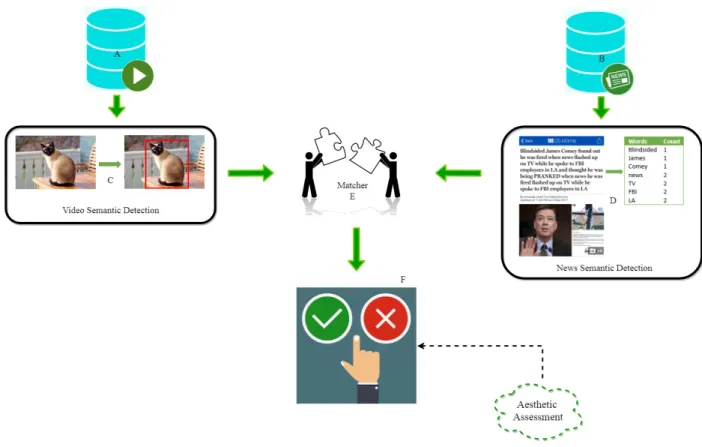
The semantics of a video is the meaning of the video itself and using this information, an idea of what the video is about can be provided, helping even in the assessment of a video. Having that in mind, this thesis uses a video collection and a news articles collection in order to extract the information regarding the objects in the scene and the terms in the news. The similarity between both information is taken into consideration to assess the quality o the videos. In this way, the assessment is done using semantic information.
The main contributions of this work are the video quality assessment based on seman-tic information and an evaluation of a set of object detection algorithms used for semanseman-tic extraction in videos.
Keywords: User Generated Content, Video Quality Assessment, Semantic, Video
O aumento da disponibilidade de conexões de internet de alta velocidade, o aumento da usabilidade do smartphone e a ubiquidade das redes sociais combinadas, criam uma grande diversidade de conteúdo gerado pelo utilizador. Acompanhando esta expansão, a tecnologia de transmissão de alta definição tem sido rapidamente desenvolvida. Isso criou a necessidade de distinguir entre vídeos de boa ou má qualidade.
O melhor método para avaliar a qualidade de um vídeo é através do olho humano. Contudo, dada a quantidade de conteúdo, tal método torna-se impraticável. Por isso, métodos computacionais são utilizados. Estes tentam avaliar o mais próximo possível do que seria avaliado pela visão humana.
A semântica de um vídeo representa o seu significado e ao utilizar essa informação, pode-se ter uma ideia sobre o seu conteúdo. Tendo isso em mente, esta tese usa uma coleção de vídeos e de artigos de notícia para extrair as informações sobre os objetos na cena e os termos encontados na notícia. A similaridade entre ambas as informações são consideradas para avaliar a qualidade de vídeos. Desta forma, a avaliação é feita utilizando informação semântica.
As principais contribuições deste trabalho são uma avaliação da qualidade de vídeos, baseando-se em informação semântica, e uma avaliação de um conjunto de algoritmos de deteção de conceitos que são usados para a extração semântica em vídeos.
Palavras-chave: Conteúdo Gerado pelo Utilizador, Avaliação da Qualidade de Vídeo,
List of Figures xiii List of Tables xv Glossary xix Acronyms xxi 1 Introduction 1 1.1 Context . . . 1
1.2 Motivation and Problem Definition . . . 2
1.3 Contributions . . . 3
1.4 Document Structure. . . 3
2 Related Work 5 2.1 Video Assessment . . . 5
2.1.1 Objective Assessment Methods . . . 5
2.1.2 Video Quality Metrics . . . 6
2.2 Video Semantic . . . 9
2.2.1 Video and Text Aligment . . . 11
2.3 Features Extraction and Classification . . . 12
2.3.1 Feature Selection . . . 12
2.3.2 Feature Extraction. . . 13
2.3.3 Feature Construction . . . 14
2.3.4 Classification by Support Vector Machine . . . 15
2.3.5 Classification by Deep Neural Network (DNN) . . . 16
2.3.6 Classification by Convolutional Neural Network . . . 17
2.4 Object Detection Systems . . . 18
2.4.1 Datasets . . . 19
2.4.2 Systems. . . 22
2.5 Previous work . . . 25
4 Implementation 31
4.1 Video Semantic Detection . . . 31
4.1.1 PySceneDetect . . . 31
4.1.2 Caffe Model Zoo . . . 32
4.1.3 TensorFlow. . . 33
4.1.4 Yolo . . . 34
4.1.5 Support Vector Machine (SVM) . . . 35
4.2 News Semantic Detection. . . 36
4.2.1 News wordcount - whole . . . 36
4.2.2 News wordcount - paragraph . . . 37
4.3 Matcher . . . 37
4.3.1 News Normalization . . . 38
4.3.2 Video Normalization . . . 38
4.3.3 Match. . . 38
4.4 Video Quality Assessment . . . 39
4.4.1 Cosine Similarity . . . 39 4.4.2 Euclidian Distance . . . 40 4.4.3 Assessment. . . 40 4.5 Aesthetic Assessment . . . 41 4.6 Interface . . . 41 5 Evaluation 45 5.1 Videos. . . 45 5.2 News Articles . . . 47 5.3 Assessment . . . 47
5.4 Semantic Detection Techniques . . . 48
5.4.1 YOLO vs OpenCV (DNN) . . . 48
5.4.2 Detection in Videos of Events . . . 50
5.4.3 Semantic Detection with Scene Detection . . . 53
5.4.4 Temporal semantic . . . 56
5.5 Video Assessment . . . 56
5.5.1 SVM classification. . . 62
5.5.2 Video Assessment - Joined classifiers . . . 63
5.6 Video Assessment - more frames . . . 67
5.6.1 Video Assessment - more frames - joined classifiers . . . 71
5.7 Video Assessment by paragraph . . . 75
6 Conclusions 81 6.1 Conclusions . . . 81
6.2 Future Work and Research Opportunities . . . 82
A 1000 ILSVRC2012 image classes 91
B Appendix - Detection in Videos of Events Test 93
B.1 Results from test - Detection in Videos of Events . . . 93
C Appendix - Video Assessment Tests 101 C.1 Results from DNN classifier . . . 101
C.2 Results from Convolution Neural Networks (CNN) classifier . . . 101
C.3 Results from YOLO classifier . . . 101
C.4 Results from joined classifiers . . . 101
C.5 Results from joined classifiers - 100% . . . 101
C.6 Results from DNN classifier - more frames . . . 101
C.7 Results from CNN classifier - more frames . . . 101
C.8 Results from YOLO classifier - more frames . . . 101
C.9 Results from joined classifiers - more frames . . . 101
1.1 Cognitus Architecture . . . 1
2.1 The stages of SVM-based automated expression recognition taken from [28] 15 2.2 CNN Structure taken from [11] . . . 17
2.3 Detection of objects of different classes using YOLO, adapted from [37] . . . 23
2.4 Detection of objects via Video Intelligence API, taken from [7] . . . 24
2.5 Previous thesis application diagram [27] . . . 25
3.1 Architecture Model . . . 27
4.1 Cosine Similarity and Euclidean Distance representation . . . 39
4.2 Cosine Similarity representation taken from [48]. . . 40
4.3 Interface Design . . . 42
4.4 Video details design . . . 43
5.1 Frames from the video used in the first test . . . 46
5.2 Frames from the videos related to popular news . . . 46
5.3 Frames from the videos retrieved from the Cognitus database . . . 46
5.4 Frames from the videos used in the video quality assessment . . . 47
5.5 YOLO vs DNN - Frames examples . . . 48
5.6 YOLO vs DNN - Hit rate . . . 48
5.7 Detection in Videos of Events - Frames examples . . . 51
5.8 Results from test - Detection in Videos of Events . . . 51
5.9 Detection in Videos of Events - Hit rate . . . 52
5.10 Semantic Detection with Scene Detection - Frames examples . . . 53
5.11 Semantic Detection with Scene Detection - Hit rate . . . 55
5.12 Temporal semantic . . . 56
5.13 SVM classification . . . 62
5.14 Comparison of the detection’s normalized values . . . 66
5.15 Comparison of the detection’s normalized values - more frames . . . 76
5.16 DNN results . . . 77
5.17 CNN results . . . 77
B.1 Detection in Videos of Events - hi rate video football . . . 93
2.1 Metric comparison . . . 9
5.1 DNN algorithm detection. . . 49
5.2 YOLO detection . . . 49
5.3 Wordcount from news article . . . 51
5.4 DNN detection . . . 54
5.5 SVM detection . . . 54
5.6 CNN detection . . . 54
5.7 YOLO detection . . . 55
5.8 Metrics table example . . . 58
5.9 Video 1 - DNN classification . . . 59 5.10 Video 2 - DNN classification . . . 59 5.11 Video 3 - DNN classification . . . 59 5.12 Video 1 - CNN classification . . . 60 5.13 Video 2 - CNN classification . . . 60 5.14 Video 3 - CNN classification . . . 60
5.15 Video 1 - YOLO classification . . . 61
5.16 Video 2 - YOLO classification . . . 61
5.17 Video 3 - YOLO classification . . . 61
5.18 Video 1 - Joined classifiers . . . 64
5.19 Video 2 - Joined classifiers . . . 64
5.20 Video 3 - Joined classifiers . . . 64
5.21 Video 1 - Joined classifiers - 100% . . . 65
5.22 Video 2 - Joined classifiers - 100% . . . 65
5.23 Video 3 - Joined classifiers - 100% . . . 65
5.24 Comparison of the values for the Cosine Similarity metric - video 1 . . . 67
5.25 Comparison of the values for the Cosine Similarity metric - video 2 . . . 67
5.26 Comparison of the values for the Cosine Similarity metric - video 3 . . . 67
5.27 Comparison of the values for the Euclidean Distance metric - video 1 . . . . 67
5.28 Comparison of the values for the Euclidean Distance metric - video 2 . . . . 68
5.29 Comparison of the values for the Euclidean Distance metric - video 3 . . . . 68
5.31 Video 2 - DNN classification - more frames . . . 69
5.32 Video 3 - DNN classification - more frames . . . 69
5.33 Video 1 - CNN classification - more frames. . . 69
5.34 Video 2 - CNN classification - more frames. . . 70
5.35 Video 3 - CNN classification - more frames. . . 70
5.36 Video 1 - YOLO classification - more frames . . . 70
5.37 Video 2 - YOLO classification - more frames . . . 71
5.38 Video 3 - YOLO classification - more frames . . . 71
5.39 Video 1 - Joined classifiers - more frames . . . 72
5.40 Video 2 - Joined classifiers - more frames . . . 72
5.41 Video 3 - Joined classifiers - more frames . . . 72
5.42 Video 1 - Joined classifiers - more frames - 100% . . . 73
5.43 Video 2 - Joined classifiers - more frames - 100% . . . 73
5.44 Video 3 - Joined classifiers - more frames - 100% . . . 73
5.45 Comparison of the values for the Cosine Similarity metric - video 1 - more frames. . . 74
5.46 Comparison of the values for the Cosine Similarity metric - video 2 - more frame . . . 74
5.47 Comparison of the values for the Cosine Similarity metric - video 3 - more frame . . . 74
5.48 Comparison of the values for the Euclidean Distance metric - video 1 - more frame . . . 75
5.49 Comparison of the values for the Euclidean Distance metric - video 2 - more frame . . . 75
5.50 Comparison of the values for the Euclidean Distance metric - video 3 - more frame . . . 75
5.51 Resuts summary . . . 76
5.52 Resuts summary - more frames . . . 76
B.1 DNN detection - football . . . 95
B.2 YOLO detection - football . . . 96
B.3 CNN detection - football . . . 97
B.4 DNN detection - eurovision . . . 98
B.5 YOLO detection - eurovision . . . 99
B.6 CNN detection - eurovision . . . 100
C.1 Video 2 - DNN classification . . . 102
C.2 Video 3 - DNN classification . . . 103
C.3 Video 2 - CNN classification . . . 104
C.4 Video 3 - CNN classification . . . 105
C.6 Video 3 - YOLO classification . . . 107
C.7 Video 2 - Joined classification . . . 108
C.8 Video 3 - Joined classification . . . 109
C.9 Video 2 - Joined classification - 100% . . . 110
C.10 Video 3 - Joined classification - 100% . . . 111
C.11 Video 2 - DNN classification - more frames . . . 112
C.12 Video 3 - DNN classification - more frames . . . 113
C.13 Video 2 - CNN classification - more frames. . . 114
C.14 Video 3 - CNN classification - more frames. . . 115
C.15 Video 2 - YOLO classification - more frames . . . 116
C.16 Video 3 - YOLO classification - more frames . . . 117
C.17 Video 2 - Joined classifiers - more frames . . . 118
C.18 Video 3 - Joined classifiers - more frames . . . 119
C.19 Video 2 - Joined classifiers - more frames - 100% . . . 120
C4.5 C4.5 is an algorithm introduced by J.R. Quinlan which produces reasonable decision tree by using a set of training set or data set.
Data Mining Data mining is the computing process of discovering
patterns in large data sets involving converging meth-ods from machine learning, statistics, and database systems.
Domain Knowledge Domain Knowledge is a particular area of work or
specific area to be worked upon.
Max-pooling layer It is a function to progressively reduce the spatial size
(using the MAX operation) of the representation to reduce the number of parameters and computation in the network.
SoftMax Function Softmax function calculates the probabilities
CNN Convolution Neural Networks.
DNN Deep Neural Network.
FR Full Reference.
GME Global Mention Extension.
HVS Human Visual System.
ILSVRC ImageNet Large Scale Visual Recognition Challenge.
MPQM Moving Pictures Quality Metric.
MSE Mean Square Error.
NQM Noise Quality Measure.
NR No-Reference.
PSNR Peak Signal-to-Noise Ratio.
RR Reduced Reference.
SBF Snipped-Based Features.
SSIM Structural Similarity Index Metric.
SVM Support Vector Machine.
TRECVid TREC Video Retrieval Evaluation.
UHD Ultra High Definition.
C
h
a
p
t
1
I n t r o d u c t i o n
The purpose of this chapter is to give a description of the context, the motivation and the definition of the problem on which this thesis aims to solve. Later the contributions and the document structure are presented.
1.1
Context
This thesis is integrated into the Cognitus project, a joint research project comprising eight European participants, led by BBC Research & Development, being University
Nova Lisboa one of its partners. Having an almost 3 years of development, from January 2016 to December 2018, being integrated into the European Horizon 2020 initiative, so far the largest innovation and research program funded by the European Commission.
This project has the intention to merge the advances inUHDbroadcasting technologies
with the massive amount of content generated by users for the sake of new interactive,
immersive modes of production. It has the purpose to optimize how UHD content is
produced and distributed, by exploiting the knowledge of professional producers, the
universality of UGCand also including the power of social creativity from interactive
networks. The requirements for the system to be implemented in this thesis result directly from use cases related to the topic Quality of Experience Enhancement (QOE) whose positioning can be seen in figure1.1[26][8].
1.2
Motivation and Problem Definition
The growth of technology evolved in a way that the access to a mobile device is available to almost everybody. This growth and the desire to share events with others in social media made the number of self-produced videos increase drastically. Despite the importance of these videos, since they capture the event in a reality that is closer to the user, each video has different quality, either by the way it was filmed or by the devices’ brand. The videos filmed by professionals, although they have a better quality than self-produced video, the content might not be to the like of users. And so, it arose the need to combine both ways, so that the videos selected could have a good quality and also have a content that matters to the user. In order to make that true, both the semantics and the quality of the videos need to be taken into account. This can be achieved through many processes being one of them through the use of machine learning.
The human eyes are the best quality assessor, however, is quite impractical to ask a human being to assess the huge amount of videos available. Apart from the fact that this assessment is highly subjective and does not give a standard measure. Having that in mind, the objective measurement is used to give some standardization and produce results in useful time.
Given all theUGC, the access to videos related to events became vulgar. Considering
the number of videos is safe to say that not all of them have either a good quality or a relevant content. The semantics of a video helps to identify objects and concepts in a video. Knowing the concepts or the objects of a video beforehand can be helpful since the user will be able to know if the particular video is of its interest or not. Besides, through its semantic, the user would be able to infer if the video follows some kind of a storyline or not. And so the problem here depicted, relates to the possibility to extract the semantics of the videos in order to help evaluate its quality.
1.3
Contributions
The use of semantics for assessing video quality is the main focus of this work.
In order to achieve this goal, the objects of the videos are detected and these detec-tions are compared to the information found in the news articles, and combining the
information of both, the videos are assessed asgood quality videos or bad quality videos
through the use of semantics.
Another aspect that was studied consists in verifying if a video tells a ”story” through time, which can imply that the content is relevant and that the video is structured.
Summarizing, as the result of the development of this thesis, here are the following contributions:
• Study of video semantic properties, considering temporal aspects;
• Evaluation of existing methods and algorithms to assess video semantics including object detection and classification;
• Assessment of the quality of videos using semantic information;
1.4
Document Structure
The presented document is structured into three chapters, which are following described.
Introduction In this chapter the context of this thesis is presented along with a
clarifi-cation of the motivation and the problem definition. The contributions of this study and the structure of the document is also referred.
Related Work The second chapter is regarded to the related work. This chapter
es-tablishes a connection between the main goals of this dissertation and the related work previously published. The definitions of the concepts are presented and also some tech-niques regarding video assessment are made clear. It is elucidated how to assess a video and how the semantics can contribute for the evaluation of the video quality. The extrac-tion of features from a video and their classificaextrac-tion is also explained. At last, systems that use semantic to identify objects are presented along with some of the most used datasets.
Semantic Quality Assessment In this chapter, the model of the architecture followed
in this thesis work is presented, being each component of it explained.
Implementation In the implementation chapter, each component of the model
previ-ously mentioned is thoroughly explained. Every detail of the implementation done in order to achieve the objective of this work is exposed. The algorithms used and how the
classification process works is presented along with the explanation of the metrics used to assess the video.
Evaluation In the evaluation chapter, the results and an analysis of the tests done
throughout the development of this thesis are presented. The data used for the tests are made clear and what were the motivations for each test. An observation of the results and a more profound analysis is also presented.
Conclusion This chapter presents what can be concluded with the work done, along
with also some of the problems faced. Some improvement possibilities are presented with some research opportunities for future works.
C
h
a
p
t
2
R e l a t e d Wo r k
The work of this thesis uses computer vision techniques. Its goal is to create autonomous systems to perform some of the tasks that the human visual system can perform and even
try to surpass it [17]. Sub-domains of this include event detection, video tracking, object
recognition, among others. The most relevant previous approaches will be presented in the following sections.
2.1
Video Assessment
Nowadays, digital videos are in our everyday life through different types of video
appli-cations, providing us videos with all kinds of quality. Although the human visual system is the one that performs the best when it comes to assessing the quality of a video (subjec-tive assessment), it is not the most reliable since it is subjec(subjec-tive to each person [42]. This created the need to develop and improve an objective assessment (which is accomplished by use of measurements), being its best characteristics the fact that they can be repeatable, standardized and can be performed quickly and easily using portable equipment, making easier to evaluate in a more standard way. The goal of the objective methods is to give
results that correlate closely with results obtained through human perception [56].
2.1.1 Objective Assessment Methods
According to Shahid et al. [43], the objective assessment methods are divided intoFull
Reference (FR),Reduced Reference (RR),No-Reference (NR)depending on the amount of information that is available from the original video as a reference in the quality assessment:
• Full Reference Methods: This method computes the quality difference by compar-ing the signals of the original video and the received video. Typically, every pixel
from the source is compared against the corresponding pixel at the received video,
with no knowledge about the encoding or transmission process in between. FR
metrics are usually the most accurate at the expense of higher computational effort. • Reduced Reference Methods: This metric extracts some representative features
of the original video in order to compare it with the corresponding information from the distorted video. This is done in order to give a quality score, being the
later provided as input for RR methods. This method is used mostly when the
original video is not available or when is impractical to do so. This makes them
more efficient thanFRmetrics.
• No-Reference Methods:NRmetrics tries to assess the quality of a distorted video
without any reference to the original signal. Instead it searches for artifacts concern-ing the pixel domain of the video or uses information concern-ingrained in the bitstream of the video. It can even perform quality assessment using a combination of the two approaches previously mentioned. Due to the absence of an original signal, this method is more efficient to compute, however they may be less accurate than the methods previously mentioned.
2.1.2 Video Quality Metrics
As observed by Wang et al. [55], nowadays the most used FR objective image and video
distortion/quality metrics are the Mean Square Error (MSE)andPeak Signal-to-Noise
Ratio (PSNR). These are the most used because of the simplicity in their calculations, the clear physical meanings and are also mathematically easy to deal with optimization purpose, however they are also criticized for not correlating well with observed quality measurement. A great effort has been made, for the past 3 or 4 decades, in objective
image and video quality assessment methods (mostly forFRquality assessment) in order
to incorporate perceptual quality measures by also consideringHuman Visual System
(HVS)characteristics.
A survey made by Wang [54] was put together in order to provide a better
understand-ing regardunderstand-ing each video quality metric. It was also his intention to compare each of the
presented metric withPSNRin order to see if there were any advantages of using that
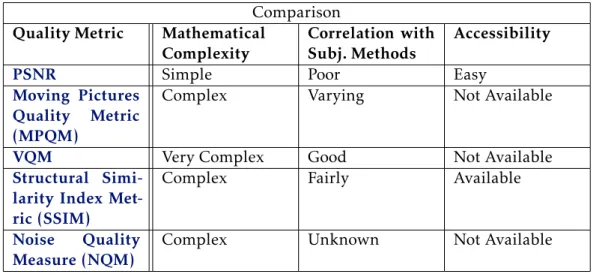
metric overPSNR. In the end of the survey, a comparison of these metrics in terms of
computational complexity was provided, as well as the correlation with subjective video quality measurement, along with the accessibility of each metric. The results can be seen
in table2.1. The metrics compared by Wang et al. were:
• Peak-Signal-to-Noise-Ratio - is derived by setting theMSEin relation to the
max-imum possible value of the luminance. The result is a single number in decibels,
ranging from medium to high-quality video. PSNRis still the most popular metric
to evaluate the quality difference among pictures, despite the fact that many models have already been developed.
• Video Quality Metrics - it measures the perceptual effects of video impairments including blurring, jerky/unnatural motion, global noise, block distortion and color distortion, combining them into a single metric. The testing shows that this met-ric has a high correlation with subjective video quality assessment and has been
adopted by ANSI1as an objective video quality standard. It processes the video as
input and computes it by following these steps:
1. Calibration: In this step, the sample video is calibrated in order to prepare for feature extraction. The spatial and temporal shift, as well as the contrast and brightness offset of the processed video sequence with respect to the original video sequence is estimated and corrected.
2. Quality Features Extraction: This step is responsible to extract a set of quality features that characterize perceptual changes in the spatial, temporal, and chrominance properties from spatial-temporal sub-regions of video streams using a mathematical function.
3. Quality Parameters Calculation: In this step, a set of quality parameters is computed that describes perceptual changes in video quality by comparing features extracted from both the processed video and the original video. 4. VQM Calculation: In the last step, the VQM is computed using a linear
com-bination of the parameters calculated from the previous steps.
Video Quality Metrics (VQM)can be computed using various models based on cer-tain optimization criteria. These models include: Television; Videoconferencing;
General; Developer andPSNR. One of the problems associated with PSNR is that
it does not take the visual masking phenomenon into consideration, meaning that every single pixel error contributes to the decrease of the PSNR, even if is not per-ceived. This matter is addressed by means of incorporating some modeling of the Human Visual System. In particular, two key human perception phenomenon that has been intensively studied are contrast sensitivity and masking. The first phe-nomenon takes into consideration the fact that a signal is detected by the eye only if its contrast is greater than some threshold. The sensitivity of the eye varies as a function of spatial frequency, orientation, and temporal frequency. The masking phenomenon takes into account the human vision response to the combination of several signals. A stimulus consists of two types of signals - foreground and back-ground. The detection threshold of the foreground will be modified as a function of the contrast of the background.
• Moving Pictures Quality Metric - is a metric for moving picture which incorpo-rates two human vision characteristics (contrast sensitivity and masking). A de-composition of the original sequence and the distorted version of it into perceptual
channels is the first step. Then, a channel-based distortion measure is computed taking into account the two human vision characteristics. In the end, the data is merged over all the channels in order to compute the quality rating which is scaled numerically from 1 to 5, being 1 considered bad and 5 excellent. MPQM does not take into consideration the chrominance and that is why the method Color MPQM (CMPQM) has been introduced. This metric represents the typical image quality assessment models based on the error sensitivity. The widely adopted assumption of these models is corresponding to direct relation between the loss of perceptual and the visibility of the error signal.
• Structural Similarity Index Metric - This metric took a different approach regard-ing the ones previously mentioned, since they were all error based, while this uses structural distortion measurement. The idea behind this is related to how the hu-man vision system is highly specialized in extracting structural information from the viewing field instead of being specialized in extracting the errors. Therefore, this kind of measurement should provide a better correlation to the subjective im-pression.
• Noise Quality Measure - In this quality measurement metric, a degraded image is first modeled as an original image being that also modeled as an original image that has been subjective to linear frequency distortion and additive noise injection.
These two sources of degradation are decoupled into two different quality measures
being these measures: a distortion measure (DM) of the effect of frequency distor-tion, and a noise quality measure (NQM) of the effect of additive noise. The last one takes into account:
1. Variation in contrast sensitivity with distance, image dimensions; 2. Variation in the local luminance mean;
3. Contrast interaction between spatial frequencies; 4. Contrast masking effects.
The first measure is computed in three steps. The first one consists of finding the frequency distortion in the degraded image. The second is relative to compute the devia-tion of the found frequency distordevia-tion from an all-pass response unity gain. Finally, the deviation is weighted by a model of the frequency response of the human visual system. An important step to a successful video quality assessment is validation. Therefore it is essential to build an image and video database with subjective evaluation scores associated with each of the images and videos sequences in the database. Then this database can be used to assess the performance of the objective quality measurement algorithms. The quality metrics produces a video quality score and these scores have to correlate with the subjective assessments given by the human evaluators. The entity
Comparison
Quality Metric Mathematical
Complexity
Correlation with Subj. Methods
Accessibility
PSNR Simple Poor Easy
Moving Pictures Quality Metric (MPQM)
Complex Varying Not Available
VQM Very Complex Good Not Available
Structural Simi-larity Index Met-ric (SSIM)
Complex Fairly Available
Noise Quality Measure (NQM)
Complex Unknown Not Available
Table 2.1: Metric comparison
responsible to validate objective video quality metric models is the Video Quality Experts
Group (VQEG) [5].
2.2
Video Semantic
The proliferation of the availability of video data is helping to create demand for methods
that understands and manages videos at the semantic level [2]. So far, most of the
infor-mation found regarding event detection frameworks was advanced towards videos with loose structures or without story units, e.g. sports videos, surveillance videos, medical videos. In opposition, the concept-extraction schemes were largely carried out on the news video, since those have content structures.
Most of these studies are operated in a procedure composed of two stages. The first is named as video content processing which consists of segmenting the video clip into cer-tain analysis units and also extracting their representative features (usually keyframes). The following stage is decision-making process where the extraction of the semantic index from the feature descriptors occurs concerning the improvement of the framework
robustness [46]. The algorithms used for the decision-making include hidden Markov
Model and controlled Markov chain, since those model temporal relations among frames or
shots of an event [4]. Hidden Markov Model scheme achieves promising results because
it automatically discovers the statistical descriptions on high-level structures and also achieves slightly better accuracy in detecting discovered structures in unlabelled videos
than a supervised approach [60]. The controlled Markov chain models, after adequately
trained, provides a list of video segments that can be extracted to be able to represent a
specific event of interest using maximum likelihood criteria [22]. Another type of
heuris-tic method uses a set of heurisheuris-tic rules, being those derived from the domain knowledge to map the feature descriptors to events. A data mining approach is also possible since it helps to mine the high-level semantics and patterns from a large amount of multimedia
data [4].
According to Shyu et al. [46] the semantic analysis of videos related to sports usually
involves two types of features: cinematic and object-based. Cinematic features refer to those that result from common video composition and production rules, for instance, shot types and replays. The objects are characterized according to their spatial features (color, texture, and shape) as well as for the spatio-temporal features (object motions, and interactions). Regarding object-based features, since they permit high-level domain anal-ysis, their extraction can become computationally costly for real-time implementation while cinematic features balance well the computational requirements and the resulting semantics [12].
The analysis and detection of sports events detection generated a lot of attention given its great commercial potentials. Regarding the processing of video content, many of the literature adopted unimodal approaches that use only the visual, auditory, or textual modality.
Concerning the algorithms for detection of events and concept extraction, SVMis
the most adopted one. Despite the fact thatSVMpresents an encouraging performance,
the training process represents a problem since the scale and the increase of the data is not proportional. Another example of sports video analysis is C4.5 with regard to data mining method. The decision tree learning algorithm is mathematically less complex making it useful to deduce the mappings from low-level features to high-level concepts,
being that way, able to select the representative feature items automatically [4].
As observed by Shyu et al. [46] there are different measures to construct the data
mining procedure such as distance-based, rule-based, instance-based, statistic-based and some others procedures. The two most used are distance-based and rule-based. Since the detection of an event or a concept is considered a difficult task, the measurement of individual data mining cannot conclude well alone, requiring some support from certain artifacts. Through the results found from previous experiences it was clear that the detection capability is limited due to the semantic gap and rare event/concept detection issue.
Semantic gap(considered one of the main challenges) is regarded to mapping
high-level semantic concepts into low-high-level spatio-temporal features that can be automatically extracted from video data. To deal with that, the rules to map is usually written into the code causing the inflexibility of the existing approaches and systems. Therefore, the use of domain knowledge is imperative to enable higher level semantics in favor of those being integrated into the techniques that capture the semantic through automatic parsing [2].
Rare event/concept(also known as imbalance dataset) issue occurs when there is a
very small percentage of positive instances while a large number of negative instances dominate the detection model training process. This causes an undesirable degradation
What was proposed by Shyu et al. [46] was a new framework that tries to offer a
solu-tion for the problems previously mensolu-tioned. It utilizes the multimodal content analysis and the distance-based and rule-based data mining techniques, being one of the best attributes the fact that it is automatic and does not need the domain knowledge. Consid-ering this fact, this framework can be easily extended to various applications domains. The approach consists of using an improvement of a previously proposed distance-based
RSPM algorithm [36] in order to perform the rough classification which includes the
feature combination and selection. Then for a further classification, the rule-based al-gorithm C4.5 decision tree is employed. The relaxation of the domain knowledge was possible because many distance-based data mining schemes were adopted in order to ease the class imbalance issue and to also reconstruct and reduce the feature dimension. The particular detail of the framework developed is the ability to mitigate the rare even-t/concept detection and semantic gap problems without the need to rely on the artifacts or the domain knowledge.
Wu et al. [59] proposed a three-layer near-real-time event inference scheme for sports
event recognition. In the first layer, aGlobal Mention Extension (GME)algorithm is used
to separate the frame’s foreground from the background. Then, low-level features are extracted from both. And so the system automatically segments the sequences of frames into clip as basic semantic inference units. Thereafter, the semantic concepts of these clips are extracted in favor of giving a semantic description. Lastly, in the third-layer, rule-based finite-state machines are designed for event inference. The results of this experiment are good since it can recognize sports events precisely.
To assess a video through the use of semantics, a combination between the subjective and objective evaluation techniques are used so that it is possible to compare the perfor-mance of both methods. The subjective assessment includes the comparison of frames and frames details.
In some cases, the importance of the content can be compared with the importance of the perceptual quality for the user satisfaction. And so the quality assessment of a multimedia signal, done by the subjective tests, that focus only on the quality scales can
fail in relating to the higher cognitive processes of a human perception [20]. Some studies
show that there is a substantial correlation between the subjective rating of video quality and the content of the video. Therefore the content of a video given by the semantics
needs to be considered in a video quality assessment [44].
2.2.1 Video and Text Aligment
Understanding the story of videos is not an easy task. The alignment of the video with texts is one way to do it.
One of the analysed case of alignment between video and text was the work done by Tapaswi. In this work, the author used mainly two sources of text in order to understand
Both sources of texts come with problems when it comes to alignment, given that the plot synopses is too summarized containing very little detail while, the book, on the other hand, contain too much detail that it is not portrayed in the video. The solution for both problems passes by selecting parts of the texts that have a direct link with the video.
The alignment of texts and videos requires that the difference in the data representa-tion must be taken care of. The author does the alignment by finding the characteristics of the data that can be found in both the text and the video. They use the notion that stories are strongly character-centric. And so for a good alignment, the crucial component is the detection and analysis of the character names in the text and the identification of characters in the video.
The similarity Φ(t, v) is defined using each segment in the video, v ∈ V , and chunks of text in the document, t ∈ T , computed at every unit of the alignment. Being that the case, the alignment problem is transformed into an optimization problem since it maximizes the similarity between the text and the video while respecting some story progression constraints.
For the plot synopses, they proposed a fine-grained approach. Which means that they tried to align individual shots of the video with each sentence from the plot synopsis. For the books, a coarse grained alignment was done - the video scenes which correspond to
particular chapters was found and used for the alignment [49].
2.3
Features Extraction and Classification
According to Motoda and Liu [29] after some experiments and research, researchers
real-ized that a pre-processing stage is a fundamental part in data-mining. The pre-processing consists of the processing the data before it is used as input for an algorithm. The main ambition of feature extraction, selection and construction is divided into three main points:
1. reducing the amount of data; 2. focusing in relevant data;
3. improving the quality of data and hence the performance of data mining algorithms (learning time, predictive accuracy).
2.3.1 Feature Selection
The work done by Motoda and Liu [29] provided a better understanding regarding the
selection of features. According to some evaluation criteria, this process is a search problem that chooses from the original set, a certain subset of features so that the feature space is reduced given some criteria.
• Feature Subset generation - The easiest way to generate subsets of features is
sequen-tially. It can be eithersequential forward selection or sequential backward selection.
Another possibility is to randomly generate the subsets.
• Feature evaluation - The optimity of a subset is always based on a particular
crite-rion of evaluation. The evaluation criteria are either anindependent or a dependent
criteria being that defined on how they depend or not on the learning algorithm. Independent criteria are distance measure, information measure, dependency
measureand consistency measure. Dependent criteria are evaluated through the
performance of the algorithm. In supervised learning, the objective is to maximize the predictive accuracy whereas for the unsupervised learning there are several heuristic criteria that estimate the quality of clustering results (cluster compact-ness, scatter separability and maximum likelihood)
Algorithms/Methods[19]
1. Chi-squared - most common that measures divergence from the expected
distribu-tion;
2. Euclidian Distance - examines the root square differences between coordinates of
pair of objects;
3. T-test - assesses if the average of two groups are statistically different from one
another;
4. Information gain - measures the increase in entropy when the feature is given in
contrast to when is absent;
5. Correlation-Based Feature Selection - searches feature subset given the degree of
redundancy amidst the features.
2.3.2 Feature Extraction
Motoda and Liu [29] clarify the concept of feature extraction. This process subsists in the
extraction of a set of new features through some functional mapping from the original set, being the new set smaller than the original set. The main target of it, is to search for a smaller set of new features after the original has been transformed according to some performance measure.
• Performance measure - It selects what is the most suitable in order to evaluate the
extracted features. For classification, the predictive accuracy can be used to deter-mine the set of features while for the clustering the measure used is for example inter-cluster/intra-cluster similarity, variance among data.
• Transformation - It takes into consideration the ways of mapping original attributes to new features being the mapping either a linear transformation or a nonlinear transformation. The transformation can be both linear and nonlinear and labeled and non-labeled. The most used techniques are K-Means, K-Medoids, Multi-layer Perceptrons.
• Number of new features - Is regarding the minimum number of new features after the
transformation that can fully represent the original set. The characteristics of the data can be seen as a critical constraint regarding the aspects previously mentioned. In addition, data attributes can be of many types: continuous, nominal, binary, mixed.
Feature extraction can have many usages: dimensionality reduction for further processing, visualization, compound features used to booster some data mining algorithms.
Algorithms/Methods[19]
1. Independent Component Analysis - Linear transformation in which the wanted
repre-sentation is regarding the minimization of the statistical dependence of the compo-nents of the representation.
2. Principal Component Analysis - Is an orthogonal transformation that converts
sam-ples from correlated variables into samsam-ples of linearly uncorrelated features.
2.3.3 Feature Construction
Researchers Motoda and Liu [29] also explained about feature construction. This process
discovers the missing information regarding the relationships between features and am-plifies the feature space supported by the derivation or the creation of additional features. The feature construction main goal is to increase the expressive power of the original features.
• Construction of new features - The approaches can be divided into four groups:
data-driven, hypothesis-data-driven, knowledge-driven and hybrid.
• Choice and design operators for feature construction - The most frequently used
con-structive operators for nominal features are conjunction, disjunction, and negation. Regarding numerical features, the operators are the algebraic operators.
• Use of operators to construct new features efficiently - It studies the connection between data mining tasks, data characteristics, and other operators considered effective. • Measurement and selection of useful new features - In order to avoid too many features
Figure 2.1: The stages of SVM-based automated expression recognition taken from [28]
2.3.4 Classification by Support Vector Machine
Support Vector Machine is a supervised machine learning algorithm which can be ad-dressed for problems regarding classification and regression. The idea of this algorithm is that the input vectors are mapped to high-dimensional feature space in a non-linearly way being each data plotted as a point in the n-dimensional space (being n, the number of features) where the value of each feature is the value of a certain coordinate. There-after, the classification is performed by finding the hyperplane that helps to differentiate
the two classes precisely [53]. This algorithm was originally implemented for separable
training data however in the work done by Cortes and Vapnik in [10] it was also extended
to non-separable training data.
Michael and Kaliouby [28] did work regarding the classification of real-time facial
feature bySVM. In their paper they used a real time facial feature tracker in order to deal
with the obstacle of face location and the feature extraction in spontaneous expressions. Their tracker extracted the location of 22 facial features from the video stream and also used a filter that tracks their position on the following frames. The displacements for each feature is calculated between the neutral and the frame that is representative of each
one of the expressions. The scheme on the figure2.1presents the structure used in this
work.
The algorithm (SVM) receives the input in its training phase, then builds a model of
it and afterward gives the output being this one a hypothesis function that can be used to
predict some future data. One of theSVMstronger points regarding previous algorithms
is that it allows some intuition and human understanding. Another point is that they deal better with noisy data and overfitting.
The implementation followed by Michael and Kaliouby [28] useslibsvm2as the
under-lyingSVMclassifier. It encapsulates its stateless functionality in an object-based manner
in favor of working in an incrementally trained interactive environment. The user has to request the training examples to be gathered at non-contiguous time intervals and also provide a label separately. Then is further combined with the displacements output that came out of the feature extraction phase and then added as a new example to the training
set, being theSVMretrained.
The results that were obtained from this shows that the properties of the algorithm associates well with the restrains related to recognition accuracy and also regarding the speed by a real-time environment.
A problem faced was related to the inaccuracy when it comes to the movement of the head such as nodding and head tilting. That was dealt with the normalization of all the feature displacements concerning the root feature, which gives an approximation to head motion in the video stream.
SVMis a highly used algorithm for image retrieval. The algorithm selects the most
informative images to query the user and quickly learns a boundary that separates the images that satisfy the concept chosen by the user from the rest of the dataset. The results
provided by the experiments using SVMinstead of the conventional query refinement
schemes, has shown a significant improvement in the search accuracy [52].
2.3.5 Classification byDNN
An Artificial Neuron (AN) is basically an engineering approach of a biological neuron. It
hasn inputs and one output. An Artificial Neuron Network consists of a large number of
simple processing elements (AN) that are interconnected with each other [45].
A deep neural network is an artificial neural network that has more than two lay-ers, adding a certain level of complexity to it. This type of network uses sophisticated mathematical modelling in order to process data in complex ways.
The learning method used by the neural net learning algorithm consists of processing several examples with the ”answers” given and, using the answer, it learns what charac-teristics of the input are needed to construct the correct output. After a sufficient number of examples have been processed, the processing of new information can begin in order to successfully give the right results. The accuracy is proportional to the numbers of exam-ples previously seen, which means that, the more examexam-ples and new inputs the program
sees, the more accurate the results are given that the program learns with experience [30].
CireşAn et al. did a work using a multi-column deep neural network to classify traffic
signs. The work developed won the final phase of the German traffic sign recognition benchmark. They used a fast, fully parametrized GPU implementation of a Deep Neural
Network and combined variousDNNs, each trained on differently preprocessed data, into
a Multi-ColumnDNN(MCDNN). The MCDNN improves the performance of the recog-nition and also makes the system indifferent to variations of contrast and illumination.
For the basic building block, a deep hierarchical neural network that alternates con-volutional with max-pooling layers was used. The last layer of the classification is a fully connected layer with one output unit per class in the recognition task. The softmax ac-tivation function is used in order to be able to interpret the output as a probability of a certain image belonging to a certain class.
The first step to train a singleDNNis to pre-process a given dataset and then during
the training, continuously distort it. The preprocessing of the data consists of: cropping the images and processing only the images inside the bounding boxes; visually inspect it; resize the images to 48x48 pixels, and do the contrast normalization.
The MCDNN is formed by averaging the output of several DNN columns.
The MCDNN developed by them had a recognition accuracy rate of 99.46% which it was better than the recognition done by humans (98.31%). They came to conclude that the Multi-Column Deep Neural Network they developed in their work had a recognition rate of 98.52%–99.46%. And also that combining the preprocessing methods into a MCDNN,
increases robustness to various types of noise and gets more traffic signs recognized [6].
2.3.6 Classification by Convolutional Neural Network
CNNis a class of deep, feed-forward artificial neural networks being composed of one or
more convolutional layers followed by one or more fully connected layers being the last one standard multilayer neural network. Its design provides minimal pre-processing. Its architecture takes advantages of the 2D structure of the input image, being that carried out by local connections and tied wights followed by some form of pooling which results in translation invariant features. Another advantage of this algorithm is that is easier to train along with the fact that requires fewer parameters when compared with fully
connected networks that have the same number of hidden units [9]. TheCNNstructure
can be seen in Figure2.2.
A study in video classification using CNN was made by Karpathy et al. [18]. In order
to speed up the runtime performance of CNN, its structure was modified in order to
contain two separate streams of processing: context stream and a high-resolutionfovea3
3In the eye, a tiny pit located in the macula of the retina that provides the clearest vision of all
stream. The first one learns features in low-resolution frames while the second stream only operates on the middle portion of the frame.
Dissimilar to images, videos show a great variation in the temporal extent and so cannot be easily processed with a fixed-size architecture. Having that in mind, this work treated the videos as a set of short, fixed-sized clips and since each clip contains many contiguous frames in time, they could extend the connectivity of the network in the time dimension in favor of learning spatio-temporal features.
Their model was trained for over a month, with models processing approximately, per second, 5 clips for full-networks and up to 20 clips per second regarding the multi-resolution networks on a single model replica. In order to produce predictions for the entire video, each one of the 20 randomly selected clip was individually presented to the network and propagated through it four times. Then the average of the network class predictions was calculated so that it could produce a more robust estimate of the class probabilities.
The features are of two types:local features and global features.
In their work, they found that a multi-layer network performs consistently and signif-icantly better than linear models regarding separated validation experiments.
Karpathy et al. concluded with their work, thatCNN architectures are capable of
learning powerful features from weakly-labeled data that outperforms the feature based methods in performance. Notably, it was found that a single-frame model already dis-plays very strong performance, which suggests that local motion cues may not be critically important, even for a dynamic dataset such as Sports.
Since the results for object detection withCNNwere good, even better ways to detect
were created such as Region CNN (R-CNN), Fast R-CNN and Faster R-CNN. R-CNN
improvesCNNthrough the addition of a bounding box to exactly identify the location of
the main object in the image [1]. TheFast R-CNN solved the R-CNN main problem, which
was that even though it works well, it is considerably slow. This problem was solved by the use of Region of Interest Pooling (RoIPool). The core of RoIPool consists of sharing
the first step ofCNNacross its subregions, meaning that it combines all models into one
network [1,15]. Despite the advances made, there was still a bottleneck, being that, the
region proposer. And so theFaster R-CNN solved it after taking into consideration that
the region proposals depended on features of the image that were already calculated in the first step of the classification. Considering that, the idea was to reuse those results for
region proposals instead of running a separate selective search algorithm [1,39].
2.4
Object Detection Systems
Object detection is part of computer vision that detects objects using semantics. The systems created for this purpose use datasets in order to be able to identify the objects. In this section, some datasets will be presented along with some of the developed systems.
2.4.1 Datasets
Many datasets were created regarding detection and recognition of objects, being the ones that follows the most known and used.
2.4.1.1 Pascal Visual Object Classes
According to Everingham et al. [13], the Pascal Visual Object Classes Challenge is a
benchmark in visual object category recognition and detection, providing both the vision and machine learning communities with a standard dataset of images and annotation, along with standard evaluation procedures. This dataset became accepted as a benchmark for object detection.
The challenge tasks are classification and detection.
• Classification - The goal of this task is to predict the presence as well as the absence of at least one object of a certain class in a test image. The classification methods consist mostly of variations of the bag-of-words method. This consists of
comput-ing local features uscomput-ing, for instance, SIFT4 descriptors. The vector is estimated
usually by k-means into a visual vocabulary and then each image is represented by a histogram that shows how often these local features are assigned to each one of
the visual words. The classifier is normally aSVMor an Earth Mover’s Distance5
kernel.
• Detection - This task predicts the bounding boxes of each object of the same class in a test image, with associated real-value confidence. The method used for detection
was thesliding window. This consists of taking a rectangular window of the image,
posteriorly features are extracted from it to later be classified as either containing an instance of a certain class or not. The classifier then runs over the image at different location and scale.
2.4.1.2 ImageNet
Russakovsky et al. [40] presented an overview onImageNet Large Scale Visual
Recogni-tion Challenge (ILSVRC). ILSVRCis a benchmark that started to run in 2010 in object category classification and detection on several of objects categories and images. This benchmark follows from the PASCAL VOC which sets the standardized evaluation of recognition algorithms.
ILSVRCis divided into two components: publicly available dataset and an annual
competition(which is not going to be focused here). The dataset allows the development
and the comparison of categorical object recognition algorithms.
4Scale Invariant Feature Transformation - is an algorithm in computer vision to detect and describe local
features in images.
5Is a method to evaluate dissimilarity between two multi-dimensional distributions in some feature
The annotation ofILSVRCcan be discriminated into two categories:
• image-level annotation of a binary label -> either 0 or 1 in case of presence or absence in the image of a certain object class.
• object-level annotation of a bounding box and the class label around an object instance.
The main motivation for the development of algorithms that can distinguish classes that are visually very similar, was the huge amount and diversification of object categories.
Regarding the construction of a large-scale object recognition image datasets, it has three main steps:
1. Image Classification - This step defines the set of target object categories, which is selected from the existing ImageNet categories. Through the use of WordNet as a foundation, the ImageNet deals with ambiguous word meanings and the combina-tion of synonyms into the same object category. The combinacombina-tion of an automatic heuristics with a manual post-processing helps to create a list of target categories adapted to each task.
2. Single-Object Localization - It collects varies set of possible images so that it can represent the elected categories. The strategies used on many search engine to do the image collection are both automatic and manual. The process modifies
according to theILSVRCtasks.
3. Object Detection - This last step is the annotation of the millions of the collected
images in order to obtain a clean dataset, being for each individual task, a crowd-sourcing strategy designed. For object detection this dataset consists of 465.567 images for training and 20.121 images used for validation for 200 different classes of varied types [14].
The paper of Russakovsky et al. also presents some of the criticisms associated with it, being those related to the insufficiently challenging dataset given that the objects are usually large and centred in the images. Another problem faced is associated with the fact that the datasets grow larger in scale, which can become impossible to fully annotate them manually.
Russakovsky et al. also presents possible future works in the area. For instance, the growth of unlabeled or partially labelled largescale datasets implies two essential things: the algorithms will have to rely more on weakly supervised training data and will also have to first make a prediction in order to be evaluated later. Which means that instead of evaluating accuracy6or recall7, these algorithms will focus more on predictions8.
6How many of the test images or objects does the algorithm get it right.
7How many of the desired images or objects does the algorithm manage to find.
Since the field of machine learning started to grow, it opened new ways to several things, which included ImageNet. In order to improve performance, larger datasets need to be collected, more powerful models need to be learnt and better techniques to prevent overfitting should also be used. To learn about an considerable amount of objects from an even bigger number of images, a model with a big learning capacity is required. So the model used should have a lot of prior knowledge to compensate for the lack of data,
which is whyCNNare used. Comparing the usually taken approach withCNN, it was
possible to conclude that it has fewer connections and parameters making it easier to train. The results that came out from this work provides the best result on these datasets [21].
2.4.1.3 Microsoft Common Objects in Context
The main goal of the presented dataset (COCO) [23] is to address the three fundamental
problems in scene understanding, being those the detection of non-iconic views of objects; the contextual reasoning between objects; and the precise 2D location of the objects. So that the database could take care of the three mentioned problems, the authors employed a novel pipeline to gather data with the use of Amazon Mechanical Turk. The first step of the creation lies in yield a large set of images that encloses contextual relationship and non-iconic object views. This was accomplished by an effective technique, that queries for pairs of objects together with images, retrieved via scene-based queries. The next step involved that each image was labelled as containing certain object categories through the use of a hierarchical labelling approach. For each category found, the individual instances were labelled, verified and in the end, segmented. Considering the ambiguity that labelling is subject to, each of the stages had many tradeoffs.
The biggest distinction between this dataset and the other (PASCAL VOC and SUN) lies in the number of labelled instances per image which can assist in learning contextual information. Another important property is that the images on the dataset are non-iconic images that contain objects in their natural context, being the amount of contextual information in each image estimated through the examination of the average number of object categories and instances per image.
Bounding-box detection - The experiment took a subset of 55,000 images and did tight-fitting bounding boxes from the annotated segmentation masks. Two different model were evaluated: DPMv5-P and DPMv5-C. The first being the last implementation trained on PASCAL VOC 2012 while the later used the same implementation but trained on COCO. The comparison of the average performance of DPMv5-P on PASCAL VOC and MS COCO showed that the performance of the later is inferior, which suggest that this dataset includes more difficult images of objects. The same happened with the second model.
Generating segmentations from detections - Following from previous works, a simple method for generating object bounding boxes and segmentation masks object is achieved
through learning the aspect-specific pixel-level segmentation masks for different cate-gories. These are learned by averaging together segmentation masks from aligned train-ing instances.
Detection evaluated by segmentation - Even after the assumption of a detector that reports correct results, segmentation can be considered a difficult task since it requires a fine localization of object part boundaries. The criteria established were demanded the standard requirement which requires that the intersection of the union between predicted and ground truth boxes needs to be at least 0.5.
2.4.1.4 TRECVid
TheTREC Video Retrieval Evaluation (TRECVid)is an international benchmarking ac-tivity to help promote a content-based use of digital video via open, metrics-based
eval-uation. To make it possible, TRECVid provides a large test collection, uniform
scor-ing procedures, and a forum so that interested organisations can compare their results. This benchmark is involved with both interactive and automatic/manual search for shots. These shots can come from within a video corpus, automatic detection of a diversity of semantic and low-level video features, shot boundary detection and also through the
de-tection of story boundaries in broadcast TV news. TRECVidis funded by the NIST9, being
also supported from other US government agencies [47] [34].TRECVid2014 continued
a total of five tasks from the previous year, being those: Semantic indexing, Instance search, Multimedia event detection, Multimedia event recounting, Surveillance event detection[34].
For the semantic indexing, the data came from short videos from the Internet Archive
under Creative Commonlicences. Those videos were included since it has a wide variety
of content style and source device. The BBC EastEnders was used for the instance search task. The Heterogeneous Audio Visual Internet Corpus collection of Internet videos was used for development and testing in multimedia event detection task. The tasks were
judged by the NIST assessors [34].
2.4.2 Systems
Several systems were developed to detect objects in real-time using the datasets previ-ously mentioned.
2.4.2.1 YOLO
YOLO9000 is a real-time object detection system [37]. They propose a new method to
tame the considerable amount of classification data that they already have and use it to expand the scope of current detection systems. The method used consists of a hierarchical
9The National Institute of Standards and Technology is a measurement standards laboratory, and a
view of object classification that makes it possible to combine distinct datasets together. The method used is the WordTree that combines data from different sources. The paper also proposes a joint training algorithm that concedes the chance to train object detectors for detection and also for classification data. The proposed method takes advantage of the labelled detection images so that it can learn to precisely localize objects while it uses classification images to increase both the vocabulary and the robustness.
The approach taken by YOLO consists of applying a single neural network to the full image instead of hard negatives. The image is divided into regions by the network to later predict the bounding boxes (which are weighted by the predicted probabilities) and the probabilities for each region.
The model looks, during test time, at the whole image and so the predictions it makes are related to the global context of the image. And since it makes predictions with a single network, unlike the other systems, it results in a faster system [61].
The limitations of this system consist of the detection regarding small objects or unusual aspects ratios [31].
A result of this system detection can be seen in figure2.3.
2.4.2.2 Video Intelligence API
Cloud Video Intelligence API for video analysis was recently introduced by Google. The system can separate signal from noise, through the information retrieved from the video, shot or frame. The API uses deep-learning models and works by selecting a video for annotation, then it detects the objects within the video (labels), scene changes and also the description of the video events over time (shot labels). Since its a Google API, it is available to developers so they can build an application that search, automatically, within the videos [16].
A demonstration of the process of detection made by the API can be seen in figure2.4.
Figure 2.4: Detection of objects via Video Intelligence API, taken from [7]
2.4.2.3 OpenCV 3 Tracking API
OpenCV 3 incorporated a new tracking API that has implementations of many object tracking algorithms, being those BOOSTING, MIL, KCF, TLD, MEDIANFLOW, and
GO-TURN [32]. The process of tracking consists of firstly opening a video and selecting a
frame, then defining a bounding box containing the object for the first frame and initial-izing the tracker with both the frame and the bounding box. The last step is to read the frames from the video and update in a loop in order to obtain a new bounding box for the current frame.
The goal of tracking is to find an object in the current frame given that the object has been successfully tracked in all (or most) of the previous frames. Considering that

![Figure 2.1: The stages of SVM-based automated expression recognition taken from [28]](https://thumb-eu.123doks.com/thumbv2/123dok_br/15740425.1072492/37.892.215.685.172.448/figure-stages-svm-based-automated-expression-recognition-taken.webp)
![Figure 2.3: Detection of objects of different classes using YOLO, adapted from [37]](https://thumb-eu.123doks.com/thumbv2/123dok_br/15740425.1072492/45.892.216.699.657.1086/figure-detection-objects-different-classes-using-yolo-adapted.webp)
![Figure 2.4: Detection of objects via Video Intelligence API, taken from [7]](https://thumb-eu.123doks.com/thumbv2/123dok_br/15740425.1072492/46.892.258.635.419.804/figure-detection-objects-video-intelligence-api-taken.webp)
![Figure 2.5: Previous thesis application diagram [27]](https://thumb-eu.123doks.com/thumbv2/123dok_br/15740425.1072492/47.892.190.702.482.948/figure-previous-thesis-application-diagram.webp)