International Journal for Quality research UDK- 658.5
Short Scientific Paper (1.03)
Quality Improvement Model At The Manufacturing
Process Preparation Level
Dusko Pavletic
1,
Abstract:
The paper expresses base for an operational quality
improvement model at the manufacturing process preparation
level. A numerous appropriate related quality assurance and
improvement methods and tools are identified. Main
manufacturing process principles are investigated in order to
scrutinize one general model of manufacturing process and to
define a manufacturing process preparation level.
Development and introduction of the operational quality
improvement model is based on a research conducted and
results of methods and tools application possibilities in real
manufacturing processes shipbuilding and automotive
industry. Basic model structure is described and presented by
appropriate general algorithm. Operational quality
improvement model developed lays down main guidelines for
practical and systematic application of quality improvements
methods and tools.
2
Mirko Sokovic
1
University of Rijeka,
Faculty of Engineering,
Vukovarska 58, 51000
Rijeka, Croatia,
2
University of Ljubljana,
Faculty of Mechanical
Engineering,
Askerceva 6, SI–1000
Ljubljana, Slovenia.
Keywords:
Quality improvement model, Simulation,
Modelling, DFSS
1.
INTRODUCTION
Phases of the implementation of developedmodel are shown with the corresponding main algorithms, indicating possibilities of implementation of various methods and tools for quality improvement.
Every type of industrial production is based on production processes. To survive in a demanding market, and still be successful, it is necessary to achieve the high level of the products quality. High product quality cans only results from the high quality of manufacturing process.
2. QUALITY
IMPROVEMENT MODEL AT
THE MANUFACTURING
PROCESS PREPARATION
Continuous improvement of manufacturing process can effectively be achieved by the systematic approach with the appropriate application of different methods
and tools. quality improvement model, the existing Developing the structure of the
models of quality improvements at the production preparation level are taken into account.Systematic methodology that take into account the application of different methods and tools of quality improvements, with the goal of designing products and processes that meet the customers expectations is called Design for Six Sigma, DFSS [
The goal of research was to find appropriate systematic approach to quality improvement in the production preparation, within the frame of metal production. Starting from the main principles and methodologies of manufacturing process quality improvement, in the paper are identified possibilities of integration of methods and tools in an operational model of quality improvement in the process of production preparation.
i].
quality in the design and preparation phase of manufacturing. It takes into account the requirements and expectations of customers and with application of various statistical analysis tools enhance the design process. In this effort it is necessary to understand the requirements of customer, and ensure that those requirements are successfully implemented in the product or process.
In order to successfully implement DFSS methodology the entire cycle of development and production of products must be taken into account, starting with collecting ideas and finishing with the modes of product exploitation. Unlike Six Sigma methodology, where DMAIC model of quality improvement is used, with the DFSS methodology there are several models. One approach of DFSS methodology is an IDOV model. Implementation of the IDOV model is carried out through four phases, which are Identify, Design, Optimise and Validate. Basic features of each phase are [ii]:
• Identify customer requirements, feasibility and costs, technical requirement, responsibilities, phases of product and process development;
• Design a product concept, estimate the possibility of nonconformity, identify key product quality indicators, select materials for the product manufacturing, and define the production plan.
• Optimise process capability, product design, design for robustness and reliability, remove existing and prevent potential nonconformities, select product tolerances based on statistics, optimise process quality.
• Validate product prototype, know the product features in operation, determine product failure modes, analyse reliability and risks. Final product control.
Other known model of the application of DFSS methodology is called DMADV model. With DMADV model the process behaviour in the exploitation is trying to be predicted.
Based on the obtained results the improvements are implemented, and the best option is selected. General features of the DMADV model are [iii]:
• Develop the project - Select the
required material, define schedules, and estimate the required resources.
• Estimate the satisfaction of customers and the quality of the process - Identify the customer’s priority requirements. Identify the key indicators of the process quality, their values and tolerances.
• Analyze collected data - Analyze the manufacturing process and equipment, its functionality, cost and reliability, as well as the possibility of the appearance of bottlenecks in the process.
• Design the process - Functionally relate output process variables with the input process variables. Define criteria for projects selection based on analysis of input and output variables. Choose the most appropriate project, make a feasibility study and select suppliers. Analyze possible deficiencies in the production. Defined the standard production procedures.
Confirm process tolerances -
Optimize input variables, define the tolerances, analyse robustness, capability and reliability of the process. Make the required experiments using the design of experiments methods. Start pre-production, assess customer satisfaction, and document suggestions for possible improvements
2.1Development of quality improvement model
During development of the quality improvement model it was assumed that, before the implementation of the model, the project improvements objectives are defined, improvement team members are selected and deadlines to achieve certain objectives defined. Also, it is assumed that team members are familiar with methods and tools for quality improvement included in the model.
methodology [iv]. Specifically, the existing 2.2 Define
quality improvements models at the production
preparation level are generic and deals with Implementation of the quality improvement model begins with the Define phase. In the beginning of work on the project of quality improvement, the responsibilities have been identified, as well as the approach to the problem and the steps in solving the problem. It is imperative to immediately begin to define the scope of the project and to distinguish and exact define the variables that will be deal with.
activities that take place in pre-design phase. Therefore, the proposed structure of the quality improvement model is such that provides guidance on the production preparation phase, especially in the technological preparation of production.
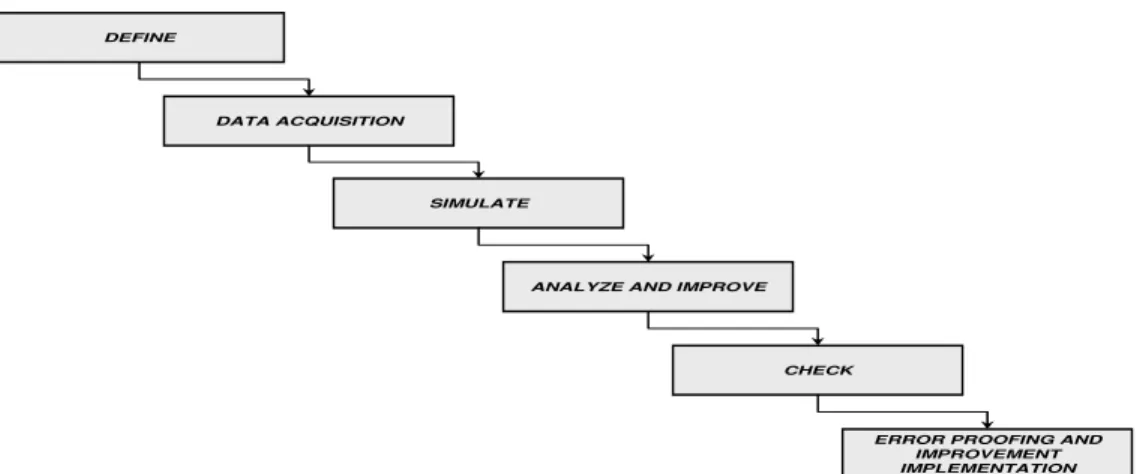
The implementation of the model takes place through six consecutive phases. In the first phase of implementation of the model it is necessary to consider project objectives and determine what is known about problem
2.3 Data acquisition
under consideration. This phase of the model is named Define. Next phase named Data
Once all the key quality improvement project variables have been defined, all necessary information have to be acquired. Acquisition. Within this phase of the model
implementation all the necessary information are collected. Then, during the Simulate phase,
At the beginning of Data acquisition phase, based on previously created graphic representations of the process, FMEA and QFD methods, taking into account the scope of the project, the data that should be collected are determined.
an appropriate simulation model of the manufacturing process is developed, which is, in the next phase of the model implementation, used to perform the necessary analysis with the aim of obtaining data that will serve as a base for improvements. This model phase is named
The manufacturing process that is in the scope of improvement is analysed, key input and output process variables are noted, production equipment, product features, transport and handling equipment identified. Analyze and improve.The results obtained in
previous phases of the application of quality improvement models is analysed in Check phase. If the project objectives are met, the last phase of the quality improvement model
The sources of data are recognized and needed forms for data collection are prepared [
implementation, phase Error proofing and improvement implementation follows. Within
vi]. The determination of liabilities and responsibilities of the team members is next task, needed measurement and control equipment is defined, and appropriated data collection plan prepared.
this phase of the model implementation possibilities of defects appearance and prevention are analyzed and identified improvements are implemented in the process. The general scheme of phases of the model is shown in Figure 1 [v].
DEFINE
DATA ACQUISITION
SIMULATE
ANALYZE AND IMPROVE
CHECK
In cases where data is collected by measurements, it is necessary to determine and define the measurement procedures. For the applied measurement system the appropriate R&R analysis have to be done in order to asses its capability and accuracy.
After the adequate measurement system has been selected, it can be preceded with the data collection and analysis.
2.4 Simulate
In this quality improvement model implementation phase the manufacturing process has to be modelled. At this point of time a manufacturing process is designed, but is not yet operational, so to improve it a process should be adequately represent, which is done by simulation modelling. After the simulation modelling is finished, the model should be validated, and, if successfully validated the model is ready for further use within the framework of process quality improvement.
2.5 Analyze and improve
Validated and verified simulation model of the manufacturing process will be used in the Analyze and improve phase, to research opportunities for the processes quality improvement in the production preparation phase.
Methods that can be effectively applied to the processes analysis and improvement in the production preparation phase are design of experiments methods. Selecting appropriate design of experiment methods all the essential features of the implementation of experiments are defined, as well as the procedure for later analysis of the results.
Before the experimentation, the key process input and output variables should be selected. It is necessary to select those output variables that will provide the necessary information for the process quality improvement. To assess variation of the output variables, it is necessary to select the appropriate measurement system.
When the all the necessary conditions are defined it can be processed with the experimentation and analysis of obtained results. Based on the conducted experiments results the optimal input variables values are selected.
The optimal solution should be validated and confirmed whether the selected optimal values of input variables provide the desired results and quality improvement. If the expected improvement of the quality is achieved, the previously selected optimum values of input variables are adopted. If this is not the case, it can be concluded that the conducted experiments were not included all the key variables or that the selected simulation model of the process is not adequate for the problem. In that case the simulation model can be modified, considering the other input variables and values that will be used in the experiments, and furthermore, the interdependence of, in previous analysis, not included variables are studied.
Final results of Analyze and improve phase are selected values of the process input variables in such a way that, for assumed environment conditions, the optimum value of output variables are achieved.
2.6 Check
When the optimal values of input variables are selected and adopted, in the Check phase verification of successfulness of activities conducted in previous phases of the implementation of the quality improvement model is conducted. Quality improvement activities, within the Check phase of the process, take place mostly during the pre-production, when the process is for the first time operational.
The goal of Check phase is, also, to ensure that the results of the quality improvement project take place over a longer period of time. Next objective is to document adopted production processes and methods.
2.7 Error proofing and improvement implementation
of the process, within the framework of the implementation of this operating model ends by the formal closing of the improvement project.
connections within the individual phases, as well as between different phases of model implementation.
Comparing developed operating model of quality improvement with the existing and previously described models, it is evident that the existing models of quality improvements are implemented through up to four or five phases, such as PDCA and DMAIC models, while developed model of quality improvements is implemented through six phases. Furthermore, it is necessary to emphasize that, unlike the existing models of quality improvements, which can be applied at all phases of production, developed model is designed primarily for use in the production preparation phase. Also, it is necessary to emphasize that developed operating model supports the principle of continuous quality improvement
2.8 Main structure of an integral algorithm of the quality improvement operating model in the production preparation process
Following the considered phases of the quality improvement operating model and their main algorithms leads to the main structure of an integrated algorithm of the operating model, shown in Figure 2. The structure of the specified algorithm models indicated only the base for implementation of the model. However, in the operational application of the model, several decisions have to be made that affects the flow of model applications. There are, also, several feedback
DEFINE DEFINE
Project goals
Selection of processes for benchmarking
Project plan Description of the production process Selection of key input and
output variables Selection of process quality
indicators
Project scheduling
DEFINE DEFINE
Project goals
Selection of processes for benchmarking
Project plan Description of the production process Selection of key input and
output variables Selection of process quality
indicators
Project scheduling
DATA ACQUISITION DATA ACQUISITION
Selection of data that has to be acquired Identification of data
sources
Measuring system analysis and validation Preparation of documentation and data basis for data acquisition Team members duties and
responsibilities Dana acquisition plan
preparation Activities that enables data
acquisition, for example
Benchmarking
Dana acquisition Analysis of acquired data
Recognition of starting position and available data
from other processes
DATA ACQUISITION DATA ACQUISITION
Selection of data that has to be acquired Identification of data
sources
Measuring system analysis and validation Preparation of documentation and data basis for data acquisition Team members duties and
responsibilities Dana acquisition plan
preparation Activities that enables data
acquisition, for example
Benchmarking
Dana acquisition Analysis of acquired data
Recognition of starting position and available data
from other processes
SIMULATE SIMULATE
Problem analysis Selection of simulation
method Production process analysis Modelling Model validation Model verification SIMULATE SIMULATE Problem analysis Selection of simulation
method Production process analysis Modelling Model validation Model verification
ANALYZE AND IMPROVE ANALYZE AND IMPROVE
Process model Objectives of model
analysis
Verification of optimal solution Selection of design of
experiments method Experimentation Analysis of experiment
results Selection of optimal
solution
Improvement and modification of model
Adopted solution
ANALYZE AND IMPROVE ANALYZE AND IMPROVE
Process model Objectives of model
analysis
Verification of optimal solution Selection of design of
experiments method Experimentation Analysis of experiment
results Selection of optimal
solution
Improvement and modification of model
Adopted solution
CHECK CHECK
Model and optimal values of key process variables
Preliminary process documentation Pre-production Acquisition and analysis of
process data Conclusions about process
quality Update of production
documentation
CHECK CHECK
Model and optimal values of key process variables
Preliminary process documentation Pre-production Acquisition and analysis of
process data Conclusions about process
quality Update of production
documentation
ERROR PROOFING AND ERROR PROOFING AND
IMPROVEMENT IMPROVEMENT IMPLEMENTATION IMPLEMENTATION
Identification of actual and possible nonconformities Necessary data acquisition
Implementation of process improvement Root cause analysis
Corrective actions Preventive actions Documentation update and
archiving
Publishing project results Closing the project
ERROR PROOFING AND ERROR PROOFING AND
IMPROVEMENT IMPROVEMENT IMPLEMENTATION IMPLEMENTATION
Identification of actual and possible nonconformities Necessary data acquisition
Implementation of process improvement Root cause analysis
Corrective actions Preventive actions Documentation update and
archiving
Publishing project results Closing the project
FEEDBACKS FEEDBACKS
A common practice is to name strips preparation for welding. On the quality improvement models with appropriate simulation model of production line for the acronyms, such are previously mention PDCA cutting of profiles are carried out necessary and DMAIC models, so developed operating tests in order to determine the optimal value of model of quality improvements could, for production line input parameters.
example, be named DASICE, according to the Experiments were conducted with the names and activities of individual phase of the application of design of experiments method.
D
model: efine, Data Acquisition, Simulate, The number of required experiments is reduced Analyze and Improve, Check, and Error to a minimum. Model, which is suited to the Proofing and Improvement Implementation. selected shipyard, simulates the production line Once, when the production process for cutting profiles, and at the level of the begin, activities on the process quality computer program allows variation and analysis improvement does not stop. of a number of different production scenarios.
A new quality improvement projects It is expected that decisions on final are opened, with an application already configuration of production line, based on the adopted, affirmed and recognized programs and analysis of different scenarios of simulation quality improvement models, based mostly on modelling, has less risk involved than one Deming PDCA cycle, Pareto principle, Six based on the conventional approach.
Sigma DMAIC methodology, applying EVOP On production line simulation model,
methods, etc. an experiment is conducted taking into account
selected inputs values. Comparison of results of simulation modelling before and after
3. MODEL IMPLEMENTATION production line optimizations is shown on
Table 1 [7].
Analysis of the adequacy of the Line optimization results in very high application of the quality improvement usage of the robot cutting lines and significant operating model at metal manufacturing total cutting time reduction. It should be also processes in the shipbuilding and automotive pointed out that the robot cutting speed has industry showed that the developed model can been kept constant, as previously mentioned.It be successfully applied in real production can be concluded that setting the value of input environment in the process of production variables in accordance with the proposed preparation, with the objective of achieving results in a total reduction of cutting time by successful results in the process quality 20.3 %, while increasing the production line
improvement. autonomy for the 19.9 % for station 1 and 17.4
Application of the quality % for station 2. It is also expected increase in improvement model in the shipyard process usage of stations for cutting profiles and strips, was conducted for the process of profiles and 25.3 % for station 1 and 25.6 % for station 2.
Table 1. Comparison of results before and after optimization Legend: tu – total cutting time
f – cutting station 1 usage factor Sl
f
S2- cutting station 2 usage factor.
u
t
S1
f
f
S2Results
min
Before optimization 5306 0,676 0,678
After optimization 3649 0,990 0,997
4. CONCLUDING REMARKS
In order to achieve adequate synergic effect of manufacturing process quality improvement, the possibilities of applying various methods and tools through an operating model of quality improvement in the process of production preparation are discussed.
As already noted, when the existing process is in the focus of improvement, the Six Sigma methodology is successfully used, supported by principles of Deming quality circle, while in cases of quality improvement in the phases that preceded the production process, DFSS methodology models are successfully used.
By studying existing models and researching in the area of quality improvement in the field of metal manufacturing processes, both in engineering and shipbuilding, it was seen nonexistence of a complete model of process quality improvement, especially at the production preparation level. So, the main guidelines of an operational model of quality improving in the production preparation are set, the main algorithms of each phase of the model are developed and the possibilities of applying the model are discussed.Developed operating model of quality improvement is implemented through six phases, which has emphasized a systematic approach to the achievement of quality improving project objectives.
The work on quality improvement project also involves the intensive teamwork, and application of appropriate methods and tools of improving quality.
For the implementation of quality improvement in the production preparation there are typically short deadlines defined in accordance with the planned production start. For this reason the iterative analysis for elimination of non-conformances is usually not possible.
Perceived non-conformances, as well as those who still can possibly occur, are analysed in the last phase of the model implementation. In that phase are, also, defined the necessary corrective actions to remove non-conformances and prevent their subsequent appearances.
As model implementation implies involvement of complex methods, which requires a good knowledge of the mathematical statistics, it can not be expected that an engineer in practice will be able to apply the above mentioned methods without appropriate professional help.
It is therefore, for the successful implementation of DFSS methodology, necessary to provide adequate professional support, so that engineers can focus on ensuring the quality of those activities that add value.
REFERENCES
[1] Treffs, D., et al., An approach to achieving Six Sigma design, ASQ Six Sigma Forum, www.sixsigmaforum.com
[2] Woodford, D., Design for Six Sigma – IDOV Methodology, www.isixsigma.com, 2003. [3] Mazur, G. H., QFD in support of Design for Six Sigma, www.mazur.net, 2003.
[4] Sokovic, M., Pavletic, D., Quality improvement - PDCA cycle vs. DMAIC and DFSS. Stroj. vestn., 53(2007), No. 6, pp. 369-378.
[5] Pavletic, D., Basis for operational quality improvement model at the manufacturing process preparation level, Ph.D. thesis, University of Rijeka, Faculty of Engineering, Rijeka, 2004. [6] Paliska, G., Pavletic, D., Sokovic, M., Quality tools: systematic use in process industry. J.
Achiev. Mater. Manuf. Eng., 26(2007), No. 1, pp. 79-86.
[7] Pavletic, D., Application of Simulation Modelling to the Shipbuilding Process, Transaction of FAMENA (ISSN 1333-1124), XXXI-2, 2007, pp. 47-54.