João Emanuel Araújo Freire
Licenciado em Ciências daEngenharia Electrotécnica e de Computadores
Dissertação para obtenção do Grau de Mestre em Engenharia Electrotécnica e de Computadores
Orientador:
Coorientador:
Presidente: Arguente: Vogal:
Professor Doutor José António Barata de Oliveira, Universidade Nova de Lisboa
Mestre André Dionísio Rocha, CTS – Uninova
Júri:
Professor Doutor Luís Augusto Bica Gomes de Oliveira
Professor Doutor Tiago Oliveira Machado de Figueiredo Cardoso Professor Doutor José António Barata de Oliveira
Transforming Home Appliances into IoT Devices
i
Transforming Home Appliances into IoT Devices
Copyright © João Freire, Faculdade de Ciências e Tecnologia, Universidade Nova de Lisboa. A Faculdade de Ciências e Tecnologia e a Universidade Nova de Lisboa têm o direito, perpétuo e sem limites geográficos, de arquivar e publicar esta dissertação através de exemplares impressos reproduzidos em papel ou de forma digital, ou por qualquer outro meio conhecido ou que venha a ser inventado, e de a divulgar através de repositórios científicos e de admitir a sua cópia e dis-tribuição com objetivos educacionais ou de investigação, não comerciais, desde que seja dado crédito ao autor e editor.
Transforming Home Appliances into IoT Devices
iii
Transforming Home Appliances into IoT Devices
v
0
1.
Acknowledgments
I would like to thank all those who contributed in some way to the work described in this dissertation.First and foremost, I thank my academic supervisor, PhD Professor José Barata, for giving me the opportunity to undertake this research study and to develop this dissertation in a subject of my interest.
Besides my supervisor, I would like to thank my co-supervisor, PhD Student André Ro-cha, for spending his time whenever I approached him and showing me the way ahead. His guid-ance helped me during the research and writing of this thesis.
I also want to take this opportunity to express gratitude to all my friends whose support and friendship proved essential.
Last but not least, I would like to thank my family for their love and support, especially my parents and sister for supporting me through my life in general.
Transforming Home Appliances into IoT Devices
vii
0
2.
Abstract
Home appliances were, until not very recently, isolated devices uncapable of communicate with others. With the recent technological advances is it possible nowadays to connect all these devices to the internet enabling them with the capacity to communicate between them and also the possibility to store and analyse the data generated making them more efficient.Due to these advancements, terms like Internet of Things and Cloud Computing surfaced. These terms represent architectures that allow communications and interactions between devices. The potential of these technologies is substantial for the improvement of productivity and eco-nomic impact.
These advancements allowed home appliances to generate an enormous amount of data, and as repercussion, the need for structures able to receive, storage and process the data emerged.
The present document contains a proposition of an architecture that allows to collect and send home appliances’ data to the Cloud, a way to store and make them available to other applications and a platform that allows the data’s visualisation and analysis. The proposed architecture was tested with a refrigerator offered by Electrolux inserted in the ProSEcO project.
Keywords: Home appliances; Meta products; Internet of Things; Cloud Computing;
Transforming Home Appliances into IoT Devices
ix
0
3.
Resumo
Os eletrodomésticos eram, até há bem pouco tempo, dispositivos isolados sem qualquer capacidade de comunicar com outros. Com os recentes avanços tecnológicos existe hoje em dia a possibilidade de ligar todos estes dispositivos à internet permitindo-os comunicar entre si e também a possibilidade de analisar os dados por eles gerados de modo a torná-los mais eficientes. Devido a estes avanços começaram a surgir termos como Internet of Things e CloudCom-puting que representam sistemas que permitem os dispositivos comunicar e interagir. Estas
tec-nologias apresentam um potencial substancial em termos de desenvolvimento de produtividade e impacto económico.
Este novo passo na evolução dos eletrodomésticos fez com que uma enorme quantidade de dados, provenientes destes dispositivos, começasse a ser gerada e, por conseguinte, a necessi-dade de estruturas capazes de receber, armazenar e tratar estes dados.
O presente documento contém uma proposta de arquitetura que permite recolher e enviar os dados dos eletrodomésticos para a Cloud, armazená-los e disponibilizá-los para outras aplica-ções assim como uma plataforma que permite a visualização e analise dos mesmos. A arquitetura proposta foi testada com um frigorífico disponibilizado pela Electrolux no âmbito do projeto ProSEcO.
Palavras-Chave: Eletrodomésticos; Meta products; Internet of Things; Cloud
Transforming Home Appliances into IoT Devices
xi
Table of Contents
1 Introduction ... 1
1.1 Problem ... 1
1.2 Research Questions and Hypothesis... 2
1.3 Motivation ... 2
1.4 Accomplished Work ... 3
1.5 Major Contributions ... 3
2 State of the Art... 5
2.1 Meta Products ... 5 2.2 Internet of Things ... 6 2.3 Cloud Computing ... 8 2.3.1 Storage ... 10 2.3.2 Web Services ... 11 2.4 Cyber-Physical Systems ... 13
2.4.1 Service Oriented Architectures ... 15
3.1 Overview ... 17
3.1.1 The ProSEcO European Project ... 17
3.1.2 The Interaction ... 18
3.2 Data Acquisition Layer ... 19
3.3 Core Layer ... 21
3.3.1 Data Storage Module ... 22
3.3.2 Data Communication Module ... 22
3.3.3 Data Processing Module ... 23
3.4 Data Visualization Layer ... 24
4 Implementation ... 27
4.1 Data Acquisition Layer ... 27
4.2 Core Layer ... 32
4.2.1 Data Storage Module ... 32
4.2.2 Data Communication Module ... 34
4.2.3 Data Processing Module ... 37
4.3 Data Visualisation Layer ... 41
5 Results and Analysis ... 47
6 Conclusions and Further Work ... 53
6.1 Conclusions ... 53
6.2 Further Work ... 54
Transforming Home Appliances into IoT Devices
xiii
Table of Figures
Figure 2.1 – Meta Products representation ... 6
Figure 3.1 - Proposed Architecture Overview... 18
Figure 3.2 – Data Acquisition Architecture ... 20
Figure 3.3 – Core Layer Sequence Diagram ... 24
Figure 3.4 – Data Visualisation Layer main architecture ... 25
Figure 4.1 – Data Acquisition Graphical User Interface ... 28
Figure 4.2 – Code of connectToServer function ... 28
Figure 4.3 – OpenFile Implementation ... 29
Figure 4.4 – SendValues – run() Implementation ... 31
Figure 4.5 – OpenConnection implementation ... 33
Figure 4.6 – Restlet Server Overview ... 34
Figure 4.7 – Store function implementation ... 38
Figure 4.8 – getVariables function implementation ... 39
Figure 4.9 – getValues function implementation ... 40
Figure 4.10 – Web page to choose the device ... 42
Figure 4.11 – Web Site main page ... 42
Figure 4.12 – Page Layout when between dates chart type is selected ... 43
Figure 4.13 – Example of the implemented chart ... 44
Figure 4.14 – Data Mining mode switching ... 45
Figure 5.1 – Server Application window ... 49
Figure 5.3 – Change Freezer Temperature test ... 51 Figure 5.4 – Open Door test ... 51 Figure 5.5 – Normal behaviour of the refrigerator test ... 52
Transforming Home Appliances into IoT Devices
xv
Table of Tables
Table 2.1 – Comparison of SQL and NoSQL ... 11 Table 2.2 – SOAP and REST Web Services Characteristics ... 12
Transforming Home Appliances into IoT Devices
xvii
Acronyms
ACID - Atomicity, Consistency, Isolation, Durability API - Application Programming Interface
CC - Cloud Computing
CPS - Cyber-Physical Systems CPU - Central Processing Unit CRUD - Create, Read, Update, Delete
CSV - Comma Separated Values
GSM - Global System for Mobile communications GUI - Graphical User Interface
HTTP - Hypertext Transfer Protocol IaaS - Infrastructure as a Service
ID - Identifier
IoT - Internet of Things
IP - Internet Protocol
IPv4 - Internet Protocol version 4 IPv6 - Internet Protocol version 6
LTE - Long Term Evolution
MP - Meta Products
NoSQL - Not Only SQL
PaaS - Platform as a Service QoI - Quality of Information QoS - Quality of Service
REST - Representational State Transfer RFID - Radio Frequency IDentification SaaS - Software as a Service
SOA - Service-Oriented Architecture SOAP - Simple Object Access Protocol SQL - Structured Query Language TCP - Transmission Control Protocol URI - Uniform Resource Identifier URL - Uniform Resource Locator WLAN - Wireless Local Area Network WSDL - Web Services Description Language WSNs - Wireless Sensor Networks
Transforming Home Appliances into IoT Devices
1
1
Introduction
1.1 Problem
During the last decades, home appliances became indispensable in the households, saving people work and time. It is now unthinkable to go back to a time where a house did not have appliances like a washing machine or a refrigerator.
In the past, these home appliances were nothing more than isolated devices that helped people cook, clean, launder, store and cool food without communicating with any other devices. Nowadays with the evolution of the hardware, with the presence of wireless internet connection in almost every house and with technologies such as Machine Learning, Cloud Computing and Internet of Things (IoT) becoming more mature and present, a new approach to these home ap-pliances started appearing. With this evolution is now possible to connect these apap-pliances to the internet, making them able to communicate with each other, control them remotely and collect their data to analyse and ideally predict some behaviours in order to improve the users experience and reduce their work.
With all these appliances now connecting to the internet and sharing their sensors data the need for a structure capable of store and process the data quickly appeared.
For the vendors, the collection and analyses of these appliances’ data are extremely val-uable since it allows them to predict the users’ behaviour and change the machines parameters during their lifecycle so they meet the users’ needs more efficiently. With this data collection it
is also possible for the vendors to plan proactive maintenance, enhancing the costumers-company relationship.
1.2 Research Questions and Hypothesis
Taking in consideration the aspects previously presented and the benefits for the customer and the vendors in having their home appliances connected to the internet some research questions can occur:
• Which architecture is capable to collect the amount of data generated by these devices?
• How to make the extracted data available to be used by other tools and applica-tions?
Regarding the first question, it is proposed in this document a modular solution based on services to collect the data from a home appliance and send it to a server to be stored. The author of this document proposes the use of a Web Services Architecture to achieve a quick data change and to guarantee a fast integration with multiple and different applications.
The use of a Web Services Architecture will also help to find an answer to the second question once it enables the possibility for different architectures to communicate easily with each other, making the collected data available for a variety of different tools.
1.3 Motivation
Nowadays it is possible to create new opportunities for home appliances and improve their capabilities. With this architecture the author aims to provide a valid answer for data acquisition from a non IoT device and its storage in a server capable of making data available for innumerable applications. The data can then be treated and presented in different outputs such as graphics and text.
This solution enables the possibility of making predictions based on behaviours and helps improving the user and the manufacturer overall experience with the devices. By analysing the collected data the devices can adapt their way of functioning to the users’ needs. This offers the user and manufacturer enhanced services such as predictive maintenance and a way to accompany the device’s evolution and performance throughout the user’s experience.
Transforming Home Appliances into IoT Devices
3
1.4 Accomplished Work
The raised questions and the suggestions put forward, have provided the basis for a pro-posal of architecture, which aims to give home appliances a connection to the internet and a way to store the collected data and make it available to other applications.
The proposed architecture consists in three main layers:
• Data Acquisition Layer – acquire data from home appliances and send it to the core layer to be stored.
• Core Layer – receive data from the devices, store it properly and also make it available for other applications to analyse.
• Data Visualisation Layer – an application that makes use of the stored data in the core layer and presents a way to easily show and analyse the data collected from the home appliances.
All the layers are independent from each other since the communication with the core layer is made through web services. It is possible to have different data acquisition applications reporting data to the core layer and also more applications making use of the collected data.
All the data used in the proposed architecture was generated by a refrigerator, which be-longs to Electrolux’s case study of ProSEco European Project. The refrigerator was enabled with a device that collected all 130 sensors state and save it locally every predefined time.
The proposed architecture was implemented using Java, HTML and Javascript program-ming languages and some libraries such as Restlet and Google Charts.
1.5 Major Contributions
The major contributions of the current work coincide in presenting an architecture that can create new opportunities for home appliances and improve their functioning.
This architecture presents a possible solution for data acquisition from a non IoT device and its storage in a server capable of making that data available for innumerable applications that can, not only present the data but also, analyse it and predict behaviours.
Although this work was tested in a refrigerator as case study, the use of the suggested architecture may be generalized for retrieving the data of every home appliance, as long as the device is capable of generate and store its data.
Transforming Home Appliances into IoT Devices
5
2
State of the Art
This chapter is a theoretical research into the actual state of the art with respect to the Internet of Things and Meta Products focusing on methods, tools and technologies that are relevant to this dissertation.
2.1 Meta Products
Meta Products (MP) are, accordingly to (Hazenberg and Huisman, 2012), physical objects with their matching web elements. Usually, these objects have activator functions that are oper-ated by the web elements and also sensorial elements that work as inputs for the system.
An IoT object is also a Meta Product since it is a real live object that has its virtual represen-tation in an internet structure and it is uniquely identifiable. The term “Internet of Things” was introduced by Kevin Ashton in 1999 (Ashton, 2009).
The virtual representation is a virtual copy of the real object, it now has more value than its physical counterpart since it may undergo any data process such as storage and visualization.
Figure 2.1 is an illustration that represents a Meta Product, it shows its physical part, its sensors and actuators, as well as its web element.
Figure 2.1 – Meta Products representation
Meta Products have the potential to transform the way that objects work, and how they can impact life. Any regular object can be converted as long as they are equipped with machine read-able identifiers or identifying devices (Mattern and Floerkemeier, 2001).
An ontology for representing MP and their relationships in the IoT has been presented and it contains seven modules (Wang et al., 2012):
• IoT service: means of interfacing the physical world with context intelligent applica-tions and services;
• Service Test: proposed for testing functional and non-functional capabilities;
• QoS and QoI: important concepts in many areas, such as communications and network-ing;
• Deployment, System and Platform: provides information regarding resources and how they are organized and deployed;
• Observation and Measurement: contains the information collected from the real world; • IoT Resources: focused on sensors and sensor networks;
• Entity of Interest and Physical Locations: object in the real world which is of interest for the user.
2.2 Internet of Things
The Internet of Things (IoT) concept is known for almost 20 years (Yashiro et al., 2013). It was proposed in 1999 by Kevin Ashton as “uniquely identifiable interoperable connected ob-jects with radio-frequency identification (RFID) technology “. Although there is not a standard definition for what IoT is (Li, Xu and Zhao, 2015), the main idea is “a world-wide network of interconnected objects uniquely addressable, based on standard communication protocols” (Atzori, Iera and Morabito, 2010; Botta et al., 2016).
Transforming Home Appliances into IoT Devices
7
The IoT concept brought a lot of advantages to working and domestic fields like domotics, assisted living, automation, industrial manufacturing and logistics (Atzori, Iera and Morabito, 2010).The RFID technology had a major role at the starting of the implementation of this concept once it allowed a normal object be automatically identified (Gubbi et al., 2013). The passive RFID is composed by a tag and a reader. The tag is composed by an antenna and a microchip and it is not battery powered using the power of the signal sent by the reader to send the answer with its identification (ID) (Want, 2006). Due to its simplicity and the low cost of the tags this technology is widely used in retail and supply chain management and in public transportation and other places where there is the need of access control (Gubbi et al., 2013).
The problem of having computer and communications power on everyday objects is that the size of the components mater, therefore, power consumption and processing power are limited (Risteska Stojkoska and Trivodaliev, 2017).
The IoT devices are generally know to be small objects in the real world, broadly distrib-uted and with limited processing capacity and storage which normally create problems related to performance, reliability privacy and security (Botta et al., 2016).
Cloud Computing has been used to provide the virtual infrastructures necessary to the IoT devices to work and communicate properly, creating the necessary environment and offering the processing power needed, giving the support needed to have utilities for integrate monitoring devices, storage devices data, analytics tools, visualization platforms and client delivery (Zhang, Cheng and Boutaba, 2010).
For the IoT devices to work properly it is necessary to have a Smart connectivity solution that works with the existing networks and have a context-aware computation using the network resources. “With the growing presence of WiFi and 4G-LTE wireless Internet access, the evolu-tion towards ubiquitous informaevolu-tion and communicaevolu-tion networks is already evident” (Gubbi et
al., 2013).
These objects, acting as sensors or actuators, are able to interact with each other in order to reach a common goal.
According to (Joseph Bradley, Barbier and Handler, 2013) there are four main subjects that are in the core of IoT systems: RFID, Wireless sensor networks, Addressing and Middleware. As it was previously stated the RFID technology had a major role in the IoT world allowing common
object being unequivocally identified in a network. Wireless Sensor Networks (WSNs) can coop-erate with RFID technology to better trach the Status of the object and also provide various useful data such as position, movement and temperature. “Uniqueness, reliability, persistence, and scala-bility represent critical features related to the creation of a unique addressing schema” that is needed for the success of the IoT. The addressing problem can be solved by protocols like the IPv4 and the recent IPv6 since it supports more devices.
As mentioned by (Joseph Bradley, Barbier and Handler, 2013) the main factors increasing the value of using IoT are:
• Increasing the return on research and innovation investments, reducing time to market, creating new business models and opportunities;
• Increasing the customer lifetime and adding more customers;
• Improve utility services such as supply chain and logistics, to a new and more efficient level;
• Improve business process with the expense on goods reduced; • Increasing the employee productivity and efficiency.
2.3 Cloud Computing
Cloud computing (CC) emerges as a consequence of the rapid development in processing and storage technologies and the easy access to an internet connection. It is, therefore, a new computer model in which resources like CPU and Storage are provided as general utilities that can be rapidly provisioned and released through the Internet in an on-demand way (Zhang, Cheng and Boutaba, 2010). The National Institute of Standards and Technology (NIST) defined five essential characteristics, three service models, and four deployment models that compose the cloud computer model (Mell and Grance, 2011).
The essential characteristics are:
On-demand self-service – a consumer can unilaterally provision computer capabilities as
needed automatically without requiring human interaction with each service provider.
Broad network access – the computer resources are available over the network and
ac-cessed through standard mechanisms that promote use by heterogeneous client platforms such as mobile phones and laptops.
Transforming Home Appliances into IoT Devices
9
Resource pooling - the provider’s computing resources are pooled to serve multiple
con-sumers with different physical and virtual resources dynamically assigned and reassigned accord-ing to consumer demand.
Rapid elasticity – computing resources can be obtained and released dynamically
accord-ing to usage demand. The capabilities available often seem to be unlimited and can be taken in any quantity at any time.
Measured service – The system automatically controls and optimizes resources used,
measuring them accordingly to the type of service (e.g., storage, processing, bandwidth, and ac-tive user accounts). Resource usage can be monitored, controlled, and reported, providing trans-parency for both the provider and consumer of the utilized service.
The Service Models are provided as a way of controlling and using the resources available allowing different layers of control over the System.
The Infrastructure as a Service (IaaS) provide to the consumer fundamentals computing resources like storage, and processing and the ability to run software on the infrastructure like the Operating System and the applications.
The Platform as a Service (PaaS) provide the consumer with the ability to deploy his own applications and programs and some configurations settings but it does not allow the control of the infrastructure like the network and the operating system.
The Software as a Service (SaaS) provide the consumer the ability to use provider’s ap-plications that are running on the infrastructure using thin client interfaces like web browsers or a program interface. The consumer does not have any control of the infrastructure and is only able to change some limited application configuration settings.
The deployment models are Private Cloud, Community Cloud, Public Cloud and Hybrid Cloud and are implementing depending on the provider’s interest in lowering the operation cost or have higher reliability and security(Zhang, Cheng and Boutaba, 2010).
Private Cloud is of exclusive use of an organization and it is usually owned and manage
by the organization itself.
Community Cloud is of exclusive use of a community of consumers from organizations
Public Cloud is available for public in general being maintained by a business
organiza-tion.
Hybrid Cloud is a composition of two or more distinct infrastructures (private,
commu-nity, or public) running part of the services infrastructure in private clouds and the other part in public ones offering more flexibility than public and private clouds. This provide more control and security but also facilitates on-demand service expansion and contraction.
2.3.1 Storage
Data was typically stored in Relational Databases, widely known as SQL databases (Li and Manoharan, 2013). These kinds of databases are great at keeping data integrity using the properties known as ACID which stands for Atomicity, Consistency, Isolation and Durability (Binani, Gutti and Upadhyay, 2016).
Until now all kinds of data where stored in Relational Databases even if they were not adequate (Hecht and Jablonski, 2011). However, with the appearance of Big Data, this kind of storage became inappropriate since they could not guarantee fast responses and quick scalability (Binani, Gutti and Upadhyay, 2016). The quick responses were not possible due to the ACID implementation (Hecht and Jablonski, 2011) and the quick scalability was difficult once the Re-lational databases only allow vertical scaling.
To deal with these problems companies, like Google and Facebook, have to manage huge quantities of data start developing their own databases systems (Hecht and Jablonski, 2011). These systems are called NoSQL databases which means Not only SQL (Gudivada, Rao and Raghavan, 2014).
NoSQL databases became very popular because they give very quick responses, allow horizontal scaling with data partition and replications as built-in features (Gudivada, Rao and Raghavan, 2014) and have as main characteristic the fact of support unstructured data (Li and Manoharan, 2013).
Various architectures for NoSQL databases emerged, however, there are four groups that can contain most of the data models which are Key-value, Document, Column and Graph.
The Key-value based system a key is mapped to a value that can contain any type of data and it is not recognised by the databased system. Examples of these systems are Amazon Dyna-moDB, CouchDB and Membase (Binani, Gutti and Upadhyay, 2016).
Transforming Home Appliances into IoT Devices
11
The Document based systems like MongoDB and Riak store documents in JSON or in similar format that encapsulates key-value pairs. Opposed to key-value types, the values are rec-ognised by the system and can be queried as well (Hecht and Jablonski, 2011).The Column Family systems are inspired by a Google system called BigTable in which rows contain key-value data and columns have unique keys. Columns can be groups in column families which allows better data organization and partition (Hecht and Jablonski, 2011).
The Graph type is used to represent connected data and the relationship between the data. Once this type of system is layered it is used to implement authorization and access control. Google knowledge graph, Facebook Open graph and HypergraphDB are some of the most com-mon databases systems of this kind (Binani, Gutti and Upadhyay, 2016).
On the Table 2.1 it is possible to see a little comparison between some factures regarding SQL databases and NoSQL databases (Binani, Gutti and Upadhyay, 2016).
Table 2.1 – Comparison of SQL and NoSQL
Distinguishing Feature
SQL
NoSQL
Relational Yes No
ACID Yes No
Scaling No Yes
Query Complexity Low High
Distributed No Yes
2.3.2 Web Services
Web Services offer us a way to communicate between applications implemented in dif-ferent languages and in difdif-ferent operative systems since they use standard protocols like HTTP and the messages are encapsulated in XML documents (Alonso et al., 2004). These Services are usually based on SOAP or REST principles(Belqasmi et al., 2012).
SOAP Web Services are based on a service provider, a service registry and a service requestor. The communication between these entities is made with SOAP messages that are XML documents with a standard format (Belqasmi et al., 2012) which is an envelope with a header and a body(Suda, 2003). The descriptions on the service registry are published using the Web Services Description Language (WSDL) and include a service description, the service methods and the binding information (Belqasmi et al., 2012).
Rest Web Services have a client-server architecture and the messages are usually changed using the HTTP protocol. REST services are based on three principles: uniformity, addressability and stateless (Belqasmi et al., 2012). The server offers various resources that are accessible by a URI (Zur Muehlen, Nickerson and Swenson, 2005) and only a few operations are allowed: Create, Read, Update and Delete (CRUD) that are implemented using Post, Get, Put and Delete (Belqasmi
et al., 2012). These have to do with addressability and uniformity. Stateless means that the request
gives the server all the information it needs so it does not need any previous information to answer new requests.
Each implementation offers different benefits, SOAP web services can encapsulate com-plex operations and increase privacy. REST web services are lightweight which makes them bet-ter when a lot of requests are made (Zur Muehlen, Nickerson and Swenson, 2005).
On the Table 2.2 is possible to find some of the main characteristics of the SOAP and the REST web services.
Table 2.2 – SOAP and REST Web Services Characteristics
SOAP Web Services
REST Web Services
A library is necessary in the client side No need for library once it uses the HTTP pro-tocol
Not supported in some platforms Do not expose the methods
Exposes the operations and methods calls Support any content type such as JSON and XML
Use larger packets of data Single resource for multiple actions Can be stateless or stateful
Have a WSDL
Usually uses HTTP Action verbs (CRUD)
More difficult to implement Easier to implement Only uses XML
Transforming Home Appliances into IoT Devices
13
2.4 Cyber-Physical Systems
In the future, it is expected that all objects and structures will be embedded with computing and communication capabilities (Rajkumar et al., 2010).
The recent developments have allowed a better availability and affordability of sensors and data acquisition technologies as well as better network systems leading to the growing use of sensors and networked machines. This result in a continuous generation of high volume data known as Big Data (Lee, Bagheri and Kao, 2015).
However a big gap between the cyber world and the physical world continued to exist. It was necessary to create a system capable of overcame the gap that exist between the cyber world, were information is changed and transformed, and the physical world (Sha et al., 2009).
The Cyber-Physical Systems (CPS) were created with this goal of link the cyber world of computer and communications to the physical world so they can be described as “physical and engineered systems whose operations are monitored, coordinated, controlled and integrated by a computing and communication core” (Rajkumar et al., 2010).
CPS are a new generation of systems with computational and physical capabilities that can interact with humans. The ability to interact with and expand the capabilities of the physical world using computation create a big opportunity to design and develop new kinds of systems such as fully autonomous cars and prostheses that allow brain signals to control objects (Baheti and Gill, 2011).
Some fields were CPS can be more relevant are medical devices and systems, transporta-tion vehicles, robotic systems, aerospace systems, intelligent highways, defence systems, process control, factory automation, building and environmental control and smart spaces (Rajkumar et
al., 2010; ZHANG et al., 2013).
CPS concept is very different from the traditional systems, therefor, they have some spe-cific characteristics that, accordingly to the authors of (Shi et al., 2011) are:
Closely integrated – CPS integrate computation and physical processes.
Cyber capability in every physical component and resource-constrained – Every
com-ponent is embedded with software and the resources as computing power and network bandwidth are usually limited.
Networked at multiple and extreme scales – CPS networks can be wired or wireless
networks making use of different technologies as Wireless LAN, Bluetooth, GSM, etc. to connect all the components. The systems scale and the devices category are extremely varied.
Dynamically reorganizing – CPS must have adaptive capabilities.
High degrees of automation, control loops must close – As CPS must have a convenient
man-machine interaction advanced feedback control technologies should be applied.
Operation must be dependable, certified in some cases – As CPS tend to evolve to large
scales and become more complex systems reliability and security measures are necessary.
CPS must operate dependably, safely, securely, efficiently and in real-time (Rajkumar et
al., 2010).
As stated by the authors of (Rajkumar et al., 2010) as the world wide web have as the core enabling technologies the hypertext, communication protocols like TCP/IP and graphical inter-faces the CPS have as their core the embedded systems, real-time systems, distributed sensor and control systems.
The CPS are a consequence or are originate or need by the raising of the IoT and the cloud computing. They bring together the discrete and powerful logic of computing to monitor and control the continuous dynamics of physical systems (Rajkumar et al., 2010).
CPS aims to managing the Big data and control machines in order to create systems more intelligent and able to self-adapt. Factories can be transformed into an Industry 4.0 factory with significant economic potential if CPS are integrated in production, logistics and other services (Lee, Bagheri and Kao, 2015).
CPS is defined as transformative technologies for managing interconnected systems be-tween its physical assets and computational capabilities (Lee, Bagheri and Kao, 2015).
Accordingly to the authors of (ZHANG et al., 2013) CPS are difficult to analyse, design and validate because of two reasons:
• CPS, opposed to traditional systems, emphasize the holistic system view over both the cyber and physical parts. The engineering of a CPS must account for the interacting and inter-dependent behaviours of cyber and physical components to achieve system level functionalities;
Transforming Home Appliances into IoT Devices
15
• CPS need to deal with two distinct worlds: the discrete world of the cyber components usually model in discrete mathematics and the continuous world of the physical compo-nents usually modelled by differential equations. Due to these differences the integration and abstraction of these components are a major challenge.To overcome the problem of integration that CPS systems have due to the existence of many kinds of operating systems, applications and other aspects, Service Oriented Architectures started to take place.
2.4.1 Service Oriented Architectures
The Service-oriented Architecture (SOA) is a concept of design, implement and assemble services that communicate with each other to achieve some goal (Barry and Dick, 2013). It have a huge importance in the fields of CPS once this architecture helps to overcome many challenges of computer distributed systems allowing the integration and communication between applica-tions that have their own protocols and standards (Papazoglou and Van Den Heuvel, 2007).
The SOA are being promoted as a next evolutionary step to help organizations overcome more complex challenges by enhancing efficiency, agility, and productivity of an enterprise by positioning services as the building block.
There is the need of connecting this services to each other in some way and, although there is no need to be Web Services, it’s developments and standards made in the recent years lead that these were chosen largely to make these connections in Service-oriented architectures (Papazoglou and Van Den Heuvel, 2007).
The main concept of this kind of architecture is the existence of a service provider and a service consumer (Barry and Dick, 2013). The services are software resources that encapsulate an operation and only offers an interface (Papazoglou and Van Den Heuvel, 2007).
Each service offered by a SOA application may implement a brand new function, use pieces of old applications that have been adapted and wrapped by the service implementation or it can implement a combination of legacy parts with new ones (Georgakopoulos and Papazoglou, 2008). In a Service-oriented Architecture the services available should have the following characteristics (Channabasavaiah, Holley and Tuggle, 2004):
• All functions in an SOA are defined as services.
• All services are independent and their behaviour is unknown from the outside. They op-erate as “black boxes” and external components do not care how they perform their func-tion, just expect a result.
• In the most general sense, the interfaces are invokable so, at an architectural level, it is irrelevant whether the services are local or remote. It does not matter what interconnect scheme or protocol is used to effect the invocation, nor which infrastructure components are required to make the connection.
Services in SOA should be designed in such a way that they become components that can be assembled in multiple ways (Papazoglou and Van Den Heuvel, 2007) to allow developers to quickly create and modify the services available to support or automate the business needs (Aljazzaf, Capretz and Perry, 2016). Due to the possibility of assembling services they are grouped in two types: atomic and composite (Barry and Dick, 2013).
The atomic service is a well-defined, self-contained function that does not depend on the context or state of other services.
The composite service is an assembly of atomic or other composite services. The ability to assemble services is referred to as composability. Composite services are also referred to as com-pound services.
The services should also be loosely coupled. This is a design concept where the internal im-plementation of one service is not known to another service. All that needs to be known is the external behaviour of the service. This way, the underlying programming of a service can be modified and, as long as external behaviour is the same, anything that uses that service continues to work as expected (Papazoglou and Van Den Heuvel, 2007; Barry and Dick, 2013) .
The architecture of this systems is composed by a service provider, which owns, implements, and controls access to the services, a service requestor, which is an application, service, or client who is searching and invoking a service and, although it was not always present, a service broker that groups all of the services together and maintains a registry of available services (Georgakopoulos and Papazoglou, 2008).
Transforming Home Appliances into IoT Devices
17
3
Architecture
As discussed on chapter 2 there are many technologies regarding the communication be-tween different devices. The Rest Web Services and The Document Databases are possible solu-tions to solve and integrate these differences between the devices.
The proposed solution aims to transform non IoT devices into devices capable of com-municating with the internet and therefore giving the system some intelligence.
3.1 Overview
3.1.1 The ProSEcO European Project
The ProSEcO solution enables the effective extension of products with Product Exten-sions Service solutions in different sectors (automotive, home appliances, automation equip-ment, machine tooling) by means of the innovative combination of Ambient Intelligence, Lean and Eco-design, Life-Cycle Assessment and Collaborative Knowledge Management techniques (Lima-Monteiro et al., 2017).
The ProSEcO platform will also have the manufacture’s specific learning algorithm that will generate predictive data regarding the devices’ sensors that need to be stored and made available by this architecture (Di et al., 2016).
3.1.2 The Interaction
The proposed architecture is designed to be integrated with the ProSEcO solution, creat-ing the middleware between the ProSEcO platform and the devices offercreat-ing also the possibility to analyse the retrieved data.
To develop this architecture a home appliance is provided with the capability to generate data and store it internally. The goal is to obtain that data and store it on the cloud making it available to the platform and other services.
The solution proposed was separated into three main layers. The core layer is responsible for receiving the data coming from the different sources and store it. It is also responsible for making the data available to other resources that may need it. Another layer is the data acquisi-tion layer. This one is responsible for acquire the data from the device and send it to the core layer. The last layer is the data visualization layer, that allows the visualisation of the stored data and the analyses of it.
Transforming Home Appliances into IoT Devices
19
The Figure 3.1 represents an overview of the proposed architecture where it is possible to see how all the elements of the system connect and interact.3.2 Data Acquisition Layer
The acquisition layer is the layer responsible for collecting the data from the home appli-ance and send it to the core layer to be stored. This layer will allow the devices that normally do not have an internet connection to become IoT devices and communicate their status to a platform online. For this architecture the used home appliances need to have the capacity to collect senso-rial information regarding their status and save it locally. This layer will read that information and send it to the core layer.
In the proposed architecture, the user uses a Graphical User Interface (GUI) that has been implemented in order to allow a more user-friendly management of the system. Although this layer is developed to acquire data from a specific type of home appliances a replication or adap-tation of it can be done since, that in the end, the sensors’ information is sent through a web service to the core layer.
Figure 3.2 – Data Acquisition Architecture
This architecture was developed having in mind that the home appliances used could lo-cally save the state of their sensors and keep a history of them.
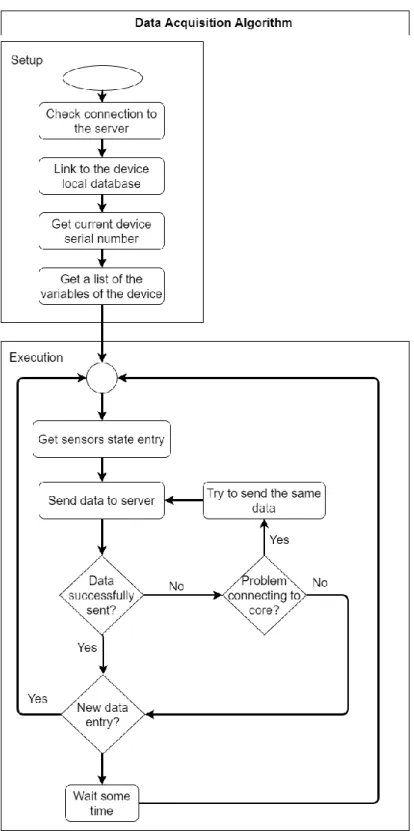
This application starts by getting a link to the file where the device stores its sensors data. When this link is successful it proceeds to get a list of the variables stored and checks if it matches
Transforming Home Appliances into IoT Devices
21
the number of variables that it was supposed to have. If the number of variables matches as ex-pected, the application will start to send one entry of data to the core system. If it delivers the data successfully it will get another reading set, otherwise will try to send the previous set again. The set of readings is sent with the addition of the device serial number to inform the core layer who generated that data.When there are no more sets of data to send the application will wait some predefined time until it checks for new data again.
3.3 Core Layer
The core layer is composed by different modules that when together make the connection between all the devices and the different layers.
These modules are responsible for receiving data, organizing it, storing it and make it availa-ble for other layers. It can be divided in 3 main blocks:
• Data Communication • Data Processing • Data Storage
The Data Communication will be supported by web services because this approach, as dis-cussed in Chapter 2, is the most efficient to use in systems that work on different programming languages. This module will allow the data to be retrieved and sent from the Core Layer and will be responsible for taking care of different types of requests, such as, requests to save data that is coming from the different devices, give a list of devices that are saved on the system, give the list of variables saved for each device and give the requested data of a certain device.
The Data Processing module will be responsible for processing the incoming data so it can be properly stored in the database. It will also be responsible for gathering the necessary data from the databases to respond to the requests made to the core layer.
The Data Storage module will be composed by the databases in which the data will be saved. As it was discussed on the Chapter 2 a NoSQL database will be used as it is more efficient to work with huge amounts of data.
3.3.1 Data Storage Module
The data storage module is composed by the databases server and the driver in the main application that allows the communication between the different components. For this architec-ture a NoSQL database will be used since it can achieve better speeds and can grow horizontally (Gudivada, Rao and Raghavan, 2014) which can fit better the needs of this solution since it will have to deal with a lot of requests from the various devices and the storage used will increase rapidly.
This solution has two databases, one to store the data from the devices and another one to store the predicted sensor data that come from other applications such as the ProSEcO platform.
The driver in the main application needs to provide to the other core elements methods that allow the communication with the database. For that, regarding each database, the driver needs to have a method to open and close the connections to the database, one to store the data received by the devices and another one to store the data sent by the ProSEcO learning algorithms. It also needs a method to find the desired data using the sensors’ name and a date.
3.3.2 Data Communication Module
The data communication module will be composed by a Web Services architecture that will allow the interaction between all the different devices, applications and the core layer. In this architecture the REST principle will be used since it can offer more combability between different kinds of devices and is more lightweight, which can be an important aspect since many devices will be communicating (Zur Muehlen, Nickerson and Swenson, 2005).
This module represents the server side of the web services architecture and it is responsi-ble for receiving the incoming requests and route them to the appropriate data processing method. For the proposed architecture to work it is necessary to offer a specific set of end-points to allow the communication between the devices and the server as well as external applications to retrieve the data. It is also necessary to make available end points for the ProSEcO platform to store the predicted data created by its learning algorithms and a way for external applications to show that data.
Transforming Home Appliances into IoT Devices
23
The necessary end-points to deal with the data generated by the devices need to:• Receive the data from a device; • Get a list of devices stored;
• Get values from a specific device and time interval; • Get values from a specific device in real time.
The data collected from the different devices can be analysed by the ProSEcO platform and the predictions made will be stored in this application core so there is also the need to create services that allow the ProSEcO platform to store de data in this database. This data can then be consulted in the same way as the generated data from the devices but will be a prediction of what it is expected for the sensors values to be. Therefore, it is, once again, necessary to also have a service to:
• Store the data generated by the algorithm; • Get a list of the devices stored;
• Get values from a specific device and time interval; • Get values from a specific device in real time.
The real time end-points offer the possibility to request the last hour of data, so the user can have an overview of the data evolution, and also the possibility to request the new data updates since the latest request.
3.3.3 Data Processing Module
The data processing module is composed of the functions that will interpret the requests coming from the data communication module and will call the appropriate methods, from the data storage module, to store or retrieve the desired data.
The functions that deal with the data storage need to validate the incoming data and call the right method from the data storage module.
The functions that deal with the requests of data need to check how many dates are given to call the appropriate function. If one date is given, they request the data generated from that date and onward, if two dates are given they request the data generated between them.
Regarding the real time data requests, the functions needs to check if the request is for the last hour of data or for the new entries and retrieve the correct data.
In Figure 3.3 it is possible to see a sequence of how the modules of the core layer com-municate between them when a request from an external application is made.
Figure 3.3 – Core Layer Sequence Diagram
3.4 Data Visualization Layer
The data visualization layer aims to provide a way for the users to see the retrieved data from the devices, as well as, the data generated by the learning algorithms. This layer also pro-vides a way to visually analyse the data generated by the devices. With that in mind, this solu-tion proposes a platform where it is possible to see the collected data in time series charts.
Transforming Home Appliances into IoT Devices
25
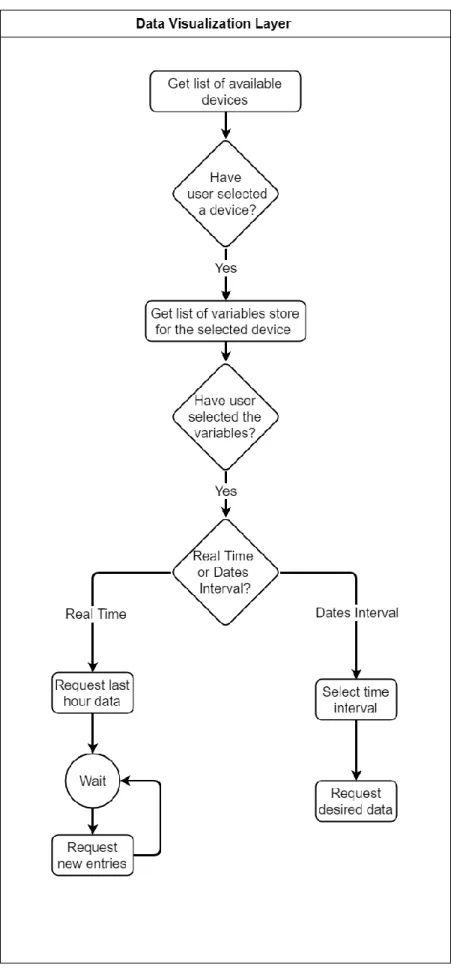
In Figure 3.4 the main behaviour of this layer is presented, although it offers more op-tions that will be explained bellow.
The visualisation platform starts by requesting all the serial numbers available and gives the user the possibility to choose one. After that, it will request to the core layer all the variables available for that device and present them to the user. After the user select the desired sensors the platform will, by default, show a time series chart with the real time data. It starts by re-questing the last hour data from that device and showing it on the chart, then, every predefined time (a few seconds), it will request the new entries for that device. The user has the possibility to stop this request, stopping the chart from changing, allowing him to better analyse some data.
If the user wants to see a specific time frame of data, it has an option to switch the type of chart. When that happens, the application will show a field to choose a start and an end date and will validate if the dates chosen by the user are correct (the start date is before the end date). If the dates are correct it will request the core layers for the desired data and show it in the chart.
The platform also gives the user the possibility to change the environment from the data collected from the device to the data predicted by the external algorithms. When this option is chosen the new list of available variables is requested and shown to the user. Then the user has the same options related to the charts that had regarding the data collected from the devices.
Transforming Home Appliances into IoT Devices
27
4
Implementation
This chapter will describe in detail the implementation of the proposed architecture ex-plained in Chapter 3, it will maintain the same format separating the architecture in three main layers, data acquisition layer, core layer and data visualisation layer.
4.1 Data Acquisition Layer
The data acquisition layer will collect the data generated by the home appliance and will send it to the Cloud. The home appliance in use is a refrigerator from Electrolux capable of writing a CSV (Comma Separated Values) file with the state of the 130 sensors every 3 seconds.
A simple Java Graphic Interface was created to help the user start the application on the gateway connected to the refrigerator, test the link to the Cloud Server and choose the right CSV file.
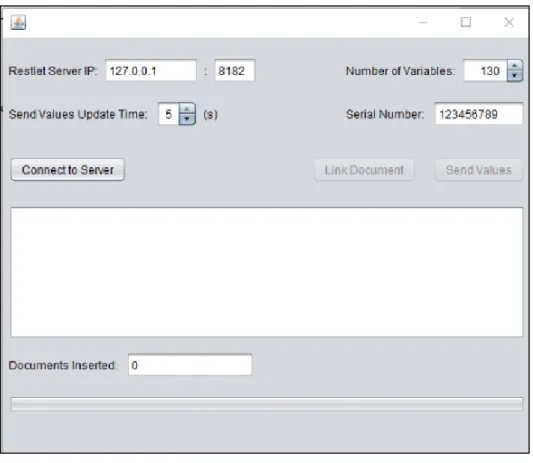
Figure 4.1 – Data Acquisition Graphical User Interface
The Figure 4.1 shows the GUI available for the user to start the data acquisition applica-tion. On this screen it is possible to set the server’s IP address and port as well as the expected number of variables, the Serial Number of the home appliance ant the update time.
After all these parameters are set correctly the Connect to Server button can be pressed which will call the connectToServer function. As it can be seen in the Figure 4.2 the base URL for the server is defined using the IP and Port defined by the user. A new ClientResource is created and stored in the variable Client to be used during the flow of the application once it has the information needed to communicate to the server. The CallGet function is then called and it will perform a REST request Get method to check if the connection is working properly.
Transforming Home Appliances into IoT Devices
29
If the connection is valid the Link Document Button will be enabled and the user can select the desired document. After selecting the document the OpenFile function will check if the document meets the desired format.The OpenFile function starts by opening the file given using the FileReader Java Library and then using the BuffuredReader Lybrary it reads one line from the file. If the line is equal to
null then the file is invalid, if not, it will try to split the line by the “;” character. If it is split in the
same amount given by the user in the Number of Variables the file is assumed as correct and a list of the variables name, including the serial number is stored in a local variable. If the Number of Variables is not met, then a new line from the file is read and the conditions tested again. If the end of the file is reached the readLine function will return null and the file is considered invalid. If the file is valid then the Send Values button will be enabled. When pressed by the user the run function from the FileHandler class is called. This function has a while loop that will run until the end of the program.
Transforming Home Appliances into IoT Devices
31
The loop implemented by the run() function is a java thread that is sleeping during the specified time interval defined by the user on the interface. When the thread awakes it checks if the isRunning variable is true, that represents if the Send Values button was selected or not. If it is true then it checks if it should read a line from the file or not. If the line variable is different from null then it is converted to an ArrayList and it is sent to the Cloud using the CallPut function. If no errors occur, another line is read from the file and sent to the Cloud until there are no more lines (line == null). When the line variable is equal to null the thread goes back to sleep.
4.2 Core Layer
As it was explained in chapter 3 the Core Layer, although it should be seen as just one component of this architecture, can be separated in 3 main modules: Data Storage, Data Commu-nication and Data Processing. The Core Layer will work as a server and is implemented as a Service Oriented Architecture that allows the easy communication with other applications.
To implement the server the Java programming language will be used, as well as, a Mon-goBD database to store the data. The Web Services used are based on the REST principle and will be implemented with the help of the Restlet Framework. This application is also made with the use of the Maven tool that works as the project’s dependency management system.
4.2.1 Data Storage Module
The Data Storage Module is composed by a MongoDB database and some functions in the Server application. The connection between the Java Application and the MongoBD database is made with the help of the MongoDB Java Driver.
As it was explained in the Chapter 3 this architecture has two separate databases: one is called Electrolux and is used to store the data received from the devices. The other one is named
ElectroluxProseco and is used to store the predicted data generated by the learning services of
Electrolux.
Although there have been created two Java Classes to deal with each database only the functions that deal with the Electrolux database will be explained since the ones used with
Elec-troluxProseco work in the same way.
To work with the database it is firstly necessary to open a connection between the Java application and the MongoDB server. For that, the OpenConnection function is used. As it can
Transforming Home Appliances into IoT Devices
33
be seen on Figure 4.5 the function will try to connect to the database that, in this case, will be running in the same host, then it will try to acquire the desired database, “Electrolux”.Figure 4.5 – OpenConnection implementation
With a connection now opened it is possible to store and retrieve data from the database. The MongoDB database stores a Document object that has a key-value structure. Each document can have as many pairs of key-values as it is needed and are stored under groups called collections.
For this solution each collection will represent a device, using its serial number as its name. The documents in each collection will represent a reading from all the sensors having as many pairs of key-value as the number of variables of the home appliance.
The InsertDocument function is used to store a reading in the database, receiving as pa-rameters the serial number, a list with the variables name and a list with the respective values. The function starts by checking if the list of variables and the list of values have the same size. If they do, it creates a document with the data and stores it in the proper collection. If no, it returns an error.
The FoundDocuments function receives a serial number and two dates and returns an
ArrayList <Document> with all the documents that it found between the two dates.
There is another FoundDocuments function that only receives one date with the differ-ence being that it returns all the documents found after that date.
The getSerials function returns a list with all the serial numbers found in the database which corresponds to the name of the collections.
The getVariables receives a serial number and returns a list with the names of all the variables available for that specific equipment. For that, it retrieves one document of the given serial number and returns the name of all the key fields present.
To deal with the real time requests explained in chapter 3 it was necessary to implement the next two functions: getLastHour and getNewEntries.
The getLastHour function receives a serial number and a client key, that should be unique for each client requesting data to the server, and return a list with all the documents found. This function starts by retrieving the date and time of the last document saved for the specified serial number and then using the FoundDocuments function it retrieves all the documents between that hour and an previous one. The date of the last document is then saved in a HashMap along with the client key for future use.
The getNewEntries function also receives as parameter a client key and a serial number and returns a list with all the documents found. This function should be used after the getLastHour function since it returns the documents whose date is greater than the one stored in the HashMap for that client key. It will return null if the client key is not found in the HashMap.
4.2.2 Data Communication Module
This module is composed by the server that will receive the requests from external appli-cations. To implement this server the Restlet Framework will be used which helps to easily im-plement REST APIs (Application programming interface) in a java application.
The Restlet server is composed by a Restlet Component that includes virtual hosts and applications. In Figure 2.1 it is possible to see how all these elements are combined.
Transforming Home Appliances into IoT Devices
35
The Restlet component will create the necessary environment for the other elements. In this case it will receive HTTP requests on the port 8182 and send it to the virtual host to be analysed which will then forward it to the right application.For this architecture two applications are necessary, one to process the requests that deal with the Electrolux database, where the data from the devices is stored and another one to pro-cess the requests that deal with the ElectroluxProseco database, where the data generated by prediction algorithms is stored.
These applications work as a router forwarding the incoming requests to the right data processing algorithm. In each application it is defined the available APIs and to which
ServerResource class are they forward.
All the HTTP requests made to this server have to start with the following format: http://[RestletServerIP]:8182/Electrolux/…..
or
http://[RestletServerIP]:8182/Proseco/…..
The virtual host will forward the requests starting like the first case to the Electrolux application and the ones starting like the second case to the ElectroluxProseco application.
The Electrolux application has the following APIs implemented: • http://[RestletServerIP]:8182/Electrolux/StoreValues/{serial}
{serial} – The serial number of the device
This is a POST request method and the body should be a Form with the pair key-values to store.
• http://[RestletServerIP]:8182/Electrolux /GetValues/{key}/{serial}/{type} {key} – Client unique key
{serial} – The serial number of the device
{type} – The value can only be Variables or Sensors
This is a GET request method. If the {type} is Variables it returns an Array with all the variables available for that device. If the {type} is Sensors then it is necessary to add to the URL the desired Sensor’s names and the dates or date. If only one date is given the system will return
all the data that is from date onward, if two dates are given then the data returned will be from the time between them.
These options should be added as parameters with the following format: Date=yyyy-MM-dd_HH:mm:ss
Sensor=sensorName
The response of this request is an Array of Strings and with the String having the follow-ing format:
sensorName=value1;value2;…..;valueN;
As an example, if the desire is to get the values of the sensor Cooler_Sensor_Temp and the respective timestamps obtained after the date 1-02-2018 the URL would be:
http://[RestletServerIP]:8182/Electrolux/GetValues/{key}/{serial}/Sensors?Sen-sor=date&Sensor=Cooler_Sensor_Temp&Date=2018-02-01_00:00:00
•
http://[RestletServerIP]:8182/Electrolux/GetValuesRealTime/{key}/{se-rial}/{operation}
{key} – Client unique key
{serial} – The serial number of the device {operation} – lastHour or update
This is a GET request method and needs as URL parameters the names of the sensors desired with the following format:
Sensor=sensorName
The response returned by this request is an Array of Strings and with the String having the following format:
sensorName=value1;value2;…..;valueN;
If the {operation} value used is lastHour the system will retrieve the values of the desired sensors regarding the last hour available in the system. The variable update should only be used after one request with the lastHour being made since that it will return new values in the system
Transforming Home Appliances into IoT Devices
37
• http://[RestletServerIP]:8182/Electrolux/GetSerialsThis request is a GET method that will return an Array with all the available serial num-bers in the system.
The endpoints implemented to work with the ElectroluxProseco database are equal to the ones described above having, as stated before, their beginning as the only difference.
4.2.3 Data Processing Module
The data processing module is composed by the implementation of the various java clas-ses that deal with the Rest requests. Due to the Restlet Framework each endpoint is associated to a java class that extends the ServerResource. In each of these classes it is possible to create dif-ferent functions to support the difdif-ferent requests methods Post, Get, Put, Delete, etc. For the framework to know which one to use it is only necessary to annotate it with the right type, e.g. @Put. In this solution it is only implemented the desired method for each endpoint having one class for each.
Has it happened with the previous modules only the classes that work with the Electrolux endpoints will be explained since the ones used to deal with the ElectroluxProseco worked in the same way with the exception that call the functions that deal with the other database.
The function store is responsible for processing the StoreValues request. As it can be seen the Figure 4.7 the function starts by retrieving from the HTTP request the serial number of the device and the form with the values to store. Then it stores all the sensors names in one ArrayList and all the values in another and sends them as parameters of the InsertDocument function that will store them in the database. If the operations succeeds a message saying that the file was stored is returned, if the operation is unsuccessful an error message is returned.
Figure 4.7 – Store function implementation
The getVariables function, described in the Figure 4.8, is responsible for processing the
GetValues request. It starts by getting the serial number, client key and the type from the requests
parameters. Then checks if the type given is “Variables”. If it is, the function will retrieve all the names of the sensors available for the device with the given serial name by calling the getVaria-bles function. If the type given is “Sensors” the function will get the sensors’ names and the dates given as parameters in the URL of the request and then analyse the number of dates given. If the number of dates given is one it will call the FoundDocuments that only receives one date as pa-rameter and that will return all the values found for the desired sensors whose dates are from after the given date. If two dates are given the FoundDocuments function that receives two dates will be called and will return all the values found between them. After this process the getVariables function will return an ArrayList of Strings that will contain the name of all the sensors or the values for the requested sensors.