Original Article Oliveira et al.
Rev Bras Ativ Fís Saúde 2016;21(5):442-451
DOI: 10.12820/rbafs.v.21n5p442-451 RBAFSSOCIEDADE BRASILEIRA DE ATIVIDADE FÍSICA E SAÚDE
Brazilian Journal of Physical Activity and Health
RBAFS
Revista Brasileira de Atividade Física & Saúde
SOCIEDADE BRASILEIRA DE ATIVIDADE FÍSICA E SAÚDE Brazilian Journal of Physical Activity and Health
RBAFS
Revista Brasileira de Atividade Física & Saúde
SOCIEDADE BRASILEIRA DE ATIVIDADE FÍSICA E SAÚDE
Brazilian Journal of Physical Activity and Health
Brazilian Journal of Physical Activity and Health Sociedade BraSileira de atividade FíSica & Saúde
Profile of professionals working in physical activity
interventions within programs in the primary
health care system in the State of Pernambuco
Perfil dos profissionais que atuam nos programas de promoção da saúde
com intervenções em atividade física da atenção básica à saúde do
estado de Pernambuco
Danyelle de Cássia Ribeiro de Oliveira1,2, Anísio Luiz da Siva Brito2, Rafael Miranda Tassitano2,3
Introduction
In 2006, the Ministry of Health (MH) released theNational Policy for Health Promotion (NPHP) ad-ding physical activity (PA) as one of the strategies to confront with non-communicable chronic diseases
1 Municipal Secretary of Health of recife – Pe/Brazil 2 Graduate Program in Physical education - UPe/UFPB, Brazil 3 Federal rural University of Pernambuco - UFrPe, Brazil
Abstract
The present study aimed to map the profile of professionals actively working in physical activity intervention programs for health promotion within the primary health care system in the State of Pernambuco, according to sociodemographic charac-teristics, education, continuous education and permanent ed-ucation. Cross-sectional study conducted in the State with 511 professional (59.1% women). Time since formal education was achieved, type of employment, curricular experiences in initial education, participation in events, lectures and courses focus-ing in physical education, as well as the social and demograph-ic characteristdemograph-ics were collected through a built and previously validated questionnaire. Descriptive and inferential analysis were conducted, and chi-square test considered a p value of <0.05. Most professionals (92.8%) have completed higher edu-cation, being 61.2% in Physical Eduedu-cation, 64.3% with up to six years of work in primary health care and 67.3% employed tem-porarily. A larger proportion of professional with State employ-ment within the Health Secretary was observed for Physical Ed-ucation rather than other areas of edEd-ucation (p<0.05). About 37.8% of professionals reported not having educational experi-ence in primary health care while in undergraduate education and 69.2% participated in events, courses and lectures related to physical activity. It is possible to identify frailty in prima-ry education of professionals as well as continued education. Investments in training may strengthen professional work in public policy programs emphasizing in physical activity. Keywords
Motor Activity; Primary Health Care; Health Human Resourc-es; Continuing Education.
Resumo
O presente estudo teve como objetivo realizar um mapeamento do perfil quanto às características sociodemográficas, de formação ini-cial, formação continuada e educação permanente dos profissionais que atuam em programas de promoção da saúde com intervenções em atividade física da atenção básica do Estado do Pernambuco. Estudo transversal de abrangência estadual com 511 profissionais (59,1% de mulheres). Tempo de formação, de atuação profissio-nal, tipo de vínculo, experiências curriculares na formação inicial, participação em eventos, palestras e cursos com foco na atividade física, bem como as características sociais e demográficas foram coletadas através de um questionário construído e previamente validado. Foram realizadas análises descritivas e para as análises inferenciais o teste de Qui-quadrado, considerando um p< 0,05. A maioria dos profissionais (92,8%) tem formação superior comple-ta, sendo 61,2% em Educação Física, 64,3% com até seis anos de atuação na atenção básica e 67,3% contratado de forma temporá-ria. Uma maior proporção de profissionais com vínculo estatutário na Secretaria de Saúde foi observada entre os licenciados plenos em Educação Física quando comparado às demais formações iniciais (p<0,05). Cerca 37,8% dos profissionais relataram não terem ne-nhuma experiência curricular na graduação relacionada à aten-ção básica e 69,2% participou no último ano de cursos, palestras ou eventos relacionados à atividade física. É possível identificar fra-gilidade tanto na formação inicial quanto na participação desses profissionais em cursos de formação continuada. Investimentos na formação pode fortalecer a atuação profissional nos programas de políticas públicas com ênfase na atividade física.
Palavras-chave
(NCDs)1-2. In 2008, the Nuclei for Support to Family Health (NSFH) were
imple-mented, which brought to question PA practice as a strategy for integral health care3. Starting in 2001, the Academia da Saude (Health Gym) Program also
intro-duced to broaden the promotion of PA, leisure and healthy lifestyles for all muni-cipalities in the country4. Before launching NPHP, a few cities offered programs
and/or interventions to promote health focused on PA, such as Academia da Ci-dade (City Gym, in Recife) in 2002, Curitibativa (Curitiba) in 2005, among others5.
From this historic context of implementation of the NPHP, as well as the rec-ognition of the Physical Education professional (PEP) in the health sector, the insertion of PEP within the Primary Health Care (PHC) has been observed6,7,8.
Re-cent studies have approached the work and education of such professionals in the PHC8-11 and, in general, indicate forms of intervention and expectation of
activi-ties developed12. Additionally, there are no studies indicating differences in initial,
continued and permanent education of professionals, considering the different careers in Physical Education. In a study by Rodrigues et al., 20158, for example,
all PEP working in the NSFH in the region of Joao Pessoa in Paraiba are fully li-censed. Even though there is proximity with the state of Pernambuco, the reality is distinct and initial education and practices in PHC are different.
In the available literature, as well as in institutional documents, there is no in-formation within the municipality, state or federal on the profile of professionals acting in health promotion programs that emphasize physical activity, according to initial, continued and permanent educational levels. Mapping such information will allow a broader look to the profile of professionals acting in programs and/or inter-ventions. Besides, it might be an important way to make higher education institu-tions reflect on the rearrangement of initial education of PEP for such field of work. Therefore, the present study aims to map the profile of professionals working in programs for health promotion in primary health care with interventions in physical activity, regarding to initial, continued and permanent education in the State of Pernambuco.
Methods
This is a cross-sectional, descriptive statewide study, part of a project entitled “Evaluation of programs and interventions related to PA in the primary health care system in the state of Pernambuco - SUS+Ativo project”. The project was sub-mitted and approved by the Ethics Committee in Research with Human Beings of the University of Pernambuco - CAAE: 13373313.5.0000.5207, and participation was volunteer after signing the free consent term.
All professionals working in programs and/or interventions for health promo-tion constituted the populapromo-tion of this study. The criterion was that, in order to be a part of the study, the programs had to be related to the State or Municipal Secretaries of Health. According to data from September 2013, the State Secretary of Health of Pernambuco informed a total of 164 Nuclei for Support to Family Health (NSFH) distributed in the 12 regional health management (in Portuguese, Geres). Moreover, currently 87 municipalities receive funding from the Ministry of Health for the development of interventions and programs for PA promotion in PHC, such as Academia da Cidade in Recife, Academia das Cidades in Pernam-buco, Academia da Saude and municipal programs. More information on the con-ception, construction and validation of instruments and methods for fieldwork can be found in paper entitles “Evaluation of programs and interventions for physical activity promotion in primary health care in Pernambuco: construction
and validation of instruments and fieldwork methods of the SUS+Ativo Project”13.
Data collection was undertaken between the months of February and June 2014 and July 2015 and interviews were conducted with a self-report question-naire entitled “Questionquestion-naire for evaluation of interventions for physical activity promotion in the primary health care system – professional version”. Among the dimensions composing the instrument, demographics (gender, age, monthly fam-ily income, marital status, race and place of residence); professional experience (type of employment, length of professional experience, length of work in PHC and length of work in PA promotion programs); initial education (area of gradu-ation, time since graduated, type of institution, participation in Pet-Health, Pro-Health, curricular internship in PHC, extracurricular internship in PHC, curricu-lar punctual experience in PHC (class, visitation and/or event), scientific initiation related to PHC and extension projects focused on PHC); continued education and permanent education (graduate education, participation in courses, events or workshops in the area of physical activity during the last year).
Data was tabled through optical reading of questionnaires using the soft-ware SPHYNX® (Sphynx Softsoft-ware Solutions Incorporation, Washington, United States). All analysis used SPSS software (version 10). Initially, some variables were categorized in the plan of analysis: time since graduation (≤ 5 years, > 5 and ≤ 10 years and > 10 years), professional experience (≤ 3 years, > 3 and ≤ 6 years, > 6 years), length of work in PHC (≤1 year, > 1 and ≤ 3 years, > 3 years) and length of work in PA promotion programs (≤1 year, > 1 and ≤ 3 years, > 3 years), amount of participa-tion in courses, events and workshops in the past 12 months (none, 1 to 2 courses, and 3 or more courses). At last, a variable was created from the sum of curricular activities related to PHC (no experience, 1 to 3 experiences, and 4 to 7 experiences). After that, descriptive analyses were conducted to determine frequency (absolute and relative) for categorical variables and means (standard deviations) for continu-ous variables. Inferential analyses used chi-square test and chi-square for tendency, in order to verify association between area of graduation and the variables from the di-mensions evaluated in this study. All tests considered p<0.05 for level of significance.
Results
A total of 511 professionals were interviewed (92.8% with formal higher educa-tion), mostly female (59.6%) with a mean age and respective standard deviation of 31.9 years (SD± 7.6). During data collection, 10 participants were lost, one due to vacation, four were on leaves and the remaining did not show in the date set for the interview. Moreover, two professionals refused to participate. From the total of professionals, 1.2% is from Physical Education and 6.0% reported not having con-cluded initial education. Additional information on demographics, economic cha-racteristics of professionals with higher education working in interventions and/ or programs for PA promotion in the state of Pernambuco are shown in table 1.
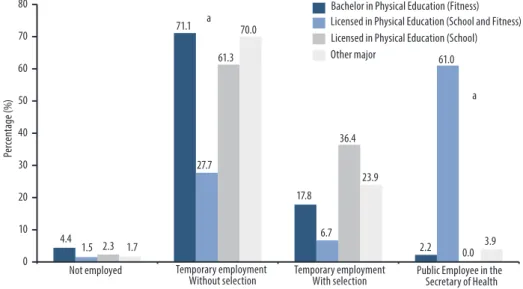
On initial education, six in every ten majored in Physical Education, being 39.0% fully licensed (bachelor in school education and fitness), 12.6% licensed (bachelor in school education) and 9.6% with a bachelor in fitness. Other fields of initial education were: social assistant, pharmacy, nurse, physical therapy, psychology, occupational therapy, nutrition, odontology, and phono audiology. About four in every ten professionals reported working for over 6 years, independent of being in PHC. Fewer have up to a year in experience in PHC (24.5%) and in programs for PA promotion (30.7%). Most (67.3%) professionals are hired temporarily and only 28.1% are public employees to Secretaries of Health. A significant difference was
found between licensed Physical Education professionals and all other majors, when relating to having State employment with the Secretary of Health (p<0.05). In figure 1 data related to type of employment with the intervention and/or pro-gram for PA promotion are presented, stratified by initial education.
Table 1 – Demographics characteristics of professionals with complete higher education working in programs and interventions for physical activity promotion in PHC in the State of Pernambuco, stratified by education (major).
Variables
Bachelor in Physical
Education (Fitness) Full License in Physical Education (school education and fitness) License in Physical Education (school education) Other higher education major *
n % n % n % n % Gender Male Female 2124 46.753.3 10689 45.654.4 2918 61.738.3 15131 17.083.0 Marital Status Single Married Other 26 16 2 59.1 36.4 4.5 65 119 10 33.5 61.3 5.2 28 16 3 59.6 34 6.4 99 74 9 54.4 37.3 6.8 Race/Color White Black Asian Brown Indigenous 19 5 3 17 1 42.2 11.1 6.7 37.8 2.2 82 21 10 79 2 42.1 10.8 5.1 4.5 1.0 14 4 3 26 0 29.8 8.5 6.4 55.3 0 98 9 10 63 1 54.1 5.0 5.5 34.8 1.0 Monthly family income**
From 1 to 4
4 or more 2718 60.040.0 12867 65.634.4 3215 68.131.9 49.590 50.592 Residence located near work
Yes
No 2914 67.432.6 13353 28.571.5 396 86.713.3 9779 55.144.9
*Social assistant, Pharmacy, Nursing, Physical Therapy, Psychology, Occupational Therapy, Nutrition, Phono audiology; ** Minimum wage at the time was R$788.00.
Figure 1 – Type of employment of professionals working in health promotion programs in PHC, with interventions in physical activity in the state of Pernambuco, by initial education.
a = significant difference between full license in Physical Education when compared to other cate-gories of initial education. Note: Other type of employment was 4.5% for bachelors, 3.1% for fully licensed and 0.5% for other initial education.
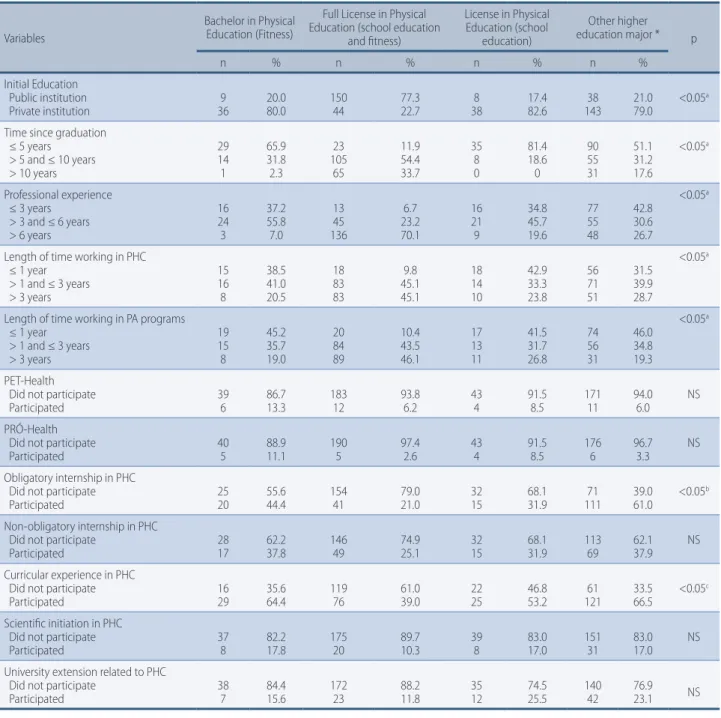
From professionals with complete higher education, 45.7% presented com-plete post-graduation in Lato Sensu, 3.0% multiprofessional residency in health and 2.6% academic master’s degree. In experiences during initial education, most professionals did not participate in activities such as PET-Health (93.5%),
PRO-Health (96.1%), obligatory curricular internship in PHC (62.8%), non-obligatory curricular internship in PHC (70.5%), scientific initiation focused on PHC (86.5%), any curricular experience focused on PHC (50.5%) and university extension fo-cused on PHC (83.4%). Additional information about professional experiences of those with complete higher education can be observed on table 2.
Table 2 – Characteristics of initial education of professionals with higher education working in programs for health promotion in PHC, with interventions in physical activity in the state of Pernambuco.
Variables
Bachelor in Physical Education (Fitness)
Full License in Physical Education (school education
and fitness) License in Physical Education (school education) Other higher education major * p n % n % n % n % Initial Education Public institution Private institution 369 20.080.0 15044 77.322.7 388 17.482.6 14338 21.079.0 <0.05 a
Time since graduation ≤ 5 years > 5 and ≤ 10 years > 10 years 29 14 1 65.9 31.8 2.3 23 105 65 11.9 54.4 33.7 35 8 0 81.4 18.6 0 90 55 31 51.1 31.2 17.6 <0.05a Professional experience ≤ 3 years > 3 and ≤ 6 years > 6 years 16 24 3 37.2 55.8 7.0 13 45 136 6.7 23.2 70.1 16 21 9 34.8 45.7 19.6 77 55 48 42.8 30.6 26.7 <0.05a
Length of time working in PHC ≤ 1 year > 1 and ≤ 3 years > 3 years 15 16 8 38.5 41.0 20.5 18 83 83 9.8 45.1 45.1 18 14 10 42.9 33.3 23.8 56 71 51 31.5 39.9 28.7 <0.05a
Length of time working in PA programs ≤ 1 year > 1 and ≤ 3 years > 3 years 19 15 8 45.2 35.7 19.0 20 84 89 10.4 43.5 46.1 17 13 11 41.5 31.7 26.8 74 56 31 46.0 34.8 19.3 <0.05a PET-Health Did not participate
Participated 396 86.713.3 18312 93.86.2 434 91.58.5 17111 94.06.0 NS PRÓ-Health
Did not participate
Participated 405 88.911.1 1905 97.42.6 434 91.58.5 1766 96.73.3 NS Obligatory internship in PHC
Did not participate
Participated 2520 55.644.4 15441 79.021.0 3215 68.131.9 11171 39.061.0 <0.05
b
Non-obligatory internship in PHC Did not participate
Participated 2817 62.237.8 14649 74.925.1 3215 68.131.9 11369 62.137.9 NS Curricular experience in PHC
Did not participate
Participated 1629 35.664.4 11976 61.039.0 2225 46.853.2 12161 33.566.5 <0.05
c
Scientific initiation in PHC Did not participate
Participated 378 82.217.8 17520 89.710.3 398 83.017.0 15131 83.017.0 NS University extension related to PHC
Did not participate
Participated 387 84.415.6 17223 88.211.8 3512 74.525.5 14042 76.923.1 NS
*Social assistant, Pharmacy, Nursing, Physical Therapy, Psychology, Occupational Therapy, Nutrition, Phono audiology; a = Significant difference between fully licensed in Physical Education when compared to other categories of initial education. b = Significant diffe-rence between licensed and fully licensed in Physical Education when compared to other categories of initial education. c = Significant difference between fully licensed in Physical Education when compared to Bachelor and other categories of initial education.
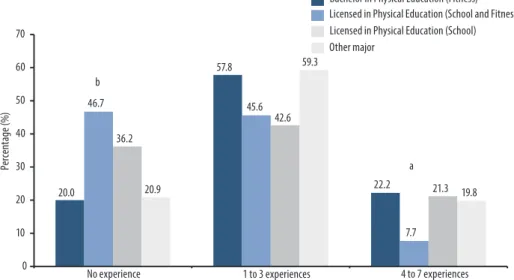
When information on experience with PHC in initial education are aggregated, we can observe 37.8% of professionals reporting not having any experiences while in
under-graduate studies related to PHC, while only 14.1% reported from 4 to 7 experiences. The proportion of professionals reporting not having experience during initial education is higher among fully licensed (45.9%) when compared to other categories. On the other hand, the proportion of those with 4 for 7 experiences is higher among bachelors in Phys-ical Education (22.2%). Stratified information by area of education is showed in figure 2. It was observed that three in every ten professionals report not participating in courses, lectures and/or workshops related to PA during the past 12 months and that similar proportion reported participating in over three courses. The proportion of those who did not participate in any action was significantly higher than those in other areas of education when compared to initial education in Physical Educa-tion (p<0.05). AddiEduca-tional informaEduca-tion on participaEduca-tion of professionals in courses, events or workshops in the field of physical activity may be observed in figure 3.
Figure 2 – Amount of curricular experiences related to PHC during initial education of professionals with higher education working in programs for health promotion in PHC, with interventions in phy-sical activity in the state of Pernambuco.
a = Significant difference between fully licensed in Physical Education when compared to other categories of initial education. b = Significant difference between fully licensed in Physical Education when compared to Bachelor and other categories of initial education.
Figure 3 – Amount of participation in courses, lectures and/or events, in the past 12 months, related to physical activity and health of professionals with higher education working in programs for health pro-motion in PHC, with interventions in physical activity in the stat of Pernambuco, by field of education. a = Significant difference between fully licensed in Physical Education when compared to other categories of initial education. b = Significant difference between other majors when compared to Physical Education.
Discussion
In general, most professionals working in programs for health promotion with in-terventions in physical activity in PHC have higher education, especially in Physical Education (Bachelor in fitness, Bachelor in School Education or Bachelor in school education and fitness). Most have up to three years of experience in the PA program and are employed between programs and have most professionals under temporary contracts. It is believed that in some regions of the State there are even fewer or none offerings for courses of high level education, even more in Physical Education, what can partially explain the considerable proportion of professionals without higher education in determined municipalities. Another aspect is the fact that most em-ployments are done under temporary contract and without a selection process may generate indication of human resource without appropriate training, especially in municipalities considered small. This frailty can be found in both professionals without higher education as well as those with completed high education.
Considering the specificity of the profession, it is a competency of the PEP actions specific to this field of knowledge, however, some authors defend that oth-er health related professionals must care for the population through counseling actions, orientation and indication to PA programs14-16. The presence of other
pro-fessionals with higher education can be tied to NSFH, which proposes as a com-mon action for all professionals to develop PA in the community14. In 2004, the
technical legitimacy was discussed for the formulation of a State policy in order to guide the education of professionals according to health need of the population, highlighting competencies in education and health sectors in that construction15.
A relevant aspect found is that four in every ten professionals reported not having experiences related to PHC during initial education, moreover in the Physical Educa-tion courses. In state reality, full licensed professionals are those who have been acting for a longer period and who, during initial education, in most cases did not have the opportunity to live activities related to PHC, disciplines focused on Public Health, such as health promotion, public policies in health, primary health care, among others. It is important to highlight that data indicate a low proportion of professionals with four or more experiences during initial education related to PHC, which show a misalignment with professional experience. The creation of a Bachelor’s in fitness and reformation of curriculum in Physical Education courses are recent and seem to have not accompanied the demands for acting in this field17. Such data exposes the frailty in education, since,
according to Curricular Guidelines, which are common orientation to all professions, high education institutions must assure the flexibility and the quality of education be-ing offered18. Beyond offering the undergraduate conditions to overcome challenges of
the conditions for professional exercise and production of knowledge, allowing diverse types of education and habilitations within the same program18. Curriculum of initial
education is a central discussion, since we can observe not only in Physical Education, but also in other areas of education still directed at another attention model19.
The participation of professionals in specialization courses is high, while low in multiprofessional residencies. Studies show that Residencies in Health and Mul-tiprofessional in family Health (RMFH) are positive strategies for training profes-sionals with the adequate profile to work in programs proposed by the Ministry of Health, since the new assistance model predicts alterations in education with ad-equate interpersonal relations, adding psychosocial aspects in interventions and approximation of education with the work field20-21. However, few slots are offered
to PEP, besides little knowledge from the professionals on the opportunities for continued education in residency courses.
In the present study it was identified that, among the professionals who look into updating education in PA fully licensed in Physical Education are higher than other professionals. Two arguments may justify this finding that is related to the effectuation of professionals. First, there is the need to access specific knowledge related to skills necessary for professional acting due to initial education not con-templating specific contents nor general contents in primary care. Another aspect is in the type of employment, since most professionals are effective to the Sec-retary of Health and fully licensed in Physical Education. This scenario may be explained by the position of Physical Education and when the Secretary of Health of Recife/PE, through the bill 17.400 de 28.12.2007, created it, and there were no bachelor’s in fitness who had already graduate. Therefore, a public selection con-ducted in the year of 2008, turned effective professionals in Academia da Cidade (PAC), whom had initial education as full license Physical Education.
According to PNAB, for the consolidation of the reorientation of the model of primary health care in Brazil, it is necessary to promote a knowing and a doing in permanent education that reflect the practice of health services22. Among other
re-sponsibilities, municipalities and the Federal District, as managers of local health systems, must stimulate and make possible for the capacitation and permanent education of professionals within teams22. As expected, the proportion of
profes-sional who had not participated in a course, lecture and/or workshop related to PA was significantly higher among those with other majors, when compared to the ones with initial education in Physical Education.
On experience, the minority of professionals had up to a year of professional experience in PHC and in programs for PA promotion. There was a significant dif-ference between professionals with a bachelor of Physical Education in school (li-censed) when compared to other professions, on having a state employment status with the Secretary of Health. Such data may be justified due to the Academia da Cidade in Recife being the oldest institutionalized program in the state of Pernam-buco, and the type of education allows those fully licensed in Physical Education to work in any context. Programs focused on PA exclusively allows for participation of the PE professional, only. According to the CONFEF resolution nº 046/2002, bill nº 9696/98, it is considered exercise of activities in Physical Education a prerogative of PE professionals23. Moreover, the state reality is that some programs have been
coordinated by professionals in nursing, physical therapy, nutritionists, among others, strengthening the need to know the type of initial and continued education on PA, and how capable are they of working in the management of such nature24.
Knowing the profile of professional acting in programs and interventions for health promotion with physical activity interventions can contribute to the reori-entation of the service. Besides, it is possible to identify a limitation both in initial education as well as in the participation of professionals in continued education courses. The Curricular Guidelines indicate that there should be education in health, as well as an approximation of institutions with the public policy manage-ment to contribute to actions from the NPHP being effective.
Beyond principle established and general orientations for undergraduate cours-es, the Curricular Guidelines in courses for the field of health reinforce the need to articulate between higher education and health systems, with the aim to have a general and specific education of undergraduate students that contemplate promo-tion, prevenpromo-tion, recovery and rehabilitation in health, where the concept of health is based on principles and guidelines established by the Unique Health System (SUS)18.
and novelty. The SUS+Ativo project visited all municipalities in Pernambuco that were identified with programs (Federal, state and municipal) in PHC that had ac-tions to promote physical activity and all professionals were interviewed, allowing a census. Moreover, a validated, specific instrument was used for evaluation of in-terventions in physical activity promotion developed in the Primary Health Care System13. However, some limitations can be identified. The presence of researchers
in the field sometimes was seen as a sort of surveillance. Even when the group of researchers was careful not to, it is believed that it might have inhibited and influ-enced the answers of some professionals and, therefore, characterize as bias. An-other aspect was the extension of the questionnaire that for some, especially pro-fessionals without higher education in Physical Education, was not interesting.
Actions taken by management for permanent education strengthens the dai-ly work of professionals. Also, it is necessary that such professionals seek other forms of capacitation, since there were few experiences in PHC during undergrad-uate courses. Such data also brings out the need for institutions to offer education with opportunities to experience and promote the full development of students to be capacitated and utilize a diversity of knowledge in the field of expertise.
Even though there is a great proportion of professionals with little experience re-lated to PHC and PA promotion while in initial education, a part of them seek to par-ticipate in courses, events and workshops focused on physical activity while in exercise of function and even have presented a post-graduate course in the level of specializa-tion Lato Sensu. Continued educaspecializa-tion may generate contextualizaspecializa-tion to the profes-sional on their acquired knowledge as well as new meaning to profesprofes-sional experience. It was observed, in the present study, that investments should be priorities for both initial and permanent education, in order to prepare professionals according to the demands for exercise of function in the public health system. To broad-en the vision of the professional redirects the look to a multiprofessional care, strengthening the insertion in public policy programs.
Acknowledgments/ funding
We thank all of those who contributed direct or indirectly to the project, especially to users, professionals and managers, to GPES and funding agencies (CNPQ, FA-CEPE and CAPES).
Authors’ contributions
Danyelle de Cássia Ribeiro de Oliveira participated in the concept of the project, writing
of manuscript and critical revision of intellectual content. Anísio Luiz da Silva Brito was
responsible for analyses and interpretation of data, writing and critical revision of the manuscript. Rafael Miranda Tassitano was responsible for the analyses and
interpre-tation of data, writing and critical revision and approval of version to be published.
References
1. Ministério da Saúde. National Policy on Health Promotion/Ministry of Health, Secretary of Health Vigilance, Secretaria de Atenção à Saúde. – 3. ed. – Brasília : Ministério da Saúde, 2010.
2. Ministério da Saúde. Redefinition of the National Policy on Health Promotion.
Departamento de Análise de Situação em Saúde. Novembro, 2014.
3. Ministério da Saúde. Nucleus for Support to Family Health. Portaria Mi nisterial de Saúde, nº154, de 24 de janeiro de 2008.
4. Malta DC, Alves da Silva MM, Albuquerque GM, Amorim RCA, Rodrigues GBA, Silva
TS, et al. National Policy for Health Promotion, description of implementation of the physical activity axis, from 2006 to 2014. Rev Bras Ativ Fís Saúde. 2014; 19(3): 286-299.
Corresponding Author
Danyelle De Cássia ribeiro De oliveira [email protected]
REcEivEd 02/12/2015
AppRovEd 17/03/2016
Avenida Beberibe, nº3530/Bl-B7-Aptº103-Porto da Madeira, Recife – PE Zip code: 50100-130
Phone number: +55 (81) 3183-3375/3183-3376
5. Amorim TC, Knuth AG, Cruz DKA, Malta DC, Reis RS, Hallal PC. Description of
municipal programs for physical activity promotion funded by the Ministry of Health. Rev Bras Ativ Fís Saúde. 2013; 18(1): 63-74.
6. CNS. National Counsel of Health. Resolução Nº 128, de 6 de Março de 1997. Disponível em: http://www.portaleducacao.com.br/Artigo/Imprimir/3227. Acesso em 25/11/15.
7. Rodrigues JD, Ferreira DKS, Silva PA, Caminha IO. Insertion and action of the physical education professional in primary health care: systematic review. Rev Bras Ativ Fís Saúde. 2013; 18(1): 5-15.
8. Rodrigues JD, Ferreira DKS, Junior JCF, Caminha IO, Florindo AA, Loch MR. Profile and action of the Physical Education Professional in the Nuclei for Support to Family Health in the metropolitan region of Joao Pessoa, PB. Rev Bras Ativ Fís Saúde. 2015; 20(4) :352-365.
9. Santos SFS, Benedetti TRB. Scenario of implementation of the Nucleus for Support to Family Health and the insertion of the Physical Education professional. Rev Bras Ativ Fís Saúde. 2012; 17(3): 188-194.
10. Scabar TG, Pelicioni AF, Pelicioni MCF. Action of the Physical Activity Professional in the United Health System: an analysis starting from the National Policy for Health Promotion and the Guidelines for the Nucleus for Support to Family Health – NA. J Health Sci Inst. 2012; 30(4): 411-8.
11. Souza SC, Loch MR. Intervention of the physical activity professional in the Nuclei for Support to Family Health in municipalities of northern Parana. Rev Bras Ativ Fís Saúde. 2010; 16(1): 05-09.
12. Freitas FF. Physical Education in the public service [Master’s thesis]. São Paulo: Universidade de São Paulo; 2007.
13. Gomes MVG, Lemos EC, Silva JRA, Moura CR, Fonseca SA, Tassitano RM. Evaluation of programs and interventions for physical activity promotion in primary health care in Pernambuco: construction and validation of instruments and fieldwork methods of the SUS+Ativo Project. RBAFS, No prelo.
14. Jacobson DM, Strohecker L, Compton MT, Katz DL. Physical Activity Counseling in the Adult Primary Care Setting. Am J Prev Med. 2005; 29(2): 158-62.
15. Ceccim RB, Feuerwerker LCM. Change in majors of health professions under the axis of integrality. Cad. Saúde Pública. Rio de Janeiro. 2004; 20(5):1400-1410.
16. Orrow G, Kinmonth AL, Sanderson S, Sutton S. Effectiveness of physical activity promotion based in primary care: systematic review and meta-analysis of randomized controlled trials. British Journal of Sports Medicine. 2012; 47(1): 27.
17. Andrade DR, Costa EF, Garcia LMT, Florindo AA. Education of the bachelor in Physical Education against the situation of health in Brazil. In: Benedetti TRB, Silva DA, Silva KS, Nascimento JV (ORG). The Education of professional of Physical Education for the health sector. Florianópolis: Postmix. 2014; 89-107.
18. Brasil. Ministério da Educação. Comments from the National Counsil in Education. Câmara da Educação Superior nº 213/2008. Disponível em: http://portal.mec.gov.br/ cne/arquivos/pdf/2008/pces213_08.pdf. Acesso em 05/11/215.
19. Haddad AE, Morita MC, Pierantoni CR, Brenelli SL, Passarella T, Campos FE. Education of health professionals in Brazil: an anlysis from 1991 to 2008. Rev. Saúde Pública. 2010; 44(3): 383-393.
20. Anjos TC, Duarte ACGO. Physical Education and the Strategy for Family Health: education and action of the professional. Physis: Rev Saude Colet. 2009; 19(4): 1114-1127.
21. Nascimento DDG, Oliveira MAC. Reflections on the professional competencies for the work process in Nuclei for Support to Family Health. Mundo Saúde. 2010; 34(1): 92-6, 2010.
22. Brasil. Ministério da Saúde. Secretary of Attention to Health. Política Nacional de Atenção Básica / Ministério da Saúde. Secretaria de Atenção à Saúde. Departamento de Atenção Básica. – Brasília: Ministério da Saúde, 2012.
23. CONFEF. Federal Counsil oh Physical Education. Disponível em: http://www.confef. org.br/extra/resolucoes/conteudo.asp?cd_resol=82. Acesso em 24/11/15.
24. Silva JRA. Practice for monitoring and evaluating interventions in physical activity promotion in primary health care in the state of Pernambuco [Master’s thesis]. Recife: Universidade de Pernambuco, 2015.