Contributions for
building a Corpora-Flow system
Andr´e Fernandes dos SantosDissertation submitted in partial fulfillment of the requirements for the degree of Master in Informatics Engineering at the University of Minho, under the
supervision of Jos´e Jo˜ao Dias de Almeida An´alia Maria Garcia Louren¸co
Departamento de Inform´atica Escola de Engenharia Universidade do Minho
Abstract
Resumo
Text corpora are important resources on natural language processing and related areas such as biomedical text mining, corpus linguistics, machine learning and information extraction.
Os corpora textuais s˜ao um recurso importante no processamento de lin-guagem natural e em ´areas rela-cionadas tais como a minera¸c˜ao de textos biom´edicos, a lingu´ıstica de corpus, aprendizagem m´aquina e re-cupera¸c˜ao de informa¸c˜ao.
Preparing documents to be included in a corpus involves several different steps and a complex network of de-pendencies and conditions, which re-sults in a workflow difficult to man-age manually.
A prepara¸c˜ao de documentos para inclus˜ao num corpus envolve v´arios passos distintos e uma rede complexa de dependˆencias e condi¸c˜oes, que re-sulta num fluxo dif´ıcil de gerir man-ualmente.
This dissertation focuses on different challenges which can be found when building corpora, and proposed meth-ods to overcome such questions.
Esta disserta¸c˜ao foca-se nos diver-sos desafios encontrados no pro-cesso de constru¸c˜ao de corpora, e prop˜oe m´etodos para ultrapassar es-sas quest˜oes.
The first problem tackled was the cleaning of text documents – remov-ing structural residues, normalizremov-ing encodings and notations and finding section delimiters – to make the docu-ments suitable for further processing.
O primeiro problema abordado foi a limpeza de documentos de texto – remo¸c˜ao de res´ıduos estruturais, nor-maliza¸c˜ao de formatos e nota¸c˜oes e detec¸c˜ao de delimitadores de sec¸c˜ao – tornando os documentos pass´ıveis de serem processados.
Another question addressed was the detection of duplicated documents and candidate document pairs for alignment. A method for measuring the similarity between documents was introduced and implemented.
Outra quest˜ao abordada foi a de-tec¸c˜ao de documentos duplicados e de pares de documentos candidatos a alinhamento, tendo sido intro-duzido e implementado um m´etodo para medi¸c˜ao da similaridade entre documentos.
by the description of an implementa-tion based on secimplementa-tion delimiters.
tos, seguido da descri¸c˜ao de uma implementa¸c˜ao baseada nos delimita-dores de sec¸c˜ao.
Two real-world scenarios were used to guide the implementation of the tools developed: multi-language docu-ment aligndocu-ment for inclusion in par-allel aligned corpora and building cor-pora of biomedical texts for text min-ing.
Dois casos de estudo reais foram uti-lizados para guiar a implementa¸c˜ao das ferramentas desenvolvidas: alin-hamento multi-l´ıngua de documentos para inclus˜ao em corpora paralelos al-inhados e a constru¸c˜ao de corpora de textos biom´edicos para minera¸c˜ao de texto.
A prototype of a corpora building management system was developed – a corpora-flow system. This sys-tem includes mechanisms which facil-itate the implementation of the work-flow needed to build a corpus.
Um prot´otipo de um sistema de gest˜ao da constru¸c˜ao de corpora foi desenvolvido – um sistema de corpora-flow. Este sistema incor-pora mecanismos que facilitam a im-plementa¸c˜ao do fluxo necess´ario para a constru¸c˜ao de um corpus.
A comparative evaluation of the set of tools developed was performed by aligning documents with and without using the tools developed. A small set of auxiliary tools was created to eval-uate the results of alignments.
Uma avalia¸c˜ao comparativa do con-junto de ferramentas desenvolvido foi realizada atrav´es do alinhamento de documentos com e sem a interven¸c˜ao das ferramentas desenvolvidas. Um pequeno conjunto de ferramentas foi desenvolvido para avaliar os resulta-dos de alinhamentos.
Acknowledgments
• Many thanks to my teachers and supervisors, Jos´e Jo˜ao Almeida and An´alia Louren¸co, for all the time spent, the guidance and the ideas. • Thanks again to An´alia for the proof-reading, and for acting as my guide
in the brave new world of bioinformatics and biomedical text mining. • Thanks to Sara, Nuno and Alberto for all the help, the good advices
and the discussions.
• Thanks again to Alberto, Nuno and Jos´e Jo˜ao for the borrowed tem-plates and the tools and modules they made available.
• Thanks to all the friends from CeSIUM, for the friendship, the good moments and for letting me part of something great.
• Thanks to everyone at GroupBuddies, for sharing with me this adven-ture which is starting a brand new company.
• Thanks to Roberto, for all the crazy projects we’ve been through to-gether – keep them coming!
• Thanks to everyone from Project Per-Fide, which helped me in my incursions in areas which I knew little about.
• Thanks to Funda¸c˜ao para a Ciˆencia e Tecnologia, for granting me with a scholarship which made most of this work possible
• Thanks to my parents and my brother, for always having supported me and for being in great deal responsible for who I am today.
• And a special thanks to Dominique. Thank you for your infinite pa-tience, for all the friendship, care, and for making me feel taller for the last 8 years! :)
Preface
This document is a master thesis in Informatics Engineering (area of Natural Language Processing) submitted to Universidade do Minho, Braga, Portugal. Throughout the document the academic plural appears often in the text to describe the work developed. This form was intentionally used for two reasons: first, some of the work here presented was done in cooperation; and second, the plural can help the reader to feel more closely connected with the work done.
Document structure
Chapter 1 introduces the subject, defining the basic concepts and ideas de-veloped throughout the document.
Chapter 2 presents some background on the concepts on which this dis-sertation is based, along with a brief overview of the state-of-the-art concerning these subjects.
Chapter 3 describes common types of noise found in text, the problem of cleaning plain text documents and the solution developed.
Chapter 4 analyzes the problem of measuring similarity between two doc-uments, and how it can be used to detect duplicated documents and candidate pairs for alignment.
Chapter 5 presents the problem of unmatched sections in the alignment of documents, introduces the concept of book synchronization, and de-scribes how it can be used to minimize the problem.
Chapter 6 introduces the concept of corpora-flow system, describes an im-plementation of a prototype for such a system based on Makefiles, and provides as an example the integration of the other developed tools.
Chapter 8 presents some conclusions and points out possible directions for future work.
Some complementary information is presented on the appendixes: Appendix A includes the documentation for some tools developed through
Contents
1 Introduction 1
1.1 Context and Motivation . . . 1
1.2 Project overview . . . 2
1.2.1 Design Goals . . . 3
1.2.2 Developed tools . . . 4
1.3 Case Studies . . . 5
1.3.1 Multi-language document alignment . . . 5
1.3.2 Biomedical text mining . . . 6
1.4 Document Summary . . . 6 2 Background 9 2.1 Introduction to corpora . . . 9 2.1.1 What is a corpus? . . . 9 2.1.2 Types of corpora . . . 10 2.2 Building corpora . . . 11 2.2.1 Common tasks . . . 11 2.2.2 Parallel corpora . . . 13 2.3 Text alignment . . . 15 2.3.1 Brief history . . . 15
2.3.2 Alignment and evaluation projects . . . 17
2.3.3 The alignment process . . . 19
2.3.4 Current projects and tools . . . 24
3 Cleaning documents 27 3.1 Introduction . . . 27 3.1.1 Motivation . . . 27 3.1.2 Common problems . . . 28 3.1.3 Design Goals . . . 29 3.2 Cleaning books . . . 29 3.2.1 Pages . . . 30 ix
3.2.2 Sections . . . 32
3.2.3 Paragraphs . . . 34
3.2.4 Footnotes . . . 34
3.2.5 Words and characters . . . 37
3.2.6 Commit . . . 38
3.3 Diagnostic report . . . 39
3.4 Declarative objects . . . 39
3.4.1 Sections Ontology . . . 40
3.5 Evaluation . . . 41
3.6 Cleaning scientific articles . . . 42
3.6.1 Sections . . . 43
3.6.2 Pages . . . 43
3.6.3 Normalizing mathematical notation . . . 43
3.7 Summary . . . 44 4 Measuring similarity 45 4.1 Introduction . . . 45 4.2 Measuring similarity . . . 46 4.3 Implementation . . . 47 4.3.1 Extraction of bag-of-words . . . 47
4.3.2 Classification according to similarity . . . 49
4.3.3 Identifying exact duplicates . . . 49
4.3.4 Identifying near duplicates and candidate pairs . . . . 49
4.4 Processing a pool of files . . . 50
4.4.1 Command line utility . . . 50
4.4.2 Optimization . . . 52 4.4.3 Choosing a version . . . 53 4.5 Evaluation . . . 54 4.6 Summary . . . 56 5 Synchronizing books 59 5.1 Introduction . . . 59 5.2 Implementation . . . 60 5.2.1 Alignment method . . . 60
5.2.2 Ghost sections and chunks . . . 62
5.3 Output objects . . . 63
5.3.1 Synchronization matrix . . . 63
5.3.2 Annotated files . . . 65
Contents xi
6 Prototype of a corpora flow 67
6.1 Introduction . . . 67
6.1.1 Workflow . . . 68
6.1.2 Makefiles . . . 69
6.2 Building a workflow with Makefiles . . . 71
7 Global evaluation 73 7.1 Alignment evaluation tools . . . 73
7.2 Evaluation process . . . 75
7.3 Results . . . 76
7.4 Discussion . . . 77
8 Conclusions and future work 81 8.1 Conclusions . . . 81
8.2 Future Work . . . 83
8.2.1 Document cleaners . . . 83
8.2.2 Document pair finding . . . 83
8.2.3 Document synchronization . . . 84
8.2.4 Corpora-flow . . . 84
A Software Documentation 93 A.1 Software Installation . . . 93
A.1.1 Requirements . . . 93
A.2 bookcleaner . . . 93
A.3 pairbooks . . . 95
A.4 syncbooks . . . 97
List of Figures
3.1 Pipeline of Text::Perfide::BookCleaner. . . 30 5.1 Matrix produced as a result of synchronizing the previous
ex-amples. . . 64 7.1 Example of the output of tmx_inspect. . . 75 7.2 Diagram of the global evaluation. . . 76
List of Tables
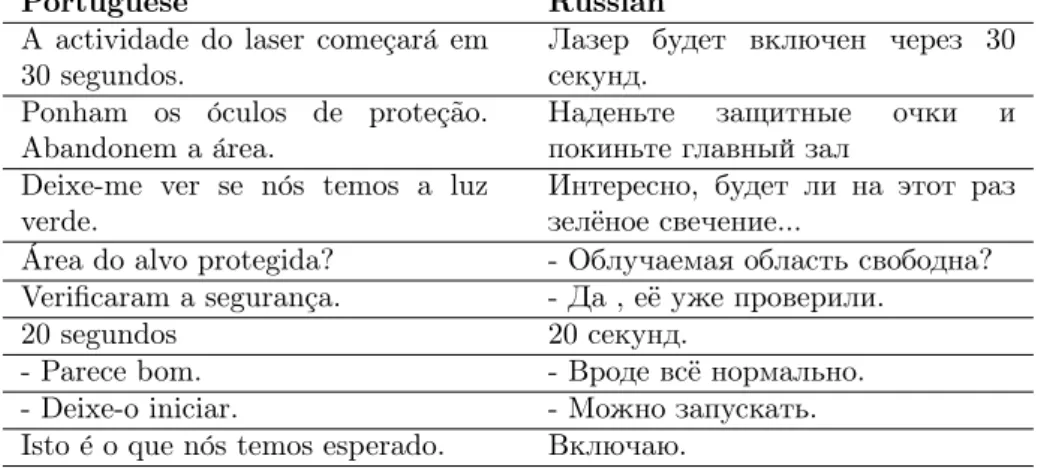
2.1 Extract of sentence-level alignment performed using Portuguese and Russian subtitles from the movie Tron. . . 22 3.1 Number of translation units obtained for each type of
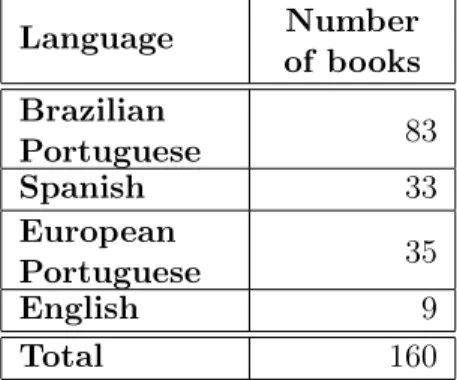
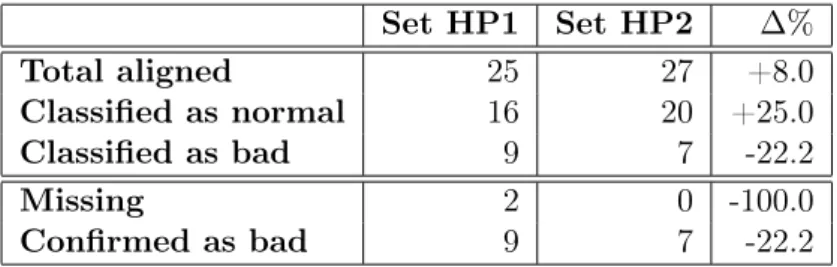
corre-spondence, with and without using Text::Perfide::BookCleaner. 42 4.1 Number of books in Set AC1, grouped by language. . . 54 4.2 Results of pairbooks and manual revision. . . 55 7.1 Number of pairs aligned and results (sets HP1 and HP2). . . 77 7.2 Number of pairs aligned and results (sets UE1 and UE2). . . 77 7.3 Translation units obtained for each type of correspondence
(sets HP1’ and HP2’). . . 78 7.4 Translation units obtained for each type of correspondence
(sets UE1’ and UE2’). . . 78
List of Examples
3.1 Detail of page structure residues before cleaning. . . 31
3.2 Detail of page structure residues, after cleaning. . . 32
3.3 Detail of section delimiters before annotation. . . 33
3.4 Detail of section delimiters after annotation. . . 33
3.5 Detail of footnotes before cleaning. . . 36
3.6 Detail of footnotes after cleaning. . . 36
3.7 Example of diagnostic report. . . 39
3.8 Extract from the sections ontology: chapter (left) and scene (right). . . 40
3.9 Extract from the sections ontology: END (left) and the nu-meral 3 (right). . . 40
4.1 pairbooks: default output. . . 51
4.2 pairbooks: list of pairs of files, including less probable pairs. 52 4.3 pairbooks: list of duplicate files. . . 52
4.4 Example of the proper names with higher occurrences in The Name of the Rose . . . 56
4.5 Similar words on the top 30 higher occurrences of proper names in The Name of the Rose. . . 56
5.1 Section structure generated by Text::Perfide::BookCleaner. 61 5.2 Diff file for section alignment. . . 61
5.3 Chunk structure. . . 63
6.1 Basic structure of a Makefile. . . 70
6.2 Example of a Makefile. . . 70
6.3 Example of a DSL for a Makefile-based workflow formal defi-nition. . . 72
7.1 tmx_compare: example of output. . . 75
Acronyms
API application programming interface
ASCII American Standard Code for Information Interchange BTM biomedical text mining
BoW bag-of-word
CQP Corpus Query Processor
DSL domain-specific language
HMM hidden Markov model
HTML HyperText Markup Language
JSC Jaccard similarity coefficient LIE language independent element
MWU multi-word unit
NLP natural language processing OCR optical character recognition
PDF Portable Document Format
PTD probabilistic translation dictionary
SL source language
TL target language
TM translation memory
TMX Translation Memory eXchange
TU translation unit
UCS Universal Character Set
Chapter 1
Introduction
The White Rabbit put on his spectacles. ’Where shall I begin, please your Majesty?’ he asked.
’Begin at the beginning,’ the King said gravely, ’and go on till you come to the end: then stop.’
Lewis Carroll, Alice’s Adventures in Wonderland
1.1
Context and Motivation
Corpora are an invaluable resource for tasks in areas such as knowledge re-trieval, machine learning, natural language processing and linguistics [V´eronis, 2000]. Some corpora have a very well defined scope (e.g. legislation [Koehn, 2005], journalistic texts [Santos and Rocha, 2001, Santos and Sarmento, 2003] and biomedical [Kim et al., 2003, Stearns et al., 2001, Vincze et al., 2008]), while others have a wider focus. Either way, when building a corpus, usually it is desirable to obtain as many different documents from as many different sources as possible. The quantity of documents is important because most of the tools which work with corpora are based on statistics, and thus, corpora must be large enough to reduce the statistical bias. This means that the re-sources used to build them need to be available in reasonable amounts. The diversity of the documents is also important because the more different types and sources of documents there are, the richer the corpus will get, which tends to increase the precision and recall of the tools which work based on it. The downside of having many different sources of documents is an increase on the range of problems that they might present, the number of different notations used, and the probability of getting documents in bad conditions.
A parallel aligned corpus is composed by texts and their translation to another language (known as bitexts). When obtaining already aligned cor-pora is not possible, they can be built through the alignment of texts. This alignment is generally performed at paragraph, sentence or word level. Text alignment, as many other text processing tasks, may be performed manually; however, these tend to be tedious and time consuming tasks, which makes them unsuitable to be performed on large amounts of documents. Thus, whenever possible, the alternative is to use automatic tools.
Automatic tools have their disadvantages too, the largest one being that they are more affected by misformatted or noisy texts, or, generally, texts not in the very best conditions. This susceptibility to noisy text often means that tasks performed automatically need to be manually prepared, supervised and corrected. Without these steps, after the alignment, one might end up reject-ing too many cases and obtain a corpus smaller than desirable, or acceptreject-ing bad cases and obtain a low-quality corpora.
Document types are often a common source of problems when automat-ically processing text. Most tools can only operate over plain text, meaning that the documents must be converted before being processed. The conver-sion to plain text format often introduces noise and leaves residues, and even documents which were originally created in plain text format use different no-tations for things like mathematical formulas, section division, page breaks, sentences, etc. Text alignment suffers from additional problems, such as par-tial or truncated documents – aligning two versions of a given document is most of the times unsuccessful when one of them is missing even a small part, let alone entire sections or chapters.
The next section presents the work developed in the context of this disser-tation, stating some design goals which guided the project development and briefly presenting the tools created. Section 1.3 introduces the case studies which served as motivation to this work and Section 1.4 presents the structure of the document, including a summary of each chapter.
1.2
Project overview
The context presented before justifies the need for tools which can help on the process of building corpora. This document will present work developed mainly in the context of Project Per-Fide (ref. PTDC/CLE-LLI/108948/2008), a project which aims to build a large parallel corpora (see Section 1.3.1, page 5), which is part of the reason why this work is mainly focused on
1.2. Project overview 3 handling books.
1.2.1 Design Goals
A set of design goals was defined to guide implementation efforts. Some of these are practical requirements for the tools, while others can be viewed more as philosophical guidelines.
• Despite having the preparation of books for alignment as central con-cern, tools should be developed as generic as possible, because many of the problems they tackle are common to other fields.
• Develop tools which are independent from each other, but which can work together and with previously existing applications, and that can be assembled into a pipeline.
• Make the tools publicly available. This includes implementing them fol-lowing the real-world standards and community practices, and making them installable and usable by third-party people and projects. This re-quires an extra effort given the difference between developing academic tools and real-world, usable applications.
• Whenever possible, identify and solve the problems automatically, gen-erating a report of what was found and done. If a given problem is not solvable automatically, correctly identifying it and asking for con-firmation is usually a viable alternative. When even this is not possible, presenting a report helps the user to decide what to do.
• Follow the Unix philosophy [Raymond, 2003]:
Write programs that do one thing and do it well. Write pro-grams to work together. Write propro-grams to handle text streams, because that is a universal interface.
Doug McIlroy This will allow the development of tools which can help with the most common problems, and designed in such a way which makes them easy to integrate with smaller tools focused on more specific problems. • Whenever possible, reuse existing well-proven tools. This includes Unix
1.2.2 Developed tools
This section presents and briefly describes the tools developed in the context of this master thesis, which include:
• a cleaner for plain text books and scientific articles.
• a tool to find book pairs and duplicated books in a collection. • a tool to synchronize pairs of books.
• a prototype for a management tool for the corpora building workflow. • small tools to evaluate and compare the results of alignments.
The tools were developed according to what was most needed at the time. As such, in this document they will not be presented necessarily in the chrono-logical order in which they were created, but instead in a way that helps getting a global view of how they can fit together.
Plain text book cleaner
A Perl module and a command line utility which implement cleaning tasks in books – including removing page breaks, delimiting sections, normalizing sentence notation and other similar tasks and, in addition, a prototype for a similar tool but targeted at cleaning tasks specific for scientific articles, such as the normalization of mathematical formulas.
Duplicated documents and candidate pairs detector
A command line utility to detect duplicate and near duplicate files and can-didate pairs for alignment, supported by a Perl module which implements algorithms for measuring similarity between files.
Book synchronizer
An utility to perform book synchronization – structural alignment based on the books’ sections, capable of generating visual representations of the syn-chronization results and creating files with anchor points for alignment.
1.3. Case Studies 5 Corpora building workflow control system
Prototype for a workflow control system which can be used to create Makefile-controlled workflows.
Alignment results evaluation tools
Tools which help in the process of assessing the quality of the Translation Memory eXchange (TMX) files resulting from document alignment and com-paring several TMX files.
1.3
Case Studies
Given the applied nature of this work, real-world use case scenarios can be used to support the design-implement-test-evaluate cycle of the development, as follows:
Design: the case studies allow to better decide which tools were needed, and which features should be implemented in those tools;
Implementation: many implementation decisions and optimizations could be triggered by the evaluation of the tool’s outputs for the use cases; Tests: the validation tests should be based on elements extracted from the
case studies, eliminating the need of constructing artificial (often in-complete or biased) tests from scratch;
Evaluation: the evaluation of the tools should be performed against the case studies, asking simple questions: are these tools being useful in these real-world situations? What problems are not solved? What could be done to overcome/minimize them?
1.3.1 Multi-language document alignment
Project Per-Fide (ref. PTDC/CLE-LLI/108948/2008) is a project which aims to build and make publicly available a large annotated parallel corpora, con-taining texts in Portuguese in parallel with Spanish, Russian, French, Italian, German and English (Pt, Es, Ru, Fr, It, De, En – Per-Fide) [Ara´ujo et al., 2010]1. The project aims to have original texts in one of the seven languages
and their translations, having Portuguese as either the source or target lan-guage.
The corpus is divided in two main genres: contemporary fiction (including, but not limited to, novels and short stories), and non-fiction: religious texts, journalistic articles, judicial texts, technical texts, and others.
Given the dimension of the tasks which it comprises, Project Per-Fide was not only the source of requirements for the tools but also has provided source documents to test and validate the tools developed.
1.3.2 Biomedical text mining
Areas of study within Life Sciences are particularly prolific in publishing sci-entific papers. In fact, the advances made in the last decades have originated not only a larger number of experiments, but also more complex experiments envisioning deeper levels of analysis.
The biomedical text mining community, comprised by specialists in ar-eas such as natural language processing, machine learning and statistics, has endorsed multiple efforts trying to develop tools suited to process this kind of literature, and thus trying to fulfill the needs of the biologists [Rassinoux et al., 2010].
Despite featuring many specific tasks, at the basis of biomedical text min-ing the construction of corpora. As such, biomedical text minmin-ing appeared as a second natural case study, giving us the possibility to develop tools with a wider range of application, allowing us to apply the techniques and algorithms developed in different contexts, and preventing us from over-specializing our tools.
1.4
Document Summary
Background
The next chapter presents some background information and the state of the art in the area of corpora construction, text alignment (given that this is one of the ways of producing parallel corpora) and text handling.
Cleaning documents
This chapter discusses the problem of processing noisy text, and describes the most common types of noise. Several methods to perform cleaning tasks
1.4. Document Summary 7 are proposed, including removing structural residues, normalizing encodings and notations, and finding sections delimiters.
Measuring similarity
This chapter introduces the problem of finding duplicated documents and finding candidate pairs of documents for alignment. A solution to this prob-lem is discussed, based on a method for measuring the similarity between documents by extracting bags-of-words (BoWs) from the text.
Synchronizing books
In this chapter the problem of aligning documents with missing sections is presented. A method to solve it is proposed, based on the identification of the missing sections by synchronizing the documents (aligning them at section level). The section delimiting is performed by the method described in Cleaning documents.
Prototype of a corpora flow
This chapter describes a prototype for a system to generate corpora building workflow managers, through the extension of the concept of Makefiles.
Global evaluation
This chapter describes a global evaluation of the tools developed in the context of this dissertation. A small set of tools was created to evaluate alignment results, and a comparative analysis of alignments with and without the tools was performed.
Conclusions and future work
This chapter presents a review over the work performed, the problems tack-led and the tools implemented. Several possible future work directions are described.
Chapter 2
Background
He wrote it in simple declarative sentences with all of the problems ahead to be lived through and made to come alive. The very beginning was written and all he had to do was go on.
Ernest Hemingway, Garden of Eden
2.1
Introduction to corpora
This section introduces the concept of corpus, explaining what it is and what types of corpora exist.
2.1.1 What is a corpus?
In the broader sense of the word, a corpus is any finite collection of multiple documents. Depending on the context, the notion of what a corpus is may change a little, and it has even been shifting over time (specially with the widespread generalization of the Internet), which means that does not exist a unique definition of what a corpus is.1 Sinclair [2005] defines corpus as follows:
1
Some authors use the Oxford Dictionary definition of corpus:
Corpus: a collection of written texts, especially the entire works of a particular author or a body of writing on a particular subject; collection of written or spoken material in machine-readable form, assembled for the purpose of linguistic research. [Dictionaries, April 2010]
Definition 1 A corpus is a collection of pieces of language text in electronic form, selected according to external criteria to represent, as far as possible, a language or language variety as a source of data for linguistic research. 3 Areas such as biomedical text mining (BTM) have their own notion of corpus, which is generally a large collection of documents, usually annotated and used to train, test or validate an automatic tool.
2.1.2 Types of corpora
Corpora are usually divided into text corpora (i.e. written material), spoken corpora and multimodal corpora. Below are presented some common types of specialized text corpora. A comprehensive list of corpora was compiled by Xiao [2008].
Treebanks: linguistically annotated corpus that includes some grammatical analysis beyond the part-of-speech level;
Historical corpus: one which is intentionally created to represent and in-vestigate past stages of a language and/or to study language change; Learner corpus: A corpus where all the data comes from language learners. Parallel and comparable corpus: multilingual corpus which is a) com-posed by texts and their translation (parallel corpora); or b) comcom-posed by texts in different languages which are not translations but are some-how similar to each other – according to previously defined parameters. Corpora can be further classified according to internal characteristics. They may be general corpus or specific corpus, in which case they may vary in the genre of texts included, the topics covered, the size and the annotations and the languages covered.
Texts genre: Corpora may be focused on a particular genre of text. For ex-ample, the Europarl Parallel Corpus contains European legislation and CETEMPublico and CETEM-Folha were put together using journalistic texts [Santos and Rocha, 2001, Santos and Sarmento, 2003].
Topics covered: Some corpora are specialized in a given topic or area of knowledge. For example, the GENIA corpus comprised abstracts from biomedical articles on human transcriptional regulation [Kim et al., 2003].
2.2. Building corpora 11 Corpus size: The (minimum) size of a corpus should depend on two main criteria: the kind of query that is anticipated from users, and the methodology they use to study the data [Sinclair, 2005]. The size is usually measured in total number of words and total number of differ-ent words.
Annotations: Many kinds of annotations can be added to a corpus: part-of-speech, lemmatisation, parsing, semantics, discoursal and text linguistic annotations, etc. A comprehensive and detailed description of common types of annotations can be found in McEnery and Wilson [2001]. Languages covered: Corpus may be monolingual, in which case all the
texts are written in the same language, or multilingual (see above the description of parallel and comparable corpora).
2.2
Building corpora
The steps required to build a corpus may depend partially on the size of the corpus, its purpose, and its scope – whether it is a specific corpus (one which only includes a given genre of text or that only covers a specific topic) or a general corpus. Nevertheless, it is possible to define a list of tasks commonly associated to the process of building a corpus.
2.2.1 Common tasks
The following list has been compiled from the existing literature on building corpora [Wynne et al., 2005, Burnard, 1999, Atkins et al., 1992], and includes the most common and important tasks required to constitute a corpus.
Planning
Like any other project, building a corpus typically starts with the planning phase, where several decisions need to be made which will affect the remaining stages. Some of these decisions, however, will most likely have to be revised and adapted during the building process when faced with practical aspects of the project. Many of these details will also be highly dependent on constraints such as the time and funds available.
The type and amount of texts that will be included in the corpus must be defined. Concerns such as the corpus being balanced and providing a good coverage (for example, in terms of textual genres and topics included) should
be taken into account. Selecting the documents that should be included will also depend on the intended use for the corpus and their availability. The procedures needed for inclusion of documents should also be established: where and how to obtain documents, and how to get the rights clearance and permissions to include the documents in the corpus.
Defining the intermediary file formats and conventions to be used in the text processing pipeline allows everybody involved in the project to create documents which can be easily understood by the tools developed, avoiding the need of reformatting or converting files. These details should also be defined at the planning phase.
Then there are the aspects related to the use of corpora: what annotations should be added to the corpus and how should the corpus be made available – in which formats should it be available and how are the analysis tools are supposed to interact with it.
Getting permissions
The documents which are in the public domain usually do not require any special permission, as they are free for anyone to use. Copyrighted documents, on the other hand, can only be used in corpora if their copyright owners explicitly allow it.
Clearing the rights to use documents is a time-consuming task, which involves identifying corporations or other entities which are more likely to detain a relevant set of documents and contact them, asking for the permis-sions to use their documents in the project and waiting for their reply. Often, getting a reply requires several contact attempts and climbing up the insti-tutions’ hierarchy. When the permission is granted, it is also common for the copyright owner to impose some specific constraints – e.g. only allowing to sample a given percentage of non-consecutive sentences – or to demand some counterparts – e.g. requiring some specific type of annotation or access to the final version of the corpus.
Gathering documents
Copyright issues to the side, documents must be retrieved. Nowadays, there are three main ways of putting together a text corpus: obtaining already digitized texts, scanning printed documents, or typing in existing material.
Documents in electronic format are usually the ones that require less ef-forts to make suitable for the corpus, but a fair amount of parsing and
refor-2.2. Building corpora 13 matting is often still required.
It is not always possible to rely solely on documents available in electronic formats. This may happen due to the nature of the corpus – documents in less popular languages, genres or topics may be harder to find in large quantities, and historical documents are less likely to be digitized. In these cases, the best alternative is usually to scan them and perform the optical character recognition (OCR). Even so, the resulting files have to be manually checked for errors, which makes this a time and effort consuming task.
Sometimes, not even the OCR is possible. This is the case with documents which are too complex or degraded, handwritten documents and whenever the transcription of audio recordings is required. In these cases, manually typing in the text is the only alternative. However, this is impractical (even impossible) to do in large quantities. This means that relying too much on manually typed documents limits the size of the corpus and delays the project, reducing its importance.
2.2.2 Parallel corpora
Building parallel corpora presents some specificities because it requires the fetching of parallel documents – documents containing the same texts in dif-ferent languages. Before being included in the corpus, the bitexts must be aligned, which requires the documents to be fetched already aligned or the alignment to be performed after getting the documents.
The process of alignment is described in detail in Section 2.3.3. Below is compiled a list of common sources for parallel documents.
Document sources
As mentioned in section 2.3.1, the lack of available corpora was one of the reasons appointed to why the earlier efforts made to align texts did not work out. Fortunately, with the massification of computers and globalization of the internet, several sources of alignable corpora have appeared:
Literary Texts
Books published in electronic format are becoming increasingly com-mon. Despite the vast majority being subject to copyright restrictions, some of them are not.
Project Gutenberg, for example, is a volunteer effort to digitize and archive cultural works. Currently it comprises more than 33.000 books,
most of them in public domain [Hart and Newby, 1997]. National li-braries are beginning to maintain a repository of eBooks as well [Varga et al., 2005].
Sometimes it is also possible to find publishers who are willing to co-operate by providing their books as long as it is for research purposes only.
Religious Texts
The Bible has been translated into over 400 languages, and other reli-gious books are widespread as well. Additionally, the Catholic Church translates papal edicts to other languages from the original Latin, and the Taiz´e Community website2 also provides a great deal of its content in several languages.
International Law
Important legal documents, such as the Universal Declaration of Human Rights3 or the Kyoto Protocol4 are freely available in many different languages. One of the first corpora used in parallel text alignment were the Hansards – proceedings of the Canadian Parliament [Brown et al., 1991, Gale and Church, 1993, Kay, 1991, Chen, 1993].
Movie subtitles
There are several on-line databases of movie subtitles. Depending on the movie, it is possible to find dozens of subtitles files, in several different languages (frequently even more than one version for each language). Subtitles are shared on the internet as plain text files (sometimes tagged with extra information such as language, genre, release year, etc) [Tiede-mann, 2007].
Software internationalization
There is an increasing amount of multilingual documentation belong-ing to software available in several countries. Open source software is particularly useful for not being subject to copyright [Tiedemann et al., 2004].
Bilingual Magazines
Magazines like National Geographic, Rolling Stone or frequent flyer magazines are often published in other languages besides English, and in
2http://www.taize.fr
3http://www.un.org/en/documents/udhr/index.shtml 4http://unfccc.int/kyoto_protocol/items/2830.php
2.3. Text alignment 15 several countries there are magazines with complete mirror translations into English.
Websites
Websites often allow the user to choose the language in which they are presented. This means that a web crawler may be pointed to this websites to retrieve all reachable pages – a process called “mining the Web” [Resnik and Smith, 2003, Tsvetkov and Wintner, 2010].
Corporate webpages are one example of websites available in several languages. Additionally, some international companies have their sub-sidiaries publishing their reports in both their native language and in their common language (usually English).
2.3
Text alignment
This section describes the evolution of text alignment since its beginnings and relevant alignment and evaluation projects. Then, a detailed step-by-step description of the alignment process is made, and the section ends with a list of current projects and tools.
2.3.1 Brief history
Parallel text use in automatic language processing was first tried in the late fifties, but probably due to limitations in the computers of this time (both in storage space and computing power) and the reduced availability of large amount of textual data in a digital format, there was a restricted use of corpora at time and the results were not encouraging [V´eronis, 2000].
In the eighties, with computers being several orders of magnitude faster, a similar increase in storage capacity and a growing amount of large cor-pora available, a new interest in text alignment emerged, resulting in several publications years later.
The first documented approaches to sentence alignment were based on measuring the length of the sentences in each text. The system developed by Kay [1991] was the first to devise an automatic parallel alignment method. This method was based on the idea that when a sentence corresponds to an-other, the words in them must also correspond. All the necessary information, including lexical mapping, was derived from the texts themselves.
The algorithm initially sets up a matrix of correspondence, based on sen-tences which are reasonable candidates: the initial and final sensen-tences have
a good probability to correspond to each other, and the remaining sentences should be distributed close to the matrix main diagonal. Then the word distributions are calculated, and words with similar distribution values are matched, and considered anchor points, narrowing the “alignment corridor” of the candidate sentences. The algorithm then iterates until it converges on a minimal solution.
However, this system was not efficient enough to apply to large cor-pora [Moore, 2002]. Two other similar methods were proposed, the main difference between them being on how the sentence length was measured: Brown et al. [1991] counted words, while Gale and Church [1993] counted characters. The authors assumed that the length of a sentence is highly cor-related with the length of its translation. Additionally, they concluded that there is a relatively fixed ratio between the sentence length in any two lan-guages. The optimal alignment minimizes the total dissimilarity of all the aligned sentences. Gale and Church [1993] achieve the optimal alignment with a dynamic programming algorithm, while Brown et al. [1991] applied hidden Markov models (HMMs).
In 1993, Chen [1993] proposed an alignment method which relied on ad-ditional lexical information. In spite of not being the first of its kind, this algorithm was the first lexical-based alignment which was efficient enough for large corpora. It required minimum human intervention – at least 100 sen-tences had to be aligned for each language pair to bootstrap the translation model – and it was capable of handling large deletions in text.
Another family of algorithms was proposed soon after, based on the con-cept of cognates. The concon-cept of cognate may vary a little, but generally cognates are defined as occurrences of tokens that are graphically or other-wise identical in some way. These tokens may be dates, proper nouns, some punctuation marks or even closely-spelled words – Simard and Plamondon [1998] considered cognates any two words which shared the first four charac-ters. When recognizable elements like dates, technical terms or markup are present in considerable amounts, this method works well even with unrelated languages, despite some loss of performance being noticeable.
Most methods developed ever since rely on one or more of these main ideas – length based, lexical or dictionary based, or partial similarity (cognate) based.
2.3. Text alignment 17 2.3.2 Alignment and evaluation projects
ARCADE
In the mid-nineties, the amount of studies describing alignment techniques was already impressive. Comparing their performance, however, was difficult due to the aligners sensitivity to factors as the type of text used or different interpretations of what is a “correct alignment”. Details on the protocols or the evaluation performed on the systems developed were also frequently not disclosed. A precise evaluation of the techniques would be most valuable; yet, there was no established framework for evaluation of parallel text alignment. The ARCADE I was a project to evaluate parallel text alignment systems which took place between 1995 and 1999, consisting in a competition among systems at the international level [Langlais et al., 1998, V´eronis and Langlais, 2000]. It was divided in two phases: the first two years were spent on corpus collection and preparation, and methodology definition, and a small compe-tition on sentence alignment was held; in the remaining time, the sentence alignment competition was opened to a larger number of teams, and a second track was created to evaluate word-level alignment.
For the sentence alignment track, several types of texts were selected: institutional texts, technical manuals, scientific articles and literature. To build the reference alignment, an automatic aligner was used, followed by hand-verification by two different persons.
F-score values were based on the number of correct alignments, proposed alignments and reference alignments, and calculated for different types of granularity. The best systems achieved an F-score of over 0.985 on institu-tional and scientific texts. On the other hand, all systems performed poorly on the literature texts.
For the word track, the systems had to perform translation spotting, a sub-problem of full alignment: for a given word or expression, the objective is to find its translation in the target text. A set of sixty French words (20 adjectives, 20 nouns and 20 verbs) were selected based on frequency criteria and polysemy features. The results were better for adjectives (0.94 precision and recall for the best system) than for verbs (0.72 and 0.62 respectively). The overall results were 0.77 and 0.73 respectively for the best system.
The ARCADE project had a few limitations: the systems were tested by limited tasks which did not reflect their full capacity, and only one lan-guage pair (French-English) was tested. Nonetheless, it allowed to conclude, at the time, that the techniques were satisfactory for texts with a similar structure. The same techniques were not as good when it came to align
texts whose structure did not match perfectly. Methodological advances on sentence alignment and, in a limited form, word alignment were also made possible, resulting in methods and tools for the generation of reference data, and a set of measures for system performance assessment. Additionally, a large standardized bilingual corpus was constructed and made available as a gold standard for future evaluations.
ARCADE-II
The second campaign of ARCADE was held between 2003 and 2005, and differed from the first one in its multilingual context and on the type of alignment addressed. French was used as the pivot language for the study of 10 other language pairs: English, German, Italian and Spanish for western-European languages; Arabic, Chinese, Greek, Japanese, Persian and Russian for more distant languages using non-Latin scripts.
Two tasks were proposed: sentence alignment and word alignment. Each task involved the alignment of Western-European languages and distant lan-guages as well. For the sentence alignment, a pre-segmented corpus and a raw corpus were provided.
The results showed that sentence alignment is more difficult on raw cor-pora (and also, curiously, that German is harder than the other languages). The systems achieved an F-score between 0.94 and 0.97 on raw corpora, and between 0.98 and 0.99 on the segmented one. As for distant languages align-ment, two systems (P1 and P2) were evaluated. The results allowed to con-clude that sentence segmentation is very hard on non-Latin scripts, as P1 was incapable of performing it and the results for raw corpora alignment of P2 scored 0.421.
Evaluating word alignment presents some additional difficulties, given the differences in word order, part-of-speech and syntactic structure, discontinu-ity of multi-token expressions, etc which are possible to find between texts and its translations. Sometimes it is not even clear how some words should be aligned when they do not have a direct correspondence in the other lan-guage. Nevertheless, a small competition was held, in which the systems were supposed to identify named entities phrases translation in the parallel text.
The scope of this task was limited; yet, it allowed to define a test protocol and metrics.
2.3. Text alignment 19 Blinker project
In 1998, a “bilingual linker”, Blinker, was created in order to help bilingual annotators (people who go through bitexts and annotate the correspondences between sentences or words) in the process of linking word tokens that are mutual translations in parallel texts. This tool was developed in the context of a project whose goal was to manually produce a gold standard which could be used to future research and development [Melamed, 1998b]. Along with these tools, several annotation guidelines were defined [Melamed, 1998a], in order to increase consistency between the annotations produced by all the teams.
The parallel texts chosen to align were a modern French version and a modern English version of the Bible. This choice was motivated by the canonical division of the Bible in verses, which is common across most of the translations. This was used as a “ready-made, indisputable and fairly detailed bitext map”.
Several methods were used to improve reliability. First, as many annota-tors as possible were recruited. This allowed to identify deviations from the norm, and to evaluate the gold standard produced in terms of inter-annotator agreement rates (how much the annotators agreed with each other).
Second, Blinker was developed with some unique features, such as forcing the annotator to annotate all the words in a given sentence before proceed-ing (either by linkproceed-ing them with the correspondproceed-ing target text word, or by declaring as “not translated”. These features aimed to ensure that a good first approximation was produced, and to discourage the annotators natural tendency to classify words whose translation was less obvious as “not trans-lated”.
Third, the annotation guidelines were created to reduce experimenter bias, and a monetary bonus was offered to the annotators who stayed closest to the guidelines.
The inter-annotator agreement rates on the gold standard were approxi-mately 82% (92% if function words were ignored), which indicated that the gold standard is reasonably reliable and that the task is reasonably easy to replicate.
2.3.3 The alignment process
Despite the existence of several methods and tools to align corpora, the pro-cess itself shares some common steps. In this section the alignment propro-cess is detailed step-by-step.
Input
The format of the documents to be aligned usually depends on where they come from: while literary texts are often obtained either as PDF or plain text files; legal documents usually come as PDF files; corporate websites come in HTML; and movie subtitles are either in SubRip or microDVD format.
Globally accepted as the standard format to share text documents, PDF files are usually converted to some kind of plain text format: either unfor-matted plain text, HTML or XML. In spite of being available several tools to perform this conversion, given that the final layout of PDF files is dictated by graphical directives, without the notion of text structure, frequently the final result of the conversion is far from perfect: remains of page structure, loss of text formatting and noise introduction are common problems. A comparative study of the tools available to convert PDF to text can be found in Robinson [2001].
HTML or XML files are less problematic. Besides being more easily pro-cessed, some of the markup elements may be used to guide the alignment process: for example, the header tags in HTML may be used to delimit the different sections of the document, and the text formatting tags as <i> or <b> might be preserved and used as well. Depending on the schema used, XML annotations can be an useful source of information too.
Document alignment
Frequently, a large number of documents is retrieved from a given source with no information provided of which documents match each other. This is typically the case when documents are gathered from websites with a crawler. Fortunately, when there are multiple versions available, in different lan-guages, of the same page, it is common to include in the name a substring identifying the language: for instance, Portuguese, por or pt [Almeida and Sim˜oes, 2010]. These substrings usually follow either the ISO-639-25 or the ISO 31666 standards. This way, it is possible to write a script with a set of rules which help to find corresponding documents.
Other ways to match documents are to analyze their meta-information, or the path where they were stored.
5http://www.loc.gov/standards/iso639-2/php/code_list.php 6http://www.iso.org/iso/country_codes/iso_3166_code_lists.htm
2.3. Text alignment 21 Paragraph/sentence boundary detection
The higher levels of alignment are section, paragraph or, most commonly, sen-tence alignment. In order to perform sensen-tence-level alignment, texts must be segmented into sentences. Some word-level aligners work based on sentence-segmented corpora as well, which allows them to achieve better results.
Splitting a text into sentences is not a trivial task because the formal definition of what is a sentence is a problem that has eluded linguistic re-search for quite a while (see Simard [1998] for further details on this subject). V´eronis and Langlais [2000] give an example of several valid yet divergent segmentations of sentences.
A simple heuristic for a sentence segmenter is to consider symbols like .!? as sentence terminators. This method may be improved by taking into account other terminator characters or abbreviations patterns; however, this patterns are typically language-dependent, which makes it impossible to have an exhaustive list for all languages7 [Koehn, 2005].
This process usually outputs the given documents with the sentences clearly delimited.
Sentence Alignment
There are several documented algorithms and tools available to perform sentence-level alignment. Generally speaking, they can be divided into three categories: length-based, dictionary or lexicon based or partial similarity- based (see Sec-tion 2.3.1 on page 15 for more informaSec-tion).
Generally, sentence aligners take as input the texts to align, and, in some cases, additional information, such as dictionaries, to help establish the cor-respondences.
A typical sentence alignment algorithm starts by calculating alignment scores, trying to find the most reliable initial points of alignment – denomi-nated “anchor points”. This score may be calculated based on the similarity in terms of length, words, lexicon or even syntax- tree [Tiedemann, 2010]. After finding the anchor points, the process is repeated, trying to align the middle points. Typically, this ends when no new correspondences are found. The alignment is performed without allowing cross-matching, meaning that the sentences in the source text must be matched in the same order in the target text.
7
An example of a sentence segmenter can be downloaded at http://www.eng.ritsumei.ac.jp/asao/resources/sentseg/.
Several outcomes are possible for each correspondence found: the most common case is when a source text sentence corresponds exactly to a target text sentence (1:1). Less frequently, there are omissions (1:0), additions (0:1) or something more complex (m:n), usually with 1 ≤ m, n ≤ 2. An example of a sentence-level alignment is presented in Table 2.1.
Table 2.1: Extract of sentence-level alignment performed using Portuguese and Rus-sian subtitles from the movie Tron.
Portuguese Russian
A actividade do laser come¸car´a em
30 segundos. Лазер будет включен через 30секунд.
Ponham os ´oculos de prote¸c˜ao.
Abandonem a ´area. Наденьтепокиньте главный залзащитные очки и Deixe-me ver se n´os temos a luz
verde. Интересно, будет ли на этот раззелёное свечение... ´Area do alvo protegida? - Облучаемая область свободна? Verificaram a seguran¸ca. - Да , её уже проверили.
20 segundos 20 секунд.
- Parece bom. - Вроде всё нормально.
- Deixe-o iniciar. - Можно запускать.
Isto ´e o que n´os temos esperado. Включаю. Tokenizer
Splitting sentences into words allows to subsequently perform word-level align-ment. As with sentence segmenting, it is possible to implement a very simple heuristic to accomplish this task by defining sets of characters which are to be considered either word characters or non-word characters. For example, in Portuguese, it is possible to define A-Z, a-z, - and ’ (and all the characters with diacritics) as belonging inside words, and all others as being non-word characters.
However, here too there are languages in which other methods must be used: in Chinese, for example, word boundaries are not as easy to determine as with Western-European languages. This imposes interesting challenges on how to align texts in some languages at word-level.
Word alignment
The word-alignment process presents some similarities with higher level align-ments. However, this is a more complex process, given the more frequent
2.3. Text alignment 23 order inversions, differences in part-of-speech and syntactic structure, and multi-word units (MWUs). As a result, research in this area is less advanced than in sentence alignment [V´eronis and Langlais, 2000, Chiao et al., 2006].
MWUs are idiomatic expressions composed by more than one word. MWUs must be taken into account because frequently they cannot be translated word-by-word; the corresponding expression must be found, whether it is also an MWU or a single word [Tiedemann, 1999, 2004]. This happens often when aligning English and German, for instance, because of the German composed words such as Geschwindigkeitsbegrenzung (in English, speed limit ).
Output
The output formats vary greatly. Generally, every format must include some kind of sentence identification (either by the offsets of its first and last char-acters or by a given identification code) and the pairs of correspondences; optionally, additional information may also be included, like a confidence value, or the stemmed form of the word.
The BAF corpus, for example, is available in the following formats [Simard, 1998]:
COAL format: An alignment in this format is composed by three files: two plain text files containing the actual sentences and words origi-nally provided, and an alignment file which contains a sequence of pairs [(s1, t1), (s2, t2), ..., (sn, tn)]. Each sthi segment in the source text has its beginning position given by si, and the end position given by Si+1− 1. The corresponding segment in the target text is delimited by ti and ti+1 − 1.
CES format: This format is also composed by three files: two text files in CESANA format, enriched with SGML mark-up that uniquely identifies each sentence, and an alignment file in CESALIGN format, containing a list of pairs of sentence identifiers. The results of ARCADE II were also stored under this format.
HTML format: Not intended for further processing purposes. This is a visualization format, displayable in a common browser.
Other possible formats are translation memory (TM) formats [D´esilets et al., 2008]. TMs are databases (in the broader sense of the word) that store pairs of “segments” (either paragraphs, sentences or words). TMs store the source text and its translation in language pairs denominated translation units. There are multiple TMs formats available.
2.3.4 Current projects and tools
This section lists some of the most relevant projects and tools being developed or used at the moment.
NATools
NATools is a set of tools for processing, analyze and extract translation re-sources from parallel corpora, developed at University of Minho. It includes sentence and word aligners, a probabilistic translation dictionary (PTD) ex-tractor, a corpus server, a set of corpora and dictionary query tools and tools for extracting bilingual resources [Sim˜oes and Almeida, 2007, 2006, 2003].
Giza++
Giza++ is an extension of an older program, Giza. This tool performs statis-tical alignment, implementing several HMMs and advanced techniques which allow to improve alignment results [Och and Ney, 2000].
hunalign
hunalign is a sentence-level aligner built on top of the algorithm proposed by Gale and Church [1993], written in C++. When provided with a dictionary, hunalign uses its information to help in the alignment process, despite being able to work without one [Varga et al., 2005].
Per-Fide
Per-Fide is an undergoing project from University of Minho which aims to compile parallel corpora between Portuguese and six other languages (see Section 1.3.1 on page 5).
cwb-align
Also known as easy-align, this tool is integrated in the IMS CWB Open Cor-pus Workbench, a collection of open source tools for managing and query large text corpora with linguistic annotations, based of an efficient query pro-cessor, the Corpus Query Processor (CQP) [Evert, 2001]. It is considered as a standard de facto, given its quality and implemented features, such as tools for encoding, indexing, compression, decoding, and frequency distributions, a
2.3. Text alignment 25 query processor and a CWB/Perl API for post-processing, scripting and web interfaces.
WinAlign
WinAlign is a commercial solution from the Trados package, developed for professional translators. It accepts previous translations as translations mem-ories and uses it to guide further alignments. This is also useful when clients provide reference material from previous jobs.
Chapter 3
Cleaning documents
What was the state of that scrap of paper when you found it? Was it clean or dirty?
Agatha Christie, Sad Cypress
This chapter addresses the problems caused by several types of noise found in texts which affect most of further processing, and describes the implemen-tation of several methods to clean books and getting them ready for align-ment. Additionally a similar tool is presented, devoted to the cleaning and preparation of scientific papers, making them suitable for text mining.
3.1
Introduction
3.1.1 Motivation
Many tasks within the natural language processing (NLP) field have text as their starting point, and the quality of results that can be obtained is tightly connected to the text quality itself.
Several types of noise may be present in texts, resulting in a wrong in-terpretation of individual characters (e.g. Greek letters, sub/superscripts, dashes and apostrophes); words, phrases and sentences; paragraph frontiers; tables; pages, headers, footers and footnotes; titles and section frontiers.
Although some of these problems are more likely to be found in some genres of text than others, their occurrence is usually more dependent on the type of the document, its origin and intended use.
3.1.2 Common problems
The main characteristics of documents which may negatively affect their pro-cessing (and consequently, their alignment [V´eronis, 2000]) are:
File format: Documents available in PDF or Microsoft Word formats (or, generally, any structured or unstructured format other than plain text) need to be converted to plain text before being processed, using tools such as pdftotext [Noonburg, 2001] or Apache Tika [Gupta and Ahmed, 2007, Mattmann and Zitting, 2011]. This conversion often leads to loss of information (text structure, text formatting, images, etc) and the introduction of noise (bad conversion of mathematical expressions, dia-critics, tables and other) [Robinson, 2001];
Text encoding format: There are available several text encoding formats. For example, Western-European languages can be encoded as ISO-8859-1 (also known as LatinISO-8859-1), Windows CP ISO-8859-1252, UTF-8 or others. Discov-ering the encoding format used in a given document is frequently not a straightforward task, and dealing with a text while assuming the wrong encoding may have a negative impact on the results;
Structural residues: Some texts, despite being in plain text format, still contain structural elements from their previous format (for example, it is common to find page numbers, headers and footers in the middle of the text of documents which have been converted from PDF to plain text);
Sectioning notation: There are endless ways to represent and numerate the several divisions and subdivisions of a document (parts, chapters, sections, etc). Several of these notations are language- dependent (e.g. Part One or Premi`ere Part ). Being able to detect the section divisions allows to differentiate and process them differently.
Additionally, in the particular case of text alignment, identifying the section titles can be used to guide the alignment process by pairing the sections first (more information on this subject can be found on Chapter 5).
Unpaired sections: Sections present an additional problem in the case of text alignment: sometimes one of the documents to be aligned contains one or more sections which are not present in the other document. For example, forewords to a given edition, preambles, etc.
3.2. Cleaning books 29 These problems are an obstacle in text processing, and are often enough to derail the alignment process, producing unacceptable results. As such, these questions are found frequently enough to justify the development of a tool to pre-process books, clean them and prepare them for further processing.
There are other tools available which also address the issue of prepar-ing corpora for alignment, such as the one described by Okita [2009]; or text cleaning, such as TextSoap, a program for cleaning text in several for-mats [UnmarkedSoftware, 2011].
In order to solve the problems previously described, the first approach was to implement a Perl script which, with the help of UNIX utilities like grep and some regular expressions, attempted to find the undesired elements and normalize, replace or delete them. As we started to have a better grasp on the task, it became clear that such a naive approach was not enough.
A more sophisticated approach was then envisioned, resulting in the cre-ation of Text::Perfide::BookCleaner (T::P::BC), a Perl module divided in separate functions, each one dealing with a specific problem.
3.1.3 Design Goals
Text::Perfide::BookCleaner was developed with several design goals in mind. Each component of the module meets the following three requirements: Optional: depending on the conditions of the books to be cleaned and what they are going to be used for, some steps of the process may not be desired or necessary. Thus, each step may be performed independently from the others, or not be performed at all.
Chainable: the functions can be used in sequence, with the output of one function passing as input to the next, with no intermediary steps re-quired.
Reversible: no information is lost (i.e. everything removed from the original document is kept in separate files). This means that, at any time, it is possible to revert the book to a previous (or even the original) state.
3.2
Cleaning books
We decided to tackle the problem in five different steps: pages, sections, paragraphs, footnotes, and words and characters. Each of these steps deals with a specific type of problems commonly found in plain text books. A
commit option is also available as a final step which irreversibly removes all the markup added along the cleaning process. The different steps are implemented as functions in Text::Perfide::BookCleaner. A Perl script, bookcleaner, implements the whole workflow.
Figure 3.1 presents the pipeline of the Text::Perfide::BookCleaner module. bookcleaner accepts as input documents in plain text format, hav-ing as default UTF-8 text encodhav-ing. The final output consists of a summary report and the cleaned version of the original document, which may then be used in several processes, such as alignment [Varga et al., 2005, Evert, 2001], ebook generation [Lee et al., 2002], or others.
Figure 3.1: Pipeline of Text::Perfide::BookCleaner.
3.2.1 Pages
Page breaks, headers and footers are structural elements of pages that must be dealt with care when automatically processing texts, because they represent misleading breaks and elements inserted in the middle of the text. In the particular case of bitext alignment, the presence of these elements is often enough to confuse the aligner and decrease its performance.
3.2. Cleaning books 31 The headers and footers usually contain information about the book au-thor, book name and section title. Despite the fact that the information provided by these elements might be relevant for some tasks, they should be identified, marked and possibly removed before further processing.
Example 3.1 presents an extract of a plain text version of La Maison `a Vapeur, from Jules Verne [Verne, 1880], containing, from line 3 to 6, a page break – in this case, a footer, a page break character and a header, surrounded by blank lines.
1 rencontrer le nabab, et assez audacieux pour 2 s’emparer de sa personne.
3
4 Page 3
5 ^L La maison `a vapeur Jules Verne
6
7 Le faquir, - ´evidemment le seul entre tous 8 que ne surexcitˆat pas l’espoir de gagner la
Example 3.1: Detail of page structure residues before cleaning.
The 0xC character (also known as Control+L, ^L or \f) indicates in plain text a page break. When present in the text, this character provides a reliable way to delimit pages. Page numbers, headers and footers should also be found near these breaks. There are books, however, which do not have their pages separated with this character.
Our algorithm starts by looking for page break characters and replacing them with a custom page break mark. If none is found, it tries to find occurrences of page numbers. These are typically lines with only three or less digits (four digits would occasionally get year references confused with page numbers), and a preceding and a following blank lines. Then, the algorithm attempts to identify headers and footers: it considers the lines which are near each page break as candidates to headers or footers (depending on whether they are after or before the break, respectively). The number of occurrences of each candidate (normalized so that changes in numbers are ignored) is calculated, and those which occur more than a given threshold are considered headers or footers.
At the end, the headers and footers are moved to a standoff file (only the page break mark is left in the original text).
1 est vrai qu’il fallait ˆetre assez chanceux pour 2 rencontrer le nabab, et assez audacieux pour 3 s’emparer de sa personne. _pb2_
4 Le faquir, - ´evidemment le seul entre tous 5 que ne surexcitˆat pas l’espoir de gagner la 6 prime, - filait au milieu des groupes, s’arrˆetant
Example 3.2: Detail of page structure residues, after cleaning. 3.2.2 Sections
There are several reasons that justify the importance of delimiting sections in a document:
• automatically generate tables of contents;
• identify sections from one version of a book that are missing on another version (for example, it is common for some editions of a book to have an exclusive preamble or afterword which cannot be found in the other editions);
• matching and comparing the sections of two books before aligning them. This allows to assess the books alignability (compatibility for align-ment), predict the results of the alignment and even to simply discard the worst sections (see Chapter 5);
• mining specific sections of scientific manuscripts from the biomedical domain (examples on Section 3.6).
Being an unstructured format, plain text by itself does not have the nec-essary means to formally represent the hierarchy of divisions of a document, particularly the ones that can be typically found in a book (chapters, sec-tions, etc). As such, the notation used to write the titles of the several divisions is dictated by the personal choices of whoever transcribed the book to electronic format, or by their previous format and the tool used to perform the conversion to plain text. Additionally, the nomenclature used is often language-dependent (e.g. Part One and Premi`ere Part or Chapter II and Cap´ıtulo 2 ).
Example 3.3 presents the beginning of the first section of a Portuguese version of Les Miserables, from Vitor Hugo:
In order to help in the sectioning process, an ontology was built (see section 3.4.1), which includes several section types and their relation, names